AI voice agents: what’s funding like now?
Whether you're building or investing in the AI voice agent market, our report covers everything you need to know: the players, the money, and what's coming next.
Summary
AI voice agent funding is healthier in 2026, particularly for startups entering the market. More companies are raising money, deals are happening more consistently, and investors are backing a wider range of products. The catch: typical rounds are smaller, while established enterprise platforms receive most of the capital.
We recorded 67 deals across 62 companies in the latest 12 months, compared with 29 deals across 27 companies previously. Total funding increased 145.7%, from $632.58 million to $1.55 billion.
The headline increase is heavily influenced by large transactions. Excluding rounds above $50 million, funding grew 39.5%, from $371.58 million to $518.51 million. The underlying market is expanding, just considerably more slowly than total investment suggests.
Smaller financings have become the norm. The median round fell 51.9%, from $11.43 million to $5.50 million, despite a slight increase in the average round. This reflects a much larger population of startups raising modest amounts alongside a handful of exceptionally large investments.
First-financing records tripled from 11 to 33, and their share of deals increased to 49.3%. But the median first financing declined from $3 million to $2.2 million. Investors are funding more new teams without necessarily committing more capital to each one.
Large follow-on rounds still dominate the market. Established companies attracted $1.43 billion, representing 92% of current funding. Eight financings exceeded $50 million, compared with two previously, and those large rounds accounted for 66.6% of all capital.
Managed platforms have emerged as the strongest funding category. Investment increased from $186.01 million to $865.63 million, with Parloa, HappyRobot and PolyAI attracting major growth rounds. Vertical applications remain the largest category by deal count, with 31 transactions.
Healthcare and testing infrastructure are also attracting substantial investment. Assort Health and Hippocratic AI raised large rounds for healthcare-focused agents, while Coval's $28 million Series A pushed testing and QA funding to $29.2 million, albeit across just two transactions.
The investor base is becoming more international. European deals increased from six to 20, and Asia-Pacific from one to 12. North America still attracts the most capital, but its share of deal activity declined from 72.4% to 50.7%.
Large rounds increasingly come with evidence of real commercial deployment. Vapi reported one billion calls, PolyAI disclosed more than 2,000 live deployments, and Assort Health expanded its patient-access workflows. The market is funding far more startups, but the biggest checks continue to reward companies that have already demonstrated enterprise adoption.

Written by the New Market Pitch teamWe track new markets so founders and investors can move faster. About us

In our report covering the AI voice agent market, you will always find fresh funding data, taken straight from our own verified funding database.
All funding deals in the AI voice agents market over the last 24 months
Below is the table listing all the deals. You can find our methodology at the end of this page.
If you want a deeper understanding of the market and its current dynamics, get our report covering the AI voice agents market.
| Company | Category | Date | Stage | Deal size | What they do | Region | Lead investors | Country | Rank |
|---|---|---|---|---|---|---|---|---|---|
| Hellobot | Managed Voice Agent Platforms | September 2026 | Seed | $1.4M | Develops and operates autonomous enterprise telephone agents that book appointments, verify customers and handle service inquiries. | Europe | Lowercap | Poland | |
| HeyDiga | Managed Voice Agent Platforms | September 2026 | Seed | $6.4M | Provides AI voice receptionists that answer customer calls and resolve bookings, inquiries and follow-up tasks for service businesses. | Europe | 6 Degrees Capital | Spain | |
| Navana.ai | Voice Agent Development Platforms | September 2026 | Series A | $4.2M | Provides multilingual Indian-language voice AI infrastructure and enterprise voice agents for telephone automation. | Asia-Pacific | Ronnie Screwvala | India | |
| Ringg AI | Voice Agent Development Platforms | August 2026 | Series A | $10M | Provides AI calling and communications orchestration software for enterprise customer interactions and automated workflows. | Asia-Pacific | Peak XV Partners | India | |
| HeyBreez | Call Orchestration & Routing | August 2026 | Seed | $2.5M | Provides telephony, callback orchestration, retries, integrations and operating infrastructure for enterprise AI voice agents. | North America | Lunara Partners | United States | |
| Omilia | Managed Voice Agent Platforms | August 2026 | Series B | $67M | Provides enterprise conversational voice AI agents that automate contact-center calls and customer-service interactions. | Europe | Expedition Growth Capital | Cyprus | |
| HappyRobot | Managed Voice Agent Platforms | August 2026 | Series C | $150M | Deploys enterprise AI agents that conduct operational phone conversations and execute connected logistics and business workflows. | North America | Prysm Capital; Eurazeo | United States | |
| Walaw | Vertical Voice Agent Applications | July 2026 | Seed | $1.1M | Provides AI receptionists for healthcare and wellness clinics that answer patient calls, schedule appointments and automate front-desk conversations. | North America | Telegraph Ventures | Canada | |
| telli | Managed Voice Agent Platforms | July 2026 | Seed | $15M | Builds AI customer-contact agents centered on automated B2C sales and service calls, with additional messaging-channel capabilities. | Europe | redalpine | Germany | |
| Hostie AI, Inc. | Vertical Voice Agent Applications | July 2026 | Series A | $12M | Provides AI restaurant receptionists that answer guest calls, manage reservations, process takeout inquiries and handle hospitality communications. | North America | Obvious Ventures | United States | |
| Callie Care Inc. | Vertical Voice Agent Applications | July 2026 | Seed | $500K | Provides proactive conversational AI phone agents that call older adults for companionship, reminders, wellness checks and everyday assistance. | North America | Not disclosed | United States | |
| Flyboard | Managed Voice Agent Platforms | July 2026 | Seed | $2.2M | Builds and operates AI voice agents for sales, customer support and complex business telephone workflows. | Europe | b2venture | Spain | |
| Assort Health | Vertical Voice Agent Applications | June 2026 | Series C | $120M | Provides conversational patient-access agents for healthcare voice calls, scheduling and connected provider workflows. | North America | Menlo Ventures | United States | |
| Chaty AI | Vertical Voice Agent Applications | June 2026 | Seed | $1.2M | Provides AI phone receptionists that answer inquiries, check availability and complete bookings for tours and attractions operators. | Asia-Pacific | Not disclosed | Australia | |
| Coval | Voice Agent Testing & QA | June 2026 | Series A | $28M | Provides simulation, testing, evaluation and production monitoring tools for conversational AI voice agents. | North America | Norwest | United States | |
| Prosper AI | Vertical Voice Agent Applications | June 2026 | Series A | $30M | Provides healthcare voice AI agents that handle patient calls, scheduling, insurance verification and patient-billing interactions. | North America | Andreessen Horowitz | United States | |
| Bland AI | Voice Agent Development Platforms | June 2026 | Series C | $50M | Provides enterprise AI voice agents that autonomously conduct complex inbound and outbound telephone conversations. | North America | Dell Technologies Capital | United States | |
| fonio.ai | Managed Voice Agent Platforms | June 2026 | Seed | $17M | Provides autonomous AI telephone agents for business customer calls, appointments, inquiries and related communications. | Europe | 20VC | Austria | |
| AethexAI | Voice Agent Development Platforms | June 2026 | Seed | $3M | Provides localized voice agent infrastructure combining speech models, telephony and call workflows for enterprises in emerging markets. | Europe | 4DX Ventures | United Kingdom | |
| Sono (Closio Oy) | Managed Voice Agent Platforms | June 2026 | Seed | $1.5M | Builds AI phone agents that independently handle inbound and outbound customer-service, booking and sales conversations. | Europe | Maki.vc | Finland | |
| Arc | Vertical Voice Agent Applications | May 2026 | Seed | $10.8M | Develops AI voice agents that autonomously take customer orders and manage ordering conversations at restaurant drive-throughs. | North America | Andreessen Horowitz | United States | |
| Vapi | Voice Agent Development Platforms | May 2026 | Series B | $50M | Provides APIs and development infrastructure for building, deploying and managing autonomous conversational voice agents. | North America | Peak XV Partners | United States | |
| Mozart | Vertical Voice Agent Applications | May 2026 | Seed | $600K | Operates conversational AI voice agents that contact debtors, negotiate repayments and automate debt-collection interactions. | Latin America | Orbit Ventures | Uruguay | |
| Phonely | Managed Voice Agent Platforms | April 2026 | Series A | $16M | Provides conversational AI phone agents that answer business calls, resolve customer inquiries and execute connected workflows. | North America | Base10 Partners | United States | |
| Vox Talk AI | Vertical Voice Agent Applications | April 2026 | Seed | ≈$1.6M | Develops autonomous multilingual voice operators for alarm-monitoring centers to verify security alerts and contact keyholders. | Europe | Delta Partners; Act Venture Capital | Ireland | |
| Chime Labs | Vertical Voice Agent Applications | April 2026 | Seed | ≈$630K | Provides AI telephone receptionists that answer calls, qualify inquiries and book jobs for trades and home-service companies. | Asia-Pacific | 500 Global | Australia | |
| Miravoice (VKL Research, Inc.) | Vertical Voice Agent Applications | April 2026 | Seed | $6.3M | Provides AI voice agents that conduct autonomous, long-form telephone surveys and structured research interviews. | North America | Unusual Ventures | United States | |
| Ringtime | Vertical Voice Agent Applications | March 2026 | Seed | ≈$2.1M | Provides voice-native AI agents that call, screen and engage candidates for high-volume recruitment. | Europe | Volta Ventures | Belgium | |
| CiaoDott | Vertical Voice Agent Applications | March 2026 | Seed | $1.7M | Provides autonomous medical-clinic voice agents that answer patient calls, make appointments and resolve routine enquiries. | Europe | The Techshop | Italy | |
| Slang AI | Vertical Voice Agent Applications | February 2026 | Series B | $28M | Provides autonomous restaurant and hospitality voice agents that handle guest calls, reservations and enquiries. | North America | U.S. Venture Partners | United States | |
| Patientdesk.ai | Vertical Voice Agent Applications | February 2026 | Seed | $1M | Provides dental voice AI receptionists that handle patient calls, bookings, insurance verification and payment workflows. | North America | Not disclosed | United States | |
| Luron AI | Managed Voice Agent Platforms | February 2026 | Seed | $1M | Provides multilingual AI phone agents that answer customer calls, qualify leads and schedule appointments. | North America | Not disclosed | United States | |
| Newo.ai | Managed Voice Agent Platforms | February 2026 | Series A | $25M | Provides white-label AI receptionists that answer business calls, qualify leads and book appointments. | North America | Ratmir Timashev | United States | |
| Simple AI | Managed Voice Agent Platforms | February 2026 | Seed | $14M | Provides autonomous phone agents for inbound sales and customer support using product-catalog information. | North America | First Harmonic | United States | |
| Veritus | Vertical Voice Agent Applications | February 2026 | Seed | $10.1M | Builds voice-first AI agents that contact borrowers, verify identities and negotiate consumer-lending payment arrangements. | North America | Crosslink Capital; Threshold Ventures | United States | |
| Linda AI | Vertical Voice Agent Applications | February 2026 | Seed | ≈$3.1M | Provides autonomous dental receptionists that answer calls, manage appointments and handle patient administration. | Europe | 6 Degrees Capital | Ireland | |
| HeyBreez | Call Orchestration & Routing | January 2026 | Seed | $1.3M | Provides no-code voice-agent infrastructure combining telephony, AI call handling and automated follow-up workflows. | North America | Wamda Capital | United States | |
| LiveKit | Voice Agent Development Platforms | January 2026 | Series C | $100M | Developer platform for building real-time voice and video AI agents | North America | Index Ventures | United States | |
| Bolna | Voice Agent Development Platforms | January 2026 | Seed | $6.3M | Provides a self-service platform for building, deploying and monitoring multilingual conversational voice agents. | Asia-Pacific | General Catalyst | India | |
| Ringg AI | Voice Agent Development Platforms | January 2026 | Series A | $5.5M | Provides a no-code platform for building multilingual enterprise voice agents for customer support, bookings and outbound calling. | Asia-Pacific | Arkam Ventures | India | |
| Parloa | Managed Voice Agent Platforms | January 2026 | Series D+ | $350M | Provides enterprise AI voice agents and a management platform for customer-service and contact-center conversations. | Europe | General Catalyst | Germany | |
| Revox | Call Orchestration & Routing | January 2026 | Seed | $3M | Provides developer APIs and infrastructure for reliable automated outbound voice-agent calls. | Europe | Seedcamp | France | |
| VoiceRun | Voice Agent Development Platforms | January 2026 | Seed | $5.5M | Provides a code-first platform for developing, deploying and operating enterprise voice AI agents. | North America | Flybridge Capital Partners | United States | |
| Flip | Managed Voice Agent Platforms | January 2026 | Series A | $20M | Provides enterprise AI phone agents that resolve customer-service calls across retail, healthcare and transportation. | North America | Next Coast Ventures; Ridge Ventures | United States | |
| Ringr | Managed Voice Agent Platforms | January 2026 | Seed | ≈$3.5M | Deploys conversational AI phone agents for enterprise call handling, customer operations and sales workflows. | Europe | Pangram Capital | Spain | |
| Presto Phoenix, Inc. | Vertical Voice Agent Applications | January 2026 | Growth Equity | $10M | Provides autonomous voice AI agents that take and process orders at quick-service restaurant drive-throughs. | North America | Metropolitan Partners Group | United States | |
| Tucuvi | Vertical Voice Agent Applications | January 2026 | Series A | $20M | Operates clinical voice agents that call patients, monitor symptoms and coordinate healthcare follow-up workflows. | Europe | Cathay Innovation; Leadwind (Kfund) | Spain | |
| Arrowhead | Vertical Voice Agent Applications | January 2026 | Seed | $3M | Builds autonomous voice agents that conduct sales and qualification calls for banks and financial-services companies. | Asia-Pacific | Stellaris Venture Partners | India | |
| PolyAI | Managed Voice Agent Platforms | December 2025 | Series D+ | $86M | Develops and operates enterprise voice agents that conduct natural customer-service conversations and complete telephone workflows. | Europe | Georgian; Hedosophia; Khosla Ventures | United Kingdom | |
| Flair Labs | Vertical Voice Agent Applications | December 2025 | Seed | $4M | Provides mortgage-focused AI voice agents for borrower calls, qualification, follow-ups and appointment booking. | North America | Leo Capital | United States | |
| Recho, Inc. | Voice Agent Development Platforms | December 2025 | Series A | ≈$2M | Develops enterprise voice-agent platforms combining conversational control, speech technology and automated telephone interactions. | Asia-Pacific | SBI Investment | Japan | |
| SuperBryn | Voice Agent Testing & QA | December 2025 | Seed | $1.2M | Provides testing, monitoring and automated evaluation tools for production AI voice agents. | Asia-Pacific | Kalaari Capital CXXO | India | |
| HeyDiga | Managed Voice Agent Platforms | December 2025 | Seed | ≈$1.2M | Develops voice AI agents that answer customer calls and autonomously execute business tasks. | Europe | KFund; Felipe Navío; Juan Urdiales | Spain | |
| fonio.ai | Managed Voice Agent Platforms | December 2025 | Seed | ≈$3.5M | Provides configurable AI telephone assistants that answer business calls and perform scheduling and customer-service tasks. | Europe | Not disclosed | Austria | |
| Annie Labs, Inc. | Vertical Voice Agent Applications | November 2025 | Seed | $4M | Provides a dental AI coworker that answers patient calls, schedules appointments and manages front-desk follow-ups. | North America | Las Olas Venture Capital; Chicago Ventures | United States | |
| Synthio Labs | Vertical Voice Agent Applications | November 2025 | Seed | $5M | Provides compliant voice AI agents for pharmaceutical companies to conduct clinician and patient conversations. | Asia-Pacific | Elevation Capital | India | |
| Pype AI | Vertical Voice Agent Applications | November 2025 | Seed | $1.2M | Develops healthcare-specific voice agents that handle patient phone calls, scheduling and routine interactions. | Asia-Pacific | Kalaari Capital | India | |
| Vida | Managed Voice Agent Platforms | November 2025 | Series A | $4M | Provides an operating system to create, deploy and manage enterprise AI phone agents. | North America | Trammell Venture Partners | United States | |
| Beside | Managed Voice Agent Platforms | November 2025 | Series A | $20M | Provides an AI receptionist that answers business calls, books appointments and manages customer follow-ups. | North America | EQT Ventures | United States | |
| Cactus | Vertical Voice Agent Applications | November 2025 | Seed | $7M | Provides voice AI agents that answer calls, qualify leads and book jobs for home-service businesses. | North America | Wellington Management; Y Combinator | United States | |
| Freya | Voice Agent Development Platforms | November 2025 | Seed | $3.5M | At financing, developed enterprise voice AI agents for automated inbound and outbound business phone conversations. | North America | Not disclosed | United States | |
| Giga | Managed Voice Agent Platforms | November 2025 | Series A | $61M | Builds AI voice agents that resolve enterprise customer-support calls and execute associated workflows. | North America | Redpoint Ventures | United States | |
| Hippocratic AI | Vertical Voice Agent Applications | November 2025 | Series C | $126M | Develops and deploys safety-focused conversational AI voice agents for patient-facing healthcare support. | North America | Avenir Growth | United States | |
| Fundamento | Vertical Voice Agent Applications | October 2025 | Unknown | $1.9M | Provides voice AI agents for financial-services customer engagement, collections and lending conversations. | Asia-Pacific | IIFL Fintech Fund | India | |
| Attuned Intelligence | Vertical Voice Agent Applications | October 2025 | Seed | $13M | Develops supervised AI voice agents that answer and triage hospital and health-system patient calls. | North America | Radical Ventures; Threshold Ventures | United States | |
| Flai | Vertical Voice Agent Applications | October 2025 | Seed | $4.5M | Provides AI agents that handle dealership phone calls, appointments and customer communications. | North America | First Round Capital | United States | |
| praxipal | Vertical Voice Agent Applications | October 2025 | Seed | $6.7M | Provides AI receptionists that answer patient calls and manage appointments for medical practices. | Europe | HV Capital | Germany | |
| Assort Health | Vertical Voice Agent Applications | September 2025 | Series B | $76M | Provides specialty-specific conversational voice agents and patient-access workflow automation for healthcare providers. | North America | Lightspeed Venture Partners | United States | |
| HappyRobot | Managed Voice Agent Platforms | September 2025 | Series B | $44M | Deploys voice-led AI workers for logistics conversations, freight operations and connected enterprise workflows. | North America | Base10 Partners | United States | |
| Cekura | Voice Agent Testing & QA | June 2025 | Seed | $2.4M | Provides automated simulation, testing and observability for conversational voice agents. | North America | Y Combinator | United States | |
| Synthflow AI | Voice Agent Development Platforms | June 2025 | Series A | $20M | Provides a no-code platform to build and operate enterprise AI voice agents for automated inbound and outbound phone calls. | Europe | Accel | Germany | |
| SuperDial | Vertical Voice Agent Applications | June 2025 | Series A | $12M | Provides autonomous healthcare voice agents that conduct administrative phone calls with insurers and other organizations. | North America | SignalFire | United States | |
| VoiceCare AI | Vertical Voice Agent Applications | June 2025 | Seed | $4.5M | Develops healthcare voice AI agents that autonomously handle insurer calls for benefits verification, authorization and claims management. | North America | Caduceus Capital Partners | United States | |
| Ellipsis Health | Vertical Voice Agent Applications | June 2025 | Series A | $45M | Develops AI voice care managers that speak with patients and coordinate follow-up and care-management tasks. | North America | Salesforce; Khosla Ventures; CVS Health Ventures | United States | |
| Toma | Vertical Voice Agent Applications | June 2025 | Series A | $17M | Provides autonomous voice agents that manage dealership phone calls, service bookings and other automotive customer workflows. | North America | Andreessen Horowitz | United States | |
| Ringg AI | Voice Agent Development Platforms | May 2025 | Seed | $1M | Provides a no-code platform for deploying multilingual AI voice agents for automated business phone calls. | Asia-Pacific | Capital 2B | India | |
| Parloa | Managed Voice Agent Platforms | May 2025 | Series C | $120M | Provides an enterprise platform for building, deploying and managing AI agents for customer-service phone conversations. | Europe | Durable Capital Partners; Altimeter Capital; General Catalyst | Germany | |
| Solda.AI | Vertical Voice Agent Applications | April 2025 | Seed | $4M | Develops autonomous voice agents that conduct telesales conversations, qualify leads and close sales by phone. | Europe | Accel | Germany | |
| Assort Health | Vertical Voice Agent Applications | April 2025 | Series A | $22M | Builds specialty-specific AI voice agents that answer patient calls and manage scheduling for healthcare practices. | North America | First Round Capital; Chemistry | United States | |
| telli | Managed Voice Agent Platforms | April 2025 | Seed | $3.6M | Provides AI voice agents that automate inbound and outbound business calls for appointment booking, lead qualification and sales. | Europe | Cherry Ventures; Y Combinator | Germany | |
| Rondah AI | Vertical Voice Agent Applications | April 2025 | Seed | $1.8M | Develops autonomous AI phone receptionists for dental service organizations, including appointment scheduling and patient communications. | North America | 2048 Ventures; Twelve Below | United States | |
| heyLibby | Vertical Voice Agent Applications | April 2025 | Seed | $4.5M | Provides AI agents that answer inbound calls and manage customer enquiries and follow-ups for fitness, wellness and recreation businesses. | North America | Aglaé Ventures; Vertical Venture Partners | United States | |
| Phonic | Voice Agent Development Platforms | April 2025 | Seed | $4M | Develops an end-to-end speech-to-speech platform for building reliable, low-latency conversational voice agents. | North America | Not disclosed | United States | |
| Hi Auto | Vertical Voice Agent Applications | April 2025 | Series A | $15M | Provides autonomous voice agents that take and process quick-service restaurant drive-thru orders. | Middle East | Delek Motors; Zisapel Family; Vasuki Tech Fund; Not disclosed | Israel | |
| Sonant AI | Vertical Voice Agent Applications | March 2025 | Seed | $3.2M | Provides AI voice receptionists that answer, route and handle routine telephone requests for insurance agencies and brokers. | North America | Not disclosed | United States | |
| Sugar AI | Voice Agent Development Platforms | March 2025 | Seed | $1M | Builds voice-interactive AI assistants that navigate websites and applications and perform user-requested tasks. | North America | Not disclosed | United States | |
| Sesame | Vertical Voice Agent Applications | February 2025 | Series A | $47.5M | Develops voice-first conversational AI assistants capable of extended natural spoken interactions. | North America | Andreessen Horowitz | United States | |
| VoicePlug AI | Vertical Voice Agent Applications | February 2025 | Seed | $1.4M | Provides AI-powered conversational ordering agents for restaurant telephone and drive-thru interactions. | North America | Not disclosed | United States | |
| Incept AI | Vertical Voice Agent Applications | February 2025 | Seed | $3M | Builds conversational voice AI agents that autonomously take restaurant drive-thru and telephone orders. | North America | Rally Ventures | United States | |
| VoiceCare AI | Vertical Voice Agent Applications | February 2025 | Seed | $3.9M | Develops AI voice agents that automate healthcare administrative phone calls and payer-provider back-office conversations. | North America | Caduceus Capital Partners | United States | |
| Zaion | Vertical Voice Agent Applications | January 2025 | Series B | ≈$11.4M | Provides conversational AI callbots that automate customer-service telephone interactions, primarily for banks and insurers. | Europe | 115K | France | |
| GetVocal | Managed Voice Agent Platforms | January 2025 | Seed | $2.8M | Develops controllable conversational AI phone agents for enterprise customer service and customer-journey workflows. | Europe | Speedinvest; Elaia | France | |
| Bland AI | Voice Agent Development Platforms | January 2025 | Series B | $40M | Provides programmable AI phone agents that autonomously conduct enterprise customer conversations and execute call workflows. | North America | Emergence Capital | United States | |
| Hippocratic AI | Vertical Voice Agent Applications | January 2025 | Series B | $141M | Deploys safety-focused conversational voice AI agents for patient outreach, healthcare support and non-diagnostic clinical tasks. | North America | Kleiner Perkins | United States | |
| Vapi | Voice Agent Development Platforms | December 2024 | Series A | $20M | Provides APIs and real-time infrastructure to build, deploy and operate autonomous conversational voice agents. | North America | Bessemer Venture Partners | United States | |
| HappyRobot | Managed Voice Agent Platforms | December 2024 | Series A | $15.6M | Provides autonomous voice agents for logistics phone calls, freight brokerage communications and connected operations. | North America | Andreessen Horowitz | United States | |
| PlayAI | Voice Agent Development Platforms | November 2024 | Seed | $21M | Develops conversational voice models and tools for businesses to build real-time AI voice agents. | North America | Kindred Ventures; 500 Global | United States |

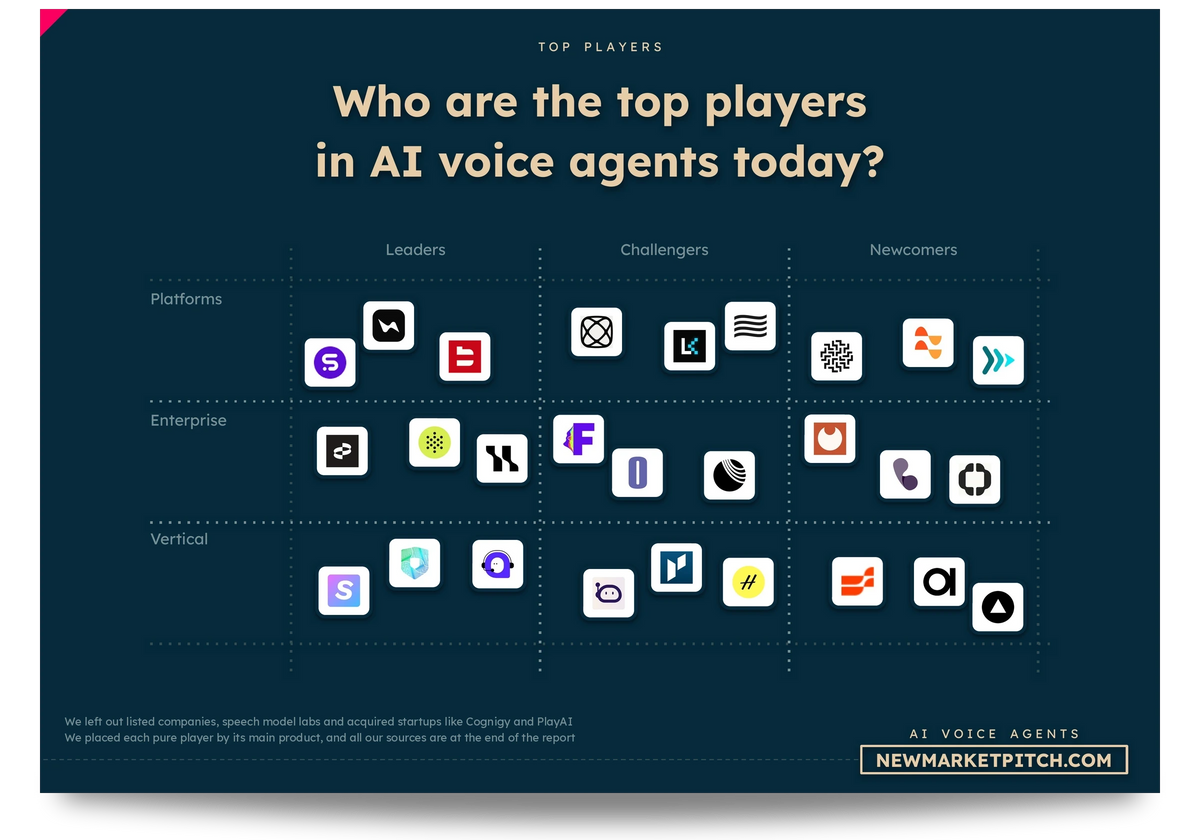
In our research about AI voice agents, we turn what is vague and complex into simple, useful visuals. Market maps like this one show you at a glance where every startup stands.
Is the AI voice agents market actually healthier than a year ago?
The AI voice agents market is in better shape, especially for startups trying to raise their first money. More companies are getting funded, deals are happening more regularly, and investors are backing a wider range of products. The catch is that the biggest checks are increasingly going to established companies.
We counted 67 funding deals across 62 companies in the latest 12-month period, compared with 29 deals across 27 companies a year earlier. That's 131% more transactions and nearly 130% more funded businesses. Investment also increased from $632.58 million to $1.55 billion.
But the median round fell from $11.43 million to $5.50 million. The funding market has opened up to more companies without making the typical financing any bigger.
There's another encouraging change. We recorded financing activity in all 12 monthly intervals, compared with three completely inactive intervals previously.
For founders, there are now more opportunities to get funded, especially at an early stage. The largest rounds, however, remain concentrated among companies with substantial operating histories.
| Metric | Previous 12M | Current L12M | Change |
|---|---|---|---|
| Total capital | $632.58M | $1,554.51M | +145.7% |
| Funding deals | 29 | 67 | +131.0% |
| Unique funded companies | 27 | 62 | +129.6% |
| Median round | $11.43M | $5.50M | -51.9% |
| Average round | $21.81M | $23.20M | +6.4% |
| First-financing records | 11 | 33 | +200.0% |
| Follow-on deals | 18 | 34 | +88.9% |
| Months with no deals | 3 | 0 | -3 |
| Capital excluding rounds above $50M | $371.58M | $518.51M | +39.5% |
Would AI voice agent funding still be growing without the biggest deals?
Yes, AI voice agent funding would still be growing without the megarounds, although nowhere near as fast as the headline suggests. Once we remove financings above $50 million, funding growth drops from 145.7% to 39.5%.
The biggest transaction was Parloa's $350 million Series D, announced in January 2026 at a $3 billion valuation. HappyRobot followed with $150 million in August, while Hippocratic AI raised $126 million in November 2025 and Assort Health secured $120 million in June 2026.
Those four deals alone brought in $746 million, nearly half of all the money raised during the period.
Yet Parloa isn't carrying the whole market. Removing its $350 million round leaves approximately $1.20 billion, still almost twice the previous year's total. Even excluding the three largest rounds from each period, the remaining capital is higher in the current year.
Below $50 million, investment increased from $371.58 million to $518.51 million, adding approximately $147 million. That's a meaningful improvement for the wider startup ecosystem, although much smaller than the nearly $922 million increase in headline funding.

Your time is limited. In our market report about AI voice agents, we put numbers on each part of the market, so you can see where it makes sense to focus.
Are more new AI voice agent startups getting funded now?
Far more AI voice agent startups are getting funded, including businesses raising their first recorded financing. The increase comes mainly from new companies entering the funded market rather than the same businesses raising repeatedly.
We identified 62 distinct funded companies in the latest period, versus 27 previously. Only five companies completed multiple recorded financings within the current year, compared with two in the earlier period.
First-financing records also tripled from 11 to 33, while the amount invested in these initial financings increased from $31.91 million to $124.21 million. Almost half of current deals were classified as first financings, up from 37.9% previously.
However, the median first financing dropped from $3 million to $2.2 million. Among companies with known founding years, the median age at first financing remained just one year.
Investors are backing more newly established teams, often with relatively modest amounts. This expansion also reaches different types of products: vertical applications increased from 16 to 31 deals, managed platforms from five to 21, and development platforms from seven to ten.
The geographic spread is wider, too. European deals increased from six to 20, while Asia-Pacific went from one to 12.
Not every first-financing record necessarily represents a company's first-ever institutional investment, since complete historical funding records aren't available for every business. But the increase in newly recorded funded companies is clear.
Are the biggest AI voice agent companies taking all the money?
Established AI voice agent companies are taking most of the money, even though newer businesses now account for almost half the deals. Follow-on financings attracted $1.43 billion, representing approximately 92% of current capital.
That percentage was actually higher the year before, at roughly 95%. So newcomers are gaining a little ground in the overall distribution, even while the largest checks remain overwhelmingly concentrated among returning companies.
Consider the distance between a $2.2 million median first financing and a $350 million Series D for Parloa. They're part of the same market, but they represent very different investment decisions.
Larger businesses can raise substantial amounts to expand internationally, strengthen enterprise infrastructure and support existing customers. A newly formed startup might still be trying to prove that one particular voice workflow is commercially viable.
The median follow-on round also declined, from $20 million to $18.5 million. The extraordinary financing amounts at the top don't reflect every company's experience.
| Financing metric | Previous 12M | Current L12M |
|---|---|---|
| First-financing deals | 11 | 33 |
| First-financing share | 37.9% | 49.3% |
| First-financing capital | $31.91M | $124.21M |
| Median first financing | $3.00M | $2.20M |
| Follow-on deals | 18 | 34 |
| Follow-on capital | $600.67M | $1,430.30M |
| Median follow-on | $20.00M | $18.50M |
| Follow-on share of capital | 95.0% | 92.0% |

In our document detailing everything you need to know about AI voice agent, we always try to gather several sources and make estimates that make sense, so you can work with solid numbers.
Why are AI voice agent funding rounds getting smaller?
AI voice agent rounds are getting smaller at the median because many more companies are raising modest amounts, while a relatively small number secure very large investments. The middle of the market is getting squeezed.
Look at the deal sizes. There were 32 financings below $5 million in the latest period, compared with 14 previously. Rounds between $5 million and $20 million increased from five to 18.
Meanwhile, the $20 million to $50 million bracket barely moved, falling from eight deals to seven. And above that range, six financings between $50 million and $100 million appeared, versus none a year earlier.
The average round therefore increased slightly to $23.2 million while the median was cut almost in half.
One possible explanation is that voice-agent development has become accessible to more teams using existing speech models, APIs and orchestration tools. That could allow businesses to launch with less initial funding. But without consistent operating-cost data from these companies, we can't establish whether lower development costs actually caused the decline.
Is AI voice agent funding becoming too concentrated?
AI voice agent funding is becoming more dependent on large growth rounds, although investment is now spread across more substantial recipients than before. The concentration figures initially seem contradictory.
The top five deals accounted for 53.5% of current funding, down from 62.8% previously. The top-ten share also declined, from 82.3% to 73.1%.
But rounds above $50 million now represent 66.6% of investment capital, compared with 41.3% previously. Eight financing events crossed that threshold, versus only two a year earlier.
The market has developed a bigger group of companies capable of attracting growth-sized investments. Dependence on large rounds has increased even though the very top of the market has become less dominant.
If investors pull back from $50 million-plus financings, total capital could fall sharply while smaller startup activity remains relatively healthy.

Our report covering the AI voice agent market gets updated several times a month, so you always get the latest view of where things stand.
Which AI voice agent companies are investors betting on most, and why?
Managed AI voice agent platforms are attracting the strongest combination of capital and deal growth, with companies such as Parloa, PolyAI and HappyRobot leading the way. Investors appear especially interested in platforms that can manage complex enterprise workflows rather than simply automate individual conversations.
Investment in managed platforms increased from $186.01 million to $865.63 million. Their share of total funding climbed from 29.4% to 55.7%.
PolyAI provides a useful example of what investors are backing. When it announced its $86 million Series D in December 2025, the company reported more than 100 enterprise customers and over 2,000 live deployments across 45 languages and more than 25 countries.
Parloa followed with its $350 million Series D in January 2026, just seven months after its previous round. The financing valued the business at $3 billion and supported further development of its AI Agent Management Platform, international expansion and enterprise reliability.
HappyRobot's $150 million Series C in August was led by Prysm Capital and co-led by Eurazeo. The company is also expanding beyond telephone conversations into broader enterprise workflows, particularly in logistics and industrial environments.
Large organizations need agents that connect to internal systems, handle complicated conversations, recover from failures and work reliably across departments. These capabilities require integrations, testing, security controls, monitoring and ongoing support.
Meanwhile, vertical applications remain the largest category by deal count, with 31 financings. Their median round declined from approximately $8 million to $4.5 million, suggesting that more specialized businesses are attracting investment at smaller amounts.
Development platforms also attracted more deals, although their relative share fell. Testing tools and orchestration companies are gaining attention from a much smaller base.
| Category | Previous deals | Current deals | Previous capital | Current capital |
|---|---|---|---|---|
| Managed platforms | 5 | 21 | $186.01M | $865.63M |
| Vertical applications | 16 | 31 | $337.17M | $512.88M |
| Development platforms | 7 | 10 | $107.00M | $140.00M |
| Testing and QA | 1 | 2 | $2.40M | $29.20M |
| Orchestration and routing | 0 | 3 | $0 | $6.80M |
| Total | 29 | 67 | $632.58M | $1,554.51M |
Is healthcare becoming one of the biggest AI voice agent opportunities?
Healthcare is becoming an important destination for large voice-agent investments, especially for companies handling patient access and administrative work. Assort Health and Hippocratic AI demonstrate how much money investors are prepared to put behind these applications.
Assort Health announced a $120 million Series C in June 2026 at a $1.2 billion valuation. Its platform covers patient scheduling, intake, referrals and other interactions that traditionally require considerable administrative work.
By August, Assort had introduced additional capabilities for processing and managing referrals, reinforcing its move toward handling complete patient workflows.
Hippocratic AI provides a different example. Its November 2025 Series C raised $126 million at a $3.5 billion valuation, with investment led by Avenir Growth. The company develops healthcare-focused generative AI agents and has emphasized clinical safety alongside wider deployment.
Healthcare organizations receive large volumes of repetitive communication, but errors can also have serious consequences. That creates demand for systems capable of handling interactions reliably and connecting them to existing clinical and administrative processes.
We cannot establish from the category totals that healthcare is the largest individual vertical, because the vertical-applications category includes multiple industries. Still, the size of these financings makes healthcare one of the more convincing areas of commercial interest.

In our research about AI voice agents, we look at what the winners do differently, so you can learn from the best instead of guessing.
Are AI voice agent testing tools becoming a serious investment opportunity?
AI voice agent testing is starting to attract meaningful venture money, with Coval providing the clearest example, but the category remains small.
Coval announced a $28 million Series A in June 2026, led by Norwest, with participation from Base10 Partners, Twilio Ventures and Y Combinator. The financing brought its total capital raised to $31 million.
The company builds tools for simulating, evaluating and monitoring AI conversations. Its technology is designed to catch problems involving interruptions, unexpected questions, accents and other situations that can cause voice agents to fail.
Those problems become harder to ignore when companies are deploying agents across thousands or millions of real customer interactions.
Vapi reported reaching one billion calls in May 2026, while PolyAI disclosed more than 2,000 live deployments in December 2025. At that scale, businesses need ways to test performance before and after releasing changes.
Testing and QA funding increased from $2.4 million to $29.2 million in our comparison, although the category recorded only two current deals. Coval accounts for almost the entire current total, making broader conclusions premature.
Are AI voice agent investors moving away from early-stage startups?
AI voice agent investors haven't abandoned early-stage startups at all. Seed and Series A financings still account for roughly 82% of deals, almost exactly the same proportion as a year earlier.
Seed transactions increased from 15 to 41, and Series A deals rose from nine to 14.
What has changed is where the dollars go.
Later-stage rounds accounted for approximately 71.6% of total capital, compared with 56.3% previously. Series C financing alone captured 28.7% of current funding, while Series D and later rounds represented another 28%.
At Seed, the median check declined only slightly, from $3.2 million to $3 million. Series A's median fell from $20 million to $18 million, while Series B's median increased from $42 million to $58.5 million.
Early-stage financing remains active, even as more of the total investment goes toward expanding established platforms. The huge funding announcements from those platforms are poor benchmarks for what a young startup should expect to raise.

In our market report about AI voice agents, we don't want to repeat what boring consulting reports say. Instead, we show you the real and latest market signals that matter.
Do AI voice agent startups need real customers to raise big rounds now?
For large AI voice agent rounds, evidence of real customer adoption is becoming an important part of the story. Vapi, PolyAI and Assort Health all provide concrete examples of businesses attracting substantial investment alongside commercial deployment.
Vapi's May 2026 Series B raised $50 million. The company reported reaching one billion calls and tenfold growth in enterprise annual recurring revenue, giving investors measurable indicators of customer usage and business growth.
PolyAI's December 2025 announcement included more than 100 enterprise customers, live deployments in over 25 countries and a growing international footprint.
Assort Health also reported substantial healthcare deployment and followed its June financing with senior hires in revenue and customer success during July.
These achievements give investors something more substantial to evaluate than a working voice assistant. They show whether companies can deploy their products in daily business operations.
We don't have complete revenue or customer data for every funded business, so we can't prove that investors universally require more traction than a year ago. The connection between commercial deployment and large financings is clearest among the better-established companies.
Are AI voice agent startups raising their next round faster these days?
Some successful AI voice agent startups are raising again remarkably quickly, but we still can't establish that the average company is fundraising faster than before.
Parloa is the standout example. Its January 2026 Series D closed just seven months after its Series C, according to the company's own announcement. Raising $350 million so soon after an earlier major round is an unusually strong example of investor support for a fast-growing business.
We also found multiple recorded financing events within the current period for Assort Health, HeyBreez, HeyDiga and fonio.ai.
However, the number of follow-on financings alone doesn't tell us how long companies waited between rounds. We would need reliable previous-round dates, complete financing histories and consistent treatment of extensions.
Fast repeat fundraising is demonstrable for selected winners, especially Parloa, but remains unproven as a market-wide trend.

Learning from others' mistakes is the cheapest lesson there is. In our document detailing everything you need to know about AI voice agent, we look at what broke startups before you, so you don't repeat it.
Is AI voice agent funding spreading beyond the United States?
AI voice agent funding is spreading much faster across Europe and Asia-Pacific, although North America still attracts the most money.
North American funding increased from $454.74 million to $916.05 million, even as its share of transactions dropped from 72.4% to 50.7%.
Europe recorded 20 deals, up from six, and attracted nearly $596 million. Germany's three transactions contributed $371.7 million, largely because of Parloa's financing.
India presents a very different growth story. We identified eight deals totaling $33.3 million, compared with one $1 million transaction previously. That suggests a larger population of funded businesses, without dependence on a single enormous round.
The increase in Asia-Pacific participation is especially striking: 12 deals versus one a year earlier. Most were smaller financings, with a regional median of $2.5 million.
Europe appears increasingly capable of supporting both large enterprise financings and smaller startups. India and other Asian markets are contributing more early-stage activity.
| Region | Previous deals | Current deals | Previous capital | Current capital |
|---|---|---|---|---|
| North America | 21 | 34 | $454.74M | $916.05M |
| Europe | 6 | 20 | $161.84M | $595.78M |
| Asia-Pacific | 1 | 12 | $1.00M | $42.08M |
| Middle East | 1 | 0 | $15.00M | $0 |
| Latin America | 0 | 1 | $0 | $0.60M |
| Total | 29 | 67 | $632.58M | $1,554.51M |
Are more venture capital firms investing in AI voice agents now?
More venture capital investors are showing up in AI voice agent funding records, and several established firms are backing companies at different stages of the market.
We counted 68 distinct names in the lead-investor fields during the current period, compared with 32 previously. That's a 112.5% increase in disclosed investor breadth.
Andreessen Horowitz, General Catalyst, Threshold Ventures and Peak XV Partners were among the names appearing repeatedly.
The company announcements provide more context. General Catalyst led Parloa's January 2026 Series D. Peak XV led Vapi's May Series B, with participation from Kleiner Perkins and Microsoft's M12. Norwest led Coval's June Series A.
These investments cover enterprise platforms, developer infrastructure and agent testing.
One limitation is that the lead-investor fields sometimes include multiple participants without identifying which investors formally led each transaction. We therefore treat the 68 names as disclosed investor participation, rather than 68 independently verified lead investors.

If you build or invest in the AI voice agent market, you need to know which business models pay off now and which ones are fading. That's why our report covering it has a whole section on it.
Are big tech companies pulling back from AI voice agent investing?
Corporate investors haven't disappeared from AI voice agent funding, but they're participating in a smaller share of recorded deals than a year ago.
We identified nine current financings naming strategic investors, compared with eight previously. Because overall deal activity more than doubled, their participation rate fell from 27.6% to 13.4%.
Several current transactions still have important corporate connections.
Microsoft's M12 participated in Vapi's May 2026 round. Twilio Ventures backed Coval's June financing. PolyAI's December 2025 Series D included NVentures, NVIDIA's venture capital arm, alongside other investors including Citi Ventures and Zendesk Ventures.
The previous period also included strategic participants such as Salesforce, CVS Health Ventures and Samsara Ventures.
Corporate investment remains present across communications infrastructure, enterprise software and industry-specific services. The lower participation rate mainly reflects how much faster total deal activity has grown, although incomplete financing-syndicate disclosures may also affect the comparison.
Are AI voice agents finally being used at real business scale?
Leading AI voice agent companies are already handling real enterprise workloads, and their recent financing announcements give us several useful measures of that progress.
Vapi reported one billion calls through its platform when announcing its $50 million Series B in May 2026. Its customers included Amazon, New York Life and Intuit, according to the company's announcement.
PolyAI disclosed more than 2,000 live deployments across 45 languages and over 25 countries in December 2025. Enterprise voice automation has clearly moved beyond isolated pilots for some providers.
HappyRobot provides another example from logistics. In January 2026, the company described its work with DHL on operational efficiency and customer communications. Its August funding announcement subsequently emphasized expanding engineering, deployment and go-to-market teams.
Healthcare offers a similar story through Assort Health, whose agents handle patient-access workflows that connect directly to scheduling and referrals.
Operational scale still varies enormously between funded companies. The leading platforms have demonstrated production usage, while many newly funded startups have yet to establish comparable deployment volumes or customer histories.

In our research about AI voice agents, we like to show you the big picture. We know your time is precious, so we make every page quick to read and packed with as much learning as possible per minute.
What are AI voice agent companies spending their new funding on?
The larger AI voice agent companies are increasingly raising money to sell, deploy and improve enterprise products, with international growth and operational reliability featuring prominently in recent announcements.
Parloa's January 2026 financing was intended to support expansion across the United States and Europe, further development of its Agent Management Platform and improvements in reliability.
Coval's June Series A focused on growing sales and solutions engineering while improving simulations, integrations and production monitoring.
After its $120 million Series C, Assort Health announced several senior appointments in July, including leaders responsible for revenue, customer success and people operations. These hires fit the company's push into larger healthcare organizations.
HappyRobot's August Series C also identified growth in engineering, deployment and commercial teams.
Commercial expansion and the practical work of operating enterprise AI feature heavily in these announcements. However, we don't have sufficiently consistent use-of-funds disclosures across both periods to calculate how spending priorities changed across the entire market.
What really changed in AI voice agent funding over the last 12 months?
The AI voice agents market is now broader, more consistently funded and more commercially developed, although smaller startups and established platforms are having very different fundraising experiences.
The most important improvement is the number of businesses receiving investment. Funded companies increased from 27 to 62, and first-financing activity tripled. Investors are supporting far more new companies.
The second major change is the widening gap between typical financings and the biggest rounds. Large transactions account for most of the dollar growth, while smaller rounds have become more common. The median financing therefore gives a much better sense of what ordinary startups are raising than the total capital figure.
Managed platforms have become the clearest category winners. Parloa, PolyAI and HappyRobot are attracting large investments to build systems capable of managing broader enterprise workflows. Healthcare applications and testing infrastructure are also attracting meaningful money, though their category-wide trajectories are less firmly established.
Funding has also become more international. Europe is securing larger enterprise rounds, while India and other Asia-Pacific markets are contributing more smaller financings. North America remains the biggest capital destination, but its dominance in deal count has weakened.
The best-funded companies increasingly have concrete commercial achievements to discuss. Vapi's call volumes, PolyAI's deployment numbers and Assort Health's healthcare integrations show what larger investors are supporting. Commercial execution is prominent among recent winners, even though the evidence is insufficient to establish a universal increase in fundraising requirements.
The market is healthier overall, particularly for company formation and financing activity. Its main weakness is the growing dependence of total capital on large follow-on rounds. The most misleading headline would be that investment more than doubled and therefore fundraising became twice as easy. Far more companies are getting funded, but the typical check is smaller, and the biggest amounts are going to businesses that have already established themselves.

When you build or invest in the AI voice agent market, you need clarity, not confusion. In our market report about AI voice agents, we always try to put numbers on and quantify whatever is usually vague and confusing.
Our methodology
This analysis examines financing in the AI voice agents market across two consecutive, non-overlapping 12-month periods: September 18, 2025 to September 17, 2026, and September 18, 2024 to September 17, 2025. Each period contains 365 days. Our primary source is our transaction-level funding database, supplemented by targeted research into company announcements, investor disclosures and industry reporting.
We reviewed 108 market-tagged financing records, of which 96 fell within the comparison periods: 67 current and 29 previous transactions. We aggregated recorded funding amounts and analyzed deal counts, unique companies, median and average financing sizes, stage distribution, first financings, follow-on rounds, company age, geographic activity and investor participation. Monthly activity was measured using aligned intervals from the 18th to the 17th.
To assess how much of the funding increase reflected broader market expansion, we recalculated capital raised after excluding rounds above $50 million and $100 million, compared the largest transactions across periods, and measured the share of funding captured by leading deals. This separates the growth in financed companies and transactions from the influence of unusually large growth rounds.
Our market definition covers companies whose core products involve autonomous voice agents, voice-led enterprise platforms, developer infrastructure or closely related applications. We retained the reported market-tagged financing records for the comparison, including identifiable borderline cases involving consumer assistants and companies expanding into broader AI workflows. Potentially overlapping announcements, currency-converted amounts and round extensions were treated as identifiable transaction-level uncertainties.
We also examined the financing context of major companies, using disclosed customer numbers, deployment volumes, product launches, investor syndicates and stated uses of proceeds. First-financing records represent the first identifiable financing in our dataset, and investor-participation counts include disclosed names rather than only independently verified lead investors. We did not infer missing revenue, previous-round dates or fundraising timelines.
Key sources include Parloa's $350 million Series D announcement, Parloa's platform and expansion update, HappyRobot's $150 million Series C announcement, PolyAI's Series D and deployment disclosures, Hippocratic AI's $126 million Series C announcement, and Assort Health's financing and operational announcements.
For voice infrastructure, customer adoption and agent testing, we used Vapi's Series B announcement, Vapi's billion-call milestone and enterprise growth disclosure, Coval's $28 million Series A announcement, Assort Health's referral automation launch, and Assort Health's executive appointments following its financing.
The resulting analysis combines structured funding calculations with company-specific evidence to assess market breadth, capital concentration, category shifts, investor activity and commercial maturity. The dataset represents recorded financing activity rather than a fully audited census of every qualifying equity transaction. Conclusions about investment growth and deal distribution are based on the transaction figures, while broader interpretations of investor behavior are grounded in the available company and financing disclosures.

A good product starts with a real problem. In our document detailing everything you need to know about AI voice agent, we show you the ones customers still live with.
Written by the New Market Pitch teamWe track new markets so founders and investors can move faster. About us