Who are the top investors in biotech?
Whether you're building or investing in the biotech market, our report covers everything you need to know: the players, the money, and what's coming next.
Summary
OrbiMed is the top biotech investor overall today, followed by ARCH Venture Partners and RA Capital Management. OrbiMed leads in recent large-round participation, ARCH stands out for founding and financing ambitious biotech startups, and RA Capital is exceptionally active across private and public biotechnology.
The scale of biotech financing is recovering, but the money is concentrated. Global biopharma venture investment reached $23.9 billion across 385 rounds in the first nine months of 2026, even as many younger companies continue struggling to raise capital.
Investor rankings can be misleading. OrbiMed participated in approximately $5.9 billion of financing rounds during 2025, but that figure measures the total size of rounds it joined, not the amount it personally invested. Leading a financing is a different measure of influence.
RA Capital may actually be participating in more large private biotech deals. One tracker counted 33 qualifying rounds for RA Capital between January and mid-May 2026, compared with 17 for OrbiMed. The most active investor depends heavily on what you count.
ARCH has a particularly strong position in early-stage biotech. Its latest announced fund exceeded $3 billion, and its historical average led-round size was approximately $200 million, far above the corresponding figures for RA Capital and OrbiMed.
Flagship Pioneering operates differently from conventional venture investors. Its competitive advantage comes from developing scientific concepts internally and creating companies around them, as it did with Moderna. That gives it unusual influence over both the science and the business.
Novo Holdings brings something most venture firms cannot offer: long-term capital without the same conventional fund-expiration pressures. Its venture division invested and committed $749 million during 2025, while its broader investment platform operates on a much larger scale.
Europe is becoming harder to overlook. Forbion raised €2.3 billion across two new funds in October 2026, bringing its reported assets under management to approximately €7.5 billion. Its history of helping create 37 companies also makes it a serious company-building competitor.
Pharmaceutical companies are increasingly competing with venture funds for promising early-stage science. Eli Lilly matched OrbiMed and Novo Holdings with 11 disclosed seed and Series A participations in 2025, showing how strategic buyers are moving earlier into drug development.
Two changes could reshape the next generation of biotech investing: AI-driven drug discovery and China's growing role in pharmaceutical innovation. Both are attracting additional capital, but experienced investors still have an advantage when evaluating clinical risks, intellectual property, and the path to an approved medicine.
Our top five are OrbiMed, ARCH, RA Capital, Flagship Pioneering, and Novo Holdings. Their positions reflect financing activity, leadership, company-building experience, and available capital: not verified investment returns, which remain largely private.

Written by the New Market Pitch teamWe track new markets so founders and investors can move faster. About us
Why are biotech investors getting more active again?
Biotech investors are putting more money into drug development again, but the recovery is uneven: companies with strong clinical data are attracting large rounds, while many younger startups still struggle to raise capital.
According to J.P. Morgan's Q3 2026 Biopharma Report, global biopharma venture financing reached $23.9 billion across 385 rounds in the first nine months of 2026. That works out to approximately $62 million per round. The same report recorded 22 biotech IPOs raising $7.5 billion, already exceeding the full-year totals for every year from 2022 through 2025.
The improvement follows several difficult years. S&P Global Market Intelligence reported that US venture-backed biotechnology financing fell to 237 rounds in 2025, down 25.2% from 2024. Disclosed funding declined 8.2% to $13.3 billion.
These figures cover different markets, so we cannot calculate a direct recovery rate. Still, the contrast is striking: financing activity contracted sharply in 2025, yet investors are now committing substantial amounts to selected companies. In the current market, having access to the biggest and most experienced biotech investors can make an enormous difference.
What makes someone a top biotech investor?
The best biotech investors stand out through their ability to lead important funding rounds, build successful drug companies, and keep financing them through years of clinical development. Simply appearing in the most deals tells us surprisingly little about investment performance.
Take ARCH Venture Partners, RA Capital Management, and Flagship Pioneering. ARCH frequently helps create companies around scientific discoveries and leads their early financings. RA Capital invests in both private and publicly traded biotechnology businesses. Flagship develops scientific ideas internally and builds companies around them.
All three are major investors, but they do different jobs.
There is another problem with popular rankings. Endpoints News uses DealForma data to rank investors partly by the total value of rounds in which they participated. If a firm invests $10 million in a $500 million round, it can receive credit for participating in a $500 million financing. That does not mean it personally invested the entire amount.
We therefore give more weight to repeated financing leadership, significant portfolio companies, available investment capital, and the ability to support businesses through clinical development. Actual fund returns would be valuable, but comparable performance data are rarely public.

In our report covering the biotech market, you will always find fresh funding data, taken straight from our own verified funding database.
Who are the biggest biotech venture investors today?
OrbiMed, RA Capital Management, ARCH Venture Partners, Novo Holdings, and Flagship Pioneering currently form the strongest group of specialist biotech investors. Their leadership comes from years of financing activity, substantial capital resources, and repeated involvement in important biotechnology companies.
The latest rankings show why the exact order is debatable. Endpoints News placed OrbiMed first in its 2026 ranking after the firm participated in approximately $5.9 billion of biotech financing rounds during 2025. RA Capital came second.
However, a separate Stifel analysis using DealForma data ranked ARCH first for the aggregate value of financing rounds it led between 2010 and March 2025, followed by RA Capital and OrbiMed.
OrbiMed therefore has the strongest recent record for participating in large financings, while ARCH stands out when we look at who actually led major rounds over a longer period.
We also include firms such as Atlas Venture, Foresite Capital, Forbion, and Sofinnova Partners because their influence extends beyond recent deal volume. Some specialize in launching new companies, while others finance clinical development or help businesses reach public markets.
| Investor | Main strength | Evidence of scale or activity |
|---|---|---|
| OrbiMed | Global biotech financing | No. 1 in Endpoints' 2026 ranking; $3B raised in new funds |
| RA Capital Management | Private and public biotech | No. 2 in Endpoints' 2026 ranking; frequent investor in large private rounds |
| ARCH Venture Partners | Early-stage company creation | No. 1 for aggregate value of led rounds in Stifel's 2010-2025 comparison |
| Novo Holdings | Long-term life sciences capital | $749M invested and committed by its venture division in 2025 |
| Flagship Pioneering | Building biotechnology platforms | $3.6B capital expansion announced in 2024 |
| Atlas Venture | Early-stage therapeutics | Established company-creation platform and frequent lead investor |
| Foresite Capital | Data-driven biotech and crossover investing | Co-led Xaira Therapeutics' $1B-plus launch financing |
| Forbion | European life sciences | €2.3B raised across two new funds in 2026 |
| Sofinnova Partners | European biotech company creation | €1.25B life sciences fund announced in 2025 |
Is OrbiMed now the most active biotech investor?
OrbiMed currently leads biotech's most prominent annual investor ranking, having more than doubled the value of financing rounds it joined to approximately $5.9 billion in 2025.
That pushed OrbiMed ahead of RA Capital in the 2026 Endpoints News ranking. Its lead becomes more convincing when we look at the capital it has recently secured.
In October 2026, OrbiMed announced $3 billion across two new investment funds. OrbiMed Private Investments X raised more than $1.9 billion for US and European life sciences investments, while OrbiMed Asia Partners VI raised more than $1 billion for healthcare investments across Asia.
The Asian fund is particularly interesting. According to Fierce Biotech, it exceeded the $751 million raised by OrbiMed Asia Partners V and the $800 million raised by its predecessor. That represents growth of more than 33% from the fifth fund.
OrbiMed also has more than $21 billion in assets under management across private equity, public equity, and credit strategies. Its recent portfolio activity includes Crinetics Pharmaceuticals, alongside public listings involving BlossomHill Therapeutics and Scribe Therapeutics.
We rank OrbiMed first overall today because few specialist biotech investors can match that combination of recent activity, global coverage, and newly raised capital.
If you want more recent data on this point, please see our latest biotechnology market report.

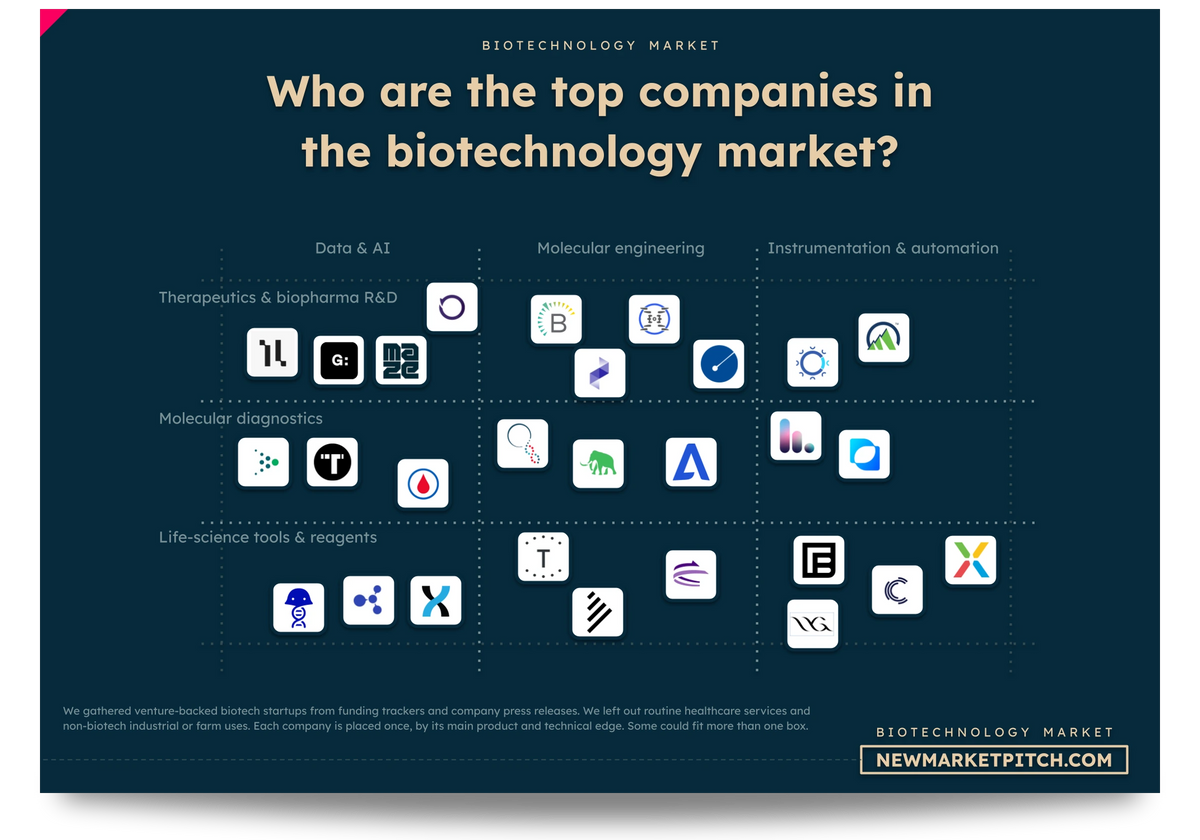
In our research about biotech companies, we turn what is vague and complex into simple, useful visuals. Market maps like this one show you at a glance where every startup stands.
Is RA Capital investing in more biotech startups than OrbiMed?
RA Capital Management is participating in more large private biotech funding rounds than OrbiMed in some recent deal-count datasets, even though OrbiMed leads the latest full-year ranking by aggregate round value.
The clearest comparison comes from BioBucks' investor tracker, covering private biotech financings of at least $20 million between January 1 and May 17, 2026. RA Capital participated in 33 rounds, compared with 17 for OrbiMed. That is nearly twice as many transactions.
The result also fits RA Capital's longer record. The firm ranked first in Endpoints' 2025 investor ranking and second in the 2026 edition. Stifel's 2010-2025 analysis placed it second behind ARCH in aggregate value of financing rounds it led.
RA Capital's investment approach helps explain its activity. It invests across private and public biotechnology companies, giving it opportunities to participate at several stages of drug development. OrbiMed operates across those markets too, but also allocates capital to medical devices, diagnostics, and other healthcare businesses.
There is an important limitation: the BioBucks tracker measures participation in qualifying rounds, without revealing how much capital each investor personally committed.
Even so, RA Capital looks exceptionally active right now. For a biotech startup seeking experienced investors capable of supporting multiple financing rounds, we would put it alongside OrbiMed at the top of the shortlist.
Is ARCH Venture Partners still the king of early-stage biotech?
ARCH Venture Partners remains our leading early-stage biotech investor, particularly for companies built around ambitious scientific discoveries that need substantial capital before reaching clinical trials.
Its financial commitment is considerable. In September 2024, ARCH announced Fund XIII with more than $3 billion dedicated to creating and financing early-stage biotechnology companies. Its investments include ArsenalBio, Metsera, Mirador Therapeutics, and Xaira Therapeutics.
Xaira provides a good example of its approach. Launched in April 2024 with more than $1 billion in committed financing, the company brought together machine learning, protein design, and drug discovery. ARCH and Foresite Capital co-led the financing alongside investors including NEA, F-Prime, Sequoia Capital, and Lightspeed.
ARCH helped assemble an unusually large financing package around a new scientific platform before the company had established a conventional commercial track record.
Its historical numbers are even more impressive. Stifel's analysis of DealForma financing rounds between 2010 and March 2025 put ARCH first for aggregate value of rounds it led. The average ARCH-led financing was approximately $200 million, compared with $74 million for RA Capital and $60 million for OrbiMed.
Those numbers describe the total size of financing rounds rather than the amount invested by ARCH itself. But the gap is striking: ARCH-led rounds were roughly 2.7 times the average size of RA Capital-led rounds and 3.3 times those led by OrbiMed.
For founders building a new biotechnology company around challenging science, ARCH still has one of the strongest records in the industry.
If you want more recent data on this point, please see our latest biotechnology market report.

In our market report about biotech companies, we always try to gather several sources and make estimates that make sense, so you can work with solid numbers.
Is Flagship Pioneering better at creating biotech companies than investing in them?
Flagship Pioneering's biggest advantage is its ability to create biotechnology companies from the beginning, giving it far more influence over their scientific direction than a traditional venture investor.
Moderna remains the firm's best-known example. Flagship founded the company in 2010, well before messenger RNA became a major pharmaceutical technology. Its broader portfolio includes Tessera Therapeutics, Generate Biomedicines, and Quotient Therapeutics.
The model starts with a scientific hypothesis, which Flagship develops through research before assembling a dedicated business. That allows the firm to influence the technology, leadership team, financing strategy, and initial intellectual property.
Flagship also has the financial resources to keep developing these ideas. In July 2024, it announced a $3.6 billion capital expansion, including $2.6 billion for Fund VIII and another $1 billion through associated commitments and partnerships. At the time, Flagship disclosed $6.4 billion raised into its funds since 2021 and outlined plans to support approximately 25 new breakthrough companies.
Its portfolio continues to explore newer technologies, including computational approaches to biology and drug discovery.
Flagship belongs near the top of any ranking focused on creating biotech platforms. ARCH is a close competitor, although ARCH's investment model draws more heavily on scientific founders and external research institutions.
Which biotech investors are best at building companies from scratch?
ARCH Venture Partners, Flagship Pioneering, Atlas Venture, and Third Rock Ventures are among the strongest biotech company builders, with long records of turning scientific discoveries into businesses.
Their approaches have some important differences.
Flagship develops many of its concepts internally, as we saw with Moderna and Generate Biomedicines. ARCH frequently works with university researchers and scientific entrepreneurs to finance companies around emerging technologies. Atlas Venture concentrates heavily on therapeutics, combining company formation with continued investment as drug programs develop.
Third Rock Ventures has followed a similar company-building strategy. Its historical portfolio includes Blueprint Medicines and Sage Therapeutics, both examples of companies created around focused pharmaceutical research programs.
Forbion also deserves attention here. Alongside its major recent fundraising, the firm disclosed that it has financed 142 companies since inception, including 37 it helped create. That means approximately 26% of its financed companies were created by Forbion itself, making its company-building record more substantial than its reputation as a conventional European investor might suggest.
The biggest challenge in comparing these firms is the lack of comparable financial returns. A company worth several billion dollars can be a major success for an early investor, but ownership dilution, follow-on commitments, and the timing of exits determine how much money the fund actually earns.
We would put ARCH and Flagship ahead for large-scale company creation, with Atlas, Third Rock, and Forbion among the most credible alternatives.
If you want more recent data on this point, please see our latest biotechnology market report.

Our document detailing everything you need to know about biotech gets updated several times a month, so you always get the latest view of where things stand.
Are pharmaceutical companies becoming major biotech investors?
Eli Lilly is now competing with specialist venture funds in early-stage biotech investing, while other pharmaceutical companies are using equity investments and licensing deals to secure access to promising drugs.
HSBC Innovation Banking's first-half 2025 healthcare report identified Lilly as the most active corporate participant in new US and European biopharma portfolio-company investments, with eight. Sanofi followed with seven.
BioCentury's full-year 2025 analysis then placed Lilly alongside OrbiMed and Novo Holdings, with each participating in 11 disclosed seed and Series A investments.
For a pharmaceutical company, that is an unusually active early-stage investment record. Lilly is investing in external innovation alongside its own internal research programs.
The broader deal market helps explain why. According to J.P. Morgan, biopharma licensing agreements reached $221.1 billion in announced research-and-development deal value through Q3 2026. Biotechnology acquisitions totaled another $138.9 billion across 113 transactions.
However, only approximately 6% of the announced licensing value represented upfront cash. The rest consisted largely of payments contingent on future development or commercial milestones.
A strategic partnership can bring a startup financing, clinical expertise, and a potential buyer, but a headline licensing agreement worth several billion dollars rarely means the company receives that amount immediately.
Lilly deserves a place among the most important corporate biotech investors. Its role is especially interesting because it can combine venture investments with much larger pharmaceutical partnerships and acquisitions.
Who are the top biotech investors in Europe?
Forbion currently has the strongest claim to being Europe's leading dedicated biotech venture investor by financial scale, while Sofinnova Partners remains a major competitor in company creation and early-stage life sciences investing.
Forbion raised €2.3 billion across two new funds in October 2026, its largest fundraising to date. According to the firm's announcement, the fundraising brought assets under management to approximately €7.5 billion and ranked among the largest dedicated life sciences venture fundraisings globally over the previous five years.
The firm's longer record adds weight to those numbers. It has supported 142 companies, helped create 37 of them, and reported 21 approved medical products originating from its portfolio.
Sofinnova Partners takes a somewhat different approach. In March 2025, it announced a €165 million biotech acceleration fund, Biovelocita II, supported by pharmaceutical investors including Amgen, Bristol Myers Squibb, and Pfizer Ventures. Its investments included BioClec, Forth Therapeutics, and Signadori Bio. Sofinnova also announced a separate €1.25 billion life sciences fund later that year.
Other established European investors include EQT Life Sciences, Jeito Capital, and Syncona. They differ in the maturity of their portfolio companies, investment focus, and involvement in company creation.
Forbion's latest financing gives it an especially strong position. Its two new funds are expected to support approximately 30 companies, meaning it has the capacity to make substantial commitments rather than spread its capital across hundreds of small investments.

In our report covering the biotech market, we look at what the winners do differently, so you can learn from the best instead of guessing.
Is Novo Holdings the most powerful long-term biotech investor?
Novo Holdings is arguably the strongest long-term life sciences investment platform in this group, thanks to its evergreen capital structure, large investment portfolio, and ability to finance companies well beyond the typical venture-fund timeline.
Its venture division reported $749 million invested and committed across 25 financings during 2025, equivalent to an average of nearly $30 million per transaction. It also generated $519 million in cash exit proceeds during the year.
At the end of 2025, the venture portfolio held 53 companies with a reported value of approximately DKK 17 billion. The division deployed around DKK 5 billion during the year across biotechnology, medical technology, and digital health.
Novo Holdings also operates on a much larger scale through its principal investment activities. In December 2024, it completed the acquisition of pharmaceutical manufacturing company Catalent at an enterprise value of approximately $16.5 billion.
That single transaction was more than five times the size of ARCH's latest announced venture fund. Of course, buying an established pharmaceutical manufacturer is very different from financing an early-stage biotech startup. The comparison mainly illustrates the financial resources available to Novo Holdings.
Its evergreen ownership structure also allows it to hold investments over longer periods without facing the same fund-expiration constraints as conventional venture firms.
We would choose OrbiMed or ARCH for a ranking focused strictly on specialist biotech venture activity. But for long-term life sciences capital, Novo Holdings has an advantage that few competitors can match.
If you want more recent data on this point, please see our latest biotechnology market report.
Are crossover investors becoming more important in biotech?
Crossover investors are gaining relevance as biotech IPO activity recovers, particularly for drug developers preparing to move from private financing into public markets.
These firms invest in private biotechnology companies while also managing publicly traded securities. RA Capital, OrbiMed, Foresite Capital, TCG Crossover Management, Cormorant Asset Management, and Janus Henderson are among the investors active across these markets.
The latest IPO numbers provide a useful test. J.P. Morgan reported that 22 biopharma IPOs raised $7.5 billion through Q3 2026, compared with 13 offerings raising $5 billion during the first half.
That means nine additional companies went public in the third quarter, raising approximately $2.5 billion. The number of IPOs increased 69% from the first-half total, although the additional proceeds represented only half the amount raised during the previous six months.
The broader venture market followed a different pattern. Venture funding grew from $16.3 billion in the first half to $23.9 billion through Q3, meaning the third quarter contributed another $7.6 billion.
Access to public markets is improving, but private financing remains essential. Investors capable of supporting companies on both sides of an IPO have an advantage when a drug developer needs capital before and after listing.
That said, the IPO recovery is still concentrated in selected companies. It would be premature to assume that most early-stage biotechnology startups can now count on public-market financing.

Theory only gets you so far. In our research about biotech companies, we dig up the real signals from the field and show you the ones worth watching.
Are biotech investors abandoning early-stage startups?
Biotech investors are becoming more selective about early-stage companies, while putting increasingly large amounts into drug developers that already have promising clinical programs.
BioPharma Dive's July 2026 review identified at least 68 biotechnology companies raising more than $9.1 billion during the first half of the year within its tracked universe. Most already had medicines undergoing testing.
The average financing across that sample exceeded $134 million per company. That is a remarkably large amount for a venture-backed business, although the dataset is weighted toward companies attracting sizeable rounds.
The contrast with earlier-stage investment is revealing. In 2025, Novo Holdings, Eli Lilly, and OrbiMed each participated in 11 disclosed seed and Series A deals according to BioCentury. ARCH also continues to finance newly created companies, including businesses developing technologies that may take years to reach clinical testing.
Early-stage biotech funding is therefore still available, particularly for experienced scientific teams working on promising technologies. But raising capital without clinical evidence has become harder, while businesses with encouraging trial results can attract very large syndicates.
The current market favors startups that can demonstrate a credible route to an important medical result, rather than companies relying mainly on excitement around a new technology.
Is AI changing which biotech investors lead the market?
AI is attracting new investors into biotechnology, but established specialists such as ARCH, Foresite Capital, and Flagship Pioneering remain central to financing companies that combine computational models with drug development.
Xaira Therapeutics offers one of the clearest examples. Its April 2024 launch brought more than $1 billion in committed financing from a syndicate combining biotech specialists with major technology investors. ARCH and Foresite co-led the financing, with participation from firms including Sequoia Capital, Lightspeed, and NEA.
That investor mix is unusual for a conventional drug developer. It shows how companies working across AI and biology can attract capital from venture firms that historically concentrated on software and computing.
Flagship has taken another approach through companies such as Generate Biomedicines and Tessera Therapeutics, which develop broader technological platforms intended to produce multiple therapeutic candidates.
The central challenge remains proving that these platforms can develop effective medicines. AI can help researchers identify targets, design molecules, and prioritize experiments, but reliable evidence that AI-developed drugs achieve better clinical approval rates is still limited.
Biotech specialists should remain important in this market. Technology investors can help finance computational platforms, while investors with pharmaceutical expertise are better equipped to judge clinical development risks.

In our market report about biotech companies, we don't want to repeat what boring consulting reports say. Instead, we show you the real and latest market signals that matter.
Is China changing who the top biotech investors are?
China is becoming an increasingly important source of pharmaceutical innovation, giving internationally active biotech investors access to drug-development opportunities that were much less prominent five years ago.
J.P. Morgan's DealForma analysis found that Chinese biopharma companies originated 39% of major global pharmaceutical licensing deals involving at least $50 million upfront in 2025. The share was 27% in 2024 and just 4% in 2020.
That is almost a tenfold increase in five years.
China's share of upfront payments in those major deals also rose from 4% in 2020 to 32% in 2025. This suggests the growth is visible in actual licensing economics, rather than only in the number of agreements announced.
OrbiMed's recent fundraising fits this development. Its new Asia fund raised more than $1 billion, compared with $751 million for the previous vehicle. Meanwhile, TCG Crossover Management raised $600 million for its first Asia life sciences fund in October 2026 and established offices in Shanghai and Hong Kong.
Established Asian healthcare investors such as Qiming Venture Partners and Vivo Capital also remain important participants.
China-focused investment experience should become more valuable as pharmaceutical companies continue sourcing assets internationally. However, geopolitical restrictions, intellectual property arrangements, and cross-border development strategies create risks that differ from investing in US or European biotech companies.
Which biotech investors look strongest for the next five years?
OrbiMed, ARCH Venture Partners, RA Capital, Novo Holdings, and Flagship Pioneering currently look best positioned to remain biotech leaders over the next five years, although their advantages come from different investment models.
OrbiMed combines leadership in recent large-round participation with $3 billion of newly raised capital and operations across major healthcare markets. ARCH has a long record of leading substantial early-stage financings, supported by its own multibillion-dollar fund. RA Capital remains extremely active across private and public biotechnology investments.
Novo Holdings brings long-term capital and a wider life sciences investment mandate. Flagship has the ability to create companies internally and continue financing their technologies as they develop.
Forbion is one of the most interesting challengers. Its recent €2.3 billion fundraising, approximately €7.5 billion in assets under management, and portfolio history of 21 approved medical products give it stronger evidence of scale and execution than many venture firms outside the United States.
The main risk for all these investors is that raising large funds does not guarantee strong returns. Clinical trial failures, delayed drug approvals, unfavorable acquisitions, and dilution from additional financing can still destroy substantial amounts of invested capital.
The strongest long-term position belongs to firms that can repeatedly access promising science, lead financing rounds, and support companies until their technologies become commercially valuable.

Learning from others' mistakes is the cheapest lesson there is. In our document detailing everything you need to know about biotech, we look at what broke startups before you, so you don't repeat it.
Who are the top investors in biotech overall?
OrbiMed is our top biotech investor overall today, followed by ARCH Venture Partners and RA Capital Management. OrbiMed has the clearest recent lead in large-round participation, while ARCH dominates our assessment of early-stage financing leadership and RA Capital stands out for deal frequency across private and public biotechnology.
Flagship Pioneering and Novo Holdings complete our top five, although both have business models that are harder to compare with conventional venture funds. Flagship is particularly strong at creating companies, while Novo Holdings can commit capital across much longer investment periods and a wider range of life sciences businesses.
Our ranking combines documented financing activity, leadership of significant rounds, financial resources, and company-building experience. Comparable audited fund returns are unavailable, so we cannot claim that these firms have produced the highest investment returns.
| Rank | Investor | Our judgment |
|---|---|---|
| 1 | OrbiMed | Strongest overall global biotech financing platform |
| 2 | ARCH Venture Partners | Leader in founding and financing science-driven startups |
| 3 | RA Capital Management | Leading private-public biotech investment specialist |
| 4 | Flagship Pioneering | Outstanding proprietary company-creation model |
| 5 | Novo Holdings | Strongest diversified long-term capital platform in this group |
| 6 | Atlas Venture | Established early-stage therapeutics company builder |
| 7 | Foresite Capital | Strong specialist combining biotech, data, and growth capital |
| 8 | Forbion | Leading European specialist with exceptional recent fundraising |
| 9 | Sofinnova Partners | Major European company-creation and biotech financing platform |
| 10 | Third Rock Ventures | Influential early-stage biotech company builder |
If you want more recent data on this point, please see our latest biotechnology market report.
Our methodology
This analysis identifies the top investors in biotech by examining documented financing activity, the ability to lead substantial investment rounds, company-building experience, available capital, and long-term support for drug development. We compared these dimensions across major specialist venture firms, company creators, crossover investors, and long-term life sciences investment platforms.
We started with recent biotech financing conditions using J.P. Morgan's biopharma deal reports and S&P Global Market Intelligence's analysis of US biotechnology venture financing. These sources establish the broader market context, including venture investment, IPO activity, acquisitions, and pharmaceutical licensing. We use the figures within their stated geographic and reporting periods rather than treating them as directly interchangeable datasets.
To compare investor activity, we examined Endpoints News' 2026 investor ranking and its previous ranking, based on DealForma financing data. We distinguish participation in a funding round from leading that round. The aggregate value of participating or led rounds does not establish how much an investor personally contributed, nor does it measure the investor's eventual financial return.
We also examined how much capital major investors have available and how they deploy it. The analysis draws on OrbiMed's October 2026 fundraising announcement, ARCH Venture Partners' Fund XIII announcement, and Flagship Pioneering's $3.6 billion capital expansion. We treat committed fund capital as evidence of investment capacity, not as a guarantee of investment success.
Company creation was assessed separately from conventional venture participation. We considered whether firms develop scientific concepts internally, help establish new biotechnology businesses, lead their early financings, and continue investing as drug programs advance. Xaira Therapeutics' launch announcement and Gunderson Dettmer's financing confirmation were used to examine ARCH and Foresite's involvement in a large AI-biotech company launch. We also reviewed Flagship Pioneering's company portfolio.
For European investors, we used Forbion's October 2026 fundraising announcement and Sofinnova Partners' Biovelocita II announcement. We considered fundraising scale, assets under management, the number of companies financed or created, and disclosed portfolio outcomes. Those measures help establish institutional scale and execution history, although they cannot substitute for comparable fund-level returns.
Novo Holdings was assessed using its 2025 Performance Report and 2024 Annual Report. We separate the venture division's investment activity from the much larger principal investment platform, including its acquisition of Catalent. This distinction is necessary because large corporate acquisitions and early-stage venture financings represent very different forms of capital deployment.
We evaluated the growing role of pharmaceutical investors and early-stage financing using HSBC Innovation Banking's Midyear 2025 Healthcare Report and BioCentury's analysis of seed and Series A investors. For recent funding concentration, we used BioPharma Dive's review of biotechnology financings during the first half of 2026. These datasets cover different transaction types and thresholds, so we use them to understand specific patterns rather than combining their deal counts into one ranking.
Our final ranking brings these findings together through a qualitative assessment of repeated financing leadership, recent activity, company-building capabilities, geographic reach, and financial resources. It is not a mechanical scoring model. Comparable audited investment returns, ownership stakes, and individual investor commitments are generally unavailable, so the ranking reflects demonstrated investment influence and capacity rather than a claim about which funds have delivered the highest financial returns.

If you build or invest in the biotech market, you need to know which business models pay off now and which ones are fading. That's why our report covering it has a whole section on it.
Written by the New Market Pitch teamWe track new markets so founders and investors can move faster. About us