Biotech: what are the biggest unsolved problems?
Whether you're building or investing in the biotech market, our report covers everything you need to know: the players, the money, and what's coming next.
Summary
Biotech's biggest unsolved problems are predicting which drugs will work in humans, controlling complex diseases over time, delivering genetic treatments safely, and making breakthrough therapies affordable and accessible. Of these, predicting human biology remains the most fundamental challenge because it affects nearly every stage of drug development.
The industry's approval numbers look encouraging, but they hide enormous failure rates. The FDA approved 46 novel drugs in 2025 and another 47 by October 20, 2026, yet Citeline estimates that only 6.7% of drug-indication programs entering Phase I eventually reach approval.
Phase II is the industry's biggest bottleneck, with a success rate of just 28%. This suggests that proving a treatment actually works in patients remains harder than discovering promising molecules or getting successful candidates through final regulatory review.
AI, organoids, and increasingly sophisticated experimental models are improving drug discovery, but none has yet demonstrated a clear industry-wide improvement in clinical approval rates. The gap between predicting molecular behavior and predicting human outcomes is still huge.
Gene editing has proved that modifying DNA can produce powerful treatments, but delivery remains a major constraint. Casgevy works by editing stem cells outside the body, while safely reaching specific cells inside the brain, lungs, muscles, and other organs is much harder.
Scientific success also doesn't guarantee patient access. Casgevy reached 64 patients through infusions in 2025 despite an estimated eligible population exceeding 60,000 across approved markets, illustrating how manufacturing, specialized hospitals, and demanding treatment procedures can limit adoption even when reimbursement is available.
Cancer and Alzheimer's expose a deeper biological problem: successfully attacking a disease mechanism rarely means fully controlling the disease. Tumors evolve resistance, while anti-amyloid Alzheimer's treatments can slow cognitive decline without stopping it.
Early detection has its own evidence problem. The NHS-Galleri trial's full results, published in September 2026, did not show a reduction in combined stage III and IV cancer diagnoses, illustrating why detecting a biological signal is not enough to prove that population screening improves outcomes.
Some of biotech's biggest problems are economic rather than scientific. Cell and gene therapies have launched at U.S. list prices exceeding $2 million, while antibiotic developers have struggled commercially precisely because valuable new antibiotics are often prescribed sparingly to preserve their effectiveness.
Our assessment is that better clinical prediction would have the broadest impact, potentially reducing wasted trials across multiple diseases. Engineering improvements could make advanced therapies easier to deliver, while better manufacturing and reimbursement models could expand access, but no single breakthrough is likely to solve all three problems.

Written by the New Market Pitch teamWe track new markets so founders and investors can move faster. About us
Is biotech getting better at developing successful drugs?
Biotech is producing more approved medicines than it used to, but more than 90% of experimental drugs entering clinical development still fail.
The FDA approved 46 novel drugs in 2025, compared with 50 in 2024 and 55 in 2023. Another 47 had already received approval during 2026 by October 20. That is a much higher output than the historical average of roughly 36 annual approvals between 1993 and 2022.
Yet the industry's success rates remain disappointing. Citeline examined 10,954 drug-indication development programs from 2014 to 2023 and found that only 6.7% of programs entering Phase I eventually reached approval. An earlier study covering 2011-2020, conducted by BIO, Informa Pharma Intelligence, and QLS Advisors, had estimated 7.9%.
The two studies cover different periods and samples, so we cannot confidently conclude that success rates are falling continuously. However, both show that drug development remains extraordinarily wasteful.
More research funding, larger pipelines, and better discovery technologies can produce more approved drugs even when the average candidate remains unlikely to succeed.
Why do so many biotech drugs fail in clinical trials?
Most biotech drugs fail because a treatment that looks promising in early experiments often fails to produce enough clinical benefit in humans. Phase II trials remain the biggest obstacle.
Citeline's 2014-2023 analysis found that only 28% of programs successfully advanced through Phase II. The success rate was 47.3% in Phase I and 55% in Phase III.
Phase II is particularly revealing because it is generally where researchers begin establishing whether a medicine works well enough in patients to justify larger trials.
Cancer provides countless examples. A molecule may successfully block a protein associated with tumor growth, yet cancer cells can activate alternative pathways. In Alzheimer's disease, removing abnormal proteins has produced considerably smaller clinical benefits than the underlying biological changes might suggest.
Inflammatory diseases create similar difficulties because blocking one immune pathway does not necessarily control the others contributing to a patient's condition.
Regulatory approval is sometimes blamed for high failure rates. Yet Citeline found that 91.8% of programs reaching regulatory submission were successful. Those programs have already survived several selection stages, but the comparison is revealing: most experimental treatments fail long before regulators make their final decision.
| Development stage | Success rate, 2014-2023 | Failure rate |
|---|---|---|
| Phase I | 47.3% | 52.7% |
| Phase II | 28.0% | 72.0% |
| Phase III | 55.0% | 45.0% |
| Regulatory submission | 91.8% | 8.2% |
| Phase I through approval | 6.7% | 93.3% |
| Phase I through approval, 2011-2020 | 7.9% | 92.1% |

A good product starts with a real problem. In our report covering the biotech market, we show you the ones customers still live with.
Why can't biotech predict whether a drug will work in humans?
Predicting how a drug will behave inside a human body remains one of biotech's biggest scientific weaknesses, even after decades of progress in laboratory testing and animal models.
Human diseases involve interactions among genes, immune responses, metabolism, aging, and environmental factors. Most experimental models reproduce only a fraction of those interactions.
A cancer drug can work exceptionally well on tumor cells grown in a laboratory, then disappoint in patients because real tumors contain immune cells, blood vessels, and competing cell populations that influence treatment response.
Animal models create additional problems. Mice are useful for studying biological mechanisms, but differences in metabolism, immune systems, and disease progression limit how confidently researchers can translate their results to humans.
New technologies are helping. Organoids, patient-derived tumor models, and organ-on-chip systems can recreate some aspects of human tissue more accurately than conventional cell cultures.
Researchers are also using AI to analyze experimental data and predict molecular interactions. AlphaFold transformed protein-structure prediction, while companies such as Recursion, Insilico Medicine, and Isomorphic Labs are trying to improve drug discovery through computational models.
Insilico Medicine's experimental fibrosis treatment rentosertib offers an interesting example. A randomized Phase IIa study published in Nature Medicine in June 2025 involved 71 participants. At the highest tested dose, lung-function measurements improved by an average of 98.4 milliliters over 12 weeks, compared with a 20.3-milliliter decline in the placebo group.
Those early results justified further investigation, but a small 12-week trial cannot establish long-term effectiveness. We still lack convincing evidence that AI-designed drugs, as a group, have higher approval rates than drugs discovered through conventional methods. That will require larger cohorts and years of follow-up.
If you want more recent data on this point, please see our latest biotechnology market report.
Why is gene editing still so difficult inside the human body?
CRISPR gene editing can modify DNA with remarkable precision in controlled settings, but delivering those edits safely to specific organs remains a major unsolved problem.
Casgevy, developed by Vertex Pharmaceuticals and CRISPR Therapeutics, proved that gene editing can produce a powerful human treatment. The therapy modifies blood-forming stem cells outside the patient's body and is authorized in the United States for eligible patients aged two and older with sickle cell disease or transfusion-dependent beta thalassemia, following an expansion of its indication in July 2026.
However, Casgevy requires collecting cells, modifying them in a specialized facility, and returning them after intensive medical preparation.
Editing cells directly inside the body is much more complicated.
The delivery vehicle must survive circulation, reach the correct tissue, enter the right cells, release its genetic components, and avoid damaging healthy tissue. Each step introduces another opportunity for failure.
The liver has attracted early in vivo gene-editing programs partly because lipid nanoparticles and certain other delivery systems can reach it relatively efficiently. Reaching the brain, lungs, muscles, or specific immune-cell populations presents different challenges.
Base editing and prime editing expand the types of genetic changes researchers can make. Yet improvements in editing chemistry do not automatically solve tissue delivery.

If you build or invest in the biotech market, you need to know which business models pay off now and which ones are fading. That's why our report covering it has a whole section on it.
Can gene therapy remain safe for an entire lifetime?
Gene therapy's long-term safety remains uncertain because a single treatment can cause lasting biological changes while clinical trials typically follow patients for only a small part of their lives.
Some risks emerge quickly, including serious immune reactions and organ toxicity. Others, such as certain delayed complications related to genetic modification, may take much longer to identify.
Sarepta Therapeutics' Elevidys, a gene therapy for Duchenne muscular dystrophy, demonstrated how serious these problems can become.
In 2025, reports of fatal acute liver failure in non-ambulatory patients prompted an FDA safety investigation. In November, regulators added a boxed warning and restricted the therapy's authorized use to eligible ambulatory patients aged four and older.
Still, researchers face a difficult question: how can we confidently predict what happens decades after a biological intervention?
This question becomes especially important when treating children. A therapy administered at age five may need to remain safe and effective for another 60 or 70 years.
Regulators increasingly require long-term monitoring for certain gene therapies, but surveillance can detect problems only after enough patients have been treated and followed.
Why are so few patients receiving approved gene therapies?
Approved gene therapies are still reaching surprisingly few patients, even when they offer major clinical benefits and insurance coverage is available.
Vertex Pharmaceuticals' Casgevy provides a particularly revealing example.
According to Vertex's full-year 2025 financial results, the treatment generated $116 million in revenue, with 64 patients receiving infusions during the year. Another 147 patients underwent their first cell collection.
The company estimated that more than 60,000 patients were eligible across countries where the therapy had been approved.
Those figures represent different stages of treatment and should not be interpreted as a precise market-penetration rate. Nevertheless, 64 annual infusions against an eligible population exceeding 60,000 shows how slowly an advanced therapy can reach patients after authorization.
There has been measurable progress. Vertex reported five Casgevy infusions in 2024, compared with 64 in 2025, a nearly thirteenfold increase from a very small starting base. First cell collections rose from 54 to 147 over the same period.
Interestingly, reimbursement is not the only barrier. Vertex reported that roughly 90% of eligible U.S. patients had reimbursed access by the end of 2025.
Patients still need specialized hospitals, cell collection, manufacturing, conditioning chemotherapy, and a lengthy treatment process.
Casgevy's U.S. list price of approximately $2.2 million adds another layer of complexity, although reimbursement agreements can differ from list prices.

Learning from others' mistakes is the cheapest lesson there is. In our market report about biotech companies, we look at what broke startups before you, so you don't repeat it.
Can biotech make cell and gene therapies affordable?
Cell and gene therapies remain extremely expensive because many treatments are difficult to manufacture, require specialized medical infrastructure, and serve relatively small patient populations.
Autologous CAR-T therapies illustrate the manufacturing problem. Products such as Yescarta, Kymriah, and Carvykti involve collecting immune cells from individual patients, genetically modifying them, expanding them, and returning them for treatment.
Each patient effectively requires a separate manufacturing batch, complete with quality controls, shipping, and specialized handling.
This makes production very different from manufacturing millions of identical tablets.
Companies are pursuing two major alternatives. Allogeneic therapies use donor-derived cells that could potentially treat multiple patients, while in vivo approaches attempt to engineer immune cells directly inside the body.
Both could reduce manufacturing complexity. However, allogeneic treatments face immune rejection and persistence challenges, while in vivo approaches introduce difficult questions about targeting and controlling genetically modified cells.
The prices of several approved advanced therapies illustrate the scale of the challenge. These figures represent historical U.S. launch list prices rather than actual net payments or current treatment availability.
| Therapy | Developer | U.S. launch list price | Technology |
|---|---|---|---|
| Casgevy | Vertex / CRISPR Therapeutics | $2.2M | Gene-edited stem cells |
| Lyfgenia | bluebird bio | $3.1M | Gene-modified stem cells |
| Zynteglo | bluebird bio | $2.8M | Gene addition |
| Skysona | bluebird bio | $3.0M | Gene-modified stem cells |
| Hemgenix | CSL Behring / uniQure | $3.5M | Viral gene delivery |
| Roctavian | BioMarin | $2.9M | Viral gene delivery |
| Elevidys | Sarepta Therapeutics | $3.2M | Viral gene delivery |
If you want more recent data on this point, please see our latest biotechnology market report.
Why can CAR-T treat blood cancer but not most solid tumors?
CAR-T therapy has transformed treatment for certain blood cancers, but solid tumors remain much harder to attack with engineered immune cells.
Treatments targeting CD19 or BCMA have produced important results in selected patients with leukemia, lymphoma, and multiple myeloma.
Blood cancers often provide relatively accessible targets. Engineered T cells can encounter malignant cells circulating through blood or residing in tissues that immune cells naturally visit.
Solid tumors create several additional obstacles.
Cancer cells within the same tumor can express different proteins, meaning a therapy targeting one antigen may leave resistant populations behind. Some promising targets also appear on healthy tissues, creating risks when engineered immune cells attack them.
Physical barriers make treatment harder still. Dense tumor structures can prevent T cells from entering, while suppressive immune cells and metabolic conditions inside tumors can weaken their activity.
Researchers are testing multi-target CAR-T cells, engineered T-cell receptors, tumor-infiltrating lymphocyte therapies, and alternative ways of delivering cells directly to tumors.
There has already been meaningful progress beyond conventional CAR-T. In 2024, the FDA approved Amtagvi, a tumor-infiltrating lymphocyte therapy for certain patients with advanced melanoma.
That approval demonstrates that expanded immune-cell approaches can work in selected solid tumors. But melanoma is only one indication, and broad success across common cancers such as lung, colorectal, and pancreatic cancer remains elusive.

When you build or invest in the biotech market, you need clarity, not confusion. In our document detailing everything you need to know about biotech, we always try to put numbers on and quantify whatever is usually vague and confusing.
Why do cancer treatments stop working after initially succeeding?
Cancer treatments frequently lose effectiveness because tumors evolve under treatment pressure, allowing resistant cells to survive and multiply.
This is particularly visible with targeted therapies.
Osimertinib can produce strong responses in EGFR-mutated lung cancer, but acquired resistance remains a common problem. Similar limitations affect therapies targeting BRAF mutations, ALK alterations, and certain KRAS variants.
The underlying biology is difficult to control. Tumors contain many different cell populations, and some may already carry resistance mechanisms before treatment begins.
When a drug eliminates susceptible cells, resistant populations can gain a competitive advantage.
Researchers can sometimes identify the resulting resistance mechanisms and develop new treatments against them. However, tumors may subsequently develop additional escape routes.
Liquid biopsies and circulating tumor DNA monitoring could help doctors detect these changes before conventional imaging reveals progression.
Combination therapies are another promising approach. By targeting several pathways simultaneously, researchers hope to reduce the opportunities for resistant cells to survive.
But combinations can increase toxicity, and predicting which resistance mechanism will emerge in a particular patient remains difficult.
Why can't biotech cure Alzheimer's disease yet?
Alzheimer's treatments can now slow cognitive decline in selected patients, but no approved medicine reliably stops or reverses the disease.
Leqembi, developed by Eisai and Biogen, and Kisunla, developed by Eli Lilly, established that targeting amyloid plaques can produce measurable clinical benefits.
In the Clarity AD trial, lecanemab slowed deterioration on the Clinical Dementia Rating-Sum of Boxes scale by approximately 27% compared with placebo over 18 months.
Donanemab also slowed cognitive and functional decline in its pivotal clinical program, with the relative benefit depending on the study population and measurement used.
These were important breakthroughs after decades of disappointing Alzheimer's research. Yet patients generally continued to deteriorate while receiving treatment.
A 2026 meta-analysis covering seven randomized trials of anti-amyloid antibodies found statistically significant but relatively modest average cognitive benefits, alongside increased risks of amyloid-related imaging abnormalities.
The difficulty is that Alzheimer's involves several interconnected biological processes, including amyloid accumulation, tau abnormalities, inflammation, vascular dysfunction, and neuronal death.
Reducing amyloid can influence disease progression, but it cannot automatically restore neurons and neural connections that have already been lost.
If you want more recent data on this point, please see our latest biotechnology market report.

In our report covering the biotech market, we look at what the winners do differently, so you can learn from the best instead of guessing.
Why do thousands of rare diseases still have no treatment?
Most rare diseases still have no approved treatment because thousands of different conditions divide patients into populations that are often too small to support conventional drug development.
The U.S. National Institutes of Health estimates that more than 10,000 rare diseases exist, collectively affecting tens of millions of Americans.
Many have an identifiable genetic cause, making them scientifically attractive candidates for gene replacement or editing.
However, a clear genetic target does not guarantee a practical treatment.
Each condition may require a separate therapeutic design, manufacturing process, clinical study, regulatory submission, and long-term safety program. When a disease affects only a few dozen patients globally, spreading those costs across a conventional commercial market becomes extremely difficult.
There has been progress. In 2025, 23 of the FDA's 46 novel drug approvals carried orphan-drug designation, according to the agency's annual review.
That means half of the year's novel approvals targeted conditions eligible for orphan-drug incentives. But progress remains uneven across thousands of rare diseases.
Sickle cell disease, spinal muscular atrophy, and selected inherited retinal disorders have received major therapeutic advances. Many extremely rare conditions have attracted little development activity.
Researchers are increasingly exploring treatment platforms that could be adapted to multiple mutations or related disorders without rebuilding the entire development process each time.
Individualized genetic therapies may also require new clinical and regulatory approaches when traditional randomized trials are impractical.
Why isn't biotech developing more new antibiotics?
Antibiotic development remains one of biotech's clearest commercial failures, despite antibiotic resistance becoming an increasingly serious global health problem.
The World Health Organization reported in October 2025 that approximately one in six laboratory-confirmed bacterial infections involving common infections worldwide in 2023 were resistant to antibiotic treatments.
Between 2018 and 2023, resistance increased in more than 40% of the pathogen-antibiotic combinations monitored, with average annual increases of 5-15% among those combinations.
Yet new antibiotic development remains financially unattractive.
The problem is partly how antibiotics are used. When doctors receive an effective new antibiotic, hospitals may reserve it for difficult infections to avoid accelerating resistance.
That is medically sensible, but it limits the manufacturer's sales.
Achaogen illustrates the consequences. The company developed and obtained FDA approval for Zemdri, an antibiotic intended for certain resistant infections, but filed for bankruptcy protection in 2019.
Melinta Therapeutics also entered Chapter 11 bankruptcy proceedings in 2019 despite commercializing antibiotic products.
Governments are experimenting with alternative payment models, including subscription arrangements that reward manufacturers for ensuring access to effective antibiotics rather than maximizing prescriptions.
The United Kingdom has been an early adopter of this approach.

In our research about biotech companies, we always try to gather several sources and make estimates that make sense, so you can work with solid numbers.
Can biotech detect cancer before patients have symptoms?
Biotech is getting better at detecting cancer-related signals in blood, but proving that these tests actually save lives remains the biggest challenge.
Liquid biopsies, circulating tumor DNA tests, and multicancer early detection technologies can identify molecular signals associated with tumors.
Companies such as GRAIL and Exact Sciences have invested heavily in these approaches, hoping to detect cancers earlier or monitor disease that remains after treatment.
Earlier detection sounds obviously beneficial. In practice, screening has several complications.
A positive test may indicate a cancer that needs treatment, but it may also produce a false alarm or identify a slow-growing abnormality that would never have caused serious illness.
The issue becomes particularly important when testing large populations where most people do not have cancer.
Consider a hypothetical screening test with 99% specificity used on 100,000 people. Even if none had the disease, approximately 1,000 could receive false-positive results.
That does not describe the actual performance of a particular commercial product. It illustrates why apparently high accuracy can still produce substantial follow-up testing at population scale.
Researchers must therefore measure cancer detection, false positives, unnecessary procedures, advanced cancer incidence, and ultimately mortality.
The NHS-Galleri trial offers an important reality check. Its first full results, published on September 23, 2026, found no overall reduction in the combined incidence of stage III and IV cancers among people offered the multicancer blood test compared with the control group. The trial therefore missed its primary endpoint.
That doesn't mean blood-based cancer screening has no future. But the results show how difficult it is to turn promising molecular detection technology into a measurable population-level benefit. Whether such tests can ultimately reduce cancer deaths remains an open question.
Why do the same biotech treatments work differently from one patient to another?
Biotech still struggles to predict which patients will benefit from a treatment because genetic differences, age, existing diseases, and immune responses can all change how medicines work.
Precision medicine has improved treatment selection for certain cancers and inherited disorders, but patient variability remains a major limitation.
Clinical trials often recruit carefully selected populations to reduce safety risks and make results easier to interpret.
These trials can exclude people with significant organ dysfunction, multiple chronic conditions, or particular combinations of medications.
That creates problems when approved treatments are later prescribed to patients who differ substantially from those studied.
Genetic diversity adds another difficulty. Important genetic variants differ in frequency between populations, and genomic databases have historically represented some ancestry groups much more extensively than others.
As a result, genetic prediction tools can perform unevenly when applied to patients whose populations were poorly represented in their development datasets.
The FDA has encouraged broader clinical trial participation and more representative eligibility criteria, including through guidance finalized in December 2025.

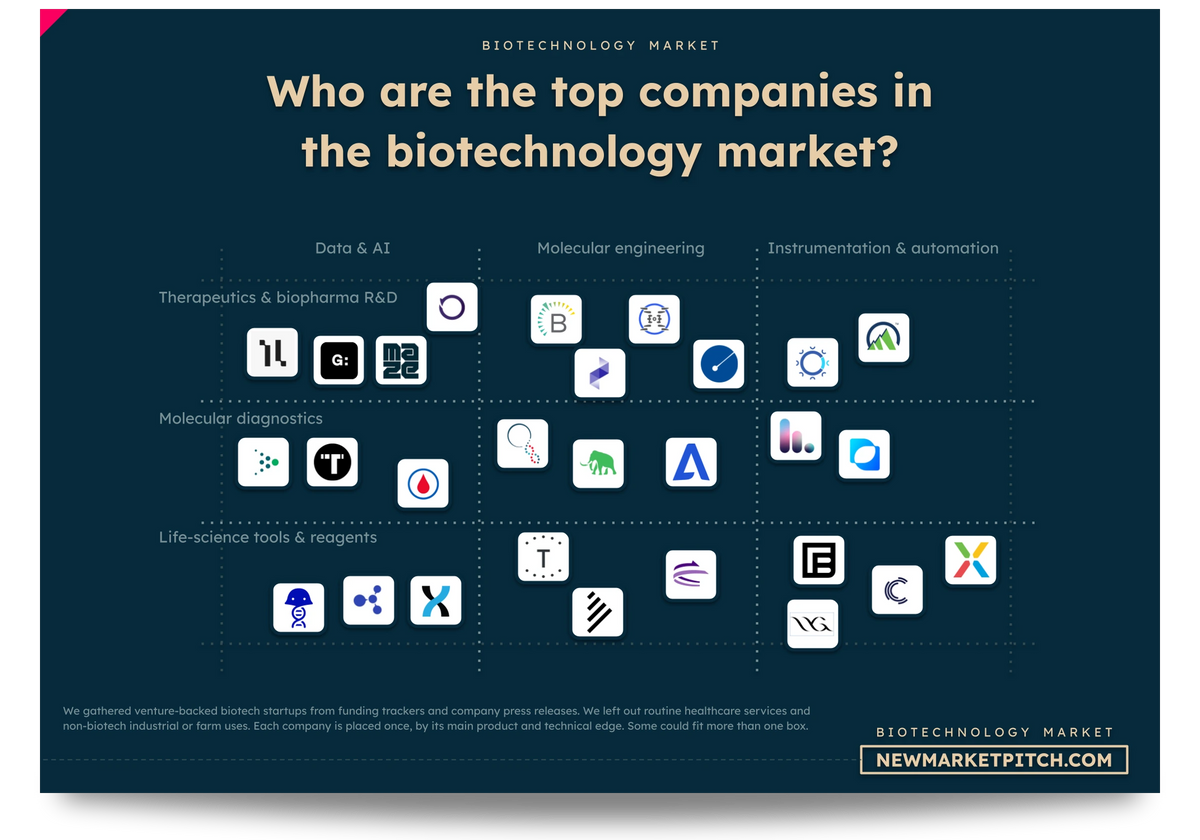
In our market report about biotech companies, we turn what is vague and complex into simple, useful visuals. Market maps like this one show you at a glance where every startup stands.
Can synthetic biology actually compete with conventional manufacturing?
Synthetic biology can already produce valuable molecules through engineered organisms, but industrial manufacturing remains difficult and expensive to scale.
Companies such as Amyris, Ginkgo Bioworks, and LanzaTech have pursued biological production methods for chemicals, materials, ingredients, and other industrial products.
The attraction is straightforward. Engineered microorganisms can sometimes produce complex molecules that are difficult or expensive to manufacture using conventional chemistry.
However, results achieved in small laboratory vessels often change when the process moves into much larger industrial equipment.
Oxygen delivery, temperature control, nutrient distribution, contamination, and metabolic stress can all affect production.
Purification introduces another challenge. A microorganism may produce the desired compound successfully, but extracting it at an acceptable cost can make or break the business.
Amyris became a notable warning. Despite developing fermentation technologies and commercial ingredients, the company filed for Chapter 11 bankruptcy protection in August 2023.
The more difficult target is replacing mature, low-cost production methods for commodity chemicals and materials.
Is biotech spending too much money on profitable diseases and too little on others?
Biotech investment is strongly influenced by expected financial returns, leaving some major medical problems underfunded despite their importance to public health.
The contrast between obesity treatments and antibiotics is particularly revealing.
Novo Nordisk and Eli Lilly demonstrated that GLP-1-based treatments could create enormous commercial markets. Their success attracted investment into oral formulations, combination therapies, new metabolic targets, and competing weight-loss drugs.
Obesity is a serious health problem, and those investments have produced important medicines.
However, antibiotic resistance also creates enormous medical and economic costs, while antibiotic developers have repeatedly struggled to remain commercially viable.
Rare diseases face a different version of the same imbalance. A therapy may offer transformative benefits but attract limited investment because only a few hundred patients could ever receive it.
The financial environment has made these choices more pronounced.
After the exceptional biotech funding conditions of 2020-2021, investors became more selective. Evaluate's 2025 biopharma review described a market where large acquisitions recovered while IPO opportunities and early-stage financing remained comparatively constrained.
Companies with encouraging human clinical data can still attract significant interest. Earlier-stage businesses may have difficulty financing the trials necessary to produce that evidence.
Public funding, nonprofit research, procurement guarantees, and alternative reimbursement models are therefore particularly important for diseases with large social costs but weak commercial incentives.
If you want more recent data on this point, please see our latest biotechnology market report.

Our document detailing everything you need to know about biotech gets updated several times a month, so you always get the latest view of where things stand.
Which biotech problems are the hardest to solve?
Predicting human disease biology, treating complex brain disorders, and preventing cancer resistance appear to be biotech's hardest unresolved scientific challenges. They involve interacting biological systems that researchers still cannot fully measure or control.
Other problems may be easier to improve through engineering or better economic arrangements.
Gene-editing delivery systems can advance as materials and targeting technologies improve. Cell therapies could become cheaper through more efficient manufacturing. Antibiotic development could attract greater investment if governments rewarded manufacturers differently.
Alzheimer's disease and cancer resistance present a deeper problem. Researchers still lack a sufficiently complete understanding of the biological processes they are trying to control.
Drug-development predictability connects these issues. Better human models could help researchers choose more promising targets, identify harmful effects earlier, select appropriate patients, and avoid trials unlikely to succeed.
The following comparison reflects our assessment of the scientific and commercial evidence. It is a qualitative judgment, not a forecast of how many years each problem will take to solve.
| Biotech problem | Main obstacle | What the evidence shows | Assessment |
|---|---|---|---|
| Predicting drug success | Incomplete understanding of human biology | 6.7% Phase I-to-approval rate in the Citeline study | Foundational problem |
| Treating Alzheimer's | Multiple interacting disease mechanisms | Anti-amyloid medicines slow decline but do not stop it | Extremely difficult |
| Preventing cancer resistance | Tumor evolution and genetic diversity | Resistance frequently emerges after targeted treatment | Extremely difficult |
| Gene-editing delivery | Reaching the right cells safely | Successful applications remain concentrated in selected tissues | Major engineering barrier |
| Gene therapy safety | Delayed and difficult-to-reverse effects | Serious safety events have changed approved treatment restrictions | Long-term uncertainty |
| Scaling advanced therapies | Expensive manufacturing and infrastructure | Several therapies launched at prices exceeding $2M | Major commercial barrier |
| Developing antibiotics | Weak commercial incentives | Resistance is rising while developers struggle financially | Structural market failure |
| Improving AI drug discovery | Limited clinical outcome evidence | AI-designed drugs have entered trials, but superior approval rates remain unproven | Unresolved clinical question |
So what are the biggest unsolved problems in biotech?
Biotech's biggest unsolved problems are predicting whether treatments will work in humans, controlling complex diseases, safely delivering genetic therapies, and making breakthrough medicines affordable enough to reach patients.
Of these, clinical predictability stands out as the most important.
The industry's 6.7% estimated Phase I-to-approval success rate means that enormous amounts of research, clinical development, and investment are still directed toward treatments that ultimately fail.
Better prediction could improve drug development across cancer, neurodegenerative diseases, rare genetic disorders, and immune conditions. It could also make AI drug discovery significantly more valuable if computational models begin identifying successful clinical candidates more reliably.
The second major problem is controlling biology over time. Gene editing can change DNA, engineered immune cells can eliminate some cancers, and targeted drugs can interrupt disease pathways. However, avoiding unintended effects, preventing resistance, and maintaining safety over decades remain serious challenges.
The third problem is economic. Casgevy's relatively small number of annual infusions compared with its eligible patient population shows how difficult advanced therapies can be to deliver. The antibiotic market demonstrates how medical need can remain disconnected from commercial incentives.
We expect meaningful progress in delivery systems, biological models, automated manufacturing, and AI-assisted research. But there is still little evidence that any single technology can solve these problems across the industry.
Our final judgment is that predicting and controlling human biology remains biotech's deepest scientific challenge, while manufacturing costs and commercial incentives determine how widely its breakthroughs can be used.
If you want more recent data on this point, please see our latest biotechnology market report.

Theory only gets you so far. In our report covering the biotech market, we dig up the real signals from the field and show you the ones worth watching.
Our methodology
We examined biotech's biggest unsolved problems by separating them into scientific uncertainty, clinical effectiveness, technological delivery and safety, and economic scalability. This distinction helps us compare problems rooted in incomplete biological understanding with those that may be addressed more directly through engineering, infrastructure, or policy.
We prioritized clinical development outcomes, published human studies, regulatory decisions, and documented treatment delivery over laboratory discoveries, pipeline announcements, or theoretical potential. Citeline's 2014-2023 clinical success rates provide the main benchmark for drug-development predictability, while the earlier BIO/Informa/QLS analysis establishes historical context. We do not treat differences between these datasets as proof of a continuous trend.
We selected specific treatments and companies where clinical results, regulatory actions, or disclosed operating figures expose broader industry problems. These cases illustrate the mechanisms behind persistent barriers rather than representing statistical samples of the entire sector. We also distinguished technical progress and biological improvements from demonstrated patient benefit, including in AI drug discovery, gene editing, Alzheimer's treatment, and cancer screening.
Our assessment of difficulty weighs the depth of unresolved biological mechanisms, the strength of clinical evidence, the persistence of each obstacle, and the potential for engineering or economic changes to address it. The comparison categories are qualitative editorial judgments, not numerical scores or predicted timelines.
We gave additional weight to problems with consequences across multiple therapeutic areas. Clinical predictability ranks highest because better human models and clinical evidence could influence target selection, safety assessment, patient selection, trial design, and development success throughout biotech.
Key sources used for this analysis include Citeline's clinical development success-rate analysis, BIO's historical clinical success-rate study, the FDA's 2025 and 2026 novel drug approval records, Nature Medicine's rentosertib clinical trial, the FDA's Casgevy authorization records, Elevidys safety communication and gene therapy follow-up guidance, Vertex's full-year 2025 financial results, and the FDA's Amtagvi approval record.
Additional clinical and industry sources include the Clarity AD trial published in the New England Journal of Medicine, JAMA's TRAILBLAZER-ALZ 2 study, NIH NCATS on rare diseases, the WHO's 2025 antimicrobial resistance surveillance report, NHS England's antimicrobial subscription model, the September 2026 NHS-Galleri trial results, and the FDA's clinical trial participation guidance. For commercial barriers, we also reviewed Achaogen's SEC filing, Amyris's restructuring announcement, and Evaluate's 2025 biopharma review.

In our research about biotech companies, we don't want to repeat what boring consulting reports say. Instead, we show you the real and latest market signals that matter.
Written by the New Market Pitch teamWe track new markets so founders and investors can move faster. About us