Can Earth observation make money beyond defense contracts?
Whether you're building or investing in the Earth observation market, our report covers everything you need to know: the players, the money, and what's coming next.
Summary
Yes, Earth observation can make money beyond defense contracts. Insurance, agricultural risk analysis, methane monitoring and maritime intelligence already generate commercial value, but private-sector demand remains too small to support most major satellite operators independently.
Defense spending is driving nearly all the recent growth at some of the industry's largest companies. Between fiscal 2024 and fiscal 2026, defense and intelligence accounted for approximately 98.4% of Planet Labs' net revenue increase, while its commercial revenue declined 15.2%.
The global Earth observation data and services market was worth approximately €3.5 billion in 2024, with EUSPA projecting €7.9 billion by 2034. That leaves considerable room for growth, but the opportunity is much smaller than the value of the industries satellites help monitor.
Planet's financial performance shows how far satellite economics have improved without establishing that private customers can sustain them. The company generated $52.9 million in free cash flow in fiscal 2026, but only 18.1% of its revenue came from commercial customers.
ICEYE offers another revealing contrast. It reported more than €250 million in annual revenue and €100 million in EBITDA, alongside a €1.5 billion backlog driven mainly by sovereign demand. Its insurance products are commercially established, but its strongest financial results cannot be separated from government spending.
The most promising commercial applications have one thing in common: satellite intelligence influences expensive decisions. Insurers need rapid damage estimates, agricultural lenders need crop-risk assessments, energy companies need methane measurements, and shipping businesses need reliable vessel information.
Agriculture's biggest customers may turn out to be financial institutions rather than farmers. Banks and insurers monitoring thousands of properties have stronger incentives to pay for satellite intelligence than individual growers buying another subscription.
Free government imagery and increasingly accessible AI analytics are putting pressure on generic satellite-data businesses. Companies with specialized radar, high-frequency observations, reliable historical records or deeply integrated decision-making tools have a much better chance of defending their prices.
Owning the satellites may not be the best way to capture commercial value. Analytics providers can avoid the capital costs of launching and replacing spacecraft, while operators must earn enough to maintain entire constellations. Spire's approximately $233.5 million maritime divestiture shows that satellite-derived intelligence can have substantial strategic value even when the original operator struggles financially.
The decisive test will be recurring private-sector revenue and profitability after ongoing satellite investment. Several companies generating more than $100 million each from private customers while remaining cash-flow positive would be much stronger evidence than another wave of pilots, satellite launches or defense-backed contracts.

Written by the New Market Pitch teamWe track new markets so founders and investors can move faster. About us
Why is Earth observation still so dependent on defense contracts?
Earth observation has a real commercial market, but defense and intelligence customers are currently doing most of the heavy lifting for the industry's largest satellite operators.
Satellites can now photograph, scan and measure the planet more frequently and in greater detail than ever before. Yet better technology hasn't translated into equally strong growth in private-sector spending.
Planet Labs shows how wide that gap has become. Its annual revenue increased 26% to $307.7 million in fiscal 2026, but commercial revenue slipped from $56.2 million to $55.6 million. Defense and intelligence revenue, meanwhile, jumped from $116.3 million to $180.2 million. Nearly all of Planet's additional revenue came from national-security customers.
BlackSky reported $106.6 million in 2025 revenue and a $345 million backlog, largely supported by defense and intelligence programs. ICEYE disclosed more than €250 million in annual revenue and €100 million in EBITDA, but attributed its €1.5 billion backlog mainly to sovereign intelligence demand.
The industry has figured out how to sell satellite imagery to governments. Whether agriculture, insurance, energy and industrial customers can eventually generate comparable revenue is much less certain.
How big is the commercial Earth observation market today?
The global Earth observation data and services market is worth about €3.5 billion annually, which is meaningful for a specialist industry but smaller than many of the headlines around satellite technology suggest.
The European Union Agency for the Space Programme estimated global Earth observation revenues at €3.5 billion in 2024 in its 2026 Space Market Report. It projects €7.9 billion by 2034, equivalent to approximately 8.5% annual growth.
These figures cover purchases of Earth observation data and services. They don't include the entire value of agricultural production, insured property or energy assets monitored using satellite information. They also exclude much of the satellite manufacturing and launch activity sometimes included in broader space-industry estimates.
This distinction is important when assessing the market's size. Agriculture generates trillions of dollars in economic activity, but only a small fraction of that spending goes toward satellite monitoring.
EUSPA's forecast implies roughly €4.4 billion in additional annual Earth observation revenue over the decade. That's a considerable opportunity for specialized data companies. Whether it can support dozens of independent satellite constellations is another question.

A good product starts with a real problem. In our report covering the Earth observation market, we show you the ones customers still live with.
Is commercial Earth observation growing as fast as defense spending?
Commercial Earth observation revenue is growing much more slowly than defense revenue at some of the industry's biggest operators, and Planet Labs offers particularly clear evidence.
Between fiscal 2024 and fiscal 2026, Planet's total revenue grew 39.4%, from $220.7 million to $307.7 million. Defense and intelligence revenue increased 90.6%, while commercial revenue declined 15.2%. Civilian government revenue rose 18.7%.
We calculated that defense and intelligence accounted for approximately $85.6 million of Planet's $87 million total revenue increase across those two years. That's 98.4% of the company's net revenue growth.
The customer mix has changed considerably. Defense and intelligence represented 42.8% of Planet's revenue in fiscal 2024 and 58.6% in fiscal 2026. Commercial customers went from nearly 30% to just 18.1%.
Planet's recent growth has become far more dependent on national-security budgets than its headline revenue numbers suggest.
| Planet Labs revenue | FY2024 | FY2025 | FY2026 | Two-year change |
|---|---|---|---|---|
| Defense and intelligence | $94.6M | $116.3M | $180.2M | +90.6% |
| Civil government | $60.6M | $71.9M | $71.9M | +18.7% |
| Commercial | $65.5M | $56.2M | $55.6M | -15.2% |
| Total revenue | $220.7M | $244.4M | $307.7M | +39.4% |
| Defense share | 42.8% | 47.6% | 58.6% | +15.8 pp |
| Commercial share | 29.7% | 23.0% | 18.1% | -11.6 pp |
| Revenue outside defense | $126.1M | $128.1M | $127.5M | +1.1% |
If you want more recent data on this point, please see our latest Earth observation market report.
Does Planet Labs prove satellite imagery can be profitable?
Planet Labs has shown that a satellite imagery business can generate positive cash flow, although its financial progress currently depends heavily on government customers.
In fiscal 2026, Planet reported $307.7 million in revenue, a 56% GAAP gross margin, $15.5 million in adjusted EBITDA and $52.9 million in free cash flow.
The company also recorded a $246.9 million GAAP net loss, including approximately $161.4 million related to changes in the fair value of warrant liabilities. Some of the positive free cash flow reflected the timing of customer payments, so it shouldn't be interpreted as a recurring operating margin.
Planet has nevertheless made considerable financial progress. It has achieved greater scale, improved adjusted profitability and accumulated more contracted revenue.
But we can't credit that improvement to private-sector adoption. Commercial revenue represented only 18.1% of sales, and defense customers supplied almost all the company's net revenue growth over the previous two fiscal years.
Planet proves that a mixed government-and-commercial satellite business can improve its economics. It has yet to prove that ordinary businesses would pay enough to sustain the same operation on their own.

If you build or invest in the Earth observation market, you need to know which business models pay off now and which ones are fading. That's why our report covering it has a whole section on it.
Which commercial Earth observation applications actually make money?
Insurance, agricultural risk assessment, energy monitoring and maritime intelligence currently offer some of the clearest opportunities to sell Earth observation data outside defense.
These applications share an important characteristic: customers can use satellite measurements to make decisions involving real money.
Insurers can assess flood damage and estimate potential claims. Agricultural lenders can evaluate crop conditions before making loans. Energy companies can identify methane leaks and prioritize repairs. Shipping businesses can track vessels and monitor disruptions.
ICEYE sells catastrophe intelligence to insurers, SatSure provides agricultural monitoring for financial institutions, GHGSat measures industrial methane emissions, and companies such as Kpler use satellite-derived information in maritime analytics.
The evidence varies considerably between these markets. Maritime intelligence has produced a major acquisition, insurance has established operational uses, and industrial methane monitoring has attracted specialized customers.
Other applications, particularly carbon-credit verification and general-purpose imagery sales, have a less convincing record of large recurring commercial revenue.
The best opportunities tend to involve customers who can calculate how much a satellite measurement saves them or helps them earn.
Can satellite-based insurance become a big business?
Satellite-based insurance is already a serious commercial application, especially for flood and catastrophe monitoring, although we still lack enough financial disclosure to judge its profitability independently.
ICEYE has developed flood, hurricane and wildfire intelligence products for insurers and reinsurers. Its flood services combine synthetic aperture radar imagery with terrain models, hydrological information and other datasets to estimate flooding at individual properties.
Radar satellites have an important advantage during natural disasters: they can collect observations at night and through cloud cover. ICEYE says it has analyzed more than 150 flood events globally since 2021.
In 2025, the company introduced Flood Rapid Impact, designed to provide initial flood information within roughly 6–12 hours.
That speed can be valuable when insurers are managing thousands of claims after a hurricane or major flood. Satellite observations can help prioritize inspections, estimate total losses and identify the worst-affected properties.
SatSure addresses agricultural insurance. The company reports processing more than 400,000 farmer claims and says its pilot methods reduced certain physical crop-cutting experiments by as much as 70%.
These are concrete uses with measurable operational benefits. What we don't know is how much insurance revenue would remain profitable after allocating the full costs of satellite infrastructure and data processing.

Learning from others' mistakes is the cheapest lesson there is. In our market report about Earth observation satellites, we look at what broke startups before you, so you don't repeat it.
Can agriculture support a large satellite data business?
Agriculture could become one of the biggest commercial markets for Earth observation, but the strongest buyers are likely to be banks, insurers and agribusinesses rather than individual farmers.
EUSPA identifies agriculture as the largest contributor to its projected €7.9 billion Earth observation market in 2034.
The technology has plenty of practical uses. Satellites can monitor crop emergence, vegetation health, water stress, planted acreage and seasonal production changes across millions of fields.
SatSure combines satellite observations with agricultural models to help lenders and insurers assess risk. EOSDA Crop Monitoring offers field-level analytics, while Planet's imagery can support agricultural monitoring and forecasting.
The difficulty is pricing. A farmer managing a relatively small property might benefit from better crop monitoring but still be unwilling to pay much for another subscription. A bank managing thousands of agricultural loans has a much stronger reason to buy consistent, large-scale information.
Agricultural Earth observation looks most attractive when the customer manages financial exposure across large areas. The opportunity is substantial, but it shouldn't be valued as though every farmer will eventually become a paying satellite-data subscriber.
If you want more recent data on this point, please see our latest Earth observation market report.
Can methane monitoring become a profitable satellite business?
Satellite methane monitoring has developed a credible commercial market, particularly among energy companies, but GHGSat's undisclosed profitability makes it difficult to judge how attractive the business really is.
GHGSat reported detecting 28,224 methane plumes across 127 countries in 2025, covering oil and gas, mining and waste operations. Its annual emissions analysis drew on observations of nearly three million industrial facilities.
These measurements help energy companies identify leaks, prioritize repairs and assess emissions from specific facilities. Investors, insurers and regulators also use emissions information to evaluate industrial operations.
GHGSat secured C$47 million in financing in 2025 and became a Copernicus Contributing Mission, allowing its high-resolution observations to support European atmospheric monitoring services.
The International Energy Agency's Global Methane Tracker 2026 also documented the growing role of satellite observations in identifying major emissions events.
But methane detection faces a commercial complication. Some data is purchased by public agencies, while other emissions information is distributed freely. Regulatory compliance can increase demand without guaranteeing that private companies will buy proprietary imagery.
GHGSat has established the usefulness of satellite methane monitoring. We still need more disclosure on recurring industrial revenue and operating margins before calling it a proven, profitable commercial satellite model.

When you build or invest in the Earth observation market, you need clarity, not confusion. In our document detailing everything you need to know about Earth observation, we always try to put numbers on and quantify whatever is usually vague and confusing.
Will environmental regulations make companies pay for satellite data?
Environmental regulations can create additional Earth observation customers, but they won't guarantee a lucrative market for every satellite provider.
The European Union's deforestation regulation requires companies handling covered commodities such as cocoa, coffee, cattle, palm oil, rubber, soy and wood to demonstrate that relevant production hasn't contributed to prohibited deforestation.
The requirements involve land geolocation and geospatial monitoring. Large and medium-sized operators are scheduled to face the main obligations from December 30, 2026, with later implementation for most smaller operators.
That creates potential demand for forest-change detection, land-use history and property-level verification.
But the regulation has already been postponed, showing how vulnerable compliance-related spending can be to political decisions. Companies can also use publicly available satellite imagery and existing monitoring services instead of buying proprietary observations.
Methane regulations create similar opportunities, particularly for monitoring and emissions verification. Yet satellites usually form part of a wider measurement system that includes ground sensors, inspections and other technologies.
Regulation should encourage more spending on environmental intelligence. How much of that spending reaches commercial satellite providers will depend on whether companies actually need paid data to comply.
Can satellite imagery companies compete with free data and AI?
Commercial satellite imagery companies can compete with free government data, but they increasingly need specialized observations or valuable analytical products to justify their prices.
The United States Geological Survey distributes Landsat imagery openly, while Europe's Copernicus program makes extensive Sentinel observations available without traditional licensing fees.
These programs already provide useful information about vegetation, land cover, water and environmental changes. For many applications, the resolution and frequency are sufficient.
Commercial operators therefore need to offer something customers can't easily obtain from public sources: sharper images, more frequent observations, radar coverage through clouds, specialized spectral measurements or guaranteed delivery.
ICEYE competes through radar imagery and rapid disaster analysis. GHGSat specializes in detecting methane emissions at industrial facilities. Planet combines frequent imagery with tasking and analytical capabilities.
AI is making this competition more interesting. Machine learning can automatically detect crop anomalies, classify buildings, estimate disaster damage and identify industrial changes. These tools make satellite information easier to integrate into ordinary business software.
But cheaper AI analysis can also weaken pricing power. A company offering basic vegetation classifications using free Sentinel imagery may struggle to charge premium prices when competitors can build similar tools.
The stronger products combine specialized observations, historical records, reliable models and integration into existing customer workflows. Insurers need flood estimates they can use to manage claims, while agricultural lenders need crop-risk assessments they can trust across multiple harvest seasons.
As analytical tools become cheaper, the hardest-to-reproduce data and the most reliable end products should capture more of the industry's commercial value.

In our report covering the Earth observation market, we look at what the winners do differently, so you can learn from the best instead of guessing.
Is selling satellite analytics a better business than owning satellites?
Satellite analytics can be a more attractive business than owning satellites because companies can avoid much of the cost of building and replacing spacecraft. Whether those savings translate into higher profits depends on the quality of the product.
A satellite operator has to pay for spacecraft development, manufacturing, launches, ground infrastructure, maintenance, replacements and data processing.
An analytics provider can buy imagery or use public datasets, then sell specific information to customers.
SatSure's agricultural insurance and lending products, EOSDA's crop-monitoring services and Descartes Labs' industrial geospatial analytics illustrate how businesses can focus on the information rather than the spacecraft.
Descartes Labs was acquired by EarthDaily Analytics in 2024, combining analytical capabilities with EarthDaily's satellite infrastructure. The transaction also shows that some companies see an advantage in bringing satellite data collection and analysis together.
The economic trade-off is straightforward. Analytics providers can avoid large infrastructure investments, but products based mainly on widely available imagery may be easy to copy. Satellite operators can control scarce observations, although that advantage comes with much higher fixed costs.
For companies targeting commercial customers, the most attractive model may be to own the customer relationship and analytical product while buying only the satellite data needed to deliver it.
If you want more recent data on this point, please see our latest Earth observation market report.
Did Spire prove that commercial satellite data can be valuable?
Spire's maritime business provides one of the clearest examples of substantial commercial value being created from satellite data.
In April 2025, Spire completed the sale of most of its maritime business to Kpler for approximately $233.5 million before adjustments, alongside a separate $7.5 million services agreement.
The transaction was initially announced at approximately $241 million, equivalent to roughly 5.8 times the business's trailing annual revenue. That implies approximately $41.6 million in annual sales at the time of the agreement.
Spire's maritime operation collected vessel-tracking signals using satellites and converted them into shipping intelligence, safety information and operational data.
Kpler wanted these capabilities to strengthen its existing commodity and maritime information platform. The acquisition gave Spire's data a buyer with established distribution channels and commercial customers.
A transaction worth hundreds of millions of dollars is meaningful evidence that satellite-derived information can become a valuable business asset.
It doesn't establish that Spire's maritime operation was independently profitable. Kpler may also have paid a premium for the strategic benefits of integrating the data into its wider platform.
Still, an actual acquisition at that price tells us more about commercial monetization than a long list of pilots or an ambitious market forecast.

Your time is limited. In our research about Earth observation satellites, we put numbers on each part of the market, so you can see where it makes sense to focus.
Why did Spire struggle despite having commercial customers?
Spire Global shows how a satellite company can build valuable commercial products and still struggle financially.
Spire reported $71.6 million in revenue for 2025, compared with $110.5 million in 2024, although the comparison is heavily affected by the sale of its maritime operation.
Commercial customers contributed $40.7 million in 2025, against $30.9 million from government customers. Commercial revenue represented approximately 57% of total sales, but had fallen from $70.5 million in 2024.
Looking at the continuing business gives a clearer picture. Excluding maritime operations, Spire generated approximately $50.6 million in 2025 revenue, compared with $64.9 million in 2024.
There were encouraging signs near the end of the year. Fourth-quarter continuing-business revenue increased 44% year over year, helped particularly by government weather-data contracts and space services.
Spire also ended 2025 debt-free after using proceeds from the maritime sale to repay borrowings. However, it still recorded a $25.1 million fourth-quarter net loss.
The striking part is that Spire had enough commercial value to sell a business for roughly $234 million, yet its remaining operations continued to lose money. Developing a product that customers value clearly doesn't guarantee that the company operating the satellites will achieve attractive margins.
Can private companies replace government demand for Earth observation?
Private companies currently cannot replace government demand at most of the major integrated Earth observation operators without leaving a large hole in their revenue.
Planet generated $55.6 million in commercial revenue in fiscal 2026, compared with $307.7 million overall. Excluding defense and intelligence, its combined commercial and civilian-government revenue was $127.5 million.
BlackSky is even more closely tied to national-security applications. Its $345 million backlog at the end of 2025 included intelligence subscriptions, international defense agreements and satellite mission solutions. The company doesn't provide a directly comparable private-sector revenue breakdown.
ICEYE has reached a considerably larger scale, reporting more than €250 million in annual revenue and a €1.5 billion backlog. But management attributed much of that contracted demand to sovereign intelligence and national-security programs.
We should also distinguish military contracts from civilian government purchases. Weather forecasting, environmental monitoring and agricultural programs can generate substantial non-defense demand even when the customer is a public institution.
For a company trying to build a genuinely private-sector business, however, those civilian government contracts still don't prove that ordinary businesses are ready to pay the same amount.
| Operator | Latest reported annual revenue | Non-defense evidence | Main limitation |
|---|---|---|---|
| Planet Labs | $307.7M | $55.6M commercial; $71.9M civil government | Defense drove nearly all recent net growth |
| BlackSky | $106.6M | Civil and commercial capabilities | Defense-heavy customer mix; limited private-sector disclosure |
| ICEYE | Over €250M | Insurance and catastrophe intelligence | Backlog heavily driven by sovereign demand |
| Spire Global | $71.6M | $40.7M commercial revenue | Revenue affected by maritime sale; continued losses |
| Satellogic | $17.7M | Commercial imagery and analytics | $31.0M operating loss |
| GHGSat | Undisclosed | Industrial methane monitoring | No disclosed standalone profitability |
| SatSure | Undisclosed | Agricultural lending and insurance products | No disclosed company-wide profitability |
If you want more recent data on this point, please see our latest Earth observation market report.

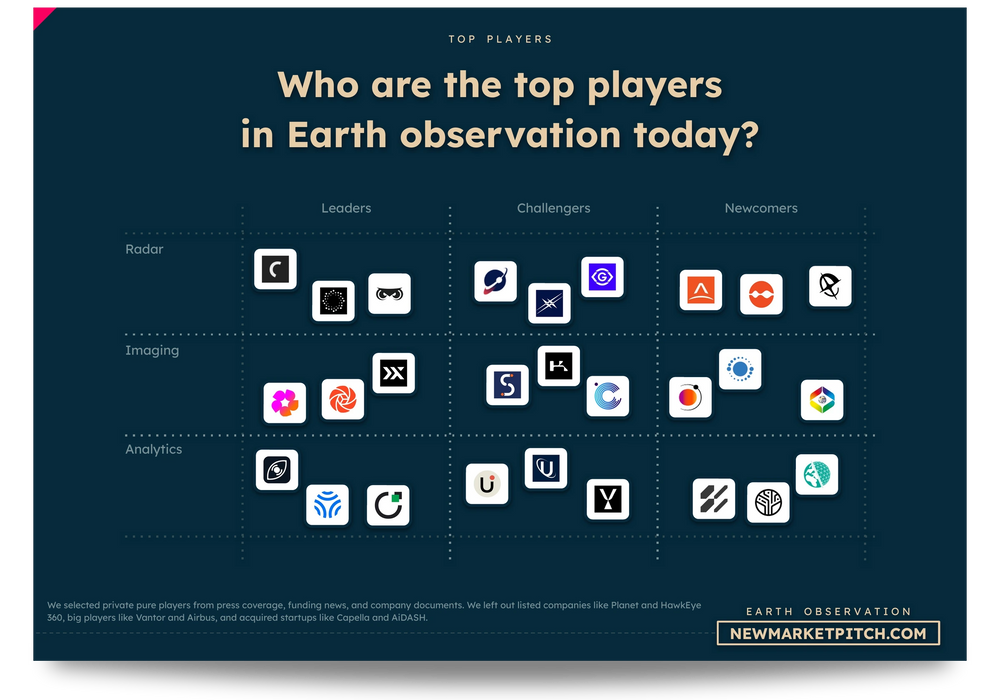
In our market report about Earth observation satellites, we turn what is vague and complex into simple, useful visuals. Market maps like this one show you at a glance where every startup stands.
Are Earth observation companies finally becoming profitable?
Some Earth observation operators are now generating positive adjusted earnings or cash flow, but consistent GAAP profitability remains uncommon among the companies reporting public financial results.
Planet generated $15.5 million in adjusted EBITDA and $52.9 million in free cash flow for fiscal 2026, while recording a GAAP net loss.
BlackSky reported its second consecutive year of positive adjusted EBITDA in 2025. The company nevertheless remained GAAP loss-making and expected to spend $50–60 million on capital expenditure in 2026.
ICEYE reported more than €100 million in EBITDA and over €130 million in operating cash flow for 2025, based on unaudited results. That's among the strongest financial performances disclosed by an independent satellite observation company, although government and defense demand plays a major role.
At the smaller end, Satellogic reported $17.7 million of revenue in 2025, up 38% from 2024, alongside a $31 million operating loss. Operating costs were approximately 2.8 times annual sales.
The difference between these operators is considerable. Some have passed $100 million in annual revenue and improved their margins, while smaller competitors are still struggling to cover basic operating expenses.
Cheaper satellite hardware, standardized manufacturing and more affordable launches should help. Yet lower collection costs also make it easier for competitors to supply similar imagery, putting pressure on prices.
Satellogic illustrates that problem. Its cost of sales excluding depreciation fell to approximately 28% of revenue in 2025, compared with 39% the previous year. The company still lost money because engineering, administration and depreciation remained expensive.
Operating a satellite constellation has become more economically viable. What we haven't seen is a broad group of profitable operators funded mainly by private-sector satellite-data subscriptions.
What would prove Earth observation can thrive without defense contracts?
The clearest proof would be several Earth observation companies generating more than $100 million each in recurring private-sector revenue while remaining cash-flow positive after their ongoing satellite investments.
That $100 million figure is our proposed benchmark rather than an industry rule. It would provide much stronger evidence of a repeatable commercial market than a collection of pilots, government contracts and isolated acquisitions.
We would also want to see customers renewing contracts, increasing spending and using satellite intelligence across several years.
Planet offers a useful public benchmark because it separately reports commercial sales. Its commercial revenue fell from $65.5 million in fiscal 2024 to $55.6 million in fiscal 2026. Reversing that trend would be more convincing evidence of commercial demand than another strong defense-driven quarter.
ICEYE, GHGSat and SatSure could strengthen the case by disclosing how much recurring revenue comes specifically from insurers, banks and industrial enterprises, along with the costs of serving those customers.
There is another possible route. A profitable analytics company using purchased or public imagery could prove that Earth observation creates attractive businesses even when those businesses don't own the satellites.
For now, the most useful figures to watch are private-sector revenue growth, customer retention and free cash flow, rather than the number of satellites launched or the total value of government-backed contracts.

Our document detailing everything you need to know about Earth observation gets updated several times a month, so you always get the latest view of where things stand.
So, can Earth observation make money beyond defense contracts?
Yes. Earth observation can already make money beyond defense contracts, particularly in insurance, agricultural risk analysis, methane monitoring and maritime intelligence. But private-sector demand is still too small to support the current scale of most major satellite operators on its own.
The commercial evidence is real. Spire sold its maritime business for approximately $234 million. ICEYE has developed operational catastrophe products for insurers. GHGSat and SatSure serve identifiable industrial and financial needs.
The biggest obstacle is scale. Defense and intelligence contributed approximately 98.4% of Planet's net revenue growth over two fiscal years, while its commercial revenue declined. BlackSky and ICEYE have also built much of their recent financial strength around national-security demand.
Our assessment is that the commercial Earth observation market is viable but still immature. Specialized intelligence providers have a clearer path to making money than companies relying on broad demand for satellite imagery.
Some winners will own constellations. Others may make more money using existing satellites and selling analytical products to insurers, lenders and industrial platforms.
Defense contracts currently help finance infrastructure that civilian customers also benefit from. The commercial market's next challenge is to grow fast enough that satellite companies can build profitable businesses without depending on that military spending.
If you want more recent data on this point, please see our latest Earth observation market report.
Sources and methodology
This analysis examines whether Earth observation can support commercially sustainable businesses beyond defense and intelligence contracts. We assess the industry's revenue sources, private-sector adoption, operating economics, competitive pressures and evidence of profitability, rather than treating technological progress or market forecasts as sufficient proof of commercial success.
We approached the question through five dimensions: the size and composition of Earth observation demand, the financial performance of satellite operators, the commercial applications attracting paying customers, the economics of owning satellites versus selling analytics, and the conditions required for private-sector revenue to support a sustainable business. For each dimension, we gathered recent evidence, aggregated the relevant findings across companies and reporting periods, and assessed what the combined results support.
Our market-size reference is EUSPA's 2026 Space Market Report, which estimates €3.5 billion in global Earth observation data and services revenue in 2024 and projects €7.9 billion by 2034. We distinguish this spending from broader space-industry revenues and from the value of the agricultural, insurance, energy and industrial assets monitored using satellite information. Market forecasts describe potential demand, not revenue already captured by Earth observation companies.
For company performance, we prioritize reported revenue, customer composition, adjusted EBITDA, GAAP results, cash flow and contracted backlog. Planet Labs provides the most detailed public comparison of commercial, civil-government, and defense-and-intelligence revenue in this analysis. We calculated changes across fiscal 2024–2026 using its reported customer categories, keeping the periods consistent and distinguishing revenue growth from changes in customer mix. We also examined BlackSky, ICEYE, Spire Global and Satellogic to compare how different business models and customer concentrations affect financial performance.
We treat profitability measures separately. Positive adjusted EBITDA does not establish GAAP profitability, operating cash flow is not the same as free cash flow, and a backlog represents contracted future activity rather than recognized annual revenue. We also account for unusual financial items, divestitures and customer-payment timing when interpreting reported results. ICEYE's 2025 financial disclosures are identified as unaudited where relevant.
To assess commercial adoption, we examined specific applications in insurance, agriculture, methane monitoring and maritime intelligence. We gave greater weight to documented customer use, operational results, reported revenue and completed transactions than to pilot announcements or technical demonstrations. Spire's completed maritime divestiture provides an observable valuation reference, but the acquisition price is not treated as evidence of standalone operating profitability. Similarly, product deployments at ICEYE, GHGSat and SatSure demonstrate commercial utility without independently establishing company-wide margins.
Our competitive assessment considers openly available Landsat and Copernicus imagery, increasingly accessible AI-based analytics, and the specialized capabilities commercial providers use to justify paid services. Regulatory demand is evaluated separately from voluntary private-sector demand because compliance requirements may increase monitoring activity without necessarily generating equivalent spending on proprietary satellite imagery.
Finally, the proposed benchmark of more than $100 million in recurring private-sector revenue per company, alongside positive free cash flow after satellite investment, is our analytical test rather than an established industry threshold. We use it to distinguish a repeatable, commercially financed business from a satellite operator whose financial viability still relies predominantly on public-sector contracts.
Key financial and market sources include EUSPA's Space Market Report, Planet Labs' financial results and filings, BlackSky's 2025 financial results, ICEYE's 2025 financial disclosure, Spire Global's 2025 financial results, and Satellogic's 2025 financial results.
For commercial applications and transactions, we used ICEYE's Flood Rapid Impact announcement, ICEYE's insurance intelligence documentation, GHGSat's 2025 Methane Emissions Report, the IEA Global Methane Tracker 2026, the IEA's methane measurement analysis, Spire's SEC filing on its completed maritime sale, Spire's original transaction announcement, Kpler's acquisition announcement, and EarthDaily Analytics' Descartes Labs acquisition announcement.
For regulation and publicly available satellite data, we consulted the European Commission's EU Deforestation Regulation guidance, the US Geological Survey's Landsat Data Access documentation, and the Copernicus Data Space Ecosystem's access terms. These sources help establish the regulatory context, the availability of open satellite observations and the competitive conditions facing commercial imagery and analytics providers.

In our report covering the Earth observation market, you will always find fresh funding data, taken straight from our own verified funding database.
Written by the New Market Pitch teamWe track new markets so founders and investors can move faster. About us