What are the most valuable Earth observation startups?
Whether you're building or investing in the Earth observation market, our report covers everything you need to know: the players, the money, and what's coming next.
Summary
ICEYE is the most valuable company in the Earth observation market, with an estimated valuation of $11.5 billion to $12.2 billion, followed by Planet Labs at $5.1 billion and Chang Guang Satellite Technology at $1.7 billion to $3.4 billion. ICEYE's June 2026 financing established a valuation above €10 billion, making it the clear leader among the 20 companies analyzed.
Only five companies in the ranking reach the $1 billion threshold: ICEYE, Planet Labs, Chang Guang Satellite Technology, HawkEye 360, and Synspective. Together, they represent approximately 78% of the sample's $28.2 billion combined indicative valuation, using the midpoint of each estimated range.
The industry's valuation gap is increasingly about government intelligence contracts. ICEYE has sold sovereign satellite systems to seven European governments, giving it a business model built around complete intelligence infrastructure rather than individual satellite images.
ICEYE and Planet Labs account for approximately 60% of the ranking's combined indicative value. Their businesses differ considerably: ICEYE specializes in radar intelligence and dedicated government systems, while Planet generated $308 million in fiscal 2026 revenue from imagery, analytics, and satellite services.
Public-market valuations reveal a less uniform picture than private financing headlines. HawkEye 360 entered the stock market in May 2026 at an implied $2.84 billion valuation, while our ranking uses a $1.2 billion market-capitalization reference. Mixing IPO prices with current trading values would distort the ranking.
Radar technology commands some of the industry's highest valuations, but ICEYE accounts for roughly 80% of the combined indicative value of the five radar-focused companies analyzed. The technology alone cannot explain that concentration; customer relationships, deployment capacity, and defense procurement are equally important.
Commercial performance is starting to separate established operators from speculative satellite businesses. HawkEye 360 increased annual revenue 74% in 2025, Planet Labs grew 26% in fiscal 2026, and BlackSky expanded approximately 4% in 2025. Their valuation multiples reflect very different growth expectations.
Below the billion-dollar tier, Umbra, Pixxel, Aerospacelab, and iQPS occupy an increasingly competitive middle market. Pixxel's $100 million September 2026 financing and its role in India's national Earth observation constellation illustrate how government partnerships can support specialized imaging companies.
Earth observation is also expanding beyond conventional satellite photography. Hyperspectral imaging, thermal observations, methane detection, and radio-frequency intelligence are creating specialized markets, although several companies developing these technologies still have valuations based on estimates rather than disclosed transactions.
The next valuation leaders will probably be companies that convert distinctive satellite data into recurring intelligence contracts while keeping constellation costs under control. AI-powered analytics could improve the economics, but reliable revenue, government demand, and cash generation will determine which businesses deserve billion-dollar valuations.

Written by the New Market Pitch teamWe track new markets so founders and investors can move faster. About us

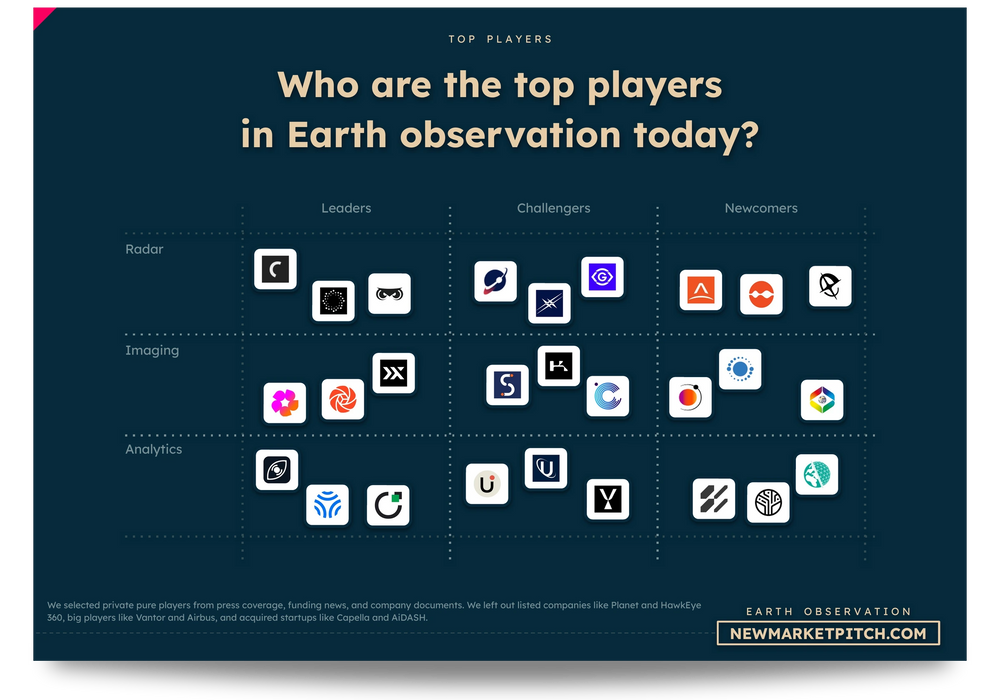
In our report covering the Earth observation market, we turn what is vague and complex into simple, useful visuals. Market maps like this one show you at a glance where every startup stands.
Top startups in the Earth observation market ranked by valuation
Here is an updated table that ranks the top startups in the Earth observation market based on their latest reported or estimated valuations. The ranking is regularly refreshed to reflect new funding rounds, public market valuations, acquisitions, and other relevant financial developments.
If you need to dig deeper and get more detailed data, please check our report covering the Earth observation market.
| # | Startup Name | What They Do | Current Valuation ($) | Valuation Confidence Level | Valuation Type | Evidence Status | Total Funding ($) | Funding Confidence Level |
|---|---|---|---|---|---|---|---|---|
| 1 | ICEYE | SAR satellites and defense intelligence | $11.5B–$12.2B | Strong Confidence | Announced Private Round Valuation | Observed | $1.6B | Strong Confidence |
| 2 | Planet Labs | Daily global satellite imagery and analytics | $5.1B | Full Confidence | Public Market Cap | Observed | ~$1.0B | Partial Confidence |
| 3 | Chang Guang Satellite Technology | High-resolution optical Earth observation satellites | $1.7B–$3.4B | Partial Confidence | Proxy-Based Estimate | Estimated | ~$411M | Partial Confidence |
| 4 | HawkEye 360 | Space-based radio frequency intelligence | $1.2B | Full Confidence | Public Market Cap | Observed | ~$585M | Strong Confidence |
| 5 | Synspective | SAR satellite imagery and analytics | $1.2B | Full Confidence | Public Market Cap | Observed | ~$258M | Strong Confidence |
| 6 | Umbra | High-resolution radar satellite intelligence | $700M–$950M | Partial Confidence | Proxy-Based Estimate | Estimated | ~$121M | Partial Confidence |
| 7 | Pixxel | Hyperspectral satellite imagery and analytics | $500M–$830M | Partial Confidence | Implied Valuation from Raise | Implied | ~$195M | Strong Confidence |
| 8 | BlackSky | Real-time geospatial intelligence monitoring | $722M | Full Confidence | Public Market Cap | Observed | N/D | Low Confidence |
| 9 | Satellogic | High-resolution optical Earth imagery | $634M | Full Confidence | Public Market Cap | Observed | ~$134M | Partial Confidence |
| 10 | Aerospacelab | Satellite manufacturing and geospatial intelligence | $520M–$680M | Partial Confidence | Comparables-Based Estimate | Estimated | ~$124M | Partial Confidence |
| 11 | iQPS | Small SAR satellite constellations | $530M–$550M | Strong Confidence | Public Market Cap | Observed | ~$112M | Partial Confidence |
| 12 | Hydrosat | Thermal satellite imagery and analytics | $350M–$500M | Partial Confidence | Implied Valuation from Raise | Implied | ~$123M | Strong Confidence |
| 13 | Capella Space | Commercial synthetic aperture radar imagery | $425M | Full Confidence | Acquisition Value | Observed | ~$250M | Partial Confidence |
| 14 | GHGSat | Satellite greenhouse gas emissions monitoring | $250M–$550M | Low Confidence | Comparables-Based Estimate | Estimated | ~$161M | Partial Confidence |
| 15 | Spire Global | Satellite weather and tracking analytics | $362M | Full Confidence | Public Market Cap | Observed | N/D | Low Confidence |
| 16 | Albedo | Very-low-orbit high-resolution satellite imaging | $180M–$350M | Low Confidence | Proxy-Based Estimate | Estimated | ~$93M | Partial Confidence |
| 17 | Array Labs | Distributed three-dimensional radar satellites | $180M–$300M | Partial Confidence | Implied Valuation from Raise | Implied | ~$56.5M | Strong Confidence |
| 18 | Axelspace | Microsatellite manufacturing and imagery services | $114M | Full Confidence | Public Market Cap | Observed | ~$111M | Strong Confidence |
| 19 | EOI Space | Very-low-orbit high-resolution satellite imagery | $25M–$75M | Low Confidence | Proxy-Based Estimate | Estimated | ~$11M | Partial Confidence |
| 20 | XpressSAR | Commercial synthetic aperture radar imaging | $15M–$60M | Low Confidence | Proxy-Based Estimate | Estimated | N/D | Low Confidence |

Our research about Earth observation satellites gets updated several times a month, so you always get the latest view of where things stand.
Which Earth observation companies are worth the most today?
ICEYE currently leads the Earth observation market by valuation, with an estimated company value of $11.5 billion to $12.2 billion, comfortably ahead of every other business in our 20-company ranking.
The strongest valuation evidence comes from ICEYE's June 2026 Series F financing. General Atlantic led a €450 million primary investment at a valuation exceeding €10 billion. Including secondary transactions, the overall financing package exceeded €1 billion.
Planet Labs follows at approximately $5.1 billion in our valuation dataset. Chang Guang Satellite Technology occupies third place at an estimated $1.7 billion to $3.4 billion, followed by HawkEye 360 and Synspective at approximately $1.2 billion each.
HawkEye 360 requires a distinction. Our ranking uses a $1.2 billion public-market valuation, while its May 2026 IPO implied an equity valuation of approximately $2.84 billion. That IPO benchmark provides useful historical context, but it should not replace a market capitalization from a different date.
The complete ranking below uses valuation midpoints to order estimated ranges. Public market capitalizations, private financing valuations, acquisition consideration, and analyst estimates are identified separately because they are not perfectly interchangeable.
| Rank | Earth observation company | Valuation reference | Main business |
|---|---|---|---|
| 1 | ICEYE | $11.5B–$12.2B | SAR satellites and sovereign defense intelligence |
| 2 | Planet Labs | $5.1B | Optical imagery, analytics, and satellite services |
| 3 | Chang Guang Satellite Technology | $1.7B–$3.4B | High-resolution optical Earth observation |
| 4 | HawkEye 360 | $1.2B | Radio-frequency intelligence |
| 5 | Synspective | $1.2B | SAR satellites and geospatial analytics |
| 6 | Umbra | $700M–$950M | High-resolution radar intelligence |
| 7 | BlackSky | $722M | Real-time geospatial intelligence |
| 8 | Pixxel | $500M–$830M | Hyperspectral imaging and analytics |
| 9 | Satellogic | $634M | High-resolution optical imagery |
| 10 | Aerospacelab | $520M–$680M | Satellite manufacturing and geospatial intelligence |
| 11 | iQPS | $530M–$550M | Small SAR satellite constellations |
| 12 | Hydrosat | $350M–$500M | Thermal satellite imagery and analytics |
| 13 | Capella Space | $425M acquisition value | Commercial SAR imagery |
| 14 | GHGSat | $250M–$550M | Satellite greenhouse gas monitoring |
| 15 | Spire Global | $362M | Satellite weather and tracking analytics |
| 16 | Albedo | $180M–$350M | Very-low-orbit satellite imaging |
| 17 | Array Labs | $180M–$300M | Distributed three-dimensional radar systems |
| 18 | Axelspace | $114M | Microsatellite manufacturing and imagery |
| 19 | EOI Space | $25M–$75M | Very-low-orbit high-resolution imagery |
| 20 | XpressSAR | $15M–$60M | Commercial SAR imaging |
Eight companies in the ranking are publicly traded, eleven are privately held, and Capella Space has been acquired. The public-market figures are dataset references rather than synchronized October 15, 2026 closing prices.
Using valuation midpoints, the combined indicative value of all 20 companies is approximately $28.2 billion. ICEYE alone represents about 42%, and the five highest-valued businesses account for nearly 78%.
That concentration is hard to ignore. Most of the industry's financial value sits with a handful of companies, even though the range of technologies and commercial applications is much broader.
Why is ICEYE worth more than $12 billion?
ICEYE's financing valuation has moved into the roughly $12 billion range because governments increasingly want their own satellite intelligence capabilities, and ICEYE has proved it can deliver them.
Its June 2026 financing provides unusually strong evidence. General Atlantic confirmed a valuation exceeding €10 billion, supported by a €450 million primary investment. The dollar equivalent depends on the exchange rate used, which is why our ranking retains an $11.5 billion to $12.2 billion reference range.
ICEYE also disclosed that seven European governments had purchased sovereign satellite systems from the company. This is a different business from selling occasional satellite images to analysts. Customers are buying access to intelligence infrastructure they can operate for national security purposes.
The manufacturing record strengthens the case. Following its July 2026 Transporter-17 launch, ICEYE reported 76 satellites successfully launched cumulatively. Its fourth-generation radar satellites offer imaging resolution down to 16 centimeters, according to the company's technical announcement.
ICEYE's position reflects more than the performance of an individual satellite. It can manufacture spacecraft, deploy constellations, provide radar imagery, and supply intelligence systems to government customers.
Investors are paying a substantial premium for that combination of technical capability, deployment history, and sovereign customers.
Whether its future earnings justify the full valuation is harder to establish. ICEYE does not disclose the same level of revenue, margin, and cash-flow information as a publicly traded company. That leaves the financing transaction as the clearest financial benchmark.

In our market report about Earth observation satellites, we look at what the winners do differently, so you can learn from the best instead of guessing.
Is ICEYE really worth twice as much as Planet Labs?
ICEYE is valued at approximately 2.3 times Planet Labs in our dataset, although that difference does not mean ICEYE generates twice as much revenue or profit.
Planet Labs is hardly a small business. Its fiscal 2026 results reported $308 million in revenue, more than $900 million in backlog, and $53 million in free cash flow. Revenue increased 26% from the previous year, according to the company's annual results.
Planet has built its business around broad optical coverage, long historical records, analytics, and increasingly dedicated satellite services. Its imagery supports agriculture, environmental monitoring, commercial intelligence, and defense customers.
ICEYE specializes in synthetic aperture radar, or SAR, which can capture observations through clouds and darkness. Its government customers can also purchase dedicated satellite systems rather than rely exclusively on shared imagery services.
At our $5.1 billion valuation estimate, Planet trades at an illustrative 16.6 times fiscal 2026 revenue. We cannot calculate a comparable reliable multiple for ICEYE without equivalent revenue disclosures.
That's the important financial difference. Planet's revenue and cash generation are visible, while ICEYE's valuation is supported by a recent financing and investors' expectations for sovereign intelligence demand.
The valuation premium is real. A direct comparison of their underlying economic value remains less certain.
How many Earth observation companies are worth more than $1 billion?
Five of the 20 Earth observation companies in our ranking have valuation references of at least $1 billion: ICEYE, Planet Labs, Chang Guang Satellite Technology, HawkEye 360, and Synspective.
That represents one-quarter of the sample. The remaining 15 companies are valued below $1 billion using their reported figures or the midpoints of their estimated ranges.
There is an important distinction between billion-dollar companies and startup unicorns. Planet Labs, HawkEye 360, and Synspective are publicly traded, while ICEYE and Chang Guang Satellite Technology are privately held. Public market capitalizations should not be counted as private startup unicorn valuations.
Among the five leaders, ICEYE has the clearest recent private financing anchor. Its valuation was supported by a completed investment rather than estimated entirely from comparable companies.
Using the midpoint of each valuation range, the five leaders represent approximately $21.9 billion of the sample's $28.2 billion combined indicative value.
That's about 78% of the total. ICEYE and Planet Labs alone represent roughly 60%, leaving the other 18 companies to share the remaining 40%.
These percentages describe our selected company sample, not the value of the entire global Earth observation industry. They also combine different valuation types, including the historical consideration paid for Capella Space.

In our document detailing everything you need to know about Earth observation, you will always find fresh funding data, taken straight from our own verified funding database.
Are defense-focused Earth observation startups worth more than commercial satellite companies?
Defense-focused Earth observation companies are attracting some of the industry's highest valuations, particularly when they sell intelligence systems directly to governments.
ICEYE offers the strongest example, with a financing valuation above €10 billion and sovereign satellite customers across seven European governments.
HawkEye 360 provides another example with publicly reported financial results. According to its SEC IPO prospectus, revenue increased from $67.6 million in 2024 to $117.7 million in 2025, a 74% rise.
BlackSky offers a more mixed picture. Its 2025 revenue reached $106.6 million, approximately 4% above the previous year, while backlog increased 32% to $345 million. Its Gen-3 satellite business has also secured dedicated satellite and intelligence contracts with defense customers.
The appeal of government intelligence is clear. Contracts can cover complete satellite systems, recurring monitoring, analytical services, and long-term infrastructure requirements.
But defense exposure does not automatically produce a higher valuation. BlackSky's $722 million market capitalization in our ranking sits below several private companies whose revenues are less transparent.
Large government contracts also bring delivery obligations, procurement delays, capital requirements, and sometimes complicated payment schedules. The companies that convert defense demand into deployed systems and repeat business have the stronger financial case.
Is synthetic aperture radar the most valuable Earth observation technology?
SAR is one of the highest-valued technologies in Earth observation, although its apparent financial dominance comes largely from ICEYE.
The five radar-focused companies in our dataset are ICEYE, Synspective, Umbra, iQPS, and Capella Space. Their combined indicative valuation reaches approximately $14.8 billion using midpoint values, with ICEYE accounting for roughly 80%.
SAR is useful because radar observations work during darkness and through cloud cover. That gives it advantages in maritime surveillance, conflict monitoring, infrastructure assessment, and disaster response.
But companies using similar sensors can have dramatically different financial outcomes. Umbra's estimated valuation is $700 million to $950 million, while Capella Space was acquired for approximately $425 million.
The difference comes down to much more than image resolution. Constellation capacity, repeat coverage, government procurement, commercial distribution, and the ability to manufacture satellites all affect what customers will pay.
Optical imagery also remains a substantial market, with Planet Labs among the industry's most valuable businesses. Hyperspectral and thermal imaging companies are developing their own specialist applications.
Radar has a particularly strong position in defense intelligence. Whether it becomes the most valuable technology category over time will depend on how widely those capabilities translate into profitable contracts beyond the current leader.

Learning from others' mistakes is the cheapest lesson there is. In our report covering the Earth observation market, we look at what broke startups before you, so you don't repeat it.
Is HawkEye 360 becoming one of the biggest satellite intelligence companies?
HawkEye 360 has established itself among the largest publicly traded satellite-intelligence specialists, with an IPO and rapidly growing revenue supporting its position.
Its May 2026 IPO was priced at $26 per share. According to Seraphim Space Investment Trust's exchange announcement, the offering implied an equity valuation of approximately $2.84 billion.
The operating figures are encouraging. HawkEye 360 generated $117.7 million in 2025 revenue, compared with $67.6 million the previous year.
Growth continued in the first half of 2026. Its SEC filings show revenue of approximately $99.6 million across the first two quarters, compared with $49.6 million in the comparable period a year earlier.
That is roughly 101% growth.
Its second-quarter revenue alone reached $49.8 million, up 87% year over year. The company also reported a $292.2 million backlog at the end of June.
HawkEye 360 is building a different business from conventional satellite photography. Its spacecraft detect radio-frequency emissions, helping customers identify signals, monitor activity, and locate assets that optical imagery cannot always reveal.
The revenue acceleration gives us considerably more information than the IPO valuation alone. The next test will be maintaining that growth while controlling operating costs and converting backlog into recognized revenue.
For valuation comparisons, the distinction between its $2.84 billion IPO benchmark and our $1.2 billion market-capitalization reference remains essential.
Is BlackSky undervalued compared with other Earth observation companies?
BlackSky looks relatively inexpensive against Planet Labs on the valuation and revenue figures in our dataset, although a lower multiple is not enough to establish that the stock is undervalued.
BlackSky generated $106.6 million in 2025 revenue and had a $345 million backlog at year-end, according to its February 2026 earnings release.
At the $722 million market capitalization we use, the company would be valued at approximately 6.8 times annual revenue.
Planet Labs, using our $5.1 billion valuation estimate and $308 million fiscal 2026 revenue, has an illustrative multiple of 16.6 times revenue.
The gap is substantial. However, BlackSky's annual revenue increased approximately 4% in 2025, compared with Planet's 26% growth during its fiscal year. The companies also have different revenue mixes, balance sheets, and capital expenditure requirements.
There are reasons to follow BlackSky closely. It reported a second consecutive year of positive adjusted EBITDA, and its growing backlog suggests stronger contracted demand than its relatively modest full-year revenue growth might imply.
BlackSky could deserve a higher multiple if its newer satellite systems accelerate revenue without consuming disproportionate amounts of cash.
We would still need synchronized market values, net debt, cash, and forward revenue estimates before calling the stock definitively cheap.

Your time is limited. In our research about Earth observation satellites, we put numbers on each part of the market, so you can see where it makes sense to focus.
How much are smaller Earth observation startups worth?
Most of the smaller Earth observation companies in our dataset are valued between $100 million and $1 billion, with their positions depending heavily on technology, financing history, and commercial progress.
Umbra occupies the upper end, with an estimated valuation of $700 million to $950 million. Pixxel follows at $500 million to $830 million, while Aerospacelab is estimated at $520 million to $680 million.
Below them, companies such as Hydrosat, GHGSat, Albedo, and Array Labs are generally valued in the hundreds of millions.
There is quite a variety of businesses in this group. Umbra develops radar intelligence, Pixxel uses hyperspectral imaging, GHGSat measures greenhouse gas emissions, and Array Labs is developing distributed three-dimensional radar systems.
The valuation ranges also have different levels of confidence. Pixxel has a recent $100 million funding round, but its valuation was not disclosed. Umbra and Array Labs have less direct valuation evidence, so their figures rely more heavily on estimates.
Publicly traded iQPS, meanwhile, has a $530 million to $550 million reference range that can be compared with its market price. It should not be treated as another private-company estimate.
These businesses serve different customers and face different capital requirements. Their valuations deserve individual assessment rather than a single multiple applied across satellite startups.
| Company | Estimated valuation | Funding in our ranking |
|---|---|---|
| Umbra | $700M–$950M | ~$121M |
| Pixxel | $500M–$830M | ~$195M |
| Aerospacelab | $520M–$680M | ~$124M |
| iQPS | $530M–$550M | ~$112M |
| Hydrosat | $350M–$500M | ~$123M |
| GHGSat | $250M–$550M | ~$161M |
| Albedo | $180M–$350M | ~$93M |
| Array Labs | $180M–$300M | ~$56.5M |
| EOI Space | $25M–$75M | ~$11M |
| XpressSAR | $15M–$60M | Not disclosed |
Private-company valuations are estimates unless supported by disclosed transactions. The iQPS figure is a public-market reference. Funding figures represent cumulative historical financing rather than cash currently available.
Can Pixxel become a billion-dollar Earth observation startup?
Pixxel has a credible route to a $1 billion valuation, especially after raising $100 million and securing a major role in India's national Earth observation program.
Its September 2026 Series C was co-led by Temasek and Seraphim, bringing cumulative funding to $195 million. The company described the transaction as India's largest space-technology funding round at that time.
Pixxel has already deployed six Firefly hyperspectral satellites and is developing a wider offering across satellite manufacturing, intelligence software, and multiple sensing technologies.
Its national constellation agreement is particularly interesting. In January 2026, Pixxel confirmed that its consortium would develop India's first privately led national Earth observation constellation under a public-private partnership.
That gives the company a potential source of long-term government demand alongside commercial customers.
Using the midpoint of its estimated $500 million to $830 million valuation, Pixxel would need approximately 50% appreciation to reach $1 billion.
The target is plausible, but the latest funding announcement did not disclose a new valuation. Investors will want to see how the constellation program translates into revenue, delivery milestones, and repeat contracts.
Pixxel has progressed beyond the stage of being simply a promising hyperspectral satellite developer. Whether investors already value it at unicorn level remains unconfirmed.

If you build or invest in the Earth observation market, you need to know which business models pay off now and which ones are fading. That's why our report covering it has a whole section on it.
Can Chinese Earth observation companies compete with Planet Labs and ICEYE?
Chinese Earth observation companies can compete at considerable scale, particularly in optical satellite imaging, although their disclosed valuations are generally harder to compare directly with Western competitors.
Chang Guang Satellite Technology is the most valuable Chinese company in our dataset, with an estimated valuation of $1.7 billion to $3.4 billion.
Its Jilin-1 constellation focuses on high-resolution optical imaging and frequent monitoring. This puts Chang Guang closer to Planet Labs' optical business than to the sovereign radar intelligence systems developed by ICEYE.
Chang Guang also benefits from operating within a substantial domestic space industry, where public-sector demand and national satellite infrastructure priorities can support constellation development.
The financial comparison remains difficult. Chang Guang's valuation is estimated, and its financing arrangements, government links, and financial reporting differ from those of publicly traded Western companies.
Satellite numbers are another imperfect measure. Having more spacecraft does not automatically mean stronger revenue, better image quality, higher observation frequency over commercially important locations, or greater customer spending.
China clearly has companies capable of building significant Earth observation infrastructure. Establishing which of them produces the most commercial value requires more comparable revenue and profitability data.
Which Earth observation startups have raised the most money?
ICEYE leads our Earth observation dataset in cumulative funding, followed by Planet Labs and HawkEye 360, although the numbers cover different financing histories and should not be confused with current cash balances.
The dataset records approximately $1.6 billion for ICEYE, $1 billion for Planet Labs, and $585 million for HawkEye 360. Chang Guang Satellite Technology follows with approximately $411 million.
ICEYE's latest financing package exceeded €1 billion when primary and secondary transactions were combined. Only the primary investment represents newly issued company equity, so the entire package should not be added mechanically to cumulative capital raised.
HawkEye 360 also completed an IPO in May 2026, introducing public-market financing after its earlier private investment rounds.
Further down the ranking, Synspective has raised approximately $258 million, Capella Space around $250 million before acquisition, and Pixxel $195 million.
These figures reveal substantial differences in access to capital, but the amount raised tells us little about how efficiently that capital was spent.
Satellite manufacturers must pay for spacecraft, engineering teams, ground systems, launches, and constellation replacement. Some businesses also develop substantial software and intelligence infrastructure.
A company with $500 million of historical financing may have spent most of it, while another with less funding could be generating meaningful cash from customers.
We therefore use cumulative funding to assess financing history and business development, not as a direct substitute for valuation or capital efficiency.

In our document detailing everything you need to know about Earth observation, we like to show you the big picture. We know your time is precious, so we make every page quick to read and packed with as much learning as possible per minute.
Why did Capella Space sell for only $425 million when ICEYE is worth $12 billion?
Capella Space's acquisition shows how widely satellite radar valuations can differ, even when the companies develop related imaging technology.
IonQ completed its acquisition of Capella in July 2025. Its SEC financial statements recorded approximately $424.8 million in total consideration, including around $376.5 million in stock and $48.3 million in cash.
That transaction amount is roughly one twenty-eighth of ICEYE's midpoint valuation. The gap is enormous, but the figures represent different things: an acquisition completed in 2025 and a private financing valuation established in 2026.
ICEYE has built a substantial sovereign intelligence business, including dedicated satellite systems for European governments. Its valuation reflects expectations about defense procurement and its ability to deliver complete satellite infrastructure.
Capella's acquisition had another strategic purpose. IonQ wanted to integrate satellite capabilities into its planned quantum-secure communications network.
The buyer was therefore assessing Capella partly through its usefulness within a larger technology strategy. Its purchase price was not a general market valuation for every SAR satellite operator.
Capella is a useful reminder that technical achievement and investor returns can diverge sharply. A company can build sophisticated satellite capabilities and still exit for much less than the headline valuations achieved by category leaders.
Are Earth observation companies actually making enough money to justify their valuations?
Several Earth observation companies now generate more than $100 million in annual revenue, but their valuations still depend heavily on future growth and the economics of maintaining satellite constellations.
Planet Labs reported $308 million in fiscal 2026 revenue, alongside positive free cash flow. HawkEye 360 generated $117.7 million in 2025, while BlackSky reached approximately $106.6 million.
Together, these three businesses generated around $532 million across their respective reported annual periods.
The growth rates tell different stories. Planet's revenue increased 26%, HawkEye 360 grew 74%, and BlackSky expanded approximately 4%.
HawkEye 360 also reported positive net income of $2.7 million in 2025, compared with a $29 million loss in 2024. Its SEC filing shows that an income tax benefit contributed to the positive bottom line, so that figure alone does not establish sustained operating profitability.
For satellite companies, the cost of maintaining a constellation is especially important. Spacecraft must be manufactured, launched, insured where appropriate, operated, and eventually replaced.
A business with rising revenue but enormous recurring capital requirements may generate less shareholder value than its sales growth suggests.
The financial evidence is strongest at companies publishing detailed operating results. Planet has demonstrated meaningful annual revenue and positive free cash flow, while HawkEye 360's recent growth shows how quickly specialist satellite intelligence businesses can expand.
| Company | Latest annual revenue used | Revenue growth | Valuation reference | Illustrative value/revenue |
|---|---|---|---|---|
| Planet Labs | $308M | +26% | $5.1B | 16.6× |
| HawkEye 360 | $117.7M | +74% | $2.84B IPO value | 24.1× |
| BlackSky | $106.6M | +4% | $722M | 6.8× |
These illustrative ratios use the stated valuation benchmarks, including HawkEye 360's historical IPO value rather than the $1.2 billion figure used in our ranking. The valuation dates and fiscal periods differ, so the results should not be interpreted as synchronized live market multiples. They also use equity value rather than enterprise value.

When you build or invest in the Earth observation market, you need clarity, not confusion. In our report covering the Earth observation market, we always try to put numbers on and quantify whatever is usually vague and confusing.
Can climate-monitoring satellite companies become billion-dollar startups?
Climate-monitoring satellite companies could reach billion-dollar valuations, but GHGSat and Hydrosat still need more commercial evidence to support that level.
GHGSat focuses on identifying greenhouse gas emissions, particularly methane. It sells monitoring capabilities that help industrial operators detect emissions from facilities and infrastructure.
Its technology has clear commercial applications. ExxonMobil has worked with GHGSat on satellite methane monitoring, and the company has expanded its constellation to improve observation coverage.
In September 2025, GHGSat announced C$47 million in new financing through convertible notes and debt. That supports its ability to finance expansion but does not provide a directly observed equity valuation.
Hydrosat uses thermal satellite observations for applications including water management and agriculture. Its estimated valuation ranges from $350 million to $500 million, compared with $250 million to $550 million for GHGSat.
The companies serve different markets. GHGSat depends on industrial monitoring needs and emissions management, while Hydrosat's opportunities include agricultural productivity, irrigation, and water-related decisions.
Those applications can create recurring demand, especially when satellite observations replace expensive physical inspections or improve operational decisions.
The commercial question is how much customers will pay, and how consistently. Valuable environmental information does not necessarily translate into a large, profitable subscription business.
Can hyperspectral and thermal satellite startups challenge Planet Labs?
Hyperspectral and thermal imaging companies can win valuable business in specialized applications, although Planet Labs retains major advantages in broad optical coverage and historical data.
Pixxel is building its business around hyperspectral imaging, which captures information across many spectral bands. This allows customers to analyze material properties and surface conditions that ordinary color imagery cannot reveal in comparable detail.
Hydrosat uses thermal data to examine heat and water-related conditions, making it relevant for agricultural monitoring and environmental applications.
Planet approaches the market from another direction. Its satellites provide frequent optical imaging, supported by a large historical archive and analytics tools.
These capabilities can complement each other. An agricultural customer might use frequent optical images to monitor changes over time, hyperspectral observations to examine vegetation characteristics, and thermal information to assess water stress.
Pixxel's recent expansion plans also show how competition is evolving. The company intends to develop radar and higher-resolution optical capabilities alongside hyperspectral systems.
Over time, companies with specialized sensors may win individual applications while larger observation platforms combine data from multiple technologies.
The commercial winners will depend on how easily customers can turn those observations into decisions worth paying for.

A good product starts with a real problem. In our research about Earth observation satellites, we show you the ones customers still live with.
Could AI make Earth observation startups much more valuable?
AI could increase the value of Earth observation businesses by helping customers extract useful intelligence from satellite data faster, particularly when the final product is an answer rather than an image.
Planet Labs already provides analytical tools alongside its imagery. BlackSky combines satellite monitoring with intelligence software, and Pixxel is developing Aurora to help customers interpret spectral data.
HawkEye 360 applies advanced analytics to radio-frequency emissions. Its customers may want to locate a suspicious signal or understand activity around a geographic area rather than receive a large dataset to analyze themselves.
The commercial opportunity is straightforward. Customers can pay more for reliable answers that save analysts time or improve important decisions.
Owning distinctive satellite data gives an operator an advantage, particularly when competitors cannot easily reproduce the observations. Radar measurements, hyperspectral signatures, and long historical imagery archives can all provide proprietary information.
However, satellite operators face competition from independent geospatial software companies and customers developing their own AI systems.
Software quality, distribution, customer access, and the cost of producing useful analytics will determine how much of the additional value satellite companies retain.
AI should help the strongest Earth observation businesses earn more from existing data. It will not automatically turn every company operating a satellite constellation into a highly valued software platform.
Will Earth observation startup valuations keep rising?
Earth observation valuations could continue rising, but the recent evidence points toward selective gains rather than an industry-wide increase.
ICEYE achieved a financing valuation above €10 billion, HawkEye 360 completed a multibillion-dollar IPO, and Pixxel raised $100 million to expand its technology and manufacturing capabilities.
These transactions reflect three different opportunities: sovereign radar intelligence, radio-frequency intelligence, and hyperspectral imaging.
There is meaningful commercial demand behind several established operators. Planet Labs reported more than $900 million in backlog, BlackSky ended 2025 with $345 million, and HawkEye 360 reported $292.2 million at the end of June 2026.
Backlog offers evidence of contracted demand, although definitions and revenue recognition schedules differ across companies.
The main constraint remains the cost of satellite infrastructure. Rising valuations become harder to sustain if spacecraft manufacturing, launches, constellation replacement, or customer acquisition absorb most of the revenue growth.
Private valuations also remain sensitive to financing conditions. A company may report a large funding round at a high valuation without immediately demonstrating the cash generation necessary to support that value over the long term.
Our expectation is selective appreciation. Businesses with confirmed customer demand, strong technical execution, and improving financial performance have a better case for higher valuations than companies whose value depends primarily on planned satellite deployments.

In our market report about Earth observation satellites, we try to remove everything that could confuse you, especially if you're investing or building in this market.
Final verdict: Which Earth observation startups are worth the most?
ICEYE is the most valuable company in our Earth observation ranking, with an estimated valuation of $11.5 billion to $12.2 billion, followed by Planet Labs at approximately $5.1 billion and Chang Guang Satellite Technology at an estimated $1.7 billion to $3.4 billion.
HawkEye 360 and Synspective complete the five-company billion-dollar group, based on the public-market references in our dataset.
The strongest valuations increasingly belong to businesses that provide specialized intelligence and complete satellite systems to government customers. ICEYE's recent financing and sovereign satellite contracts make it the clearest example.
Planet Labs demonstrates another viable model through its substantial optical imagery business, reported annual revenue, growing backlog, and positive free cash flow.
Further down the market, Pixxel, Umbra, GHGSat, and Hydrosat are developing technologies that could support future billion-dollar companies. Their valuations are less firmly established, and the next financing rounds or disclosed operating results will provide important benchmarks.
For now, the valuation hierarchy is clear at the top and much less certain below it. The companies most likely to close the gap are those that can translate specialized sensing capabilities into substantial, repeatable revenue while improving their cash economics.
Our methodology
This analysis ranks 20 companies in the Earth observation market using valuation evidence available for an October 15, 2026 reference date. We focus on companies whose core activities involve satellite-based Earth observation, geospatial intelligence, optical or radar imagery, and related sensing technologies. The ranking covers eight publicly traded companies, eleven private companies, and one acquired business.
We assembled the ranking by reviewing recent financing announcements, company and investor disclosures, SEC filings, public-market valuation references, acquisition consideration, cumulative funding data, and operating results. Each source contributed a specific piece of evidence, from financing valuations and transaction structures to revenue growth, backlog, satellite deployment, or customer contracts. These findings were aggregated into a company-level assessment, with direct financial transactions receiving greater weight than operating proxies.
We distinguish public market capitalizations, private financing valuations, acquisition consideration, and estimated values. Public-company figures use our market-capitalization references, while completed private funding rounds and acquisitions provide transaction-based benchmarks. For companies without disclosed valuations, we considered financing history, comparable businesses, dilution assumptions, commercial progress, and relevant operating evidence. Recent evidence received greater weight than older financing marks.
Companies are ordered using valuation midpoints where ranges are necessary. We applied the same approach to the combined indicative valuation of approximately $28.2 billion and the concentration calculations. These totals combine different valuation types and should be understood as comparisons within the selected sample rather than a synchronized measurement of total industry market capitalization. The $2.84 billion HawkEye 360 IPO valuation is retained as a historical transaction benchmark, separately from its $1.2 billion dataset market-capitalization reference.
Funding totals represent cumulative historical financing and are assessed separately from valuations. Primary equity investments, secondary transactions, debt, and convertible financing have different economic meanings. We also assessed commercial maturity through disclosed revenue, growth, backlog, government contracts, satellite deployments, and cash-flow evidence. Illustrative valuation-to-revenue multiples use the stated financial periods and valuation references, without treating them as live trading multiples.
Key sources include ICEYE's June 2026 financing announcement, General Atlantic's confirmation of the transaction, ICEYE's satellite deployment disclosure, Planet Labs' financial results, HawkEye 360's SEC IPO prospectus, Seraphim Space Investment Trust's IPO valuation announcement, HawkEye 360's second-quarter 2026 filing, BlackSky's full-year 2025 results, IonQ's acquisition accounting for Capella Space, Pixxel's September 2026 Series C announcement, and Pixxel's national Earth Observation constellation agreement.
In our document detailing everything you need to know about Earth observation, we turn what is vague and complex into simple, useful visuals. Market maps like this one show you at a glance where every startup stands.
Written by the New Market Pitch teamWe track new markets so founders and investors can move faster. About us