How big is the Earth observation market beyond defense?
Whether you're building or investing in the Earth observation market, our report covers everything you need to know: the players, the money, and what's coming next.
Summary
The Earth observation market beyond defense generates less than $3 billion annually under Novaspace's 2024 market definition, including civilian government and private-sector customers. Civilian satellite data purchases alone account for less than $770 million, making the independent commercial market considerably smaller than the industry's headline figures suggest.
The broader Earth observation data and services market reached $5.4 billion in 2024. Defense represented more than 65% of satellite data demand and nearly half of total industry revenue, showing how dependent the sector remains on military and intelligence budgets.
Satellite analytics is already a bigger business than selling images. Value-added services generated $3.2 billion compared with $2.2 billion for satellite data, but the available figures do not establish how much of the analytics market belongs to civilian customers.
Planet Labs provides a revealing commercial benchmark. Of its $307.7 million in fiscal 2026 revenue, approximately $182 million came from defense and intelligence, $71 million from civilian government and just $55 million from commercial customers. Its defense exposure is substantial despite years of expansion into private-sector applications.
Government procurement increasingly shapes the economics of satellite operators. ICEYE reported a €1.5 billion contracted backlog in 2025, largely supported by sovereign intelligence demand, while BlackSky secured major government contracts. Dedicated satellite systems and guaranteed collection capacity are becoming important sources of revenue.
Agriculture is the leading candidate for the largest civilian EO application, but widespread satellite usage does not automatically create large proprietary data revenues. Free Copernicus imagery and agricultural software intermediaries limit how much of the value reaches satellite operators.
Methane monitoring is one of the clearest examples of specialized commercial demand. GHGSat detected 28,224 methane plumes in 2025 and monitored nearly 3 million facilities, demonstrating substantial operational activity without establishing the industry's subscription revenue.
Insurance, energy, mining and infrastructure offer high-value uses where satellite observations can reduce inspection costs or identify expensive risks. Yet there is no reliable evidence that insurance-specific EO revenue has reached $1 billion annually, and industrial applications remain fragmented across imagery, analytics and integrated software.
Civilian governments are a meaningful part of the non-defense market. NASA's commercial satellite data acquisition programme has a $476 million cumulative contracting ceiling through November 2028, illustrating demand that supports private operators but should not be confused with private-enterprise spending or guaranteed revenue.
The overall market is expected to grow rather than explode. Novaspace's forecast implies approximately 4.5% annual growth through 2034, while EUSPA's broader downstream forecast implies 8.5%. The biggest unresolved question is whether AI and specialized analytics can turn civilian satellite monitoring into a routine recurring purchase, large enough to support operators without defense contracts.

Written by the New Market Pitch teamWe track new markets so founders and investors can move faster. About us

Your time is limited. In our report covering the Earth observation market, we put numbers on each part of the market, so you can see where it makes sense to focus.
Is Earth observation becoming a real commercial market, or is defense driving most of the growth?
Earth observation is already a commercial industry worth billions of dollars, but defense and intelligence customers still account for a remarkably large share of what satellite companies actually sell.
According to Novaspace's October 2025 Earth Observation Data and Services Market report, global revenue reached $5.4 billion in 2024, including $2.2 billion from satellite data and $3.2 billion from value-added services. Defense represented more than 65% of satellite data demand and nearly half of the combined market.
The financial results of major operators tell a similar story. Planet Labs generated $307.7 million in fiscal 2026 revenue, up 26%, with defense and intelligence representing 59% of sales. ICEYE reported more than €250 million in 2025 revenue, approximately double the previous year, while building a €1.5 billion contracted backlog tied to sovereign intelligence demand.
Meanwhile, satellite imagery is widely used in agriculture, insurance, energy, infrastructure and environmental monitoring. Companies can track crops, identify methane leaks, assess flood damage and monitor remote industrial assets without sending people to inspect every location.
The question is how much customers actually spend on these civilian applications. For now, satellite operators are growing faster where governments have large intelligence budgets than where private businesses have recurring operational needs.
How big is the Earth observation market today?
The global Earth observation market generates roughly $5 billion to $6 billion annually under broad data-and-services definitions, although that figure includes substantial defense spending.
Novaspace estimated $5.4 billion in global EO revenue for 2024. EUSPA, the European Union Agency for the Space Programme, published a different estimate in May 2026: €3.5 billion in 2024, growing to €7.9 billion by 2034.
The difference comes from what each organization counts. Novaspace covers satellite data and value-added services, while EUSPA measures downstream EO revenue across defined applications. Neither figure should be confused with the cost of building satellites, launching them or operating the entire geospatial software industry.
The distinction becomes especially important when we remove defense. Some civilian demand comes from private companies buying crop analytics or industrial monitoring. Another large part comes from NASA, meteorological agencies, environmental authorities and other civilian government customers.
Both groups belong in a non-defense market estimate. But if we want to understand how large Earth observation could become as a private-enterprise business, government-funded scientific and environmental contracts need to be separated from corporate spending.
| Market measurement | Reported value | What it covers |
|---|---|---|
| Novaspace global EO market, 2024 | $5.4B | Satellite data and value-added services |
| Satellite data revenue | $2.2B | EO data demand |
| Value-added services revenue | $3.2B | Processing, analytics and related services |
| Defense share of EO data | Over 65% | Military and intelligence applications |
| Non-defense EO data | Below $770M | Calculated upper bound |
| EUSPA EO market, 2024 | €3.5B | Downstream EO market |
| EUSPA forecast, 2034 | €7.9B | Projected downstream revenue |
| Novaspace forecast, 2034 | $8.4B | Projected data and services revenue |

In our research about Earth observation satellites, we like to show you the big picture. We know your time is precious, so we make every page quick to read and packed with as much learning as possible per minute.
How much of the Earth observation market is actually outside defense?
The non-defense Earth observation market accounts for less than $3 billion of the $5.4 billion measured by Novaspace in 2024, and the market for civilian satellite data alone is considerably smaller.
Novaspace reported that defense-related data and value-added services exceeded $2.4 billion in 2024. Subtracting that amount from the $5.4 billion industry total leaves less than $3 billion for civilian governments and commercial customers combined. Since the defense figure is a lower bound, the remaining non-defense figure is an upper bound.
The raw data market reveals even greater concentration. Defense represented more than 65% of the $2.2 billion satellite data segment. That leaves less than $770 million for all non-defense data customers worldwide.
That calculation cannot simply be extended to analytics. Novaspace recorded another $3.2 billion in value-added services, but the published figures do not establish precisely how much of that revenue came from military customers.
A company selling agricultural risk models or environmental monitoring software may generate revenue from satellite observations without buying much proprietary imagery. Conversely, defense agencies often purchase imagery together with processing and intelligence services.
The evidence supports a clear ceiling of less than $3 billion for non-defense EO under Novaspace's 2024 definitions. It does not support a precise figure for private-enterprise spending alone.
If you want more recent data on this point, please see our latest Earth observation market report.
Is Planet Labs proof that commercial Earth observation can become a big business?
Planet Labs has built a business generating more than $300 million annually, but only about $55 million of its latest fiscal-year revenue came from customers classified as commercial.
Planet reported $307.7 million in fiscal 2026 revenue, up 26% from approximately $244 million the year before. Its investor presentation divided revenue into 59% defense and intelligence, 23% civil government, and 18% commercial.
Using those reported percentages, we calculate approximately $182 million from defense and intelligence, $71 million from civilian government and $55 million from commercial customers.
This is a revealing split for one of the world's best-known Earth observation companies. Despite operating a large satellite fleet, maintaining an extensive historical imagery archive and serving customers across multiple industries, Planet still generated less than one-fifth of its revenue from its commercial category.
There is another interesting change in its recent results. Planet's fiscal 2026 annual revenue increased by approximately $64 million, while its commercial share fell from 21% in its second-quarter fiscal 2026 presentation to 18% for the full year. Those percentages represent different reporting periods, so they cannot establish an exact year-over-year decline in commercial revenue. They do show that the company's recent growth has been accompanied by a heavier defense-oriented revenue mix.
At the same time, Planet's backlog increased 79% to more than $900 million. Its ability to secure large contracts is becoming stronger, even while private-enterprise customers remain a relatively modest part of the business.
For the broader market, Planet offers an important benchmark: a successful EO operator can reach hundreds of millions in annual revenue without building an equally large commercial customer base outside government.

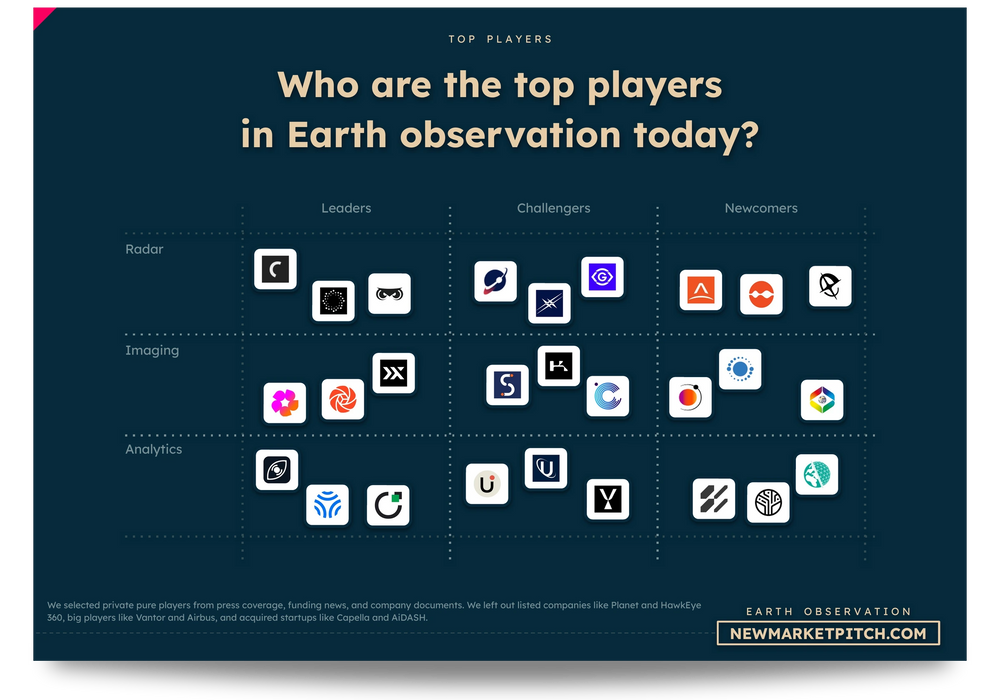
In our market report about Earth observation satellites, we turn what is vague and complex into simple, useful visuals. Market maps like this one show you at a glance where every startup stands.
Are Earth observation companies becoming more dependent on military contracts?
Defense demand is becoming more important to several of the industry's biggest Earth observation operators, and the strongest recent contracts show why.
ICEYE's 2025 results are particularly striking. The Finnish radar satellite company reported more than €250 million in revenue, over €100 million in EBITDA and €1.5 billion in contracted backlog. Its management explicitly connected the backlog to long-term national security priorities.
BlackSky shows a similar pattern. The company reported $106.6 million in 2025 revenue and $345 million in year-end backlog, up 32%. Its announced wins included an eight-figure international defense contract for a high-resolution satellite and imagery services, alongside purchases from the U.S. National Geospatial-Intelligence Agency and Space Force.
The pattern extends beyond buying satellite images. Governments increasingly want dedicated satellites, guaranteed access and direct control over collection priorities. ICEYE has built a business around delivering sovereign radar systems, while BlackSky's mission-solutions business includes satellites, ground infrastructure and software.
That changes the size of individual contracts. Selling an imagery subscription might generate recurring revenue over several years. Delivering an entire satellite system can bring a much larger agreement, although it also involves manufacturing and integration costs.
We cannot calculate the industry's exact defense revenue growth from these company disclosures because their products and reporting categories differ. Still, the direction is hard to miss. Sovereign customers are currently supporting some of the largest contracts and fastest-growing operators in Earth observation.
If you want more recent data on this point, please see our latest Earth observation market report.
Is agriculture really the biggest civilian market for satellite imagery?
Agriculture is the strongest candidate for the largest civilian Earth observation application, and EUSPA expects it to contribute more EO revenue than any other application segment over the next decade.
The opportunity comes from how frequently agricultural conditions change. Satellite observations can identify differences in crop development, monitor drought stress, estimate cultivated areas and help agricultural businesses forecast production across large regions.
A farming group managing thousands of fields can use regular imagery to identify problems before sending staff to investigate. Crop insurers can compare field conditions with historical records. Commodity traders can use regional observations to improve estimates of agricultural supply.
These uses also explain why the market is difficult to measure. Much of the imagery reaches farmers through agricultural software companies, insurance products or trading platforms. The farmer may pay for a broader service without ever buying satellite data directly.
Planet, Airbus and EarthDaily serve different parts of this market, while public Copernicus observations provide free data that many agricultural analytics businesses can use.
EUSPA's 2026 market report identifies agriculture as the largest contributor to expected EO revenue growth, ahead of other civilian applications. That supports agriculture's importance, although it does not tell us how much of the spending ultimately reaches commercial satellite operators rather than downstream software providers.
The demand is genuine and recurring. The harder commercial question is how much of the value created by better crop monitoring satellite companies can capture.

Our document detailing everything you need to know about Earth observation gets updated several times a month, so you always get the latest view of where things stand.
Can insurance become a billion-dollar Earth observation market?
Insurance is already a paying market for satellite imagery and geospatial analytics, but there is no reliable evidence that insurance-specific Earth observation revenue has reached $1 billion annually.
Insurers use satellite information to assess property exposure, monitor crop losses, evaluate flood damage and identify changes to insured assets. These tasks are particularly valuable when a company covers hundreds of thousands of properties across different countries.
The business case becomes stronger when satellite observations replace repeated manual inspections or help settle claims faster. Following a major flood, for example, imagery can identify affected areas before insurers can send adjusters to every property.
Planet has worked with insurance and risk specialists, including Swiss Re and AXA Climate. EarthDaily's acquisition of Descartes Labs in October 2024 also brought insurance-focused analytical capabilities into a satellite data business.
But satellite imagery competes with aerial photography, drones, weather models and property databases. Many insurance products combine all these sources, making it difficult to isolate what customers spend specifically on Earth observation.
The market could eventually become much larger if satellite-derived risk monitoring becomes standard across property and agricultural insurance portfolios. Today, though, we cannot justify a billion-dollar figure from disclosed insurance contracts or supplier revenue.
Is methane monitoring becoming a serious commercial satellite business?
Methane monitoring is one of the most convincing specialized commercial applications for Earth observation, with satellite companies already measuring emissions across millions of industrial facilities.
GHGSat's June 2026 emissions report provides an unusually detailed example. During 2025, the company detected 28,224 methane plumes across oil and gas, waste and mining operations in 127 countries. Its satellite and aircraft observations covered nearly 3 million facilities and identified emissions equivalent to 702 million tonnes of CO₂.
There is also a measurable increase in activity. GHGSat's previous annual report discussed more than 20,000 detected plumes in 2024. The 2025 total exceeds that reference by at least 41%, although the comparison is affected by changes in monitoring coverage and detection capacity.
The industrial applications are straightforward. Energy companies can identify leaking facilities, prioritize repairs and monitor large portfolios without depending entirely on ground inspections. Regulators can compare reported emissions with independent observations.
GHGSat also received a two-year NASA commercial data contract in March 2025, showing how specialized providers can sell to both industrial customers and civilian public agencies.
The commercial question remains the size of recurring subscriptions. GHGSat's published measurements establish substantial monitoring activity, but detection counts cannot be converted directly into revenue.
Still, methane monitoring stands out because the customer needs a specific answer about a specific facility. That gives specialized observations a clearer pricing rationale than general-purpose imagery.

In our report covering the Earth observation market, you will always find fresh funding data, taken straight from our own verified funding database.
Could energy, mining and infrastructure become bigger Earth observation markets than agriculture?
Energy, mining and infrastructure offer some of the highest-value civilian uses for satellite observation, although the available revenue figures do not show that they have overtaken agriculture.
An energy company may need to inspect thousands of kilometers of pipelines or identify methane emissions across remote installations. A mining business can monitor tailings facilities, land disturbance and geological conditions. Infrastructure operators can use satellite radar to track ground movement around roads, dams and industrial sites.
These are situations where missing a problem can be expensive. Satellite-based monitoring can also reduce travel and allow companies to observe locations that are difficult to reach.
EarthDaily expanded its analytics capabilities through the Descartes Labs acquisition in 2024, including applications in mining, energy and other industrial sectors. ICEYE's radar technology also has uses in flood monitoring and infrastructure observation, while GHGSat specializes in facility-level emissions.
Yet these applications do not all produce the same kind of revenue. Some customers pay for continuous subscriptions; others commission specific surveys or use satellite imagery alongside engineering sensors and aerial inspections.
We would give industrial monitoring a high ranking for potential revenue per customer, especially where assets are valuable and geographically dispersed. Agriculture remains the stronger candidate for aggregate civilian EO revenue, based on EUSPA's sector outlook.
| Civilian market | Examples of providers | Main customer need | Commercial position |
|---|---|---|---|
| Agriculture | Planet, EarthDaily, Airbus | Crop monitoring and yield estimates | Large established application |
| Insurance | Planet, EarthDaily | Claims and risk assessment | Established specialist market |
| Methane monitoring | GHGSat, Kayrros | Emissions detection and reporting | Growing specialized market |
| Energy | EarthDaily, GHGSat | Asset and emissions monitoring | Established industrial use |
| Mining | EarthDaily, geospatial vendors | Site monitoring and exploration | Established specialist use |
| Infrastructure | Radar analytics providers, ICEYE | Ground movement and asset monitoring | Specialized industrial use |
| Forestry | Planet, geospatial software vendors | Forest inventory and change detection | Established niche |
| Weather and climate | Spire, weather data providers | Forecasting and environmental data | Established, government-supported market |
If you want more recent data on this point, please see our latest Earth observation market report.
Why aren't more businesses paying for Earth observation data?
Commercial Earth observation remains smaller than its range of applications would suggest because businesses often need answers that satellite images alone cannot provide.
A satellite can observe a field, but agricultural software must translate that observation into useful information about crop conditions. A radar satellite can measure ground movement, but an infrastructure company needs an assessment of whether the movement threatens an asset. Insurance customers want a risk score or damage estimate rather than a collection of images.
Turning satellite observations into those outputs requires additional data, models and integration with existing software. That creates extra costs and gives customers alternatives to buying proprietary imagery.
Free public data adds another competitive pressure. The European Copernicus programme offers open access to Sentinel observations, allowing companies to build agricultural, environmental and mapping products without paying commercial operators for every image.
That forces private providers to compete on capabilities that public systems cannot always offer: higher resolution, more frequent coverage, specialized sensors, faster delivery or proprietary historical data.
We can see how the economics have shaped the industry. Planet competes through frequent imagery and its extensive archive. ICEYE offers radar observations that work through clouds and darkness. GHGSat provides specialized methane measurements. Downstream companies such as Descartes Labs focus on turning observations into useful information.
For customers, this competition is beneficial. For satellite operators, it limits the amount they can charge for standard imagery.

In our research about Earth observation satellites, we look at what the winners do differently, so you can learn from the best instead of guessing.
Is satellite analytics now a bigger business than selling images?
Satellite analytics and other value-added services already generate more revenue than the underlying EO data segment, accounting for approximately 59% of Novaspace's measured market in 2024.
Novaspace reported $3.2 billion in value-added services against $2.2 billion in satellite data sales. Both segments grew at roughly 7% annually between 2019 and 2024, according to its October 2025 research.
The revenue split reflects what buyers increasingly purchase. Agricultural companies want crop assessments, insurers want damage estimates and energy operators want alerts about changes at specific facilities.
A useful example comes from the maritime data industry, which sits next to traditional Earth observation. In April 2025, Kpler acquired Spire's maritime business for approximately $233.5 million, with a separate $7.5 million transitional services agreement.
Spire had previously disclosed roughly $42 million in trailing revenue for that business. Using the final base transaction price, we calculate a purchase multiple of approximately 5.6 times trailing revenue.
Kpler already sold trade and commodity intelligence, so the acquisition helped it bring space-derived maritime information into a broader commercial product. It illustrates how specialized data can gain value when combined with other information that customers use every day.
Maritime AIS services are not directly equivalent to optical or radar imagery, and we should not add that transaction to the traditional EO market total. The commercial model is nevertheless relevant: customers pay for an operational picture, including the interpretation of data from multiple sources.
Can Earth observation companies make money without military customers?
Earth observation companies can develop profitable data and analytics products, but the financial results of major satellite operators have yet to prove that privately funded civilian demand alone can support their full cost base.
Planet's fiscal 2026 results show both the opportunity and the challenge. The company reported $307.7 million in revenue, a 56% gross margin and approximately $53 million in positive free cash flow.
However, Planet also recorded a $246.9 million net loss, substantially affected by non-cash warrant-liability revaluation. The gross margin and cash flow figures are more useful for understanding its underlying operations than the headline net loss alone.
BlackSky generated $106.6 million in 2025 revenue and achieved a second consecutive year of positive adjusted EBITDA, but it still reported a GAAP net loss. Its cost of sales also increased from 27% to 33% of revenue as the business mix changed.
ICEYE reported more than €100 million in EBITDA on over €250 million in 2025 revenue. That is a much stronger profitability indicator, although its results were unaudited and its large sovereign intelligence contracts remain central to the business.
These financial profiles cannot establish the economics of an entirely civilian satellite company. Dedicated satellite missions, subscriptions, analytical software and government contracts have different costs and margins.
The evidence is strongest that EO operators can improve profitability with large recurring contracts and better utilization of their satellite fleets. It remains much weaker for a business funded primarily by agriculture, insurance and other private-enterprise customers.
If you want more recent data on this point, please see our latest Earth observation market report.

If you build or invest in the Earth observation market, you need to know which business models pay off now and which ones are fading. That's why our report covering it has a whole section on it.
How much civilian Earth observation revenue still comes from governments?
Civilian governments are important Earth observation customers, and excluding them makes the addressable private market substantially smaller.
NASA offers one of the clearest examples. Its Commercial Satellite Data Acquisition programme has a cumulative contracting ceiling of $476 million through November 2028, covering purchases from multiple commercial data providers. That ceiling is a maximum potential contract value rather than guaranteed spending.
NASA expanded the programme in June 2026, selecting eight additional providers and adding products from existing contractors. The available observations include optical imagery, radar, meteorological information and specialized environmental measurements.
Similar demand exists in weather forecasting, environmental regulation, disaster response and agricultural monitoring. NOAA buys commercial weather data, while European public programmes support extensive Earth observation use for environmental and scientific purposes.
This has a substantial impact on how we define the commercial market. A government agency paying a private company for satellite observations creates commercial revenue, even when the intended application is scientific or environmental rather than military.
Planet's approximately $71 million in fiscal 2026 civilian government revenue gives us a concrete example of that distinction.
When we measure Earth observation beyond defense, civilian government spending belongs in the total. When we assess the industry's ability to grow from private demand alone, it needs to be separated.
Could AI make the commercial Earth observation market much bigger?
AI could make satellite observation useful to far more businesses, but the industry's revenue growth has not yet demonstrated an AI-driven commercial boom.
The biggest opportunity comes from automating work that previously required specialists. Machine learning can identify objects, compare observations, classify crops, detect environmental changes and process large image archives.
For businesses monitoring thousands of assets, this can change how often satellite data is used. An insurer could receive alerts when properties are damaged. An energy operator could monitor emissions across facilities. A construction company could track changes around multiple worksites without repeatedly ordering custom analysis.
There is also an economic risk for satellite providers. AI makes it easier for software companies to build their own applications using public imagery. If competing products produce similar results from freely available Sentinel observations, prices could fall even while usage increases.
Novaspace's latest market research points to growing integration between sensors, analytics and AI systems. The shift is visible in acquisitions such as EarthDaily's purchase of Descartes Labs and in the product strategies of operators building automated intelligence services.
The next test is whether AI turns occasional geospatial projects into subscriptions that companies renew every year. That would expand the paying customer base rather than simply making existing satellite analysis cheaper.

When you build or invest in the Earth observation market, you need clarity, not confusion. In our document detailing everything you need to know about Earth observation, we always try to put numbers on and quantify whatever is usually vague and confusing.
How fast will the Earth observation market grow outside defense?
The overall Earth observation market is expected to grow steadily through 2034, but no published industry-wide forecast convincingly separates future civilian growth from military and intelligence spending.
EUSPA's May 2026 report projected that global downstream EO revenue would increase from €3.5 billion in 2024 to €7.9 billion in 2034. We calculate a compound annual growth rate of approximately 8.5%.
Novaspace's estimate is more conservative. Its forecast of $8.4 billion in 2034, compared with $5.4 billion in 2024, implies approximately 4.5% annual growth.
The gap reflects different market definitions and forecasting assumptions. Both forecasts suggest a growing industry, but neither supports the idea that commercial satellite observation is on the verge of multiplying tenfold.
The most relevant question for non-defense growth is whether companies will start purchasing satellite analytics as routinely as they purchase weather forecasts, logistics software or industrial monitoring services.
Agriculture, emissions monitoring and insurance already show that such recurring uses exist. The challenge is their revenue scale. Large government contracts remain easier to identify than comparably large purchases from private industrial customers.
For now, we can support mid-single-digit to high-single-digit growth expectations for the overall EO industry. A separate growth rate for private-enterprise EO demand would require more detailed customer revenue disclosures than operators currently provide.
How big is the Earth observation market beyond defense, really?
The non-defense Earth observation market is a genuine commercial business worth up to a few billion dollars annually, but private-sector satellite data spending is much smaller than the industry's headline figures suggest.
The clearest market boundary comes from Novaspace. Out of $5.4 billion in global EO data and services revenue in 2024, more than $2.4 billion came from defense-related applications. That leaves less than $3 billion for civilian government and commercial customers combined.
Within the $2.2 billion satellite data segment, non-defense applications represented less than $770 million. The larger value-added services segment contains additional civilian revenue, although the available figures do not isolate it precisely.
We also have enough company evidence to understand where the money is going. Planet generated approximately $55 million from commercial customers in fiscal 2026, against $182 million from defense and intelligence. ICEYE's €1.5 billion backlog and BlackSky's expanding government contracts reinforce the importance of sovereign customers.
Civilian demand is nevertheless well established. Agriculture offers the broadest application base, methane monitoring has demonstrated large-scale operational use, and insurance, energy and infrastructure create opportunities for recurring specialized analytics.
EUSPA expects the global EO market to more than double to €7.9 billion by 2034, with agriculture contributing the largest share of growth. The opportunity for civilian suppliers could therefore expand substantially, particularly as AI makes satellite observations easier to integrate into existing software.
Our judgment is that the Earth observation industry has already reached meaningful commercial scale, but the private-enterprise market remains relatively small and poorly disclosed. The best-established non-defense opportunities are in agricultural analytics, insurance, industrial monitoring and civilian government services.
Defense continues to anchor the industry's largest satellite operators. The next stage of growth depends on whether civilian customers can turn satellite monitoring into a routine operating expense across enough businesses to support a much larger independent market.
If you want more recent data on this point, please see our latest Earth observation market report.

A good product starts with a real problem. In our report covering the Earth observation market, we show you the ones customers still live with.
Our methodology
This analysis examines how much of the Earth observation market exists beyond defense and intelligence, separating civilian government purchasing from private-enterprise demand. We measure the economic scale of satellite data and value-added services, examine who actually pays for them, and assess whether commercial applications can support a larger industry independently of military contracts.
We structured the research around distinct dimensions: total market revenue, defense concentration, operator customer mix, satellite data versus analytics, civilian applications, government procurement, company economics and long-term growth. For each dimension, we identified the most relevant recent evidence, aggregated comparable findings, assessed their meaning and limitations, and used those results to build the overall conclusions.
Our main market-size reference is Novaspace's October 2025 Earth Observation Data and Services Market report, which estimated $5.4 billion in 2024 revenue. We use its defense-related revenue disclosures to establish an upper bound of less than $3 billion for the non-defense market, and its satellite data breakdown to calculate a civilian data ceiling below $770 million. These are market boundaries rather than independently reported private-enterprise revenue totals.
We compare those estimates with EUSPA's 2026 EU Space Market Report, which measures a differently defined downstream market. Because the two research organizations include different activities, we do not combine their revenue totals or treat their projections as directly interchangeable. We calculate the implied compound annual growth rates from their reported 2024 baselines and 2034 forecasts.
To assess customer concentration and operator economics, we examined Planet Labs' fiscal 2026 financial results and investor presentation, ICEYE's 2025 financial disclosures and BlackSky's SEC-reported results. Planet's reported customer percentages were applied to its total revenue to estimate defense, civilian government and commercial sales. We treated financial results, contracted backlogs and announced procurement agreements separately, since they represent different stages of commercial activity.
Civilian adoption was evaluated through agriculture, insurance, methane monitoring, energy, mining, infrastructure and environmental services. We compared documented operational activity, customer applications and procurement with evidence of recurring monetization. GHGSat's methane observations, for example, demonstrate monitoring activity, but detection volumes were not treated as a substitute for sales figures. Likewise, NASA's commercial satellite data acquisition ceiling was treated as procurement capacity, not guaranteed expenditure.
We also assessed the commercial role of open satellite data, particularly Copernicus, and the growing importance of software and analytics. EarthDaily's acquisition of Descartes Labs and Spire's maritime business transaction provide additional examples of how satellite-derived information can be monetized. The maritime transaction was used as an adjacent business-model comparison, not included in traditional Earth observation market revenue.
For the forward-looking assessment, we compared industry forecasts with recent operator revenue, government contracts, application-level activity and evidence of private-sector purchasing. This structured aggregation allowed us to distinguish established paying demand from technical adoption and prospective market opportunities, with particular attention to whether civilian customers could support commercially repeatable services at scale.
Key sources include Novaspace's Earth Observation Data and Services Market research, Novaspace's commercial Earth observation market outlook, EUSPA's EU Space Market Report, EUSPA's 2026 report announcement, Planet Labs' fiscal financial results, Planet Labs' fiscal 2026 investor presentation, ICEYE's 2025 financial results, and BlackSky's 2025 financial disclosures.
Additional evidence comes from GHGSat's 2025 Methane Emissions Report, NASA's assessment of GHGSat emissions data, NASA's Commercial Satellite Data Acquisition programme, NOAA's Commercial Data Program, Copernicus' public data-access documentation, EarthDaily's Descartes Labs acquisition announcement, Spire Global's maritime transaction disclosure, and Planet's insurance applications.

Learning from others' mistakes is the cheapest lesson there is. In our research about Earth observation satellites, we look at what broke startups before you, so you don't repeat it.
Written by the New Market Pitch teamWe track new markets so founders and investors can move faster. About us