
What’s the latest funding news in the Earth observation market? (October 2026)
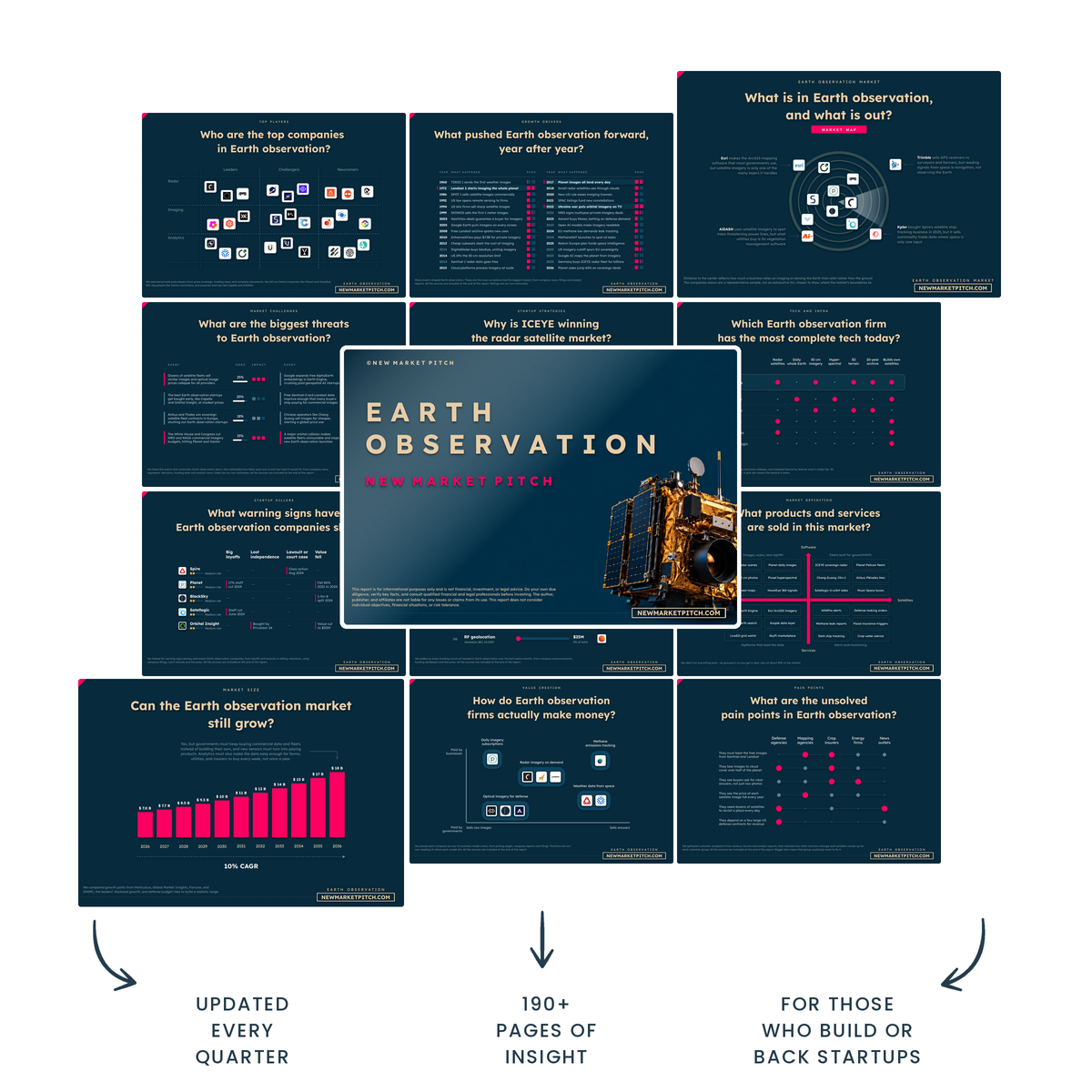
Whether you're building or investing in the Earth observation market, our report covers everything you need to know: the players, the money, and what's coming next.
Earth observation startups are attracting major investment as governments and businesses seek more accurate information about our planet from space.
Our October 2026 review covers 12 recent fundraising announcements, from emerging satellite analytics startups to established operators raising hundreds of millions of dollars.
Radar imaging, thermal intelligence, hyperspectral sensing, and AI-powered geospatial analytics are among the technologies driving investment across this market.
And if you want to better understand this new industry, you can download our pitch covering the Earth observation market.
Insights
- The 12 Earth observation funding announcements represent approximately $1.45 billion in new financing. Chang Guang Satellite Technology and ICEYE account for roughly 84% of this total, showing how concentrated investment is among large satellite operators.
- Seven of the 12 Earth observation deals involved less than $25 million. This highlights an active early-stage market alongside the much larger investments needed to manufacture satellites and expand operational constellations.
- Defense and security are becoming important customers for satellite intelligence. Kapta Space, ICEYE, Array Labs, and Pixxel are developing observation capabilities that help governments monitor activity, identify targets, and maintain awareness across large territories.
- Specialized satellite sensors are gaining investor attention beyond traditional optical imaging. Radar, thermal infrared, and hyperspectral systems appear throughout these funding announcements, reflecting demand for information that conventional satellite photographs cannot easily provide.
- ICEYE raised approximately $520 million in new equity, while its total financing package exceeded $1 billion when secondary transactions were included. This distinction matters because secondary share sales do not provide equivalent new operating capital.
- Two companies, Hydrosat and Tomorrow.io, announced extensions of existing financing rounds worth a combined $45 million. These investments provided additional growth capital without creating entirely new funding series.
- Earth observation analytics can attract funding without requiring ownership of a large satellite constellation. Stellaria, LiveEO, and New Space Intelligence illustrate growing demand for software that turns satellite measurements into practical intelligence.
- Climate applications remain an important commercial opportunity. Hydrosat, Satellites on Fire, and SatLeo Labs apply satellite-derived information to water stress, temperature monitoring, wildfire detection, and environmental risk management.
- The funding announcements cover companies headquartered across North America, Europe, Asia, the Middle East, and Latin America. Earth observation innovation is geographically diverse, although the largest financing rounds remain concentrated among established operators.

Written by the New Market Pitch teamWe track new markets so founders and investors can move faster. About us

In our report covering the Earth observation market, you will always find fresh funding data, taken straight from our own verified funding database.
Summary table of the latest funding deals in the Earth observation market as of October 2026
We define the Earth observation market as products and services that collect or analyze information about Earth from space.
We include Earth-imaging satellites, remote-sensing operators and specialized analytics derived from satellite observations.
We exclude satellite communications, navigation services and ground-only sensing without satellite data.
The table below presents 12 recent Earth observation funding announcements, ranked from the newest to the oldest, with funding amounts converted into US dollars where necessary.
| Name | When | Amount in $ | Round Type | Category |
|---|---|---|---|---|
| Kapta Space | October 9, 2026 | $24M | Series A | Spaceborne Radar & Defense Intelligence |
| Hydrosat | September 21, 2026 | $10M | Series B Extension | Thermal Earth observation & Climate Analytics |
| Pixxel | September 7, 2026 | $100M | Series C | Hyperspectral Satellite Imaging |
| Stellaria | August 25, 2026 | $6.8M | Seed | Geospatial AI & Satellite Intelligence |
| Array Labs | July 27, 2026 | $21M | Strategic Equity | 3D Satellite Radar & Defense Tracking |
| Chang Guang Satellite Technology | July 4, 2026 | Approximately $690M-$700M | Growth Equity | Optical Satellite Imaging & Remote Sensing |
| ICEYE | June 9, 2026 | $520M | Series F | Synthetic Aperture Radar & Defense Intelligence |
| Tomorrow.io | May 18, 2026 | $35M | Series F Extension | Satellite Weather Observation & AI Forecasting |
| LiveEO | May 6, 2026 | More than $32.8M | Growth Funding | Satellite Analytics & Infrastructure Monitoring |
| Satellites on Fire | April 9, 2026 | $2.7M | Seed | Satellite Wildfire Detection & Environmental Intelligence |
| New Space Intelligence | April 7, 2026 | Approximately $2.9M | Series A | Satellite Data Integration & Remote-Sensing Analytics |
| SatLeo Labs | April 6, 2026 | $2.2M | Seed | Thermal Satellite Imaging & Earth Intelligence |
Funding amounts refer to the newly announced financing rather than cumulative capital raised. Non-dollar amounts are approximate conversions, and the list represents a researched selection rather than an exhaustive global transaction database.
All the latest funding deals in the Earth observation market as of October 2026
Kapta Space raised $24 million in October 2026 to scale its satellite radar technology.
When was it?
Kapta Space announced its financing on October 9, 2026.
Who are they?
Kapta Space develops electronically steerable radar payloads that allow satellites to detect and track moving vehicles and other targets on Earth's surface.
Geographical focus?
Kapta Space is based in Seattle, United States, and initially focuses on American defense and intelligence customers.
Why do we include them in the Earth observation market?
Kapta Space develops sensors that collect radar observations of Earth from orbit, placing the company in the spaceborne radar and moving-target intelligence category.
What is the company stage?
Kapta Space is entering early commercial growth, with classified government contracts secured and manufacturing activities expanding.
How much did they raise?
Kapta Space raised $24 million, bringing its announced total funding to approximately $30 million, with Washington Harbour Partners and Bison Ventures co-leading the investment.
What round is it?
Kapta Space completed a Series A financing round, with participation from MetaVC Partners, MYDA Advisors, Entrada Ventures, Aurelia Foundry, and Fitz Gate Ventures.
Why did they raise?
Kapta Space will use the financing to manufacture more radar payloads, fulfill classified defense contracts, and prepare demonstration missions for larger satellite deployments.
Hydrosat secured $10 million in September 2026 to expand its thermal Earth observation business.
When was it?
Hydrosat announced the additional investment on September 21, 2026.
Who are they?
Hydrosat operates thermal imaging satellites and develops software that helps customers monitor crop water stress, manage irrigation, and understand environmental risks.
Geographical focus?
Hydrosat operates internationally from Luxembourg and the United States, with this investment particularly supporting expansion in Spain and the Iberian Peninsula.
Why do we include them in the Earth observation market?
Hydrosat collects temperature measurements through satellites and converts those observations into agricultural and climate intelligence products.
What is the company stage?
Hydrosat is in commercial growth, with its IrriWatch platform serving more than 90 customers across over 70 countries.
How much did they raise?
Hydrosat received $10 million in additional financing from Suma Capital through its SC Net Zero Ventures fund, following a previously announced $60 million Series B.
What round is it?
Hydrosat completed a Series B extension, bringing additional capital into an existing financing series rather than launching a new round.
Why did they raise?
Hydrosat plans to expand its thermal satellite constellation, strengthen engineering and commercial teams, and develop more products for water management and environmental monitoring.

In our research about Earth observation satellites, we turn what is vague and complex into simple, useful visuals. Market maps like this one show you at a glance where every startup stands.
Pixxel raised $100 million in September 2026 to expand its satellite imaging and intelligence operations.
When was it?
Pixxel announced the financing on September 7, 2026.
Who are they?
Pixxel develops hyperspectral imaging satellites that identify detailed material signatures across crops, minerals, industrial sites, and the environment.
Geographical focus?
Pixxel operates across India and the United States while serving international commercial and government customers.
Why do we include them in the Earth observation market?
Pixxel specializes in collecting hyperspectral observations from space and converting them into detailed Earth intelligence through its Aurora software platform.
What is the company stage?
Pixxel is in commercial growth, with six Firefly hyperspectral satellites deployed and an expanding software and government customer business.
How much did they raise?
Pixxel raised $100 million, bringing cumulative funding to approximately $195 million, in a round co-led by Temasek and Seraphim.
What round is it?
Pixxel completed a Series C round involving new investors 360 ONE Asset and IMM Investment alongside returning investors including Radical Ventures and growX ventures.
Why did they raise?
Pixxel intends to develop additional radar and optical sensing capabilities, expand its Aurora intelligence platform, increase manufacturing capacity, and pursue larger sovereign satellite programs.
Stellaria raised $6.8 million in August 2026 to expand its geospatial AI intelligence platform.
When was it?
Stellaria announced its seed financing on August 25, 2026.
Who are they?
Stellaria develops AI software that analyzes satellite imagery and other geographic data to monitor maritime activity, identify targets, and assess environmental changes.
Geographical focus?
Stellaria is based in the United Arab Emirates and targets government, defense, maritime, and infrastructure customers in domestic and international markets.
Why do we include them in the Earth observation market?
Stellaria uses satellite imagery as an important source for its Stella geospatial intelligence platform, making satellite-derived analytics a central product capability.
What is the company stage?
Stellaria is in early commercialization, expanding an existing AI intelligence platform for government and enterprise users.
How much did they raise?
Stellaria secured approximately $6.8 million, equivalent to AED 25 million, from undisclosed angel investors at a reported valuation of about $114.4 million.
What round is it?
Stellaria completed a seed funding round, with no individual lead investor publicly identified.
Why did they raise?
Stellaria plans to develop more geospatial AI models, recruit technical specialists, and expand deployments across the UAE and international markets.

Your time is limited. In our market report about Earth observation satellites, we put numbers on each part of the market, so you can see where it makes sense to focus.
Array Labs secured $21 million in July 2026 to commercialize satellite radar tracking technology.
When was it?
Array Labs published its financing announcement on July 27, 2026, with wider press coverage following on July 28 and 29.
Who are they?
Array Labs develops coordinated radar satellite systems that produce detailed three-dimensional observations and help track aircraft, ships, and other moving objects.
Geographical focus?
Array Labs is headquartered in Redwood City, California, and is expanding its defense and security activities across the Asia-Pacific region.
Why do we include them in the Earth observation market?
Array Labs focuses on space-based radar sensing and detailed observations of Earth's surface and moving targets, placing it within satellite remote sensing.
What is the company stage?
Array Labs is validating its satellite radar technology and moving toward early commercial deployment, supported by defense research contracts and strategic partnerships.
How much did they raise?
Array Labs raised $21 million in strategic financing anchored by Mitsubishi Electric, with participation from Catapult Ventures, Kompas VC, and Y Combinator.
What round is it?
Array Labs announced a strategic equity financing following its earlier Series A, rather than a newly named standalone funding series.
Why did they raise?
Array Labs will accelerate its radar satellite technology and work with Mitsubishi Electric to commercialize airborne and maritime tracking services for regional defense customers.
Chang Guang Satellite Technology raised nearly $700 million in July 2026 to expand its Earth observation constellation.
When was it?
Chang Guang Satellite Technology announced its financing on July 4, 2026.
Who are they?
Chang Guang Satellite Technology operates China's Jilin-1 satellite constellation, supplying high-resolution images for agriculture, forestry, infrastructure, environmental monitoring, and government applications.
Geographical focus?
Chang Guang Satellite Technology is based in Changchun, China, and primarily serves the Chinese market while developing international remote-sensing activities.
Why do we include them in the Earth observation market?
Chang Guang Satellite Technology operates one of the largest commercial optical Earth observation constellations, although the company also has satellite communications manufacturing activities.
What is the company stage?
Chang Guang Satellite Technology is a mature commercial operator expanding production capacity, with 161 Jilin-1 satellites reported as launched by the financing announcement.
How much did they raise?
Chang Guang Satellite Technology raised nearly RMB 5 billion, equivalent to approximately $690 million to $700 million, with Changfa Group and Lushi Investment co-leading.
What round is it?
Chang Guang Satellite Technology completed a large growth-stage equity financing involving institutional and state-linked investors, with no consistently confirmed standalone series designation.
Why did they raise?
Chang Guang Satellite Technology plans to increase satellite manufacturing capacity, expand the Jilin-1 constellation, and develop more commercial applications for its remote-sensing imagery.

Our document detailing everything you need to know about Earth observation gets updated several times a month, so you always get the latest view of where things stand.
ICEYE raised $520 million in June 2026 to expand its satellite radar intelligence operations.
When was it?
ICEYE announced its financing on June 9, 2026.
Who are they?
ICEYE operates synthetic aperture radar satellites that capture detailed observations of Earth's surface through darkness and cloud cover.
Geographical focus?
ICEYE is headquartered in Finland and serves international defense, intelligence, disaster response, and infrastructure customers across Europe and other global markets.
Why do we include them in the Earth observation market?
ICEYE collects radar imagery from orbit and delivers satellite-derived intelligence, making Earth observation the foundation of its commercial services.
What is the company stage?
ICEYE is in advanced commercial growth, with operational satellite systems, established government customers, and a substantial international order pipeline.
How much did they raise?
ICEYE raised €450 million, approximately $520 million, in new primary equity, while the broader financing exceeded €1 billion including secondary share transactions.
What round is it?
ICEYE completed a Series F financing led by General Atlantic, with EQT subsequently identified as a co-lead and participation from additional institutional investors.
Why did they raise?
ICEYE intends to increase radar satellite production, expand international manufacturing and operational capabilities, and supply governments with more independent space-based intelligence systems.
Tomorrow.io raised an additional $35 million in May 2026 to expand its satellite-based weather intelligence platform.
When was it?
Tomorrow.io announced its additional financing on May 18, 2026.
Who are they?
Tomorrow.io combines satellite weather measurements, atmospheric models, and AI to help businesses and governments anticipate weather-related operational risks.
Geographical focus?
Tomorrow.io is headquartered in Boston, United States, and serves enterprise and government customers internationally.
Why do we include them in the Earth observation market?
Tomorrow.io operates proprietary satellites that observe atmospheric conditions from space, placing the company in satellite weather observation rather than traditional land imagery.
What is the company stage?
Tomorrow.io is in commercial growth, with established enterprise relationships and continued investment in its DeepSky satellite observation program.
How much did they raise?
Tomorrow.io secured $35 million from Pitango and Harel Insurance, increasing its previously announced Series F financing from $175 million to $210 million.
What round is it?
Tomorrow.io completed a Series F extension, adding capital to its existing funding series.
Why did they raise?
Tomorrow.io plans to expand its space-based weather observation network, develop AI forecasting capabilities, and improve its platform for enterprise risk management.

In our report covering the Earth observation market, we look at what the winners do differently, so you can learn from the best instead of guessing.
LiveEO raised more than $32.8 million in May 2026 to expand satellite intelligence for infrastructure and defense.
When was it?
LiveEO announced the first closing of its new growth financing on May 6, 2026.
Who are they?
LiveEO analyzes satellite imagery with AI to monitor vegetation near infrastructure, detect changes around critical assets, and identify operational and environmental risks.
Geographical focus?
LiveEO is headquartered in Berlin, Germany, and serves international infrastructure customers while expanding its European defense activities.
Why do we include them in the Earth observation market?
LiveEO turns satellite images into monitoring and decision-support products, making satellite-derived geospatial analytics central to its business.
What is the company stage?
LiveEO is in commercial growth, with established infrastructure monitoring products and plans to develop its own Twinspector satellite constellation.
How much did they raise?
LiveEO raised more than €28 million, approximately $32.8 million, with new investors including Helantic, b2ventures, and the European Innovation Council.
What round is it?
LiveEO announced the first closing of a new growth funding round, which some financing databases classify as Series C.
Why did they raise?
LiveEO will expand its satellite monitoring business, develop its Twinspector imagery supply, and build more automated intelligence products for infrastructure and defense customers.
Satellites on Fire raised $2.7 million in April 2026 to improve wildfire detection and expand internationally.
When was it?
Satellites on Fire announced its financing on April 9, 2026, with additional media coverage in the following days.
Who are they?
Satellites on Fire uses satellite images, AI, and complementary sensor data to detect wildfires early and predict how fires might spread.
Geographical focus?
Satellites on Fire was founded in Argentina and operates across Latin America while expanding into the United States.
Why do we include them in the Earth observation market?
Satellites on Fire relies on satellite-derived observations to identify environmental threats, placing it in the wildfire detection and environmental intelligence category.
What is the company stage?
Satellites on Fire is in early commercial growth, with deployments across several countries and customers in forestry, agriculture, energy, insurance, and emergency response.
How much did they raise?
Satellites on Fire raised $2.7 million in financing led by Dalus Capital, alongside investors including Draper Associates, Draper Cygnus, and Savia Ventures.
What round is it?
Satellites on Fire completed a seed financing round to support its next stage of commercial development.
Why did they raise?
Satellites on Fire plans to improve its wildfire detection and prediction technology, enter new markets, and make its early-warning platform available to more customers.

Learning from others' mistakes is the cheapest lesson there is. In our research about Earth observation satellites, we look at what broke startups before you, so you don't repeat it.
New Space Intelligence raised approximately $2.9 million in April 2026 to expand its satellite data integration platform.
When was it?
New Space Intelligence announced its funding on April 7, 2026.
Who are they?
New Space Intelligence develops software that calibrates and combines observations from different satellites, helping organizations analyze infrastructure, disasters, and land-use changes.
Geographical focus?
New Space Intelligence is headquartered in Japan and focuses on Japanese infrastructure and industrial customers while developing opportunities in international markets.
Why do we include them in the Earth observation market?
New Space Intelligence builds software specifically for processing and integrating Earth observation satellite data, making remote-sensing analytics its primary business activity.
What is the company stage?
New Space Intelligence is in early commercial growth, expanding its satellite data processing technology into practical products for infrastructure and environmental monitoring.
How much did they raise?
New Space Intelligence raised ¥430 million, approximately $2.9 million, in equity financing led by Partners Fund and involving several strategic investors.
What round is it?
New Space Intelligence completed a Series A round involving investors from mapping, transportation, communications, and financial services.
Why did they raise?
New Space Intelligence plans to improve its satellite data platform, develop new applications, strengthen commercial teams, and expand adoption through industrial partnerships.
SatLeo Labs raised $2.2 million in April 2026 to advance its first thermal Earth observation satellite mission.
When was it?
SatLeo Labs announced its seed financing on April 6, 2026.
Who are they?
SatLeo Labs develops satellites that combine thermal and visible-light imaging to provide temperature intelligence for agriculture, industrial infrastructure, defense, and environmental monitoring.
Geographical focus?
SatLeo Labs is based in India and is developing satellite observation services for domestic customers and future international markets.
Why do we include them in the Earth observation market?
SatLeo Labs is building dedicated Earth observation satellites that measure surface temperature and support remote-sensing analytics across several industries.
What is the company stage?
SatLeo Labs is in pre-commercial satellite development, with an experimental thermal payload approaching launch readiness and early commercial pilot activities underway.
How much did they raise?
SatLeo Labs raised $2.2 million, bringing total reported funding to approximately $5.5 million, in a round led by Unicorn India Ventures.
What round is it?
SatLeo Labs completed a seed financing round with participation from Merak Ventures, Java Capital, IIMA-CIIE, and angel investor Manish Gandhi.
Why did they raise?
SatLeo Labs will advance its thermal satellite mission, complete hardware development, and expand its AI platform for turning temperature measurements into commercial intelligence.
Written by the New Market Pitch teamWe track new markets so founders and investors can move faster. About us