
Earth observation funding: a quarter-by-quarter analysis
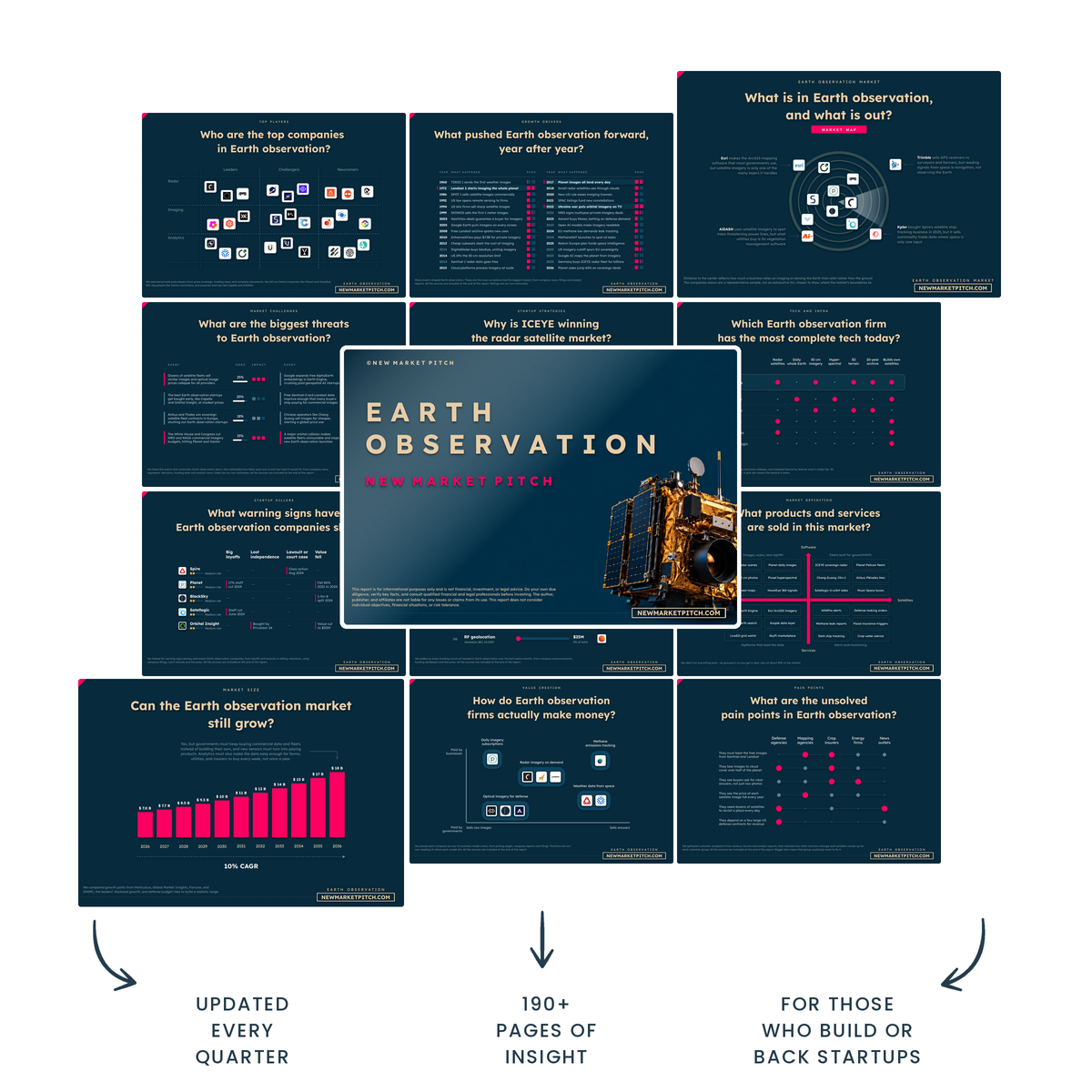
Whether you're building or investing in the Earth observation market, our report covers everything you need to know: the players, the money, and what's coming next.
Summary
Earth observation startup funding accelerated dramatically from Q3 2025 through Q2 2026, before falling sharply in Q3 2026. But the headline growth was driven primarily by a handful of exceptionally large transactions, rather than a sustained expansion in financing across the industry.
Across five quarters, 36 companies raised approximately $1.63 billion through 43 rounds. Quarterly investment climbed from $68.4 million to a peak of $825.7 million, while deal activity increased much more modestly, from eight to thirteen transactions.
The first apparent surge, in Q4 2025, was almost entirely attributable to ICEYE's $175 million financing. Without that transaction, quarterly capital actually declined 62% from Q3. A rising investment total concealed weakening conditions for the typical startup.
Q1 2026 offered the clearest evidence of broader growth financing. Although only nine companies raised capital, four transactions fell between $20 million and $50 million, and the median financing reached $23 million. The improvement was concentrated among established companies rather than first-time fundraisers.
Q2 produced the largest funding total, but ICEYE's $520 million Series F accounted for 63% of investment. Excluding that transaction, quarterly funding would have been approximately $306 million, below Q1's $382 million. The median round also fell from $23 million to $11 million.
The divide between established operators and smaller businesses is substantial. Follow-on financings represented 34 of 43 transactions and approximately 96% of capital. Later-stage companies captured 97% of Q2 funding, even though early-stage businesses still accounted for nearly half the deals.
Technology categories followed different financing patterns. Radar intelligence attracted the largest commitments through ICEYE, thermal imaging produced a $144 million cluster in Q1, and geospatial analytics consistently generated transactions without attracting comparable amounts of capital.
Weather intelligence and hyperspectral imaging also produced major individual winners. Tomorrow.io raised $175 million in Q1, while Pixxel's $100 million Series C represented 67% of Q3 funding. Neither transaction, by itself, establishes a sustained category-wide funding boom.
Geographically, Europe captured approximately 63% of five-quarter capital, heavily influenced by ICEYE and Xoople. Asia-Pacific participation increased toward the end of the period, accounting for three of Q3's five recorded deals, but the small sample makes a lasting regional shift difficult to establish.
The reported Q3 decline, from $825.7 million to $149.2 million, is substantial but remains provisional because only five transactions have been captured. The decisive question for the next few quarters is whether more Earth observation startups can secure meaningful growth capital, or whether increasingly large investments will continue flowing to a narrow group of established operators.

Written by the New Market Pitch teamWe track new markets so founders and investors can move faster. About us

In our report covering the Earth observation market, you will always find fresh funding data, taken straight from our own verified funding database.
All funding deals in the Earth observation market over the last years
Below is the table listing all the deals. You can find our methodology at the end of this page.
If you want a deeper understanding of the market and its current dynamics, get our report covering the Earth observation market.
| Company | Category | Date | Stage | Deal size | What they do | Region | Lead investors | Country |
|---|---|---|---|---|---|---|---|---|
| Hydrosat | Thermal Infrared Imaging | September 2026 | Series B | $10M | Operates thermal-infrared Earth-observation satellites and provides satellite-derived analytics for agriculture, water management, and environmental monitoring. | Europe | Not disclosed | Luxembourg |
| Pixxel | Hyperspectral Imaging | September 2026 | Series C | $100M | Operates hyperspectral Earth-imaging satellites and develops satellite-derived intelligence software. | Asia-Pacific | Temasek; Seraphim | India |
| Stellaria (formerly Farmin) | Geospatial Analytics | August 2026 | Seed | $6.8M | Provides AI-powered analysis of satellite imagery for environmental monitoring, maritime intelligence, and geospatial decision-making. | Middle East | Not disclosed | United Arab Emirates |
| Muon Space | Optical Imaging | August 2026 | Series C | $250M | Builds and operates satellite constellations for wildfire observation and climate-related remote sensing, including FireSat, while manufacturing spacecraft for wider commercial and national-security missions. | North America | Eclipse | United States |
| Insight Spacetime Technology Co., Ltd. (洞察时空(成都)科技有限公司) | Geospatial Analytics | July 2026 | Unknown | Not Disclosed | Develops a multisensor Earth-observation constellation and AI models for satellite-derived geospatial intelligence. | Asia-Pacific | Not disclosed | China |
| Ruiqi Deep Space Technology (Suzhou) Co., Ltd. (瑞启深空科技(苏州)有限公司) | Geospatial Analytics | July 2026 | Seed | $32.4M | Develops a multisensor Earth-observation satellite constellation and AI-powered geospatial intelligence services. | Asia-Pacific | Not disclosed | China |
| Chang Guang Satellite Technology | Optical Imaging | July 2026 | Unknown | ≈$700M | Operates the Jilin-1 optical remote-sensing satellite constellation and sells imagery and data services. | Asia-Pacific | Changfa Group; Lushi Investment | China |
| Ubotica Technologies Limited | Geospatial Analytics | June 2026 | Series A | $11M | Develops onboard satellite AI and orbital analytics platforms that process Earth-observation imagery for real-time maritime intelligence. | Europe | Act Venture Capital; Greencode Ventures | Ireland |
| ICEYE Oy | Synthetic Aperture Radar | June 2026 | Series D+ | $520M | Operates a global SAR satellite constellation providing all-weather radar imagery and space-based intelligence. | Europe | General Atlantic | Finland |
| Tomorrow.io (The Tomorrow Companies Inc.) | Atmospheric & Weather Sensing | May 2026 | Series D+ | $35M | Operates weather-observation satellites and combines atmospheric measurements with AI forecasting and weather-intelligence services. | North America | Not disclosed | United States |
| Yingsa Technology (Jiangsu) Co., Ltd. (鹰飒科技(江苏)有限公司) | Synthetic Aperture Radar | May 2026 | Seed | >$1.4M | Develops spaceborne SAR radar payloads, associated software and microwave remote-sensing applications for Earth-observation satellites. | Asia-Pacific | Baiyun Financial Holdings | China |
| LiveEO GmbH | Geospatial Analytics | May 2026 | Series B | >$32M | Uses satellite imagery and AI to detect vegetation, ground-movement and other risks affecting critical infrastructure. | Europe | Not disclosed | Germany |
| Aspia Space Limited | Geospatial Analytics | May 2026 | Unknown | ≈$1.3M | Applies AI to satellite SAR imagery to produce cloud-independent land monitoring and agricultural intelligence. | Europe | Not disclosed | United Kingdom |
| Zhixing Space / Smart Satellite (济南智星空间科技有限公司) | Synthetic Aperture Radar | April 2026 | Series B | >$14M | Designs and operates synthetic-aperture-radar satellites and supplies radar imagery and geospatial monitoring services. | Asia-Pacific | BOCI Investment | China |
| Tianwei Technology (厦门天卫科技有限公司) | Optical Imaging | April 2026 | Seed | >$1.4M | Develops satellite remote-sensing systems and geospatial data services, including a planned multisensor Earth-observation constellation. | Asia-Pacific | Not disclosed | China |
| New Space Intelligence Inc. | Geospatial Analytics | April 2026 | Series A | ≈$2.7M | Provides satellite-data calibration, harmonization and analytics platforms for infrastructure monitoring and environmental intelligence. | Asia-Pacific | Partners Fund | Japan |
| Satellites on Fire | Geospatial Analytics | April 2026 | Seed | $2.7M | Analyzes satellite thermal imagery with AI to detect wildfires, monitor their spread and generate early warnings. | Latin America | Dalus Capital | Argentina |
| SatLeo Labs | Thermal Infrared Imaging | April 2026 | Seed | $2.2M | Develops thermal-imaging satellites and AI analytics to measure surface temperatures and environmental conditions from orbit. | Asia-Pacific | Unicorn India Ventures | India |
| Xoople | Geospatial Analytics | April 2026 | Series B | $130M | Develops a satellite-derived Earth-data infrastructure platform for monitoring physical changes and supplying geospatial intelligence to enterprise AI systems. | Europe | Nazca Capital | Spain |
| Yunyao Aerospace | Atmospheric & Weather Sensing | April 2026 | Series B | >$72M | Operates a satellite constellation that collects atmospheric radio-occultation data for weather observation and forecasting. | Asia-Pacific | Not disclosed | China |
| Arlula Pty Ltd | Geospatial Analytics | March 2026 | Unknown | ≈$2.4M | Provides software infrastructure and APIs for acquiring, tasking, processing and distributing commercial Earth observation satellite imagery. | Asia-Pacific | Paspalis Capital | Australia |
| GalaxEye | Synthetic Aperture Radar | March 2026 | Series A | ≈$4.8M | Develops Earth observation satellites combining optical and synthetic aperture radar sensors to produce fused imagery and geospatial intelligence. | Asia-Pacific | Not disclosed | India |
| HawkEye 360, Inc. | RF Geolocation | March 2026 | Series D+ | ≈$23M | Operates satellites that detect, geolocate and analyze radio-frequency emissions for maritime, defence and intelligence applications. | North America | Not disclosed | United States |
| SatVu | Thermal Infrared Imaging | February 2026 | Unknown | ≈$40M | Develops and operates high-resolution thermal imaging satellites to monitor infrastructure and operational activity from space. | Europe | Molten Ventures | United Kingdom |
| constellr GmbH | Thermal Infrared Imaging | February 2026 | Series A | ≈$44M | Operates thermal infrared satellites providing high-precision surface-temperature observations and activity intelligence. | Europe | Alpine Space Ventures; Lakestar | Germany |
| Tomorrow.io (The Tomorrow Companies Inc.) | Atmospheric & Weather Sensing | February 2026 | Series D+ | $175M | Operates weather-observation satellites and integrates their atmospheric measurements into AI-based weather forecasting and intelligence services. | North America | Stonecourt Capital; HarbourVest Partners | United States |
| Hydrosat | Thermal Infrared Imaging | January 2026 | Series B | $60M | Operates thermal infrared Earth observation satellites and produces satellite-derived analytics for water management, agriculture and environmental monitoring. | Europe | Hartree Partners; Subutai Capital Partners; Space 4 Earth | Luxembourg |
| SkyFi | Geospatial Analytics | January 2026 | Series A | $12.7M | Provides an online platform for procuring satellite imagery and generating AI-powered geospatial intelligence from multiple observation providers. | North America | Buoyant Ventures; IronGate Capital Advisors | United States |
| Array Labs | Synthetic Aperture Radar | January 2026 | Series A | $20M | Develops mass-manufacturable space-based radar systems and satellite constellations for high-resolution 3D Earth imaging and intelligence. | North America | Catapult Ventures | United States |
| Tenchijin | Geospatial Analytics | December 2025 | Series B | $646K | Uses satellite data and AI to detect water-infrastructure risks and provide land, agriculture and energy intelligence. | Asia-Pacific | Not disclosed | Japan |
| ICEYE Oy | Synthetic Aperture Radar | December 2025 | Series D+ | $175M | Operates a global synthetic-aperture-radar satellite constellation providing Earth imagery, intelligence and monitoring services. | Europe | General Catalyst | Finland |
| Spotlite | Geospatial Analytics | December 2025 | Seed | $4.1M | Combines satellite observations and AI to monitor infrastructure condition, ground movement and physical risks. | Europe | Indico Capital Partners; Explorer Investments | Portugal |
| Marble Imaging GmbH | Optical Imaging | December 2025 | Seed | $6.2M | Develops very-high-resolution multispectral imaging satellites and Earth-observation analytics services. | Europe | High-Tech Gründerfonds (HTGF) | Germany |
| Extellis Inc. | Synthetic Aperture Radar | November 2025 | Seed | $6.8M | Develops high-capacity synthetic-aperture-radar satellites using metasurface antennas for all-weather Earth imaging. | North America | Oval Park Capital | United States |
| ULOOK Technologies Private Limited | RF Geolocation | November 2025 | Seed | $2.2M | Develops satellite swarms that detect and geolocate radio-frequency emissions for maritime and terrestrial intelligence. | Asia-Pacific | growX Ventures; Info Edge Ventures | India |
| Eoliann S.r.l. Società Benefit | Geospatial Analytics | October 2025 | Seed | $4.9M | Uses satellite observations, AI and predictive models to assess physical climate risks affecting infrastructure and assets. | Europe | Montage Ventures | Italy |
| Aspia Space Limited | Geospatial Analytics | October 2025 | Unknown | $1.4M | Provides AI-generated cloud-free satellite imagery and land intelligence for environmental and infrastructure monitoring. | Europe | Not disclosed | United Kingdom |
| Messium Ltd | Hyperspectral Imaging | September 2025 | Seed | $4.5M | Uses hyperspectral satellite imagery and AI crop models to measure crop nitrogen status and optimize fertilizer application. | Europe | UK Innovation & Science Seed Fund (UKI2S); Expansion Aerospace Ventures | United Kingdom |
| Tenchijin | Geospatial Analytics | September 2025 | Series B | $4.7M | Analyzes satellite observations using AI to detect water-infrastructure risks and provide environmental and agricultural intelligence. | Asia-Pacific | Frontier Innovations; Inclusion Japan | Japan |
| ICEYE Oy | Synthetic Aperture Radar | August 2025 | Growth Equity | >$10.9M | Designs and operates synthetic aperture radar satellite constellations providing all-weather Earth imagery and geospatial intelligence. | Europe | Not disclosed | Finland |
| Xovian Aerospace Private Limited | RF Geolocation | August 2025 | Seed | $2.5M | Develops AI-native RF-sensing satellites to detect and analyze radio-frequency signals from Earth for geolocation and intelligence applications. | Asia-Pacific | Piper Serica; Turbostart | India |
| Xoople | Geospatial Analytics | July 2025 | Unknown | $25.5M | Develops proprietary satellite-derived Earth data infrastructure for continuous geospatial monitoring and AI-driven analysis. | Europe | Not disclosed | Spain |
| askEarth AG | Geospatial Analytics | July 2025 | Seed | $2.9M | Provides an AI-powered platform for querying satellite Earth observation data and extracting geospatial intelligence. | Europe | 42CAP | Switzerland |
| LGND AI, Inc. | Geospatial Analytics | July 2025 | Seed | $9M | Converts satellite imagery into searchable geospatial embeddings and AI-ready datasets for Earth intelligence applications. | North America | Javelin Venture Partners | United States |
| Chloris Geospatial | Geospatial Analytics | July 2025 | Series A | $8.5M | Uses satellite observations and proprietary analytics to measure forest biomass, carbon stocks, and ecosystem changes. | North America | Future Energy Ventures | United States |

In our research about Earth observation satellites, we turn what is vague and complex into simple, useful visuals. Market maps like this one show you at a glance where every startup stands.
Earth observation startups raised approximately $1.63 billion across 43 funding rounds involving 36 companies between Q3 2025 and Q3 2026. Funding accelerated sharply through Q2 2026, but most of the increase came from a handful of unusually large financings rather than a sustained expansion across the industry.
The underlying market is becoming more selective. Established satellite operators are attracting increasingly large investments, particularly in radar intelligence, sovereign space infrastructure and advanced sensing. Smaller geospatial analytics companies continue to raise capital, but at a very different scale.
Q3 2026 introduces an apparent reversal. However, the latest quarter has only five recorded transactions and may still be incompletely populated. We therefore distinguish established patterns from changes that are too recent to interpret confidently.
Is Earth observation startup funding actually accelerating?
Earth observation funding accelerated dramatically through Q2 2026, but the increase was driven mainly by larger transactions rather than a consistently expanding pool of funded startups.
Quarterly investment climbed from $68.4 million in Q3 2025 to $201.1 million in Q4, $381.9 million in Q1 2026 and $825.7 million in Q2. That represents more than a twelvefold increase across four quarters.
Deal activity increased much more slowly, moving from eight rounds in Q3 2025 to eight, nine and thirteen over the following quarters. Meanwhile, average round size rose from $8.6 million to $63.5 million.
The distinction becomes clearer when we remove individual transactions. Q4 2025's increase came almost entirely from ICEYE's $175 million financing. Q2 2026's record depended heavily on another ICEYE round worth $520 million.
By Q3 2026, reported funding had fallen to $149.2 million across five transactions. That decline interrupts the headline growth trajectory, although the quarter's limited coverage prevents us from treating it as a confirmed market contraction.
| Quarter | Deals | Funding | Median round | Largest round |
|---|---|---|---|---|
| Q3 2025 | 8 | $68.4M | $6.6M | $25.5M |
| Q4 2025 | 8 | $201.1M | $4.5M | $175M |
| Q1 2026 | 9 | $381.9M | $23M | $175M |
| Q2 2026 | 13 | $825.7M | $11M | $520M |
| Q3 2026 | 5 | $149.2M | $21.2M | $100M |
| Five-quarter total | 43 | $1,626.3M | $8.75M | $520M |
Was the Q4 2025 funding surge just one giant deal?
The Q4 2025 Earth observation funding surge was almost entirely an ICEYE story, while the broader market actually weakened.
Capital increased 194% between Q3 and Q4, despite the number of financing rounds remaining unchanged at eight. ICEYE's $175 million investment accounted for approximately 87% of the quarter's funding.
Removing that transaction leaves only $26.1 million, compared with $68.4 million in Q3. Even removing each quarter's largest round produces a 39% decline, from $42.9 million to $26.1 million.
The median financing also fell from $6.6 million to $4.5 million. Five of Q4's eight rounds were below $5 million, versus four in the preceding quarter.
There was one positive development: first financings increased from two to four, with a median size of approximately $4.2 million. Smaller businesses were still attracting backing even as overall deal sizes weakened.
The quarter combined a major vote of confidence in an established satellite operator with softer conditions for the typical startup. It was hardly a general funding recovery.

Your time is limited. In our market report about Earth observation satellites, we put numbers on each part of the market, so you can see where it makes sense to focus.
What changed in Earth observation funding in Q1 2026?
Q1 2026 produced the strongest cluster of mid-sized Earth observation financings, even though Q2 ultimately recorded more deals and raised more money.
Funding reached $381.9 million across nine deals, up 90% from Q4. More importantly, capital excluding rounds larger than $50 million increased from $26.1 million to $146.9 million.
The median financing jumped from $4.5 million to $23 million, and four rounds fell into the $20 million to $50 million category. With nine transactions overall, Q1 was not the broadest quarter by deal count. Its strength came from the unusually substantial group of mid-sized financings.
Several thermal observation companies contributed to the shift. Constellr, SatVu and Hydrosat formed a cluster accounting for approximately 38% of quarterly capital. Tomorrow.io's $175 million financing simultaneously established atmospheric and weather intelligence as a major recipient of investment.
The improvement was concentrated in existing companies rather than newcomers. All nine rounds were classified as follow-on financings.
Q1 therefore marked a genuine widening of growth financing for established Earth observation companies. But much of that mid-sized funding cluster disappeared in the following quarters, making it difficult to call this the start of a lasting market-wide recovery.
Why did Earth observation funding explode in Q2 2026?
Earth observation funding reached a record $825.7 million in Q2 2026 because investors financed a few large-scale satellite businesses while smaller rounds also became more numerous.
The biggest transaction was ICEYE's $520 million primary Series F financing announced on June 9, led by General Atlantic. The round represented 63% of all capital recorded during the quarter.
ICEYE's announcement was particularly significant because the company reported that seven European governments had procured sovereign satellite systems. Its investors included Nokia, Qatar Investment Authority and several Finnish institutions. The transaction was connected to an established government procurement market, rather than merely expectations about future satellite capabilities.
Another major transaction was Xoople's $130 million Series B announced on April 6. The company positioned its satellite-data infrastructure as a system for monitoring physical changes on Earth, with applications extending into AI and enterprise decision-making.
ICEYE and Xoople represent two different investment opportunities: sovereign intelligence infrastructure and commercial geospatial data infrastructure.
Yet the underlying funding market became less balanced. Six of the quarter's thirteen transactions were below $5 million, while three rounds exceeded $50 million.
Without ICEYE, Q2 capital would have been approximately $306 million, below Q1's $382 million. The record quarter ultimately combined more small deals with exceptionally large commitments to established operators.

Our document detailing everything you need to know about Earth observation gets updated several times a month, so you always get the latest view of where things stand.
Is Earth observation funding becoming more concentrated?
Earth observation startup funding is highly concentrated, and the pattern has persisted throughout all five quarters rather than appearing in one exceptional period.
The three largest transactions accounted for between 66% and 95% of quarterly capital. In Q4 2025, ICEYE alone represented 87%. In Q2 2026, its $520 million transaction represented 63%. In Q3 2026, Pixxel's $100 million Series C accounted for 67%.
Across the entire period, ICEYE contributed approximately 43% of disclosed capital. ICEYE, Xoople and Tomorrow.io together accounted for roughly 66%.
The gap between total investment and typical financing sizes is revealing. Q2 raised more than twice as much as Q1, yet its median round fell from $23 million to $11 million.
Quarterly funding totals are therefore unusually sensitive to the financing requirements of a few successful businesses. The market can support enormous satellite infrastructure investments without generating similarly strong conditions for companies below those leaders.
| Quarter | Largest deal share | Top 3 share | Capital excluding rounds above $50M |
|---|---|---|---|
| Q3 2025 | 37% | 66% | $68.4M |
| Q4 2025 | 87% | 93% | $26.1M |
| Q1 2026 | 46% | 73% | $146.9M |
| Q2 2026 | 63% | 87% | $103.7M |
| Q3 2026 | 67% | 95% | $49.2M |
Are more Earth observation startups getting funded each quarter?
Earth observation deal activity expanded through Q2 2026, but we have not found evidence of a sustained increase in the number of companies accessing capital.
Quarterly deals moved from eight to eight, nine and thirteen between Q3 2025 and Q2 2026. Each quarter involved a different company for every recorded financing, so the increase to thirteen reflected broader company participation within that quarter.
However, repeat financings across quarters tell another story. ICEYE appeared three times, while Xoople, Hydrosat, Tomorrow.io, Tenchijin and Aspia Space each appeared twice.
Increased deal activity does not necessarily mean more newly created businesses are obtaining their first institutional funding.
The first-financing figures reinforce that distinction. Four companies received their first recorded financing in Q4 2025, none did in Q1 2026, and only one did in Q2.
New financing opportunities existed, particularly among smaller geospatial and Chinese satellite businesses, but the largest capital flows continued to favor an established cohort.
More companies participated in Q2's financing activity. Whether that marks a lasting expansion of the startup ecosystem is another question.

In our report covering the Earth observation market, we look at what the winners do differently, so you can learn from the best instead of guessing.
Are investors abandoning smaller Earth observation funding rounds?
Smaller Earth observation startups are still raising capital, but their financings account for a shrinking share of the money deployed during the industry's largest quarters.
In Q3 2025, four of eight transactions were below $5 million. Q4 recorded five such rounds, while Q2 2026 recorded six.
Those small financings show that early company development did not stop. However, six sub-$5 million transactions represented 46% of Q2's deal count and only about 1% of its funding.
At the opposite end, Q2 included three rounds larger than $50 million, accounting for approximately 87% of capital.
The missing segment is the middle. Four companies raised between $20 million and $50 million in Q1 2026, but that figure declined to two in Q2 and one in Q3.
For a satellite business, moving from a small technology-development financing to a much larger constellation deployment round can require evidence of customer adoption, manufacturing capability and repeatable operations.
The quarterly data cannot prove that every company faces this obstacle. It does show that middle-sized financings remain relatively uncommon compared with the industry's largest transactions.
Is satellite radar becoming the biggest funding winner?
Synthetic aperture radar has become one of Earth observation's largest recipients of capital, but the category's apparent dominance depends heavily on ICEYE.
SAR accounted for approximately 90% of funding in Q4 2025, dropped to 6% in Q1 2026 and returned to 65% in Q2.
Those swings are too extreme to represent a gradual industry-wide rotation. They largely follow the timing of ICEYE's financings.
Nevertheless, the underlying commercial catalyst is substantial. Radar satellites can capture imagery at night and through cloud cover, making them valuable for persistent surveillance. ICEYE's government procurement relationships provide direct evidence that buyers are willing to pay for these capabilities.
The June 2026 financing also illustrates how sovereign intelligence demand can support exceptionally large investments. ICEYE's €450 million primary raise formed part of a larger transaction exceeding €1 billion when secondary share sales were included. Only the primary capital is reflected in our $520 million funding figure.
SAR has a compelling commercial case. The caution is that its funding leadership still rests overwhelmingly on one company.

Learning from others' mistakes is the cheapest lesson there is. In our research about Earth observation satellites, we look at what broke startups before you, so you don't repeat it.
Is thermal satellite imaging becoming a serious funding category?
Thermal Earth observation emerged as a significant investment category in Q1 2026, but the following quarters do not yet establish lasting momentum.
Three thermal businesses raised approximately $144 million collectively in Q1, accounting for 38% of the quarter's total. Constellr, SatVu and Hydrosat provided a concentrated group of financings rather than a single isolated transaction.
That distinguishes thermal imaging from categories whose capital share rose almost entirely because of one company.
Thermal observation has potential applications in industrial heat detection, environmental monitoring, water management and infrastructure analysis. These uses help explain why investors may consider it valuable beyond conventional satellite imagery.
However, the funding pattern weakened immediately afterward. Thermal-related rounds fell to approximately $2.2 million in Q2 and $10 million in Q3.
The technology attracted meaningful growth capital during Q1, but the data does not show several consecutive quarters of expanding investment or company participation.
Thermal imaging looks like an established area of investor interest with a notable one-quarter funding cluster, rather than the market's strongest sustained growth category.
Why is geospatial analytics getting so many deals but relatively little money?
Geospatial analytics is one of Earth observation's most consistently active categories, but investors are committing much larger sums to a smaller number of satellite infrastructure providers.
The category recorded five deals in Q3 2025, four in Q4, two in Q1 2026, six in Q2 and three in Q3.
Despite that activity, geospatial analytics accounted for no more than 26% of quarterly capital from Q4 2025 onward.
Xoople was an important exception. Its $130 million Series B in April 2026 was much larger than the typical analytics financing and reflected the company's ambition to build a proprietary system for measuring changes across the physical world.
Xoople's announcement also connected satellite data with AI applications, positioning Earth observation as an input for automated analysis and decision-making rather than merely an imagery product.
Even with Xoople's large transaction included, Q2's geospatial analytics median was approximately $6.9 million.
There is consistent company-level activity in analytics. What remains scarce is the kind of capital available to selected infrastructure-heavy satellite operators.

If you build or invest in the Earth observation market, you need to know which business models pay off now and which ones are fading. That's why our report covering it has a whole section on it.
Did hyperspectral imaging suddenly overtake other Earth observation technologies?
Hyperspectral Earth observation briefly became Q3 2026's largest funding category because Pixxel raised $100 million, not because numerous hyperspectral startups simultaneously attracted investment.
Pixxel announced its Series C on September 7, 2026, with Temasek and Seraphim as co-leads. The transaction represented approximately 67% of the quarter's disclosed capital.
The financing followed concrete technical and commercial progress. Pixxel had deployed six Firefly hyperspectral satellites, developed its Aurora intelligence software and secured relationships involving NASA and the US National Reconnaissance Office.
Its plans also extended beyond hyperspectral sensors. The company described investments in next-generation Honeybee satellites, radar and high-resolution optical imaging, sovereign systems and expanded manufacturing.
Pixxel is attempting to build a broader Earth intelligence business spanning hardware, software and multiple sensing technologies.
Nevertheless, the quarterly database contains only one hyperspectral financing in Q3 2026, following a single $4.5 million deal in Q3 2025 and none in the intervening quarters.
The $100 million round validates an individual company's ability to raise major growth capital. It does not establish hyperspectral imaging as a consistently broadening investment category.
Is weather intelligence attracting a new wave of satellite investment?
Atmospheric and weather intelligence became a major recipient of capital in early 2026, although its rise was concentrated in a very small group of businesses.
The category was absent from the first two quarters, then attracted approximately 46% of all investment in Q1 2026.
Tomorrow.io accounted for the largest transaction, raising $175 million. Its financing helped establish the category as one of the quarter's dominant investment destinations.
Weather intelligence remained present in Q2, with two deals representing approximately 13% of capital. Tomorrow.io and Yunyao were important contributors across the period.
The emergence of these financings points toward investor interest in businesses that combine satellite observations with operational weather and atmospheric intelligence.
However, the category disappeared from the recorded Q3 2026 deals. With only a few transactions across the whole period, the evidence supports a concentrated financing cycle rather than a sustained increase in the number of weather intelligence startups receiving capital.
Weather intelligence has produced some unusually large growth financings. Whether it can sustain that level of investment across several companies remains open.

In our document detailing everything you need to know about Earth observation, we like to show you the big picture. We know your time is precious, so we make every page quick to read and packed with as much learning as possible per minute.
Are Earth observation investors moving toward later-stage startups?
Earth observation investors are allocating an increasingly large share of capital to later-stage companies, while early-stage businesses remain visible mainly through smaller transactions.
Later-stage rounds accounted for 25% of deals in Q3 and Q4 2025, increased to 33% in Q1 2026 and reached 46% in Q2. The figure was 40% in Q3 2026.
The capital figures are even more revealing. Later-stage businesses captured approximately 87% of funding in Q4 2025, 68% in Q1 2026, 97% in Q2 and 74% in Q3.
Company age follows a similar pattern. Median age moved from 3.8 years in Q4 2025 to 7.7 years in Q1 2026 and approximately seven years in the following quarters.
The biggest rounds illustrate why. ICEYE was financing the expansion of an established satellite intelligence platform, Xoople had spent years developing its infrastructure before commercialization, and Pixxel had already deployed satellites and developed software before its Series C.
The data suggests that the largest investors increasingly favor companies that have moved beyond initial technology development.
Early-stage investors have not disappeared. But early-stage activity and growth-stage capital now occupy very different parts of this market.
| Quarter | Early-stage deals | Later-stage deals | Later-stage capital share |
|---|---|---|---|
| Q3 2025 | 62% | 25% | 23% |
| Q4 2025 | 62% | 25% | 87% |
| Q1 2026 | 44% | 33% | 68% |
| Q2 2026 | 46% | 46% | 97% |
| Q3 2026 | 40% | 40% | 74% |
Are new Earth observation startups being squeezed out of funding?
First-time Earth observation financings have been inconsistent, while companies that previously raised money received nearly all the capital in our database.
Across the five quarters, 34 of 43 transactions were classified as follow-on financings. Those deals accounted for approximately 96% of total disclosed funding.
Q1 2026 provides the clearest example. It raised $381.9 million without recording a single first financing. Q2 subsequently delivered a record $825.7 million, but only one of its thirteen transactions was classified as a first financing.
The pattern partially reversed in Q3, when two of five transactions were first financings. Ruiqi's approximately $32.4 million round was unusually substantial for a new company, particularly given its March 2026 founding date.
Investors clearly haven't stopped backing new businesses.
Still, major financing rounds overwhelmingly went to companies with existing financing histories. Breaking into the market and raising enough capital to scale a satellite business appear to be two very different challenges.
Because the first-financing classification relies on a lightweight historical check, we treat the exact proportions as directional rather than an exhaustive reconstruction of each company's previous investments.

When you build or invest in the Earth observation market, you need clarity, not confusion. In our report covering the Earth observation market, we always try to put numbers on and quantify whatever is usually vague and confusing.
Why are corporate investors suddenly interested in Earth observation?
Corporate investors entered Earth observation funding most visibly between Q4 2025 and Q2 2026, moving from smaller utility-related investments toward much larger infrastructure and intelligence transactions.
The database identifies seven strategically backed deals during those three consecutive quarters, compared with none in Q3 2025 or Q3 2026.
In Q4 2025, corporate participation included utilities such as Terna and EDP in smaller geospatial investments. The median strategically backed round was approximately $4.5 million.
By Q1 2026, investors connected to energy, aerospace and assurance, including Statkraft, Lockheed and DNV, appeared in Series A and B financings. The strategically backed median increased to $40 million.
Q2 introduced another change. Nokia participated in ICEYE's major financing, while Zenrin and JR East appeared in New Space Intelligence's investor group.
The median strategically backed round reached approximately $261.4 million, although this was heavily influenced by ICEYE.
Collectively, the seven strategically backed rounds accounted for approximately 40% of capital over the full period. That does not mean corporate investors supplied 40% of the money: the calculation includes the entire value of rounds in which strategic investors participated.
Satellite observation is attracting companies with direct infrastructure, intelligence and industrial applications. Whether that translates into regular corporate investment beyond these exceptional rounds remains to be seen.
Are the same venture capital firms repeatedly leading Earth observation rounds?
Earth observation lead-investor activity remains fragmented, with no named investor repeatedly appearing as lead across the five-quarter dataset.
Our analysis identifies 40 named lead investors, none recorded as leading more than one financing during the period.
The absence of repeat leads is notable given the number of repeat-funded businesses. Companies such as ICEYE, Xoople and Hydrosat returned to the market, but the disclosed leadership of their rounds did not show the same recurring pattern.
Large transactions brought in different investor groups. General Atlantic led ICEYE's June 2026 financing, while Xoople's April Series B included Nazca Capital and other Spanish and international investors. Pixxel's September Series C was co-led by Temasek and Seraphim.
These examples demonstrate the variety of investors willing to finance satellite infrastructure.
However, disclosed lead coverage deteriorated during the period. Approximately 75% to 78% of deals had identified leads through Q1 2026, compared with 62% in Q2 and only 20% in Q3.
That limits what we can conclude about changes over time. The records show little repetition among disclosed leads, but missing information prevents a definitive assessment of whether investor leadership is becoming more fragmented.

A good product starts with a real problem. In our research about Earth observation satellites, we show you the ones customers still live with.
Is Earth observation funding shifting away from the US toward Europe and Asia?
Earth observation funding has become geographically uneven, with Europe dominating capital and Asia-Pacific gaining deal share, but the changes depend heavily on individual financings.
European companies accounted for approximately 63% of capital across the five quarters, compared with 22% for North America and 15% for Asia-Pacific.
Europe's capital share jumped to 95% in Q4 2025, fell to 22% in Q1 2026, recovered to 84% in Q2 and dropped to 7% in Q3. ICEYE's financings explain much of that volatility, with Xoople also contributing substantially in Q2.
North America recorded five financings in Q1 2026, representing 76% of quarterly capital, supported by Tomorrow.io and Hydrosat. It then fell to one recorded deal in Q2 and none in Q3.
Asia-Pacific moved in the opposite direction on deal count, increasing from two rounds in Q1 to six in Q2 before recording three of the five Q3 transactions.
Pixxel's $100 million financing and Ruiqi's approximately $32.4 million round made Asia-Pacific responsible for roughly 89% of Q3 capital.
However, several Chinese financings were reported using approximate amounts or minimum estimates. Hydrosat was also classified inconsistently between North America and Europe.
Asia-Pacific participation is clearly becoming more visible in the recorded deal flow. A durable geographic transfer of capital away from US or European companies is much harder to establish, especially when a single large round can change a region's quarterly share so dramatically.
Did Earth observation funding collapse in Q3 2026?
Q3 2026 looks dramatically weaker than Q2 in the reported Earth observation data, but we cannot establish that the industry has entered a genuine funding downturn.
Disclosed capital dropped 82%, from $825.7 million to $149.2 million, while transactions fell from thirteen to five.
Removing rounds over $50 million narrows the funding decline to 53%, from $103.7 million to $49.2 million. This confirms that weakness was not exclusively caused by the disappearance of ICEYE-sized transactions.
However, the median financing increased from $11 million to $21.2 million, calculated across the four rounds with disclosed amounts. No recorded financing fell below $5 million.
Pixxel's $100 million Series C and Ruiqi's approximately $32.4 million financing accounted for most of the quarter's capital. The activity that remained was concentrated in a few relatively large transactions.
The latest reported deal is dated September 21, and the database contains substantially fewer observations than in Q2. Late-reported rounds may still change the quarterly picture.
The recorded market contracted sharply. Whether that reflects a genuine downturn or incomplete reporting is still unresolved.

In our market report about Earth observation satellites, we try to remove everything that could confuse you, especially if you're investing or building in this market.
What is the funding trend actually telling us?
Our research points to six conclusions about Earth observation funding between Q3 2025 and Q3 2026.
First, the industry has demonstrated that established Earth observation companies can attract hundreds of millions of dollars. ICEYE's $520 million primary financing, Xoople's $130 million Series B and Pixxel's $100 million Series C illustrate the scale now available to selected operators.
Second, headline funding growth is a poor measure of broader market health. The three largest funded companies accounted for approximately 66% of total capital, and individual transactions repeatedly determined whether a quarter appeared strong or weak.
Third, Q1 2026 was the most convincing period of wider funding improvement for mid-sized rounds. Its median financing reached $23 million, four rounds fell between $20 million and $50 million, and capital excluding large transactions increased substantially. This was achieved across nine deals, fewer than Q2's thirteen, which is precisely why deal count and financing breadth need to be assessed separately.
Fourth, maturity increasingly determines access to substantial capital. Follow-on rounds accounted for 96% of investment, and later-stage businesses captured most capital after Q3 2025. Investors are financing constellation deployment, commercial expansion and established infrastructure more heavily than startup formation.
Fifth, sovereign radar intelligence has demonstrated the strongest ability to attract very large financings, but largely through ICEYE. Geospatial analytics shows more consistent deal activity, while thermal, weather and hyperspectral observation have produced promising yet less persistent funding clusters.
Sixth, strategic investor participation and Asia-Pacific deal activity are meaningful developments, but neither is sufficiently consistent to establish a permanent shift. Corporate-backed funding was concentrated in three quarters, and the apparent Q3 geographic reversal depends on a small and potentially incomplete sample.
The central change is that a few commercially advanced satellite businesses are accessing a different scale of capital from the wider startup market. The next important test will be whether more companies begin securing substantial growth financings, or whether the gap between industry leaders and smaller operators continues to widen.
Our methodology
This analysis examines Earth observation startup financing across five consecutive quarters, from Q3 2025 through Q3 2026. We aggregate 43 recorded funding rounds involving 36 companies, representing approximately $1.63 billion in disclosed capital, to assess quarterly changes in investment volume, deal activity, financing size, category allocation and investor participation.
We evaluate each quarter through several complementary measures rather than relying on funding totals alone. These include deal counts, median and average round sizes, largest-transaction concentration, the share of capital captured by the three biggest rounds, and funding excluding transactions above $50 million. Comparing these measures helps distinguish broader changes in financing activity from quarters dominated by exceptional transactions.
Company-level records are classified by technology category, geography, financing stage and investment history. We distinguish first recorded financings from follow-on rounds and examine changes in early-stage versus later-stage participation. Investor analysis covers disclosed lead investors and strategically backed transactions. For corporate participation, the capital measure represents the total value of rounds involving strategic investors, rather than the amount invested specifically by those corporate participants.
Funding figures are presented in US dollars and reflect disclosed or reported transaction values, including approximate amounts where applicable. We distinguish primary financing from secondary share transactions when the underlying disclosures permit it. This is particularly important for ICEYE's June 2026 financing, where the €450 million primary raise formed part of a larger transaction exceeding €1 billion including secondary sales. The classification of first financings is based on recorded financing histories, while geographic and stage comparisons follow the available company-level classifications.
The analysis combines quarterly aggregation with company announcements and publicly disclosed transaction information. Key primary sources include ICEYE's June 2026 Series F announcement, detailing its primary financing, investor group and sovereign satellite procurement; Xoople's April 2026 Series B announcement, covering its satellite-data infrastructure strategy; and Pixxel's September 2026 Series C announcement, describing its hyperspectral constellation and expansion into broader Earth intelligence infrastructure. We also use TechCrunch's reporting on Xoople and Seraphim's Pixxel investment announcement for additional transaction context.
We treat Q3 2026 as provisional because only five transactions were recorded at the time of analysis, despite the quarter having ended. Late-reported financings could materially change its totals, category mix and geographic distribution. Conclusions about sustained trends therefore rely on comparisons across multiple quarters, with particular attention to whether apparent changes are supported by several companies and financing rounds rather than one exceptional transaction.
In our document detailing everything you need to know about Earth observation, you will always find fresh funding data, taken straight from our own verified funding database.
Written by the New Market Pitch teamWe track new markets so founders and investors can move faster. About us