
What are the top Earth observation startups by total funding raised?
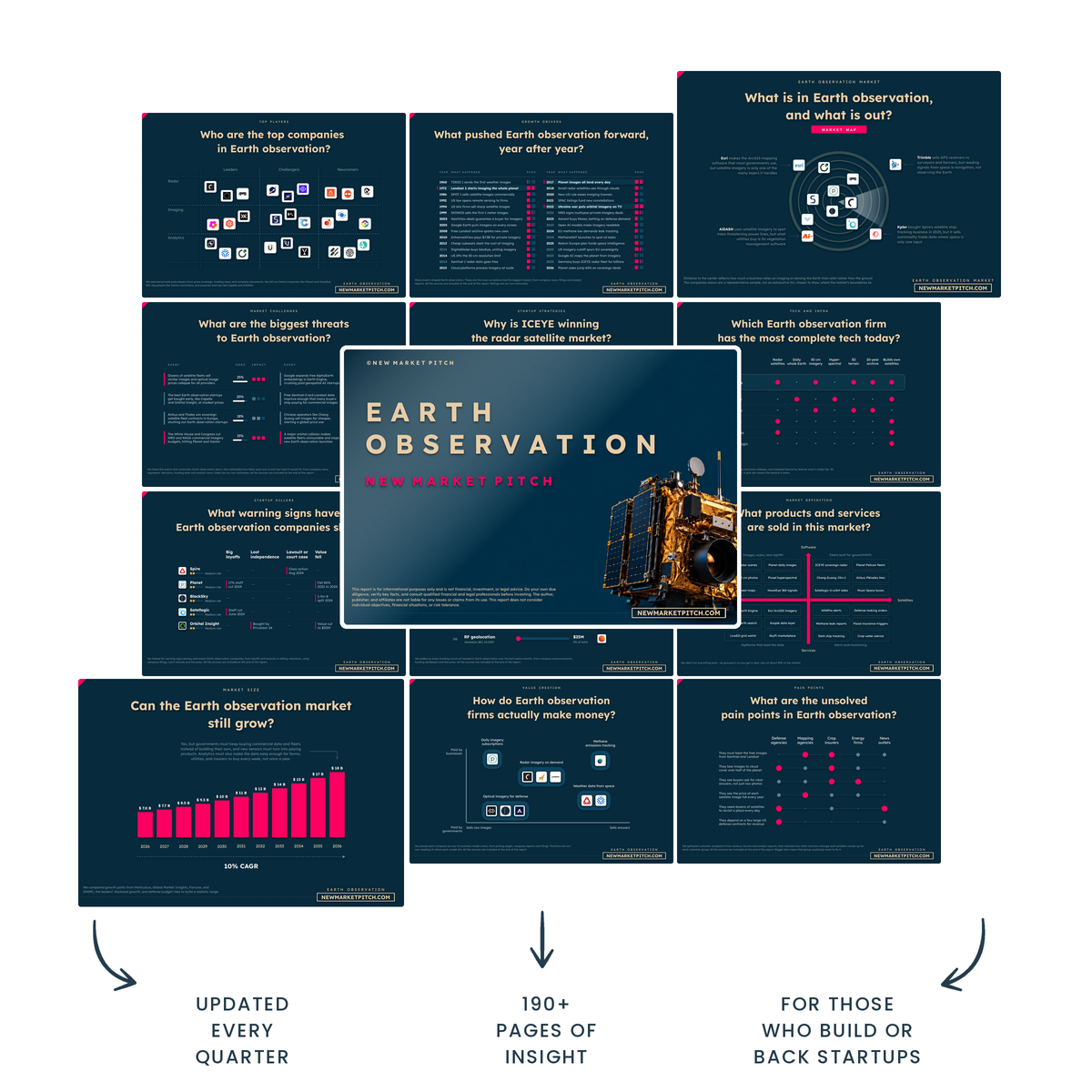
Whether you're building or investing in the Earth observation market, our report covers everything you need to know: the players, the money, and what's coming next.
Summary
Chang Guang Satellite Technology, ICEYE and HawkEye 360 are the best-funded Earth observation companies in our ranking, with approximately $1.07 billion, $956 million and $901 million in identifiable historical equity financing, respectively. Their funding histories include very different types of capital, from private strategic rounds to primary IPO proceeds.
Across the 20 companies examined, 18 have usable numerical funding estimates totaling approximately $6.09 billion. The three leaders account for 48% of that capital, while the six largest companies represent roughly 73%. EOI Space and XpressSAR remain unranked because their qualifying equity totals could not be established.
The biggest fundraising shift came in 2026. Nine identified financing events brought approximately $1.96 billion into the selected companies, with Chang Guang Satellite, ICEYE and HawkEye 360 capturing about 83%. Large satellite-intelligence operators are attracting capital on a completely different scale from smaller sensing specialists.
ICEYE's $520 million Series F is particularly significant because it represents new primary equity invested directly into the company. The wider transaction exceeded €1 billion, but included secondary share sales that cannot be counted as additional corporate funding. ICEYE also reported approximately €250 million in 2025 revenue and a backlog of around €1.5 billion.
Public-market access has become an important source of funding. HawkEye 360 raised $416 million through newly issued IPO shares in May 2026, while Planet Labs, Spire Global, Satellogic and BlackSky have used PIPEs or subsequent share placements. These qualify as equity financing when they create new shares and deliver proceeds to the issuer, but they are economically different from private venture rounds.
Radar and radio-frequency intelligence are drawing exceptional investment because governments need satellite systems that operate through cloud cover, at night or across contested regions. ICEYE and HawkEye 360 illustrate how demand for persistent intelligence can support much larger financing rounds than traditional satellite-data businesses.
Optical imaging has not lost its importance. Chang Guang Satellite's approximately $1.07 billion in reconstructed funding, Planet's $576 million and Satellogic's provisional $423 million show that optical-focused companies still command enormous resources. Radar and optical systems solve overlapping but distinct customer problems.
Company revenue reveals a different hierarchy from fundraising. Planet generated approximately $308 million in fiscal 2026 revenue and reported backlog above $900 million, despite ranking fourth by identified equity. Historical funding shows how much capital a business has attracted, not how successful its current operations are.
Specialized sensing remains investable. Pixxel has raised approximately $195 million according to its latest company disclosure for hyperspectral intelligence, while Hydrosat, Albedo and Array Labs are pursuing thermal observation, ultra-high-resolution imagery and distributed radar. Their funding totals are far smaller, but their products address specific markets that broader constellations may not serve as well.
Earth observation companies are also moving beyond selling imagery. ICEYE, Pixxel, Aerospacelab and BlackSky are developing or delivering satellites, sovereign systems and integrated intelligence services. That expands their potential contract sizes, while adding manufacturing costs and execution risks.
The ranking remains partly provisional because some historical transactions contain debt, secondary sales, SPAC proceeds or overlapping round announcements. Our comparison counts identifiable primary equity, including qualifying IPO and PIPE issuances, but excludes acquisition consideration and unverified financing amounts. On that basis, the clearest conclusion is that Earth observation capital is increasingly concentrated among large strategic operators, while specialists continue to find room to grow.

Written by the New Market Pitch teamWe track new markets so founders and investors can move faster. About us

In our report covering the Earth observation market, you will always find fresh funding data, taken straight from our own verified funding database.
Top startups in the Earth observation market ranked by total funding raised
Here is an updated table that ranks the top startups in the Earth observation market based on the total amount of funding they have raised to date.
The table also includes the total number of funding rounds, the date and size of the latest round, the financing type (e.g. Series A, equity financing), key investors, the startup's current status (active, IPO, acquired, or shut down), and a confidence score based on the data collected (we excluded startups with very low data confidence, to make sure everything is reliable).
If you need to dig deeper and get more detailed data, please check our report covering the Earth observation market.
| # | Startup | What They Do | Total Raised ($) | Total Rounds | Last Round Date | Last Round Amount ($) | Last Round Type | Key Investors | Current Stage | Confidence |
|---|---|---|---|---|---|---|---|---|---|---|
| 1 | Chang Guang Satellite Technology | High-resolution optical Earth observation satellites | $1.1B* | 2+ | July 2026 | ~$690M | Strategic Equity | Changfa Group, Lushi Investment, Chengtong Fund | Active | Partial |
| 2 | ICEYE | SAR satellite imagery and intelligence | $956M* | 7+ | June 2026 | $520M | Series F | General Atlantic, Solidium, Qatar Investment Authority | Active | Partial |
| 3 | HawkEye 360 | Satellite radio-frequency intelligence and analytics | $901M* | 12+ | May 2026 | $416M | IPO | Public investors | IPO | Partial |
| 4 | Planet Labs | Daily global satellite imagery | $576M* | 6+ | December 2021 | $250M | SPAC PIPE | BlackRock, Google, CPP Investments | IPO | Partial |
| 5 | Spire Global | Satellite weather and maritime intelligence | $532M* | 9+ | April 2026 | $70M | Private Placement | Institutional purchasers | IPO | Partial |
| 6 | Satellogic | High-resolution optical satellite imagery | $423M* | 7+ | January 2026 | $35M | Registered Direct Offering | Undisclosed institutional investor | IPO | Partial |
| 7 | BlackSky | Real-time geospatial intelligence and monitoring | $256M* | 3+ | September 2024 | ~$46M | Public Equity Offering | Public investors | IPO | Partial |
| 8 | Capella Space | SAR satellite imaging and intelligence | $234M* | 7+ | January 2023 | $60M | Series C Extension | US Innovative Technology Fund | Acquired | Partial |
| 9 | Pixxel | Hyperspectral satellite imagery and analytics | $198M* | 8 | September 2026 | $100M | Series C | Temasek, Seraphim, 360 ONE Asset | Active | Strong |
| 10 | Synspective | SAR satellite imagery and analytics | ~$195M* | 3+ | June 2024 | ~$44M | Series C | Japan Growth Capital Investment, JAFCO, Mizuho Capital | IPO | Partial |
| 11 | iQPS | High-resolution radar satellite imagery | $168M* | 5+ | March 2026 | ~$97M | Strategic Equity | Mitsui Sumitomo Insurance, Mitsuuroko, SKY Perfect JSAT | IPO | Partial |
| 12 | Aerospacelab | Satellite manufacturing and geospatial intelligence | $134M* | 3+ | August 2025 | ~$66M | Series B Extension | Airbus Ventures, imec.xpand, BNP Paribas Fortis | Active | Partial |
| 13 | Hydrosat | Thermal satellite data and analytics | $107M* | 5+ | September 2026 | $10M | Series B Extension | Suma Capital | Active | Strong |
| 14 | Axelspace | Microsatellites and Earth observation services | $106M* | 4+ | December 2023 | $44M | Series D | SMBC-GB Growth, Global Brain, Keio Innovation Initiative | IPO | Partial |
| 15 | Albedo | Very-high-resolution low-orbit satellite imagery | $93M | 3 | January 2024 | $35M | Series A-1 | Standard Investments, Booz Allen Ventures | Active | Strong |
| 16 | Array Labs | Distributed radar satellite imaging systems | $56M | 4 | July 2026 | $21M | Strategic Equity | Mitsubishi Electric, Catapult Ventures, Kompas VC | Active | Strong |
| 17 | GHGSat | Satellite greenhouse gas emissions monitoring | ≥$55M | 4+ | September 2023 | Undisclosed equity portion | Series C1 | Fonds FTQ, BDC Capital, Investissement Québec | Active | Partial |
| 18 | Umbra | High-resolution SAR satellite imagery | ≥$32M | 4+ | September 2024 | Undisclosed | Venture Equity | Undisclosed investors | Active | Partial |
Funding figures reflect identifiable primary equity transactions as of October 13, 2026. An asterisk (*) indicates an approximate, incomplete, or provisional amount. Figures marked ≥ represent documented minimum funding. Rankings may change as additional financing details become available. Debt, grants, secondary share sales, and acquisition proceeds are excluded. Companies with Low confidence have been omitted.

In our research about Earth observation satellites, we turn what is vague and complex into simple, useful visuals. Market maps like this one show you at a glance where every startup stands.
Which Earth observation startups have raised the most funding?
Chang Guang Satellite Technology, ICEYE and HawkEye 360 currently lead our Earth observation funding ranking, with approximately $1.07 billion, $956 million and $901 million in reconstructed cumulative equity financing, respectively.
Across the 20 companies examined, 18 have usable numerical estimates totaling approximately $6.09 billion. The three leaders account for about 48% of that amount, while the six largest companies represent roughly 73%. These percentages use the itemized estimates rather than rounding Chang Guang Satellite's $1.065 billion to $1.1 billion before calculating the total.
The remaining two companies, EOI Space and XpressSAR, have insufficiently documented equity histories and are unranked. Their absence from the numerical total does not mean they have raised no money.
The leading companies have very different businesses. China's Chang Guang Satellite Technology operates the Jilin-1 optical constellation. Finland's ICEYE specializes in synthetic aperture radar (SAR), which can capture images through clouds and at night. US-based HawkEye 360 detects radio-frequency signals from space for intelligence and security applications.
Planet Labs, Spire Global and Satellogic form the next group, with reported funding between $423 million and $576 million. All three have accessed public capital markets, making their historical financing less directly comparable with companies financed exclusively through private rounds.
The comparison includes newly issued shares sold through qualifying IPOs, SPAC PIPEs and subsequent equity placements. It excludes secondary share sales, debt, acquisition proceeds and SPAC trust proceeds under the narrower accounting convention used here.
| Rank | Earth observation company | Identified cumulative equity | Status |
|---|---|---|---|
| 1 | Chang Guang Satellite Technology | ~$1.065B* | Private |
| 2 | ICEYE | ~$956M* | Private |
| 3 | HawkEye 360 | ~$901M* | Public |
| 4 | Planet Labs | ~$576M* | Public |
| 5 | Spire Global | ~$532M* | Public |
| 6 | Satellogic | ~$423M* | Public |
| 7 | BlackSky | ~$256M* | Public |
| 8 | Capella Space | ~$234M* | Acquired |
| 9 | Pixxel | ~$195–198M* | Private |
| 10 | Synspective | ~$195M* | Public |
*Provisional or approximate historical equity total. Pixxel's company-reported cumulative figure is $195 million, compared with approximately $198 million from individually identified transactions. The complete 18-company comparison includes iQPS, Aerospacelab, Hydrosat, Axelspace, Albedo, Array Labs, GHGSat and Umbra.
Why are Earth observation startups attracting so much investment?
Earth observation startups are attracting major investment because satellite data has become increasingly valuable for defense, national security and government intelligence, alongside established commercial applications such as agriculture and environmental monitoring.
The recent financing figures are striking. ICEYE secured $520 million in primary equity financing in June 2026, Chang Guang Satellite reportedly completed an approximately $690 million strategic financing in July, and HawkEye 360 raised $416 million through its May IPO.
Together, those three transactions represent approximately $1.63 billion in reported new equity financing. They also show where the largest pools of capital are going: radar intelligence, national satellite infrastructure and radio-frequency surveillance.
Commercial applications still attract funding. Pixxel raised $100 million for hyperspectral imaging, while Hydrosat added $10 million to expand thermal satellite intelligence. These technologies serve customers interested in agriculture, industrial monitoring, resource management and environmental risks.
The funding gap between these groups has become substantial. Governments and defense-related customers are helping create opportunities for satellite businesses that can supply entire intelligence systems, while smaller companies often focus on selling specialized data and analytical services.

Your time is limited. In our market report about Earth observation satellites, we put numbers on each part of the market, so you can see where it makes sense to focus.
How much funding has Chang Guang Satellite Technology raised?
Chang Guang Satellite Technology has approximately $1.065 billion in reconstructed cumulative equity funding, putting the Chinese satellite operator at the top of our selected Earth observation ranking.
The company's largest reported recent financing was approximately RMB 5 billion, equivalent to around $690 million, in July 2026. Investors identified in our research include Changfa Group, Lushi Investment and China Chengtong-related capital.
Combined with approximately $375 million in reported financing from November 2020, those two transactions produce an estimated total of $1.065 billion. The July round alone represents about 65% of that reconstructed amount.
The percentage is remarkable, although earlier financing records remain incomplete and the lifetime total should be treated as an estimate. Rounding the cumulative amount to $1.1 billion is reasonable for a headline, but calculations should use the more precise reconstructed figure.
Chang Guang operates the Jilin-1 constellation, which supplies high-resolution optical imagery for applications ranging from land monitoring to infrastructure and environmental observation.
Its investment profile also differs from that of US venture-backed satellite startups. The reported participation of Chinese state-linked and regional strategic investors connects the company's expansion to domestic industrial-development priorities.
Chang Guang's leadership is substantial, but its cumulative funding requires more historical reconciliation than ICEYE's latest disclosed round or HawkEye 360's publicly documented IPO.
Is ICEYE now the best-funded private Earth observation startup outside China?
ICEYE is the strongest candidate for the best-funded private Earth observation company outside China in our research, with approximately $956 million in reconstructed cumulative equity financing.
On June 9, 2026, ICEYE announced a €450 million primary Series F round, equivalent to approximately $520 million. General Atlantic led the investment, joined by Solidium, Qatar Investment Authority, Nokia, TCV and several Finnish institutions.
The round valued ICEYE at more than €10 billion. A secondary share placement brought the wider transaction above €1 billion, although those secondary proceeds did not provide additional operating capital to ICEYE.
The $520 million primary financing represents approximately 54% of ICEYE's reconstructed historical funding, making it by far the company's most important disclosed round.
Earlier rounds account for approximately $436 million of the reconstructed total. Certain 2024 transactions included mixed financing or potentially overlapping amounts, so those amounts have not been added without a reliable equity-only allocation.
ICEYE also has substantial commercial activity behind its fundraising. The Financial Times reported approximately €250 million in 2025 revenue and an order backlog of around €1.5 billion. The company's financing announcement stated that seven European governments had already procured its sovereign satellite systems.
That combination of government customers, revenue and manufacturing capabilities places ICEYE among the most financially advanced private businesses in the sector.

Our document detailing everything you need to know about Earth observation gets updated several times a month, so you always get the latest view of where things stand.
How much money has HawkEye 360 raised, and what changed after its IPO?
HawkEye 360 has raised approximately $901 million in reconstructed cumulative financing, with its $416 million IPO giving the satellite-intelligence company a much larger capital base.
On May 6, 2026, HawkEye 360 priced 16 million shares at $26 each. Its SEC prospectus confirms $416 million in gross offering proceeds, before underwriting costs and other expenses. Trading began on the New York Stock Exchange under the ticker HAWK on May 7.
The IPO accounts for approximately 46% of the company's reconstructed historical funding. The remaining approximately $485 million consists of earlier identified equity rounds, including venture financings, extensions and the equity portion of its Series E.
The distinction is important. Its December 2025 financing headline was $150 million, but that package included debt. Only the approximately $80 million attributed to equity enters our reconstruction, pending final reconciliation.
HawkEye 360 is unusual among Earth observation businesses. Instead of primarily collecting optical or radar images, its satellites detect and locate radio-frequency emissions. These capabilities support applications such as identifying suspicious maritime activity and monitoring electronic signals in areas of security interest.
The flotation showed that public investors were willing to finance this specialized intelligence model on a substantial scale. Its offering valuation was approximately $2.84 billion, according to Seraphim Space Investment Trust's disclosure.
That valuation is separate from the $416 million raised. The first measures the implied value of the company at the offering price; the second measures proceeds from newly issued shares.
HawkEye 360 now has access to public equity markets, though future growth will depend on translating its technology and government relationships into profitable contracts.
Are Earth observation startups raising more money now than before?
Recent Earth observation fundraising has produced some exceptionally large transactions, but the clearest change is that more of the disclosed capital is concentrated in a handful of major companies.
We identified nine latest-round events in the dataset during 2026, representing approximately $1.96 billion in reported primary equity financing. Chang Guang Satellite, ICEYE and HawkEye 360 alone contributed roughly $1.63 billion, or 83% of that amount.
The remaining six transactions were much smaller. Pixxel raised $100 million, iQPS reportedly secured approximately $97 million, Spire raised $70 million, Satellogic obtained $35 million, Array Labs raised $21 million and Hydrosat added $10 million.
Those six transactions represent approximately $333 million, against $1.626 billion for the three largest events. The difference is huge.
The largest companies are receiving financial commitments several times greater than those obtained by smaller specialists, even when the latter have credible technology and commercial customers.
We cannot establish an industry-wide year-over-year increase from a sample of companies selected partly for their fundraising histories. What we can establish is that recent funding among these companies has become heavily concentrated at the top.

In our report covering the Earth observation market, we look at what the winners do differently, so you can learn from the best instead of guessing.
What are the largest recent funding rounds in Earth observation?
The largest recent Earth observation financing events belong to Chang Guang Satellite, ICEYE and HawkEye 360, with reported transactions of approximately $690 million, $520 million and $416 million.
The gap between the largest deals and the rest of the market is enormous. Pixxel's $100 million Series C, announced as India's largest space-technology funding round, was less than one-fifth of ICEYE's latest primary financing.
Spire Global's $70 million private placement and Satellogic's $35 million registered direct offering also show that listed satellite companies continue raising new equity after their initial market debuts.
Hydrosat's $10 million Series B extension sits at the other end of the sample. The company is expanding an existing thermal satellite business rather than financing a multibillion-dollar sovereign intelligence platform.
| Company | Recent financing | Announcement date | Financing type |
|---|---|---|---|
| Chang Guang Satellite | ~$690M* | July 2026 | Strategic equity |
| ICEYE | $520M | June 2026 | Series F |
| HawkEye 360 | $416M | May 2026 | Primary IPO shares |
| Pixxel | $100M | September 2026 | Series C |
| iQPS | ~$97M* | March 2026 | Strategic equity |
| Spire Global | $70M | April 2026 | Private placement |
| Satellogic | $35M | January 2026 | Registered direct offering |
| Array Labs | $21M | July 2026 | Strategic equity |
| Hydrosat | $10M | September 2026 | Series B extension |
*Approximate transactions requiring final reconciliation of the attributable primary equity proceeds. The nine reported amounts sum to approximately $1.959 billion.
All nine events are included as reported primary-equity financing, including HawkEye 360's IPO. A completed IPO offering of newly issued shares brings money into the company just as a private capital increase does, although pricing, liquidity and investor participation differ considerably.
Why are radar satellite startups attracting so much funding?
Radar satellite startups are attracting large investments because their satellites can observe the Earth through clouds and at night, capabilities that are especially useful for military intelligence and continuous monitoring.
ICEYE is the clearest example, with nearly $1 billion in reconstructed historical funding and a primary Series F valued at $520 million. Its expansion includes supplying sovereign satellite systems rather than relying entirely on selling individual images.
Japan's Synspective has pursued another approach, developing the StriX radar satellite series and establishing a manufacturing facility intended to support a 30-satellite constellation by the late 2020s. The company listed on the Tokyo Stock Exchange in December 2024.
Capella Space developed high-resolution radar imaging before IonQ acquired it in July 2025. Meanwhile, Array Labs raised $21 million in July 2026 to advance satellite-based tracking technology with Mitsubishi Electric.
Adding ICEYE, Synspective, Capella, iQPS, Umbra and Array Labs gives approximately $1.64 billion in reconstructed historical financing across radar-related operators in our dataset. That total includes roughly $32 million of clearly identified equity for Umbra, rather than disputed additional rounds.
Radar has become one of the industry's most heavily financed technology groups. The strongest commercial opportunities involve persistent intelligence, defense applications and dedicated government systems.

Learning from others' mistakes is the cheapest lesson there is. In our research about Earth observation satellites, we look at what broke startups before you, so you don't repeat it.
Are optical Earth observation startups losing ground to radar companies?
Optical Earth observation companies remain major funding recipients, despite radar startups gaining attention for defense and all-weather intelligence applications.
Chang Guang Satellite leads the entire selected ranking with approximately $1.065 billion in reconstructed funding. Planet Labs has raised approximately $576 million, and Satellogic has approximately $423 million in provisional historical financing.
Those three optical-focused businesses alone account for roughly $2.06 billion, exceeding the combined reported funding of the six radar-related companies examined above.
The companies compete in different parts of the optical market. Planet specializes in broad geographic coverage and frequent observations. Satellogic supplies high-resolution imagery, while Chang Guang is building substantial constellation capacity in China.
Albedo is pursuing an even more specialized approach: very-high-resolution imagery from very low Earth orbit. Its January 2024 $35 million financing supported technology intended to deliver image detail approaching that of aerial photography.
Optical systems remain valuable for agriculture, mapping, infrastructure monitoring and many intelligence applications. Radar adds capabilities that optical sensors cannot provide reliably under poor visibility conditions.
The investment data suggests these technologies will continue developing alongside each other, with customers choosing according to resolution, coverage, observation frequency and operating conditions.
Is Planet Labs still one of the biggest Earth observation companies?
Planet Labs remains one of the industry's biggest commercial Earth observation businesses, even though ICEYE, HawkEye 360 and Chang Guang Satellite have overtaken it in reconstructed cumulative fundraising.
Planet's identified historical subtotal is approximately $576 million, including the $250 million PIPE associated with its December 2021 public listing.
The company's separately reported pre-SPAC equity total of approximately $384 million exceeds the $326.1 million reconstructed from individually listed private rounds. The difference of about $58 million has not been added without reconciling the underlying transactions. SPAC trust proceeds are also excluded under our accounting convention.
Planet's operating figures offer a more useful measure of the company's current scale. For the fiscal year ended January 31, 2026, Planet reported record revenue of $308 million, compared with approximately $244 million the previous year. That represents growth of about 26%.
Planet also reported $852 million in remaining performance obligations and backlog exceeding $900 million. Backlog rose approximately 79% year over year.
These numbers show that Planet has moved well beyond its original startup financing phase. It is generating hundreds of millions of dollars in annual revenue and has a substantial pipeline of contracted business.
ICEYE has a larger reconstructed fundraising total and a rapidly growing government-intelligence business. Planet, meanwhile, provides stronger public visibility into its financial performance.
Planet remains a major competitor because of its established operations and customer relationships, not because of where it appears in a historical funding ranking.

If you build or invest in the Earth observation market, you need to know which business models pay off now and which ones are fading. That's why our report covering it has a whole section on it.
Which Earth observation startups have gone public?
Planet Labs, Spire Global, Satellogic, BlackSky, HawkEye 360, Synspective, iQPS and Axelspace are among the Earth observation businesses that have accessed public equity markets.
Their listings happened through different routes and at different stages of market development. Planet, Spire, Satellogic and BlackSky entered public markets during the earlier commercial-space listing wave.
Japanese operators followed another trajectory. Synspective joined the Tokyo Stock Exchange Growth Market in December 2024, and Axelspace Holdings listed in August 2025.
HawkEye 360's $416 million IPO in May 2026 was a particularly large recent offering for a specialized satellite-intelligence company.
Public status also enables companies to raise further equity through subsequent transactions. Spire completed a $70 million private placement in April 2026, while Satellogic closed a $35 million registered direct offering in January.
There is an important accounting distinction between these events. An IPO contributes to cumulative funding only to the extent that newly issued shares generate proceeds for the company. Sales of existing shares by shareholders do not. A SPAC PIPE can also qualify, while gross merger consideration, acquisition values and stock-market valuations do not represent equivalent amounts of new financing.
A successful stock-market listing does not guarantee a successful long-term investment. Companies can access public markets while still needing substantial capital for satellites, manufacturing and working capital.
Still, these examples establish that Earth observation businesses have financing options extending beyond venture capital and strategic private investors.
Which Earth observation startups are leading hyperspectral imaging?
Pixxel is the clearest fundraising leader in hyperspectral Earth observation within our dataset, having raised $100 million in Series C financing and reached $195 million in company-reported cumulative funding.
On September 7, 2026, Pixxel announced that Temasek and Seraphim had co-led the round. Additional investors included 360 ONE Asset, IMM Investment and existing backers.
The individually identified financing events total approximately $197.98 million, compared with the company's reported $195 million. The roughly $3 million difference may reflect rounding, historical classifications or overlapping transactions. We retain both numbers rather than forcing a false match.
The company originally focused on hyperspectral imagery, which analyzes light across many spectral bands to identify material and environmental characteristics that ordinary optical images may miss.
Its latest financing also supports a broader business. Pixxel is developing Earth intelligence software, sovereign satellite systems and manufacturing capabilities alongside its sensing technology.
The $100 million Series C represents approximately 51% of the company's stated lifetime funding. That's a large jump in available capital.
Pixxel also announced a strategic commercial-enhancement contract with the US National Reconnaissance Office in May 2026, providing an additional example of hyperspectral imaging's relevance to government customers.
Among the specialized sensing companies we examined, Pixxel has attracted unusually large financing and is moving toward a wider set of products and customers.

In our document detailing everything you need to know about Earth observation, we like to show you the big picture. We know your time is precious, so we make every page quick to read and packed with as much learning as possible per minute.
How much funding is going into climate-focused Earth observation startups?
Hydrosat and GHGSat are two of the most relevant funded companies focused on environmental satellite intelligence, with approximately $100 million to $107 million and at least $55 million in identifiable equity financing, respectively.
Hydrosat raised $60 million in Series B financing earlier in 2026 and announced an additional $10 million investment from Suma Capital in September.
Its directly itemized funding rounds total $100 million. Including an inferred approximately $7 million Series A expansion brings the estimate to $107 million, although that additional component could overlap earlier financing descriptions.
The company uses thermal satellite data to monitor agricultural water stress, irrigation and environmental conditions. Its IrriWatch platform serves more than 90 customers across over 70 countries, according to its September funding announcement.
GHGSat focuses on greenhouse gas emissions, particularly methane detection. In September 2023, it announced a $44 million Series C1 containing both debt and equity. The company disclosed more than $126 million in total financing at the time, but that broader figure cannot be treated entirely as equity.
Combined, the two companies represent at least $155 million in directly itemized qualifying equity, or approximately $162 million when Hydrosat's inferred additional financing is included.
Their commercial opportunities are distinct. Hydrosat addresses water use and temperature-related intelligence, while GHGSat serves companies and institutions seeking emissions measurements.
These businesses attract less disclosed capital than the largest defense-related operators, yet both are building services around recurring environmental information needs.
Who are the biggest investors in Earth observation startups?
General Atlantic, Temasek, Seraphim, Qatar Investment Authority and several national or industrial investment groups are among the most prominent investors appearing in major Earth observation financing rounds.
General Atlantic led ICEYE's $520 million primary Series F, with participation from Qatar Investment Authority, Solidium, Nokia and other institutions.
Temasek and Seraphim co-led Pixxel's $100 million Series C, while 360 ONE Asset and IMM Investment joined the round.
Industrial participation has also become increasingly visible. Mitsubishi Electric invested $10 million in Array Labs in July 2026, alongside an agreement to develop satellite-based tracking services.
Hydrosat attracted $10 million from Suma Capital, while GHGSat has received backing from Fonds de solidarité FTQ, BDC Capital and Investissement Québec.
These investors have different objectives. Sovereign investors help finance strategically important infrastructure, specialist funds back emerging space technologies, and industrial groups can provide manufacturing expertise and customer relationships alongside capital.
| Investor | Company | Documented involvement | Investor type |
|---|---|---|---|
| General Atlantic | ICEYE | Led $520M Series F | Growth equity |
| Qatar Investment Authority | ICEYE | Series F participant | Sovereign investor |
| Solidium | ICEYE | Series F participant | State-owned investment |
| Temasek | Pixxel | Co-led $100M Series C | Global investment |
| Seraphim | Pixxel | Co-led $100M Series C | Space investment |
| Mitsubishi Electric | Array Labs | Invested $10M | Industrial strategic |
| Suma Capital | Hydrosat | Invested $10M | Climate and growth |
| Standard Investments | Albedo | Led $35M Series A-1 | Private investment |
| BDC Capital | GHGSat | Series C1 participant | Development capital |

When you build or invest in the Earth observation market, you need clarity, not confusion. In our report covering the Earth observation market, we always try to put numbers on and quantify whatever is usually vague and confusing.
Is defense spending becoming the main driver of Earth observation funding?
Defense and national-security applications are driving some of the largest recent Earth observation investments, particularly in radar, signals intelligence and sovereign satellite systems.
ICEYE's June financing announcement identified seven European governments that had already procured sovereign satellite systems. HawkEye 360 specializes in signals intelligence, while Array Labs is developing satellite-based tracking applications with Mitsubishi Electric for defense and security customers.
Industrial partnerships strengthen this pattern. Mitsubishi Electric's investment combines financing with access to defense manufacturing experience and established customer relationships in Asia-Pacific.
BlackSky provides another example of the growing importance of government-related services. Its 2025 annual results reported $106.6 million in revenue, including activity tied to satellite deliveries and mission solutions.
The change extends beyond purchasing imagery. Some customers now want dedicated satellites, secure systems and integrated intelligence capabilities.
Government demand can support large contracts, but it also brings procurement delays, export restrictions and dependence on national budgets.
Our dataset shows defense-related companies dominating several of the largest recent financings. It does not establish that defense accounts for most Earth observation industry revenue worldwide, since complete comparable revenue data are unavailable.
Which countries have the best-funded Earth observation startups?
China, Finland and the United States have the strongest individual fundraising leaders in our selected Earth observation dataset, while Japan and India have built notable companies in radar and hyperspectral imaging.
China's Chang Guang Satellite leads with approximately $1.065 billion in reconstructed funding, followed by Finland's ICEYE at $956 million.
The United States has a broader group of funded operators, including HawkEye 360, Planet Labs, Spire Global, BlackSky, Albedo, Array Labs and Umbra. Satellogic, originally founded in Argentina, is also publicly listed in the United States.
India's Pixxel has reached $195 million in company-reported funding after its September Series C, giving India a prominent company in advanced spectral sensing.
Japan is particularly active in radar and satellite services. Synspective has approximately $195 million in indicative pre-IPO equity financing, iQPS around $168 million in identified placements excluding unreconciled IPO proceeds, and Axelspace approximately $106 million in reconstructed private equity funding.
Funding structures also vary across these markets. China relies heavily on domestic strategic capital, European operators attract international growth and sovereign investors, and Japan has developed a route to local public listings.
The figures identify important national ecosystems, although a broader set of companies would be required to rank entire countries by total Earth observation investment.

A good product starts with a real problem. In our research about Earth observation satellites, we show you the ones customers still live with.
Are Japanese Earth observation startups catching up with ICEYE and US competitors?
Japan's Earth observation industry is making meaningful progress, but its leading startups remain substantially smaller than ICEYE in reconstructed cumulative funding.
Synspective, iQPS and Axelspace together account for approximately $469 million in our dataset. ICEYE alone has raised about $956 million, roughly twice their combined historical financing.
These figures are not fully like-for-like. Synspective's estimate largely reflects a company-reported pre-IPO equity aggregate, while iQPS and Axelspace have public-listing proceeds that are not fully incorporated into their reconstructed totals.
Japanese companies have nevertheless achieved important milestones. Synspective listed on the Tokyo Stock Exchange in December 2024, following the opening of a production facility intended to support its planned 30-satellite radar constellation.
Axelspace Holdings went public in August 2025. Its business combines microsatellite development services through AxelLiner with Earth observation data supplied through AxelGlobe.
iQPS has also developed radar satellite capabilities and accessed public financing, with approximately $97 million in strategic equity attributed to March 2026 in our data.
Japan's progress extends beyond a single company. It now has several publicly traded satellite operators working across radar imaging, satellite manufacturing and data services.
ICEYE still has a much larger financial base, especially following its recent Series F. Japanese operators have established credible technologies and public-market access, but have not yet matched the leading European radar company's fundraising scale.
Are Earth observation startups becoming satellite manufacturers instead of data providers?
Several major Earth observation companies are expanding into satellite manufacturing and dedicated infrastructure because customers increasingly want complete systems alongside access to data.
ICEYE already supplies sovereign radar satellite systems to European governments. Its business includes more than operating its own constellation and selling imagery.
Pixxel's September financing announcement described expansion into satellite manufacturing, sovereign systems and Earth intelligence software.
Aerospacelab, with approximately $134 million in reconstructed historical funding, combines spacecraft manufacturing with geospatial intelligence services. Axelspace follows a comparable dual-business approach through AxelLiner and AxelGlobe.
BlackSky is also generating revenue from mission solutions. Its fourth-quarter 2025 results showed that satellite-delivery contracts contributed to a 16% year-over-year increase in quarterly revenue.
Customers can purchase dedicated spacecraft, specialized technology and ongoing intelligence services from related providers. That potentially means much larger contracts than conventional imagery subscriptions alone.
The economics vary, though. Manufacturing contracts require hardware investment and delivery capacity, while recurring data services have different revenue and cost structures.
Companies capable of combining both may win larger customer contracts, provided they can manage the additional operational complexity.

In our market report about Earth observation satellites, we try to remove everything that could confuse you, especially if you're investing or building in this market.
What happened to Capella Space after raising $234 million?
Capella Space was acquired by IonQ in July 2025 after developing radar-imaging capabilities and accumulating approximately $234 million in reconstructed historical equity financing.
IonQ's annual SEC filing records total acquisition consideration of approximately $424.8 million. The transaction consisted of about $376.5 million in stock and $48.3 million in cash.
That purchase price was approximately 1.8 times Capella's reconstructed cumulative funding, although this ratio does not reveal the returns earned by individual investors.
Capella's technology also had an unusual strategic appeal. IonQ plans to integrate the company's satellite infrastructure into its work on space-based quantum-secure communications.
The acquisition brought Capella into a business with a different long-term technological focus from conventional commercial Earth observation.
For investors, the transaction demonstrates that satellite assets can attract buyers seeking valuable infrastructure, engineering expertise or capabilities beyond imagery sales.
Its $424.8 million purchase consideration must remain separate from the funding ranking. An acquisition transfers ownership of an existing business, while primary equity financing provides new capital to the company.
Can smaller Earth observation startups compete with ICEYE and Planet Labs?
Smaller Earth observation startups can still become major competitors in specialized markets, even when they have raised a fraction of the capital available to ICEYE or Planet Labs.
Albedo has raised approximately $93 million in identifiable equity and is developing exceptionally high-resolution satellite imagery. Array Labs has around $56 million and is building distributed radar capabilities, while Hydrosat has approximately $100 million in directly itemized financing, potentially reaching $107 million when an additional inferred transaction is included.
Together, these three businesses represent approximately $249 million to $256 million in reconstructed historical funding, equivalent to roughly half of ICEYE's latest $520 million primary financing.
Their competitive opportunities are narrower but potentially attractive. Albedo targets customers requiring fine image detail, Array Labs is pursuing satellite-based moving-target tracking, and Hydrosat helps customers monitor temperature and water stress.
Larger companies have advantages in manufacturing capacity, satellite deployments and financing flexibility. Smaller companies can compete where their sensors or analytical capabilities solve problems that broader constellations do not address as effectively.
For now, the most credible route for these specialists is to win a well-defined customer market before attempting to expand into additional services.
In our document detailing everything you need to know about Earth observation, you will always find fresh funding data, taken straight from our own verified funding database.
Will the best-funded Earth observation startups dominate the market?
The best-funded Earth observation companies are likely to remain powerful competitors, but fundraising leadership alone will not decide who wins across the entire industry.
Chang Guang Satellite, ICEYE and HawkEye 360 collectively account for approximately 48% of the reconstructed equity funding in our 18-company numerical comparison. Their financial scale gives them substantial resources to develop satellites, manufacturing systems and customer relationships.
Yet their technologies serve different purposes. Chang Guang concentrates on optical observation, ICEYE specializes in radar, and HawkEye 360 detects radio-frequency signals.
Planet Labs illustrates why commercial scale also matters. Its $308 million in fiscal 2026 revenue and backlog above $900 million show substantial business activity, despite its lower position in the cumulative funding ranking.
As seen above, smaller specialists are also attracting capital for capabilities that larger providers may not offer in the same form, including hyperspectral, thermal and advanced radar-based tracking technologies.
The strongest companies will be those that can turn financing into dependable satellite operations, recurring contracts and attractive economics.
Earth observation funding is becoming concentrated among a few large strategic operators, especially in defense and sovereign intelligence. Those companies have a considerable advantage, but the market still leaves room for specialized businesses with differentiated technology and paying customers.
Our methodology
This Earth observation market analysis ranks the original 20 companies selected for the research, using information available through October 13, 2026. We reconstructed identifiable equity fundraising histories, compared financing structures and assessed how capital is distributed across optical imaging, radar, radio-frequency intelligence and specialized Earth observation applications.
The ranking covers primary equity capital received by companies, including venture rounds, strategic share placements, primary PIPE transactions and newly issued shares sold through IPOs or subsequent public offerings. Debt, grants, unconverted convertible instruments, government contracts, secondary share sales and acquisition consideration are excluded. For SPAC transactions, we count identifiable PIPE funding but exclude SPAC trust proceeds under the consistent narrower convention applied throughout this comparison.
For each company, we reviewed reported round dates, amounts, financing types and investors, then reconstructed cumulative funding from identifiable transactions. We distinguished individually verified rounds from company-reported aggregates, provisional estimates and mixed financing packages. Historical financing events were retained because the ranking measures cumulative funding rather than capital raised only in 2026.
The numerical comparison includes 18 companies with usable estimates, totaling approximately $6.087 billion. This calculation uses approximately $1.065 billion for Chang Guang Satellite rather than substituting its rounded $1.1 billion headline. Doing so keeps the funding total, 48% top-three concentration and 73% top-six concentration internally consistent. EOI Space and XpressSAR remain outside the numerical ranking because their qualifying equity amounts are undetermined.
Primary IPO proceeds are included because they provide new capital to the issuer, but we distinguish them from private financing when interpreting fundraising leadership. HawkEye 360's $416 million primary IPO is counted alongside its earlier equity rounds; ICEYE's secondary share sales are excluded; and Capella Space's acquisition consideration is treated separately. For listed companies with incompletely reconciled public transactions, the displayed totals represent identified equity rather than comprehensive lifetime capital received.
We assessed funding concentration using the reconstructed company totals and recent 2026 transactions. The nine reported 2026 events total approximately $1.959 billion, including primary public offerings and placements. These observations describe the selected companies, not a complete global census of Earth observation financing.
Our source hierarchy prioritizes regulatory filings, securities-exchange disclosures, company financing announcements and investor confirmations, supplemented by established financial reporting. Key sources include ICEYE's Series F announcement, General Atlantic's investment confirmation, HawkEye 360's SEC IPO prospectus, Pixxel's Series C announcement, and Planet Labs' financial results.
Additional transaction and operating evidence comes from Spire Global's SEC filing, Satellogic's registered direct offering announcement, BlackSky's annual results, Hydrosat's Series B extension, Mitsubishi Electric's Array Labs investment disclosure, Synspective's exchange listing announcement, Axelspace's listing announcement, IonQ's SEC acquisition filing, and GHGSat's Series C1 disclosure.
All funding amounts are expressed in US dollars, with historical currency conversions treated as approximate when original transactions were denominated in euros, yen or renminbi. Figures marked as provisional reflect differences in disclosure dates, historical classifications or round-level attribution. We preserve those distinctions rather than combining unrelated financing categories into a deceptively precise total.
In our report covering the Earth observation market, we turn what is vague and complex into simple, useful visuals. Market maps like this one show you at a glance where every startup stands.
Written by the New Market Pitch teamWe track new markets so founders and investors can move faster. About us