What are the most valuable energy storage startups?
Whether you're building or investing in the energy storage market, our report covers everything you need to know: the players, the money, and what's coming next.
Summary
Base Power is the most valuable energy storage startup in our ranking, at $13B, followed by a group of multibillion-dollar battery manufacturers and technology companies including Group14 Technologies ($4.2B–$5.4B), SVOLT Energy Technology ($3.2B–$4.5B), Verkor ($3.4B–$4.2B) and Hithium ($3.0B–$4.2B).
The striking feature of energy storage valuations is how differently investors price the same underlying opportunity. Base Power commands a much higher valuation through residential electricity services, while Hithium has shipped more than 200 GWh of batteries and is valued at a fraction of that amount.
China's battery manufacturers have a major scale advantage, but increasingly fierce competition limits the valuation premium they can capture. Chinese battery packs averaged $84/kWh in 2025, and stationary-storage packs globally fell to just $70/kWh, creating a difficult pricing environment for new battery technologies.
Europe's storage investment boom is moving decisively toward large projects. The continent installed 36 GWh of battery capacity in 2025, up 48%, with utility-scale systems overtaking residential installations as the largest source of annual growth.
Residential storage presents a more complicated picture. EU household battery installations fell 6% in 2025, yet companies combining home batteries with electricity retailing and virtual power plants continue to attract high valuations because they can earn revenue beyond the initial equipment sale.
AI data centers are opening another market for energy storage. The International Energy Agency projects data center electricity consumption reaching 950 TWh by 2030, supporting demand for everything from short-duration backup batteries to multiday iron-air storage and industrial thermal systems.
Alternative battery technologies are attracting substantial capital, but cheap lithium iron phosphate batteries are raising the competitive bar. Sodium-ion, metal-hydrogen, iron-air and flow batteries will need to deliver clear advantages in cost, duration, safety or operating performance to justify their valuations.
Funding requirements vary enormously across the industry. Battery manufacturers such as Form Energy and Sila have raised billions for industrial expansion, while software companies such as ACCURE Battery Intelligence can develop their products with tens of millions. Project financing and venture equity also need to be treated separately.
The downside can be brutal. Our Next Energy, once valued at $1.2B, has fallen to approximately $22M–$30M after successive financings repriced its equity. Its roughly 98% decline shows how quickly manufacturing problems and capital requirements can overwhelm an attractive technology story.
The energy storage market has genuine momentum, with global battery additions reaching 108 GW in 2025, up 40%. The startups best positioned to defend their valuations are those converting that demand into recurring revenue, competitive production costs, operating cash flow and businesses that can grow without constant injections of new capital.

Written by the New Market Pitch teamWe track new markets so founders and investors can move faster. About us

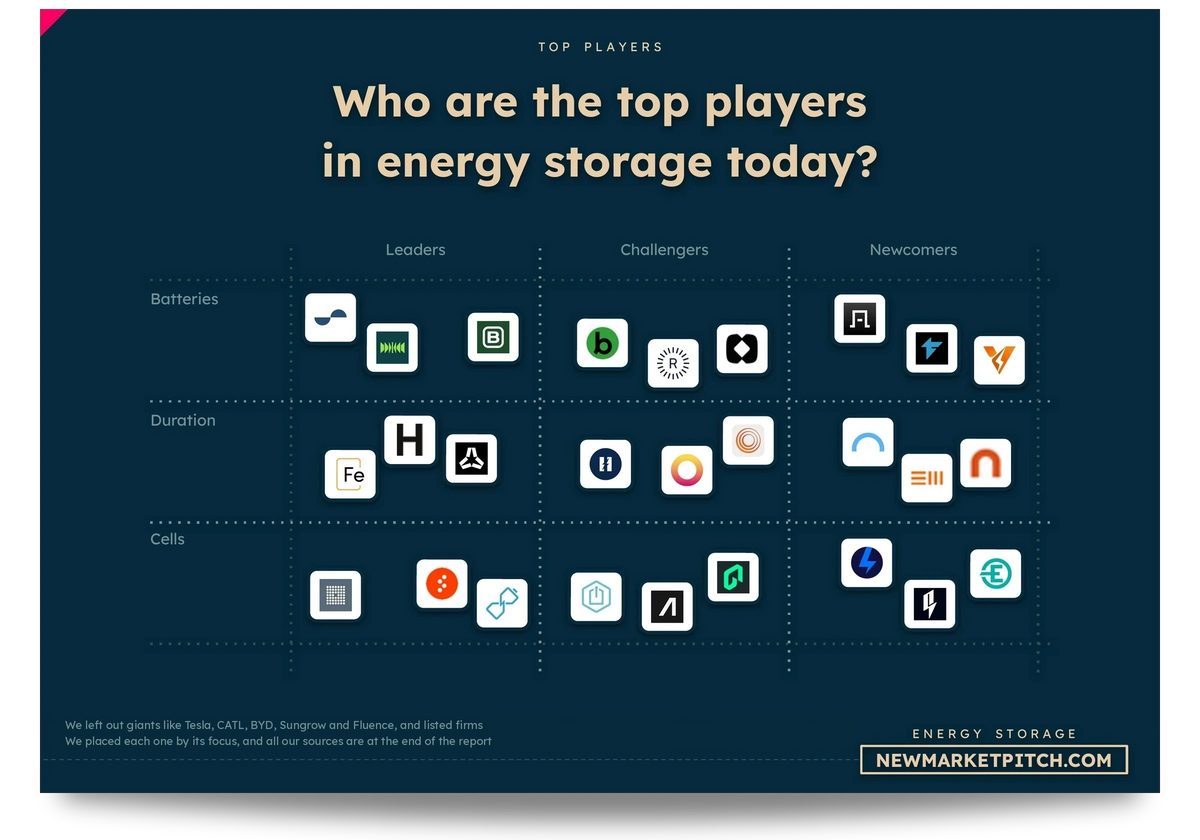
In our report covering the energy storage market, we turn what is vague and complex into simple, useful visuals. Market maps like this one show you at a glance where every startup stands.
Top startups in the energy storage market ranked by valuation
Here is an updated table that ranks the top startups in the energy storage market based on their latest reported or estimated valuations.
If you need to dig deeper and get more detailed data, please check our report covering the energy storage market.
| # | Startup Name | What They Do | Current Valuation ($) | Valuation Confidence Level | Valuation Type | Evidence Status | Total Funding ($) | Funding Confidence Level | Country |
|---|---|---|---|---|---|---|---|---|---|
| 1 | Base Power | Residential batteries and virtual power plants | $13B | Strong Confidence | Implied Valuation from Raise | Estimated | $2.27B | - | United States |
| 2 | Group14 Technologies | Silicon battery anode materials | $4.2B–$5.4B | Strong Confidence | Implied Valuation from Raise | Estimated | ≥$1.1B | Strong Confidence | United States |
| 3 | Torus | Hybrid flywheel battery systems | $4.0B | Strong Confidence | Implied Valuation from Raise | Estimated | ~$393M | - | United States |
| 4 | SVOLT Energy Technology | EV and stationary battery manufacturing | $3.2B–$4.5B | Partial Confidence | Comparables-Based Estimate | Estimated | ~$3.2B | Partial Confidence | China |
| 5 | ProLogium | Solid-state lithium ceramic batteries | $3.8B | Strong Confidence | IPO or Listing Range Valuation | Observed | ≥$426M | Partial Confidence | Taiwan |
| 6 | Verkor | Low-carbon lithium-ion battery cells | $3.4B–$4.2B | Partial Confidence | Comparables-Based Estimate | Estimated | $1.0B+ | Partial Confidence | France |
| 7 | Hithium | Utility-scale battery storage systems | $3.0B–$4.2B | Partial Confidence | Comparables-Based Estimate | Estimated | ≥$899M | Partial Confidence | China |
| 8 | Form Energy | Iron-air multiday grid batteries | $2.5B–$2.7B | Strong Confidence | Implied Valuation from Raise | Estimated | $2.0B+ | Strong Confidence | United States |
| 9 | Antora Energy | Industrial thermal batteries and power | $2.3B–$2.7B | Strong Confidence | Implied Valuation from Raise | Estimated | ≥$750M | Strong Confidence | United States |
| 10 | Sila Nanotechnologies | Silicon battery anode materials | $2.33B | Strong Confidence | Implied Valuation from Raise | Estimated | ≥$1.6B | Partial Confidence | United States |
| 11 | Zenobē Energy | Battery storage and fleet electrification | $1.4B–$2.1B | Partial Confidence | Comparables-Based Estimate | Estimated | $1.3B+ | Partial Confidence | United Kingdom |
| 12 | Lyten | Lithium-sulfur batteries and materials | $1.2B–$2.2B | Low Confidence | Comparables-Based Estimate | Estimated | $625M+ | - | United States |
| 13 | Plus Power | Utility-scale battery storage projects | $1.3B–$2.1B | Low Confidence | Comparables-Based Estimate | Estimated | $3B+1 | - | United States |
| 14 | Return | European grid-scale battery storage | $1.2B–$1.8B | Partial Confidence | Implied Valuation from Raise | Implied | ~$650M+ | - | Netherlands |
| 15 | Jupiter Power | Utility-scale battery storage projects | $1.1B–$1.9B | Partial Confidence | Comparables-Based Estimate | Estimated | $3B+1 | - | United States |
| 16 | Fidra Energy | Utility-scale battery storage development | $1.0B–$1.8B | Low Confidence | Comparables-Based Estimate | Estimated | $1.3B+1 | - | United Kingdom |
| 17 | EnerVenue | Metal-hydrogen stationary storage batteries | $1.1B–$1.6B | Partial Confidence | Implied Valuation from Raise | Implied | $745M | Partial Confidence | United States |
| 18 | 24M Technologies | Advanced lithium battery manufacturing technology | $1.1B–$1.4B | Partial Confidence | Comparables-Based Estimate | Estimated | $500M+ | - | United States |
| 19 | CMBlu Energy | Organic flow batteries for grids | $1.16B+ | Strong Confidence | Implied Valuation from Raise | Estimated | ~$198M–$257M | - | Germany |
| 20 | Highview Power | Liquid-air energy storage systems | $850M–$1.3B | Partial Confidence | Implied Valuation from Raise | Implied | Undisclosed | Low Confidence | United Kingdom |
| 21 | EcoFlow | Portable power and home batteries | $800M–$1.3B | Partial Confidence | Comparables-Based Estimate | Estimated | ~$117M | - | China |
| 22 | Nyobolt | Ultra-fast-charging battery technology | $950M–$1.1B | Strong Confidence | Implied Valuation from Raise | Estimated | ~$159M | - | United Kingdom |
| 23 | esVolta | Utility-scale battery asset ownership | $750M–$1.3B | Low Confidence | Comparables-Based Estimate | Estimated | $525M1 | - | United States |
| 24 | Skeleton Technologies | Supercapacitors and power systems | $1.0B+ | Strong Confidence | Implied Valuation from Raise | Estimated | ~$600M+ | - | Estonia |
| 25 | Nexeon | High-performance silicon battery anodes | $890M–$1.1B | Partial Confidence | Implied Valuation from Raise | Implied | ~$457M | - | United Kingdom |
| 26 | terralayr | Virtualized grid battery capacity | $750M–$1.1B | Partial Confidence | Implied Valuation from Raise | Implied | ~$404M1 | - | Switzerland |
| 27 | Green Flexibility | German grid-scale battery projects | $700M–$1.1B | Partial Confidence | Comparables-Based Estimate | Estimated | ~$430M1 | - | Germany |
| 28 | NineDot Energy | Community-scale urban battery storage | $700M–$1.1B | Partial Confidence | Comparables-Based Estimate | Estimated | $225M+ | - | United States |
| 29 | Field | European battery storage infrastructure | $650M–$1.1B | Partial Confidence | Comparables-Based Estimate | Estimated | $670M+1 | - | United Kingdom |
| 30 | Peak Energy | Sodium-ion grid storage systems | $720M–$1.0B | Partial Confidence | Implied Valuation from Raise | Implied | ~$173M | - | United States |
| 31 | Hydrostor | Compressed-air energy storage projects | $650M–$950M | Partial Confidence | Implied Valuation from Raise | Implied | Undisclosed | Partial Confidence | Canada |
| 32 | Lunar Energy | Residential batteries and VPP software | $680M–$900M | Strong Confidence | Implied Valuation from Raise | Implied | $532M | - | United States |
| 33 | China Storage Guoneng | Compressed-air long-duration energy storage | $650M–$850M | Partial Confidence | Comparables-Based Estimate | Estimated | ≥$140M | - | China |
| 34 | FlexGen | Battery integration and management software | $550M–$950M | Partial Confidence | Comparables-Based Estimate | Estimated | $361M | - | United States |
| 35 | GridStor | Grid-scale battery storage developer | $550M–$850M | Partial Confidence | Comparables-Based Estimate | Estimated | $390M1 | - | United States |
| 36 | Peregrine Energy Solutions | Utility-scale battery storage assets | $550M–$850M | Partial Confidence | Comparables-Based Estimate | Estimated | $1B+1 | - | United States |
| 37 | Dalian Rongke Power | Utility-scale vanadium flow batteries | $550M–$825M | Partial Confidence | Comparables-Based Estimate | Estimated | ≥$170M | - | China |
| 38 | Blue Current | Silicon-based solid-state battery cells | $500M–$850M | Partial Confidence | Implied Valuation from Raise | Implied | $150M+ | - | United States |
| 39 | GIGA Storage | European grid-scale battery development | $450M–$850M | Low Confidence | Comparables-Based Estimate | Estimated | $854M1 | - | Netherlands |
| 40 | Convergent Energy and Power | Grid battery project development and operations | $450M–$800M | Low Confidence | Proxy-Based Estimate | Estimated | $597M1 | - | United States |
| 41 | ZincFive | Nickel-zinc backup battery systems | $600M | Strong Confidence | IPO or Listing Range Valuation | Estimated | ~$254M | - | United States |
| 42 | Energy Dome | Carbon-dioxide long-duration energy storage | $450M–$750M | Partial Confidence | Revenue or ARR Multiple Estimate | Estimated | ~$230M+ | - | Italy |
| 43 | Spearmint Energy | Utility-scale battery storage projects | $400M–$700M | Low Confidence | Comparables-Based Estimate | Estimated | $900M+1 | - | United States |
| 44 | Rondo Energy | Industrial thermal heat batteries | $450M–$650M | Partial Confidence | Comparables-Based Estimate | Estimated | ~$274M | - | United States |
| 45 | Corvus Energy | Maritime battery and propulsion systems | $400M–$650M | Partial Confidence | Revenue or ARR Multiple Estimate | Estimated | ~$66M | - | Norway |
| 46 | Ingrid Capacity | Nordic battery storage infrastructure | $400M–$650M | Partial Confidence | Comparables-Based Estimate | Estimated | $108M+1 | - | Sweden |
| 47 | Alsym Energy | Nonflammable sodium-based energy storage batteries | $350M–$650M | Partial Confidence | Comparables-Based Estimate | Estimated | ~$110M | - | United States |
| 48 | Exowatt | Thermal batteries for data centers | $350M–$600M | Partial Confidence | Implied Valuation from Raise | Implied | $140M | - | United States |
| 49 | Pulse Clean Energy | UK grid-scale battery storage | $350M–$600M | Partial Confidence | Comparables-Based Estimate | Estimated | ~$509M1 | - | United Kingdom |
| 50 | Nanotech Energy | Graphene-enhanced battery technologies | $250M–$650M | Low Confidence | Comparables-Based Estimate | Estimated | $95M2 | - | United States |
| 51 | Weijing Energy Storage | Zinc-iron flow battery systems | $320M–$550M | Low Confidence | Comparables-Based Estimate | Estimated | ~$143M | - | China |
| 52 | Liminal Energy | Utility-scale battery project investment | $300M–$550M | Low Confidence | Proxy-Based Estimate | Estimated | $200M1 | - | United States |
| 53 | Instagrid | Portable industrial battery systems | $350M–$480M | Partial Confidence | Comparables-Based Estimate | Estimated | $137M | - | Germany |
| 54 | Sion Power | Lithium-metal EV batteries | $300M–$500M | Partial Confidence | Comparables-Based Estimate | Estimated | $150M+ | - | United States |
| 55 | Caban Energy | Battery-backed power for critical infrastructure | $280M–$480M | Partial Confidence | Implied Valuation from Raise | Implied | ≥$50M | - | United States |
| 56 | Iontra | Advanced battery charging technology | $250M–$340M | Partial Confidence | Implied Valuation from Raise | Implied | $124M | - | United States |
| 57 | Hydrogenious LOHC Technologies | Liquid-organic hydrogen carrier systems | $240M–$350M | Partial Confidence | Comparables-Based Estimate | Estimated | ~$196M | - | Germany |
| 58 | Malta | Long-duration thermal energy storage | $230M–$350M | Partial Confidence | Implied Valuation from Raise | Implied | ~$142M | - | United States |
| 59 | Mitra Chem | Advanced battery cathode materials | $250M–$320M | Partial Confidence | Comparables-Based Estimate | Estimated | ~$96M | - | United States |
| 60 | TWAICE | Predictive battery analytics software | $200M–$350M | Partial Confidence | Comparables-Based Estimate | Estimated | $75M | - | Germany |
| 61 | Moment Energy | Repurposed EV batteries for storage | $230M–$310M | Strong Confidence | Implied Valuation from Raise | Implied | $100M+ | - | Canada |
| 62 | FranklinWH | Residential battery backup and energy management | $180M–$320M | Partial Confidence | Comparables-Based Estimate | Estimated | $25M+ | - | United States |
| 63 | Polarium | Modular intelligent battery storage | $180M–$300M | Partial Confidence | Revenue or ARR Multiple Estimate | Estimated | Undisclosed | - | Sweden |
| 64 | StoreDot | Extreme-fast-charging battery technologies | $120M–$350M | Low Confidence | Comparables-Based Estimate | Estimated | ~$206M | - | Israel |
| 65 | Tempo Energy | Industrial thermochemical energy storage | $150M–$250M | Partial Confidence | Active Raise Valuation | Implied | ~$66M | - | United Kingdom |
| 66 | Ampd Energy | Mobile batteries replacing diesel generators | $140M–$250M | Partial Confidence | Comparables-Based Estimate | Estimated | ~$47M | - | Singapore |
| 67 | AlphaESS | Residential and commercial battery storage | $120M–$220M | Low Confidence | Comparables-Based Estimate | Estimated | ~$6M | - | China |
| 68 | Advanced Battery Concepts | Bipolar lead-acid battery technology | $100M–$240M | Low Confidence | Comparables-Based Estimate | Estimated | ~$26M | - | United States |
| 69 | ACCURE Battery Intelligence | AI battery safety and optimization | $110M–$200M | Partial Confidence | Comparables-Based Estimate | Estimated | ~$27M–$34M | - | Germany |
| 70 | Elestor | Hydrogen-bromine long-duration flow batteries | $110M–$200M | Low Confidence | Comparables-Based Estimate | Estimated | $33M | - | Netherlands |
| 71 | e-Zinc | Zinc-air long-duration battery storage | $105M–$195M | Low Confidence | Comparables-Based Estimate | Estimated | $71M | - | Canada |
| 72 | On.Energy | Battery infrastructure development and operations | $100M–$180M | Low Confidence | Comparables-Based Estimate | Estimated | ~$263M1 | - | United States |
| 73 | ION Storage Systems | Solid-state lithium-metal battery cells | $100M–$170M | Partial Confidence | Comparables-Based Estimate | Estimated | $86M | - | United States |
| 74 | Electrified Thermal Solutions | Electrified industrial heat storage | $90M–$170M | Partial Confidence | Comparables-Based Estimate | Estimated | ~$24M | - | United States |
| 75 | EnergyNest | Industrial thermal energy storage systems | $80M–$180M | Low Confidence | Revenue or ARR Multiple Estimate | Estimated | Undisclosed | - | Norway |
| 76 | Kraftblock | Industrial thermal energy storage | $85M–$150M | Low Confidence | Comparables-Based Estimate | Estimated | $24M+ | - | Germany |
| 77 | Fourth Power | Ultra-high-temperature thermal electricity storage | $85M–$125M | Partial Confidence | Implied Valuation from Raise | Implied | $45M | - | United States |
| 78 | Amber Kinetics | Long-duration flywheel energy storage | $40M–$100M | Low Confidence | Proxy-Based Estimate | Estimated | ~$19M | - | United States |
| 79 | Relectrify | Battery control and inverter technology | $50M–$85M | Partial Confidence | Comparables-Based Estimate | Estimated | ~$28M | - | Australia |
| 80 | Quidnet Energy | Underground geomechanical energy storage | $45M–$80M | Low Confidence | Comparables-Based Estimate | Estimated | ~$43M | - | United States |
| 81 | Nostromo Energy | Ice-based thermal energy storage | $30M–$70M | Low Confidence | Comparables-Based Estimate | Estimated | Undisclosed | - | Israel |
| 82 | Sunamp | Phase-change thermal batteries | $25M–$65M | Low Confidence | Comparables-Based Estimate | Estimated | ~$31M | - | United Kingdom |
| 83 | Terra One | Grid battery development and optimization | $30M–$60M | Low Confidence | Comparables-Based Estimate | Estimated | ~$170M+1 | - | Germany |
| 84 | Inlyte Energy | Iron-sodium grid storage batteries | $30M–$55M | Low Confidence | Comparables-Based Estimate | Estimated | $13M | - | United States |
| 85 | LiNa Energy | Solid-state sodium battery technology | $25M–$45M | Low Confidence | Comparables-Based Estimate | Estimated | ~$22M | - | United Kingdom |
| 86 | Our Next Energy | Lithium iron phosphate batteries | $22M–$30M | Strong Confidence | Implied Valuation from Raise | Estimated | ≥$390M | Partial Confidence | United States |
Which startups in the energy storage market have been acquired or gone public?
These startups no longer have a private-market valuation of their own, so we list them separately, using their acquisition price or their current market capitalization.
| # | Startup Name | What They Do | Current Valuation ($) | Valuation Confidence Level | Valuation Type | Evidence Status | Total Funding ($) | Funding Confidence Level | Country |
|---|---|---|---|---|---|---|---|---|---|
| 1 | QuantumScape | Solid-state lithium-metal batteries | $2.6B | Full Confidence | Public Market Cap | Observed | ~$2.3B | Partial Confidence | United States |
| 2 | Amprius Technologies | High-energy silicon-anode lithium batteries | $1.25B | Full Confidence | Public Market Cap | Observed | Undisclosed | - | United States |
| 3 | Enovix | High-density silicon-anode lithium batteries | $753M | Full Confidence | Public Market Cap | Observed | Undisclosed | - | United States |
| 4 | Eos Energy Enterprises | Zinc-based long-duration battery systems | $710M | Full Confidence | Public Market Cap | Observed | ≥$697M | Partial Confidence | United States |
| 5 | Harmony Energy | European battery storage infrastructure | $500M–$800M3 | Partial Confidence | Acquisition Value | Estimated | Undisclosed | - | United Kingdom |
| 6 | Energy Vault | Gravity and battery storage systems | $562M | Full Confidence | Public Market Cap | Observed | ≥$446M | Partial Confidence | United States |
| 7 | Factorial Energy | Solid-state batteries for multiple applications | $468M | Full Confidence | Public Market Cap | Observed | Undisclosed | - | United States |
| 8 | Solid Power | Solid-state battery technologies | $446M | Full Confidence | Public Market Cap | Observed | ~$700M+ | - | United States |
| 9 | Invinity Energy Systems | Vanadium-flow battery storage systems | $85M–$95M | Strong Confidence | Public Market Cap | Estimated | Undisclosed | - | United Kingdom |
| 10 | Enevate | Fast-charging battery technology and patents | $5M–$30M4 | Low Confidence | Proxy-Based Estimate | Estimated | $199M | - | United States |
| 11 | ESS Tech | Iron-flow grid battery systems | $6M | Full Confidence | Public Market Cap | Observed | ≥$298M | Partial Confidence | United States |
| 12 | VoltStorage | Iron-salt flow battery technology | $1M–$2M4 | Partial Confidence | Acquisition Value | Estimated | ~$65M | - | Germany |
- Includes project debt, grants, tax equity or commitments, not just company equity.
- Published funding totals vary widely for this company.
- Deal price undisclosed; range is an estimated whole-company value.
- Price paid for assets, not a valuation of the whole company.

Our research about energy storage gets updated several times a month, so you always get the latest view of where things stand.
Are Chinese energy storage startups undervalued compared with American competitors?
Chinese energy storage companies have achieved extraordinary manufacturing scale, but that does not automatically translate into higher private-market valuations than American startups. Global competition, industrial margins and the structure of each business help explain the difference.
Hithium illustrates the distinction. With a valuation of $3.0B–$4.2B, it announced in October 2026 that cumulative battery shipments had surpassed 200 GWh. The company had crossed 100 GWh in August 2025, meaning it doubled its historical shipment volume in approximately 14 months.
Yet Base Power's $13B valuation is much higher, despite pursuing a fundamentally different business model centered on residential batteries and electricity services.
SVOLT Energy Technology, valued at $3.2B–$4.5B, provides another example of Chinese manufacturing exposure, while EcoFlow, valued at $800M–$1.3B, operates closer to consumer power products.
Manufacturing scale and corporate valuation are not interchangeable. BloombergNEF found that Chinese battery pack prices averaged $84/kWh in 2025, compared with significantly higher regional averages in North America and Europe. China's production advantages support competitive pricing, but intense domestic competition can squeeze margins.
Chinese companies have demonstrated exceptional industrial capacity, while American valuations sometimes assign a larger premium to energy services, proprietary technology or software-enabled business models. That is a difference in investment expectations, not proof that American companies manufacture batteries more efficiently.
Why are European energy storage startups attracting so much investment?
European energy storage startups benefit from a growing market for grid flexibility, domestic energy infrastructure and industrial electrification. The strongest investment case is increasingly linked to large battery projects rather than the residential battery boom that characterized earlier growth.
According to SolarPower Europe's European Battery Market Outlook 2026–2030, the continent installed 36 GWh of batteries during 2025, an increase of 48% over the previous year. Cumulative operational capacity exceeded 100 GWh, and utility-scale installations accounted for more than half of annual additions.
This shift supports developers including Zenobē Energy, Return, Fidra Energy, terralayr, Green Flexibility and Field. Their commercial opportunities are closely connected to grid access, electricity price volatility, balancing markets and investment in storage infrastructure.
Europe also supports alternative battery technologies. Verkor is valued at $3.4B–$4.2B, CMBlu Energy at more than $1.16B, Skeleton Technologies at more than $1.0B and Highview Power at $850M–$1.3B. These companies pursue different combinations of manufacturing, industrial power and longer-duration storage.
The growth is not uniform. SolarPower Europe reported a 6% decline in European Union residential installations during 2025, while utility-scale projects represented 55% of new EU capacity. Germany, the United Kingdom and Italy remained major markets, although emerging markets such as Ukraine and Bulgaria contributed increasingly meaningful volumes.
Europe's investment opportunity is shifting toward large infrastructure projects and specialized technologies. The developers securing grid connections and building profitable operating assets could be better positioned than companies relying on another surge in household battery demand.

In our market report about energy storage, we look at what the winners do differently, so you can learn from the best instead of guessing.
Are residential battery startups still attractive investments?
Residential battery startups remain attractive, but the investment case increasingly depends on software, electricity services and grid integration rather than hardware sales alone.
Base Power's $13B valuation demonstrates how substantial the opportunity can appear when residential batteries are combined with electricity-market participation. Lunar Energy, valued at $680M–$900M, pursues a related combination of home batteries and virtual power plant software. FranklinWH, at $180M–$320M, focuses on residential backup power and energy management.
The challenge is that residential battery adoption does not grow uniformly across regions. SolarPower Europe reported that EU residential battery installations declined 6% during 2025, even while overall EU battery additions increased 45%.
That contrast is revealing. Battery demand can accelerate at the grid level while household installations weaken because consumer payback periods, electricity tariffs, subsidies and financing conditions change.
Residential battery companies have two possible growth engines. One is acquiring additional homes through attractive equipment economics. The other is generating more value from installed systems through coordinated charging, discharging and grid services.
The second opportunity is particularly interesting, but its commercial value depends on electricity-market regulations, battery availability and the ability to share revenues with homeowners. A large installed base is useful only if the company can monetize it without compromising the customer's need for backup power.
Are energy storage startups benefiting from the AI data center boom?
Energy storage startups are becoming increasingly relevant to AI data centers, although the opportunity varies considerably by technology. Short-duration batteries, power-quality systems and multiday storage solve different problems in data center operations.
The International Energy Agency's 2026 assessment of energy and AI projects global data center electricity demand rising from approximately 485 TWh in 2025 to 950 TWh by 2030. It also estimates that data centers could have 20–25 GW of installed battery storage capacity by 2030.
That creates opportunities beyond conventional backup systems. Form Energy has announced a 12 GWh iron-air storage agreement involving data center developer Crusoe. Antora Energy specifically identified data centers alongside industry and grid applications when announcing its $550 million Series C. Exowatt, valued at $350M–$600M, is developing thermal battery technology for data center energy requirements.
Other businesses address the power infrastructure around energy-intensive computing. Torus develops hybrid storage systems, while ZincFive, valued at $600M, specializes in nickel-zinc batteries for critical backup applications.
The key distinction is between power reliability and energy supply. Batteries designed to bridge short interruptions cannot necessarily replace a multiday energy system. Conversely, technology suited to storing energy for several days may not be optimized for every short-duration power-quality problem.
AI infrastructure is creating an additional demand channel for energy storage. That could become a major source of business for companies with the right technology, although rising data center electricity consumption alone does not guarantee contracts or revenue.

In our document detailing everything you need to know about energy storage, you will always find fresh funding data, taken straight from our own verified funding database.
Which battery technologies have the highest startup valuations?
Energy storage startup valuations show that investors favor several technologies simultaneously, rather than concentrating all capital on one battery chemistry. Lithium-ion-related materials and manufacturing, integrated storage systems, and alternative long-duration technologies have all produced multibillion-dollar businesses.
Group14 Technologies and Sila Nanotechnologies focus on silicon-anode materials. ProLogium develops solid-state lithium ceramic batteries, while Verkor and SVOLT Energy Technology operate in lithium-ion cell manufacturing. Form Energy takes a different route with iron-air batteries, and Antora Energy uses thermal storage.
Other approaches include EnerVenue's metal-hydrogen systems, CMBlu Energy's organic flow batteries and Skeleton Technologies' supercapacitors.
The commercial challenge for alternative technologies is the falling cost of incumbent lithium-ion systems. BloombergNEF reported that lithium iron phosphate battery packs averaged $81/kWh across applications in 2025, compared with $128/kWh for nickel manganese cobalt batteries.
This pricing environment makes lithium iron phosphate an increasingly difficult benchmark to beat in applications where energy density is less important than price, cycling capability and reliability.
High valuations in alternative storage technologies reflect expectations that they can solve problems ordinary lithium-ion batteries handle less efficiently. The real test comes when these technologies reach commercial scale and customers have to decide whether their advantages are worth paying for.
Can sodium-ion batteries become the next big energy storage technology?
Sodium-ion batteries have a credible opportunity in stationary energy storage, but their future depends on achieving a meaningful cost or supply-chain advantage over increasingly inexpensive lithium iron phosphate batteries.
Peak Energy, valued at $720M–$1.0B, develops sodium-ion grid storage systems. Inlyte Energy, valued at $30M–$55M, works on iron-sodium batteries, while LiNa Energy, at $25M–$45M, pursues solid-state sodium battery technology.
These technologies share an interest in reducing dependence on conventional lithium-ion materials, but their designs and intended applications differ substantially.
The competitive benchmark has become more demanding. BloombergNEF recorded a 45% annual decline in stationary-storage lithium-ion battery pack prices during 2025, reaching $70/kWh. Any alternative targeting the mainstream grid battery market must compete against that rapidly improving cost structure.
Sodium-based storage could still succeed where abundant materials, operational safety, temperature performance or supply-chain independence provide measurable economic advantages. Cheap raw materials alone won't be enough if manufacturing costs remain high.
Sodium-ion looks like a serious candidate for selected storage applications, but replacing lithium iron phosphate across the broader market is a much bigger challenge. Sustained commercial production, independently verified performance and competitive delivered-system costs will determine how far it goes.

Learning from others' mistakes is the cheapest lesson there is. In our report covering the energy storage market, we look at what broke startups before you, so you don't repeat it.
Do energy storage startups need billions in funding to succeed?
Energy storage startups do not all need billions in equity financing, but businesses manufacturing batteries or developing large energy projects frequently require more capital than software-oriented startups.
Form Energy has raised more than $2B in equity financing while establishing iron-air manufacturing. Group14 Technologies has reported at least $1.1B in cumulative funding and is expanding production across multiple continents. Sila Nanotechnologies has raised at least $1.6B as it commercializes advanced battery materials.
Project developers have a different financing structure. Plus Power and Jupiter Power each report more than $3B in financing and capital commitments, but those figures include project debt and other non-equity sources. The same distinction applies to several other storage infrastructure developers.
By comparison, ACCURE Battery Intelligence has reported approximately $27M–$34M in funding for battery analytics and optimization, while Relectrify has raised approximately $28M for battery control and inverter technology.
This does not mean the less capital-intensive companies have superior economics. It shows just how different the funding requirements are across energy storage.
A useful comparison is the type of financing each business needs, rather than the headline cumulative amount.
| Business model | Examples | Main funding requirement | Principal economic test |
|---|---|---|---|
| Battery materials | Group14, Sila | Factories and qualification | Cost per unit and customer demand |
| Battery manufacturing | Verkor, Hithium | Production capacity | Utilization and operating margins |
| Long-duration technology | Form Energy, CMBlu | Engineering and industrial scale-up | Delivered storage cost |
| Grid project development | Plus Power, Jupiter Power | Project debt and equity | Project cash flow |
| Residential energy systems | Base Power, Lunar Energy | Equipment and customer acquisition | Lifetime customer economics |
| Industrial thermal storage | Antora, Rondo | Manufacturing and deployments | Customer energy savings |
| Storage software | TWAICE, ACCURE | Product development and distribution | Recurring revenue and retention |
Can energy storage software startups reach billion-dollar valuations?
Energy storage software startups can potentially achieve billion-dollar valuations, but software by itself does not guarantee a premium. The strongest opportunity lies in controlling commercially important decisions across large fleets of batteries.
FlexGen, valued at $550M–$950M, combines battery integration with energy management software. TWAICE, valued at $200M–$350M, focuses on predictive battery analytics. ACCURE Battery Intelligence, at $110M–$200M, develops battery safety and optimization software.
terralayr, valued at $750M–$1.1B, takes a different approach by connecting virtualized battery capacity with energy markets. Relectrify, at $50M–$85M, combines battery control technology with power electronics.
These companies are not direct substitutes. Monitoring battery degradation, coordinating storage fleets and selling access to battery flexibility are distinct commercial activities.
Their broader opportunity expands alongside installed battery capacity. The U.S. Energy Information Administration reported nearly 52 GW of operating utility-scale battery capacity by mid-2026, compared with 43.6 GW at the end of 2025.
More installed batteries create additional demand for monitoring, forecasting, optimization and asset management. However, integrated battery manufacturers and inverter suppliers may offer competing software functionality.
Specialized software has a strong case where it produces measurable improvements in revenue, battery lifetime, safety or operating expenses. Startups that cannot demonstrate those outcomes will struggle to defend premium valuations as software becomes more standardized.

Your time is limited. In our research about energy storage, we put numbers on each part of the market, so you can see where it makes sense to focus.
Are public energy storage companies worth less than private startups?
Several publicly traded energy storage companies currently carry lower market capitalizations than highly valued private startups. But public and private valuations behave very differently, particularly in an industry where manufacturing delays and financing requirements can change a company's prospects quickly.
Among publicly traded energy storage companies, QuantumScape has a market capitalization of $2.6B, Amprius Technologies $1.25B, Enovix $753M, Eos Energy Enterprises $710M and Energy Vault $562M. These companies are tracked separately from independent private startups in our ranking.
Meanwhile, Base Power, Group14 Technologies, Torus and several other private companies have valuation ranges substantially above those public-market figures.
The difference partly reflects what each valuation measures and when investors set it. Public market capitalizations fluctuate with share prices and incorporate frequent reassessments of commercial progress, financing requirements and business prospects. Private valuations often derive from less frequent funding transactions or estimates.
Technology also matters. QuantumScape and Solid Power target solid-state batteries, while Energy Vault combines gravity-based and battery storage technologies. Their business trajectories are not equivalent to residential electricity services or utility-scale project development.
Public-market investors can continuously reprice commercialization delays, dilution and financial results. Private-market valuations may adjust less frequently, especially when new financing transactions are limited.
So a private company carrying a higher valuation than a listed competitor does not necessarily mean investors have identified a better business. It may simply mean the private company has not faced the same continuous market scrutiny.
Can an energy storage startup lose most of its valuation?
Energy storage startups can experience severe valuation declines when manufacturing plans, commercial demand or financing assumptions fail to develop as expected. Our Next Energy, now valued at $22M–$30M after successive financing rounds sharply repriced its equity, offers one of the clearest examples.
The company has raised at least $390M historically, substantially more than its current valuation. Business challenges and repeated financing have led to a steep reduction in the value assigned to its equity.
Our Next Energy had previously reached a reported $1.2B valuation in February 2023. Forge's private-market financing records subsequently show a series of much lower valuations, including a May 2026 financing with a reported post-money valuation of approximately $24.62 million.
That represents a decline of roughly 98% from the historical $1.2B valuation. And it happened while the wider energy storage industry was experiencing strong growth in battery demand.
Our Next Energy illustrates how little protection a fast-growing market offers an individual manufacturer struggling with capital shortages, production challenges, dilution or a loss of investor confidence.
The lesson extends beyond one company. Energy storage businesses involving substantial industrial investment must reach commercial scale before financing conditions become unsustainable.
A multibillion-dollar valuation can reflect genuine technological potential, but it is no guarantee of durable equity value.

In our market report about energy storage, we always try to gather several sources and make estimates that make sense, so you can work with solid numbers.
Which energy storage startups are most likely to justify higher valuations?
The energy storage startups with the clearest potential for valuation growth are those translating financing into actual manufacturing capacity, commercial deployments or operating assets. Promising technology and large funding rounds are important, but measurable execution makes a much stronger case.
Group14 Technologies is progressing from battery materials development toward an international production network. Hithium has demonstrated large cumulative battery shipments, with its reported total reaching 200 GWh. Form Energy has moved into commercial demonstration and secured additional financing for manufacturing expansion.
Other companies offer different signs of progress. Antora Energy raised $550 million to support commercial expansion, while Peak Energy and CMBlu Energy are pursuing technologies whose future market size depends on successful deployment beyond initial projects.
None of these developments guarantees a valuation increase. Greater production can come with lower margins, and stronger demand can attract additional competitors.
We would prioritize three things when judging whether higher valuations are deserved: sustained customer deliveries, improving unit economics and the ability to fund growth without repeatedly diluting shareholders.
Those results carry much more weight than announcing another factory, signing a nonbinding agreement or demonstrating a technical prototype.
| Evidence of progress | What it establishes | What remains uncertain |
|---|---|---|
| New equity financing | Continued investor support | Future profitability |
| Operating factory | Manufacturing capability | Full-capacity utilization |
| Customer qualification | Product acceptance | Recurring purchase volume |
| Cumulative shipments | Commercial scale | Gross margins |
| Grid-connected demonstration | Technical feasibility | Long-term performance |
| Signed project contract | Commercial demand | Final delivery and returns |
| Commissioned storage project | Operational asset | Lifetime cash generation |
| Positive operating cash flow | Greater financial self-sufficiency | Long-term competitive durability |
Are energy storage startup valuations justified today?
Energy storage startup valuations are broadly supported by extraordinary market growth, but the highest individual valuations remain conditional on execution, profitability and long-term competitive advantages.
The demand evidence is compelling. The International Energy Agency reported 108 GW of worldwide battery additions in 2025, 40% above the previous year. BloombergNEF recorded sharply falling battery costs, while the U.S. Energy Information Administration documented rapid growth in operational storage capacity.
Those developments provide a strong foundation for the sector. Lower equipment costs make additional applications economically viable, and rising electricity demand creates opportunities in grid storage, industrial energy systems, residential power and data center infrastructure.
Yet the valuations are not equally secure. Base Power's $13B valuation reflects substantial expectations for distributed energy services. Group14 Technologies' $4.2B–$5.4B depends partly on successful manufacturing expansion, while Form Energy's $2.5B–$2.7B requires long-duration iron-air systems to demonstrate commercial competitiveness.
Our Next Energy's $22M–$30M valuation illustrates how sharply expectations can change when financing and execution disappoint. Publicly traded energy storage companies likewise demonstrate that promising technologies can experience substantial market repricing.
The energy storage sector deserves significant investor attention, and its leading startups are operating in a real, expanding market. But the strongest valuations will ultimately belong to businesses that convert growing storage demand into defensible revenue, reliable margins and sustainable cash generation.
The central question is no longer whether the world needs more energy storage. The evidence strongly indicates that it does. What matters now is which companies will capture a durable share of the economic value created by that growth.

If you build or invest in the energy storage market, you need to know which business models pay off now and which ones are fading. That's why our report covering it has a whole section on it.
Our methodology
This analysis examines the valuations of private companies operating in the energy storage market, including battery manufacturers, advanced materials developers, long-duration storage technologies, residential energy systems, grid-scale project developers and storage software companies. We compare company valuations with their business models, financing histories, manufacturing progress and commercial activity.
Private-company valuation ranges reflect reported funding-round valuations, financing transactions and private-market estimates. Publicly traded and acquired companies are considered separately. Funding totals are also distinguished from company valuations, with project debt, infrastructure financing and equity investment treated according to their different financial roles.
To assess the wider market, we use battery deployment statistics, battery pack prices, grid storage capacity, regional installation trends and electricity demand forecasts. These indicators help explain the commercial conditions affecting startup valuations across different storage technologies and geographic markets.
We also examine practical measures of company progress, including cumulative battery shipments, factory expansion, customer contracts, grid-connected projects, commercial deployments and operating performance. This allows us to compare manufacturers, infrastructure developers and software businesses without assuming that the same financial measures apply equally to each model.
A company can appear in this ranking even when its total funding is undisclosed: its position depends on its valuation, not on the capital it has raised.
Key sources include the International Energy Agency's Global Energy Review 2026 for global battery deployment, the IEA's Key Questions on Energy and AI for data center electricity demand and storage projections, SolarPower Europe's European Battery Market Outlook 2026–2030 for European installations, SolarPower Europe's EU battery market statistics, and BloombergNEF's battery price research for manufacturing and chemistry cost comparisons.
Additional sources include the U.S. Energy Information Administration's battery storage capacity statistics, Hithium's October 2026 shipment announcement, Group14 Technologies' financing and manufacturing announcements, and Forge's financing and valuation history for Our Next Energy. Company announcements, investment disclosures and financing records are used for additional context on capital raised, commercial expansion and operating milestones.

In our report covering the energy storage market, we don't want to repeat what boring consulting reports say. Instead, we show you the real and latest market signals that matter.
Written by the New Market Pitch teamWe track new markets so founders and investors can move faster. About us