What are the top energy storage startups by revenue today?
Whether you're building or investing in the energy storage market, our report covers everything you need to know: the players, the money, and what's coming next.
Summary
Hithium is the top energy storage startup by revenue today, with CNY 12.9B in FY2024 sales, followed by HyperStrong at CNY 11.6B in FY2025, EcoFlow at $1.5B in 2024, Sigenergy at CNY 9B in FY2025, and Enpal at more than €1.1B in 2025.
The ranking spans several very different businesses. Hithium manufactures battery cells, HyperStrong integrates large storage systems, EcoFlow sells portable and residential batteries, and Enpal earns revenue from complete household energy installations. Their financial figures are not all storage-specific, and the reporting periods vary.
China dominates the industry's commercial leaders. Nine of the top ten companies are Chinese-headquartered, reflecting a manufacturing ecosystem that serves both the world's largest domestic storage market and international customers.
Hithium and HyperStrong have reached comparable financial scale through different business models. Hithium reported 200 GWh in cumulative shipments by October 2026, while HyperStrong's FY2025 revenue grew 40.4% and its net profit reached approximately CNY 951M.
Portable storage has become a billion-dollar consumer business. EcoFlow generated $1.5B in annual revenue, while Hello Tech Energy reported CNY 3.22B specifically from storage products, nearly 78% of its FY2025 sales.
Some of the biggest revenue figures include equipment beyond batteries. Enpal's €1.1B-plus business includes solar panels and heat pumps, while Growatt generated approximately 63% of its CNY 5.23B revenue from storage systems. Those distinctions matter when comparing market leaders.
High sales do not guarantee profitability. HyperStrong reported a substantial profit, but Gogoro lost approximately $80M in 2025 despite generating $281.5M in total revenue. SolaX Power also reported falling profit despite strong sales growth.
Battery swapping and storage software have created sizeable businesses without following the traditional battery-manufacturing model. Gogoro earned $149M from swapping services, while GridBeyond's estimated 2024 revenue reached $47.9M through electricity optimization and flexibility services.
Emerging long-duration technologies are attracting huge commitments but remain far behind lithium-ion suppliers in disclosed revenue. Form Energy reported approximately 80 GWh of contracted backlog, while Peak Energy announced around $1.1B in bookings. Neither figure represents recognized annual sales.
The main divide is now between companies delivering storage at industrial scale and developers still commercializing newer technologies. Lithium-ion manufacturers dominate today's revenue ranking, while iron-air, sodium-ion, compressed-air and thermal storage companies are building the projects that could reshape the market over the next decade.

Written by the New Market Pitch teamWe track new markets so founders and investors can move faster. About us

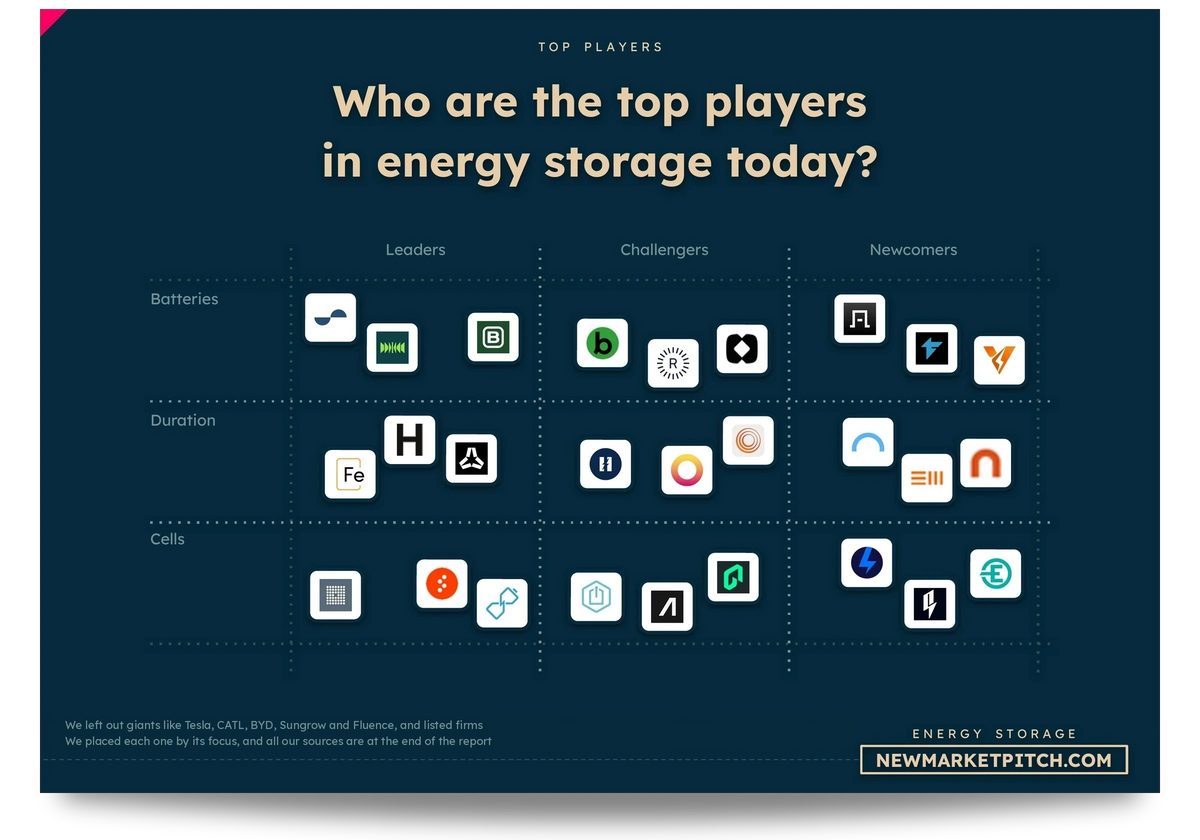
In our report covering the energy storage market, we turn what is vague and complex into simple, useful visuals. Market maps like this one show you at a glance where every startup stands.
The ranking of top startups in the energy storage market by revenue
Below is a table ranking the startups of this market by their current revenue scale. You can find our methodology at the end of this page.
If you want a deeper understanding of the market and its current dynamics, get our report on the energy storage market.
| Ranking | Company | Latest Metric | Metric Type | Freshness | Disclosed When | Source Quality | Confidence | Segment | Why This Ranking | Local Metric | Country |
|---|---|---|---|---|---|---|---|---|---|---|---|
| 1 | Hithium | ~$1.82B | Fiscal-Year Revenue | Aging · 22mo | Mar 25, 2025 | Credible Reported | Medium | Grid-Scale Battery Cells | The large FY2024 revenue is directly reported, but the historic period limits the rank. A 2026 milestone of 200 GWh cumulative shipments is not substituted for revenue. | CNY 12.9B | cn |
| 2 | HyperStrong | ~$1.63B | Fiscal-Year Revenue | Fresh · 10mo | Apr 2026 | Filed / Audited | High | Grid-Scale Battery Systems | 2025 recognized system revenue makes the company directly comparable with leading storage vendors; listed in 2025. | CNY 11.6B | cn |
| 3 | EcoFlow | $1.5B | Annual Revenue | Aging · 22mo | 2025 | Company Disclosed | Medium | Portable and Home Storage | Company-level 2024 sales demonstrate exceptional consumer-storage scale, although the disclosed year is older than 2025 filings. | cn | |
| 4 | Sigenergy | ~$1.26B | Fiscal-Year Revenue | Fresh · 10mo | Aug 28, 2026 | Credible Reported | Medium | Home and Commercial Storage | The 2025 company-wide revenue measure is preferred to the even larger H1 2026 partial-year figure; listing began in 2026. | CNY 9B | cn |
| 5 | Enpal | >$1.25B | Annual Revenue | Fresh · 10mo | Jan 29, 2026 | Company Disclosed | Medium | Integrated Home and Grid Storage | High company sales include solar installation and heat pumps alongside home batteries; the revenue perimeter is broader than storage. | >€1.1B | de |
| 6 | Growatt | ~$733M | Fiscal-Year Revenue | Fresh · 10mo | Jun 18, 2026 | Credible Reported | Medium | Home and Commercial Storage | Storage is the majority of revenue, but solar inverter products remain in the company-wide total. | CNY 5.23B | cn |
| 7 | Hello Tech Energy | ~$580M | Fiscal-Year Revenue | Fresh · 10mo | Apr 2026 | Filed / Audited | High | Portable and Home Storage | Full-year audited revenue captures the Jackery storage business at company level rather than brand-only retail sales. | CNY 4.14B | cn |
| 8 | SolaX Power | ~$571M | Fiscal-Year Revenue | Fresh · 10mo | Apr 28, 2026 | Filed / Audited | Medium | Home and Commercial Storage | Audited company revenue includes storage products and related hybrid inverters; more comparable than shipment-only peers. | CNY 4.08B | cn |
| 9 | PowerOak / BLUETTI | ~$307M | Fiscal-Year Revenue | Aging · 22mo | Apr 2026 | Credible Reported | Medium | Portable and Home Storage | 2024 sales are directly relevant, but lag newer filings from other consumer storage suppliers; BLUETTI is a PowerOak brand. | CNY 2.17B | cn |
| 10 | RelyEZ | ~$262M | Fiscal-Year Revenue | Fresh · 10mo | Aug 11, 2026 | Filed / Audited | High | Grid-Scale Battery Systems | Filed FY2025 revenue is a better scale measure than 2026 four-month sales, though it trails the largest system integrators. | CNY 1.87B | cn |
| 11 | Energy Vault | $204M | Fiscal-Year Revenue | Fresh · 10mo | Mar 17, 2026 | Filed / Audited | High | Grid-Scale Battery Systems | Audited revenue is current and predominantly from storage project deliveries; recent AI infrastructure activity may dilute future comparability. | us | |
| 12 | Zenobē Energy | ~$191M | Fiscal-Year Revenue | Fresh · 10mo | Jun 17, 2026 | Filed / Audited | High | Storage Asset Development | Filed group turnover supports a sizeable operating storage and electric-fleet battery business; mixed services reduce pure BESS comparability. | £145M | gb |
| 13 | Gogoro | $149M | Segment Revenue | Fresh · 10mo | Mar 2026 | Filed / Audited | High | Battery Swapping | Battery-swapping service revenue excludes $132M in hardware and other sales, increasing storage-specific relevance. | tw | |
| 14 | FENECON | ~$149M | Fiscal-Year Revenue | Fresh · 10mo | Sep 2026 | Credible Reported | Medium | Home and Commercial Storage | Recent reported company turnover is substantial, though the precise consolidated perimeter is less clear than audited listed peers. | ~€131M | de |
| 15 | Polarium | ~$93.2M | Fiscal-Year Revenue | Fresh · 10mo | Aug 2026 | Company Disclosed | High | Industrial Backup Storage | 2025 company sales are more current than larger 2024 turnover and reflect a significant business transition. | SEK 896M | se |
| 16 | Amprius Technologies | $73M | Fiscal-Year Revenue | Fresh · 10mo | Mar 4, 2026 | Filed / Audited | Medium | Advanced Battery Cells | Strong recent audited battery sales, although end markets include aviation and other mobile applications beyond stationary storage. | us | |
| 17 | ZincFive | $65M | Fiscal-Year Revenue | Fresh · 10mo | Oct 2026 | Company Disclosed | High | Industrial Backup Storage | Company actual revenue in a public transaction filing is better evidence than estimates and its larger cumulative sales figure. | us | |
| 18 | GivEnergy | ~$64.3M | Fiscal-Year Revenue | Aging · 22mo | Dec 20, 2025 | Filed / Audited | Low | Home and Commercial Storage | Historical revenue is not indicative of present operating scale after the company entered administration in Apr 2026. | £50.3M | gb |
| 19 | myenergi | ~$56.2M | Fiscal-Year Revenue | Fresh · 17mo | Jan 4, 2026 | Filed / Audited | Medium | Home and Commercial Storage | Latest filed turnover includes EV charging products alongside libbi home storage, so only part of group revenue is storage-related. | £43.9M | gb |
| 20 | TESVOLT | ~$49.9M | Fiscal-Year Revenue | Aging · 22mo | Apr 30, 2026 | Filed / Audited | Medium | Home and Commercial Storage | Filed 2024 revenue is preferred to an imprecise 2025 growth percentage; recognized sales may now be materially higher. | €46.2M | de |
| 21 | GridBeyond | $47.9M | Annual Revenue | Aging · 22mo | 2026 | Third-Party Estimate | Low | Storage Optimization Software | Useful but indirect revenue estimate for a software-plus-flexibility portfolio; 2025 managed-capacity claims are not revenue. | ie | |
| 22 | Battery Smart | ~$42.7M | Fiscal-Year Revenue | Fresh · 7mo | Oct 2026 | Filed / Audited | High | Battery Swapping | FY2026 filed sales are newer than the widely repeated FY2025 INR2.49B figure; independent battery-swap operations. | INR 3.58B | in |
| 23 | Skeleton Technologies | ~$33.3M | Fiscal-Year Revenue | Fresh · 10mo | Oct 21, 2026 | Filed / Audited | High | Supercapacitor Storage | Consolidated group revenue measures commercial ultracapacitor scale; high-power short-duration storage has different economics from BESS. | €29.2M | ee |
| 24 | SES AI | $21M | Fiscal-Year Revenue | Fresh · 10mo | Mar 4, 2026 | Filed / Audited | Medium | Advanced Battery Cells | Recognized revenue is well evidenced, but much of it came from development services rather than commercial battery shipments. | us | |
| 25 | Solid Power | $17.9M | Fiscal-Year Revenue | Fresh · 10mo | Feb 2026 | Filed / Audited | Medium | Advanced Battery Cells | Audited development and battery-material revenue is real but reflects technology licensing more than mature storage system sales. | us | |
| 26 | BeePlanet Factory | ~$5.47M | Fiscal-Year Revenue | Aging · 22mo | 2026 | Credible Reported | Medium | Second-Life Battery Storage | Filed sales demonstrate real second-life battery activity, but 2024 data are less current than peers with 2025 results. | €5.06M | es |
| 27 | Peak Energy | $1.1B | Bookings | Very Fresh · 3mo | Jul 8, 2026 | Company Disclosed | Low | Grid-Scale Battery Cells | Contracts are substantial but are not recognized sales; ranked after companies with actual revenue rather than treated as a $1.1B revenue business. | us | |
| 28 | Form Energy | 80 GWh contracted backlog | Other Scale Signal | Fresh · 7mo | Mar 24, 2026 | Company Disclosed | Low | Long-Duration Electrochemical Storage | Large iron-air contract pipeline shows demand, not delivered capacity or recognized revenue; relative money rank cannot be inferred. | us | |
| 29 | Energy Dome | >2 GWh operating or contracted | Other Scale Signal | Very Fresh · 0mo | Oct 12, 2026 | Credible Reported | Low | Compressed-Gas Storage | Operating and contracted projects are combined; neither megawatt-hours nor pipeline estimates show company revenue. | it | |
| 30 | FlexGen | >25 GWh projects supported | Other Scale Signal | Fresh · 14mo | Aug 15, 2025 | Company Disclosed | Low | Storage Optimization Software | Large supported fleet demonstrates software and services reach, but combines completed and contracted projects and is not revenue. | us | |
| 31 | Sermatec | >15 GWh cumulative deliveries | Other Scale Signal | Undated | Company Disclosed | Low | Grid-Scale Battery Systems | Delivered capacity indicates commercial operations but lacks transaction value and a dated measurement period. | cn | ||
| 32 | AlphaESS | >300K systems installed | Units Sold | Undated | Company Disclosed | Low | Home and Commercial Storage | Installed systems are an unusually tangible customer base, but units cannot be converted into recognized company revenue. | cn | ||
| 33 | Highview Power | 50 MW / 300 MWh under construction | Other Scale Signal | Very Fresh · 5mo | May 30, 2026 | Credible Reported | Low | Cryogenic Storage | Capacity under construction is not yet an operating asset and does not establish annual sales. | gb | |
| 34 | Hydrostor | 50 MW / 400 MWh contracted | Other Scale Signal | Fresh · 8mo | Feb 12, 2026 | Credible Reported | Low | Compressed-Air Storage | Contracted long-duration capacity supports commercial interest but not executed project revenue or group turnover. | ca | |
| 35 | Antora Energy | 5 GWh system commissioning | Other Scale Signal | Very Fresh · 5mo | May 19, 2026 | Company Disclosed | Low | Thermal Storage | Gigawatt-hour figure is a thermal-energy commissioning project, not electricity sold or recognized revenue. | us | |
| 36 | Rondo Energy | 100 MWh operating capacity | Other Scale Signal | Fresh · 12mo | Oct 16, 2025 | Company Disclosed | Low | Thermal Storage | Operational thermal storage is a stronger implementation signal than a planned project, but gives no direct annual sales. | us | |
| 37 | Polar Night Energy | 100 MWh operating capacity | Other Scale Signal | Fresh · 16mo | Jun 11, 2025 | Company Disclosed | Low | Thermal Storage | Operational heat storage validates the product; project capacity alone does not establish company-wide revenue. | fi | |
| 38 | Electrified Thermal Solutions | 20 MWh operating capacity | Other Scale Signal | Fresh · 9mo | Jan 23, 2026 | Company Disclosed | Low | Thermal Storage | Commercial pilot operating scale is real, but neither total orders nor company sales have been quantified. | us | |
| 39 | InoBat | 30 MWh industrial project | Other Scale Signal | Fresh · 9mo | Jan 22, 2026 | Company Disclosed | Low | Industrial Battery Systems | A disclosed 30 MWh industrial storage project demonstrates market access, but does not establish delivered volume or group revenue. | sk | |
| 40 | EnerVenue | 11 MWh commercial order | Other Scale Signal | Very Fresh · 1mo | Sep 23, 2026 | Company Disclosed | Low | Long-Duration Electrochemical Storage | This is an order scheduled for future delivery, not recognized revenue or operating capacity. | us | |
| 41 | MGA Thermal | 5 MWh demonstration capacity | Other Scale Signal | Fresh · 18mo | Apr 2025 | Company Disclosed | Low | Thermal Storage | A pilot validates engineered storage, but does not indicate commercial product revenue. | au | |
| 42 | Morrow Batteries | Commercial deliveries begun | Other Scale Signal | Fresh · 9mo | Jan 9, 2026 | Company Disclosed | Low | Advanced Battery Cells | Initial cell deliveries establish commercialization without sales amount or shipped MWh; late-stage production ramp remains uncertain. | no | |
| 43 | ProLogium | Mass production commenced | Other Scale Signal | Very Fresh · 1mo | Sep 2, 2026 | Company Disclosed | Low | Advanced Battery Cells | Commercial manufacturing is independently useful but without annual sold units or revenue cannot be dollar-ranked. | tw | |
| NR | Quidnet Energy | Not disclosed | Other Scale Signal | Undated | Company Disclosed | Low | Pumped-Hydro Storage | Technology has commercial partnerships but no verified company revenue or comparable deployed capacity figure. | us | ||
| NR | Gravitricity | Not disclosed | Other Scale Signal | Undated | Company Disclosed | Low | Gravity Storage | No attributable annual revenue or ARR is public. | gb | ||
| NR | Fourth Power | Not disclosed | Other Scale Signal | Undated | Company Disclosed | Low | Thermal Storage | Technology-stage business has no defensible public revenue disclosure or commercial sales proxy. | us | ||
| NR | Malta | Not disclosed | Other Scale Signal | Undated | Company Disclosed | Low | Thermal Storage | No attributable annual revenue or ARR is public. | us | ||
| NR | Hydrogenious LOHC | Not disclosed | Other Scale Signal | Undated | Company Disclosed | Low | Hydrogen Storage | Dedicated chemical-carrier hydrogen storage developer; no attributable revenue is public. | de | ||
| NR | TWAICE | Not disclosed | Other Scale Signal | Undated | Company Disclosed | Low | Storage Optimization Software | Revenue and managed-storage footprint are not publicly quantified. | de | ||
| NR | Sunamp | Not disclosed | Other Scale Signal | Undated | Company Disclosed | Low | Thermal Storage | Established heat-battery products; financial scale is not disclosed. | gb | ||
| NR | Lunar Energy | Not disclosed | Other Scale Signal | Undated | Company Disclosed | Low | Home and Commercial Storage | No attributable annual revenue or ARR is public. | us | ||
| NR | Base Power | Not disclosed | Other Scale Signal | Undated | Company Disclosed | Low | Home and Commercial Storage | Residential storage deployments are visible, but no recognized revenue is public. | us | ||
| NR | Exowatt | Not disclosed | Other Scale Signal | Undated | Company Disclosed | Low | Thermal Storage | No verifiable current sales figure is public. | us |

Our research about energy storage gets updated several times a month, so you always get the latest view of where things stand.
Why are energy storage startups making so much money now?
Energy storage startups are making much more money because battery storage has become a large-scale electricity business, with 108 GW of new capacity installed worldwide in 2025, 40% more than in 2024, according to the International Energy Agency (IEA).
The change in demand is substantial. Global battery storage capacity additions are now eleven times higher than in 2021. Around 80% of new installations in 2025 were utility-scale projects, while China accounted for approximately 60% of worldwide additions.
The technology mix has also become more standardized. Lithium-iron-phosphate (LFP) batteries accounted for around 90% of new deployments, compared with less than half five years earlier. Their relatively low cost and ability to handle frequent charging cycles make them particularly attractive for stationary storage.
This growth has created several different opportunities. Hithium and HyperStrong are benefiting from demand for large battery systems, while EcoFlow and Hello Tech Energy sell portable and residential storage products. Enpal has built a large household energy business around solar installations, batteries and heat pumps.
Companies across these categories are already generating substantial revenue. Energy storage has moved well beyond the stage where commercial success is measured mainly through pilot projects and announced manufacturing capacity.
Which energy storage startups have the highest revenue today?
Hithium holds the first position in our energy storage startup ranking, with CNY 12.9B in FY2024 revenue, followed by HyperStrong with CNY 11.6B in FY2025 and EcoFlow with $1.5B in 2024 annual revenue.
The top five also include Sigenergy and Enpal, while Growatt, Hello Tech Energy, SolaX Power, PowerOak and RelyEZ complete the top ten. The ranking covers several business models, from battery manufacturing and grid-scale integration to portable power and household energy systems.
The figures below retain their original currencies, reporting periods and metric types. Some represent storage-specific revenue, while others cover broader company activities. We also retain the selected historical reporting periods rather than replacing them with newer, less comparable measurements.
| Rank | Startup | Revenue | Metric and period |
|---|---|---|---|
| 1 | Hithium | CNY 12.9B | FY2024 revenue |
| 2 | HyperStrong | CNY 11.6B | FY2025 revenue |
| 3 | EcoFlow | $1.5B | 2024 annual revenue |
| 4 | Sigenergy | CNY 9B | FY2025 revenue |
| 5 | Enpal | >€1.1B | 2025 annual revenue |
| 6 | Growatt | CNY 5.23B | FY2025 revenue |
| 7 | Hello Tech Energy | CNY 4.14B | FY2025 revenue |
| 8 | SolaX Power | CNY 4.08B | FY2025 revenue |
| 9 | PowerOak / BLUETTI | CNY 2.17B | FY2024 revenue |
| 10 | RelyEZ | CNY 1.87B | FY2025 revenue |
| 11 | Energy Vault | $204M | FY2025 revenue |
| 12 | Zenobē Energy | £145M | FY2025 revenue |
| 13 | Gogoro | $149M | FY2025 battery-swapping service revenue |
| 14 | FENECON | ~€131M | FY2025 revenue |
| 15 | Polarium | SEK 896M | FY2025 revenue |
| 16 | Amprius Technologies | $73M | FY2025 revenue |
| 17 | ZincFive | $65M | FY2025 revenue |
| 18 | GivEnergy | £50.3M | FY2024 revenue |
| 19 | myenergi | £43.9M | FY2025 revenue |
| 20 | TESVOLT | €46.2M | FY2024 revenue |
| 21 | GridBeyond | $47.9M | 2024 estimated revenue |
| 22 | Battery Smart | INR 3.58B | FY2026 revenue |
| 23 | Skeleton Technologies | €29.2M | FY2025 revenue |
| 24 | SES AI | $21M | FY2025 revenue |
| 25 | Solid Power | $17.9M | FY2025 revenue |
| 26 | BeePlanet Factory | €5.06M | FY2024 revenue |

In our market report about energy storage, we look at what the winners do differently, so you can learn from the best instead of guessing.
How much revenue does Hithium make?
Hithium generated CNY 12.9B in FY2024 revenue, according to the audited financial information in its Hong Kong IPO application, giving it the first position in our energy storage startup ranking.
The company focuses on lithium-ion battery cells and systems designed specifically for stationary energy storage. That specialization gives its revenue a relatively direct connection to the market we are studying.
Its subsequent shipment figures also show how quickly the business has expanded. Hithium announced that cumulative shipments passed 100 GWh in August 2025, then reported reaching 200 GWh in October 2026. The company doubled its cumulative shipments in roughly fourteen months.
Those figures are cumulative rather than annual shipments, but they show that Hithium continued expanding its manufacturing and delivery operations after the FY2024 financial results.
Hithium has also expanded its international manufacturing presence, including its Texas facility, and is increasingly targeting longer-duration storage applications. Its commercial position rests on manufacturing scale, international delivery and a product range dedicated to stationary storage.
Is HyperStrong almost as big as Hithium?
HyperStrong generated CNY 11.6B in FY2025 revenue, placing it second in our ranking and within CNY 1.3B of Hithium's older FY2024 figure.
The company's financial trajectory is particularly strong. Its FY2025 annual report shows revenue increasing from CNY 8.27B in 2024 to CNY 11.61B in 2025, representing growth of approximately 40.4%.
Net profit also increased, reaching approximately CNY 951M in 2025, compared with CNY 648M the previous year. That's a substantial profit for a company growing at this pace.
HyperStrong specializes in integrated energy storage systems, including battery equipment, power conversion, controls and engineering. Its annual report and corporate profile describe a business built around delivering complete storage solutions for utility-scale and commercial customers.
The company also reported cumulative deployed capacity exceeding 50 GWh in 2025. By 2026, its corporate profile reported more than 70 GWh.
Hithium and HyperStrong capture different parts of the same market: Hithium manufactures storage cells, while HyperStrong earns its revenue by delivering complete battery storage systems.

In our document detailing everything you need to know about energy storage, you will always find fresh funding data, taken straight from our own verified funding database.
Which portable battery startups make the most money?
EcoFlow ranks third among energy storage startups, followed by Hello Tech Energy in seventh place and PowerOak / BLUETTI in ninth. Portable and residential batteries have clearly become big businesses.
EcoFlow disclosed $1.5B in 2024 annual revenue through its official partner information. Its products include portable power stations, residential backup systems, solar-compatible batteries and associated energy equipment.
Hello Tech Energy generated CNY 4.14B in FY2025 revenue, according to its annual accounts. Its business includes the Jackery brand, which sells portable power stations and solar generators. An especially useful detail in its financial reporting is that storage products generated CNY 3.22B, representing 77.76% of total revenue.
PowerOak, the company behind BLUETTI, reported approximately CNY 2.17B in FY2024 revenue in its Hong Kong IPO filing.
The three companies serve households preparing for power outages, people using portable electricity outdoors and homeowners looking to store electricity generated by solar panels.
Hello Tech's product breakdown is particularly revealing: almost four-fifths of its revenue already comes from storage products. Portable batteries have become a substantial business in their own right rather than an accessory category attached to other consumer electronics.
Is Sigenergy becoming one of the biggest energy storage startups?
Sigenergy ranks fourth with CNY 9B in FY2025 revenue, establishing it as one of the largest residential and commercial energy storage suppliers in our ranking.
The company combines battery storage, hybrid inverters, power electronics and energy management into integrated systems. Its SigenStor product range targets households and commercial customers looking for a coordinated solar, storage and electricity-management solution.
The company's FY2025 revenue figure covers a full financial year, making it a useful baseline for comparison.
Sigenergy also benefits from selling several connected components within the same installation. Customers purchasing a complete system can buy batteries, inverters and associated equipment together, allowing the company to capture more of the value of each installation.
The company's rapid expansion into international markets has helped it reach a scale that would have been difficult to achieve through a purely domestic residential storage business.

Learning from others' mistakes is the cheapest lesson there is. In our report covering the energy storage market, we look at what broke startups before you, so you don't repeat it.
Is Enpal really an energy storage company?
Enpal ranks fifth with more than €1.1B in 2025 annual revenue, although its financial results cover a broader household energy business rather than battery storage alone.
The German company sells integrated residential energy systems, combining rooftop solar installations, batteries, heat pumps and related services. Home batteries are an important part of its offering because they allow customers to store excess solar electricity and use it later.
According to Enpal's January 2026 financial announcement, revenue at its operating subgroup increased 25% in 2025, reaching more than €1.1B compared with €890M in 2024.
The same announcement reported that the operating subgroup generated positive free cash flow for the first time over a complete financial year.
Enpal captures revenue from the entire household energy installation. Its financial scale therefore cannot be compared directly with the battery-only sales of a manufacturer such as Hithium.
Enpal still belongs in an energy storage startup ranking because batteries are a central part of its integrated offering, but its €1.1B figure should never be presented as standalone battery revenue.
Are Growatt and SolaX Power making most of their money from storage?
Growatt generates most of its revenue from energy storage systems, while SolaX Power has a broader mix of storage equipment and related solar power products.
Growatt ranks sixth with CNY 5.23B in FY2025 company revenue. Its 2025 IPO information identifies approximately CNY 3.315B in storage-system sales, meaning storage represented around 63% of total revenue.
That is a substantial majority and gives us a relatively clear picture of Growatt's business mix.
SolaX Power ranks eighth with CNY 4.08B in FY2025 consolidated revenue. The company sells battery storage systems, hybrid inverters and other energy equipment, so its total revenue should not be interpreted as battery sales alone.
The two companies compete in a market built around connecting solar generation, batteries and household or commercial electricity systems.
Growatt's disclosed storage share makes its revenue composition easier to quantify, while SolaX's financial results cover a broader integrated solar and storage equipment business.

Your time is limited. In our research about energy storage, we put numbers on each part of the market, so you can see where it makes sense to focus.
How big are grid-scale energy storage startups beyond Hithium and HyperStrong?
RelyEZ ranks tenth with CNY 1.87B in FY2025 revenue, followed by Energy Vault in eleventh place with $204M in FY2025 revenue.
RelyEZ supplies integrated battery storage systems for commercial and utility applications. Its FY2025 revenue figure comes from its Hong Kong listing application and offers a useful measure of its industrial scale.
Energy Vault has a different history. The company originally became widely known for its gravity-based storage technology, but its commercial business now includes a broader range of energy storage products and project delivery.
Its FY2025 Form 10-K provides an interesting breakdown: $196.2M of its $203.7M total revenue came from energy storage product sales. That means approximately 96% of its revenue came from this category.
There is also a concentration risk worth watching. Two customers accounted for approximately 88% of Energy Vault's FY2025 revenue, according to the same filing.
Energy Vault has reached meaningful sales, but much of its revenue depends on a small number of large project customers. A delay or cancellation involving one of them could have an outsized impact on its financial results.
Can battery storage companies make serious money without manufacturing batteries?
Zenobē Energy shows that energy storage companies can generate substantial revenue through asset ownership, project development and operations without relying primarily on battery manufacturing.
The British company ranks twelfth with £145M in FY2025 consolidated turnover, according to its Companies House accounts.
Zenobē develops and operates battery storage assets and also offers battery-related services for electric vehicle fleets. Its business involves developing infrastructure, connecting storage systems to electricity markets and managing their operation.
Manufacturers earn revenue when they sell equipment, while infrastructure operators can generate income over the lifetime of their assets and associated services.
Zenobē's £145M figure covers the consolidated group, including activities beyond grid-scale battery storage. Nevertheless, it demonstrates that asset ownership and operating services have already become substantial businesses in the energy storage market.

In our market report about energy storage, we always try to gather several sources and make estimates that make sense, so you can work with solid numbers.
How much revenue do battery-swapping startups make?
Gogoro generates $149M in FY2025 battery-swapping service revenue, while Battery Smart reported INR 3.58B in FY2026 operating revenue. Battery swapping has become a meaningful commercial business, particularly for electric two-wheelers and three-wheelers.
Gogoro ranks thirteenth in our ranking. Its FY2025 Form 20-F reports $149M in battery-swapping service revenue, an increase of 8.1% from $137.9M in 2024.
The company also generated $132.5M in hardware and other revenue, bringing total FY2025 revenue to $281.5M. Battery swapping therefore accounted for slightly more than half of the company's total revenue.
The model is built around a network of battery-swapping stations that allow electric scooter users to exchange depleted batteries for charged ones. Gogoro reported more than 665,000 subscribers at the end of 2025.
Battery Smart, which operates in India, ranks twenty-second with INR 3.58B in FY2026 revenue. Its network focuses on battery swapping for electric two- and three-wheelers.
The two companies demonstrate how recurring battery services can generate substantial revenue alongside conventional equipment sales. Their figures also belong to a different segment from stationary grid storage, even though battery storage remains central to both businesses.
Which smaller energy storage startups are already making tens of millions?
Several smaller energy storage startups have reached meaningful commercial scale, with FENECON, Polarium, ZincFive, GivEnergy and myenergi among the companies reporting substantial sales.
FENECON ranks fourteenth with approximately €131M in FY2025 revenue. The German company provides residential, commercial and industrial battery systems.
Polarium ranks fifteenth with SEK 896M in FY2025 net sales. Its business focuses on industrial backup power and distributed energy storage, particularly for telecommunications and other applications requiring reliable electricity.
ZincFive ranks seventeenth with $65M in FY2025 revenue, according to its investor presentation filed with the SEC. Its nickel-zinc batteries are designed primarily for mission-critical backup power, including data centers.
GivEnergy ranks eighteenth with £50.3M in FY2024 turnover. The company subsequently entered administration in April 2026, and GivEnergy Ltd ceased trading. Its historical revenue therefore provides no indication of current sales from that legal entity.
myenergi ranks nineteenth with £43.9M in FY2025 turnover, while TESVOLT ranks twentieth with €46.2M in FY2024 revenue. Both operate in the broader residential and commercial energy equipment market.
GridBeyond ranks twenty-first with an estimated $47.9M in 2024 revenue. Skeleton Technologies ranks twenty-third with €29.2M in FY2025 revenue, and BeePlanet Factory ranks twenty-sixth with €5.06M in FY2024 sales.
These companies cover very different applications, from industrial backup and commercial batteries to electricity optimization software and second-life battery systems. Their individual business models are just as important as the revenue figures.

If you build or invest in the energy storage market, you need to know which business models pay off now and which ones are fading. That's why our report covering it has a whole section on it.
Are advanced battery startups already generating meaningful revenue?
Advanced battery startups are beginning to generate real sales, but Amprius, SES AI and Solid Power remain much smaller businesses than the leading storage manufacturers.
Amprius Technologies ranks sixteenth with $73M in FY2025 revenue, according to its SEC filing. Its silicon-anode battery technology targets applications requiring high energy density, including aviation and specialized mobility.
SES AI ranks twenty-fourth with $21M in FY2025 revenue. Its financial statements show that $13.6M came from services and $7.4M from battery products.
Most of SES AI's commercial activity therefore still comes from development services rather than large-scale battery manufacturing.
Solid Power ranks twenty-fifth with $17.9M in FY2025 revenue, primarily from electrolyte materials and development agreements.
These companies are commercially active, but their financial profiles still reflect an earlier stage of industrial development. Amprius has meaningful product sales, while SES AI and Solid Power continue to rely substantially on customer-funded development and technology-related activities.
Are energy storage startups with high revenue actually making profits?
Energy storage startups have very different profitability profiles, and some companies generating hundreds of millions in revenue are still losing money.
HyperStrong offers one of the strongest examples of profitable growth. Its FY2025 net profit reached approximately CNY 951M, alongside revenue of CNY 11.6B.
Enpal also reported a positive free cash flow for its operating subgroup in 2025, its first positive full-year result.
Other companies face more difficult economics. SolaX Power increased FY2025 revenue by 32.84%, but its net profit attributable to shareholders fell 40.61% to approximately CNY 121M.
Gogoro reported a FY2025 net loss of approximately $80M despite generating $281.5M in total revenue. Its full-year gross margin was approximately 8.2%.
Polarium's FY2025 results provide another useful example. Net sales fell from SEK 1.33B in 2024 to SEK 896M in 2025, although gross profit improved to SEK 114M from a negative SEK 46M. Its EBITDA loss also narrowed substantially, from SEK 270M to SEK 61M.
Revenue alone tells us little about the quality of these businesses. Manufacturing costs, installation expenses, customer acquisition, working capital and project timing can eat into sales very quickly. HyperStrong's profitability looks particularly strong against that backdrop.

In our report covering the energy storage market, we don't want to repeat what boring consulting reports say. Instead, we show you the real and latest market signals that matter.
Why are Chinese energy storage startups so prominent in the revenue ranking?
Chinese companies occupy nine of the first ten positions in our energy storage startup ranking, making China's manufacturing ecosystem the clearest geographical concentration in the industry.
The nine companies are Hithium, HyperStrong, EcoFlow, Sigenergy, Growatt, Hello Tech Energy, SolaX Power, PowerOak / BLUETTI and RelyEZ. Enpal, headquartered in Germany, is the only non-Chinese company in the top ten.
The concentration extends beyond the highest-revenue businesses. Sermatec and AlphaESS also appear among the companies with quantified commercial-scale indicators.
The IEA's deployment figures help explain this pattern. China accounted for approximately 60% of new global battery storage capacity in 2025, giving domestic manufacturers access to an enormous market for battery cells, systems and related equipment.
The companies also operate across different parts of the supply chain. Hithium manufactures storage batteries, HyperStrong integrates large systems, EcoFlow and PowerOak sell portable storage products, while Growatt and SolaX Power combine batteries with solar power electronics.
China's advantage is much broader than one battery technology or one type of customer. Its manufacturers are generating substantial revenue across grid-scale, residential and portable storage, with businesses at several stages of the supply chain.
Are long-duration energy storage startups catching up with lithium-ion suppliers?
Long-duration energy storage startups are securing larger projects and contracts, but their disclosed commercial figures still consist mainly of project capacity and backlog rather than comparable annual revenue.
Form Energy is developing iron-air batteries designed for long-duration electricity storage. The company reported approximately 80 GWh of contracted backlog in 2026, showing that customers are willing to commit to a technology that targets much longer discharge periods than conventional lithium-ion systems.
Energy Dome is pursuing compressed-CO2 storage and reported more than 2 GWh of projects operating or under contract in 2026.
Highview Power is developing liquid-air energy storage, including a 50 MW / 300 MWh facility under construction. Hydrostor has disclosed a 50 MW / 400 MWh contracted advanced compressed-air storage project.
These technologies target electricity systems that need storage for longer periods, particularly when renewable generation fluctuates over extended periods.
The contracts are getting bigger, but the companies still need to turn projects into delivered systems and recognized sales. The financial scale already achieved by the largest lithium-ion suppliers remains considerably more established.

In our research about energy storage, we like to show you the big picture. We know your time is precious, so we make every page quick to read and packed with as much learning as possible per minute.
Can thermal energy storage startups become major energy businesses?
Thermal energy storage startups have started operating industrial-scale projects, creating a commercial market around storing heat rather than electricity alone.
Antora Energy reported a 5 GWh industrial thermal battery commissioning project in 2026. Its technology stores energy as heat and supplies industrial customers with high-temperature thermal energy.
Rondo Energy has already moved further into operation. Its 100 MWh industrial heat battery entered commercial operation in October 2025, supplying continuous industrial steam using solar electricity.
Polar Night Energy also operates a 100 MWh commercial sand battery, while Electrified Thermal Solutions reported a 20 MWh commercial-scale thermal battery operating in early 2026.
MGA Thermal has demonstrated a 5 MWh thermal storage installation.
Many industrial facilities need continuous heat for manufacturing processes, and thermal batteries can store electricity or other energy inputs before delivering heat when required.
One important caveat: a GWh of stored thermal energy should not be directly compared with a GWh of electricity storage. The technologies serve different applications and have different commercial economics.
The projects show that thermal storage is moving beyond laboratory development, although the companies' annual revenue remains largely undisclosed.
Do billion-dollar energy storage contracts mean a startup has billion-dollar revenue?
A billion-dollar energy storage contract can demonstrate substantial customer demand, but it does not mean that the startup has already generated a billion dollars in revenue.
Peak Energy provides a good example. The sodium-ion battery startup announced approximately $1.1B in contracted commitments, associated with more than 6 GWh of storage demand.
That is a large commercial commitment, especially for a company developing an alternative battery chemistry. However, the figure represents bookings rather than recognized revenue.
Form Energy's approximately 80 GWh backlog raises the same question. It demonstrates substantial customer commitments for long-duration storage, but the value of those future deliveries should not be confused with completed sales.
EnerVenue has also disclosed an 11 MWh commercial order for its metal-hydrogen storage technology.
The timing of revenue recognition depends on project delivery, contractual obligations and accounting treatment. A large contract can generate revenue over several years, and some projects may be delayed or modified.
For now, these announcements show that emerging technologies are attracting serious customers. They do not justify placing the companies alongside established manufacturers based on revenue.

When you build or invest in the energy storage market, you need clarity, not confusion. In our market report about energy storage, we always try to put numbers on and quantify whatever is usually vague and confusing.
Can energy storage software startups make serious money without selling batteries?
Energy storage software startups can generate meaningful revenue by helping operators manage electricity assets, optimize battery dispatch and participate in energy markets.
GridBeyond ranks twenty-first with an estimated $47.9M in 2024 revenue, according to CB Insights. Its business combines software, electricity-market optimization and flexibility services.
FlexGen has disclosed more than 25 GWh of storage projects supported through its software and services. That is a substantial operational footprint, although the figure combines completed and contracted projects and does not establish annual revenue.
TWAICE develops battery analytics software for storage operators and manufacturers, but we have not found a comparable public revenue figure for the company.
Software businesses can expand the amount of storage they manage without building new factories. Still, a managed fleet's capacity cannot be converted directly into company revenue.
GridBeyond's estimated sales show that software and energy flexibility can support a meaningful business. FlexGen and TWAICE have demonstrated operational reach, but their annual turnover is harder to assess.
Which energy storage startups have real projects but no disclosed revenue?
Several energy storage startups have already secured customers, installed equipment or begun manufacturing, although their public disclosures still do not establish comparable annual revenue.
Peak Energy's bookings, Form Energy's backlog and Energy Dome's operating or contracted projects illustrate the commercial progress being made by newer storage technologies.
Other companies have reached different milestones. Sermatec reports more than 15 GWh in cumulative deliveries, while AlphaESS reports more than 300,000 installed systems. These are meaningful measures of commercial activity, but they do not tell us how much revenue the companies recognized over a particular year.
The following positions preserve the commercial-scale assessment while keeping each company's disclosed measurement separate from financial revenue.
| Position | Startup | Disclosed commercial indicator | Period |
|---|---|---|---|
| 27 | Peak Energy | $1.1B bookings | As of Jul 2026 |
| 28 | Form Energy | 80 GWh contracted backlog | As of Mar 2026 |
| 29 | Energy Dome | >2 GWh operating or contracted | As of Oct 2026 |
| 30 | FlexGen | >25 GWh projects supported | As of Aug 2025 |
| 31 | Sermatec | >15 GWh cumulative deliveries | Undated |
| 32 | AlphaESS | >300K systems installed | Undated |
| 33 | Highview Power | 50 MW / 300 MWh under construction | As of May 2026 |
| 34 | Hydrostor | 50 MW / 400 MWh contracted | As of Feb 2026 |
| 35 | Antora Energy | 5 GWh system commissioning | As of May 2026 |
| 36 | Rondo Energy | 100 MWh operating capacity | As of Oct 2025 |
| 37 | Polar Night Energy | 100 MWh operating capacity | As of Jun 2025 |
| 38 | Electrified Thermal Solutions | 20 MWh operating capacity | As of Jan 2026 |
| 39 | InoBat | 30 MWh industrial project | As of Jan 2026 |
| 40 | EnerVenue | 11 MWh commercial order | As of Sep 2026 |
| 41 | MGA Thermal | 5 MWh demonstration capacity | As of Apr 2025 |
| 42 | Morrow Batteries | Commercial deliveries begun | As of Jan 2026 |
| 43 | ProLogium | Mass production commenced | As of Sep 2026 |
Quidnet Energy, Gravitricity, Fourth Power, Malta, Hydrogenious LOHC, TWAICE, Sunamp, Lunar Energy, Base Power and Exowatt remain unranked because we could not establish a sufficiently comparable public revenue figure or quantified commercial-scale measurement.

A good product starts with a real problem. In our document detailing everything you need to know about energy storage, we show you the ones customers still live with.
So, which energy storage startups make the most money today?
Hithium is the top energy storage startup by revenue in our ranking, followed by HyperStrong, EcoFlow, Sigenergy and Enpal. These five companies have already built large businesses around battery manufacturing, integrated storage systems and household energy equipment.
The strongest revenue concentration is in Chinese manufacturers and equipment suppliers. Nine of the first ten positions belong to Chinese-headquartered startups, while the rest of the ranking includes European infrastructure operators, residential energy businesses, battery-swapping networks and specialized technology developers.
The financial evidence also favors companies that have already established repeatable sales. Hithium and HyperStrong have reached multibillion-yuan revenue, EcoFlow has built a $1.5B business around portable and residential power, and Sigenergy has reached CNY 9B in FY2025 sales.
Meanwhile, the next generation of long-duration and thermal storage companies is attracting substantial contracts and building real projects. Their technology could become increasingly important as electricity systems require longer storage periods, although their revenue still needs to catch up with their commercial ambitions.
For now, Hithium leads, with HyperStrong close behind. The biggest energy storage businesses are being built by companies that can manufacture, deliver and sell storage systems at scale.
Our methodology
We ranked energy storage startups using the latest attributable annual revenue figures selected for each company, with financial reporting periods ranging mainly from FY2024 to FY2026. The analysis covers battery manufacturers, integrated storage suppliers, portable power companies, residential energy businesses, storage infrastructure operators, battery-swapping networks and specialized battery technologies.
We prioritized audited accounts, stock exchange filings, IPO applications, annual reports and official company financial announcements. When companies disclosed storage-specific revenue, we identified that figure separately from consolidated company revenue. We retained original currencies and reporting periods rather than treating figures from different years and business segments as perfectly comparable.
Our ranking includes recognized revenue, turnover and clearly identified third-party revenue estimates. Contract bookings, project backlog, cumulative shipments, installed capacity and operational milestones are treated as commercial-scale indicators, not annual sales. Companies with only these indicators appear separately from the revenue ranking.
The company selection includes businesses where energy storage is central to the product or service offering, even when their reported sales cover additional activities. This includes Enpal's household energy installations, Growatt's solar and storage equipment, Gogoro's battery-swapping services and GridBeyond's electricity optimization business. The ranking therefore measures the commercial scale of energy storage-related companies rather than revenue from battery storage alone.
Key sources include the International Energy Agency's battery storage deployment statistics; Hithium, PowerOak, Growatt and RelyEZ's Hong Kong IPO materials; HyperStrong's FY2025 annual report; EcoFlow's official partner information; Sigenergy's financial disclosures; Enpal's January 2026 financial announcement; and annual financial reports from Hello Tech Energy and SolaX Power.
For other publicly reporting businesses, we used Energy Vault, Gogoro, Amprius Technologies, SES AI and Solid Power's SEC filings; Zenobē Energy, GivEnergy and myenergi's UK corporate accounts; Polarium's annual financial reporting; and ZincFive's investor financial disclosures. GridBeyond's revenue estimate comes from CB Insights. Company announcements and project updates were used to assess commercial activity among startups without comparable annual sales figures.
The analysis reflects information available as of November 2026. Revenue rankings reflect the selected reporting periods and the scope of each company's business, while project commitments and capacity indicators are assessed separately.

In our report covering the energy storage market, we try to remove everything that could confuse you, especially if you're investing or building in this market.
Written by the New Market Pitch teamWe track new markets so founders and investors can move faster. About us