How big is the healthcare AI agents market beyond scribes?
Whether you're building or investing in the healthcare AI agent market, our report covers everything you need to know: the players, the money, and what's coming next.
Summary
The U.S. Healthcare AI agents market beyond standalone medical scribes already generates an estimated $1.5 billion to $3 billion in annual vendor revenue, with a central estimate of $2 billion. We believe it could reach $10 billion to $20 billion within five years, although that would require aggressive adoption across healthcare administration.
The opportunity has moved well beyond generating clinical notes. AI agents are handling patient scheduling, insurance communications, billing calls, revenue-cycle operations, and post-discharge follow-up. These workflows collectively represent a much larger commercial opportunity than documentation alone.
Real deployment volumes are becoming substantial. Infinitus has reported more than 100 million minutes of healthcare conversations, Cedar nearly 400,000 patient billing calls, and Assort deployments across more than 1,000 providers. But interaction volume tells us less about actual revenue and labor replacement than vendors sometimes suggest.
The underlying budgets are enormous, though they shouldn't be confused with AI market revenue. CAQH estimated approximately $440 billion in U.S. administrative costs and identified roughly $20 billion in additional savings from electronic workflows. Capturing even 10% to 20% of that narrower savings opportunity would support $2 billion to $4 billion in annual vendor revenue.
Revenue-cycle management may be the most attractive commercial category. Candid Health reported 190% growth in annual contracted run-rate revenue during 2025 and 180% net dollar retention. Claims processing, denial management, collections, and coding give hospitals measurable financial reasons to buy automation.
Healthcare voice agents are proving useful, but deployment quality matters more than conversational fluency. Clarion Health reportedly improved an outbound scheduling agent from below 1% appointment conversion to 5.62% after more than 100 iterations. Reliable automation takes considerable workflow engineering.
Prior authorization is another major opportunity, with physicians reporting approximately 40 requests and 13 hours of related work per week. New CMS electronic authorization requirements should make automation easier, although faster paperwork won't resolve disputes over medical necessity.
Clinical agents could eventually expand the market significantly. Hippocratic AI is already being deployed for post-discharge engagement, but patient-facing medical workflows require stronger safety controls and evidence of improved outcomes than administrative systems.
The biggest competitive threat comes from existing healthcare software platforms. Epic, Microsoft, and Optum already control critical systems, integrations, and customer relationships. They could bundle agents into products hospitals already purchase, limiting how much revenue independent startups capture.
Our central five-year scenario is a $15 billion annual U.S. market, implying roughly 50% compound annual growth from today's estimated $2 billion. A $40 billion market is conceivable over a longer period, but sustained revenue depends on vendors capturing real automation budgets rather than simply generating more AI interactions.

Written by the New Market Pitch teamWe track new markets so founders and investors can move faster. About us
Why are healthcare AI companies moving beyond medical scribes?
Healthcare AI companies are moving beyond medical scribes because hospitals and insurers are starting to use AI to handle billing, patient calls, insurance paperwork, and other tasks that used to require administrative staff.
Ambient documentation opened the door. In June 2025, Abridge reported partnerships with more than 150 enterprise health systems and expected its platform to support 50 million clinical conversations that year. Its original pitch was simple: help doctors spend less time writing notes. But the information captured during consultations can also help with coding, reimbursement, and patient follow-up.
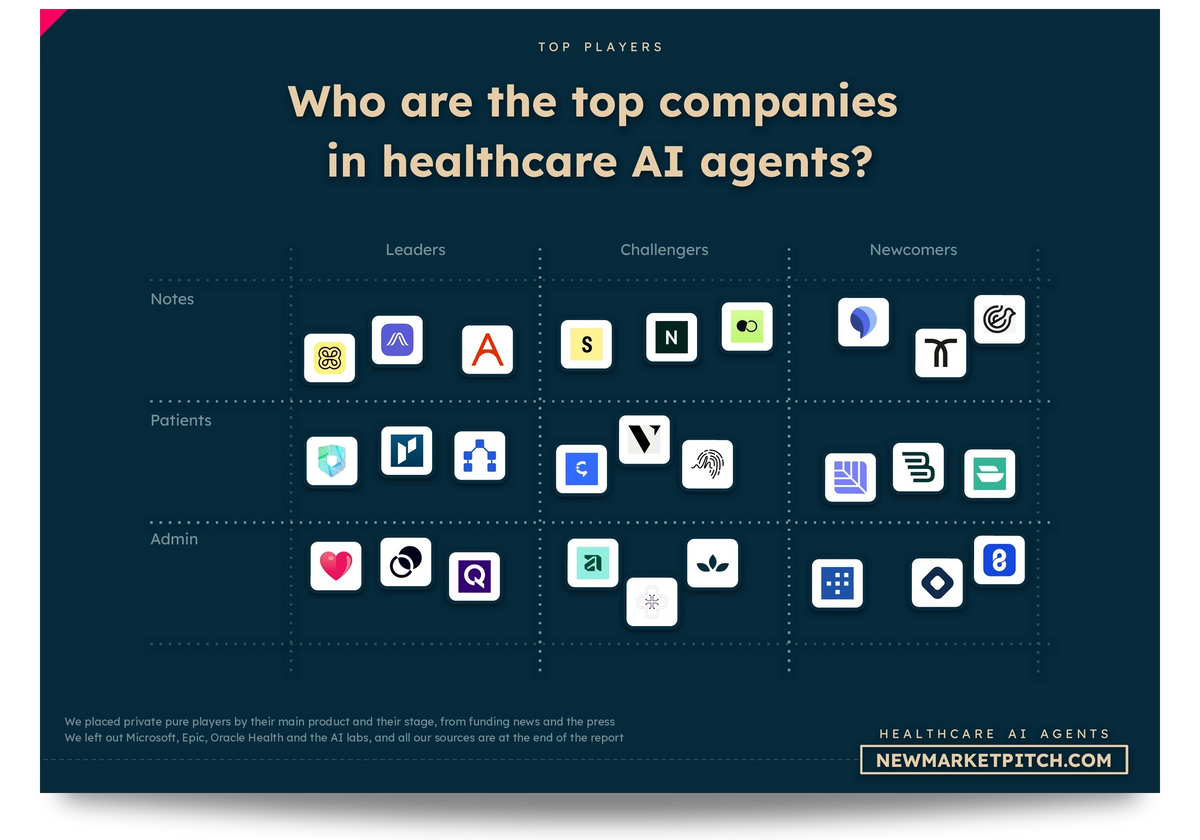
A different group of companies is now building AI agents that don't depend on recording consultations. Assort Health handles patient calls and scheduling, Infinitus automates healthcare communications, Hippocratic AI conducts patient outreach, and Candid Health automates revenue-cycle operations.
The timing is interesting. The 2025 CAQH Index, published in February 2026, documented $258 billion in annual administrative costs avoided through electronic transactions and better data exchange. CMS is also introducing new electronic prior authorization requirements, pushing healthcare organizations toward more automated workflows.
We can already see two markets developing. One helps doctors and nurses work faster. The other takes administrative tasks away from staff altogether. The second is younger, but the amount of money healthcare organizations spend on those tasks is much larger than the documentation market alone.
What actually counts as a healthcare AI agent?
A healthcare AI agent should be able to complete meaningful parts of a clinical or administrative task, rather than simply generate information for someone else to use.
Take medical documentation. A system that listens to a consultation and produces a note is mainly an AI assistant. An agent goes further: it could extract a diagnosis, check insurance requirements, prepare an authorization request, submit the necessary information, and send difficult cases to a staff member.
That distinction changes how we measure the market. We include agents that handle scheduling, patient outreach, care navigation, claims, revenue-cycle operations, and supervised clinical coordination. We exclude ordinary medical imaging AI, hospital analytics, basic chatbots, and traditional automation tools unless they actually perform agent-like tasks.
There are also different levels of autonomy. An AI product that drafts an insurance appeal is doing less work than one that assembles the supporting documents, submits the appeal, tracks its progress, and alerts a human if something goes wrong.

Your time is limited. In our report covering the healthcare AI agent market, we put numbers on each part of the market, so you can see where it makes sense to focus.
How big is the healthcare AI agents market today?
We estimate that healthcare AI agents beyond standalone medical scribes generate roughly $1.5 billion to $3 billion in annualized vendor revenue in the United States, with a central estimate around $2 billion.
This is our estimate based on the available evidence, rather than a published industry total or an audited sum of company revenues. It covers AI-led administrative work, patient-access automation, payer communications, revenue-cycle operations, and clinical coordination. Pure documentation, conventional analytics, and human-delivered outsourcing are excluded.
The estimate is deliberately much smaller than the enormous figures often associated with healthcare administration. Hospitals may spend hundreds of billions on administrative work, but only a small part of that spending currently goes to AI agent vendors.
Deloitte's 2026 healthcare executive outlook helps put adoption into perspective. It found that 49% of surveyed organizations were still experimenting with generative or agentic AI, while 18% had not adopted those technologies. Approximately one-third were operating AI at scale.
| Market definition | Estimated U.S. annual market or spending |
|---|---|
| Healthcare AI agents, excluding standalone scribes | $1.5B–$3B |
| Our central estimate for current agent vendor revenue | ~$2B |
| Potential annual agent revenue within five years | $10B–$20B |
| Ambitious longer-term annual revenue opportunity | $25B–$40B+ |
| Administrative transactions tracked by CAQH in its 2024 Index | ~$90B in costs |
| Broad U.S. administrative complexity, CAQH 2024 benchmark | ~$440B in costs |
| U.S. digital health venture funding in 2025 | $14.2B invested, not revenue |
The first four rows are our estimates or scenarios. The remaining figures come from external spending and investment benchmarks. They measure different things and should not be added together.
If you want more recent data on this point, please see our latest healthcare AI agents market report.
Is healthcare administration big enough to make AI agents a huge market?
Healthcare administration is easily big enough to support a multibillion-dollar AI agent market, even if AI vendors capture only a small fraction of the money currently spent on paperwork and manual processes.
The 2024 CAQH Index estimated roughly $440 billion in annual U.S. administrative costs. Within that broader total, CAQH tracked approximately $90 billion associated with specific medical and dental administrative transactions and identified around $20 billion in additional savings available from moving manual processes to electronic workflows.
Let's use the last figure rather than the much larger headline. If software vendors captured 10% to 20% of those potential savings through fees, that would create $2 billion to $4 billion in annual revenue from a relatively narrow group of tasks.
That calculation is a scenario, not a forecast. CAQH measures electronic transactions, and many of the improvements it identifies can come from technology that existed before generative AI. Agents will compete with standard APIs, conventional automation, and established software providers for those savings.
There are also much broader estimates. Abridge has referenced nearly $1.5 trillion in administrative costs, using a wider definition than CAQH. We would not use that number directly to size healthcare AI agents because it includes spending that AI vendors cannot realistically capture.

In our research about AI agents in healthcare, we always try to gather several sources and make estimates that make sense, so you can work with solid numbers.
Are healthcare AI agents actually doing real work today?
Healthcare AI agents are already handling millions of real patient and administrative interactions, although most deployments still focus on relatively predictable tasks rather than independent medical decisions.
Infinitus reported more than 100 million minutes of healthcare conversations supported by its platform when it introduced an expanded member-services product in February 2026. Cedar reported that its Kora voice agent had handled nearly 400,000 patient billing calls since launching in April 2025. Assort Health said its outbound patient-engagement product was being used across more than 1,000 providers.
These companies are doing different jobs. Infinitus handles communications between healthcare organizations, Cedar answers billing questions, and Assort manages patient access and outreach. Agent adoption is spreading beyond one popular application.
The reported volumes need some interpretation. Cedar's approximately 400,000 calls over roughly 14 months would average around 29,000 calls per month across its deployments, assuming the reported volume covers the entire period. Infinitus reports minutes rather than completed calls, so we cannot directly compare its volume with Cedar's.
We also don't know how many interactions were resolved without human help or how much revenue each company earned from them.
Which healthcare AI agents have the biggest opportunity beyond scribes?
Revenue-cycle agents, patient scheduling systems, and payer communication agents currently have the clearest path to making serious money because they handle repetitive work with results hospitals can measure.
Revenue-cycle automation is especially attractive. It can improve claims processing, reduce denials, accelerate collections, and lower operating costs. Patient-access agents can answer calls, book appointments, and contact people who haven't completed their care. Payer communication agents can deal with routine questions about eligibility, benefits, and claim status.
Clinical coordination could eventually become just as important, but it is harder to deploy safely. An agent that makes a scheduling mistake creates an operational problem. An agent that gives incorrect medical advice could harm a patient.
We rank these applications by how ready they are to generate meaningful commercial revenue, rather than by the maximum amount of spending they might eventually influence.
| Healthcare AI agent application | Representative companies | Commercial opportunity today |
|---|---|---|
| Revenue-cycle and claims operations | Candid Health, AKASA | Very high |
| Patient scheduling and intake | Assort Health, Hyro | Very high |
| Payer-provider communications | Infinitus, Optum | Very high |
| Prior authorization processing | Cohere Health, Optum | High |
| Patient billing and collections | Cedar, Candid Health | High |
| Post-discharge follow-up | Hippocratic AI | High |
| Medication adherence and care navigation | Hippocratic AI, Infinitus | High |
| Clinical coordination | Abridge, Microsoft | Emerging |
| Autonomous diagnosis and treatment | Specialized clinical AI developers | Limited near-term readiness |
The ranking reflects current commercial readiness and the nature of each workflow. It does not imply that every company listed has disclosed meaningful standalone agent revenue.

In our market report about AI agents in healthcare, we don't want to repeat what boring consulting reports say. Instead, we show you the real and latest market signals that matter.
Could revenue-cycle AI agents become bigger than medical scribes?
Revenue-cycle AI agents could become a bigger software business than standalone medical scribes because hospitals have many more financial workflows to automate than documentation tasks alone.
Medical scribes mainly help clinicians save time. Revenue-cycle software can influence claim submission, coding, denial prevention, collections, and the speed at which hospitals receive payments. A single customer may buy several of these capabilities.
Candid Health is one of the more interesting examples. In July 2026, the company announced a $120 million Series D and reported 190% year-over-year growth in annual contracted run-rate revenue during 2025, alongside 180% net dollar retention.
Those numbers suggest customers were spending considerably more with Candid over time. They do not tell us how much of the company's revenue came specifically from autonomous agents, since Candid sells broader revenue-cycle infrastructure.
Meanwhile, companies that began with documentation are moving toward financial workflows. Microsoft has been expanding Dragon Copilot into revenue-cycle and clinical integrations, while Abridge has linked clinical documentation with coding and reimbursement.
How much money can healthcare AI agents actually save hospitals?
Healthcare AI agents can already deliver measurable savings in selected hospital workflows, but reported improvements in productivity do not automatically translate into equivalent reductions in operating costs.
Gastro Health reported a 24% reduction in live-agent handling time after introducing Cedar's Kora voice AI system. That is a meaningful improvement in call-center efficiency, although it doesn't mean the organization's entire call-center budget fell by 24%.
An ActiumHealth case study described an academic health system using AI-assisted outbound calls to contact patients with outstanding care orders. The vendor reported a 7.8-fold improvement in contact-center agent productivity and $39 million in additional annual revenue. That figure represents reported financial benefits for the health system, rather than payments made to the technology vendor. The published case study does not provide an independently audited comparison.
We can also test the economics with a simple example. Suppose a hospital spends $10 million annually on administrative work suitable for automation. A verified 20% reduction in those costs would save $2 million. If software, integration, and human oversight cost $600,000 annually, the hospital would keep $1.4 million in net savings.
Those are illustrative assumptions. Actual results depend on which tasks disappear, how many exceptions still need people, and how much it costs to integrate the technology.

In our document detailing everything you need to know about healthcare AI agent, we like to show you the big picture. We know your time is precious, so we make every page quick to read and packed with as much learning as possible per minute.
Are healthcare AI voice agents starting to replace call centers?
Healthcare AI voice agents are already taking over parts of hospital and insurer call-center workloads, particularly scheduling, billing, routine insurance questions, and patient follow-up.
Cedar, Assort Health, and Infinitus have all reported production deployments in these areas. Their products cover different parts of the communication process, from contacting patients to dealing with insurers.
A particularly revealing example comes from Clarion Health's work with Oscar Health. According to the vendor's case study, its outbound scheduling agent initially converted fewer than 1% of calls into appointments, compared with a 3.5% human benchmark.
After more than 100 iterations, the agent reportedly reached a 5.62% conversion rate by December 2025, while handling approximately 20,000 scheduling calls per month. Clarion also reported more than 40,000 monthly patient conversations across several workflows as the partnership expanded.
The improvement is more interesting than the final conversion number alone. It suggests that successful healthcare voice automation takes a lot of workflow refinement. Having a good conversational model is only part of the job.
We should also distinguish answering calls from resolving them. A voice agent may handle the first interaction while a staff member completes a complicated insurance problem. Without knowing escalation rates and successful resolution rates, call volumes can exaggerate the amount of work being automated.
If you want more recent data on this point, please see our latest healthcare AI agents market report.
Can healthcare AI agents finally fix prior authorization?
Healthcare AI agents can remove a lot of the paperwork behind prior authorization, but they cannot fix the disagreements between doctors and insurers over which treatments should be approved.
The American Medical Association's 2025 physician survey, published in May 2026, found that physicians handled an average of 40 prior authorizations per week. Those requests consumed approximately 13 hours of physician and staff time, while 32% of respondents said requests were often or always denied.
An earlier AMA survey covering 2024 found 39 requests per week and the same 13-hour average workload. Despite years of efforts to simplify prior authorization, the burden had barely changed.
AI agents can help by collecting clinical records, filling out authorization forms, checking request status, and preparing appeals. They can also identify missing information before a request reaches an insurer.
Regulation is pushing the industry in the same direction. CMS introduced new operational requirements beginning in 2026, with major prior authorization API requirements generally taking effect in 2027. Covered payer categories will need to support more standardized electronic exchange of authorization information.
But faster paperwork won't necessarily mean more treatments get approved. The biggest gains will come from removing repetitive work, while medical necessity decisions remain subject to clinical and insurer review.

In our report covering the healthcare AI agent market, we turn what is vague and complex into simple, useful visuals. Market maps like this one show you at a glance where every startup stands.
Can healthcare AI agents take over patient care too?
Healthcare AI agents are starting to handle patient follow-up and care coordination, but independent medical treatment remains a much more difficult business.
Hippocratic AI is one of the clearest examples of the opportunity. In June 2025, Universal Health Services announced deployments of its generative AI agents for post-discharge patient engagement at Summerlin Hospital Medical Center and Texoma Medical Center.
The goal was to contact patients after they left the hospital, reinforce instructions, and help identify situations requiring follow-up. These are recurring tasks that human care teams often struggle to perform consistently for every discharged patient.
Investors are taking the opportunity seriously. Hippocratic AI announced a $126 million Series C in November 2025 at a $3.5 billion valuation, bringing its reported total funding to $404 million.
That valuation reflects expectations for the company's future. It does not tell us how much recurring revenue Hippocratic AI currently generates.
Clinical agents also face a tougher test than administrative ones. A scheduling agent can be measured by appointments booked. A post-discharge agent needs to recognize symptoms, escalate urgent situations, and avoid giving dangerous advice. Ultimately, hospitals will want evidence that these systems improve patient outcomes, not just engagement rates.
Are hospitals and investors actually spending serious money on healthcare AI agents?
Hospitals, insurers, and investors are committing much more money to healthcare AI, although only a portion of that spending can be attributed specifically to autonomous agents.
On the customer side, Deloitte's 2026 healthcare survey found that about one-third of organizations were operating AI at scale. Nearly half were still experimenting, which shows how far adoption still has to go.
Large institutions are nevertheless making substantial commitments. In June 2026, NHS England announced Microsoft 365 Copilot access for 505,000 clinical and support staff, following a 30,000-person trial that reported average administrative time savings of 43 minutes per day among users.
The agreement also includes Copilot Studio for developing agents. However, the 505,000 figure measures access to a broader AI assistant platform rather than the number of people using autonomous healthcare agents.
UnitedHealth Group disclosed plans to invest nearly $1.5 billion in AI-related initiatives in 2026. Optum has also been developing automated payer operations and digital prior authorization capabilities. That investment covers a wider set of AI activities than the agent category alone.
The funding picture points in the same direction. Rock Health reported that U.S. digital health startups raised $14.2 billion across 482 deals in 2025, compared with $10.5 billion across 509 deals in 2024. Funding increased 35%, while deal count fell approximately 5%.
AI-enabled digital health companies attracted 54% of invested capital in 2025, up from 37% in 2024. That implies approximately $7.7 billion went to the broad AI-enabled category in 2025, compared with roughly $3.9 billion the year before.
Those figures cover many kinds of healthcare AI, including products unrelated to agents. Still, several financing rounds show that investors are also backing workflow automation directly: Candid Health raised $120 million in July 2026, Hippocratic AI raised $126 million in November 2025, and Abridge raised $300 million in June 2025.
The three rounds total $546 million. They cover different product categories, with Abridge still strongly associated with documentation, but show that investors are financing broader healthcare automation rather than concentrating exclusively on scribes.

Our research about AI agents in healthcare gets updated several times a month, so you always get the latest view of where things stand.
Will Epic, Microsoft, and Optum crush healthcare AI agent startups?
Epic, Microsoft, and Optum could take a large share of the healthcare AI agents market because they already control much of the software, data access, and customer relationships that independent agents depend on.
Microsoft has been turning Dragon Copilot into a broader platform for clinical applications and partner-built agents. Its 2026 expansion includes integrations with revenue-cycle tools, clinical decision support, and workflows for physicians, nurses, and radiologists.
Epic has an equally important advantage. Its software sits at the center of clinical operations in many large U.S. health systems. An independent AI agent that needs to read records, update patient information, or launch a clinical workflow often depends on access to systems controlled by the hospital's existing vendors.
Optum brings another combination of advantages: payer relationships, reimbursement infrastructure, and automation capabilities. Its April 2026 collaboration with Google focused on AI-enabled payer operations, including replacing routine provider phone calls with digital information exchange.
That creates a difficult competitive environment for startups selling simple AI functions. If a hospital can get a satisfactory scheduling agent through an existing platform, it has less reason to buy a separate product.
Specialist companies can still win where the workflow is difficult enough to require dedicated technology. Assort builds specialty-specific patient communication tools, Candid focuses on reimbursement operations, and Hippocratic AI works on patient-facing clinical conversations.
If you want more recent data on this point, please see our latest healthcare AI agents market report.
What can healthcare AI agent startups build that competitors can't easily copy?
The most defensible healthcare AI agent companies are building expertise around difficult workflows, integrations, and operational data, rather than relying on language models alone.
A good conversational model is increasingly easy to access. What remains difficult is making it work reliably inside healthcare systems.
Consider an agent calling an insurer. It must establish identity, find the correct policy and patient information, navigate phone menus, interpret inconsistent answers, record evidence, complete permitted actions, and recognize when a human should take over.
Infinitus's accumulated conversation volume may help the company improve its handling of payer communications, although the total number of minutes does not establish that it has an exclusive advantage over competitors.
Candid Health has a different potential advantage through its revenue-cycle integrations and accumulated knowledge of billing workflows. A company that repeatedly processes claims can learn which exceptions matter, where errors arise, and how different insurers respond.
The same principle applies to clinical agents, where reliability, safe escalation, and integration with patient records are particularly important.

In our market report about AI agents in healthcare, you will always find fresh funding data, taken straight from our own verified funding database.
Could safety and regulation slow down healthcare AI agents?
Safety and regulation will slow the expansion of healthcare AI agents into medical decisions, but administrative automation can continue growing under existing healthcare oversight rules.
Healthcare software can cause serious problems even when it isn't making diagnoses. Incorrect scheduling can delay treatment. A mistaken insurance response can leave patients with unexpected bills. Wrong clinical advice can have much worse consequences.
The FDA's January 2026 clinical decision support guidance distinguishes certain non-device software functions from products that may qualify as regulated medical devices. The rules depend on what the software actually does and how it is intended to be used.
An agent that prepares information for a clinician to review therefore faces different requirements from one that independently makes a treatment decision.
Healthcare organizations also need to protect patient data, manage access permissions, document agent activity, and make sure staff can intervene when necessary.
An Imprivata survey reported by Axios in October 2026 found that 72% of healthcare industry leaders were aware of AI tools operating without formal IT approval. That illustrates how quickly adoption can get ahead of internal controls.
How big could the healthcare AI agents market become in five years?
We estimate that healthcare AI agents beyond standalone scribes could generate $10 billion to $20 billion in annual U.S. vendor revenue within five years, with approximately $15 billion as our central scenario.
Starting from our current estimate of roughly $2 billion, reaching $15 billion would mean the market grows 7.5 times, equivalent to approximately 50% compound annual growth.
That is aggressive, but it doesn't require AI agents to replace every healthcare administrative worker. It requires hospitals, physician groups, and insurers to move a meaningful portion of their existing software and operating budgets into automated workflows.
We can test the scale with a simple spending scenario. If 100,000 eligible provider organizations and healthcare administrative buyers each spent an average of $100,000 annually on agent software, that would produce $10 billion in revenue. Another $5 billion from large payer and health-system contracts would bring the total to $15 billion.
Those customer counts and average spending figures are assumptions, not observed market totals. We would also have to avoid counting individual providers separately when they buy software through the same parent organization.
A weaker market could result if Epic, Microsoft, Optum, and existing outsourcing companies bundle agents into products customers already pay for. In that case, agent usage could grow very quickly while standalone vendor revenue grows much more slowly.
| Five-year U.S. scenario | Annual vendor revenue | Implied CAGR from $2B |
|---|---|---|
| Limited adoption and strong bundling | $4B | 15% |
| Gradual workflow adoption | $6B | 25% |
| Moderate enterprise penetration | $10B | 38% |
| Central expansion scenario | $15B | 50% |
| Strong multi-workflow adoption | $20B | 58% |
| Broad administrative transformation | $30B | 72% |
| Exceptional platform expansion | $40B | 82% |
These are alternative scenarios, not independent forecasts for different market segments. The higher outcomes would require unusually fast enterprise adoption and a substantial shift of existing healthcare spending toward AI software.

In our document detailing everything you need to know about healthcare AI agent, we look at what the winners do differently, so you can learn from the best instead of guessing.
Could healthcare AI agents eventually become a $40 billion market?
A $40 billion annual U.S. Healthcare AI agents market is possible, but today's deployment and revenue evidence doesn't justify treating that figure as the most likely near-term outcome.
Compared with CAQH's approximately $440 billion benchmark for administrative complexity, $40 billion would equal about 9% of that spending.
The comparison shows that the underlying budget is large enough. It doesn't prove healthcare organizations would be willing to pay AI vendors that amount.
Hospitals need to keep a meaningful share of the savings to justify adopting agents. Some administrative work will also become cheaper through standardized APIs, existing software, and conventional automation without a separate AI agent subscription.
Reaching $40 billion would therefore require extensive paid adoption across scheduling, communications, prior authorization, claims, coding, collections, and clinical coordination. Vendors would also need enough pricing power to retain those contracts as larger software companies offer competing tools.
There is another complication: healthcare AI agents may increasingly be sold as part of established software products. A customer already paying for billing infrastructure might simply add automated appeals or collections through the same provider. Abridge's move toward reimbursement workflows, Microsoft's expansion of Dragon Copilot, and Optum's payer automation all show how easily agents can become part of broader platforms.
That could produce enormous usage without creating an equally enormous independent agent software category.
For now, we consider $40 billion an ambitious longer-term scenario. The more defensible five-year range is $10 billion to $20 billion, assuming successful expansion across multiple healthcare workflows.
If you want more recent data on this point, please see our latest healthcare AI agents market report.
So how big is the healthcare AI agents market beyond scribes?
The healthcare AI agents market beyond scribes is already worth an estimated $1.5 billion to $3 billion annually in the United States, and we believe it could reach $10 billion to $20 billion within five years. Our central estimates are approximately $2 billion today and $15 billion over that horizon.
The evidence is stronger than it was when medical scribes dominated healthcare AI conversations. Infinitus has reported more than 100 million minutes of healthcare communications, Cedar has automated hundreds of thousands of billing calls, and Assort has expanded across a large provider base. These companies are already handling work that previously required administrative staff.
At the same time, the financial opportunity extends well beyond patient conversations. CAQH documents hundreds of billions of dollars in administrative costs, the AMA continues to report heavy prior authorization workloads, and companies such as Candid Health are expanding rapidly in revenue-cycle automation.
We see the largest near-term opportunities in revenue-cycle management, patient access, payer communications, and prior authorization. These tasks occur frequently, cost healthcare organizations substantial money, and offer relatively clear ways to measure whether automation works.
Clinical agents could make the market much larger over time, particularly in follow-up care, medication adherence, and care coordination. However, their commercial expansion will depend on stronger evidence of safety and patient outcomes.
The biggest uncertainty now concerns who captures the revenue. Independent startups are building specialized products, while Epic, Microsoft, Optum, and other established platforms are incorporating agents into software hospitals already use.
Our conclusion is that healthcare AI agents can become a much larger business than medical scribes. A $15 billion annual U.S. market is a plausible five-year outcome, although it remains an aggressive forecast. The opportunity is real, the first production businesses are already operating at meaningful scale, and the next test is whether those deployments turn into sustained, profitable software revenue.

If you build or invest in the healthcare AI agent market, you need to know which business models pay off now and which ones are fading. That's why our report covering it has a whole section on it.
Our methodology
This analysis estimates the U.S. Healthcare AI agents market beyond standalone medical scribes by examining what vendors are selling, which healthcare workflows they automate, how extensively their products are deployed, and the revenue opportunities those deployments create. We distinguish agentic automation from conventional medical documentation, analytics, rule-based software, and human-delivered services.
We built the assessment through a structured aggregation of recent commercial and operational evidence. For each dimension, we gathered company disclosures, customer deployments, conversation volumes, contracted revenue indicators, financing activity, and institutional adoption data. We then assessed the strength and relevance of those signals before combining them into broader conclusions about commercial maturity and market size.
Reported conversation minutes, call volumes, provider counts, customer growth, and financing rounds are treated as different measures. A deployment demonstrates operational adoption, while contracted revenue growth is closer to evidence of commercial demand. Neither necessarily establishes how much revenue comes specifically from autonomous agents. We therefore avoid adding operational metrics, healthcare spending, and investment totals together.
For market economics, we used the CAQH 2024 Index Report to establish administrative cost benchmarks and potential electronic transaction savings, the Deloitte 2026 U.S. Health Care Executive Outlook for adoption maturity, and Rock Health's 2025 funding overview for investment activity. The American Medical Association's prior authorization survey provides a workload benchmark for one of the most promising administrative applications.
We assessed operational adoption through first-hand disclosures from Abridge, Infinitus, Cedar, and Assort Health. We also examined Sixth Street's account of Candid Health's financing and growth, Hippocratic AI's Series C announcement, and Universal Health Services' deployment announcement. Company-reported outcomes are used as evidence of individual deployments rather than independently audited industry-wide performance.
To assess enterprise distribution and competitive pressure, we examined NHS England's Microsoft Copilot rollout, UnitedHealth Group's 2026 earnings remarks, UnitedHealth Group's modernization initiatives, and Abridge's expansion into Epic-integrated clinical workflows. These help establish how agents may be distributed through established healthcare platforms rather than only through independent vendors.
Regulatory readiness was assessed using the CMS Interoperability and Prior Authorization Final Rule and the FDA's January 2026 Clinical Decision Support Software Guidance. We considered the difference between automating administrative activities and performing clinical functions that require stronger supervision or potentially fall under medical-device oversight.
Our current U.S. revenue estimate of $1.5 billion to $3 billion, with a $2 billion central assessment, is an analytical estimate rather than an externally published market total. We evaluated available commercial activity against administrative spending, workflow penetration, and enterprise adoption. For the five-year scenarios, we tested alternative combinations of customer spending, deployment breadth, automation depth, incumbent bundling, and vendor pricing power. The central $15 billion scenario implies approximately 50% annual growth from the present estimate; it should be read as an ambitious commercial outcome rather than a confirmed forecast.
The resulting assessment separates three things: the amount healthcare organizations currently pay for AI agents, the administrative and clinical spending those agents could influence, and the share of that spending vendors may eventually capture. That distinction is central to our conclusion that healthcare AI agents have a credible multibillion-dollar market beyond scribes, while the upper-end opportunity remains highly dependent on implementation economics, clinical reliability, and competition from established healthcare software providers.

When you build or invest in the healthcare AI agent market, you need clarity, not confusion. In our research about AI agents in healthcare, we always try to put numbers on and quantify whatever is usually vague and confusing.
Written by the New Market Pitch teamWe track new markets so founders and investors can move faster. About us