Can healthcare AI agents make money from broke hospitals?
Whether you're building or investing in the healthcare AI agent market, our report covers everything you need to know: the players, the money, and what's coming next.
Summary
Yes, healthcare AI agents can make money selling to financially strained hospitals, especially when they reduce billing costs, recover genuinely lost revenue, or eliminate repetitive administrative work. The strongest opportunities are in revenue cycle automation, medical coding, and insurance administration, where financial returns can be measured.
Hospital finances are tight enough to make every contract matter. Kaufman Hall reported an average adjusted operating margin of just 1.3% for 2025, meaning a $500,000 AI contract could absorb nearly 8% of the operating earnings of a hospital generating $500 million in revenue.
Financial pressure is actually helping create demand for some AI products. Oliver Wyman found that 70% to 90% of surveyed revenue cycle decision-makers expected to increase AI-enabled spending over three years, suggesting hospitals are willing to invest when automation promises measurable savings.
Revenue cycle AI has a stronger financial argument than most clinical AI applications. Experian Health found that 41% of surveyed providers reported claim denial rates of at least 10%, creating an opportunity to reduce rework, prevent avoidable denials, and improve collections.
Small improvements can have an outsized effect on hospital profits. For a hospital generating $500 million in annual net patient revenue, an additional 0.2% in genuine net collections would produce $1 million, equivalent to roughly 15% of operating earnings at a 1.3% margin, before additional costs.
Clinical AI scribes have already demonstrated meaningful benefits, but the economics are less straightforward. Lower burnout and faster documentation are valuable, while a reported $13,000 in annual coding-related benefit per clinician at St. Luke's shows how documentation products can develop a more concrete financial case.
The real automation rate matters more than the advertised AI capability. An agent that completes most tasks but requires expensive human intervention for complex cases may generate far less profit than its headline efficiency suggests, especially once integration and supervision are included.
The hospitals needing AI most urgently are not necessarily the best direct customers. Rural hospitals often lack the transaction volume and implementation budgets required to justify expensive enterprise contracts, making distribution through hospital networks and existing service providers more promising.
Commercial adoption is increasingly credible, but startup profitability remains largely unproven. Abridge reports more than 150 enterprise health system deployments, while Waystar's $1.099 billion in 2025 revenue and approximately 42% adjusted EBITDA margin demonstrate the profitability possible in mature healthcare software businesses.
Incumbents have a major structural advantage. Epic, Microsoft, and Waystar already possess hospital relationships, integrations, and distribution channels, forcing independent startups to deliver substantially better results in specialized workflows rather than compete on generic AI functionality.
The likely winners will combine measurable hospital-level returns with repeatable deployment economics and defensible pricing. Hospitals can be short of money and still become valuable AI customers, but vendors must capture enough of the savings they create without losing those gains to implementation costs, human supervision, or incumbent competition.

Written by the New Market Pitch teamWe track new markets so founders and investors can move faster. About us
Are US hospitals really too broke to buy healthcare AI?
US hospitals are still struggling financially, but plenty of them can afford healthcare AI agents when the software helps them save or recover more money than it costs.
Kaufman Hall's National Hospital Flash Report, covering more than 1,300 hospitals, reported a 1.3% adjusted operating margin for 2025. That improved to 1.7% through March 2026, although rising bad debt, charity care, and drug expenses continued to put pressure on hospital finances.
At a 1.3% operating margin, a hospital generating $500 million in annual revenue earns just $6.5 million from operations. A $500,000 annual AI contract would absorb nearly 8% of those operating earnings before implementation costs. Even a relatively small software purchase can therefore become a serious financial decision.
The situation is worse among smaller providers. The American Hospital Association's 2026 Environmental Scan reported that 48% of rural hospitals operated at a financial loss in 2023. Research from the Center for Healthcare Quality and Payment Reform also found that approximately one-third of rural hospitals were at risk of closing.
But those figures hide enormous differences between hospital groups. A large academic medical center with several billion dollars in revenue has considerably more room to invest than a rural hospital operating on a few million dollars of annual income.
For healthcare AI startups, the biggest commercial opportunity lies with health systems that handle enough administrative work to generate substantial savings. The hospitals under the greatest financial pressure may need automation most, but they are often the hardest customers to sell to.
Why are hospitals buying AI agents when they are cutting costs?
Hospitals are investing in AI agents because reducing administrative expenses has become one of the few ways to improve their finances without cutting essential medical services.
According to the American Hospital Association, workforce expenses represented 56% of hospital costs in 2024. Hospitals can reduce some administrative workloads through automation, while cutting clinical staff is much harder without affecting patient care.
We can already see this in purchasing intentions. Oliver Wyman's 2026 healthcare revenue cycle survey, covering more than 200 decision-makers and 90 end users, found that 70% to 90% of decision-makers expected to increase spending on AI-enabled revenue cycle capabilities over the following three years.
That's a striking result for an industry facing persistent financial pressure. Some of that money will come from budgets previously allocated to outsourced billing, temporary administrative workers, and older software.
However, those survey results measure planned spending rather than completed purchases. We still need to see how much of that interest translates into signed contracts, larger deployments, and recurring vendor revenue.

A good product starts with a real problem. In our report covering the healthcare AI agent market, we show you the ones customers still live with.
What jobs are healthcare AI agents actually replacing?
Healthcare AI agents are taking over parts of medical documentation, insurance administration, billing, and patient communications, with administrative work moving toward automation faster than clinical decision-making.
The difference between an AI assistant and an AI agent matters here. An ambient scribe that listens to a consultation and drafts a note saves time, but the clinician generally remains responsible for reviewing and signing it. An agent that checks insurance eligibility, retrieves missing information, and updates a billing workflow can complete a larger share of the task.
Abridge has built its business around clinical documentation and increasingly connected clinical workflows. AKASA focuses on revenue cycle processes, especially medical coding and documentation accuracy. Infinitus automates healthcare communications, including repetitive calls involving insurers, providers, and patients.
These companies serve different needs, and the savings they promise are different too.
Documentation software may allow doctors to spend less time writing notes or completing records. Revenue cycle agents can reduce billing expenses and improve collections. Communications agents can replace repetitive calls and administrative follow-ups.
The important question is how much of the original human work each product actually eliminates. A system that prepares information for an employee may be useful, but its financial value is usually lower than one that completes the task without additional intervention.
Are hospitals actually using AI agents at scale, or just testing them?
Healthcare AI has moved beyond pilots in clinical documentation and some administrative workflows, although fully autonomous hospital operations are still far from widespread.
Oliver Wyman's 2026 survey found that approximately 20% to 40% of provider organizations reported broad or enterprise-wide adoption of AI-enabled tools across different revenue cycle activities. Adoption varied considerably by workflow, and many hospitals were still using automation within individual departments.
Several vendor deployments support this picture. Abridge reported more than 150 enterprise health system deployments in its ambient AI impact report. Ambience Healthcare also announced an enterprise rollout with MultiCare Health System after an evaluation involving more than 550 clinicians across over 20 specialties.
MultiCare's decision is particularly interesting because the hospital system compared three ambient AI products during 2025. The evaluation went beyond checking whether AI could produce acceptable documentation. It considered which product performed better in actual clinical work.
A hospital using AI documentation across thousands of clinicians has achieved considerable adoption. But that doesn't mean its billing department, scheduling team, or insurance authorization processes are operating autonomously.

If you build or invest in the healthcare AI agent market, you need to know which business models pay off now and which ones are fading. That's why our report covering it has a whole section on it.
Which healthcare AI agents can make hospitals the most money?
Revenue cycle AI agents currently have the strongest financial case because hospitals can measure their impact through recovered payments, fewer billing errors, and lower administrative costs.
Experian Health's 2025 State of Claims survey found that 41% of surveyed healthcare providers had claim denial rates of at least 10%, compared with 30% in 2022. The same survey found that 43% were struggling with staffing shortages and that 90% of denied claims received some human review before resubmission.
That combination makes insurance administration an obvious target. Hospitals face a growing number of rejected claims while relying on employees to investigate and correct them.
Medical coding offers another opportunity because incorrect or incomplete documentation can affect legitimate reimbursement. AKASA has developed AI systems specifically for complex inpatient coding, where accuracy and compliance directly affect hospital finances.
Clinical documentation can also produce financial returns. A study involving St. Luke's Health System and Ambience Healthcare reported approximately $13,000 in annual coding-related financial benefit per clinician, connecting better documentation with reimbursement outcomes.
Patient communications and scheduling are further opportunities, although their financial results depend more heavily on whether automation replaces paid work or increases completed appointments.
| AI agent application | Main financial opportunity | Evidence or constraint |
|---|---|---|
| Claim denial prevention | Protect collectible revenue | 41% of surveyed providers report denial rates of at least 10% |
| Medical coding | Improve coding accuracy and reduce manual work | AKASA reports autonomous coding for complex inpatient records |
| Clinical documentation | Save clinician time and support accurate reimbursement | St. Luke's reported $13,000 in annual coding-related benefit per clinician |
| Prior authorization | Reduce administrative effort and delays | 35% of surveyed providers cited authorization problems as a denial cause |
| Insurance eligibility checks | Prevent billing errors before treatment | 32% cited inaccurate or incomplete registration data |
| Patient scheduling | Reduce administrative costs and unused appointment capacity | Returns depend on completed visits and actual labor savings |
| Clinical decision support | Improve clinical work and decision quality | Direct cash savings remain harder to measure |
If you want more recent data on this point, please see our latest healthcare AI agents market report.
Can AI agents really recover millions in lost hospital revenue?
Hospital revenue cycle AI agents can potentially recover millions of dollars annually, even with small improvements in collections, but vendors must prove that the money would otherwise have been lost.
Experian Health's 2025 survey identified authorization problems, registration errors, and missing or inaccurate information as major contributors to claim denials.
These problems are well suited to automation because many involve checking information against existing records and insurance requirements.
Consider a hospital generating $500 million in annual net patient revenue. If an AI system increases actual net collections by just 0.2%, the hospital receives an additional $1 million per year. A 0.5% improvement produces $2.5 million.
Those are illustrative calculations, rather than observed average results from AI deployments. They demonstrate the size of the opportunity.
Using Kaufman Hall's 1.3% operating margin as a reference, a hospital with $500 million in revenue would earn approximately $6.5 million from operations. An extra $1 million in net operating results, assuming no offsetting costs, would increase those earnings by about 15%.
But there's a catch with claims recovery.
Many rejected claims eventually get paid after employees correct and resubmit them. An AI system that prevents those denials may save labor and accelerate payments, but counting the entire value of those claims as new revenue would exaggerate its contribution.
We should therefore judge revenue cycle agents on verified additional net collections, lower write-offs, reduced administrative costs, and faster payments. Gross claim values alone tell us very little about how much money the hospital actually makes.

Learning from others' mistakes is the cheapest lesson there is. In our market report about AI agents in healthcare, we look at what broke startups before you, so you don't repeat it.
Are AI medical scribes saving hospitals money or just making doctors happier?
AI medical scribes are already reducing clinician burnout and documentation work, but their direct financial returns are much harder to establish than those of billing automation.
A multicenter study published in JAMA Network Open in 2025 examined 263 clinicians across six healthcare systems. After 30 days of using ambient AI scribes, the proportion reporting burnout fell from 51.9% to 38.8%, a reduction of 13.1 percentage points.
That's a meaningful improvement for hospitals struggling to retain clinicians. However, lower burnout does not automatically translate into lower spending.
A randomized crossover trial involving 160 outpatient clinicians found differences between two ambient scribe products in workflow satisfaction and documentation time, but no meaningful differences in after-hours electronic health record time.
The results show why the financial case varies across products and deployments. Saving a physician 20 minutes of documentation may improve working conditions without reducing payroll costs or creating additional appointments.
The picture changes when documentation software improves billing accuracy.
A KLAS Research study involving St. Luke's Health System and Ambience Healthcare reported a 41% reduction in chart closure time alongside approximately $13,000 in annual coding-related financial benefit per clinician.
If 500 clinicians achieved the same financial benefit, the total would reach $6.5 million annually. That calculation is illustrative, and actual results would depend on clinician mix, reimbursement, and deployment costs.
Are healthcare AI agents actually cheap enough to be profitable?
Healthcare AI agents can be profitable when they automate large volumes of repetitive work, but hospitals and startups need to account for integration, supervision, and difficult cases alongside AI processing costs.
A hospital pays for completed work. The cost of generating an AI response is only one part of delivering that work.
An agent may need to retrieve patient information, access insurance systems, interpret policy requirements, update hospital records, and escalate complicated cases to employees.
If the system completes 90% of tasks independently, the remaining 10% may be considerably more expensive than average because the difficult cases require experienced staff.
We can model the potential economics of a hospital processing one million administrative tasks annually, each previously costing $4 in labor.
| Operating scenario | Annual amount |
|---|---|
| Existing administrative labor cost | $4,000,000 |
| Tasks completed independently by AI at 80% automation | 800,000 |
| Gross avoided labor value at $4 per task | $3,200,000 |
| Remaining manual workload | $800,000 |
| AI infrastructure and usage costs, assumed | $300,000 |
| Integration, supervision, and support, assumed | $400,000 |
| Potential savings before vendor subscription | $2,500,000 |
These figures are hypothetical and assume that the hospital can actually eliminate the equivalent labor expenses. If employees simply spend the saved time on other work, the accounting savings may be much smaller.
Under these assumptions, a $1 million annual vendor fee would leave the hospital with $1.5 million in potential savings.
For the startup, however, that same $1 million is revenue rather than profit. The vendor still needs to cover its own technology costs, implementation teams, customer support, and product development.
If you want more recent data on this point, please see our latest healthcare AI agents market report.

When you build or invest in the healthcare AI agent market, you need clarity, not confusion. In our document detailing everything you need to know about healthcare AI agent, we always try to put numbers on and quantify whatever is usually vague and confusing.
Can hospitals benefit from AI agents without firing employees?
Healthcare AI agents can deliver financial value without layoffs by reducing overtime, avoiding future hires, and allowing hospitals to handle more work with existing staff.
Many hospitals are dealing with staffing shortages rather than having excess employees. Repetitive administrative work can occupy people who could otherwise focus on more complicated cases.
Infinitus provides an example through healthcare communications. The company reported that its AI platform automated calls on behalf of 1.17 million patients in 2025.
That level of activity suggests AI can handle significant volumes of repetitive coordination work. But the number of automated calls does not reveal how much hospitals or other healthcare customers actually saved.
If the calls replace outsourced services or reduce overtime, the savings can be direct. If they simply allow an existing team to process more cases, the financial benefits depend on whether the additional capacity increases revenue or avoids future spending.
For hospital buyers, avoiding five planned administrative hires can be a valid return even if no existing employee loses a job.
Can small rural hospitals afford healthcare AI agents?
Rural hospitals are unlikely to become major direct customers for expensive healthcare AI agents unless vendors can offer lower-cost products with minimal implementation work.
The American Hospital Association has repeatedly documented financial pressure among rural providers. Its 2026 Environmental Scan highlighted the high proportion of rural institutions operating at a loss, while the Center for Healthcare Quality and Payment Reform warned that many remained at risk of closing.
Patient volumes are also much smaller than at major health systems.
A $200,000 annual AI contract might make sense for a large organization processing hundreds of thousands of claims. For a rural hospital handling a fraction of that volume, the same price could be impossible to justify.
Still, smaller hospitals could benefit from administrative automation, particularly when they have difficulty recruiting specialized billing or coding staff.
The better commercial approach may be to distribute AI through regional hospital networks, outsourced revenue cycle companies, or existing software providers. A single technology platform could serve dozens of smaller hospitals without requiring separate engineering teams for each installation.
If you want more recent data on this point, please see our latest healthcare AI agents market report.

In our report covering the healthcare AI agent market, we look at what the winners do differently, so you can learn from the best instead of guessing.
Are healthcare AI startups making real money yet?
Healthcare AI startups are winning substantial enterprise contracts and deployments, but publicly available information still doesn't establish that most AI-native vendors are profitable.
Abridge is one of the strongest examples of commercial adoption. The company reported more than 150 enterprise health system deployments, while CB Insights estimated its 2025 revenue at approximately $117 million.
That revenue estimate comes from a third party rather than an audited company disclosure, so it should be treated cautiously. Still, combined with Abridge's deployment figures, it suggests a business that has progressed well beyond small experiments.
Ambience Healthcare raised $243 million in a Series C round in July 2025. Its subsequent selection by MultiCare following a competitive evaluation provided further evidence that hospitals are purchasing specialized clinical AI products.
Yet neither a large financing round nor a major customer announcement proves profitability.
For a stronger financial reference, we can examine Waystar, an established healthcare payments software company rather than an AI-native startup.
Waystar reported $1.099 billion in revenue for 2025, approximately $112 million in net income, and $462 million in adjusted EBITDA. Its adjusted EBITDA margin was roughly 42%.
Those figures establish that healthcare software businesses can produce substantial profits while serving hospitals and other providers facing financial pressure.
There is still a major difference between Waystar's mature platform and a venture-backed startup building and deploying AI agents. The startup may have considerably higher development costs relative to revenue, less predictable contracts, and more expensive implementations.
Could Epic, Microsoft, and Waystar crush healthcare AI startups?
Epic, Microsoft, and Waystar are serious threats to independent healthcare AI startups because they already have access to hospital workflows, large customer bases, and established distribution channels.
Waystar offers a particularly useful comparison. Its 2026 agentic AI announcement described a network handling more than 7.5 billion annual transactions and touching approximately one in three US hospital discharges.
The company also reported that its AltitudeAI technology had helped prevent $15.5 billion in denials in less than one year. That is a vendor-reported measure of prevented denials, rather than verified additional cash collected, but it shows the scale at which the platform operates.
Waystar's financial results reinforce its advantage. In the first half of 2026, the company reported $633.5 million in revenue, up 20.2% year over year. It also disclosed 108.3% net revenue retention and more than 1,400 customers generating at least $100,000 in trailing annual revenue.
An AI startup entering the same market must spend time securing data access, meeting security requirements, integrating systems, and proving it can be trusted.
Waystar can develop AI capabilities inside an existing payments network. Epic benefits from its position inside hospital electronic health records, while Microsoft can distribute clinical AI through products and commercial relationships that hospitals already use.
That advantage becomes even greater when established vendors package AI into broader software contracts.
Specialized startups still have room to win. A product that handles complex medical coding, specialty documentation, or insurance workflows considerably better than an incumbent can justify a separate contract.
If you want more recent data on this point, please see our latest healthcare AI agents market report.

Your time is limited. In our research about AI agents in healthcare, we put numbers on each part of the market, so you can see where it makes sense to focus.
Can healthcare AI agents connect to hospital software without expensive custom work?
Connecting healthcare AI agents to existing hospital systems is one of the biggest barriers to scaling, especially for startups that must build custom integrations for each customer.
A hospital agent may need access to patient records, billing applications, insurance portals, appointment systems, and internal approval processes.
These systems handle sensitive information and were often designed around employees following established workflows. Autonomous software needs carefully controlled access, audit trails, and reliable ways to manage errors.
The leading vendors have adapted their products accordingly. Abridge emphasizes integration with clinical documentation workflows inside electronic health records. AKASA develops technology around specialized coding and revenue cycle processes. Waystar can use the infrastructure of its existing payments network.
An independent startup without those advantages may need substantial engineering and support work for every deployment.
That can seriously damage margins. A company may sell an expensive annual subscription but spend much of the contract's value on implementation, integration, and ongoing support.
Clinical accuracy creates another cost. AKASA has reported third-party evaluations in which its autonomous inpatient coding technology matched or exceeded expert coder accuracy, while estimating that 65% to 85% of inpatient volume at most health systems could be addressed autonomously.
Those results suggest a significant opportunity, although the remaining cases still require appropriate human involvement.
Healthcare security adds further complexity. An Imprivata survey reported in 2026 that 72% of healthcare industry leaders had encountered AI tool use without formal IT approval, illustrating the governance problems hospitals must manage.
If connecting the twentieth hospital costs almost as much as connecting the second, the business may struggle to achieve the margins normally associated with enterprise software.
Will hospitals pay healthcare AI agents monthly or only when they deliver results?
Healthcare AI pricing is moving toward a combination of subscriptions, usage fees, and performance-linked contracts, because different hospital workflows produce different kinds of measurable value.
Clinical documentation is naturally suited to per-clinician pricing. Hospitals know how many doctors use the software and can compare subscription expenses with time saved or other documented benefits.
Claims processing and insurance verification are better suited to transaction-based fees because the number of completed tasks is measurable.
Revenue recovery creates an opportunity for performance-linked contracts, where the vendor receives a share of verified additional collections or an agreed amount for successful outcomes.
That approach is attractive to financially constrained hospitals because it reduces the risk of paying for technology that delivers disappointing results.
However, performance pricing is complicated. A hospital and vendor must agree on what would have happened without AI, which recovered payments are genuinely incremental, and how to account for existing staff contributions.
We can compare the main approaches.
| Pricing model | Best application | Main challenge |
|---|---|---|
| Per-clinician subscription | Clinical documentation | Usage and financial value vary by specialty |
| Enterprise subscription | Broad hospital AI platform | Requires a large budget commitment |
| Per completed transaction | Claims processing and insurance verification | Revenue depends on completed volume |
| Per automated call | Patient and insurance communications | Calls do not always replace paid work |
| Share of recovered revenue | Claim denial and underpayment recovery | Difficult to measure incremental collections |
| Share of verified savings | Administrative cost reduction | Both parties need an agreed baseline |
| Subscription plus usage fees | Multiple administrative workflows | Hospitals need predictable spending |
Established healthcare technology companies already demonstrate the appeal of recurring and transaction-based revenue.
Waystar's 2026 regulatory filing reported that more than 99% of its revenue was recurring subscriptions or came from highly predictable transaction volumes.
For AI-native startups, a minimum subscription combined with fees for completed work may be particularly attractive. It gives the vendor predictable income while allowing hospitals to connect part of their spending to actual activity.
Performance-based pricing could become more common as vendors accumulate reliable data on outcomes, but it's unlikely to replace subscriptions across every healthcare AI category.

In our market report about AI agents in healthcare, we always try to gather several sources and make estimates that make sense, so you can work with solid numbers.
Can healthcare AI startups survive long hospital sales cycles as prices fall?
Healthcare AI startups can survive lengthy hospital evaluations and growing price competition, but they need deployments to become cheaper and customer adoption to expand faster than prices decline.
MultiCare's selection of Ambience Healthcare followed a head-to-head evaluation involving more than 550 clinicians across over 20 specialties. Such evaluations can support major contracts, but they also require considerable time and resources before a startup earns recurring revenue.
Abridge's large number of enterprise deployments shows that hospitals can repeatedly adopt the same technology. What remains less visible is how much implementation work each new customer requires and how quickly signed contracts turn into revenue.
Meanwhile, ambient documentation is becoming increasingly competitive. Abridge, Ambience Healthcare, Microsoft's Dragon Copilot, Nabla, and other vendors now offer overlapping capabilities.
MultiCare's comparison of three solutions shows how hospitals can use that competition to evaluate quality, negotiate prices, and demand more functionality.
Lower prices are not necessarily disastrous. A vendor could charge less per clinician while increasing revenue through broader deployment or additional workflows. But startups selling features already included in existing hospital software contracts will have a harder time defending premium pricing.
Complex processes involving payer rules, medical coding, clinical data, and exception handling may offer stronger protection from commoditization than basic documentation tools.
The commercial test is whether an AI startup can expand inside existing hospital customers while reducing implementation costs and retaining enough pricing power to build healthy margins.
Can healthcare AI agents make money from broke hospitals?
Yes. Healthcare AI agents can build profitable businesses selling to financially constrained hospitals, particularly when they automate billing, coding, insurance administration, and other work that directly affects costs or revenue.
The evidence is stronger than it was during the early wave of hospital AI experiments.
As we saw above, Kaufman Hall documents thin hospital operating margins, while Experian Health shows that claim denials and administrative problems remain expensive. Yet healthcare providers are still planning higher AI spending, and vendors such as Abridge and Ambience Healthcare have secured substantial enterprise deployments.
The most attractive business models are emerging around measurable financial outcomes. A hospital with hundreds of millions of dollars in revenue can justify a substantial AI contract if the technology produces even modest improvements in legitimate collections or administrative expenses.
Clinical documentation is also a real market, but vendors relying primarily on time savings and clinician satisfaction may face greater pressure on pricing. Products connecting documentation to accurate coding, reimbursement, and productivity have a stronger argument.
The biggest unresolved question is startup profitability. Waystar demonstrates that healthcare payments software can generate billion-dollar revenue and strong operating margins. AI-native companies have shown growing commercial adoption, but most have yet to disclose the financial results needed to prove comparable profitability.
Competition will also get harder. Epic, Microsoft, Waystar, and other established vendors already have the hospital relationships and integrations that independent startups must build. Generic AI capabilities will become increasingly difficult to sell at premium prices.
Our judgment is that healthcare AI agents have a genuine path to profitability, but the opportunity is narrower than the excitement around hospital automation suggests. The companies most likely to succeed will sell measurable improvements in hospital finances, deploy across customers without expensive custom work, and retain enough of the savings they create to support healthy margins.
Hospitals may be short of money, but they already spend enormous amounts on administration. Healthcare AI startups can make money by taking over part of that work more cheaply. The harder challenge is proving that they can do it consistently, at scale, and with enough profit left over for themselves.
If you want more recent data on this point, please see our latest healthcare AI agents market report.

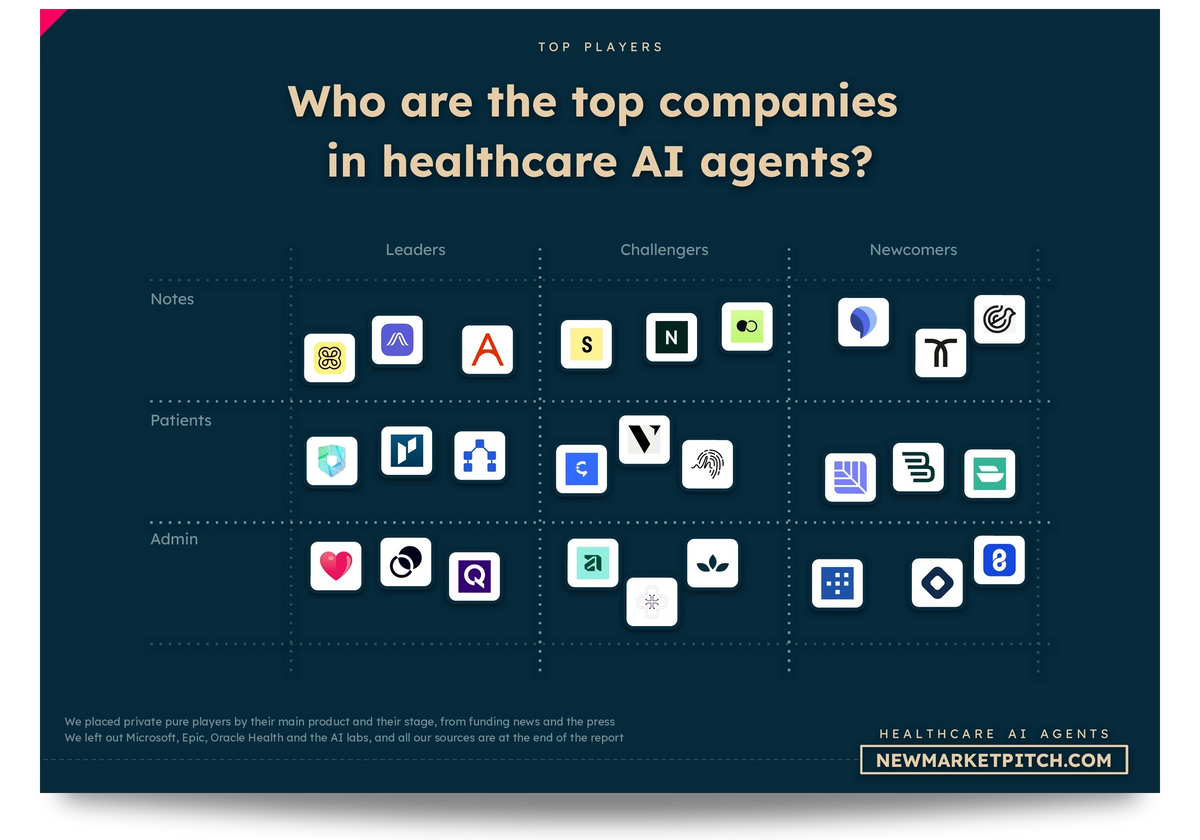
In our document detailing everything you need to know about healthcare AI agent, we turn what is vague and complex into simple, useful visuals. Market maps like this one show you at a glance where every startup stands.
Our methodology
This analysis examines whether healthcare AI agents can build profitable businesses selling to financially constrained US hospitals. Rather than assuming that strong demand for automation translates into an attractive market, we broke the question into its main commercial dimensions: hospital purchasing capacity, operational savings, revenue recovery, actual adoption, vendor economics, implementation costs, and competitive pressure.
For each dimension, we examined recent evidence from hospital financial reports, healthcare purchasing surveys, clinical research, enterprise deployment announcements, company operating disclosures, and public financial filings. We aggregated the most relevant observations, assessed what each demonstrated, and compared findings across different applications, vendors, and hospital environments. Our conclusions come from connecting those individual assessments rather than extrapolating from a few successful deployments.
Hospital purchasing capacity is assessed against operating profitability, not revenue alone. We used Kaufman Hall's hospital margin data alongside American Hospital Association research and rural hospital financial assessments to distinguish large health systems with meaningful investment capacity from smaller institutions under greater financial pressure. Purchasing intentions and reported AI adoption are treated separately from signed contracts and realized vendor revenue.
To evaluate economic value, we distinguished incremental net collections, avoided administrative costs, faster reimbursement, clinician productivity, and improvements in working conditions. These outcomes cannot simply be added together. In particular, prevented claim denials are not automatically new revenue, documentation time savings are not automatically payroll savings, and vendor-reported automation volumes do not establish realized customer profits.
Our operating scenarios use explicit assumptions to test how relatively small changes in collections or administrative workloads can affect hospital economics. They are illustrations, not reported deployment averages. We also separated customer returns from vendor profitability, accounting for integration, AI infrastructure, supervision, implementation, and support. Waystar serves as a mature healthcare software profitability reference, not a direct proxy for the margins of AI-native startups.
We assessed commercial scalability through deployment breadth, repeatability of integrations, workflow complexity, pricing models, incumbent distribution, and evidence of customer expansion. Company-reported operational outcomes were considered alongside independent research, with particular attention to whether the available evidence demonstrates an actual financial result or primarily indicates adoption and technical capability.
Key sources include Kaufman Hall's hospital financial analysis, its March 2026 hospital performance update, the American Hospital Association's 2026 Environmental Scan, the Center for Healthcare Quality and Payment Reform's rural hospital assessment, the AHA's hospital cost report, Oliver Wyman's 2026 revenue cycle research, and Experian Health's State of Claims survey.
For deployment and technology evidence, we used Abridge's enterprise adoption report, Ambience Healthcare's MultiCare deployment announcement, its Series C disclosure, AKASA's autonomous coding research and product disclosures, Infinitus's healthcare communications activity report, the 2025 JAMA Network Open multicenter ambient AI study, and the randomized crossover study published in the Journal of the American Medical Informatics Association.
For established-vendor economics and competitive positioning, we drew on Waystar's full-year 2025 financial results, its agentic AI announcement, its 2026 regulatory filing, and Imprivata's research on healthcare AI governance. These sources help distinguish the economic characteristics of mature healthcare software platforms from the less transparent profitability of venture-backed AI startups.
The resulting assessment gives more weight to verified financial improvements, repeatable enterprise adoption, predictable revenue, and sustainable operating economics than to funding rounds, announced partnerships, or claimed automation potential. Our conclusion reflects the combined evidence across hospital budgets, customer outcomes, vendor cost structures, and competitive dynamics, with the strongest commercial case assigned to workflows where both value creation and value capture can be measured.

Our report covering the healthcare AI agent market gets updated several times a month, so you always get the latest view of where things stand.
Written by the New Market Pitch teamWe track new markets so founders and investors can move faster. About us