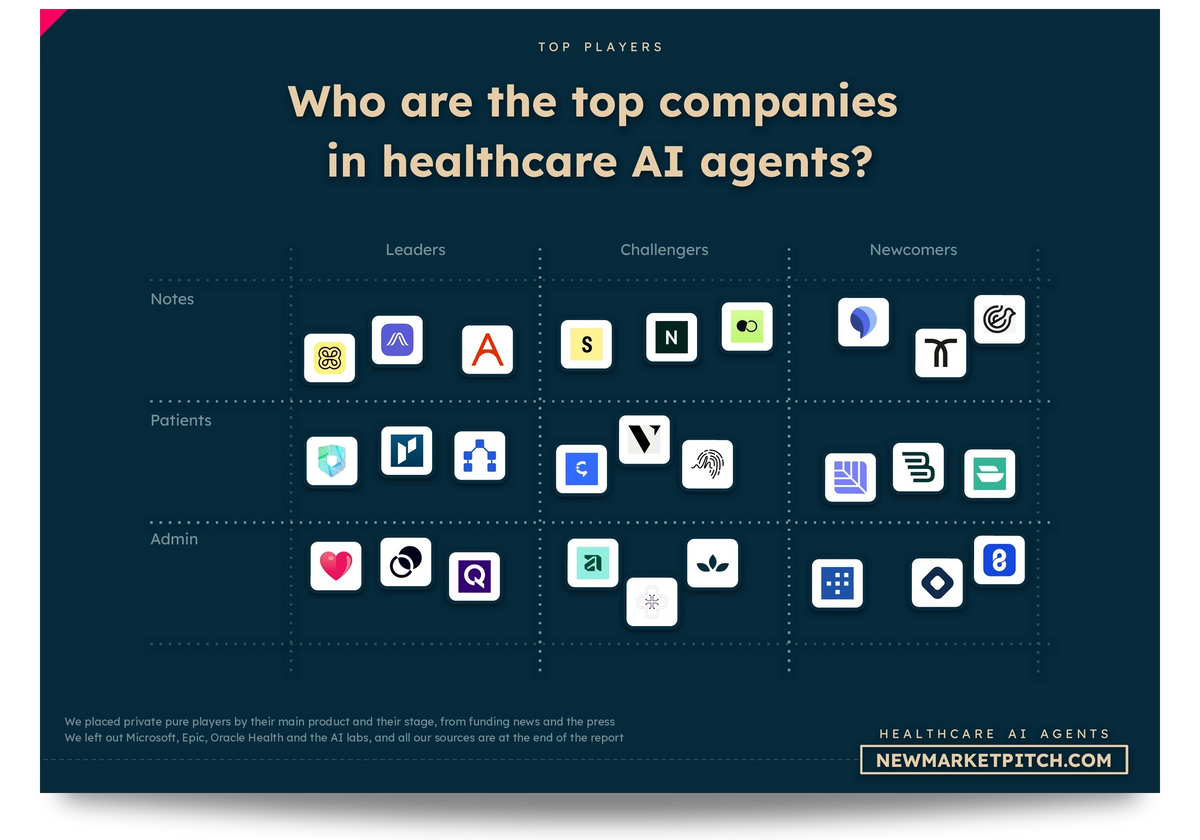
Who are the top healthcare AI startups beyond scribes?
Whether you're building or investing in the healthcare AI agent market, our report covers everything you need to know: the players, the money, and what's coming next.
Summary
Viz.ai, Aidoc, Qventus, CodaMetrix, Hippocratic AI, and OpenEvidence are the top independent healthcare AI startups beyond medical scribes. Viz.ai leads in clinical care coordination, while the others have established strong positions in imaging, hospital operations, medical coding, patient-facing agents, and physician decision support.
Healthcare AI is developing into several distinct businesses. Detecting a stroke, filling an operating room, coding a medical claim, and answering a doctor's clinical question require different technology, customer relationships, and evidence of success. Comparing these companies by valuation alone tells us very little.
Viz.ai has the strongest overall clinical platform position, with deployments across 2,000 hospitals, more than 50 AI-enabled care pathways, and over 125 peer-reviewed publications. Its advantage increasingly comes from expanding across specialties through an established hospital network, rather than relying on its original stroke detection product.
Aidoc is Viz.ai's closest major competitor in imaging-centered clinical AI, with 31 reported FDA clearances as of April 2026. But a real-world study covering more than 67,000 CT examinations found meaningful differences in sensitivity across its pulmonary embolism algorithms. Regulatory breadth and clinical performance are not interchangeable.
Qventus has one of the clearest economic arguments in the sector. At Erlanger Health System, its software reportedly helped generate 220 additional surgical cases per month, with break-even in less than three months and a projected fivefold annualized return. Hospital operations may offer a more immediately measurable AI business case than some diagnostic applications.
CodaMetrix and AKASA have secured substantial positions in medical coding. CodaMetrix's customers represent approximately $180 billion in annual net patient revenue, while AKASA reports a footprint covering roughly one in ten U.S. inpatient discharges. These are measures of customer reach, not revenue processed or earned, and neither establishes which vendor leads financially.
Hippocratic AI reported more than 250 million patient interactions by August 2026, making it a major player in healthcare voice agents. Its deployments focus on structured, non-diagnostic patient communication rather than replacing nurses. The next test is whether that volume produces independently measurable improvements in adherence, readmissions, and patient safety.
OpenEvidence may have the most unusual distribution advantage. It reportedly reached more than two-thirds of U.S. physicians and secured a $15 billion valuation in September 2026. Its free professional-access model can build physician habits before hospitals make purchasing decisions, although public revenue and clinical outcome evidence remain limited.
Radiology is becoming a harder market for single-purpose startups. Aidoc, Qure.ai, and Gleamer are broadening their portfolios while GE HealthCare and Siemens Healthineers can integrate AI into existing imaging relationships. Startups with deep clinical workflow integration are better positioned than vendors selling one easily replicated detection feature.
Public companies reveal both the potential and the costs of healthcare AI. Tempus generated approximately $1.27 billion in 2025 revenue, largely from diagnostics, while Heartflow reported $176 million in revenue and an operating loss. The likely long-term winners are those combining sustained clinical adoption with measurable outcomes, durable revenue, and economics that improve as deployments scale.

Written by the New Market Pitch teamWe track new markets so founders and investors can move faster. About us

In our report covering the healthcare AI agent market, we turn what is vague and complex into simple, useful visuals. Market maps like this one show you at a glance where every startup stands.
Has healthcare AI finally moved beyond medical scribes?
Healthcare AI has already moved well beyond medical scribes, with companies such as Viz.ai, Aidoc, Qventus, and Hippocratic AI building sizeable businesses around disease detection, hospital operations, and patient care.
Medical scribes became popular because they solve an obvious problem: doctors spend too much time writing notes. But some of the biggest opportunities in healthcare AI involve much more expensive problems, including delayed diagnoses, operating rooms sitting empty, coding errors, and patients who never receive the follow-up care they need.
The commercial evidence is getting harder to ignore. Viz.ai now reports deployments across 2,000 hospitals, Qventus has helped one health system add 220 surgical cases per month, and Hippocratic AI reported more than 250 million patient interactions in August 2026. Publicly listed Tempus, meanwhile, generated $1.27 billion in 2025 revenue from its diagnostics and data businesses.
These figures measure different things, so we cannot use them to produce a straightforward revenue ranking. Still, they show how far the sector has developed. Some companies have reached large clinical networks, others have demonstrated concrete financial benefits, and a few are building products that physicians use directly.
The more interesting question is which of these businesses have established an advantage that hospitals, insurers, and larger technology companies will struggle to reproduce.
Who are the biggest healthcare AI startups beyond scribes right now?
Viz.ai, Aidoc, Qventus, CodaMetrix, Hippocratic AI, and OpenEvidence are our strongest candidates for the top independent healthcare AI startups beyond scribes.
Viz.ai and Aidoc have built substantial positions in clinical AI, particularly disease detection and care coordination. Qventus focuses on hospital efficiency, while CodaMetrix handles medical coding. Hippocratic AI has become a prominent provider of patient-facing voice agents, and OpenEvidence has attracted widespread physician adoption with its AI medical research assistant.
We would also include Qure.ai, AKASA, and Gleamer among the specialists worth watching. Their businesses address narrower problems, but those problems can be large enough to support substantial companies.
The important distinction is how much each startup has proved. Viz.ai has a large hospital network and published clinical research. Qventus can point to operational results. OpenEvidence has reported exceptional physician adoption, although its revenue and clinical impact are harder to assess publicly.
We also separate private startups from companies that have already gone public. Tempus and Heartflow offer useful financial benchmarks, while Freenome became publicly traded in July 2026. PathAI entered an acquisition agreement with Roche in May 2026.
| Company | Main activity | Concrete evidence | Our assessment |
|---|---|---|---|
| Viz.ai | Clinical AI and care coordination | 2,000 hospitals | Leading clinical platform |
| Aidoc | Imaging and acute-care AI | 31 FDA clearances reported in April 2026 | Leading imaging specialist |
| Qventus | Hospital operations | 220 additional monthly surgical cases at Erlanger | Strong operational ROI |
| CodaMetrix | Autonomous medical coding | Customers representing $180B in patient revenue | Leading coding specialist |
| Hippocratic AI | Patient-facing voice agents | 250M+ reported patient interactions | Major agentic AI contender |
| OpenEvidence | AI medical research assistant | Reported $15B valuation | Major physician-facing platform |
| Qure.ai | Radiology and disease screening | 26 FDA-cleared chest X-ray indications reported | Strong international specialist |
| AKASA | Inpatient coding and revenue cycle | Customer footprint covering roughly 10% of U.S. inpatient discharges | Established specialist |
| Gleamer | Medical imaging AI | Expanded imaging portfolio and international deployments | Imaging contender |
If you want more recent data on this point, please see our latest healthcare AI agents market report.

Our research about AI agents in healthcare gets updated several times a month, so you always get the latest view of where things stand.
Is Viz.ai the strongest clinical AI startup today?
Viz.ai has the strongest overall claim to leadership among independent clinical AI startups because it combines a large hospital network, published research, and a growing number of medical applications.
In July 2026, Viz.ai reported that its technology was deployed across 2,000 hospitals serving a combined population of approximately 230 million people. The company also reported more than 50 AI-enabled care pathways and over 125 peer-reviewed publications.
The 230 million figure needs some context. It describes the population served by hospitals in the network, rather than patients personally diagnosed or treated using Viz.ai.
What makes Viz.ai particularly interesting is how far the business has moved from its original stroke detection product. In January 2025, the company reported a footprint of 1,700 hospitals and relationships with 10 pharmaceutical companies. By January 2026, it had reached nearly 2,000 hospitals and expanded to 13 life sciences partnerships.
That means its reported hospital footprint increased by roughly 18% in about a year, while its pharmaceutical partnership count grew by 30%. The company also said its life sciences business doubled over the preceding 18 months.
Viz.ai is using its existing clinical network to introduce tools for cardiology, oncology, pulmonology, and other medical specialties. Its collaboration with Novartis on prostate and breast cancer workflows is one example.
Viz.ai also reported that its healthcare business achieved profitability in 2025, although it has not published enough financial detail to independently assess that claim.
For now, we put Viz.ai first in clinical care coordination. Its hospital distribution is difficult for a younger competitor to match, and the growing number of applications makes that network more useful over time.
Can Aidoc actually catch Viz.ai in clinical AI?
Aidoc is probably Viz.ai's closest major competitor in imaging-centered clinical AI, but the two companies are increasingly building different businesses.
Aidoc concentrates on analyzing medical images, identifying potentially urgent findings, and alerting the appropriate clinical teams. In April 2026, the company raised $150 million in Series E funding and was reported to have accumulated 31 FDA clearances.
The breadth of its regulatory portfolio is impressive, particularly when compared with younger imaging startups that have only one or two authorized products.
Aidoc has also expanded internationally. Germany's Asklepios hospital group rolled out its technology across 28 hospitals, representing approximately 35,000 CT and X-ray examinations per month.
But counting FDA clearances is a poor substitute for examining clinical performance.
A multi-site study published in September 2026 evaluated two Aidoc pulmonary embolism algorithms across 17 healthcare facilities. The researchers examined more than 67,000 CT examinations and found sensitivity of 86.8% for the dedicated pulmonary embolism model and 73.5% for the incidental embolism model. Specificity exceeded 99% for both.
The findings also showed lower sensitivity for certain peripheral and non-acute embolisms. Real-world performance was weaker than some regulatory validation benchmarks.
That study gives us a more useful picture of Aidoc than another product announcement would. Its technology is being used in demanding clinical environments, but performance varies by application and patient population.
Viz.ai remains ahead in the breadth of its care-coordination network. Aidoc looks especially strong where the clinical workflow begins with medical imaging. We would put both near the top rather than pretend one is clearly winning every part of clinical AI.
If you want more recent data on this point, please see our latest healthcare AI agents market report.

In our market report about AI agents in healthcare, we look at what the winners do differently, so you can learn from the best instead of guessing.
Is OpenEvidence becoming the ChatGPT for doctors?
OpenEvidence has become one of the most prominent AI tools designed specifically for physicians, with reported adoption reaching more than two-thirds of U.S. doctors.
The company helps clinicians search medical literature, examine evidence, and answer questions about diagnoses and treatments. That makes it quite different from medical scribes, which mainly automate documentation.
Its financial rise has been extraordinary. Business Insider reported that OpenEvidence raised $250 million in September 2026 at a $15 billion valuation, up from $12 billion in January.
The increase represents a 25% valuation gain in roughly eight months. More importantly, the company has reportedly raised over $1 billion during the past year, showing how aggressively investors are backing its distribution among doctors.
Physician adoption is the critical part of the story, although we still need to distinguish occasional use from regular reliance. Two-thirds of physicians having used OpenEvidence would be an exceptional reach, but it would tell us much less about daily engagement or changes in medical decisions.
OpenEvidence also has an unusual business model. It offers its core service to verified medical professionals without the conventional per-seat hospital subscription, while developing monetization around its professional audience.
That creates an opportunity to become a default medical information tool before hospitals formally standardize their AI purchasing.
We consider OpenEvidence one of the most important healthcare AI companies to watch, especially in physician decision support. Its $15 billion valuation is much easier to verify than its underlying economics, however. Until we have clearer revenue, retention, and clinical outcome data, its commercial position deserves a different level of confidence from Viz.ai's established hospital network.
Is Qventus the healthcare AI startup with the clearest return on investment?
Qventus has one of the clearest financial cases in healthcare AI because its software helps hospitals perform more procedures and make better use of existing resources.
The company automates tasks involving surgical scheduling, operating room capacity, patient flow, and related hospital operations.
An especially useful example comes from Erlanger Health System. In February 2026, Qventus reported that its deployment across four Erlanger sites had helped generate 220 additional surgical cases per month compared with the previous year.
The same deployment reportedly created nearly 12 additional operating room hours per room each month. Erlanger reached break-even in less than three months and was on track for a fivefold annualized return on investment.
At a sustained rate of 220 additional monthly procedures, that would represent approximately 2,640 extra surgical cases per year. Actual financial gains depend on reimbursement, case mix, staffing, and operating costs, so case growth should not be confused with profit.
There is also evidence that this is part of a longer commercial effort. In January 2025, Qventus raised $105 million in financing led by KKR and reported helping hospital partners eliminate more than 36,000 excess inpatient days over the preceding year.
Both findings are company-reported, and broader independent studies would strengthen the case. But the pattern is encouraging: Qventus has helped hospitals reduce unnecessary inpatient time and increase the use of surgical capacity.
Those are tangible reasons to keep paying for the software.
For hospitals facing staffing constraints and pressure on margins, Qventus currently has one of the most straightforward economic arguments among healthcare AI startups.
If you want more recent data on this point, please see our latest healthcare AI agents market report.

In our document detailing everything you need to know about healthcare AI agent, you will always find fresh funding data, taken straight from our own verified funding database.
Can CodaMetrix and AKASA take over medical coding?
CodaMetrix and AKASA are serious contenders to automate large parts of medical coding, although complex inpatient records and reimbursement disputes will continue to require human oversight.
Medical coding determines how procedures, diagnoses, and other services are represented in claims sent to insurers. Mistakes can delay payment, create compliance problems, or lead to lost revenue.
CodaMetrix reported in June 2025 that its customers represented roughly $180 billion in annual net patient revenue, or about 12% of the U.S. total under the company's calculation.
That is a measure of customer footprint. It does not mean CodaMetrix processes $180 billion in claims or generates anything close to that amount in revenue.
AKASA has separately reported that its customer footprint represents approximately one in ten U.S. inpatient discharges.
Together, these disclosures suggest that AI coding vendors have entered a meaningful part of the American hospital market. Their footprints may overlap, so adding the percentages together would exaggerate the combined reach.
The companies approach the problem differently. CodaMetrix has developed autonomous coding tools across specialties including radiology and pathology. AKASA has emphasized complex inpatient coding and clinical documentation integrity.
An interesting development came in June 2026, when CodaMetrix launched a Coding Quality Council to establish clearer standards for assessing coding performance.
The underlying problem is that a claimed 95% coding accuracy rate can mean very different things depending on whether the company measures individual codes, entire encounters, or financially material errors.
For us, the useful comparison is the share of cases completed without human intervention, the frequency of coding corrections, and the effect on reimbursement and claim denials.
CodaMetrix currently stands out for its broad autonomous coding ambition, while AKASA has a strong position in complex inpatient workflows. Neither company's publicly disclosed figures are enough to establish a clear revenue leader.
Is Hippocratic AI actually replacing nurses with AI agents?
Hippocratic AI has become a major healthcare voice-agent company, but its current deployments mainly automate structured patient communication rather than the full responsibilities of nurses.
Its agents handle activities such as patient outreach, medication reminders, chronic-care follow-up, appointment coordination, and information gathering. The company has deliberately focused on non-diagnostic applications rather than allowing agents to prescribe treatments or independently diagnose patients.
The scale has developed quickly. Hippocratic AI reported more than 150 million patient interactions in January 2026. By August, that figure had exceeded 250 million.
That is an increase of at least 100 million interactions over roughly seven months, equivalent to more than 14 million additional interactions per month on average during the interval.
Interaction counts can include repeated conversations with the same patients, so they tell us little about unique patient numbers. Nevertheless, that volume shows the company has moved far beyond small demonstrations.
Hippocratic AI also raised $126 million in November 2025 at a $3.5 billion valuation.
In August 2026, it introduced a system of coordinated agents designed to manage broader processes such as readmission reduction, chronic disease management, and clinical trial enrollment. The company wants to move from individual phone calls toward managing complete patient outreach programs.
Whether those programs consistently improve medical outcomes remains less clear. We still need independently validated evidence on patient safety, escalation failures, adherence, and changes in readmission rates.
Hippocratic AI deserves a place among the leading healthcare AI startups for its commercial deployment scale. Calling it a replacement for nurses would go much further than the available evidence supports.

Learning from others' mistakes is the cheapest lesson there is. In our report covering the healthcare AI agent market, we look at what broke startups before you, so you don't repeat it.
Which healthcare AI startups have actually proved their technology works?
Viz.ai, Aidoc, and publicly listed Heartflow have some of the more substantial clinical evidence bases among prominent healthcare AI companies. But the strength of that evidence varies by product, medical condition, and study design.
Viz.ai has reported more than 125 peer-reviewed publications across its expanding set of clinical applications. Its research includes studies on stroke treatment coordination and earlier identification of cardiovascular conditions.
Heartflow provides another useful comparison. Its technology analyzes coronary CT scans to help clinicians assess coronary artery disease. The company had 1,465 installed U.S. accounts at the end of 2025 and generated $176 million in annual revenue, up 40%.
Aidoc's pulmonary embolism study, discussed earlier, shows why independent real-world testing matters. A regulatory clearance establishes that a device met the applicable authorization requirements, but it does not guarantee identical performance across every hospital or patient group.
For companies outside diagnostics, we need different evidence. Qventus should be assessed through hospital capacity and financial results. CodaMetrix needs rigorous coding accuracy and denial-rate data. Hippocratic AI needs patient safety and treatment-adherence outcomes.
We cannot responsibly collapse these different measures into one clinical performance score.
| Company | Evidence worth examining | Reported benchmark | What it establishes |
|---|---|---|---|
| Viz.ai | Clinical studies | 125+ peer-reviewed publications | Broad research base |
| Aidoc | Real-world diagnostic studies | 67,000+ CT examinations in one multi-site study | Performance across clinical settings |
| Heartflow | Clinical adoption and reimbursement | 1,465 U.S. accounts | Established diagnostic usage |
| Qventus | Hospital operational results | 220 additional monthly surgeries at Erlanger | Measured customer benefit |
| CodaMetrix | Coding deployments | $180B customer revenue footprint | Enterprise distribution |
| AKASA | Inpatient workflow adoption | Roughly 10% of U.S. inpatient discharges represented | Customer reach |
| Hippocratic AI | Patient-agent activity | 250M+ interactions | Large reported usage volume |
| OpenEvidence | Physician adoption | More than two-thirds of U.S. doctors reportedly reached | Broad professional distribution |
Is radiology AI becoming too crowded for startups?
Radiology AI is already crowded, and younger startups will have a harder time winning customers with a single image-analysis algorithm.
Radiology accounts for the largest share of FDA-authorized AI medical devices. The agency's published device lists show a heavy concentration in this specialty, reflecting how well image-based medical tasks fit machine learning.
Startups including Aidoc, Qure.ai, Gleamer, and Subtle Medical compete across different parts of medical imaging. At the same time, GE HealthCare and Siemens Healthineers can distribute AI capabilities through equipment and software relationships that hospitals already use.
Qure.ai illustrates how startups are responding. In February 2026, the company reported that its chest X-ray portfolio had reached 26 FDA-cleared indications, following authorization for six additional findings.
That gives it a broader clinical offering than a vendor specializing in one abnormality.
Gleamer has also built a wider portfolio around radiology workflows, particularly musculoskeletal imaging and other diagnostic applications.
The problem for smaller companies is that hospitals do not necessarily want separate procurement contracts, interfaces, and technical support for every algorithm. A useful feature included in an existing imaging platform could be more attractive than another standalone subscription.
We think radiology remains a strong market for companies that can become part of everyday imaging workflows. The weaker position belongs to vendors whose entire advantage depends on detecting one finding slightly better than competing tools.
If you want more recent data on this point, please see our latest healthcare AI agents market report.

Your time is limited. In our research about AI agents in healthcare, we put numbers on each part of the market, so you can see where it makes sense to focus.
Which healthcare AI startups could become major cancer diagnostics companies?
Healthcare AI companies working on cancer detection and precision medicine have some of the strongest long-term opportunities, particularly when their models are connected to validated tests, laboratory infrastructure, and clinical data.
Tempus offers the clearest public financial example. Its revenue reached $1.272 billion in 2025, although that includes diagnostics and data services rather than pure AI software.
In the second quarter of 2026, Tempus reported $382.5 million in revenue, up 22% year over year. Diagnostics accounted for $289.3 million, while Data and Applications contributed $93.2 million.
That means approximately 76% of quarterly revenue came from diagnostics and 24% from data and applications. The business is still driven primarily by testing, even as its data products expand.
Tempus also reported 31% annual growth in oncology testing volume and signed approximately $200 million in new Data and Applications licenses during the quarter.
Freenome has taken a different route. In July 2026, the FDA approved its SimpleScreen CRC blood test for colorectal cancer screening among average-risk adults aged 45 and older. Abbott is responsible for U.S. commercialization, and Freenome became publicly traded that same month.
The FDA decision was a major commercial milestone. Yet the company's updated clinical validation results showed 80.4% sensitivity for colorectal cancer and 18.2% sensitivity for advanced precancerous lesions. Detecting existing cancer and identifying precancerous lesions are two different clinical benefits, and the gap is substantial.
PathAI demonstrates a third route through digital pathology and pharmaceutical development. Roche signed an agreement to acquire PathAI in May 2026 after several years of collaboration.
Each requires substantial clinical development and regulatory work. Those requirements slow growth, but they also make successful products harder for general-purpose AI companies to reproduce.
Can healthcare AI startups survive Epic, Oracle, and the big medical technology companies?
Independent healthcare AI startups can survive competition from Epic, Oracle, GE HealthCare, and Siemens Healthineers, but companies selling easily copied features face a much tougher future.
Established healthcare vendors already control much of the technology doctors and hospitals use every day. Epic and Oracle are deeply involved in electronic health records, while GE HealthCare and Siemens Healthineers have established distribution networks in medical imaging.
That gives the incumbents an obvious advantage. Hospitals may choose a capable AI feature bundled into an existing platform rather than pay for another vendor.
However, some independent startups have already built positions that would take years to reproduce.
Viz.ai's reach across hospitals and pharmaceutical partnerships creates opportunities that extend beyond individual algorithms. Aidoc has accumulated regulatory authorizations and expertise in acute imaging workflows. Qventus has built tools that connect directly to hospital scheduling and capacity management.
We can also see another possible outcome in Roche's agreement to acquire PathAI. Rather than build every digital pathology capability internally, Roche chose to acquire a specialist it had worked with since 2021.
The companies facing the greatest pressure are likely to be those offering generic documentation, summarization, or basic image interpretation without proprietary workflows or strong customer relationships.
For the leading clinical and operational specialists, the question is whether their products keep delivering enough additional value to justify a separate contract.

In our market report about AI agents in healthcare, we always try to gather several sources and make estimates that make sense, so you can work with solid numbers.
Are healthcare AI startup valuations getting ahead of actual revenue?
Healthcare AI valuations have risen dramatically for some companies, but the public financial evidence is still too limited to conclude that the highest-valued startups have the strongest businesses.
OpenEvidence reached a reported $15 billion valuation in September 2026. Hippocratic AI raised financing at a $3.5 billion valuation in November 2025.
Those figures reflect investor expectations about future growth. Neither company has published comprehensive financial statements that would allow us to calculate reliable revenue multiples or operating margins.
We get a better sense of healthcare AI economics from public companies.
Heartflow generated $176 million in revenue in 2025, up from approximately $126 million in 2024 and $87 million in 2023. Revenue therefore roughly doubled over two years.
Its gross margin improved to 76.8% in 2025, but operating expenses reached approximately $199 million, exceeding the year's revenue. The company reported an operating loss of about $64 million.
Those numbers show that a healthcare AI business can achieve substantial revenue growth and strong gross margins while still spending heavily on product development and commercialization.
Tempus has a larger revenue base, but its economics are influenced by diagnostics and acquisitions. Its second-quarter 2026 results showed positive GAAP net income of $5.6 million, helped by $98.5 million in unrealized investment gains. That accounting result should not be mistaken for a comparable amount of recurring operating profit.
The private companies that deserve particular attention are therefore those connecting adoption with tangible business results. Qventus has reported customer-level financial returns, while Viz.ai has reported profitability in its healthcare business.
We are more confident that these companies have established commercial demand than we are about the revenue multiples implied by the valuations of newer physician and patient-agent platforms.
If you want more recent data on this point, please see our latest healthcare AI agents market report.
What could stop healthcare AI startups from growing much bigger?
The biggest constraint on healthcare AI startups is whether they can maintain clinical reliability and financial value once their products are used across thousands of hospitals and millions of patient interactions.
In diagnostics, accuracy can vary with patient characteristics, disease prevalence, imaging protocols, and clinical environments. A product that works well during validation may need continued monitoring after deployment.
Patient-facing agents bring different risks. Hippocratic AI's non-diagnostic restrictions reduce some exposure, but errors in medical communication or inappropriate escalation can still affect patient safety.
Revenue-cycle companies also face complex real-world requirements. Coding rules change, insurers dispute claims, and hospitals produce medical records with varying levels of completeness. A high accuracy score on a controlled dataset is only a starting point.
Security and governance are another concern. An Imprivata survey released in October 2026 reported that 72% of surveyed healthcare leaders had observed AI tools being used without formal IT approval.
That illustrates how quickly adoption can run ahead of hospital oversight.
We expect companies with substantial implementation teams, regulatory expertise, and ongoing validation processes to be better equipped to handle these problems. Smaller startups may struggle with the cost of supporting numerous complex deployments.
Healthcare AI products often become harder to operate as their customer base expands. Winning a pilot is much easier than maintaining consistent performance across hundreds of different clinical environments.

If you build or invest in the healthcare AI agent market, you need to know which business models pay off now and which ones are fading. That's why our report covering it has a whole section on it.
Who are the top healthcare AI startups beyond scribes, ultimately?
Viz.ai, Aidoc, Qventus, CodaMetrix, Hippocratic AI, and OpenEvidence currently stand out as the top independent healthcare AI startups beyond medical scribes. Viz.ai is our overall leader in clinical care coordination, while the other five lead or seriously challenge within their respective specialties.
The evidence behind those positions varies considerably.
Viz.ai has the strongest combination of a large clinical network, published research, and a broadening product portfolio. Aidoc is a leading competitor in medical imaging, although real-world studies show that performance still varies by task.
Qventus has demonstrated unusually concrete financial results for a hospital AI vendor. CodaMetrix has established a substantial customer footprint in autonomous coding. Hippocratic AI has reached remarkable interaction volumes, while OpenEvidence has built one of the most widely adopted physician-facing AI products.
We would put Qure.ai and AKASA in the next group of important specialists. Tempus and Heartflow provide useful commercial benchmarks as public companies, while PathAI's agreement with Roche shows what can happen when specialist healthcare AI becomes strategically valuable to an established diagnostics business.
The distinction we would make is between proven deployment and proven outcomes. Large customer networks and high usage volumes are evidence of adoption. Clinical studies, revenue disclosures, and measured financial benefits provide a stronger basis for assessing lasting business value.
Viz.ai has the most convincing overall position among independent clinical AI platforms. Qventus stands out for measurable hospital economics, and OpenEvidence and Hippocratic AI are among the companies with the greatest potential to reshape how healthcare professionals and patients interact with AI.
There is no universal winner across healthcare AI because diagnosing a stroke, managing hospital capacity, and answering a doctor's medical question involve different customers, risks, and business models.
But the leading companies are already clear enough to identify. The next major separation will come from which ones can turn their impressive adoption figures into repeatable clinical benefits, durable revenue, and profitable growth.
Our methodology
This analysis identifies the leading independent healthcare AI startups beyond medical scribes by comparing their clinical deployment, commercial adoption, product validation, business economics, and competitive positions. We examine companies working in clinical decision support, medical imaging, hospital operations, medical coding, patient communication, and diagnostics. Publicly traded companies such as Tempus and Heartflow are included as financial and clinical benchmarks rather than ranked alongside private startups.
Our selection is based on a structured aggregation of recent evidence across six dimensions: market positioning, commercial adoption, clinical and operational validation, business economics, competitive durability, and strategic momentum. For each dimension, we collected recent developments from healthcare providers, company announcements, regulatory records, clinical research, financial filings, financing disclosures, and strategic transactions. We then aggregated comparable findings, assessed their strength and limitations, and used the accumulated evidence to reach broader conclusions about company leadership.
We distinguished carefully between different measures of scale. Hospital deployments, populations served, medical examinations, patient interactions, physician adoption, and customer revenue footprints describe different activities and cannot be added together or treated as equivalent to company revenue. The 230 million people associated with Viz.ai's hospital network, CodaMetrix's $180 billion customer revenue footprint, and Hippocratic AI's 250 million reported interactions are therefore assessed within their respective business contexts.
Clinical and operational evidence was evaluated according to the application being assessed. For diagnostic AI, we considered regulatory clearances, peer-reviewed research, real-world performance, and clinical implementation. For hospital operations and revenue-cycle automation, we examined reported efficiency improvements, financial benefits, coding performance, and customer reach. For physician assistants and patient-facing agents, we considered adoption and deployment while distinguishing usage volumes from independently established clinical outcomes. Company-reported results were treated as evidence of commercial activity, with greater weight assigned to externally validated findings where available.
We also compared recent developments with earlier disclosures to assess whether each company's position was strengthening. Viz.ai's hospital expansion, Aidoc's regulatory and international deployment progress, Qventus's reported operational improvements, and Hippocratic AI's increasing interaction volumes were examined alongside financing and product expansion. For business economics, publicly reported results from Tempus and Heartflow provided reference points for revenue scale, margins, operating losses, and the cost of commercializing healthcare AI.
We did not assign an artificial numerical score or equate valuation with leadership. Companies were compared directly where their products and metrics were genuinely comparable, then assessed across their respective specialties. The final selection reflects the strength of each company's accumulated evidence, including clinical integration, distribution advantages, measurable customer benefits, regulatory expertise, and the likelihood that its position can withstand competition from established healthcare technology providers.
Key sources include Viz.ai's July 2026 hospital network and clinical research disclosure, Viz.ai's 2025 commercial performance update, Aidoc's April 2026 Series E announcement, Qventus's Erlanger operational results, Qventus's surgical capacity case study, CodaMetrix's customer footprint disclosure, and AKASA's company disclosures.
Additional sources include Hippocratic AI's August 2026 patient-interaction and agent announcement, Hippocratic AI's Series C financing disclosure, the FDA database of authorized AI-enabled medical devices, the FDA's AI-enabled medical device regulatory resources, and Qure.ai's February 2026 chest X-ray authorization announcement.
Public-company financial benchmarks were drawn from Heartflow's 2025 financial results, its 2025 SEC annual filing, Tempus's full-year 2025 financial results, and Tempus's second-quarter 2026 results. Strategic and regulatory developments were checked against Roche's May 2026 PathAI acquisition announcement and the FDA approval record for Freenome's SimpleScreen CRC test. Together, these sources support the distinction between reported adoption, demonstrated clinical and operational value, and the longer-term commercial strength of healthcare AI startups.

In our report covering the healthcare AI agent market, we don't want to repeat what boring consulting reports say. Instead, we show you the real and latest market signals that matter.
Written by the New Market Pitch teamWe track new markets so founders and investors can move faster. About us