What are the top healthcare AI agent startups by revenue?
Whether you're building or investing in the healthcare AI agent market, our report covers everything you need to know: the players, the money, and what's coming next.
Summary
Heidi Health leads our healthcare AI agent revenue ranking with $50M of annual recurring revenue (ARR) as of April 2026. Suki follows on ~$20M in annual revenue for 2025, and Forus is third with a >$10M annualized run-rate as of December 2025. These figures describe different periods and measures, so the order is useful but not an audited like-for-like comparison.
Heidi's lead reflects more than enthusiasm for automatic notes. The Australian company began with clinical documentation and has extended toward clinical assistance and downstream workflows. Its September 2026 financing announcement described an ambition to move from summarizing consultations to supervised action across health systems.
Assort Health, often cited as the patient-access leader, is not ranked. Forbes estimated a $30M run-rate in June 2026, while CB Insights puts the business near $3M. Two estimates that far apart give an order of size, not a position. The company automates appointment scheduling and related patient interactions that previously consumed call-center staff time.
Suki adds a different kind of evidence: an annual revenue figure for a completed year, rather than ARR or a snapshot run-rate. Its reported scale is below Heidi's current ARR, but a past full-year revenue number is not a current revenue ceiling.
The remaining ranked companies cover clinician documentation and claims automation. Freed disclosed $10M of ARR without specifying a period, and Cair Health reported a smaller ARR minimum without a stated measurement date. Both figures come from the companies, so they rank, but at low confidence.
Many famous companies still leave us without a usable revenue figure. Abridge and Ambience Healthcare have analyst estimates but no qualifying independent confirmation. Their large healthcare partnerships and fundraising histories cannot substitute for recognized sales.
Other companies publicize contracts instead of sales. Artera.io disclosed contracted annual recurring revenue based on signed agreements, which can be different from revenue actually earned. Luma Health and Tennr have bookings measures. Those cannot be ranked against annual revenue.
Large deployment figures are informative but answer a different question. Tandem Health reports adoption across care organizations, Infinitus describes patients supported, and Nym reports facilities using its coding engine. None of those statements reveals what customers paid in a year.
The companies earn money in different ways. Heidi, Suki and Freed sell documentation and workflow assistance to clinicians, Forus works through medication access and pharmaceutical partners, while Cair Health sells tools for claims and billing operations. Revenue durability will depend on customer retention, workflow reliability and integration, not only model quality.
Healthcare AI agents are selling, but only a few startups disclose figures that support a clear revenue ranking. Heidi Health ranks first on the measures we can defend. Famous companies with undisclosed or weakly estimated figures remain visible without being assigned fictional positions.

Written by the New Market Pitch teamWe track new markets so founders and investors can move faster. About us

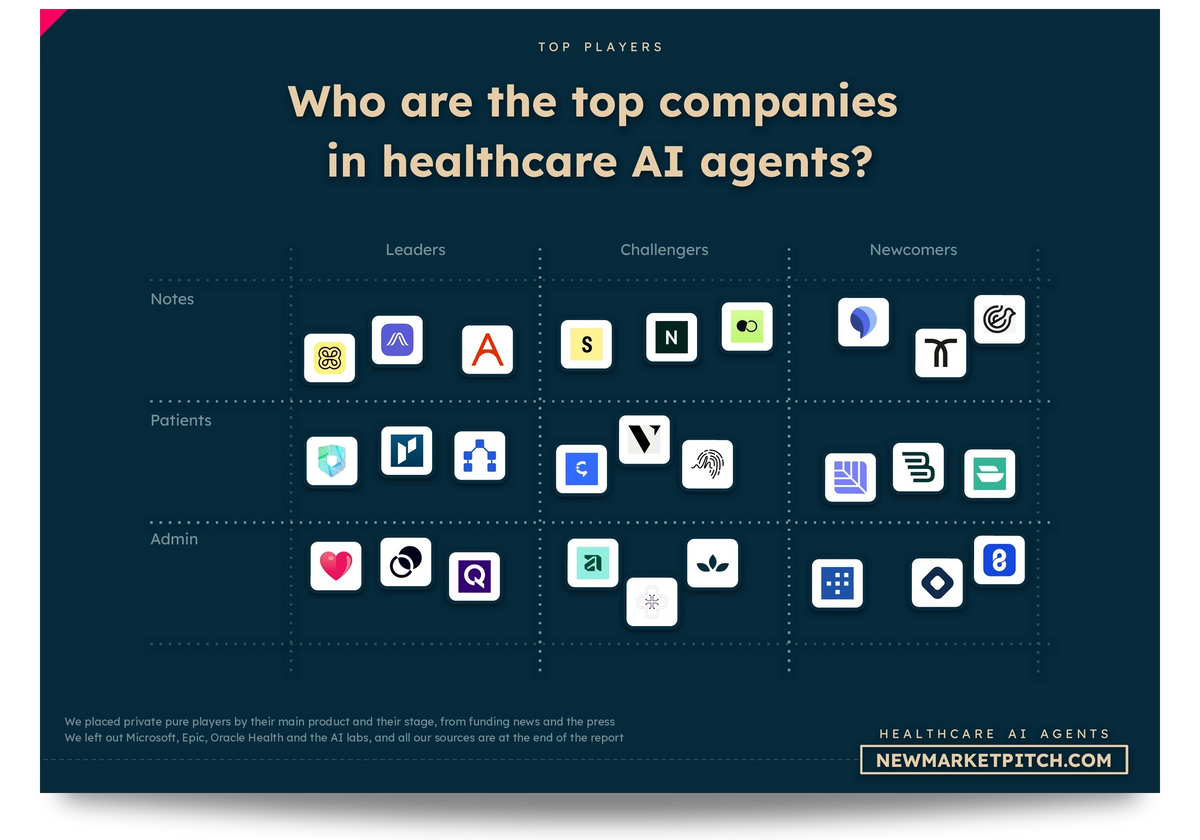
In our report covering the healthcare AI agent market, we turn what is vague and complex into simple, useful visuals. Market maps like this one show you at a glance where every startup stands.
The ranking of top startups in the healthcare AI agents market by revenue
Below is a table ranking the startups of this market by their current revenue scale. You can find our methodology at the end of this page.
If you want a deeper understanding of the market and its current dynamics, get our report on the healthcare AI agents market.
| Ranking | Company | Latest Metric | Metric Type | Freshness | Disclosed When | Source Quality | Confidence | Segment | Why This Ranking | Local Metric | Country |
|---|---|---|---|---|---|---|---|---|---|---|---|
| 1 | Heidi Health | $50M | ARR | Fresh · 7mo | Sep 22, 2026 | Company Disclosed | Medium | Clinical Documentation Agents | Heidi Health disclosed $50M of ARR as of April 2026. The fresh company figure annualizes recurring sales. It is not full-year recognized revenue. | au | |
| 2 | Suki | ~$20M | Annual Revenue | Fresh · 11mo | Oct 12, 2026 | Credible Reported | Medium | Clinical Documentation Agents | Axios reported ~$20M of annual revenue for 2025. This fresh completed-year figure ranks ahead of Forus, whose company figure is better documented but is a floor just above $10M. | us | |
| 3 | Forus | >$10M | Revenue Run-Rate | Fresh · 11mo | May 12, 2026 | Company Disclosed | Medium | Prior Authorization Agents | Forus disclosed a >$10M annualized revenue run-rate as of December 2025. The fresh minimum is not recognized full-year revenue. | us | |
| 4 | Freed | $10M | ARR | Period not stated · collected 25mo ago | Period not stated | Company Disclosed | Low | Clinical Documentation Agents | Freed disclosed $10M ARR in a founder interview collected October 2024, without a stated measurement period, so it ranks at low confidence, just below Forus. | us | |
| 5 | Cair Health | >$1M | ARR | Period not stated · collected this month | Period not stated | Company Disclosed | Low | Revenue Cycle Agents | Cair Health disclosed >$1M ARR on a company recruitment page collected November 2026. Its measurement period is not stated, so it ranks at low confidence. | us | |
| NR | SmarterDx | ~$150M | Annual Revenue | Period not stated · collected 3mo ago | Period not stated | Credible Reported | Medium | Revenue Cycle Agents | Axios Pro reported ~$150M of annual revenue, collected August 2026, but gave no measurement period. Only a company's own undated figure can rank, so this press figure stays unranked despite its scale. | us | |
| NR | Abridge | $100M | ARR | Fresh · 18mo | May 20, 2025 | Third-Party Estimate | Low | Clinical Documentation Agents | Sacra estimated $100M ARR as of May 2025. A single uncorroborated analyst estimate cannot establish a revenue rank. | us | |
| NR | Cohere Health | $100M | Annual Revenue | Aging · 23mo | 2026 | Third-Party Estimate | Low | Prior Authorization Agents | CB Insights estimated $100M of annual revenue for 2024. An uncorroborated automated company-data estimate is not ranked. | us | |
| NR | Candid Health | $57M | Annual Revenue | Period not stated · collected 1mo ago | Period not stated | Third-Party Estimate | Low | Revenue Cycle Agents | GetLatka/Growjo estimated $57M of annual revenue, collected October 2026, without a stated period. It is an uncorroborated automated estimate. | us | |
| NR | Notable | $42.5M | Annual Revenue | Historical · 35mo | Dec 1, 2023 | Third-Party Estimate | Low | Provider Operations Agents | GetLatka estimated $42.5M of annual revenue for 2023. This historical automated estimate does not qualify for ranking. | us | |
| NR | Ambience Healthcare | $30M | ARR | Fresh · 18mo | May 20, 2025 | Third-Party Estimate | Low | Clinical Documentation Agents | Sacra estimated $30M ARR as of May 2025. It is a single analyst estimate rather than corroborated sales evidence. | us | |
| NR | Nabla | $27.8M | Annual Revenue | Fresh · 11mo | Aug 10, 2026 | Third-Party Estimate | Low | Clinical Documentation Agents | GetLatka estimated $27.8M of annual revenue for 2025. An uncorroborated automated estimate remains unranked. | fr | |
| NR | Eleos Health | $15M–$37M | Annual Revenue | Fresh · 14mo | Oct 30, 2026 | Third-Party Estimate | Low | Clinical Documentation Agents | Third-party annual revenue estimates as of September 2025 conflict, giving $15M–$37M. The wide range is not a defensible rank. | us | |
| NR | Qventus | $21.8M | Annual Revenue | Historical · 35mo | Sep 10, 2026 | Third-Party Estimate | Low | Provider Operations Agents | GetLatka estimated $21.8M of annual revenue for 2023. The historical single-source estimate is not ranked. | us | |
| NR | Thoughtful AI | ~$17M | Annual Revenue | Fresh · 11mo | 2026 | Third-Party Estimate | Low | Revenue Cycle Agents | GetLatka estimated ~$17M of annual revenue for 2025. An uncorroborated automated estimate cannot fix its revenue position. | us | |
| NR | Hippocratic AI | $15.8M | Annual Revenue | Fresh · 11mo | Sep 2026 | Third-Party Estimate | Low | Patient Communication & Navigation Agents | GetLatka estimated $15.8M of annual revenue for 2025. The single automated estimate has no qualifying confirmation. | us | |
| NR | DeepScribe | ~$14.6M | Annual Revenue | Period not stated · collected 1mo ago | Period not stated | Third-Party Estimate | Low | Clinical Documentation Agents | GetLatka estimated ~$14.6M in annual revenue, collected October 2026, without stating a period. The automated estimate is unranked. | us | |
| NR | CodaMetrix | $14.5M | Annual Revenue | Historical · 35mo | Oct 5, 2026 | Third-Party Estimate | Low | Revenue Cycle Agents | GetLatka/Growjo estimated $14.5M in annual revenue for 2023. That historical single-source estimate is not ranked. | us | |
| NR | Rad AI | $13.4M | Annual Revenue | Historical · 35mo | Oct 5, 2026 | Third-Party Estimate | Low | Clinical Documentation Agents | GetLatka/Growjo estimated $13.4M in annual revenue for 2023. It is an uncorroborated historical estimate. | us | |
| NR | Corti | $13.3M | Annual Revenue | Period not stated · collected 1mo ago | Period not stated | Third-Party Estimate | Low | Clinical Documentation Agents | GetLatka estimated $13.3M of annual revenue, collected October 2026, with no measurement period. That alone cannot support ranking. | dk | |
| NR | Syllable | $10.7M | Annual Revenue | Period not stated · collected 1mo ago | Period not stated | Third-Party Estimate | Low | Patient Access & Scheduling Agents | GetLatka/Growjo estimated $10.7M of annual revenue, collected October 2026, without a period. Its automated estimate remains unranked. | us | |
| NR | Assort Health | $3M–$30M | Revenue Run-Rate | Very Fresh · 5mo | Jun 24, 2026 | Third-Party Estimate | Low | Patient Access & Scheduling Agents | Forbes estimated a $30M annualized revenue run-rate in June 2026 and CB Insights about $3M. Estimates that disagree this much give an order of size, not a rank. | us | |
| NR | Voize | $9.4M | Annual Revenue | Period not stated · collected 19mo ago | Period not stated | Third-Party Estimate | Low | Clinical Documentation Agents | GetLatka estimated $9.4M of annual revenue, collected April 2025, without a stated period. It lacks independent confirmation. | de | |
| NR | Hello Patient | $1.8M | Annual Revenue | Fresh · 14mo | Aug 10, 2026 | Third-Party Estimate | Low | Patient Communication & Navigation Agents | GetLatka estimated $1.8M of annual revenue for the year to September 2025. An uncorroborated automated estimate remains unranked. | us | |
| NR | Flagler Health | $164K | Annual Revenue | Period not stated · collected this month | Period not stated | Third-Party Estimate | Low | Provider Operations Agents | CB Insights estimated $164K of annual revenue without a stated period, collected November 2026. The figure is an automated estimate and remains unranked. | us | |
| NR | Tandem Health | 10K care organizations | Other Scale Signal | Very Fresh · 2mo | Sep 14, 2026 | Company Disclosed | Medium | Clinical Documentation Agents | Tandem reported 10K care organizations using its software as of September 2026. Organizational adoption is not revenue. | se | |
| NR | Tennr | ~$5–10M (bookings, not revenue) | Bookings | Aging · 23mo | 2024 | Credible Reported | Medium | Care Coordination Agents | The Information reported ~$5M to $10M in bookings for 2024. Bookings are not recognized revenue and cannot establish a rank. | us | |
| NR | Luma Health | ~$100M (bookings, not revenue) | Bookings | Period not stated · collected 3mo ago | Period not stated | Company Disclosed | Medium | Patient Access & Scheduling Agents | Mergermarket reported ~$100M in bookings, collected August 2026, with no stated period. Bookings are not revenue. | us | |
| NR | Artera.io | $100M (bookings, not revenue) | Bookings | Fresh · 11mo | Dec 3, 2025 | Company Disclosed | Medium | Patient Communication & Navigation Agents | Artera disclosed $100M of contracted ARR as of December 2025. Contracted commitments are not the same as recognized revenue. | us | |
| NR | Infinitus | >3.7M patients supported | Other Scale Signal | Fresh · 7mo | May 2026 | Company Disclosed | Medium | Patient Communication Agents | Infinitus disclosed >3.7M patients supported as of April 2026. Patient reach is not revenue. | us | |
| NR | Hyro | >100M patient conversations | Transactions | Very Fresh · 4mo | Jul 29, 2026 | Company Disclosed | Medium | Healthcare Agents | Hyro reported >100M patient conversations through July 2026. Conversation volume is not revenue. | us | |
| NR | Nym | >400 facilities | Locations | Very Fresh · 2mo | Sep 18, 2026 | Company Disclosed | Medium | Autonomous Medical Coding | Nym disclosed use across >400 facilities as of September 2026. Facility count is not a revenue result. | us | |
| NR | Adonis | >100M claims | Transactions | Aging · 23mo | Jan 2025 | Company Disclosed | Medium | AI Denials and Claims Analytics | Adonis said it processed >100M claims in 2024. Claim volume cannot be converted into company revenue. | us | |
| NR | TJM Labs | >500K tasks | Other Scale Signal | Very Fresh · 4mo | Jul 8, 2026 | Company Disclosed | Medium | Provider Operations Agents | TJM Labs reported >500K daily tasks as of July 2026. Activity volume does not establish revenue. | us | |
| NR | Regard | >150 hospitals | Customers | Forecast | 2026 | Company Disclosed | Medium | Clinical Diagnosis & Documentation AI | Regard reported >150 hospitals as a 2026 customer-scale target. A projected customer count is not recognized revenue. | us | |
| NR | AKASA | ~10 % of U.S. inpatient discharges | Other Scale Signal | Very Fresh · 1mo | Oct 2, 2026 | Company Disclosed | Medium | Autonomous Medical Coding | AKASA reported a customer footprint representing ~10% of U.S. inpatient discharges in October 2026. This adoption signal is not revenue. | us | |
| NR | Anterior | 50M covered lives | Other Scale Signal | Very Fresh · 4mo | Jul 23, 2026 | Company Disclosed | Medium | Prior Authorization Agents | Anterior disclosed 50M covered lives in July 2026. Covered lives are not customer payments. | us |

Our research about AI agents in healthcare gets updated several times a month, so you always get the latest view of where things stand.
How much does Heidi Health really make from its healthcare AI agents?
Heidi Health reported $50M of ARR as of April 2026, the strongest qualifying revenue figure among healthcare AI agent startups.
That company-disclosed ARR annualizes recurring sales. It is not revenue recognized across a completed year.
The business started with a direct problem: clinicians spend large parts of their day writing notes and preparing documents. Heidi's product captures the clinical encounter and creates structured drafts, then helps with subsequent tasks. Its September 2026 company announcement described a move beyond documentation into supervised actions throughout the working day, which matters because a documentation tool alone can be easy for larger software platforms to imitate.
Heidi also uses a different route to market from vendors selling only large hospital contracts. It attracts individual clinicians and can expand into organizational contracts and system integration. Heidi reports broad use across countries and care settings, but the number of encounters does not tell us how many people pay. The company-disclosed ARR currently gives Heidi the strongest qualifying figure. We cannot infer profitability from it.
Why isn't Assort Health ranked on revenue?
Assort Health is not ranked because the outside estimates of its revenue disagree, from about $3M to a $30M run-rate.
The higher figure is a Forbes estimate from June 2026, not a company disclosure, and CB Insights puts the business near $3M. Neither is a figure Assort has published itself.
Assort has tackled a problem familiar to patients: the appointment phone call that never reaches the right person. Its agents search schedules, apply specialty rules, find appointment slots and complete patient access workflows. Forbes reported in June 2026 that the company was deployed across thousands of physicians and was expanding beyond initial appointment booking toward callbacks, rescheduling and related administrative work.
That broader product gives Assort more ways to sell to clinics. A scheduler can be purchased for a narrow task, while a system that can maintain patient context across calls and follow-up tasks can become embedded in how a practice operates. That may support larger contracts, but we do not infer contract size, customer retention or future revenue from product features. Assort may well be a large business. Until it publishes a figure of its own, we show the estimates and leave it unranked.

In our market report about AI agents in healthcare, we look at what the winners do differently, so you can learn from the best instead of guessing.
Is Suki earning more from healthcare AI agents than Heidi Health?
No, Suki ranks second among healthcare AI agent startups, behind Heidi Health, on a reported ~$20M of annual revenue for 2025.
That completed-year revenue is different from the newer annualized figures reported by Heidi Health and Forus.
Suki first became known for ambient clinical documentation. The important development is its expansion toward agents that perform more work around the clinical encounter. Axios reported in October 2026 that the company raised a new late-stage round to scale and add agentic workflows. That positions Suki within the same strategic race as Abridge, Ambience Healthcare and Heidi Health: the race to become more useful than a stand-alone note writer.
The periods do not match. Suki's full-year sales were measured for a past period, while Heidi and Forus disclosed snapshots of current annualized business. Suki may have grown since that fiscal year, but we cannot substitute a financing announcement or user count for a new revenue result. Suki has a solid revenue figure for 2025 and is clearly expanding, so its sales today may well be higher.
Is Abridge actually making more money than Heidi Health?
Abridge may sell more healthcare AI agent software than Heidi Health, but public revenue evidence does not establish that.
The $100M ARR figure associated with Abridge is a single analyst estimate for May 2025, not a qualifying company sales disclosure.
Abridge does have concrete evidence of large-scale operations. In June 2025 it said it was partnering with more than 150 enterprise health systems, and its September 2026 launch connected clinical conversations to coding and pre-bill review. Those are meaningful developments: hospitals can use the software to improve clinician documentation and then evaluate whether billed diagnoses match what happened during care.
The missing link is a defensible revenue number. Hospital deployments, large venture rounds and product breadth are not accounting figures. Enterprise contracts can also have different deployment schedules, minimums and pricing terms, which make a public customer count an unreliable proxy for sales. So Abridge stays unranked: one outside estimate isn't proof of what it earns today.

In our document detailing everything you need to know about healthcare AI agent, you will always find fresh funding data, taken straight from our own verified funding database.
How much revenue does Ambience Healthcare make from clinical AI?
Ambience Healthcare has major hospital customers, but its healthcare AI agent revenue is not documented well enough for a ranked position.
Its May 2025 ARR figure is a single analyst estimate without independent confirmation.
Ambience has stronger proof of real deployments than of revenue. Ambience's July 2025 financing announcement described a platform covering documentation, coding and clinical documentation integrity across major health systems, including Cleveland Clinic, UCSF Health and Houston Methodist. It also described direct electronic health record integration and use across more than 100 medical specialties. Those are characteristics of a serious enterprise product, not a laboratory demonstration.
But product adoption is not an audited income statement. A hospital might deploy a tool to selected departments first, adopt it more widely later or contract under terms not visible publicly. The resulting revenue cannot be reconstructed from the number of hospitals named in a press release. Ambience is one of the startups to watch, but until it shares a real revenue figure, we can't rank it.
Is Forus already making money from medication AI agents?
Forus already makes money from healthcare medication-access agents, with a >$10M revenue run-rate as of December 2025.
That company-disclosed annualized minimum puts Forus third, behind Suki. Forus's own figure is better documented than the press figure for Suki, but it is a floor just above $10M, against ~$20M. It is not recognized full-year revenue.
Forus automates the work between a doctor's prescription and a patient actually getting the medication. Forbes described a system that checks pharmacy routing, insurance requirements, earlier therapies and other conditions that often cause prescriptions to stall. Instead of only generating a recommendation, the software helps move the case through successive administrative steps. That makes it relevant to healthcare agents rather than generic clinical question-answering software.
Its customers and payment relationships also differ from those of documentation vendors. Forbes reported that Forus works with pharmaceutical partners whose products need to reach patients after prescription. A practice can benefit from the service without necessarily being the direct party paying for it. That opens a different way to get paid, but it also creates dependencies on drug launches, payer rules and partner relationships. We retain the qualifying historical run-rate rather than projecting newer sales from reports of rapid expansion.

Learning from others' mistakes is the cheapest lesson there is. In our report covering the healthcare AI agent market, we look at what broke startups before you, so you don't repeat it.
Is Freed really making money from AI medical documentation?
Freed sells healthcare AI documentation software and disclosed $10M of ARR, although the company did not specify the period.
Freed ranks fourth, just below Forus, at $10M against a figure above $10M. Because the company never gave a measurement date, we show it at low confidence.
Freed's appeal is deliberately simple. An independent clinician can use the tool to turn consultations into notes without arranging a long hospital procurement project. In an October 2024 N47 conversation, its founder described building around the pain of documenting care and expanding with a product that clinicians could adopt directly. That is a different sales motion from an enterprise platform installed across a health system.
The challenge is that note generation alone is becoming a feature in larger systems. Freed has reason to add search, coding, reception and workflow capabilities around its core product, but publicly discussed capabilities are not the same as verified incremental sales. Because Freed never said when that ARR was measured, the figure comes with a clear warning. We do not replace it with an unaudited later estimate or treat an old milestone as fresh annual revenue.
Are medical scribes earning more than patient scheduling agents?
Clinical documentation agents have the strongest positions in the healthcare AI agent revenue ranking, but patient scheduling is making real money too.
Heidi Health, Suki and Freed illustrate documentation-related products. No patient scheduling startup has a ranked figure yet.
The comparison is not as simple as counting transcription tools against telephone agents. Heidi creates clinical notes and expands into post-visit work. Suki is adding agentic workflows. Assort Health helps patients find appointments under complex specialty rules and is moving into additional interactions. The products are converging on the same general promise: carry out a sequence of useful tasks inside healthcare organizations.
The revenue evidence remains uneven. Some prominent documentation businesses, such as Abridge and Ambience Healthcare, are not ranked because their figures are estimates. The patient access field also includes companies with only bookings or use statistics. A category with more public ARR announcements is not automatically a category generating more aggregate market revenue. We can say that both models have customers, and that every ranked figure today belongs to a documentation, medication-access or claims vendor.

Your time is limited. In our research about AI agents in healthcare, we put numbers on each part of the market, so you can see where it makes sense to focus.
Is healthcare AI agent revenue real sales or just ARR?
Healthcare AI agent startups report real revenue, ARR and annualized run-rates, and the figures mean different things.
Suki reported a completed sales year. Heidi Health, Freed and Cair Health report ARR, while Forus reports a run-rate.
ARR extrapolates recurring contract revenue at a point in time. An annualized run-rate similarly scales a recent sales level to a hypothetical annual pace. Neither proves that the company already recognized that amount during a twelve-month accounting period. That is especially important in healthcare, where hospital-wide deployment can take time after a contract is signed and professional services, pilots and usage fees may be treated differently.
We keep the measure visible so that a reader can compare the scale of businesses without pretending that every figure has the same meaning. A current run-rate may indicate momentum that an old income statement misses. A completed-year statement is more directly tied to what a business actually earned. Both are useful evidence when identified precisely, but neither should be silently converted into the other.
Which healthcare AI agent startups are making eight figures?
Heidi Health, Suki, Forus and Freed all report healthcare AI agent sales at eight-figure annual or annualized scale.
Some figures are ARR or run-rates, not audited full-year revenue, so the threshold is not identical across companies.
The distinction matters most at the boundary. Forus disclosed an annualized run-rate minimum as of December 2025. Freed disclosed ARR with an unspecified period. Suki has reported annual revenue for 2025, whereas Heidi has a more current annualized measure. Readers who describe all these numbers as completed-year sales would be exaggerating the evidence.
It is also wrong to conclude that famous unranked businesses have not crossed a similar threshold. Abridge, Assort Health, Cohere Health, Ambience Healthcare and Nabla have figures circulating from analysts or automated company-data providers. The absence of a qualifying revenue disclosure is a limit on what we can prove, not proof that those businesses have low sales. A small group publishes revenue figures we can use, and many other firms do not.

In our market report about AI agents in healthcare, we always try to gather several sources and make estimates that make sense, so you can work with solid numbers.
Can AI appointment scheduling really make money for startups?
AI scheduling agents have real customers, as Assort Health shows, but no scheduling startup publishes a revenue figure we can rank.
Its agents book appointments and carry out related patient-access tasks under each practice’s rules.
Forbes's June 2026 account described how the startup handled scheduling across multiple specialties and expanded into callbacks, rescheduling and other administrative functions. That matters because an agent that merely answers the telephone might reduce waiting time but leave staff responsible for the actual task. When an AI system finds the right physician, books the visit and updates the workflow, the customer can see a clearer operational benefit.
Usage figures do not reveal sales. A large volume of patient interactions might be served under a fixed contract, a transaction fee or another arrangement. Without the pricing, none of those interactions can be converted into revenue. Artera.io and Luma Health also show the scale of patient-access infrastructure, but their disclosed contract and bookings measures are not the same as current recognized sales. For Assort itself, the outside estimates run from about $3M to $30M, so the scale of its sales is still an open question.
How does Forus make money if doctors use its AI for free?
Forus earns money from pharmaceutical relationships tied to medication access, even when physicians and patients use its healthcare AI agents without paying.
Forbes described that payment model in its May 2026 reporting.
That model changes what the product needs to accomplish. The agent has to navigate formulary restrictions, prior authorizations, pharmacy selection and patient follow-up. It must help move a medicine from prescription to access, rather than simply make the conversation easier. A pharmaceutical manufacturer may pay for a more reliable way to support a therapy's launch and use, while the patient and doctor see less administrative delay.
But commercial traction under this model depends on different factors than the scribe subscription model. Partnerships, therapy launches, reimbursement rules and measurable completion rates all matter. The existence of such partnerships does not tell us profit margins or customer concentration. Forus's run-rate shows it was already earning money at the end of 2025. Its model shows that healthcare agents can get paid by someone other than the clinicians who use them.
Are healthcare claims and coding AI agents making real revenue?
Healthcare claims and coding AI agents are making revenue, but few startups in this category publish figures reliable enough to rank.
Cair Health has a company-disclosed >$1M ARR figure without a stated period. Other claims and coding vendors publish usage or estimates instead.
Nym says its automated coding engine processes millions of encounters across more than 400 facilities. AKASA has announced expansion from pre-bill review into autonomous inpatient coding, and says its customer base represents a significant portion of US inpatient care. These are concrete signs of deployment, yet neither supplies a revenue figure that can be compared responsibly with Cair Health's ARR.
The economic logic is understandable. Providers need bills coded accurately, claims submitted promptly and denials handled without repeated manual work. A coding agent that completes these tasks with an audit trail can potentially reduce staffing expense and delayed payments. Still, potential savings are not the vendor's revenue. Proof that the software works is not the same as a published sales figure, and the strongest companies may have the first without sharing the second.

If you build or invest in the healthcare AI agent market, you need to know which business models pay off now and which ones are fading. That's why our report covering it has a whole section on it.
Can small healthcare claims AI startups earn recurring revenue?
Cair Health has reported >$1M of ARR from healthcare claims automation, showing that even smaller AI agent startups can sell this software.
The company has not specified the measurement period, so the figure ranks at low confidence. Cair Health ranks fifth on the qualifying evidence.
The company develops AI agents for billing and claims work, including integrations with provider and revenue cycle systems. Its Y Combinator recruitment page describes a product used by clinics, billing companies, digital health companies and other healthcare organizations. The company also says it is profitable, but a self-reported profitability claim is not a published audited margin, and it does not reveal the cost of operating the AI models at scale.
What makes Cair worth tracking is the specificity of the workflow. Healthcare claims require data extraction, payer-specific rules, submission and exception handling. Each new customer may need integration and monitoring work that makes scaling harder than selling a generic subscription. Cair shows that a smaller company can already collect recurring revenue for such work. The larger test is whether it can replicate the result across many organizations without adding manual service work at the same pace.
Does Hippocratic AI's scale prove it earns more than the revenue leaders?
No, Hippocratic AI has shown extensive healthcare agent usage, but it has not disclosed the revenue needed to outrank the leaders.
Its $15.8M estimated annual revenue for 2025 comes from an uncorroborated automated source and does not qualify for ranking.
Hippocratic AI's own November 2025 financing announcement described extensive patient interactions, multiple healthcare use cases and relationships with health systems, payers and other healthcare companies. These signals matter because a patient-facing clinical agent must prove safe escalation, consistent execution and deployment at scale. A health system's willingness to use the software is evidence that it can handle real operational demands.
However, patient conversations are not a unit of revenue. Some deployments may be paid differently, some interactions may be included in broader agreements, and the public materials do not provide an income statement covering the same period as other startups. It would be wrong to infer a higher revenue rank from its fundraising or interaction count. Hippocratic AI matters commercially, but we can't compare its revenue until it shares a better figure.

In our report covering the healthcare AI agent market, we don't want to repeat what boring consulting reports say. Instead, we show you the real and latest market signals that matter.
Are US healthcare AI startups ahead of European competitors in revenue?
Most ranked healthcare AI agent startups are American, but the largest qualifying revenue-scale figure belongs to Australian Heidi Health.
European startups such as Nabla, Corti, Voize and Tandem Health have products and deployment evidence without qualifying revenue disclosures.
European healthcare AI startups also have real customers. Tandem Health said in September 2026 that its technology was used by care organizations across several European markets and described its shift toward a broader clinic operating system. Nabla builds clinician documentation software, Corti provides clinical conversational infrastructure, and Voize develops voice documentation for nurses. These products address genuine healthcare workflows.
The gap is in what the companies have disclosed. The numbers associated with Nabla, Corti and Voize in our research come from automated third-party estimates rather than independently confirmed sales. Tandem disclosed organizational reach, not revenue. So we cannot conclude from the ranked companies alone that European agents earn less in aggregate. What can be stated clearly is that the leading qualifying published revenue number is Australian, while most other ranked disclosures come from the United States.
Does Tandem Health's medical AI adoption mean strong revenue?
Tandem Health has wide adoption of its medical AI software in Europe, but that does not establish how much revenue it earns.
The company reported use at 10K care organizations in September 2026, which cannot be converted into sales without financial data.
Tandem started with AI medical documentation and described plans to develop a broader clinic operating system that connects existing clinical software. It also reported research on clinician administrative time and work satisfaction in connection with its financing announcement. Those signs matter because clinicians can use a tool heavily without their employer necessarily purchasing a large enterprise contract. Adoption and sales must be tested separately.
A free or low-cost entry product can create extensive usage before recurring organizational sales become visible. Conversely, a smaller user base can generate more revenue if the buyer pays for deep integration and enterprise support. Tandem's current disclosure establishes meaningful workflow reach, not where it sits among revenue-ranked startups. Leaving Tandem unranked says nothing against its growth. A usage number just isn't revenue.

In our research about AI agents in healthcare, we like to show you the big picture. We know your time is precious, so we make every page quick to read and packed with as much learning as possible per minute.
Does Artera.io really have $100M in revenue from healthcare agents?
No, Artera.io reported $100M of contracted annual recurring revenue as of December 2025, rather than recognized healthcare agent sales.
The figure describes contracted commitments, and Artera also sells products outside this narrower agent category.
Artera's December 2025 announcement described a broad patient communications platform that includes scheduling, intake, payments, messaging and agents. The company had a large installed base before the current wave of generative AI agents, and its own product description combines traditional automation, staff assistance and increasingly autonomous workflows. That distribution could help new agent products get adopted quickly.
Contracted revenue works differently. Contracted recurring revenue can include commitments scheduled to begin later, while actual sales depend on delivery and recognition. In a business that contains both agentic and non-agentic products, an additional problem is identifying what share belongs to the agent market specifically. The contract figure signals commercial reach. It does not justify placing Artera beside startups whose revenue or ARR refers to their qualifying healthcare-agent business.
Why are healthcare AI startups so quiet about their revenue?
Many well-known healthcare AI agent startups publicize customers, deployments and funding while keeping detailed revenue private.
Those facts show that products are being used, but they cannot establish what each company earns.
Abridge reports health-system relationships. Infinitus reports the number of patients its agents support. Hyro reports patient conversations. Nym reports facilities using automated coding. And Anterior describes the covered lives reached through health-plan relationships. These are different, legitimate business signals. None reveals the revenue recognized from customers or the portion attributable to the agent product rather than other software and services.
SmarterDx, bought by Smarter Technologies in 2025, has the largest reported figure in this market, ~$150M of annual revenue. It stays unranked because that figure comes from the press with no stated measurement period, and only a company's own figure can rank without a period, as Freed and Cair Health do. Abridge and Ambience Healthcare instead have analyst estimates. Each company has a different gap in its disclosure. We leave those gaps visible. Being unranked says nothing about whether the business is successful.
The table below shows selected unranked healthcare AI companies and the distinct measures or evidence limits that keep them outside a revenue ranking.
| Startup | Public measure | Main limitation |
|---|---|---|
| SmarterDx | ~$150M | Period unstated |
| Abridge | $100M | Analyst estimate |
| Cohere Health | $100M | Automated estimate |
| Candid Health | $57M | Automated estimate |
| Notable | $42.5M | Automated estimate |
| Nabla | $27.8M | Automated estimate |
| Eleos Health | $15M–$37M | Conflicting estimates |
| Assort Health | $3M–$30M | Conflicting estimates |
Figures refer to the revenue measure and period recorded for each company. They are not independently comparable audited sales.

When you build or invest in the healthcare AI agent market, you need clarity, not confusion. In our market report about AI agents in healthcare, we always try to put numbers on and quantify whatever is usually vague and confusing.
Could Epic take customers away from healthcare AI agent startups?
Epic and other established healthcare software vendors could take business from healthcare AI agent startups by adding similar functions to their existing systems.
The greatest risk falls on products that stop at producing a note and do not complete other workflow steps.
Suki's October 2026 financing coverage explicitly placed its agent expansion in a competitive landscape that includes Epic and Oracle. Abridge and Ambience Healthcare have responded by deepening links between documentation, coding and financial workflows. Heidi Health is pursuing a broader care partner product. Freed's appeal remains direct adoption by individual clinicians. These moves suggest that independent startups increasingly need to demonstrate value beyond a polished transcript.
But no comparison of incumbent and startup revenue can be made from the startup ranking alone. Epic and Oracle operate much larger, mixed software businesses, and their product revenue is not isolated to the same healthcare agent market. Their distribution creates a competitive advantage. It does not mean they should be inserted into a venture-startup revenue leaderboard. Specialized startups must prove they can complete multi-step work better than tools already built into hospital systems.
So, which healthcare AI agent startups earn the most today?
Heidi Health ranks first among healthcare AI agent startups on the qualifying revenue evidence, followed by Suki and Forus.
Freed and Cair Health complete the ranked group of five. Several famous competitors remain unranked because their sales figures are weaker or unavailable.
The figures measure different things. ARR, run-rates and past annual sales offer different views of a business. Current customer counts, contracted bookings and vendor estimates add context without replacing them. A reader choosing between these companies should separately examine how each earns money, who pays for the service, how deep the integrations run and what its revenue disclosure actually measures.
The table below shows what we found.
| Question | Answer |
|---|---|
| Does the biggest disclosed agent business sell medical documentation? | Yes, Heidi Health leads the ranked healthcare agent businesses today. It reported $50M ARR as of April 2026. That is annualized recurring sales, not audited full-year revenue. |
| Has voice scheduling proven its revenue yet? | Not publicly, Assort Health has no figure of its own. Outside estimates run from $3M to $30M. That gap is too wide to rank it. |
| Is a completed sales year available for comparison? | Suki offers a completed-year figure rather than a current annualization. It reported ~$20M of annual revenue for 2025. That older period limits comparisons with newer run-rates. |
| Can medication access agents earn money outside subscriptions? | They can, and Forus uses a different payment model. It disclosed a >$10M run-rate as of December 2025. Pharmaceutical relationships help fund work used by clinics and patients. |
| Does independent-clinic documentation have paying customers already? | Yes, Freed has disclosed a recurring-revenue milestone from clinicians. Its $10M ARR disclosure has no stated measurement period. That missing date limits how confidently we compare it today. |
| Are small claims automation agents generating recurring sales? | Yes, Cair Health reports an early commercial recurring-revenue base. Its company statement gives >$1M ARR without a stated period. The figure shows traction without establishing broad market leadership. |
| Should a famous hospital vendor outrank companies with disclosures? | No, large customer lists cannot substitute for verified revenue. Abridge's $100M ARR figure is a single analyst estimate. It stays unranked despite extensive clinical deployments. |
| Do signed communications contracts count as earned sales? | No, Artera.io disclosed contracted recurring business, not recognized revenue. Its $100M CARR refers to commitments as of December 2025. So the figure cannot decide a startup revenue position. |
| Does European clinical AI adoption establish a revenue lead? | Tandem Health reports deployment rather than sales. It reports use at 10K care organizations. The commercial reach is notable but cannot support revenue ranking. |
| Are hospital coding deployments enough to establish profitability? | No, adoption outcomes and profit margins are different financial questions. Nym says its technology reaches >400 facilities. That does not reveal revenue, operating expense or profitability. |

A good product starts with a real problem. In our document detailing everything you need to know about healthcare AI agent, we show you the ones customers still live with.
Our methodology
Our data runs through November 13, 2026. We cover healthcare AI agents that complete linked clinical and administrative workflows for healthcare organizations, including patient communication, coordination, documentation and operational tasks under appropriate human oversight. Pure transcription, basic chatbots and standalone predictions do not qualify, while borderline products qualify when they execute downstream work. Every ranked company is a venture-scale startup founded in 2000 or later under our common definition, including recently acquired or listed startups within our specified windows. Established software groups are not ranked as startups even when their sales are much larger.
We examined company releases, regulatory documents, annual reports, investor materials and reliable press coverage covering the companies' histories. Companies describe commercial scale in different ways, so we preserve every measure as disclosed. Full-year revenue is not interchangeable with annual recurring revenue, annualized run-rate, a partial-period result or a segment figure. Bookings, contracted commitments, transaction volume, customer count and forecasts are not treated as earned revenue, and we never derive revenue by multiplying reported users by assumed prices.
We select one qualifying figure per company, preferring a figure measured within the last 18 months, then the strongest source: a filing or direct company statement, followed by credible press reporting, analyst research and finally automated estimates. Where otherwise comparable, we prefer full-year revenue to ARR or run-rate, then partial or segment revenue. We order companies by their selected figure, using the geometric mean for a genuine range and its lower boundary for a minimum. Figures older than 36 months and measures that are not revenue remain unranked rather than being silently converted.
We label freshness as Very Fresh, Fresh, Aging or Historical using the number of months since the end of the period covered. High confidence requires a recent, exact full-year disclosure from a filing or the company. Medium applies to ARR, run-rates, partial periods, press figures, minimums or figures aged 18 to 30 months. Low applies to estimates, broad ranges, older disclosures and company figures with no stated period. We retain the original currency and use fixed conversion rates when necessary. A single analyst or automated estimate cannot create a rank, while agreeing independent estimates may rank at Low confidence, and conflicting estimates appear as an unranked range. A company-disclosed figure with an unstated period can rank with that limitation, but an undated estimate cannot. A diversified business without a published healthcare-agent segment cannot rank on company-wide sales.
The most common objection is that a well-funded company or a startup with many hospital users may in reality earn more than a company higher in the list. That is possible, but it is not a reason to assign a speculative position. We deliberately show unranked businesses and their strongest public scale signals, so a reader can see both what the market has built and what its companies have actually disclosed. Mixing ARR and full-year revenue is also imperfect, but identifying the metric and period beside each figure is more informative than excluding otherwise strong company disclosures or presenting all annualized numbers as accounting revenue.
Key sources include Heidi Health company disclosure and expansion toward agent workflows, Heidi's care partner expansion and financing announcement, Assort Health run-rate and patient scheduling deployments, Suki financing and agentic workflow expansion, Forus run-rate, medication workflows and payment relationships, Freed founder on company ARR and physician adoption, Cair Health company ARR statement and customer model, Abridge's major health-system deployment base, Abridge's coding and pre-bill product expansion, Ambience product, integrations and hospital deployments, Tandem Health's European organizational reach, Artera contracted recurring revenue and agent business model, Infinitus patient reach and connected healthcare agents, Nym coding facilities and customer outcomes, AKASA automated coding and health-system deployment, Anterior health-plan reach and prior authorization workflows, Hippocratic AI operational adoption claims, and Evidence of autonomous clinical chart review and payer workflow.

In our report covering the healthcare AI agent market, we try to remove everything that could confuse you, especially if you're investing or building in this market.
Written by the New Market Pitch teamWe track new markets so founders and investors can move faster. About us