How big is the home robot market beyond vacuums?
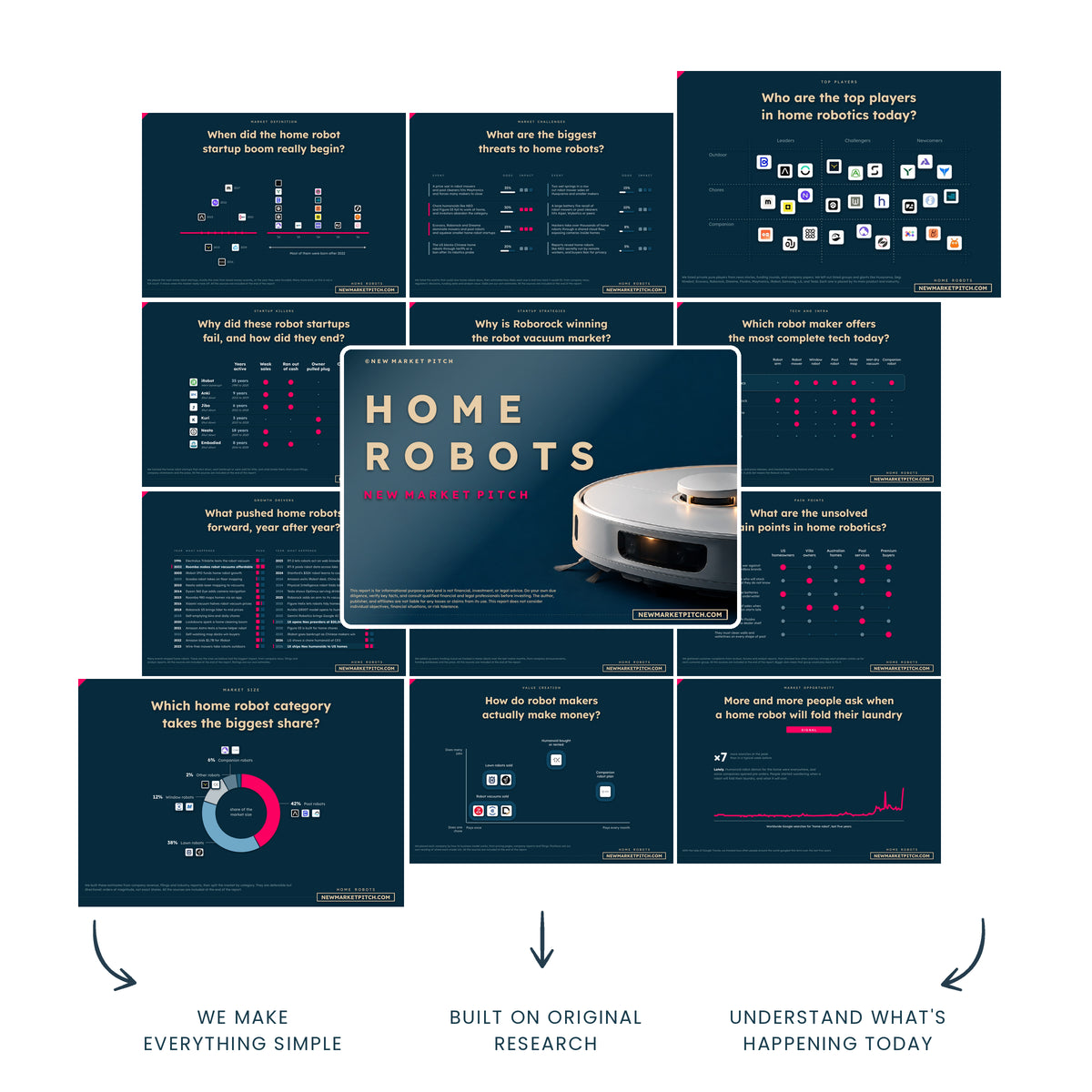
Whether you're building or investing in the home robot market, our report covers everything you need to know: the players, the money, and what's coming next.
Summary
The home robot market beyond vacuums is already worth approximately $4 billion to $6 billion annually in global retail hardware sales, with around $5 billion as our central estimate. Almost all that business comes from specialized robots that mow lawns, clean swimming pools and wash windows, rather than humanoid household assistants.
Global shipments reached approximately 8.60 million non-vacuum home cleaning robots in 2025, representing 26.3% of the broader home cleaning robot market. These categories are growing roughly 29% annually in units, considerably faster than robotic vacuums at 17.1%.
Pool cleaning dominates shipments, with 4.24 million robots sold in 2025, compared with 2.37 million window cleaners and 1.99 million robotic lawn mowers. But lawn robots can generate disproportionately large revenue because their selling prices are substantially higher.
Robotic mowing is going through a technological reset. Wire-free models accounted for about 66% of mower shipments in 2025, up from roughly 38% a year earlier. Removing boundary-wire installation is making the category easier to adopt and giving newer manufacturers an opening against established equipment brands.
Window-cleaning robots are expanding even faster, with shipments up 70.4% in 2025. Ecovacs controls more than half the market, although rapid unit growth and increasingly similar products are creating pressure on selling prices.
Pool robots show the other side of the market. They outsell mowers by more than two to one, yet overall shipment growth has been relatively modest. Maytronics reported falling revenue and margins in 2025, illustrating how a large installed product category can become commercially difficult even when demand remains substantial.
Chinese manufacturers are reshaping competition across these businesses. Segway Navimow, Mammotion, Dreame, Ecovacs and Aiper are applying navigation systems, sensors and consumer-electronics manufacturing expertise to household chores previously served by specialist appliance companies.
The humanoid market is operating on a completely different scale. The International Federation of Robotics reported approximately 7,000 full-size humanoids sold for commercial and professional purposes in 2025, compared with 8.60 million non-vacuum cleaning robots. Verified consumer humanoid deployments remain far smaller still.
General-purpose robots also face a steep economic hurdle. At 1X NEO's announced $20,000 purchase price, reaching $10 billion in annual hardware sales would require 500,000 units sold every year. Buyers would need convincing evidence that a single expensive machine can reliably handle chores that specialized appliances cannot.
A $10 billion non-vacuum home robot market by 2030 is plausible without a humanoid breakthrough. Starting from approximately $5 billion today, the market would need around 15% annual revenue growth to double over five years. Our planning range is $8 billion to $12 billion, depending on shipment growth, category mix and selling-price declines.
The strongest near-term opportunity is still task-specific automation. Homeowners are already purchasing millions of machines that solve recurring problems. General-purpose home robots could eventually create another large consumer category, but the market's next several billion dollars are more likely to come from better mowers, pool cleaners, window robots and other specialized products.

Written by the New Market Pitch teamWe track new markets so founders and investors can move faster. About us
Is there already a big home robot market beyond vacuum cleaners?
The home robot market beyond vacuums is already worth several billion dollars a year, but almost all the money comes from robots designed to handle one specific household chore.
According to IDC, global shipments of home cleaning robots reached 32.72 million units in 2025, including 24.12 million robotic vacuums. That leaves approximately 8.60 million robots sold for other cleaning tasks, mainly mowing lawns, cleaning swimming pools and washing windows.
Those non-vacuum machines accounted for 26.3% of home cleaning robot shipments. More interestingly, combining IDC's shipment figures and growth rates suggests that sales volumes outside vacuums grew approximately 29% year over year, compared with 17.1% for robotic vacuums.
The International Federation of Robotics provides another perspective. Its latest reporting puts consumer service robot sales at almost 34.2 million units in 2025, up 37%. That broader category includes domestic, social, educational and home-care robots, although its classifications differ from IDC's.
The market is already much bigger than the humanoid robot demonstrations attracting attention these days. Pool cleaners, lawn mowers and window-cleaning robots are selling in millions of units, while robots capable of cooking, folding laundry or tidying an entire house have barely started reaching consumers.
How much money does the home robot market make without vacuums?
We estimate that home robots beyond vacuums currently generate around $4 billion to $6 billion in annual global hardware sales, with approximately $5 billion as our central estimate.
That figure covers robotic lawn mowers, pool cleaners, window cleaners and smaller specialized domestic machines. It excludes robotic vacuums, commercial-only equipment, conventional smart appliances and general-purpose humanoids without meaningful verified consumer sales.
There is no single audited global revenue figure for these categories. We therefore reconstructed the market using IDC's 8.60 million non-vacuum cleaning robot shipments in 2025 and estimated selling prices for the main product groups.
For lawn robots, we used an illustrative global average selling price of $700–$1,200. For pool robots, $350–$650. For window robots, $180–$350. These ranges reflect different product tiers and regional price levels, rather than assuming every machine sells for its advertised premium retail price.
Together, the three categories imply approximately $3.3 billion to $6 billion in retail hardware sales. Allowing for uncertainty around product mix and the likelihood that actual selling prices fall within those ranges gives us a practical working estimate of $4 billion to $6 billion.
One important distinction: retail sales are higher than manufacturers' recognized revenue because distributors and retailers take a share. Our $5 billion estimate describes the approximate value of robots purchased by consumers, not the combined revenue reported by robot manufacturers.
| Home robot category | 2025 shipments | Estimated average selling price | Estimated retail sales |
|---|---|---|---|
| Robotic lawn mowers | 1.99M | $700–$1,200 | $1.39B–$2.39B |
| Robotic pool cleaners | 4.24M | $350–$650 | $1.48B–$2.75B |
| Robotic window cleaners | 2.37M | $180–$350 | $0.43B–$0.83B |
| Three-category subtotal | 8.60M | Mixed | $3.30B–$5.97B |
| Other specialized home robots | Not consistently tracked | Varies | Not independently quantified |
| Central market estimate | Approximately 8.60M+ | Mixed | Approximately $5B |
| Working market range | Hardware only | Retail value | Approximately $4B–$6B |
If you want more recent data on this point, please see our latest home robots market report.

Your time is limited. In our report covering the home robot market, we put numbers on each part of the market, so you can see where it makes sense to focus.
Which home robots are people actually buying?
Pool cleaners, window cleaners and lawn mowers account for almost all the non-vacuum household cleaning robot shipments tracked by IDC, with pool robots leading by a wide margin.
In 2025, approximately 4.24 million robotic pool cleaners were shipped worldwide, followed by 2.37 million window-cleaning robots and 1.99 million robotic lawn mowers.
Pool robots represented almost half the non-vacuum total. Window robots contributed around 28%, while lawn mowers accounted for approximately 23%.
But shipment volumes tell only part of the story. Robotic lawn mowers generally cost considerably more than window cleaners, so their revenue contribution can be much larger than their share of units.
The differences between these products also explain why they have reached consumers faster than humanoids. Pool cleaners work within a relatively predictable environment. Robotic mowers navigate a defined outdoor area. Window robots repeat cleaning patterns on glass surfaces.
Each product tackles a recurring chore with hardware designed specifically for that job.
And these are established consumer categories. Husqvarna and Gardena have spent years selling robotic lawn mowers, while Dolphin, Zodiac and Polaris have long histories in robotic pool cleaning. Newer companies such as Aiper, Mammotion and Segway Navimow are now competing aggressively for customers.
Are robotic lawn mowers becoming the next big home robot?
Robotic lawn mowers are one of the fastest-growing consumer robot categories right now, with global shipments jumping 63.8% to 1.99 million units in 2025.
Much of that growth comes from one practical improvement: newer robotic mowers can navigate lawns without requiring homeowners to install boundary wires.
IDC reported 1.32 million wire-free robotic mower shipments in 2025, up 182.4% from the previous year. Traditional boundary-wire models went the opposite way, declining 10.1% to approximately 673,000 units.
We calculate that wire-free machines represented around 66% of global robotic mower shipments in 2025, up from approximately 38% the previous year.
That's a remarkable shift for an established appliance category.
The technology behind it includes satellite positioning, RTK correction, computer vision and LiDAR navigation. Segway Navimow, Mammotion and Dreame have introduced models that can map gardens with far less installation work than older machines.
This has changed the competitive landscape. Companies that built their business around conventional garden equipment now face brands with experience in autonomous navigation, sensors and consumer electronics.
Robotic mowers remain much smaller than vacuums in unit sales, with 1.99 million annual shipments versus 24.12 million. But they command higher prices, and they replace a chore for which homeowners already spend money on equipment or professional services.

In our research about home robots, we always try to gather several sources and make estimates that make sense, so you can work with solid numbers.
Is the robotic pool cleaner market bigger than lawn robots?
Robotic pool cleaners already outsell robotic lawn mowers by more than two to one globally, making pool maintenance the largest non-vacuum home cleaning robot category by unit volume.
IDC counted approximately 4.24 million robotic pool cleaners shipped in 2025. That included 2.75 million in-ground pool cleaners, 1.26 million above-ground cleaners and 233,000 surface-cleaning robots.
The volume is impressive considering that pool ownership is concentrated in specific climates and property types. Robotic mowers address a broader potential household base, yet pool robots currently sell far more units.
However, the two markets are moving at different speeds.
While robotic mower shipments jumped more than 60%, overall pool robot shipments were relatively stable in 2025. The important change has been the move toward cordless machines.
According to IDC, cordless penetration among in-ground pool cleaners reached 55%, with the company reporting a 32.8% increase in that measure.
Established manufacturers are feeling the competition. Maytronics, the Israeli company behind Dolphin robots, reported approximately NIS 1.4 billion in total revenue for 2025, down from NIS 1.62 billion in 2024. Its residential robotic pool cleaner revenue fell approximately 18%.
Meanwhile, Fluidra acquired an initial 27% stake in cordless pool robot manufacturer Aiper in 2025.
The pool robot market is already large, but manufacturers are now fighting over cordless technology, prices and distribution. Higher unit volumes across the industry won't necessarily translate into higher revenue for every brand.
Why are window-cleaning robots suddenly selling so well?
Window-cleaning robots are growing even faster than robotic lawn mowers, with worldwide shipments rising 70.4% to 2.37 million units in 2025.
Using IDC's reported growth rate, we calculate that approximately 1.39 million units were shipped in 2024. That means manufacturers sold almost one million additional window robots the following year.
The growth makes sense once we look at the problem these machines solve. Cleaning exterior windows on high-rise apartments can be dangerous, while large glass surfaces in houses are inconvenient to maintain manually.
Ecovacs has benefited enormously from this demand. According to IDC, the Chinese manufacturer held more than 50% of the global window-cleaning robot market.
Its Winbot products have developed around automatic cleaning paths, suction-based attachment, better edge detection and increasingly cordless designs.
But there is a downside to the rapid expansion. IDC has also pointed to product homogenization and price competition in window-cleaning robots.
A category can grow 70% in units while manufacturers struggle to increase profits, especially when several brands sell machines offering very similar features.
Window robots are becoming an established household appliance category, although their relatively low prices mean they generate less revenue per unit than robotic lawn mowers.

In our market report about home robots, we don't want to repeat what boring consulting reports say. Instead, we show you the real and latest market signals that matter.
Is the home robot market growing faster outside vacuums?
Yes. Non-vacuum home cleaning robot shipments grew approximately 29% in 2025, significantly faster than the 17.1% growth recorded for robotic vacuums.
Using IDC's shipment figures, we reconstructed the previous year's volumes to compare the two markets directly.
Non-vacuum cleaning robot shipments increased from approximately 6.65 million units in 2024 to 8.60 million in 2025. That added roughly 1.95 million machines in one year.
Robotic vacuum shipments rose from around 20.60 million to 24.12 million, adding approximately 3.52 million units.
So vacuums still generated more additional sales in absolute terms. But non-vacuum robots accounted for roughly 36% of total incremental shipments, despite representing only 26% of the market in 2025.
The composition of that growth is especially interesting. Window robots and robotic mowers contributed most of the additional non-vacuum volume, while pool cleaning remained relatively stable.
Vacuum cleaners are still the industry's main product, but they're no longer driving all of its expansion. More of the growth is coming from machines that automate chores outside the house or beyond traditional floor cleaning.
| Home robot category | 2024 estimated shipments | 2025 shipments | Annual growth |
|---|---|---|---|
| Robotic vacuums | 20.60M | 24.12M | +17.1% |
| Robotic lawn mowers | 1.22M | 1.99M | +63.8% |
| Robotic window cleaners | 1.39M | 2.37M | +70.4% |
| Pool robots and remaining non-vacuum categories | ~4.04M | ~4.24M | ~5% |
| All non-vacuum cleaning robots | 6.65M | 8.60M | ~+29% |
| Total home cleaning robots | 27.24M | 32.72M | +20.1% |
| Non-vacuum share of shipments | 24.4% | 26.3% | +1.9 percentage points |
If you want more recent data on this point, please see our latest home robots market report.
Are companies actually making serious money selling home robots?
Several home robot manufacturers already generate hundreds of millions of dollars in annual sales beyond vacuums, although rising demand doesn't automatically mean rising profits.
Husqvarna is a useful example. The Swedish manufacturer reported SEK 8.1 billion in robotic mower revenue in 2023 and SEK 7.2 billion in 2024. The latter represented roughly $700 million at approximate exchange rates.
These figures include professional as well as residential products, so they are broader than the household market alone.
Husqvarna subsequently introduced 13 new wire-free robotic mower models for the 2025 gardening season. Its early 2026 financial results identified Husqvarna-branded robotic lawn mowers as an important contributor to organic growth.
Compare that with Maytronics. Despite operating in a pool robot category shipping millions of units annually, its total revenue declined approximately 14% in 2025. Gross margins also fell from 36% to 26.7%.
Fluidra offers a third example. The Spanish pool equipment company generated €2.18 billion in total sales in 2025 and invested in Aiper to strengthen its cordless robot business. Most of Fluidra's revenue comes from other pool equipment, so the entire figure cannot be attributed to robotics.
The economics vary sharply across household robot categories. Husqvarna is benefiting from new navigation technology, Maytronics faces pricing pressure, and Fluidra is investing to expand its position.

In our document detailing everything you need to know about home robot, we like to show you the big picture. We know your time is precious, so we make every page quick to read and packed with as much learning as possible per minute.
Are Chinese companies taking over the home robot market?
Chinese manufacturers are becoming major players in home robotics well beyond vacuums, particularly in wire-free lawn mowers, window cleaners and cordless pool robots.
IDC identified Chinese companies as the leaders in wire-free robotic mowing. Its six leading brands in that segment were all Chinese manufacturers, including companies competing with established European garden equipment suppliers.
Segway-Ninebot, Mammotion and Dreame have brought new navigation systems and consumer electronics-style product development into robotic mowing.
Window cleaning shows an even clearer concentration. Ecovacs controlled more than half of global shipments in 2025, according to IDC.
Pool robotics is experiencing similar pressure. Aiper has become commercially important enough for Fluidra to purchase a strategic stake, while Maytronics has faced tougher competition from lower-priced products and online sales channels.
Across these categories, we're seeing companies that developed expertise in robotic vacuums, sensors, battery systems and autonomous navigation apply similar technology to new household chores.
That gives Chinese manufacturers an advantage in product development speed and hardware costs. It also puts pressure on older specialists that built their businesses around a single appliance category.
Are humanoid home robots actually selling yet?
Humanoid home robots are beginning to appear as commercial products, but their verified sales remain tiny compared with specialized household machines.
The International Federation of Robotics reported approximately 7,000 full-size humanoid robots sold globally in 2025 for commercial and professional uses beyond research and entertainment.
Those sales mainly concern professional applications, so they cannot be interpreted as humanoid robots purchased by households.
For comparison, IDC reported 8.60 million non-vacuum home cleaning robot shipments in the same year. That's more than 1,200 times the IFR's reported volume of commercial and professional full-size humanoids.
The gap becomes even wider when we focus specifically on consumer humanoids.
1X is among the most advanced companies attempting to sell a general-purpose robot for domestic use. Its NEO robot was announced with an early-access purchase price of $20,000 or a subscription costing $499 per month, with initial US deliveries scheduled for 2026.
The launch provides a concrete commercial offering, but there is a considerable difference between taking orders and delivering tens of thousands of reliable robots into people's homes.
For now, the humanoid home robot market is still too early for a credible large-scale revenue estimate based on verified consumer deployments.
If you want more recent data on this point, please see our latest home robots market report.

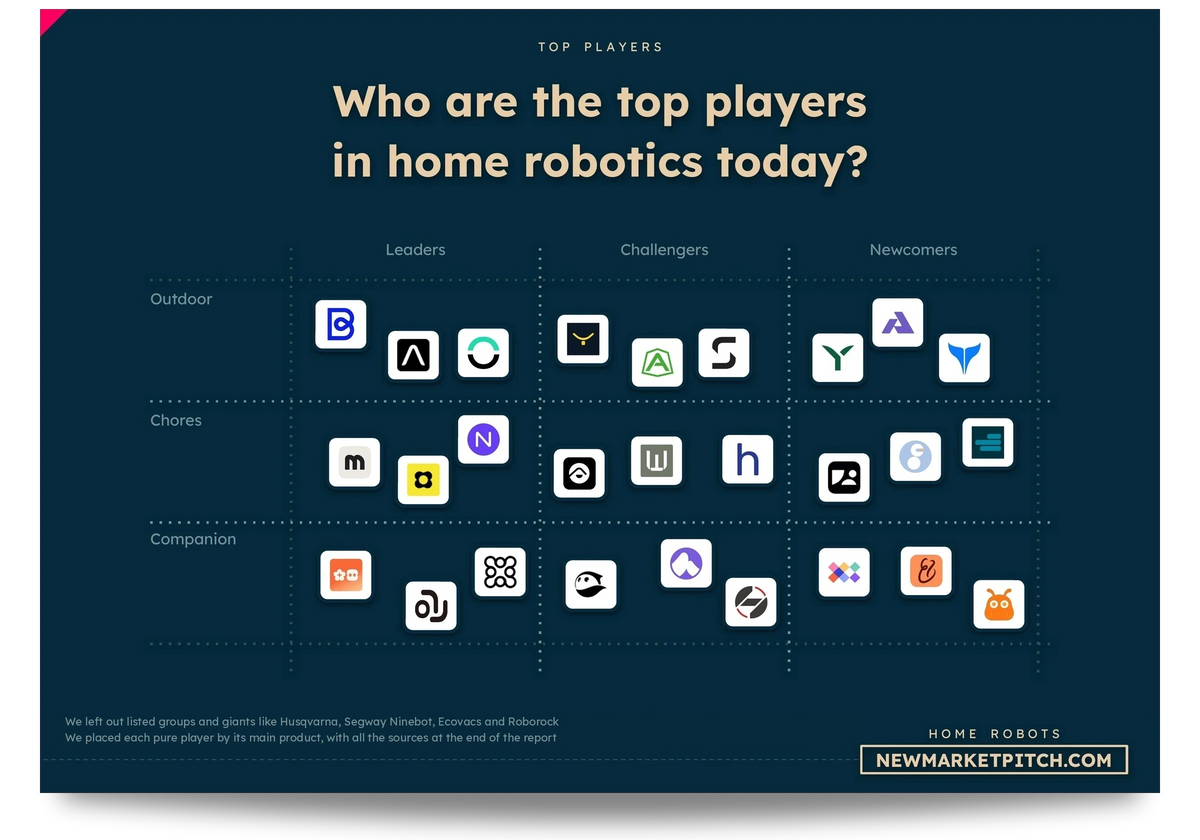
In our report covering the home robot market, we turn what is vague and complex into simple, useful visuals. Market maps like this one show you at a glance where every startup stands.
Can home robots actually do laundry, dishes and everyday housework?
General-purpose home robots can now demonstrate tasks such as handling laundry and kitchen objects, but manufacturers haven't yet shown that these machines can perform everyday household work reliably without human assistance.
LG demonstrated its CLOiD home robot at CES 2026, showing activities associated with laundry and kitchen chores. The company presented the machine as part of its long-term vision for domestic automation, rather than reporting large-scale consumer deliveries.
1X has demonstrated NEO performing household tasks and has introduced a consumer ordering model. However, the company's Expert Mode allows a human operator to remotely assist with activities the robot cannot complete autonomously.
That distinction is important when evaluating how much household labor these machines can really replace.
Samsung's Ballie illustrates another challenge: getting from a promising demonstration to a product people can buy. Originally presented in 2020, Ballie was subsequently associated with consumer launch plans, yet Samsung described it as an active innovation platform in early 2026 without confirming a retail release.
The technical difficulties are substantial. Folding laundry requires manipulating flexible fabric. Clearing dishes involves fragile objects with different shapes and weights. Tidying a room means recognizing objects, understanding where they belong and navigating unpredictable spaces.
Specialized machines avoid much of that complexity by handling a smaller range of tasks.
Before treating general-purpose home robots as a major commercial market, we need evidence of thousands of households using them regularly, including data on completed tasks, failures and how often human operators must intervene.
Could robots become a big business in elderly care?
Robots designed to help older people at home have a potentially enormous customer base, but verified commercial adoption remains extremely small.
The International Federation of Robotics recorded just 536 home-care robot sales in the supplier sample used for its 2025 report, which covered 2024 activity.
That figure is not a complete worldwide count. Still, it gives a useful indication of the limited commercial scale visible in this category compared with millions of annual cleaning robot shipments.
The potential uses are easy to understand. Home-care robots could help people with limited mobility, fetch objects, provide reminders, support daily routines or assist with some physical tasks.
But the most valuable applications also carry the greatest technical and safety requirements.
Cleaning a pool incorrectly creates inconvenience. Failing while helping an older person stand up or move around a room could cause a serious injury.
It's also worth separating physical assistance from companionship. Conversational devices can provide interaction, reminders and remote monitoring without needing sophisticated robotic arms or legs.
Population aging gives the category a strong long-term demand driver. What we still lack is evidence that physical home-care robots can deliver useful assistance at a price households or healthcare systems are willing to pay.

Our research about home robots gets updated several times a month, so you always get the latest view of where things stand.
Will humanoid robots replace specialized home robots?
Humanoid robots are unlikely to replace robotic mowers, pool cleaners and other specialized household machines anytime soon, even if general-purpose home robots become commercially successful.
A pool robot is waterproof and designed to move underwater. A robotic mower uses cutting equipment and outdoor navigation systems. A window robot relies on suction and controlled movement across glass.
These machines are efficient because their hardware is built around one job.
A humanoid could eventually handle a much wider range of tasks. It might carry laundry, clear dishes, open cupboards, collect objects and operate tools already designed for humans.
That flexibility is valuable, but it comes with higher mechanical complexity, more expensive hardware and greater maintenance requirements.
There is also a practical limitation to household demand. A robotic mower only appeals to people with suitable lawns. Pool cleaners serve households with swimming pools, while window robots are more attractive in homes with large or difficult-to-reach glass surfaces.
That narrower customer base hasn't prevented specialized robots from selling millions of units. Many households may eventually own several machines, each handling a different chore.
We expect the home robot market to resemble the broader household appliance business, where different products coexist because they solve different problems. General-purpose robots would add another category rather than automatically replace existing ones.
If you want more recent data on this point, please see our latest home robots market report.
Could the home robot market reach $10 billion by 2030?
A non-vacuum home robot market worth more than $10 billion annually by 2030 looks achievable, although it would require specialized robots to keep growing and manufacturers to avoid excessive price declines.
Starting from our estimated $5 billion in annual retail hardware sales, reaching $10 billion over five years would require compound annual growth of approximately 15%.
That's considerably slower than the roughly 29% increase in non-vacuum home cleaning robot shipments reconstructed for 2025.
But we shouldn't simply extend one strong year into the future.
Robotic mowing and window cleaning are expanding rapidly, partly because newer products are easier to install and use. Pool cleaning, on the other hand, already has substantial volume and has shown much slower growth.
Lower prices could help all three categories attract new buyers, although cheaper machines would also reduce revenue per unit.
For example, if annual shipments doubled while average selling prices declined 20%, total retail sales would increase 60%, rather than 100%.
Taking these factors together, we consider approximately $8 billion to $12 billion in annual non-vacuum household robot hardware sales by 2030 a reasonable planning scenario.
This is our scenario based on current shipments, estimated prices and the growth required to reach that level. It is not a published industry forecast, and it doesn't depend on humanoid robots becoming mass-market products.

In our market report about home robots, you will always find fresh funding data, taken straight from our own verified funding database.
How cheap would humanoid home robots need to become to reach $10 billion in sales?
General-purpose home robots could become a $10 billion annual market at several different price points, but every realistic scenario requires hundreds of thousands or millions of robots to be sold each year.
At 1X NEO's announced $20,000 purchase price, manufacturers would need to sell 500,000 robots annually to generate $10 billion in hardware sales.
At $10,000 per robot, they would need one million annual sales. At $5,000, the number rises to two million.
Those volumes are far beyond the roughly 7,000 commercial and professional humanoids reported by the IFR for 2025, even before excluding machines purchased for non-residential applications.
The $20,000 price point also creates a difficult comparison with specialized robots.
A household could buy separate machines for vacuuming, mowing and pool cleaning for substantially less than $20,000. A humanoid would need to perform enough additional useful work to justify its much higher price.
Subscriptions don't eliminate that challenge. NEO's announced $499 monthly option would cost $5,988 per year, or almost $18,000 over three years, assuming the same monthly price throughout.
The strongest economic case would be a robot that reliably handles chores that conventional appliances cannot automate, without requiring frequent human intervention.
We're still waiting for the kind of deployment and reliability data that would demonstrate this at scale.
| Home robot price | Annual units needed for $10B sales | Consumer market implication |
|---|---|---|
| $25,000 | 400,000 | Very expensive premium product |
| $20,000 | 500,000 | NEO's announced purchase price |
| $15,000 | ~667,000 | High-end household purchase |
| $10,000 | 1,000,000 | Premium consumer appliance |
| $7,500 | ~1,333,000 | Wider affluent-household market |
| $5,000 | 2,000,000 | Potential mass-premium product |
| $2,500 | 4,000,000 | Requires major hardware cost reductions |
How big is the home robot market beyond vacuums, really?
The home robot market beyond vacuums is already worth roughly $4 billion to $6 billion annually in retail hardware sales, and it has a credible path toward $10 billion by 2030. Almost all that business currently comes from specialized robots rather than humanoid household assistants.
The biggest existing markets are pool cleaning, robotic mowing and window cleaning. Together, they accounted for approximately 8.60 million shipments in 2025, with robotic lawn mowers and window robots growing particularly quickly.
The industry is also changing. Wire-free navigation is transforming lawn mowing, cordless designs are reshaping pool cleaning, and Chinese manufacturers are challenging established brands across several categories.
The evidence for general-purpose home robots is much weaker. Companies such as 1X and LG are developing increasingly capable machines, but verified consumer deployments remain far below the scale of specialized household robots.
Our conclusion is that home robotics has already become a serious consumer hardware market beyond vacuum cleaners. The next several billion dollars in sales will most likely come from robots that mow lawns, clean pools and handle other specific chores. Humanoids could eventually make the market much larger, but that opportunity still depends on proving that one expensive, general-purpose machine can reliably do enough work to justify its cost.
If you want more recent data on this point, please see our latest home robots market report.

In our document detailing everything you need to know about home robot, we look at what the winners do differently, so you can learn from the best instead of guessing.
Our methodology
This analysis examines how much commercial activity already exists in home robotics beyond vacuum cleaners, which household robot categories are expanding fastest, and whether general-purpose robots are approaching meaningful consumer adoption. We assess the market through shipment volumes, estimated retail spending, product adoption, manufacturer performance, competitive dynamics and the economics of further expansion through 2030.
We built the assessment through a structured aggregation of recent, verifiable evidence. For each dimension, we identified fresh market and company developments, compared the relevant figures, aggregated the findings where definitions allowed, and used the combined evidence to assess the strength of the commercial opportunity. This distinguishes categories already selling millions of units from those whose commercial potential is still largely based on product demonstrations and launch announcements.
Our market boundary excludes robotic vacuum cleaners, conventional smart appliances, commercial-only machines and general-purpose humanoids without meaningful verified consumer sales. The core market comprises residential robotic lawn mowers, pool cleaners and window cleaners. We use the IDC global home cleaning robot market analysis as the principal reference for 2025 category shipments, annual growth, wire-free mower adoption and manufacturer positioning. We also examine service robotics through the International Federation of Robotics, keeping its broader classifications separate from IDC's household cleaning categories.
To estimate retail market size, we combine approximately 8.60 million non-vacuum cleaning robot shipments with illustrative selling-price ranges of $700–$1,200 for lawn mowers, $350–$650 for pool cleaners and $180–$350 for window robots. The resulting three-category range is approximately $3.3 billion to $6 billion, from which we use $4 billion to $6 billion as a practical working estimate and $5 billion as the central value. These figures represent estimated consumer retail expenditure rather than audited manufacturer revenue. We do not add unquantified specialist categories as separate revenue lines.
For growth comparisons, we reconstruct previous-year unit shipments from reported 2025 volumes and year-over-year growth rates. We then compare absolute unit additions, percentage growth, product mix and the contribution of individual categories to the overall market. This is particularly important for differentiating the rapid transition to wire-free robotic mowing from the more mature pool-cleaning market and the fast-growing but lower-priced window-cleaning category.
Company-level analysis draws on Husqvarna's 2024 annual report, its 2024 year-end results and its 13-model wire-free mower launch; Maytronics' 2025 financial reports; and Fluidra's 2025 results. We also use Fluidra's completed investment in Aiper and its strategic investment announcement to assess how established manufacturers are responding to the cordless pool-cleaner market. Revenue attributable to broader pool equipment or professional mowing is not treated as exclusively residential robotics revenue.
We assess technological adoption through documented product changes rather than treating every new capability as evidence of market penetration. Relevant manufacturer sources include Segway Navimow's X3 launch, Mammotion's robotic mower releases and Ecovacs' WINBOT product range. We compare these product developments with shipment growth and changes in competitive positioning to evaluate which innovations are translating into commercial demand.
For general-purpose and home-care robots, the evidence threshold is different. The IFR World Robotics 2025 service robots executive summary provides historical adoption context, including the limited number of reported home-care robot sales. We examine 1X NEO's announced pricing and ordering terms, 1X's domestic robot development, LG's CLOiD demonstration and Samsung's Ballie announcements. We distinguish product demonstrations, preorders, human-assisted operation and scheduled deliveries from verified consumer deployments.
Finally, our 2030 market estimate is an independent economic scenario, rather than a published market forecast. We start from the reconstructed $5 billion retail hardware baseline and calculate the growth needed to reach $10 billion over five years. We then consider how shipment expansion, lower average selling prices and differences between product categories could affect that outcome. For humanoid robots, we separately calculate the annual unit volumes required to generate $10 billion in sales at different hardware prices, using 1X NEO's announced terms as one commercial reference point.
The resulting assessment combines recent market-tracking data, manufacturer financial disclosures, product-level developments and explicit calculations. Historical shipments, estimated retail sales, manufacturer revenue and forward-looking scenarios are kept distinct so that established commercial demand can be evaluated separately from the much larger but still unproven ambitions of general-purpose domestic robotics.

If you build or invest in the home robot market, you need to know which business models pay off now and which ones are fading. That's why our report covering it has a whole section on it.
Written by the New Market Pitch teamWe track new markets so founders and investors can move faster. About us