Who are the top home robot startups shipping in 2026?
Whether you're building or investing in the home robot market, our report covers everything you need to know: the players, the money, and what's coming next.
Summary
Matic, Yarbo and Enabot are the top home robot startups with established consumer-shipping records in 2026, while Unitree leads in accessible humanoid hardware. Figure, 1X and Sunday Robotics are the strongest emerging contenders for general-purpose household assistance, but their consumer deployments remain largely unproven.
The crucial difference is between robots delivered to households, robots manufactured for broader use and machines available for preorder. These figures are routinely compared, even though they represent very different levels of commercial progress.
Matic has one of the clearest records among younger indoor robotics companies: more than 6,000 robots shipped, 110 million square feet cleaned and 80,000 miles traveled inside homes by January 2026. Its strength comes from combining deliveries with actual household usage.
Yarbo delivered more than 5,000 outdoor robots during 2024 alone, following over 1,000 deliveries in 2023. Its modular approach to mowing, snow removal and other yard work demonstrates that practical home robotics can scale without humanoid technology.
Enabot reports more than 600,000 users across over 70 countries and regions, giving its mobile monitoring and companion robots substantial international reach. However, users are not equivalent to shipped devices, so its physical sales volume remains harder to establish.
Unitree has pushed humanoid entry prices below $5,000 with the R1 Air and offers its G1 from $13,500. That makes sophisticated robotic hardware more accessible, but these products remain closer to programmable robotics platforms than autonomous household workers.
Figure manufactured its 1,000th Figure 03 humanoid by July 2026, showing rapid improvement in production capability. Yet manufacturing volume says little about how many robots are performing sustained chores in private homes, especially when the same fleet supports research and industrial applications.
1X has taken the clearest step toward selling a general-purpose humanoid directly to consumers, advertising NEO at $20,000 or $499 per month. Its initial operating model includes remote human assistance, and comparable figures for completed household deliveries and autonomous performance are still missing.
Sunday Robotics is taking a different route, using large collections of human demonstrations to train its wheeled Memo robot for domestic manipulation. Its $165 million financing supports a planned late-2026 household beta, although a hand-built Memo currently costs around $20,000 to manufacture.
The biggest unanswered question is how much useful work general-purpose robots can complete independently. Without comparable figures for task success, human interventions and reliability across unfamiliar homes, the strongest commercial evidence still belongs to specialized machines that already perform recurring household chores.

Written by the New Market Pitch teamWe track new markets so founders and investors can move faster. About us
Are home robots finally reaching customers, or are most still prototypes?
Home robot startups are finally shipping thousands of machines, although the biggest gap remains between robots that handle one household chore and humanoids promising to handle almost everything.
Matic reported more than 6,000 robot shipments in January 2026, along with 110 million square feet cleaned inside homes. Yarbo's published history records more than 5,000 outdoor robots delivered during 2024 alone. Enabot sells mobile monitoring and companion robots internationally, while Unitree has made humanoid hardware available at prices starting below $5,000.
The general-purpose category is moving quickly too. Figure reached its 1,000th Figure 03 humanoid in July 2026, according to founder Brett Adcock, after reporting just over 350 units in April. Meanwhile, 1X opened consumer reservations for NEO, and Sunday Robotics raised $165 million to launch household testing of Memo.
But those achievements describe different stages of commercialization. Figure's manufacturing totals include robots used for research and development. Unitree's affordable humanoids are largely programmable platforms. Sunday is preparing controlled household deployments, and 1X has advertised consumer deliveries without publishing a comparable record of completed household shipments.
For this ranking, we count a home robot as shipping when physical units have been delivered for residential use. We distinguish completed deliveries from preorders, household beta programs and robotics platforms sold primarily to developers. That distinction changes the ranking considerably.
Which home robot startups have actually shipped products in 2026?
Matic, Yarbo and Enabot have the clearest records of consumer home robot sales, while Unitree is the strongest contender for commercially available humanoid hardware.
The evidence differs in quality. Matic has disclosed both shipments and cumulative household activity. Yarbo has published annual delivery milestones. Enabot reports a large international user base, but without an equivalent breakdown of physical units shipped.
Unitree also belongs in the comparison because its G1 humanoid and Go2 quadruped are commercially available. Its lower-cost R1 has appeared in official purchasing channels, although availability varies by model and configuration. Buying one of these machines gives customers a robotics platform rather than a finished autonomous housekeeper.
The second group consists of companies producing or preparing more capable domestic assistants. Figure has a growing physical fleet, 1X has published consumer pricing, and Sunday has announced a household beta. None has yet disclosed the same kind of sustained, comparable consumer-home activity that would put it ahead of the established shipping specialists.
| Startup | Main product | Strongest public evidence | Assessment |
|---|---|---|---|
| Matic | Vacuum-mop robot | 6,000+ shipped; extensive cleaning activity | Confirmed consumer shipping |
| Yarbo | Modular yard robot | 5,000+ units delivered in 2024 | Confirmed consumer shipping |
| Enabot | EBO companion robots | Commercial products; 600,000+ reported users | Established consumer sales |
| Unitree | G1, R1, Go2 | Commercial hardware availability | Shipping robotics hardware |
| Hello Robot | Stretch | Commercial research-platform deliveries | Shipping to specialist buyers |
| 1X | NEO | Consumer ordering; deliveries scheduled for 2026 | Household shipments not independently established |
| Sunday Robotics | Memo | Household beta planned for late 2026 | Pre-commercial deployment |
| Figure AI | Figure 03 | 1,000 robots manufactured by July 2026 | Manufacturing proven; consumer rollout unproven |

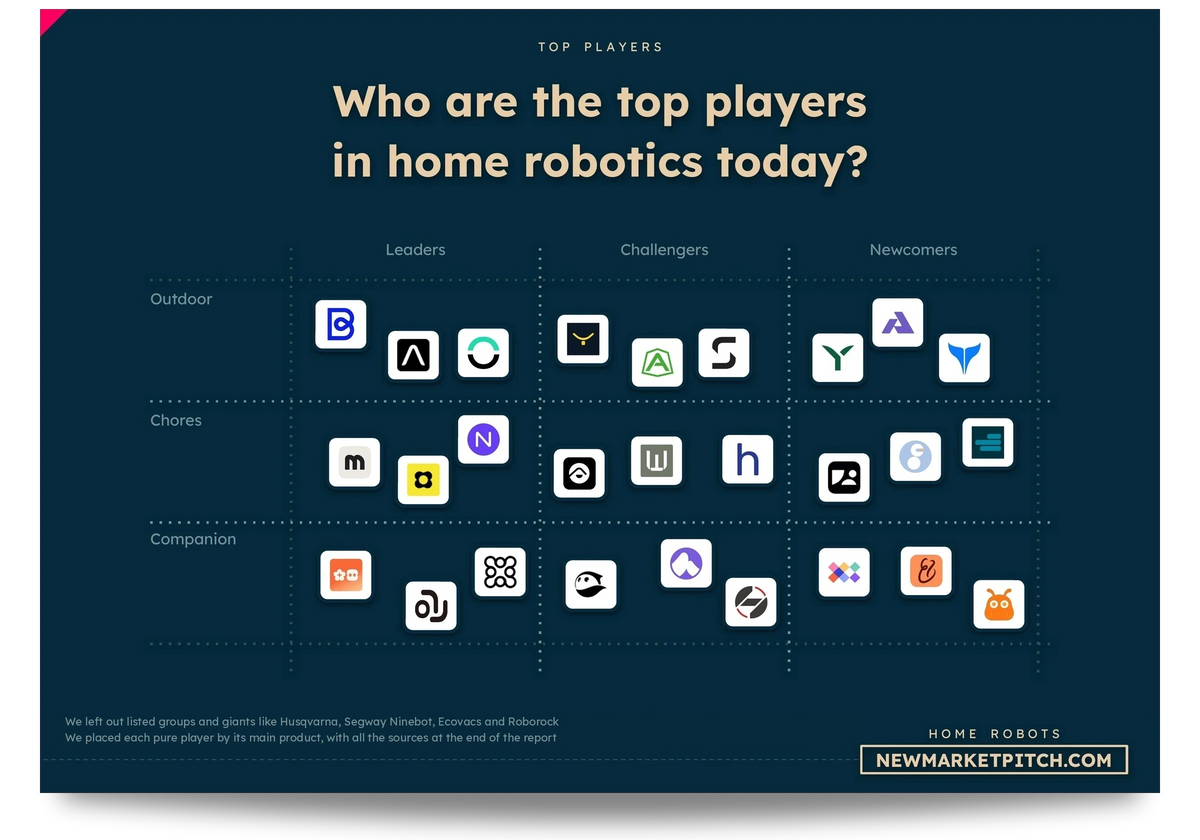
In our report covering the home robot market, we turn what is vague and complex into simple, useful visuals. Market maps like this one show you at a glance where every startup stands.
Is Matic the strongest home robot startup already shipping useful products?
Matic is currently one of the strongest shipping-first home robotics startups because its machines are already doing measurable work in thousands of households.
The company provided unusually detailed figures when announcing $60 million in new funding in January 2026. It had shipped more than 6,000 robots, cleaned over 110 million square feet and traveled more than 80,000 miles inside homes.
Dividing the reported activity by 6,000 robots gives approximately 18,300 square feet cleaned and 13.3 miles traveled per machine. These are rough cumulative ratios rather than standardized productivity measures, since customers received their robots at different times and the totals are rounded.
Matic's growth is also worth examining. In a January interview with TBPN, co-founder Mehul Nariyawala described an expansion from roughly 200 to 6,000 robots during the preceding year, equivalent to approximately 30 times the starting volume. That's a lot more informative than another polished robot demonstration.
There has also been a commercial reality check. In September 2026, Matic increased its retail price from $1,245 to $1,495, citing higher component costs, including memory. The increase was approximately 20%. Around the same period, the company introduced Matic Cues, allowing users to direct cleaning with gestures and voice commands.
The company is shipping more hardware while continuing to improve machines already in customers' homes. That's the kind of repeatable product development the humanoid category still needs to demonstrate.
Matic remains tiny compared with established robot-vacuum manufacturers, and its latest shipment claims are company-reported rather than independently audited. Still, among younger indoor robotics companies, its combination of deliveries, usage and software improvements makes it a particularly convincing commercial contender.
If you want more recent data on this point, please see our latest home robots market report.
Is Yarbo shipping more practical home robots than the humanoid startups?
Yarbo has already delivered thousands of robots that perform outdoor household chores, giving it a much stronger fulfillment record than most startups selling the idea of a general-purpose housekeeper.
Yarbo began with snow removal before expanding into lawn mowing, blowing and trimming. Its modular architecture allows customers to use the same robotic base with different attachments, reducing the need to purchase a separate drive system for every outdoor job.
The company's milestones show a progression. Its 2022 crowdfunding campaign raised approximately $3.45 million. More than 1,000 snow-removal units were delivered in 2023, followed by over 5,000 units globally in 2024. Yarbo added a Lawn Mower Pro and trimming package in 2025, then promoted its smaller M Series in 2026.
That record gives Yarbo several years of experience manufacturing and fulfilling consumer robotics orders. It also helps explain why the modular approach is attractive. A machine that can remove snow during winter and maintain a lawn during summer has more potential uses than a robot dedicated to one season.
The economics are still demanding. Buyers must pay for the base and relevant attachments, while maintenance costs and long-term reliability are harder to evaluate from public shipment figures. Yarbo's reported delivery totals can also include different hardware configurations, so they should not automatically be interpreted as identical complete systems.
For households with substantial outdoor maintenance needs, however, Yarbo is already offering something concrete. It belongs among the leading commercial home robotics startups, especially outside the house.

Our research about home robots gets updated several times a month, so you always get the latest view of where things stand.
Is Enabot already selling home robots at a larger scale than humanoid startups?
Enabot has a far wider reported consumer footprint than most emerging humanoid companies, although its products are designed mainly for monitoring, interaction and companionship.
Its EBO family includes mobile cameras and companion robots such as EBO X, EBO Air 2 Plus and EBO Mini. These products can move around the house, provide video monitoring and enable remote interaction with pets or family members.
Enabot reports more than 600,000 users across over 70 countries and regions. Those numbers suggest broad international reach, but they come with an important limitation: one robot can have multiple users, and the company does not provide an equivalent total of shipped or currently active devices.
Its product history is revealing. Rather than pursuing one expensive humanoid launch, Enabot has introduced successive generations of smaller machines, adding navigation, communication and AI features over time. In March 2026, it announced EBO Max as another step toward richer household interaction.
Enabot's machines can already perform useful monitoring tasks because the mechanical requirements are relatively simple. They don't need to manipulate kitchen utensils or pick up laundry. And that's a big advantage when you're trying to sell something people can use straight out of the box.
That narrower focus has allowed Enabot to build a consumer business while more ambitious competitors are still preparing their first household deployments. It is already a commercial leader in mobile home-monitoring robots, although its user count does not establish that it ships more physical units than every humanoid competitor.
Has Unitree made humanoid robots cheap enough for ordinary homes?
Unitree has brought humanoid hardware prices down dramatically, but its cheapest machines still require considerable development before they can act as autonomous household assistants.
Its official product range includes the G1 humanoid, advertised from $13,500, and the smaller R1 family, with the R1 Air starting at $4,900 and the standard R1 at $5,900. Unitree also sells the Go2 quadruped from approximately $1,600.
The lower price points are remarkable for machines with articulated limbs, onboard sensing and programmable control systems. The G1 itself was initially advertised at around $16,000 in 2024, before its starting price fell to $13,500, a reduction of roughly 16%.
Manufacturing scale is another advantage. Industry reporting indicates that Unitree shipped more than 5,500 humanoids in 2025, although that number should be treated as reported volume rather than independently audited consumer deliveries. More importantly, those shipments span research, development and commercial applications rather than household chores alone.
For an ordinary buyer, the gap is considerable. The entry-level R1 Air does not provide the manipulation hardware and software required to become a fully capable domestic worker. Higher-specification machines still need suitable task programming and supervision.
Unitree is making humanoid robotics accessible to developers and technically sophisticated customers. Its lead in affordable hardware is real. But there's no evidence that thousands of families are using Unitree humanoids to clean kitchens or manage laundry, regardless of how many robots the company manufactures.
If you want more recent data on this point, please see our latest home robots market report.

In our market report about home robots, we look at what the winners do differently, so you can learn from the best instead of guessing.
Is 1X NEO really shipping to customers in 2026?
1X NEO is one of the most credible attempts to sell a general-purpose home humanoid directly to consumers, but publicly documented customer deliveries remain less convincing than the company's published launch plans.
1X has made its commercial proposition unusually explicit. Early-access buyers can reserve ownership for $20,000, while a subscription option is advertised at $499 per month. The order page requires a refundable $200 deposit and states that U.S. deliveries begin in 2026.
The subscription comes to $5,988 over twelve months, or $17,964 over three years. A $20,000 purchase is equivalent to approximately 40 months of subscription payments, before taking warranties, service terms and ownership differences into account.
Those prices put NEO in an entirely different category from a $1,495 Matic cleaning robot. Customers are paying for a much broader promise: help with physical chores across the household.
1X acknowledges that the first units will have limited autonomous abilities. Its scheduled Expert Mode allows a remote human operator to assist with difficult activities while the robot learns.
That can make an early product genuinely useful, but it also introduces a dependency on human assistance. We would need to know how often customers use Expert Mode, how many chores NEO completes independently and how performance changes after software updates to evaluate the actual service.
Until 1X publishes confirmed household delivery numbers and reliable task-performance data, NEO remains a leading consumer-launch contender. Its published pricing and ordering process put it ahead of many prototype-stage startups in commercial readiness, but they do not yet establish that NEO is winning on deliveries.
Can Sunday Robotics make a more useful home robot than 1X?
Sunday Robotics could become a serious competitor to 1X by concentrating on autonomous household chores, but its Memo robot is still preparing for controlled deployment.
Sunday raised $165 million in March 2026 at a $1.15 billion valuation, in a round led by Coatue. Its product, Memo, uses a wheeled base and articulated arms to handle tasks such as clearing tables, working with dishes and organizing objects.
That design is a deliberate trade-off. Wheels provide stability and simplify movement on flat surfaces, allowing the engineering team to devote more attention to manipulation. Sunday doesn't need to solve humanlike walking before Memo can reach a kitchen counter.
Its training strategy is equally distinctive. Instead of relying primarily on human operators controlling robots remotely, Sunday collects demonstrations through its Skill Capture Gloves. The company says thousands of gloves have been distributed, gathering millions of examples of ordinary household movements.
This has allowed Sunday to train its ACT-series robot models on everyday tasks before placing large numbers of machines in customer homes. Its later ACT-2 work focuses on making behavior more reliable across different households and object arrangements.
The company's own website is candid about the remaining work. Memo's late-2026 beta is intended to test reliability, safety and usefulness in real homes. Retail sales are not yet open, and Sunday estimates that an individual hand-built Memo currently costs around $20,000.
The race between Sunday and 1X is particularly interesting because both target physical chores, but their early operating models differ. Sunday is aiming for greater autonomy through data collected from human demonstrations, while 1X is explicitly building remote assistance into its initial consumer service.
Sunday has a compelling technical approach, particularly if it can make manipulation reliable without constant human intervention. Its first household deployments will show whether the approach works outside carefully demonstrated conditions.

In our document detailing everything you need to know about home robot, you will always find fresh funding data, taken straight from our own verified funding database.
Has Figure AI built enough robots to become a real home robotics company?
Figure has crossed an important manufacturing milestone, with 1,000 Figure 03 humanoids produced by July 2026, but the number of robots actually working in private homes remains unclear.
The company's BotQ facility reported more than 350 Figure 03 units by April and a demonstrated production cycle of one robot per hour, up from one robot per day in less than 120 days.
Three months later, founder Brett Adcock announced the 1,000th Figure 03. That means the fleet grew by at least 650 units between the two milestones, a more useful production trend than the factory's theoretical hourly throughput alone.
Figure has also disclosed manufacturing details that make the production story more credible. Its April update described over 9,000 actuators produced, more than 150 networked workstations and a first-pass robot inspection yield above 80%.
Still, Figure's robots are being allocated across internal research, data collection, commercial development and household-task experimentation. The manufacturing total is therefore broader than consumer shipments.
Its background in industrial robotics gives it practical experience. Figure 02 participated in BMW manufacturing operations during 2025, and the company subsequently introduced Figure 03 into that industrial environment.
Figure's Helix AI system is also being developed to handle more varied real-world tasks, including manipulation and movement in unfamiliar homes.
Figure is now one of the stronger manufacturers among general-purpose humanoid startups. Its progress is harder to dismiss than a series of isolated demonstrations, especially after the company crossed 1,000 manufactured units. But until it publishes household deployment counts and sustained autonomous performance, Figure remains a manufacturing leader rather than a proven consumer-home leader.
If you want more recent data on this point, please see our latest home robots market report.
Are specialized home robots still doing more useful work than humanoids?
Specialized robots currently perform far more documented everyday household work than general-purpose humanoids, and the evidence comes from several different consumer categories.
Matic has recorded extensive indoor cleaning activity. Yarbo has delivered thousands of machines for outdoor maintenance. Enabot sells mobile monitoring products internationally. In pool cleaning, Aiper has built a substantial consumer business, with Euromonitor research commissioned by the company identifying it as the leading smart robotic pool-cleaner brand by 2025 manufacturer sales volume.
These businesses have a common advantage: their products are engineered around tasks customers already understand and perform regularly.
A pool-cleaning robot spends its working life underwater. A robotic mower navigates lawns. A vacuum must handle floors, furniture and obstacles. None needs the full range of physical abilities required of a humanoid.
The limitation is that customers may eventually own multiple machines to automate different chores. A reliable general-purpose assistant could combine some of those activities, potentially making a much higher purchase price worthwhile.
For now, that remains a largely unproven consumer proposition. The following comparison shows where the main applications stand.
| Household task | Representative startup | Commercial state |
|---|---|---|
| Floor vacuuming | Matic | Commercial shipping |
| Floor mopping | Matic | Commercial shipping |
| Lawn maintenance | Yarbo | Commercial shipping |
| Snow removal | Yarbo | Commercial shipping |
| Home and pet monitoring | Enabot | Commercial shipping |
| Pool cleaning | Aiper | Established consumer sales |
| Carrying household items | Labrador Systems | Pilot and provider-focused deployment |
| General indoor chores | 1X | Consumer rollout planned |
| Dish handling and table clearing | Sunday Robotics | Household beta planned |

Learning from others' mistakes is the cheapest lesson there is. In our report covering the home robot market, we look at what broke startups before you, so you don't repeat it.
Can smaller robots from Labrador and Hello Robot handle real household chores?
Labrador Systems and Hello Robot have shown that useful indoor manipulation does not require a walking humanoid, but neither has established a large consumer market.
Labrador's Retriever is designed to carry items such as food, laundry and personal belongings around a home. The company began putting pilot robots into homes in 2021, with early user deployments lasting several weeks.
Its development subsequently moved toward professional care organizations, including senior-living and home-care providers. That gives Labrador a practical route to customers who need physical assistance, although its public disclosures do not establish mass-market consumer shipments.
Hello Robot has pursued a different buyer. Its Stretch family combines a wheeled base, a robotic arm and open-source software. Stretch 3 was offered at approximately $24,950, primarily for researchers developing mobile manipulation systems.
Labrador has focused on delivering a narrowly defined service, while Hello Robot supplies a platform on which researchers can build more sophisticated behaviors.
Both have hardware suited to reaching, grasping and carrying objects in human environments. They also avoid the balance problems of bipedal humanoids.
Neither belongs ahead of Matic or Yarbo on consumer scale. But their work suggests that some of the first practical household-assistance robots may have wheels and arms rather than legs.
Can consumers actually afford a general-purpose home robot today?
General-purpose home robots are currently priced for enthusiasts and early adopters, with purchase costs several times higher than established single-purpose alternatives.
The advertised price gap is large. Unitree's R1 Air starts around $4,900, although it requires development work for complex autonomous tasks. The 1X NEO ownership option costs $20,000. Sunday's hand-built Memo also costs around $20,000 to manufacture, according to the company, before the savings it expects from scaled production.
Matic's $1,495 retail price provides a useful comparison. One NEO purchase costs roughly as much as 13 Matic robots, although the machines obviously offer very different capabilities.
For NEO, a $20,000 initial purchase spread over five years works out to approximately $333 per month before maintenance and other expenses. The advertised $499 subscription comes to nearly $6,000 annually.
That price could make sense for a robot performing substantial daily household work, especially if it replaces several chores that people otherwise pay others to perform. But we have no reliable public measurement showing that today's general-purpose household robots consistently deliver enough independent labor to support that calculation.
Matic's recent price increase also provides a reminder that hardware economics are difficult even for a much simpler robot. In its September announcement, the company pointed to rising component prices, particularly for memory.
Hardware should become cheaper as production improves, but a lower robot price alone won't make the economics work. The hours of useful work delivered per month will determine whether a household assistant represents good value.

Your time is limited. In our research about home robots, we put numbers on each part of the market, so you can see where it makes sense to focus.
Can 1X, Sunday and Figure home robots actually work without human help?
No general-purpose home robot startup has yet published enough comparable real-household performance data to prove that its machines can reliably complete a wide range of chores without assistance.
1X, Sunday and Figure have all demonstrated increasingly sophisticated behavior, but their methods and published evidence differ.
1X's NEO is designed to combine autonomous operation with scheduled remote assistance. Sunday trains Memo using human demonstrations captured by its gloves, aiming to complete household tasks without teleoperation. Figure's Helix models are being tested across manipulation, navigation and whole-body behavior.
The challenge becomes clearer when we examine multi-step tasks.
A robot clearing a dining table must identify objects, approach them, grip each item appropriately, avoid collisions, transport objects and release them in the correct place. A single mistake can interrupt the entire sequence.
Consider a hypothetical task requiring ten actions, with each action succeeding independently 95% of the time. The probability of completing all ten without an error would be approximately 60%. That calculation is illustrative, not a measured rate for any of these companies, but it shows why completing individual movements successfully is insufficient.
We would be much more confident comparing the startups if they regularly disclosed unattended task-completion rates, interventions per hour, average recovery times and performance across previously unseen homes.
Sunday has begun emphasizing reliability across unfamiliar household environments. Figure is increasing the number of robots available for experimentation, and 1X has designed a mechanism to assist when autonomy fails.
Each company is addressing a real part of the problem. Yet none has supplied a standardized public operating record that would justify a clear winner on autonomous household labor.
If you want more recent data on this point, please see our latest home robots market report.
Are real household deployments giving home robot startups better AI?
Real household experience is becoming a valuable source of robotics training data, but the companies collecting the most data are not necessarily developing the most capable robots.
Matic's deployed cleaning fleet encounters furniture arrangements, lighting conditions, cables, carpets and moving obstacles that laboratory testing cannot reproduce in full. Its recent software releases show how an already-shipping robot can acquire new abilities without replacing the hardware.
Sunday uses a different method. Through its Skill Capture Gloves, people record ordinary household movements directly, allowing the company to gather manipulation examples across many homes. Its website describes thousands of gloves distributed and training demonstrations collected in residential environments.
1X can gather information from NEO's autonomous actions and remotely assisted tasks once robots are operating with consumers. Figure benefits from its growing fleet of manufactured humanoids, which can be allocated to training, testing and physical experimentation.
These data sources have different strengths. Matic collects observations of robots performing a relatively narrow job. Sunday gathers demonstrations of a broader set of human actions. 1X and Figure are trying to improve general-purpose robot behavior through combinations of real-world operation, supervised learning and model development.
But the volume of training examples can be misleading. Ten million similar demonstrations might teach a robot less about handling an unfamiliar situation than a smaller dataset containing diverse objects, failures and corrections.
The measurement that would settle this is improvement in autonomous task success across homes the robot has never encountered before. Until the companies disclose comparable results, we can identify the strength of each training approach without confidently ranking the underlying intelligence.

In our market report about home robots, we always try to gather several sources and make estimates that make sense, so you can work with solid numbers.
Which home robot startups are most likely to scale beyond early adopters?
Matic, Yarbo and Enabot are currently better positioned to demonstrate repeatable consumer distribution, while Figure, 1X and Sunday have more to prove about turning general-purpose robots into finished household products.
Commercial scaling involves manufacturing, customer support, installation, maintenance and product reliability. Several younger robotics companies are already working through those challenges.
Matic's online store advertises delivery within days, a one-year warranty and a six-month risk-free trial. Yarbo has years of documented fulfillment experience and has developed multiple attachments and products. Enabot has a multigenerational lineup sold internationally.
Figure has demonstrated rapid manufacturing growth, but it has not published a broad household-customer base. 1X has committed to explicit consumer pricing and delivery schedules. Sunday has raised money specifically to move Memo into real homes through a controlled beta.
The manufacturers also face different practical problems. A broken vacuum mainly interrupts cleaning. A malfunctioning humanoid moving around fragile objects, pets and people could create a much more complicated service incident.
For now, Figure looks particularly strong in manufacturing, 1X is furthest along in packaging a paid humanoid home-assistance offering, and Sunday has a focused plan for autonomous manipulation. Their longer-term success will depend on making those systems dependable for people who have no interest in programming robots.
Who are the top home robot startups shipping in 2026?
Matic, Yarbo and Enabot are currently the strongest home robot startups with established consumer-shipping evidence, while Unitree leads in commercially accessible humanoid hardware. Among the next generation of general-purpose home assistants, 1X, Sunday Robotics and Figure are the companies to watch most closely.
Matic stands out in indoor household cleaning because it has backed its delivery record with real usage measurements and regular software improvements. Yarbo has built a multiyear outdoor robotics business around modular equipment. Enabot has developed an international customer presence in mobile home monitoring and companionship.
Unitree is making a different kind of progress. Its humanoids are becoming much cheaper and more accessible, but customers still need considerable technical capability to turn them into useful domestic assistants.
The picture changes when we look at general-purpose robots. Figure's production record now extends to 1,000 humanoids, 1X has established a consumer pricing and reservation channel, and Sunday is moving toward its first household beta. These companies could eventually address far more chores than the current specialized products.
Our ranking therefore depends on what has actually been achieved. For documented domestic usefulness and shipments, the leaders are Matic, Yarbo and Enabot. For affordable humanoid hardware, Unitree leads. For the next wave of autonomous household assistance, 1X, Sunday and Figure are the strongest contenders, although their comparative consumer performance remains unproven.
Home robotics has already become a functioning consumer market through specialized machines. General-purpose home robots are approaching their first serious commercial test. The winner of that next stage will be the company whose robots can handle everyday chores reliably across thousands of homes, with minimal human assistance and at a price families are actually willing to pay.
If you want more recent data on this point, please see our latest home robots market report.

If you build or invest in the home robot market, you need to know which business models pay off now and which ones are fading. That's why our report covering it has a whole section on it.
Our methodology
This analysis examines which home robot startups are actually shipping useful products in 2026. We compare consumer deliveries, manufacturing milestones, commercial availability, household usage, autonomy, pricing and readiness to scale. The central question is how much real residential activity each company has demonstrated, rather than how impressive its latest robot demonstration looks.
We used a structured aggregation of recent developments to assess each dimension. First, we collected relevant company disclosures, official product information, executive statements, operational figures and deployment updates. We then compared the observations within each dimension, examined their development over time and combined them to reach conclusions about commercial maturity and household usefulness.
Physical deliveries to residential customers carry more weight in the shipping assessment than manufactured units, reservations or announced production capacity. We distinguish established consumer products from research platforms and controlled household pilots. This is particularly important when comparing companies such as Matic and Yarbo with Figure, 1X and Sunday Robotics, whose reported achievements measure different stages of development.
For commercial traction, we examined disclosed shipment counts, cumulative household activity, user reach, product availability and successive delivery milestones. Matic's cleaning figures and Yarbo's delivery history provide direct evidence of physical use and fulfillment. Enabot's reported users provide evidence of reach, but are not treated as equivalent to devices shipped. Similarly, Unitree's reported humanoid volumes are assessed separately from consumer-home adoption.
We examined manufacturing progress through actual production milestones and operational details rather than advertised capacity alone. Figure's successive Figure 03 production disclosures, including its 350-plus-unit milestone, subsequent 1,000th robot and factory statistics, help establish the pace of manufacturing development. We do not convert those totals into household shipment estimates.
Autonomy was assessed through the capabilities companies have demonstrated, their operating models and the evidence available from household testing. We distinguish independent task execution from remotely assisted work, human demonstrations used for training and successful individual demonstrations. We also considered the importance of unattended completion rates, intervention frequency, recovery behavior and performance in unfamiliar environments when evaluating claims of general-purpose household usefulness.
For affordability, we compared official retail prices, subscriptions and disclosed manufacturing costs, then calculated illustrative monthly or multiyear costs where the terms were sufficiently clear. Those comparisons are purchasing-cost benchmarks, not estimates of economic value or lifetime ownership costs. We also examined how price changes, warranties, servicing and manufacturing maturity affect the prospects for broader consumer adoption.
Successive announcements were evaluated together rather than in isolation. For each company, we compared recent delivery, production, product-development and commercialization milestones to identify evidence of continued execution. Company-reported figures are attributed as such, and company-commissioned market research is distinguished from independently audited commercial results.
Key sources for consumer shipping and product availability include Matic's January 2026 funding and shipment announcement, the TBPN interview with Matic's co-founder, Matic's official product page, Matic's software release notes, Yarbo's company milestones, and Enabot's official company and product information.
For humanoid pricing, availability and household-launch plans, we used Unitree's R1 product specifications, Unitree's G1 product page, 1X's official NEO ordering page, 1X's consumer launch information, Sunday Robotics' Series B announcement, Sunday's official Memo information, and Sunday's ACT-2 research update.
For Figure's manufacturing and autonomy progress, we examined its BotQ production update, founder Brett Adcock's 1,000th Figure 03 announcement, Figure's BMW production results, the Figure 03 BMW deployment update, the Helix 02 technical announcement, and Figure's Helix 2.5 household-generalization research. The pool-cleaner market-position claim is based on Aiper's attribution to company-commissioned Euromonitor International research.
The final assessment combines the evidence across these dimensions without assigning a numerical score that would obscure important differences between products. Consumer shipments and repeated household activity determine the established shipping leaders; manufacturing execution, consumer availability and demonstrated autonomy inform the assessment of emerging general-purpose competitors. This keeps the comparison anchored to what each company has actually achieved as of October 2026.

In our report covering the home robot market, we don't want to repeat what boring consulting reports say. Instead, we show you the real and latest market signals that matter.
Written by the New Market Pitch teamWe track new markets so founders and investors can move faster. About us