Can home robots make money at $499 a month?
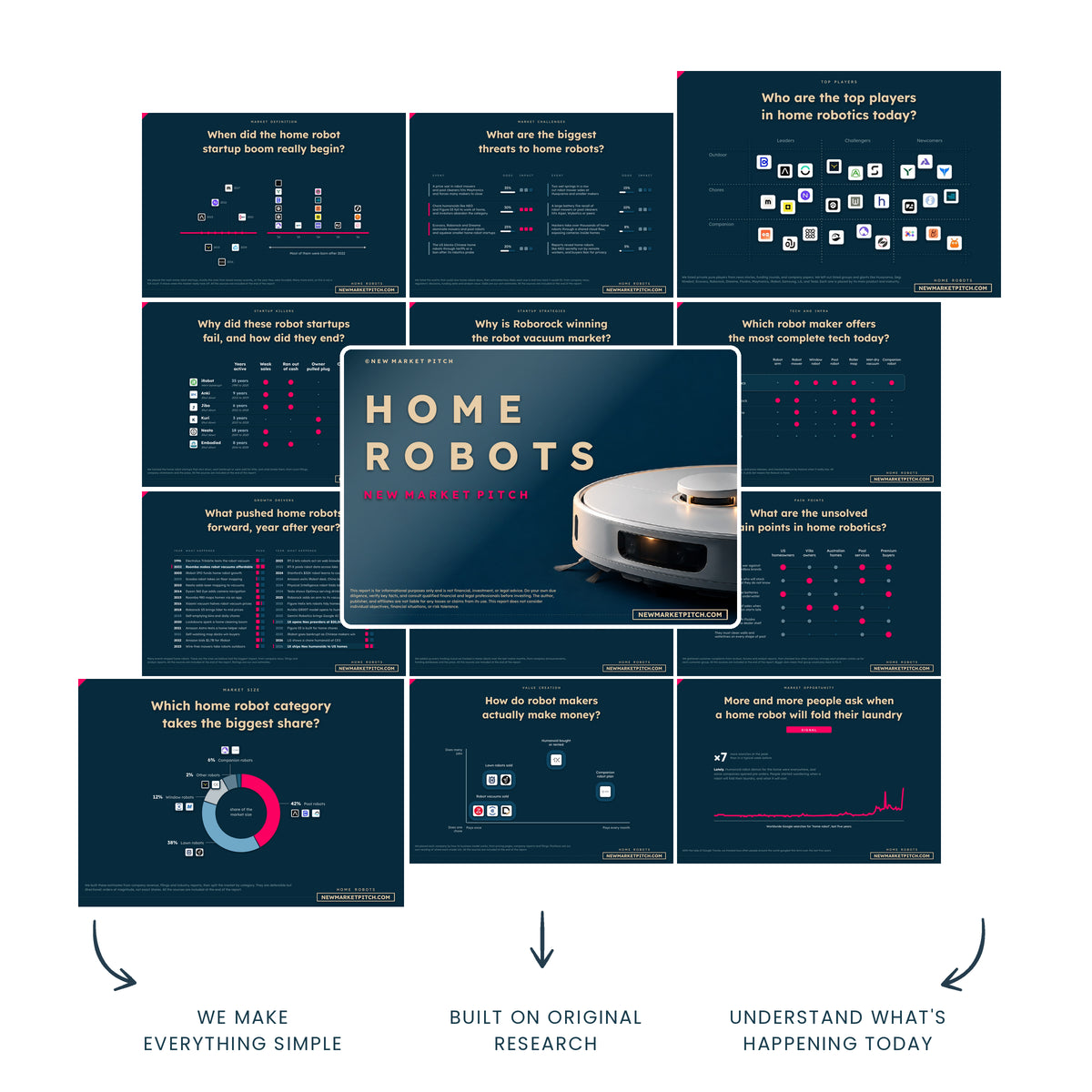
Whether you're building or investing in the home robot market, our report covers everything you need to know: the players, the money, and what's coming next.
Summary
Home robots can make money at $499 a month, but only if they become cheap enough to manufacture, reliable enough to operate for years, and autonomous enough to avoid expensive human assistance. 1X's NEO has made the subscription model commercially plausible, but profitability remains unproven.
The economics are surprisingly sensitive to customer retention. At $499 monthly, a subscriber generates $5,988 annually and $29,940 over five years. But 1X needs about 40 months of payments merely to match NEO's $20,000 outright selling price in cumulative revenue.
Manufacturing cost could determine whether the business works at all. Under an illustrative $100 monthly operating-cost assumption, a $5,000 robot recovers its hardware cost in about 13 months, a $10,000 robot needs 25 months, and a $15,000 robot needs almost 38 months. None of these production costs has been disclosed by 1X.
The company's 10,000 reservations demonstrate a serious appetite for household humanoids, but a refundable $200 deposit is a weak predictor of multi-year subscription spending. If all 10,000 converted into $499 subscriptions, they would represent nearly $60 million in annualized revenue. The actual conversion rate remains unknown.
The customer's economic calculation is different from the manufacturer's. At typical professional cleaning rates of $25 to $35 per hour, $499 buys roughly 14 to 20 hours of household help monthly. NEO must eliminate a meaningful amount of real human work to justify that expense, rather than simply spend hours performing chores slowly.
Remote human assistance is one of the biggest threats to profitability. At an illustrative $20 per operator hour, ten hours of assistance consumes $200 of the monthly fee. That leaves just $299 before recovering hardware costs, paying for computing, maintenance and other expenses.
Early cancellations create an expensive mismatch between upfront investment and recurring payments. A $10,000 robot rented for one year produces only $4,788 in contribution after the assumed $100 monthly operating expense, leaving more than half its original manufacturing cost unrecovered.
Outright ownership offers 1X a very different financial profile. Selling a NEO for $20,000 brings in substantial cash upfront, while a five-year subscription could collect almost $30,000. Subscriptions offer more lifetime revenue potential, but also expose the manufacturer to financing needs, cancellations and servicing expenses.
The broader robotics market proves that people buy automation, though not necessarily humanoids. Nearly 34.2 million consumer service robots were sold globally in 2025, while professional robot rentals are gaining ground. Yet around 7,000 full-size humanoids were sold for professional applications, illustrating how early the versatile-robot market remains.
Scaling the business would require enormous capital. Roughly 167,000 active subscribers would generate $1 billion in annualized revenue, but manufacturing that fleet at a hypothetical $10,000 per robot would require $1.67 billion in hardware spending alone. Fast subscriber growth could therefore coexist with negative cash flow.
Our conclusion is that $499 is a credible premium-market price, particularly for affluent households already purchasing domestic help. The decisive test is whether NEO can consistently save hours of housework with little supervision, limited repairs and minimal teleoperation. Until those numbers are demonstrated in paying households, the business opportunity is substantial, but the margins are still theoretical.

Written by the New Market Pitch teamWe track new markets so founders and investors can move faster. About us
Why is 1X selling a home robot for $499 a month?
The $499 monthly home robot is now a real consumer offer, but nobody has demonstrated that general-purpose humanoids can make money at that price. On October 28, 2025, 1X Technologies introduced NEO, a household humanoid available for $20,000 outright or through a $499 monthly subscription, with first U.S. deliveries planned for 2026. The company indicated that subscription deliveries would follow those for early-access buyers.
The announcement attracted considerable attention because 1X was asking consumers to pay for a robot designed to handle everyday chores, from tidying rooms to folding laundry. In April 2026, the company said it had filled its entire first-year production allocation of 10,000 robots within five days of opening preorders.
Those reservations suggested strong early interest, but the commercial model remains unusual. 1X must manufacture an expensive machine, keep it working inside unpredictable homes, provide software and customer support, and sometimes involve a remote human operator when the robot cannot finish a task independently.
That combination makes $499 a particularly interesting price. It is expensive compared with ordinary household appliances but potentially affordable compared with recurring domestic help. Whether it works depends largely on how many useful chores the robot completes without human intervention and how long customers keep paying.
Is $499 a month enough to make a home robot profitable?
A $499 home robot subscription can produce enough revenue to become profitable, especially if customers keep paying for four or five years. The problem is recovering the robot's manufacturing cost before cancellations, repairs and support expenses eat through the subscription revenue.
At $499 monthly, one robot generates $5,988 annually, $17,964 over three years and $29,940 over five years. A customer reaches the equivalent of 1X's $20,000 outright purchase price after approximately 40 months.
That creates an interesting business opportunity. If a robot lasts five years and costs substantially less than $20,000 to manufacture, the company could earn considerably more from subscriptions than from a one-time hardware sale.
However, 1X has not disclosed NEO's actual manufacturing cost, monthly support expense or subscription gross margin. Its $20,000 selling price cannot be treated as the cost of making the machine.
The key number is how much money remains after manufacturing, maintenance, computing and human assistance. Subscription revenue looks attractive over five years, but much less attractive when customers cancel after twelve months.
| Subscription duration | Total revenue per robot | Share of $20,000 purchase price |
|---|---|---|
| 6 months | $2,994 | 15% |
| 12 months | $5,988 | 30% |
| 18 months | $8,982 | 45% |
| 24 months | $11,976 | 60% |
| 36 months | $17,964 | 90% |
| 42 months | $20,958 | 105% |
| 48 months | $23,952 | 120% |
| 60 months | $29,940 | 150% |
If you want more recent data on this point, please see our latest home robots market report.

A good product starts with a real problem. In our report covering the home robot market, we show you the ones customers still live with.
How cheap would 1X's NEO robot need to become?
Manufacturing NEO for less than $10,000 would make the $499 subscription much easier to sustain, although profitability still depends on operating costs and customer retention. Every additional $6,000 in manufacturing expense consumes approximately another year of subscription revenue before servicing costs.
We tested different manufacturing costs using an illustrative $100 monthly allowance for maintenance, computing and customer support. That leaves $399 a month to recover the hardware and eventually generate profit.
At a $5,000 production cost, the robot would recover its manufacturing expense in about 13 months. At $10,000, payback takes roughly 25 months. A $15,000 machine would require almost 38 months, assuming the customer pays continuously and no additional expenses arise.
These figures are scenarios, since 1X has not disclosed NEO's production cost. They also exclude financing, customer acquisition, taxes and corporate overhead.
It's easy to see how much the hardware cost changes the business. The same $499 subscription might become attractive with a $5,000 robot and deeply unprofitable with a $20,000 robot if customers stay for only three years.
| Manufacturing cost | Monthly contribution after $100 operating costs | Hardware payback | Contribution after 3 years, less hardware |
|---|---|---|---|
| $3,000 | $399 | 7.5 months | $11,364 |
| $5,000 | $399 | 12.5 months | $9,364 |
| $7,500 | $399 | 18.8 months | $6,864 |
| $10,000 | $399 | 25.1 months | $4,364 |
| $12,500 | $399 | 31.3 months | $1,864 |
| $15,000 | $399 | 37.6 months | -$636 |
| $20,000 | $399 | 50.1 months | -$5,636 |
Do 1X's 10,000 home robot reservations prove people will pay $499 a month?
1X's 10,000 NEO reservations show that consumers are interested in household humanoids, but they tell us remarkably little about how many people will maintain a $499 monthly subscription. The reservation process requires a refundable $200 deposit, which is a much smaller commitment than paying nearly $6,000 annually.
The April 2026 factory announcement described the entire first-year production allocation as reserved in five days. Filling that allocation was impressive for a consumer product with no established mass market, especially at a listed purchase price of $20,000.
Still, the company has not publicly provided a verified breakdown of reservations choosing subscriptions versus outright purchases, nor a conversion rate from refundable deposits to paying households.
If all 10,000 reservations became active $499 subscriptions, they would represent almost $60 million in annualized revenue. If half converted, annualized revenue would be about $30 million. A 20% conversion rate would produce approximately $12 million.
Launch excitement is one thing; recurring demand is another. The first buyers of an entirely new technology are often enthusiasts who tolerate limitations that ordinary customers would reject. The more revealing figures will be delivered robots, paid subscriptions, renewals and refunds.

If you build or invest in the home robot market, you need to know which business models pay off now and which ones are fading. That's why our report covering it has a whole section on it.
Can a $499 home robot actually replace $499 worth of housework?
A $499 home robot could justify its price by replacing roughly 15 to 30 hours of paid household help each month, depending on local service rates. But today's general-purpose humanoids have not yet demonstrated that level of independently completed work across ordinary homes.
The U.S. Bureau of Labor Statistics reported a median annual wage of $35,510 for maids and housekeeping cleaners in May 2025. That works out to approximately $17 an hour for full-time employment. Households booking professional cleaning services often pay more per hour because service prices include travel, management and overhead.
At $25 an hour, $499 buys approximately 20 hours of cleaning. At $35, it buys around 14 hours. A robot capable of reliably cleaning, sorting laundry, loading a dishwasher and tidying rooms throughout the week could offer comparable value, particularly for households that already pay for domestic help.
But operating hours are a poor measure of useful work. Spending 90 minutes folding a basket of clothes that a person finishes in 15 minutes does not create 90 minutes of savings.
What matters is how much human effort disappears. We would need reliable data on completed chores, intervention rates and customer time saved to determine whether NEO actually replaces hundreds of dollars of household labor each month.
If you want more recent data on this point, please see our latest home robots market report.
Are home robots autonomous enough to earn $499 a month today?
Home humanoids can perform increasingly sophisticated household movements, but they still struggle with the reliable independence that a $499 subscription demands. 1X's NEO can demonstrate manipulation, walking and household tasks, yet its service model also includes scheduled human assistance for work the robot cannot handle alone.
1X has made progress through its Redwood AI system, which combines movement and manipulation rather than relying entirely on separately programmed actions. The company has also shown improvements to NEO's hands and object-handling capabilities.
The difficulty is doing these things consistently. A household robot may need to distinguish fragile glassware from ordinary dishes, pick up clothes scattered around a room, navigate changing furniture arrangements and recover when an object slips.
Recent robotics industry data underline the gap. The International Federation of Robotics' World Robotics 2026 report described humanoid robots as an emerging commercial category and identified reliable manipulation, safety and economic scaling as major remaining challenges. Most actual humanoid applications remain specialized, often with some human teleoperation.
We still lack a published, independently verified measure showing that NEO can complete a broad set of ordinary household chores autonomously over hundreds or thousands of customer deployments. Until that changes, $499 is largely a bet on improving capabilities.

Learning from others' mistakes is the cheapest lesson there is. In our market report about home robots, we look at what broke startups before you, so you don't repeat it.
Could human operators make $499 home robot subscriptions unprofitable?
Human teleoperation could destroy the economics of a $499 home robot subscription if customers regularly need remote assistance. Each hour of paid human work consumes revenue that could otherwise recover the hardware or support the robot's maintenance.
1X's Expert Mode allows a remote operator to help NEO complete tasks. This is valuable during early deployment because customers can request useful work before the AI has mastered every situation. It also gives the company opportunities to learn from difficult household tasks.
The economics get uncomfortable quickly. At an illustrative fully loaded operator cost of $20 per productive hour, five hours of assistance each month cost $100. Ten hours cost $200, leaving $299 from the subscription before manufacturing recovery, computing and other expenses.
Twenty hours would consume $400, or approximately 80% of the monthly fee. Actual operator costs could differ considerably, and 1X has not disclosed average assistance hours per deployed robot.
There is also a privacy problem. Human operators may need camera access inside customers' homes, even when the company provides permission controls and limits access to sensitive spaces. WIRED's July 2026 reporting examined those protections and the remaining concerns.
The crucial improvement will be reducing human assistance per successful chore. If NEO eventually completes nearly everything independently, remote support becomes an occasional expense. If subscribers routinely need several hours of help every week, $499 becomes difficult to defend financially.
If you want more recent data on this point, please see our latest home robots market report.
Will ordinary families really pay $499 a month for a home robot?
The $499 home robot subscription currently looks much more realistic for affluent households than for average consumers. At $5,988 annually, NEO competes with meaningful household expenses, and most families already have cheaper ways to automate individual chores.
A dedicated robotic vacuum cleaner, dishwasher or washing machine can handle a specific task without a substantial monthly subscription. None offers the flexibility promised by a humanoid, but each has a well-understood job and a much lower overall financial commitment.
The strongest potential customers are households where several chores consume significant time and convenience is worth paying for. A family already spending hundreds of dollars monthly on cleaning and other domestic services has a more obvious reason to consider NEO than someone who rarely pays for household help.
Even affluent consumers will expect reliability. A robot that regularly needs help, moves slowly or fails at common chores could quickly feel expensive despite its technological sophistication.
There is currently no large, public dataset establishing mainstream willingness to pay $499 monthly for a general-purpose household humanoid. The early reservation numbers demonstrate curiosity and initial demand, while actual household retention will tell us whether that interest lasts.

When you build or invest in the home robot market, you need clarity, not confusion. In our document detailing everything you need to know about home robot, we always try to put numbers on and quantify whatever is usually vague and confusing.
What happens if people cancel their home robot subscription after a year?
A home robot provider could lose thousands of dollars when customers cancel during their first year, particularly if the machine costs around $10,000 or more to manufacture. Unlike a software subscription, a robotics subscription requires a considerable upfront investment in a physical product.
Using our earlier $10,000 manufacturing scenario and $100 in monthly service costs, a customer paying for twelve months generates $5,988 in revenue and $4,788 after recurring expenses. That leaves $5,212 of the original manufacturing expense unrecovered.
After two years, cumulative contribution reaches $9,576. The manufacturer finally recovers the initial hardware cost around month 26, assuming uninterrupted payments and no extraordinary repairs.
Returned robots could potentially be refurbished and deployed to new customers. That would reduce losses, but the company would still pay for transportation, inspections, repairs and time between subscriptions. A robot with an expensive hardware failure might have little remaining value.
The bigger problem is the timing. 1X needs cash to build each robot well before collecting several years of subscription revenue. Poor retention could create financial pressure even while new orders continue growing.
Could home robot repairs wipe out the monthly profit?
Repairs could become one of the biggest hidden expenses in a $499 home robot subscription, especially while humanoids are still relatively new consumer products. The combination of articulated limbs, mechanical hands, sensors, batteries and moving joints creates more potential failure points than a conventional domestic appliance.
NEO is supposed to operate in homes containing furniture, pets, stairs, fragile objects and unexpected obstacles. Every mechanical incident can create support costs, and some failures may require replacement parts or a technician rather than a software update.
The impact becomes large across a fleet. An additional $50 in average maintenance expense per robot per month costs $600 annually. Across 10,000 active robots, that represents $6 million a year. At $150 per month, the same fleet would incur $18 million annually.
We cannot yet calculate NEO's actual maintenance burden because 1X has not published large-scale consumer failure rates, repair expenses or average time between failures.
A machine that stays functional for five years with occasional maintenance has a completely different financial profile from one requiring frequent repairs after its first year. Hardware reliability will matter almost as much as autonomy once robots start spending substantial time in customers' homes.

In our report covering the home robot market, we look at what the winners do differently, so you can learn from the best instead of guessing.
Is selling a home robot for $20,000 better than renting it for $499 a month?
Selling a NEO robot outright for $20,000 gives 1X faster cash recovery, while the $499 subscription could eventually generate more revenue from customers who stay long enough. The better model depends on whether the company can finance its robot fleet and keep it working for several years.
The subscription reaches $20,000 in cumulative payments after roughly 40 months. Over five years, the customer pays $29,940, almost $10,000 more than the purchase price.
That additional revenue is attractive, but a subscription provider may remain responsible for servicing expenses and the risks of early cancellation, depending on the contract. An outright sale brings most revenue upfront and transfers ownership to the customer.
The monthly option can still help 1X reach people unwilling to commit $20,000 to a product that may improve rapidly or become obsolete. It also creates a continuing relationship through software, support and potential upgrades.
The difference is especially important for a startup expanding production. Selling 10,000 machines at $20,000 would generate $200 million in gross hardware revenue if every unit sold and was paid for. Renting 10,000 machines at $499 generates just under $60 million over their first twelve months, assuming full-year subscriptions. The subscription model may ultimately earn more, but it requires much more patience and financing.
If you want more recent data on this point, please see our latest home robots market report.
Do robot vacuum sales prove there is a market for $499 humanoids?
Robot vacuum sales prove that people increasingly buy household automation, but the numbers offer limited support for a $499 monthly humanoid subscription. Consumers have been adopting specialized machines with clearly defined jobs, while general-purpose household robots remain commercially untested.
The International Federation of Robotics reported almost 34.2 million consumer service robots sold worldwide in 2025, a 37% increase from the previous year under its latest reporting. Most were domestic robots handling tasks such as floor cleaning and lawn mowing.
Compare that with roughly 7,000 full-size humanoid robots reported in the IFR's 2025 market assessment for industrial and professional applications. Those figures cover different categories and applications, but the contrast is revealing: established service robots sell in the tens of millions, while commercially deployed humanoids are still measured in thousands.
The difference comes down partly to reliability and cost. A robotic vacuum does one relatively predictable job. A humanoid has to recognize unfamiliar objects, manipulate them safely and decide what to do when something unexpected happens.
For home humanoids, the opportunity is to combine several useful chores in one machine. We have evidence that households want automation. The missing proof is that consumers will pay a large recurring premium for a more versatile machine.

Your time is limited. In our research about home robots, we put numbers on each part of the market, so you can see where it makes sense to focus.
Does robot-as-a-service already work in warehouses?
Robot-as-a-service is commercially established in professional robotics, particularly in logistics, but warehouse success does not automatically translate into profitable home humanoids. Businesses have clearer ways to measure whether a rented robot saves enough labor or increases output to justify its cost.
According to the International Federation of Robotics, global shipments of professional service robots reached nearly 250,000 units in 2025, up 24%. Transportation and logistics accounted for approximately 117,500 units, representing 47% of the total and increasing 21% year over year.
That is a much stronger commercial record than household humanoids have today. Warehouse robots can move goods along planned routes, operate in controlled environments and potentially work across multiple shifts. Companies can compare their cost directly with workers, equipment and productivity.
The IFR has also reported growing adoption of robot rental and robot-as-a-service arrangements, showing that companies are increasingly comfortable paying for robotic capabilities without owning the machines outright.
Households are harder. A home robot deals with far more variation, generally works fewer productive hours and has a customer whose willingness to pay may depend as much on convenience as measurable savings.
Still, professional robotics demonstrates that recurring payments can finance useful machines. Household humanoids need to match the reliability and economic usefulness that made that approach viable elsewhere.
Can 1X build enough NEO robots to make $499 profitable at scale?
1X has a serious manufacturing ambition, but increasing output alone will not guarantee profitable $499 subscriptions. The company has announced plans to move from an initial annual production capacity of 10,000 NEO robots toward more than 100,000 units annually by the end of 2027.
In April 2026, 1X announced the opening of its NEO factory in Hayward, California. The company described a vertically integrated manufacturing strategy and said early production was supporting research and internal home testing ahead of customer deliveries.
The planned increase from roughly 10,000 to more than 100,000 units represents at least a tenfold expansion in annual capacity. Higher volume could help 1X negotiate component prices, automate assembly and spread engineering costs across more machines.
But production capacity needs to be distinguished from delivered and functioning robots. Building 100,000 units would involve substantial capital. At a hypothetical $10,000 manufacturing cost per unit, that production volume represents $1 billion in manufacturing spending.
The revenue opportunity is similarly large. If 100,000 robots were deployed on $499 subscriptions for a full year, annual revenue would approach $599 million. That still leaves the company paying to manufacture, support and finance the machines.
As we saw earlier, manufacturing cost matters enormously to the payback period. What we need from 1X now is evidence that larger production runs are actually reducing unit costs while maintaining acceptable reliability.

In our market report about home robots, we always try to gather several sources and make estimates that make sense, so you can work with solid numbers.
How many $499 home robot subscribers would 1X need to make $1 billion a year?
1X would need approximately 167,000 active subscribers paying $499 monthly to generate $1 billion in annualized subscription revenue. That is a possible long-term commercial target, but it remains well beyond the company's announced initial production allocation.
The calculation is straightforward: one subscription generates $5,988 in annual billings. At 10,000 customers, that produces $59.9 million. At 100,000, the figure reaches $598.8 million.
There is an important catch in reaching those numbers. At an illustrative $10,000 manufacturing cost, deploying 167,000 robots requires approximately $1.67 billion in manufacturing spending before operating costs, financing and overhead. The manufacturer must fund that investment while customers pay monthly.
Revenue scale could therefore arrive before positive cash flow. A robotics company expanding too quickly might need repeated external financing despite reporting impressive subscription growth.
The opportunity is substantial if hardware gets cheaper and customer retention proves strong. The size of the potential business isn't really the weak point. The unanswered question is how much capital 1X must deploy for every dollar of profitable recurring revenue.
| Active subscriptions | Annualized revenue | Manufacturing cost at $10,000/unit |
|---|---|---|
| 1,000 | $6.0M | $10M |
| 5,000 | $29.9M | $50M |
| 10,000 | $59.9M | $100M |
| 25,000 | $149.7M | $250M |
| 50,000 | $299.4M | $500M |
| 100,000 | $598.8M | $1.0B |
| 167,000 | $1.0B | $1.67B |
| 250,000 | $1.50B | $2.5B |
If you want more recent data on this point, please see our latest home robots market report.
Can home robots really make money at $499 a month?
Yes, home robots can make money at $499 a month, but general-purpose humanoids have not yet proved that they can do so consistently. The subscription price is potentially high enough to finance an expensive machine and generate attractive recurring revenue. The real uncertainty is how cheaply manufacturers can build these robots and how independently they can operate.
Our calculations suggest that a robot manufactured for $5,000 to $10,000 could recover its hardware cost in approximately 13 to 25 months if monthly operating expenses stayed around $100. Those are workable economics in principle, though they remain hypothetical until manufacturers disclose actual costs and retention figures.
The encouraging evidence is tangible. 1X filled its initial announced production allocation, consumer service robot sales have reached tens of millions annually, and professional robot subscriptions have found real customers in logistics and other industries.
However, NEO has not yet demonstrated mature subscription margins, low repair costs or years of customer retention. Remote human assistance also introduces an expense that could seriously weaken profitability if robots need it regularly.
For now, the strongest market is likely to be affluent households willing to pay for convenience and early access to new technology. Wider adoption will depend on the robot becoming reliable enough to replace several hours of useful household work each week.
The price is ultimately less troubling than the amount of autonomy customers receive for it. At $499, a robot that reliably saves an hour of housework every day could become an attractive product. One that regularly needs supervision, remote operators and expensive repairs would struggle financially even with enthusiastic customers.
Our conclusion is that $499 is a credible starting price for a premium home robot business, but profitable mass-market deployment remains premature. The companies that make robots genuinely useful without constant human support will have a much stronger chance of turning that monthly fee into sustainable profit.

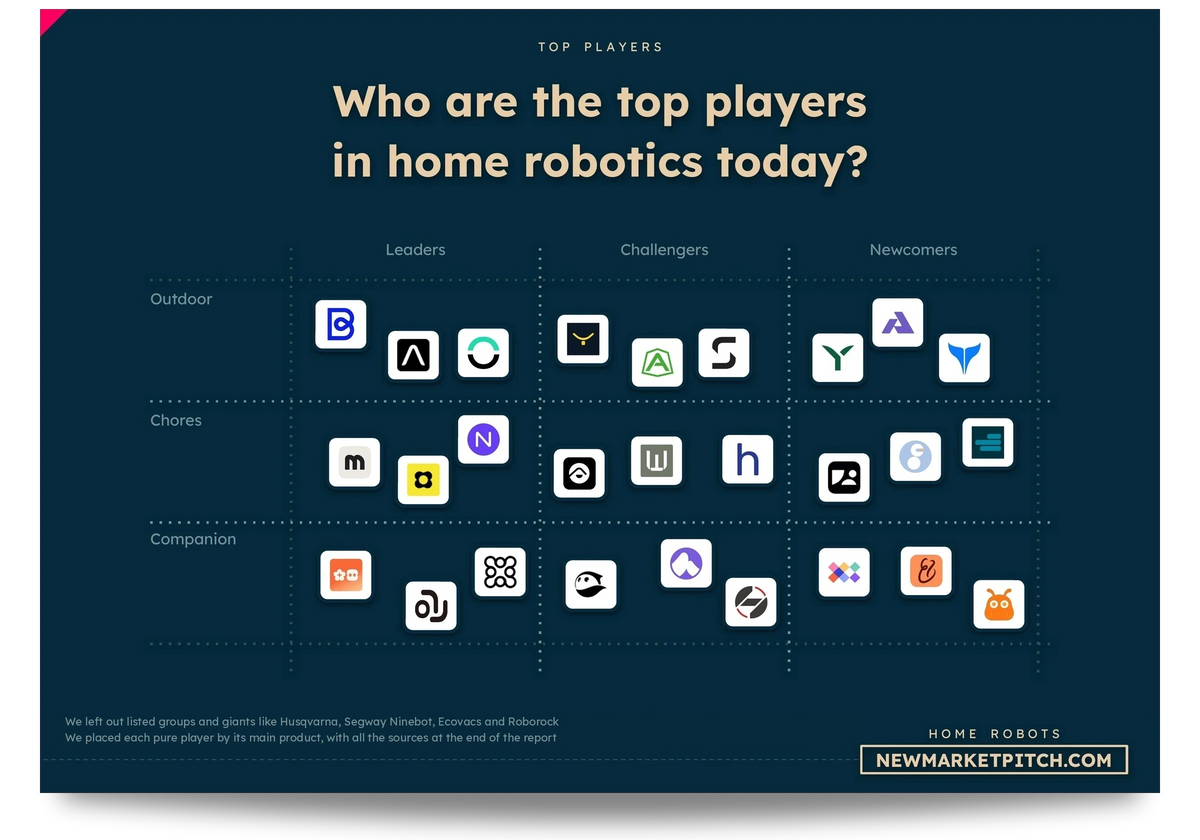
In our document detailing everything you need to know about home robot, we turn what is vague and complex into simple, useful visuals. Market maps like this one show you at a glance where every startup stands.
Our methodology
Can home robots make money at $499 a month? We approached this question by breaking the business model into the factors that actually determine profitability: hardware cost, subscription duration, operating expenses, autonomy, human assistance, household labor value, manufacturing capacity and customer adoption. For each dimension, we examined fresh commercial and industry evidence, aggregated the relevant observations, assessed their economic implications and then brought those findings together to reach a stronger conclusion.
Our research prioritizes observable developments over predictions: published product prices, official preorder announcements, manufacturing disclosures, demonstrated robot capabilities, government wage statistics and industry-wide robotics sales data. We distinguish reservations from paying subscriptions, production capacity from delivered machines, and supervised demonstrations from independently completed household work. These distinctions are essential when assessing a market whose commercial activity is still at an early stage.
The unit-economics analysis uses 1X's publicly advertised $499 monthly subscription and $20,000 ownership price as fixed starting points. We calculate cumulative subscription revenue across different durations, then test illustrative hardware costs from $3,000 to $20,000 against a $100 monthly allowance for operating expenses. Hardware payback is calculated from the monthly contribution remaining after that allowance. These scenarios are sensitivity tests, not estimates of 1X's undisclosed manufacturing costs or actual margins.
We also tested the model against early cancellations, teleoperation expenses and fleet-scale manufacturing requirements. The $20 hourly operator cost, alternative manufacturing costs and customer-conversion scenarios are explicitly illustrative. The calculations exclude financing charges, customer acquisition, corporate overhead and other costs unless stated. We use these assumptions to identify where profitability becomes plausible and where the subscription model starts to break down, rather than to assign false precision to the company's financial performance.
For market comparisons, we combined U.S. household cleaning wage data with International Federation of Robotics statistics on consumer service robots, professional robot shipments, humanoid sales and robot-as-a-service adoption. These benchmarks establish what households already purchase and how recurring robotics businesses operate elsewhere, while accounting for the much greater variability of general-purpose robots working inside homes.
Key primary sources include 1X's official NEO pricing and ordering page, the NEO product launch announcement, the April 2026 NEO factory announcement covering 10,000 reservations and production plans, 1X's preorder and contractual terms, 1X's Redwood AI technical publication, and its mobility research.
External benchmarks and technical assessments draw on the IFR's World Robotics 2026 service robot findings, the IFR's Humanoid Robots: Vision and Reality position paper, the U.S. Bureau of Labor Statistics' May 2025 occupational wage data, and WIRED's July 2026 reporting on NEO's dexterity, teleoperation and household privacy.
The final assessment weighs these findings together rather than allowing any single preorder figure, technology demonstration or market forecast to determine the answer. In particular, we give greater importance to the economics of a functioning robot over several years than to headline subscription revenue alone. That combination of recent evidence, comparable operating models and transparent financial scenarios underpins our conclusion about whether $499 can support a sustainable home robotics business.

Our report covering the home robot market gets updated several times a month, so you always get the latest view of where things stand.
Written by the New Market Pitch teamWe track new markets so founders and investors can move faster. About us