Who are the top investors in home robots?
Whether you're building or investing in the home robot market, our report covers everything you need to know: the players, the money, and what's coming next.
Summary
HongShan is the most active investor in home robot startups, with 5 equity rounds joined across 4 startups. Matrix Partners China and GSR Ventures are tied behind it. That puts HongShan first on participation, although other investors stand out in recent rounds and particular stages.
We found 157 named investors across 100 equity rounds involving 47 startups. Home robotics is attracting plenty of backers, but even its busiest investor has only a small piece of the activity. Nobody has become the fund every household robot startup needs.
HongShan's choices are also revealing. It has backed LeXiang Technology (Zeroth), Robopoet, Enabot and Hengzhi Future. These companies show why the home robotics market now includes companions and household assistants alongside familiar cleaning machines.
Leading a round tells a different story from simply joining it. Matrix Partners China, Zhongding Capital and Accel have all been named as leads in deals we counted. A famous name on the investor list cannot tell us how much of the round that firm paid for.
The latest deals have widened the field. Among the 20 most active investors, 14 have joined a round this year and 6 have not. HongShan is still participating, but it is no longer setting the fastest recent pace by itself.
Linear Capital, 5Y Capital and Xiaomi are part of the current activity. Their choices include household manipulation and interactive robots, areas where the product is harder to build than a machine that repeats a narrow cleaning task.
Most of the action starts early. Seed accounts for 51 of the 81 rounds with a known stage, and Matrix Partners China and GSR Ventures share the lead there. Founders looking for Series A or later funding face a much shorter list of repeat participants.
Consumer products give investors very different things to judge. Accel backs Posha's kitchen robot, Anker Innovations backs Beatbot's pool-cleaning business, and Caduceus Capital Partners backs Tombot's companion animal. Each targets a job a household can understand immediately.
The ambition is growing, too. Coatue has backed Sunday Robotics' general-purpose Memo project, while Weave Robotics is moving from a laundry-folding machine toward a mobile helper. That brings mainstream technology funds into a market previously associated with appliances and specialist hardware.
Investors often return to the same startup rather than team up across the market. Robopoet and XCANBOT each have repeat backers, which makes their investor relationships different from a broad group financing the whole sector. HongShan leads the overall count, but who matters most to a founder now depends on the robot, its stage and whether the backer can help get it into homes.

Written by the New Market Pitch teamWe track new markets so founders and investors can move faster. About us

In our report covering the home robot market, you will always find fresh funding data, taken straight from our own verified funding database.
Which VCs invest the most in home robots right now?
HongShan leads home robotics investing right now, with 5 rounds joined.
Matrix Partners China and GSR Ventures are tied behind HongShan at 3 rounds each. Among the 157 named investors we identified, no other firm has matched HongShan's repeat participation. That makes it the clear leader by appearances, although not by every measure of influence.
Look at the companies and the difference becomes clearer. HongShan has appeared with LeXiang Technology, Robopoet, Enabot and Hengzhi Future. Matrix Partners China's home robot investments include LeXiang Technology, Knowin AI and PokeBot, while GSR Ventures' recorded activity centers on Robopoet. Enabot already sells mobile robots that let families check on pets and rooms remotely. Knowin AI belongs to a newer group trying to help robots handle physical household tasks. Those bets ask distinct things of a product.
The count measures who came back to invest. It doesn't measure the checks individual funds wrote, and it doesn't mean their startups have sold the most robots. We treat both distinctions seriously when deciding who deserves to be called a top investor.
The table below ranks the 20 most active home robots investors by the number of equity rounds they joined, with the rounds they led, their main stages, the startups they backed and the biggest round they joined.
If you want to go more into detail and get more data to understand what investors are betting on now, please check our home robots report.
| # | Investor | Rounds | Led | Main stages | Home robots startups backed | Biggest round joined | Latest round |
|---|---|---|---|---|---|---|---|
| 1 | HongShan ▼ | 5 | 2Leads half its rounds (lead known for 4 of 5 rounds) |
Seed 2Series A 1 | LeXiang Technology, Robopoet, Enabot, Hengzhi Future | $28MLeXiang Technology · 2025 | Jul 2026 |
| 2 | Matrix Partners China ▲ | 3 | 2Named as lead in every round found (lead known for 2 of 3 rounds) |
Seed 3 | LeXiang Technology, Knowin AI, PokeBot | $74MKnowin AI · 2026 | Aug 2026 |
| 3 | GSR Ventures ▼ | 3 | 1Mostly follows (led 33% of its rounds) |
Seed 3 | Robopoet | $14MRobopoet · 2026 | Jul 2026 |
| 4 | Zhongding Capital | 2 | 2Named as lead in every round found | Seed 2 | LeXiang Technology, Knowin AI | $28MLeXiang Technology · 2025 | Mar 2026 |
| 5 | Accel | 2 | 2Named as lead in every round found | Seed 1Series A 1 | Posha, Swish Robotics | $8MPosha · 2025 | May 2025 |
| 6 | Cathay Capital | 2 | 2Named as lead in every round found | Seed 1Series A 1 | Beatbot, Vita Dynamics | Undisclosed | Mar 2025 |
| 7 | Linear Capital | 2 | 1Named as lead in every round found (lead known for 1 of 2 rounds) |
Seed 2 | Ludens AI, Xieyue Intelligence | $3.8MLudens AI · 2026 | Sep 2026 |
| 8 | Caduceus Capital Partners | 2 | 1Named as lead in every round found (lead known for 1 of 2 rounds) |
Series A 2 | Tombot | $7MTombot · 2026 | Jun 2026 |
| 9 | 5Y Capital | 2 | 1Leads half its rounds | Seed 1Series A 1 | Ola Dimensions, xLean Robotics | Undisclosed | Jun 2026 |
| 10 | Chuxin Capital | 2 | 1Named as lead in every round found (lead known for 1 of 2 rounds) |
Seed 2 | Cyan Robotics, Entropy Technology | Undisclosed | May 2026 |
| 11 | ZhenFund | 2 | 1Leads half its rounds | Seed 1 | LeXiang Technology, Futuring Robot | $29MFuturing Robot · 2026 | Jan 2026 |
| 12 | IDG Capital | 2 | 1Leads half its rounds | Seed 1 | LeXiang Technology | $28MLeXiang Technology · 2025 | Sep 2025 |
| 13 | Anker Innovations | 2 | 1Leads half its rounds | Series A 2 | Beatbot | $140MBeatbot · 2025 | Sep 2025 |
| 14 | Hillhouse Investment | 2 | 1Named as lead in every round found (lead known for 1 of 2 rounds) |
Seed 1Growth 1 | Narwal Robotics, Vita Dynamics | $14MVita Dynamics · 2025 | Jan 2025 |
| 15 | Zhenzhi Ventures | 2 | 1Named as lead in every round found (lead known for 1 of 2 rounds) |
Seed 2 | Ropet | $3MRopet · 2024 | Dec 2024 |
| 16 | Walden International | 2 | 0Never led (lead known for 1 of 2 rounds) |
Seed 2 | Knowin AI | $74MKnowin AI · 2026 | Sep 2026 |
| 17 | Zhejiang Jiecang Linear Motion Technology | 2 | 0Lead not published | Seed 2 | XCANBOT | $1.4MXCANBOT · 2026 | Sep 2026 |
| 18 | Zhejiang YAT Electrical Appliance | 2 | 0Lead not published | Seed 2 | XCANBOT | $1.4MXCANBOT · 2026 | Sep 2026 |
| 19 | Xiaomi | 2 | 0Never led | Seed 2 | PokeBot | Undisclosed | Aug 2026 |
| 20 | Lianxin Capital | 2 | 0Never led | Seed 2 | Futuring Robot | $29MFuturing Robot · 2026 | Mar 2026 |
No investors match this search.
Data from January 2024 through 19 November 2026, which is enough to show who is active today and who has been for years. Rounds: equity rounds in which the investor is named. Led: rounds it led or co-led. ▲ more rounds in 2026 so far than its 2025 pace, ▼ fewer.

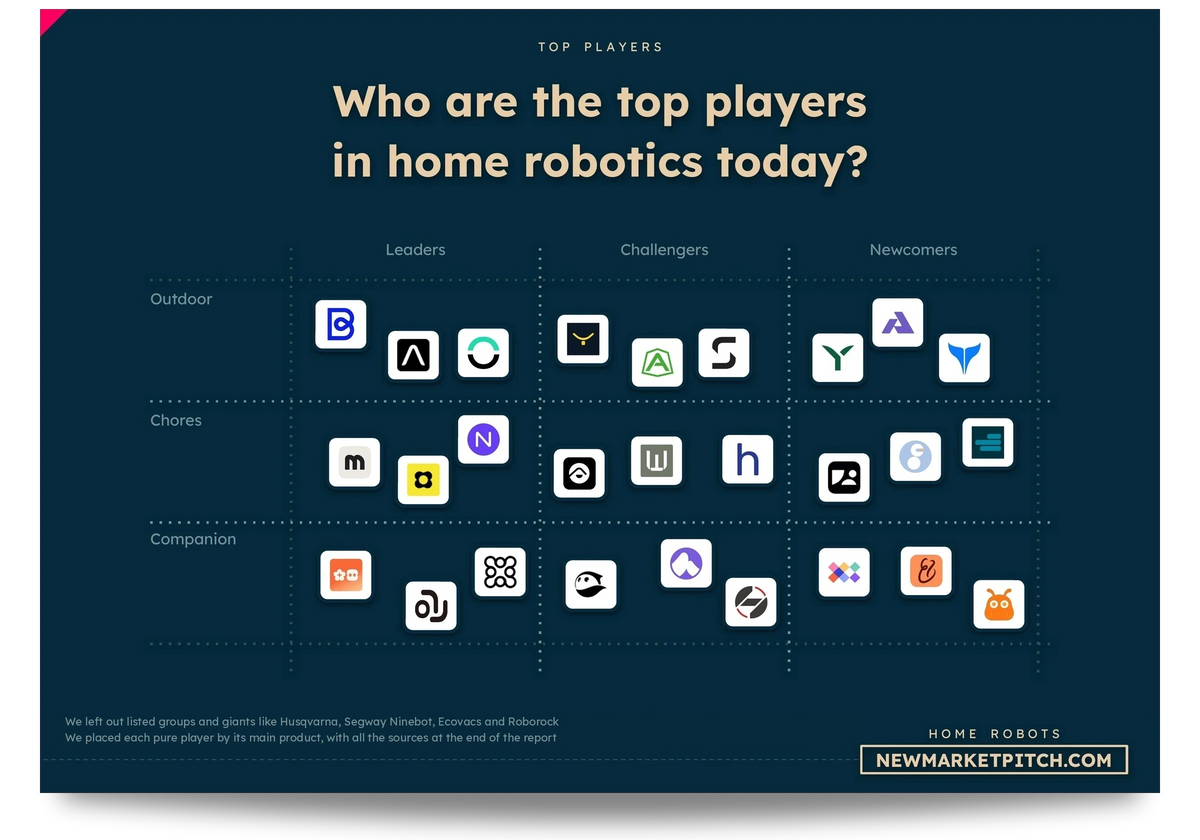
In our research about home robots, we turn what is vague and complex into simple, useful visuals. Market maps like this one show you at a glance where every startup stands.
Does HongShan actually lead home robot funding rounds?
Yes, HongShan has led 2 home robotics rounds, but Matrix Partners China, Zhongding Capital, Accel and Cathay Capital have led just as many.
HongShan was named as lead in 2 financings, or 50% of its rounds with a known lead. Matrix Partners China and Zhongding Capital were each named as lead in 2 rounds as well. A lead investor typically plays a bigger role in organizing a financing, so that distinction matters to founders choosing whom to approach.
There is another useful difference. Matrix Partners China backed LeXiang Technology, Knowin AI and PokeBot; Zhongding Capital backed LeXiang Technology and Knowin AI. Accel's deals involved Posha and Swish Robotics, while Cathay Capital appeared with Beatbot and Vita Dynamics. Some funds take the lead across several startups, while others return to a familiar company.
A lead percentage cannot fill in what an announcement leaves unsaid. When a round's lead is not disclosed, we cannot label the other investors as followers. Announcements are also more likely to name the lead than every participant. Accel's public Posha portfolio page confirms its interest in a robot that cooks in an actual kitchen, but it says nothing about the size of Accel's individual check. The useful comparison is visible deal leadership, not a guessed capital commitment.
The table below shows how selected active investors compare on visible deal leadership.
| Investor | Rounds | Led | Lead rate |
|---|---|---|---|
| HongShan | 5 | 2 | 50% |
| Matrix Partners China | 3 | 2 | 100% |
| GSR Ventures | 3 | 1 | 33% |
| Zhongding Capital | 2 | 2 | 100% |
| Accel | 2 | 2 | 100% |
| Cathay Capital | 2 | 2 | 100% |
| Linear Capital | 2 | 1 | 100% |
Lead rates cover rounds with a published lead and are an upper bound.
Is Sequoia backing home robots, or is that HongShan?
Those home robot deals belong to HongShan: it is now independent from Sequoia Capital, so its home robotics investments are counted separately.
That makes a real difference when looking for the investors behind household robots. Reuters reported in June 2023 that Sequoia would separate its China, India and Southeast Asia, and US and European businesses. The China business became HongShan, while the US and European firm kept the Sequoia Capital name. Treating them as one current investor would give readers the wrong picture.
HongShan's domestic robot companies include Enabot, whose mobile devices can patrol rooms and help owners interact with pets, and Robopoet, which sits in the companion-robot part of the market. Those are the investments tied to HongShan's own current identity. Sequoia's fame may explain why readers recognize the name, but it doesn't turn HongShan's later decisions into investments by the American firm.
We therefore keep HongShan separate in the investor record. For someone trying to find the actual decision-maker behind a household robot startup, the distinction is practical: a familiar historical brand and the firm writing today's checks are not always the same organization.

Your time is limited. In our market report about home robots, we put numbers on each part of the market, so you can see where it makes sense to focus.
Why is HongShan backing home robot companions?
Home robot companions already have real uses, which helps explain HongShan's interest in them.
The firm's home robot companies include LeXiang Technology, Robopoet, Enabot and Hengzhi Future. Enabot offers the clearest picture of a product already on sale. Its EBO and ROLA devices let people move a camera around the home, interact with pets and monitor rooms remotely. Some models add features such as treat dispensing or automatic navigation. None needs the hands or walking ability of a humanoid robot.
Companionship presents a different challenge from pool or floor cleaning. A device has to be safe around people and pets, useful enough to turn on repeatedly, and simple enough for a family to maintain. Robopoet and LeXiang Technology push farther toward interactive domestic machines, while Enabot shows how a narrower job can already support a consumer product. That spread makes more sense than a blanket bet on a future robot servant.
It would be a stretch to claim we know HongShan's internal investment thesis. We can see the products it has funded. Across these companies, the common thread is a robot designed for the home rather than an industrial machine whose makers merely mention homes as a possible future market.
Is Matrix Partners China betting big on home robots?
Yes, Matrix Partners China is one of the busiest home robot investors this year, with 2 rounds joined, all its home robot bets at seed.
Matrix Partners China joined 2 rounds this year, while HongShan joined 1. Matrix's recorded home robotics activity is entirely at seed, across LeXiang Technology, Knowin AI and PokeBot. HongShan has appeared across more than one stage. The firms are therefore competing for somewhat different opportunities: Matrix is particularly visible where a new domestic robot idea first raises institutional money.
Knowin AI shows what is attracting early investors. Matrix Partners China joined its $74M seed round, which is the size of the whole financing, not Matrix's own check. Work on household manipulation is more difficult than moving a camera or vacuum around a room. It requires robots to recognize unfamiliar objects, handle them safely and cope when something goes wrong. PokeBot and LeXiang Technology offer further examples of Matrix backing companies in this part of home robotics.
If fresh seed investments remain its priority, Matrix Partners China could eventually take the overall lead. It hasn't yet. A busy current year gives us evidence of recent interest, rather than proof that the firm will keep investing at the same rate.
Do home robot investors lead deals or just join them?
Many home robot investors mostly join deals rather than lead them: GSR Ventures, one of the busiest, led just 1 of its 3 rounds, all with Robopoet.
GSR Ventures was named as lead in 1 round. That's different from Matrix Partners China, despite their tie in overall participation. Matrix has backed several domestic robot companies; GSR Ventures has returned to the same companion-robot company. The distinction is easy to miss if we look only at the count next to each fund's name.
Repeated financing can matter to a startup. Investors who have followed its development may be willing to support another product iteration or another attempt to reach consumers. But participation in a later round alone doesn't tell us how much a fund paid or whether the robot is selling well. Robopoet still has to be judged by what it ships and how people use it.
GSR Ventures has joined a home robotics round this year, so its interest has not disappeared. Our evidence supports a narrower conclusion: GSR Ventures has maintained a relationship with Robopoet, while Matrix Partners China's activity reaches across more young home robot makers. For a founder, those are meaningfully different investor profiles.
Has Accel stopped investing in home robots?
Accel has not joined a home robotics round this year, but its deals with Posha and Swish Robotics still matter.
Accel was named as lead in 2 rounds we counted. Posha makes a countertop cooking robot, and Accel's Atoms portfolio page says the company has hundreds of customers using the product upwards of 12 times a week. That's a concrete claim about household behavior, not just a video of a robot making dinner once. It also gives an investor something to test: whether people keep using the machine after the novelty wears off.
Accel's wider business is early-stage technology investing, so a home robot doesn't need to resemble a traditional appliance investment to fit. The firm has described its commitment to investing early, while Posha puts software, sensors, hardware and food preparation inside a device consumers can buy. Swish Robotics is another name in Accel's home robotics record, though its product trajectory should not simply be assumed to match Posha's.
A quiet year in this category isn't an announcement of retreat. Accel is still a relevant example of a generalist fund willing to lead specialized home robot deals. The important proof now will be how those products perform in customers' homes.

In our document detailing everything you need to know about home robot, we always try to gather several sources and make estimates that make sense, so you can work with solid numbers.
Are Xiaomi and Anker becoming major home robot investors?
Xiaomi and Anker Innovations are backing home robot startups, but neither has overtaken the leading VCs.
Xiaomi joined 2 PokeBot rounds, while Anker Innovations joined 2 Beatbot rounds. PokeBot is pursuing domestic assistance; Beatbot sells robotic pool cleaners. Xiaomi's deals point toward robots that can handle more varied physical tasks, while Anker's connection to Beatbot is closer to an established consumer product category. Their records show participation, not the amount either company personally invested.
There's a useful comparison outside those names. Fluidra, a pool equipment business, announced in December 2025 that it had completed its investment in Aiper. The partnership brings together robotic pool-cleaning technology and an established company's distribution experience. A hardware business can sometimes help a startup reach retailers and service customers in ways a financial investor cannot.
We shouldn't assume every corporate investor supplies the same help. Component knowledge, manufacturing contacts and sales channels are possibilities, not benefits proved by an entry on an investor list. What is clear is that home robots now draw interest from companies that already know how physical consumer products are built and sold.
Are robot pool cleaners a better bet than home humanoids?
Robot pool cleaners offer investors a much easier product to judge than home humanoids, although that does not settle which will pay off best.
A pool cleaner has an obvious job, an established customer and measurable results. Beatbot has promoted its expansion in the US and Europe, and Anker Innovations and Cathay Capital are among its named backers. Fluidra's completed Aiper investment shows that established pool equipment companies also see business value in this category. They are paying attention to a product people already know how to buy.
Now compare that with Sunday Robotics' Memo, Weave Robotics' Isaac 1 and 1X's NEO. Memo is headed into home beta testing. Weave says Isaac 1 can handle laundry and room-tidying tasks with remote assistance when needed. 1X is taking NEO orders while acknowledging that difficult tasks may require a human expert to supervise. These companies are trying to solve a much wider set of problems, including unfamiliar rooms, fragile objects and everyday safety.
The choice is partly about what an investor wants to prove. Beatbot can be judged against sales, cleaning performance and customer support. A general household helper still has to show that it can handle many changing tasks at a cost households will accept. Higher ambition brings more possible uses, along with far more things that can go wrong.
Are big AI funds finally backing robots for the home?
Yes, Coatue and other well-known technology investors are already backing general-purpose robots for homes.
Sunday Robotics announced a $165M Series B in March 2026, led by Coatue, with Bain Capital Ventures, Fidelity Management & Research Company, Tiger Global and Benchmark among the participants. The company's plan is to test its Memo robot in real households rather than keep producing demonstrations. It says Memo can clear tables and load a dishwasher, and that the beta will test safety and usefulness in messy homes. The planned customer tests remain a harder proof point than a funding announcement.
Sunday is not alone in asking investors to bet on a wider set of chores. 1X is taking orders for NEO, which offers basic autonomy and scheduled expert assistance. Weave has gone from a stationary laundry-folding robot to a mobile model intended to put away clothes and reset rooms. Those are different ways to work toward the same customer promise: save people time on work they actually do at home.
Coatue's financing gives household robotics a recognizable mainstream backer. It doesn't mean Coatue has become the market's most frequent investor. A single prominent deal and repeated participation across startups answer different questions, and we keep them separate.
Which home robots investors are still investing this year?
There is no sole busiest home robot investor this year: 8 investors are tied at 2 rounds each.
Of the 20 most active investors overall, 14 have joined a round this year and 6 have not. HongShan remains active with 1 deal, compared with 4 last year. Its latest recorded investment involved Robopoet, so the overall leader has not vanished, even if other investors are matching or exceeding its recent pace.
The current leaders include Matrix Partners China, Linear Capital, 5Y Capital, Xiaomi, Walden International, Lianxin Capital, Zhejiang Jiecang Linear Motion Technology and Zhejiang YAT Electrical Appliance. Matrix has backed different young companies, whereas Xiaomi's recorded deals are with PokeBot and the Zhejiang companies appear with XCANBOT. Those are different ways to stay involved: discover new founders, return to a company, or back technology close to an existing hardware business.
We count 29 rounds with at least one named investor this year, compared with 38 last year, but the current year is not finished. For a founder seeking an active investor now, the fresh participation matters more than a historical reputation. It is still too early to treat this year's count as a final full-year comparison.
The table below shows, year by year, how many rounds 12 of the most active home robots investors joined, so it is easy to see who is still investing and who has slowed down.
If you want to go more into detail and see which investors are still writing checks and which have slowed down, please check our home robots report.
| Investor | 2024 | 2025 | 2026* | Total |
|---|---|---|---|---|
| Matrix Partners China | 1 | 2 | 3 | |
| Linear Capital | 2 | 2 | ||
| 5Y Capital | 2 | 2 | ||
| Walden International | 2 | 2 | ||
| Zhejiang Jiecang Linear Motion Technology | 2 | 2 | ||
| Zhejiang YAT Electrical Appliance | 2 | 2 | ||
| Xiaomi | 2 | 2 | ||
| Lianxin Capital | 2 | 2 | ||
| HongShan | 4 | 1 | 5 | |
| GSR Ventures | 2 | 1 | 3 | |
| Zhongding Capital | 1 | 1 | 2 | |
| Caduceus Capital Partners | 1 | 1 | 2 |
* 2026: January to 19 November. Darker cells mean more rounds that year. Data from January 2024 through 19 November 2026.

Our report covering the home robot market gets updated several times a month, so you always get the latest view of where things stand.
Are new investors still coming into home robots?
Yes, new investors are still coming into home robots, and several firms made their first investment in this market recently.
Linear Capital has backed Ludens AI and Xieyue Intelligence, while 5Y Capital has backed Ola Dimensions and xLean Robotics. Xiaomi appears with PokeBot, Walden International with Knowin AI, and Zhejiang Jiecang Linear Motion Technology and Zhejiang YAT Electrical Appliance with XCANBOT. These investors aren't simply following the oldest household appliance companies. Their names appear in fresh rounds involving domestic assistants, companions and the hardware needed to build them.
The products explain the interest better than a generic claim that everyone wants robots. A mobile pet companion has to move safely around a home. A robot designed to pick up objects must coordinate vision, movement and grasping. A manufacturer that already knows motion systems may see a practical way to judge that second problem, while a venture firm may focus on the team and its ability to improve the product quickly.
Getting a new name onto an investor list is only the beginning. The harder test is whether those backers return once the first devices leave the lab and customers start finding faults. For now, the range of new participants shows that the funding conversation extends beyond the firms that have dominated older home robot categories.
Who is backing Futuring Robot's household robots?
Futuring Robot has drawn repeat backing this year: Lianxin Capital joined 2 of its rounds, and ZhenFund led its $29M Seed round in January 2026.
Futuring Robot is a Chinese startup developing general household service robots. Its $29M Seed round in January 2026 is its first financing in our records, led by ZhenFund. Lianxin Capital took part in that round and came back for another Seed round in March 2026, led by Boyu Capital, whose amount was not disclosed. Lianxin Capital did not lead either round, so its place in our ranking reflects repeat participation, not setting the terms.
ZhenFund also appears in LeXiang Technology's financing history. That gives it bets on both a companion robot and a household assistant, two distinct ways to bring a robot into a home.
Several rounds within a few months show that investors are willing to fund a broad household helper step by step. Funding rounds alone do not tell us how close Futuring Robot's machines are to working reliably in customers' homes.
Are investors funding robot companions for older people?
Yes, Caduceus Capital Partners is backing Tombot, a home robot built around companionship and care.
Tombot's Jennie resembles a puppy and responds to interaction. Caduceus has explained that the product is designed for people who may benefit from animal companionship but cannot care for a live dog. In June 2026, Tombot raised a further $7M Series A to help scale operations and expand its robotic companion products. Our records show Caduceus participating in Tombot's financing activity rather than spreading its home robot bets across unrelated products.
Intuition Robotics' ElliQ provides another way to think about the need. Its company materials describe a program with older New Yorkers that studies how an AI companion affects social connection and daily routines. Tombot and ElliQ approach companionship differently: one resembles an animal, while the other uses conversation and daily prompts. Neither needs to lift a basket of laundry to be useful.
Investors in this part of home robotics have to look beyond technical demonstrations. People need a device that feels reassuring, survives daily use and offers something they actually want. The market for helpful domestic robots includes companionship and independence as well as household chores.

In our research about home robots, we look at what the winners do differently, so you can learn from the best instead of guessing.
Which home robots investors back seed rounds, and which back growth rounds?
Seed dominates home robotics investing: 51 of the 81 rounds with a known stage are seed rounds.
Matrix Partners China and GSR Ventures are tied as the most active seed investors, with 3 rounds each. Caduceus Capital Partners and Anker Innovations share the Series A lead at 2 rounds each. Only 7 rounds with a known stage reached Series C or later, and no investor in the leading group has built a similarly large record of recurring late-stage participation.
That pattern makes sense when we look at what startups are trying to build. A household manipulation company still has to prove it can recognize and safely handle unfamiliar objects. Investors can fund that work before there is a widely sold product. Further along, Accel's Posha has customers using a kitchen robot, Beatbot sells pool-cleaning machines, and Tombot is preparing a companion animal for a specific care need. These companies have more concrete customer and manufacturing questions to answer.
The move from prototype to product is difficult. Sunday Robotics' Memo remains in a household testing phase, while 1X and Weave openly describe ways human operators can help their robots complete tasks. Anyone seeking growth funding should expect investors to ask what the robot actually does for paying customers, not simply whether the latest demo looks better.
The table below shows, for 12 of the most active home robots investors, how many rounds they joined at each stage, from seed to growth.
If you want to go more into detail and see where each investor places its bets, from seed to growth, please check our home robots report.
| Investor | Seed | Series A | Series B | Series C | Series D+ | Growth |
|---|---|---|---|---|---|---|
| HongShan | 2 | 1 | · | 1 | · | · |
| Matrix Partners China | 3 | · | · | · | · | · |
| GSR Ventures | 3 | · | · | · | · | · |
| Zhongding Capital | 2 | · | · | · | · | · |
| Accel | 1 | 1 | · | · | · | · |
| Cathay Capital | 1 | 1 | · | · | · | · |
| Linear Capital | 2 | · | · | · | · | · |
| Caduceus Capital Partners | · | 2 | · | · | · | · |
| 5Y Capital | 1 | 1 | · | · | · | · |
| Chuxin Capital | 2 | · | · | · | · | · |
| ZhenFund | 1 | · | · | · | · | · |
| IDG Capital | 1 | · | · | · | · | · |
Most active at each stage, among all home robots investors: Seed, Matrix Partners China and GSR Ventures · Series A, Caduceus Capital Partners and Anker Innovations · Series B, no investor joined more than one round · Series C, no investor joined more than one round · Series D+, no investor joined more than one round · Growth, no investor joined more than one round. Bigger dots mean more rounds. Data from January 2024 through 19 November 2026.
Who funds home robots after the first prototype?
Accel, Cathay Capital, Caduceus Capital Partners and Anker Innovations are among the investors backing home robots beyond seed.
Caduceus Capital Partners appears with Tombot, Accel with Posha and Swish Robotics, Cathay Capital with Beatbot and Vita Dynamics, and Anker Innovations with Beatbot. These investments connect later fundraising to products that customers can understand: a kitchen robot, a pool cleaner or an interactive companion. They also show that the next backer does not have to be the same kind of fund that financed the first experiment.
Tombot's financing announcements describe plans to increase production and bring Jennie to more people. Beatbot's company announcements describe selling into US and European markets. Posha has moved beyond a prototype into customers' kitchens. Each example comes with work that extends beyond robotics research: assembling a dependable device, getting it into customers' hands and supporting it when something fails.
There is a reason later-stage participation is thinner. A working demonstration may show that a machine can complete a task under particular conditions. A business has to do it over and over in different homes, at a price people will pay. Investors entering after seed are being asked to support that much tougher transition.
Do investors prefer simple home robots or all-purpose helpers?
Investors are funding both single-task home robots and all-purpose helpers, but the easier products can show results sooner.
Posha cooks food, Beatbot cleans pools and Tombot offers an interactive companion. Their backers include Accel, Anker Innovations and Caduceus Capital Partners. Buyers can judge Posha by how well it cooks and Beatbot by how well it cleans. Both offer a clearer test than a promise to handle every chore. Even Tombot, which serves a different need, has a clearly defined user in mind.
Sunday Robotics, 1X and Weave are trying to make household robots perform more varied jobs. Memo's planned home beta, NEO's scheduled expert support and Isaac 1's combination of autonomy and remote assistance all show how much remains to be proved outside a controlled demonstration. Weave's earlier Isaac 0 gives it a narrower product in the field as it works on the mobile version. That is a more grounded progression than promising every household task at once.
We cannot rank one approach as a better investment from participation counts alone. The practical distinction is in the proof investors can ask for today. A pool robot can be tested against a pool; a mobile helper must work in houses that rarely look alike. The second promise is larger, and so is the job still ahead.
Which home robots investors most often invest together?
Home robot investors have no single most frequent pair: 2 pairs are tied at 2 shared rounds each.
GSR Ventures and HongShan appeared together in Robopoet financings. Zhejiang Jiecang Linear Motion Technology and Zhejiang YAT Electrical Appliance also appeared together at XCANBOT. The former pair links established venture investors to a companion-robot startup; the latter brings industrial companies into a domestic robotics business.
That repeated backing can help a company through successive rounds, especially while the product is changing. But the relationship is specific to each startup. We found 157 named investors across the broader market, and the leading repeat pairs do not form a club backing every home robot company. Nor does being named beside another fund establish who wrote the larger check.
Founders can draw a practical lesson from these relationships. An investor who knows a company's engineering problems may keep supporting it as the product improves. That can be useful, but the ultimate test still comes from homes where the robot has to work reliably, not from the names appearing together on another announcement.
The table below lists the pairs of home robots investors named together in at least two equity rounds, with the startups they backed together.
If you want to go more into detail and see which investor networks back the same startups, please check our home robots report.
| Investor pair | Rounds together | Startups backed together |
|---|---|---|
| GSR Ventures + HongShanRobopoet | 2 | Robopoet |
| Zhejiang Jiecang Linear Motion Technology + Zhejiang YAT Electrical ApplianceXCANBOT | 2 | XCANBOT |
Pairs of investors named in the same equity round. Data from January 2024 through 19 November 2026.

In our market report about home robots, we don't want to repeat what boring consulting reports say. Instead, we show you the real and latest market signals that matter.
Does repeat funding mean a home robot startup is succeeding?
Repeat funding shows that home robot investors remain interested, but it doesn't prove that customers want the product.
Robopoet has drawn repeated support from GSR Ventures and HongShan; XCANBOT has attracted the Zhejiang industrial investors more than once. That is evidence that their investors kept the relationship going. It does not tell us how many robots were shipped, whether buyers use them every day or whether the product can be made at a profit.
There are better ways to start answering those questions. Weave says its Isaac 0 is already handling real laundry loads in California. Matic's website now says its floor-cleaning device is in 18,000+ homes. Tombot's announcements, by comparison, describe plans to scale a companion-robot product rather than reporting widespread deployment. Those are company-reported claims rather than independent audited sales figures, but each can be checked against a clear real-world activity.
For a young home robot company, fresh investors can pay for the next version. They cannot replace the customers who will test whether that version works. We give repeated financing credit as investor commitment, and leave the question of commercial success to evidence about the product itself.
So, who are the biggest investors in home robot startups today?
HongShan is the most active investor in home robot startups today, with Matrix Partners China and GSR Ventures its closest challengers.
That is the clearest answer when we count the rounds investors have joined. It is not a claim that HongShan wrote the largest checks. Its recent pace has eased, while Matrix Partners China has kept backing early domestic robot companies. GSR Ventures has shown a different kind of commitment by repeatedly financing Robopoet.
Other investors matter in narrower ways. Accel stands out for leading deals involving Posha and Swish Robotics. Caduceus Capital Partners has followed Tombot's care-focused robotic companion, while Anker Innovations has backed Beatbot's pool-cleaning products. Xiaomi is active in PokeBot, and mainstream technology investors such as Coatue have entered the race to build general-purpose household robots. These names should not be treated as interchangeable: they are buying into different products at different stages.
So the answer depends on what the founder needs next. For a new idea, an active seed investor matters. For a robot already reaching customers, manufacturing experience and follow-on support matter more. HongShan leads the count today, but there is room for several kinds of investors to shape what actually reaches homes.
The table below shows what we found.
| Question | Answer |
|---|---|
| Which firm keeps showing up in home robots? | HongShan leads home robot investing by repeat participation in financing rounds. It has backed 4 startups in our home robotics research. That leadership reflects activity, not a published total of checks. |
| Are HongShan's closest rivals far behind now? | Matrix Partners China and GSR Ventures remain its closest participation challengers. Each has appeared in 3 qualifying home robotics rounds. Their records differ sharply in how many companies they back. |
| Does joining deals mean leading the deal? | No, home robot investors can participate without taking the lead. HongShan was named as lead in 2 recorded rounds. The identity of a lead matters more than simple attendance. |
| Is HongShan still making fresh robot bets? | Yes, HongShan remains an active home robotics backer these days. It joined 1 qualifying round this year, involving Robopoet. But other investors have been matching or exceeding its pace. |
| Are new investors still entering domestic robotics? | Yes, younger home robotics bets are attracting fresh investor names. Linear Capital joined 2 home robotics rounds this year. Its selections include Ludens AI and Xieyue Intelligence, not established vacuums. |
| Does Accel bring more than a famous name? | Accel has led actual home robotics deals, including Posha's business. It was named lead in 2 rounds we counted. Posha's cooking device offers a clear customer test beyond the demo. |
| Are consumer electronics companies replacing traditional VCs? | No, consumer electronics firms are joining rather than replacing venture investors. Xiaomi participated in 2 rounds involving household robot maker PokeBot. Its activity reflects a specific product interest, not market-wide control. |
| Is early-stage home robotics still the busiest? | Yes, most known-stage home robotics financings happen very early. Seed accounts for 51 rounds with a known stage. That leaves fewer repeat investors available as companies mature. |
| Can older people's companion robots attract investors? | Yes, home robot companionship has attracted investors with healthcare interests. Caduceus Capital Partners backed Tombot's $7M Series A in June 2026. Jennie targets people who may not manage a live pet. |
| Do joint investors guarantee a product's success? | No, recurring backers show support rather than proof of customers. HongShan and GSR Ventures shared 2 Robopoet financing rounds. Real household use still decides whether the robot lasts. |
| Are late-stage home robot investors plentiful yet? | Not yet, because mature home robot financings remain relatively scarce. Only 7 known-stage rounds reached Series C or later. Growth investors still have fewer proven businesses to choose from. |

Learning from others' mistakes is the cheapest lesson there is. In our document detailing everything you need to know about home robot, we look at what broke startups before you, so you don't repeat it.
Our methodology
Our data runs through November 19, 2026. We then reviewed this article and updated its answers on November 24, 2026, the date shown under the title. We systematically tracked equity rounds in the home robots market, deal by deal, since January 2024, a window long enough to identify investors active today. We include robots designed primarily for domestic cleaning, outdoor upkeep, household manipulation, care, security and embodied companionship, including pre-commercial products with a documented home-first goal. We exclude industrial-only robots, general robot platforms intended mainly for business users and smart devices without a physical robotic function. Every company counted meets our startup definition, and we retain qualifying companies at the edges of adjacent robotics categories instead of excluding them arbitrarily.
We count the equity rounds each investor joined and the rounds it led, not the money the investor put in, which is rarely publicly disclosed. We exclude IPOs and other post-listing offerings because they are not private rounds an investor joins. We identify investors from company announcements and press reporting, merge alternate names for the same firm, and exclude vague references such as 'existing investors' and 'angel investors'. We merge duplicate reports of the same round. The current-year column is introduced in March, once three months of observations are available. A financing counts once for each named participant in the investor statistics, whereas a deal tracker counts the underlying financing once, including deals with no named backer; that is why the totals differ.
Announcements name lead investors more reliably than smaller participants, so rounds that an investor joined without leading are undercounted and lead rates are an upper bound.
Rounds confirmed by a company announcement, a press article or a regulatory filing are counted in full. Where no article exists, a round is counted only when at least two recognised databases agree on its date (within one month) and amount (within 5%), and it is marked as low confidence; a round found in a single database stays in the company's history but is left out of totals. For companies that have raised more than $100M, every round counted is backed by an article.
We never use investor lists published by Crunchbase, PitchBook or similar commercial databases on their own: they can include participants who were not in the round or mix in debt and grants. Of the 100 equity rounds counted, 87 name at least one investor, a coverage rate of 87%. Deals without a disclosed investor do not appear in investor activity totals, so every participation count is a floor rather than a complete inventory of undisclosed backing.
We rank investors by how often they joined qualifying home robotics equity rounds because that is a comparable measure of current engagement, not because all investors make equal checks. A broad technology fund may rank above a specialist simply because it joined more qualifying rounds; a corporate investor may be crucial to manufacturing without appearing frequently. We report lead investors separately, preserve ties in participation counts, and distinguish home-first robots from industrial humanoids whose domestic use remains only a possible future application. These choices keep the answer focused on who demonstrably backs startups building robots for homes.
Key sources include Reuters account of Sequoia China's separation and HongShan name, Accel confirmation of Posha and its cooking robot, Accel's description of Posha's customers and repeat use, Accel's early-stage investing approach, Tombot's healthcare use and Jennie companion robot, Tombot's later financing and Caduceus announcements, Sunday Robotics on the Coatue-led financing and Memo beta, Memo's household abilities and testing plans, 1X's NEO home robot launch and planned deliveries, 1X's NEO autonomy and expert-assistance model, Y Combinator's Weave Robotics profile, Weave's current Isaac 0 deployment and field usage, Weave's Isaac 1 capabilities and delivery plans, Fluidra's Aiper investment and commercial partnership, Enabot's mobile family and pet robot range, Intuition Robotics' ElliQ program for older adults, Matic's reported number of home robot deployments, and Beatbot's US and European expansion announcement.

If you build or invest in the home robot market, you need to know which business models pay off now and which ones are fading. That's why our report covering it has a whole section on it.
Written by the New Market Pitch teamWe track new markets so founders and investors can move faster. About us