What are the top home robots startups by revenue today?
Whether you're building or investing in the home robot market, our report covers everything you need to know: the players, the money, and what's coming next.
Summary
Picea Robotics is the number one home robots startup by revenue today, with ~$556M of fiscal-year revenue for FY2024. Aiper follows with $257M of annual revenue in 2025, and Miko comes third. Dreame Technology has a much larger reported figure, ~$2.86B for 2025, but it covers the whole company, appliances included, so Dreame is shown without a rank.
These businesses earn money from specific chores, especially cleaning floors and pools. General-purpose home humanoids attract attention, but their actual sales are far harder to pin down.
The customer base is already sizeable. IDC recorded 32.72 million cleaning robots shipped worldwide in 2025, up 20.1% from the previous year. Shipments are not revenue, but people clearly buy these machines.
Roborock shipped more cleaning robots than Dreame in that period and still led the individual robot-vacuum brands in the first half of 2026. As a listed company, however, Roborock belongs in the wider industry comparison, not a startup revenue ranking.
Picea is less familiar to shoppers because it makes robots for other brands. Its acquisition of Roomba maker iRobot also turned a behind-the-scenes supplier into the owner of a household name.
Pool robots offer another working business model. Aiper's cordless cleaners sold well enough for Fluidra, a major pool-equipment company, to buy a minority stake.
Outdoor robots look promising, particularly as wire-free robotic mowers spread. Yarbo sells modular yard equipment, although its published annual-revenue figure is still a single outside estimate.
Children's companion robots have made it into paying households too. Miko sells educational devices and content, while other companion startups have disclosed contracts or crowdfunding bookings instead of recognized revenue.
Then there is 1X Technologies, with a humanoid called NEO aimed directly at homes. Consumers can see prices and order options, but there is no independently confirmed figure for revenue from delivered NEO robots.
For now, the home robot business belongs mainly to companies doing familiar jobs reliably. The interesting next question is whether outdoor, companion and humanoid robots can turn early interest into repeat sales.

Written by the New Market Pitch teamWe track new markets so founders and investors can move faster. About us

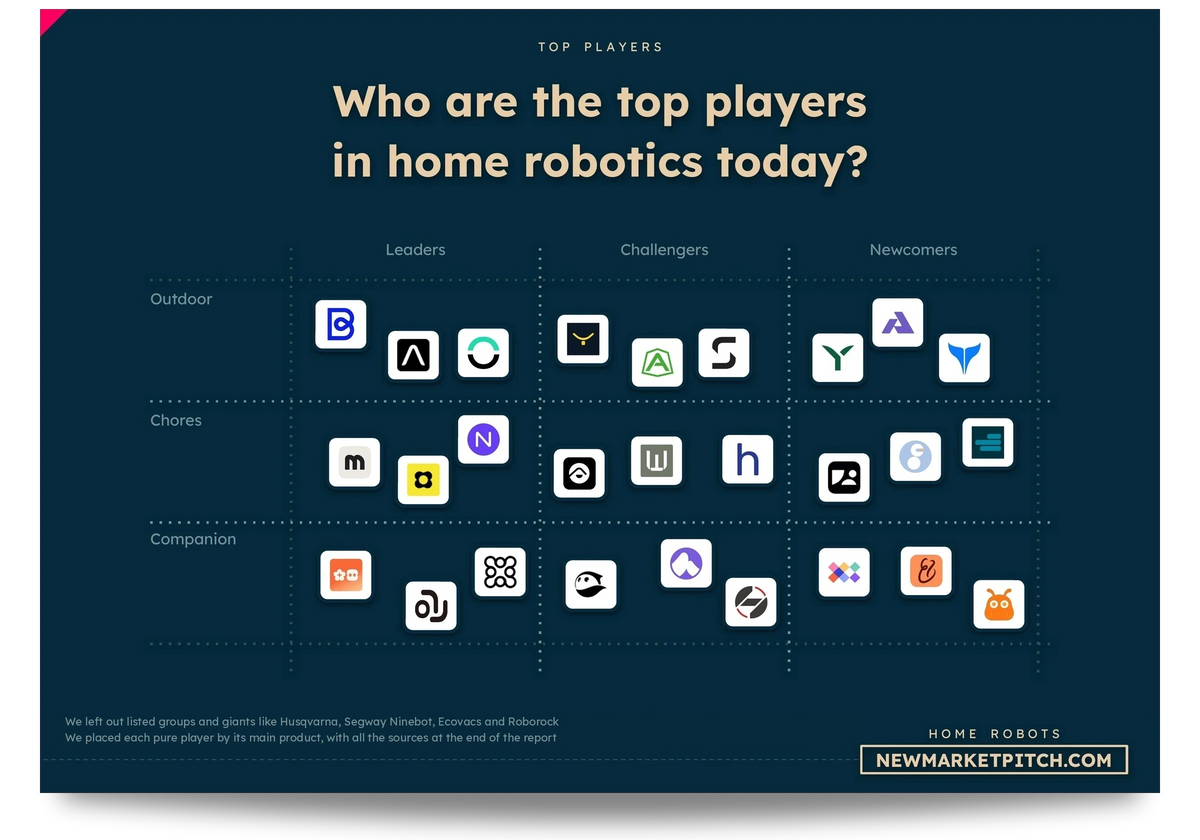
In our report covering the home robot market, we turn what is vague and complex into simple, useful visuals. Market maps like this one show you at a glance where every startup stands.
The ranking of top startups in the home robots market by revenue
Below is a table ranking the startups of this market by their current revenue scale. You can find our methodology at the end of this page.
If you want a deeper understanding of the market and its current dynamics, get our report on the home robots market.
| Ranking | Company | Latest Metric | Metric Type | Freshness | Disclosed When | Source Quality | Confidence | Segment | Why This Ranking | Local Metric | Country |
|---|---|---|---|---|---|---|---|---|---|---|---|
| 1 | Picea Robotics | ~$556M | Fiscal-Year Revenue | Aging · 23mo | 2026 | Credible Reported | Medium | Floor Cleaning Robots | The Guangdong Intellectual Property Protection Association reported ~$556M of FY2024 fiscal-year revenue. The older figure covers its vacuum-robot manufacturing and technology business. | CNY 4.06B | cn |
| 2 | Aiper | $257M | Annual Revenue | Fresh · 11mo | Feb 26, 2026 | Company Disclosed | High | Pool Cleaning Robots | Fluidra's unaudited FY2025 presentation reported $257M of 2025 annual revenue. This figure is more recent than Picea Robotics' ~$556M, but smaller. | us | |
| 3 | Miko | ~$42.9M | Fiscal-Year Revenue | Historical · 32mo | May 22, 2025 | Credible Reported | Low | Companion & Social Robots | Indian registrar accounts reported by the press show ~$42.9M of fiscal-year revenue ending March 2024. The 32-month-old result is a weak guide to today's sales. | INR 3.58B | in |
| NR | Dreame Technology | ~$2.86B | Annual Revenue | Fresh · 11mo | Jun 26, 2026 | Credible Reported | Medium | Floor Cleaning Robots | Caixin reported ~$2.86B of 2025 annual revenue, an unaudited investor estimate. It covers the whole company, appliances outside home robots included, and the home robot share is not published. | CNY 20B | cn |
| NR | 1X Technologies | $222M | Annual Revenue | Undated | Third-Party Estimate | Low | Household Manipulation Robots | Growjo's $222M annual-revenue estimate has no stated period and no independent corroboration. It is not a company-disclosed home humanoid sales figure. | us | ||
| NR | Yarbo | $27.4M | Annual Revenue | Aging · 23mo | Nov 18, 2026 | Third-Party Estimate | Low | Lawn & Outdoor Robots | CB Insights lists a $27.4M annual-revenue estimate for 2024. This aging automated figure lacks a second independent source, so Yarbo is unranked. | cn | |
| NR | Seauto | >$13.7M | Annual Revenue | Aging · 23mo | Oct 2026 | Third-Party Estimate | Low | Pool Cleaning Robots | TR Sourcing estimates more than $13.7M of 2024 annual revenue. This aging third-party estimate has no second independent confirmation, so it has no rank. | CNY 100M | cn |
| NR | Beatbot | >$61.6M (gross sales, not revenue) | Gross Sales | Aging · 23mo | Aug 4, 2026 | Credible Reported | Medium | Pool Cleaning Robots | The press reported more than $61.6M of gross sales for 2024. Gross sales are not recognized revenue, so the pool-robot maker remains unranked. | CNY 450M | cn |
| NR | Narwal Robotics | >$235M (gross sales, not revenue) | Gross Sales | Aging · 24mo | Nov 13, 2024 | Company Disclosed | Medium | Floor Cleaning Robots | The company disclosed more than $235M of gross sales during its 2024 Singles Day campaign. Promotional-period gross sales are not annual revenue. | CNY 1.7B | cn |
| NR | Intuition Robotics | $2.1M (contract value, not revenue) | Contract Value | Very Fresh · 5mo | Jun 23, 2026 | Filed / Audited | Medium | Companion & Social Robots | New York State records a $2.1M contract value for a multi-year grant. A multi-year award is not recognized revenue. | il | |
| NR | Ropet | ~$104K (bookings, not revenue) | Bookings | Fresh · 10mo | Jan 15, 2026 | Company Disclosed | Medium | Companion & Social Robots | Its Zeczec campaign disclosed ~$104K of bookings through January 2026. Crowdfunding commitments are not recognized annual revenue. | TWD 3.35M | cn |
| NR | Tombot | $0 | Fiscal-Year Revenue | Aging · 22mo | May 29, 2025 | Filed / Audited | Medium | Companion & Social Robots | An SEC Form C-AR recorded no fiscal-year revenue for the period ended January 2025. With no revenue reported for that period, the company has no positive sales figure to rank. | us |

Our research about home robots gets updated several times a month, so you always get the latest view of where things stand.
Are home robots actually selling in big numbers yet?
Yes, home robots already sell in large numbers, mainly as machines that clean floors, windows and other parts of a home.
IDC counted 32.72 million cleaning robots shipped worldwide in 2025, a 20.1% increase. Smart vacuums accounted for 24.12 million units. Those figures describe devices sent into sales channels, so they cannot tell us what manufacturers ultimately booked as revenue. They do show that automatic cleaning is an established consumer purchase rather than a novelty.
The International Federation of Robotics looked at a somewhat wider consumer-service-robot market and reported almost 34.2 million units sold in 2025, up 37%. Its supplier survey covers different products and should not be added to IDC's shipment total. Even with that distinction, the broad direction is clear: households are buying more specialized robots.
Look at the companies with usable financial records. Picea Robotics makes robot vacuums and related technology, and Aiper sells pool cleaners. Miko has a smaller business in children's educational robots. The machines designed to handle any chore in a home are still looking for the same kind of proof that consumers will pay for them at scale.
How much of Dreame Technology's revenue comes from home robots?
We cannot say, because Dreame Technology's reported revenue covers the whole company and it does not publish the share earned by its home robots.
Caixin reported in June 2026 that investors put Dreame Technology's 2025 revenue at about CNY 20B, or ~$2.86B. The figure is not audited, and the company says its revenue was above CNY 40B. Dreame also sells outside home robots: the reported figure covers robot vacuums and other smart-home appliances, and Dreame does not publish the share that comes from its robots, so it has no rank in our revenue comparison.
The reason is easier to see in its stores and products. A robot vacuum solves a problem a shopper immediately understands, and Dreame sells models for different budgets and countries. In IDC's 2025 cleaning-robot review, Dreame grew internationally while competing with well-known Chinese brands and the Roomba name. Caixin also described overseas markets as accounting for roughly 80% of Dreame's sales, while questioning the pace of its broader expansion.
The expansion comes with a risk. A brand can sell a great many machines and still face problems if it expands too quickly. Dreame has crossed the difficult hurdle of finding customers for its robots. Whether every new product category will do the same is a separate question.

In our market report about home robots, we look at what the winners do differently, so you can learn from the best instead of guessing.
Does shipping the most robot vacuums mean making the most money?
No, the home robot company shipping the most machines does not necessarily make the most revenue.
IDC counts units, while revenue depends on how much a manufacturer actually earns from those units. One expensive robot vacuum with a self-cleaning dock can sell for much more than a basic model. A contract factory that makes somebody else's robot may also record a different kind of sale from the brand that sells it to a household.
Narwal Robotics offers a good example of the confusion. The company disclosed >$235M of gross sales during its 2024 Singles Day shopping campaign. Narwal's management linked that campaign to new products, trade-in support and sales through physical stores. It was a busy selling period, but gross sales during a promotion cannot be read as full-year recognized revenue. Returns, discounts and the way a sales channel accounts for orders all matter.
We have a more dependable comparison for Aiper because Fluidra reported the pool-robot maker's actual annual sales. That is the kind of figure needed to answer who earns more, not simply who ships more boxes or gets the biggest shopping-day headline.
Is Roborock bigger than Dreame Technology in robot vacuums?
Yes, Roborock still led individual robot-vacuum brands in worldwide shipments during the first half of 2026, although it is not a startup.
In the full year of 2025, an IDC table showed 5.8 million cleaning robots shipped by Roborock, against 3.4 million for Dreame. The figures use the same broad category, which includes more than robot vacuums. The race has remained close: Dreame claimed the lead in robot-vacuum shipments and sales value for the first quarter of 2026, while Roborock, citing IDC, reported the lead across the first half. Neither result establishes each company's recognized annual revenue from home robots.
Roborock is listed, which puts it outside our definition of a startup. A claim about shipping the most machines should stay a claim about shipments. Press releases and research articles often use "number one" without making that distinction obvious.
IDC also found that iRobot had fallen out of the top five worldwide smart-vacuum brands. That is a striking change for the maker of Roomba. It helps explain why being a familiar name is no guarantee of keeping the leading position in a fast-moving market.

In our document detailing everything you need to know about home robot, you will always find fresh funding data, taken straight from our own verified funding database.
How big is Picea Robotics' robot vacuum business?
Picea Robotics has built a sizeable robot vacuum business by designing and manufacturing machines that other companies sell.
The Guangdong Intellectual Property Protection Association reported ~$556M of Picea Robotics fiscal-year revenue for FY2024, based on CNY 4.06B. Its account also says Picea shipped 4 million robot vacuums during 2024. Those machines and the engineering behind them gave Picea a business long before most consumers knew its name.
Picea makes products for other brands and sells its own 3i line. This gives it two routes to customers: retailers can sell a Picea brand, or a familiar appliance brand can buy a machine designed and built by Picea. The company is first in our home robot startup revenue ranking, ahead of Aiper, although the Picea figure is older and comes from an industry association rather than a listed partner's results. Dreame's larger figure covers its whole business, appliances included, so it does not take the top spot.
For a contract manufacturer, the challenge is getting enough orders to keep factories running without relying too heavily on any one brand. Building its own 3i products gives Picea another route to consumers. The reported FY2024 figure describes that earlier business and should not be mixed with transactions from later years.
Did buying Roomba maker iRobot change Picea Robotics' business?
Yes, Picea Robotics became a much more visible home robot competitor when it acquired iRobot, the maker of Roomba.
iRobot confirmed the acquisition on January 23, 2026, after a court-supervised Chapter 11 restructuring. Picea acquired all of iRobot's equity, having previously been its primary contract manufacturer and secured lender. The transaction put a major consumer brand, international distribution and a large base of existing Roomba owners under the control of its longtime supplier.
The history makes the deal more interesting than a normal takeover. Picea had been making hardware for iRobot before it became iRobot's owner. Bringing product design, manufacturing and retail decisions closer together could make it easier to compete on price or launch new products. But the acquisition does not tell us whether future Roomba sales will grow.
It is also worth remembering why iRobot changed hands. The company entered Chapter 11 after serious financial trouble even though its robots had sold to households for decades. Brand recognition plainly was not enough to protect the business. The Picea revenue figure we use predates the deal, and we have not added old iRobot sales to it.

Learning from others' mistakes is the cheapest lesson there is. In our report covering the home robot market, we look at what broke startups before you, so you don't repeat it.
Is Aiper already making serious money from pool-cleaning robots?
Aiper is already making serious money in home robotics by selling cordless machines that clean swimming pools.
Fluidra's FY2025 financial presentation reported $257M of Aiper annual revenue for 2025. Fluidra notes that these figures were not audited when published. That puts Aiper second among the home robot startups in our comparison. Fluidra showed historical sales separately from its forecasts, so the completed period can be assessed without treating a target as money already earned.
The product is easy to explain. Aiper's cordless robots remove the need to drag a wired cleaner through a pool, while newer models tackle walls and the waterline as well as the floor. The market is narrower than the market for indoor vacuums because only people with pools need one. But buyers who previously cleaned by hand or dealt with cumbersome equipment have a clear reason to upgrade.
Fluidra bought an initial minority stake in Aiper in December 2025. That matters more than a flashy product launch: an established pool-equipment supplier had seen enough demand to invest in the company. Aiper's revenue is also documented more recently and directly than Picea's reported FY2024 result, though Picea remains ahead on the figures used here.
Can Aiper take customers from established pool-equipment brands?
Partly, Aiper has won a serious place in robotic pool cleaning, but the older pool-equipment companies still control many other things homeowners buy.
Fluidra completed its purchase of a 27% stake in Aiper in December 2025. The agreement also created a path toward majority ownership if certain targets are met. Fluidra already sells pool pumps, filters and connected equipment. It wanted the consumer brand and cordless robotics expertise that Aiper had built, rather than starting every part of that business itself.
Fluidra's FY2025 presentation estimated Aiper's share of the robotic pool-cleaner market at 26%. That is Fluidra's estimate, calculated using retail-price assumptions, rather than an independent audited measure. Even so, it shows why the partnership is important: a specialist in robot cleaners has become a relevant part of a much larger pool-equipment business.
Aiper will still face models from Beatbot and other competing brands. Apps, navigation, surface skimming and cordless operation are becoming features that competitors can offer too. As more cleaners look alike, keeping prices attractive, getting products into stores and dealing well with repairs will decide who holds customers.

Your time is limited. In our research about home robots, we put numbers on each part of the market, so you can see where it makes sense to focus.
Who actually makes the robot vacuums sold by big brands?
Some familiar home robot brands design and sell their own machines, while manufacturers such as Picea Robotics also build robots for other companies.
Picea's work as an original-design manufacturer means its engineers can design a vacuum and its factories can produce it for another brand. Consumers may never see Picea on the packaging. The association describing its business also identifies the company's own 3i products, which are sold directly under a consumer-facing name.
The business can stretch from designing a circuit board or navigation system to delivering a finished robot in a branded box. One part of that chain may be invisible to shoppers, even when a manufacturer makes millions of machines. That helps explain why a company most households cannot name can have a substantial robotics business.
Dreame Technology and Aiper are useful contrasts. Both promote their own products and work to win customers in stores and online. Their costs will include marketing and distribution in ways a factory supplier's accounts may not. That is why sales from a manufacturer and sales from a retail brand can have different meanings, even when the end product is a robot that cleans a house.
Are pool-cleaning robots really the next big home robot business?
Pool-cleaning robots are a real consumer business, but the latest shipment evidence does not show the same boom as robot vacuums.
IDC's 2025 review described worldwide pool-cleaning robot shipments as broadly stable even as cordless models became more common. It said cordless cleaners reached 55% penetration among in-ground pool cleaners. That points to buyers changing the kind of robot they purchase, rather than a sudden jump in the number of pools needing one.
Aiper has benefited from that shift by making cordless machines for consumers. Beatbot sells AquaSense models that clean pool floors and walls, and Seauto offers its own cordless products. Yet a press-reported >$61.6M of 2024 gross sales for Beatbot is not recognized annual revenue. Seauto's >$13.7M annual-revenue estimate for 2024 comes from one automated source and therefore does not receive a rank.
The opportunity is attractive but limited by the number of homes with pools. There is room for better navigation, less maintenance and more cordless adoption. Treating every product upgrade as proof of a new robot-vacuum-sized market would get ahead of the evidence.

In our market report about home robots, we always try to gather several sources and make estimates that make sense, so you can work with solid numbers.
Are robotic lawn mowers growing faster than robot vacuums?
Yes, robotic lawn mowers are growing faster in shipments than robot vacuums, although many more households still buy the indoor machines.
IDC recorded 1.99 million robotic lawn-mower shipments in 2025, up 63.8%, compared with 24.12 million smart vacuums, up 17.1%. Both figures come from the same worldwide tracking exercise. The difference shows a smaller product category gaining buyers quickly, not lawn robots catching up with vacuum sales overnight.
A practical change helps explain the interest. Older robotic mowers often required homeowners to bury boundary wire. IDC said wire-free models grew much faster than traditional wired models in 2025. Removing installation work makes the product easier to buy and start using. It may also give brands a chance to persuade owners of existing mowers to replace them.
For outdoor-robot startups, this is encouraging evidence of demand. It still says little about each company's recognized revenue. A mower can be a successful category while the makers are fighting with expensive hardware, seasonal demand and customer-service costs.
Can Yarbo actually make money from outdoor home robots?
Yarbo sells a real line of outdoor home robots, but its annual revenue has yet to be confirmed independently.
Yarbo's modular system uses one powered base for mowing grass, blowing leaves and clearing snow. Its store lists configurations costing thousands of dollars. People with large yards may value a machine that works through several seasons, especially where snow removal and lawn care both take time.
The public figure for Yarbo is $27.4M of estimated 2024 annual revenue from CB Insights. It is a single third-party estimate rather than a company financial statement, so Yarbo is shown without a rank. Product listings and preorders prove there is something to buy; they do not establish how much revenue Yarbo recognized after deliveries and refunds.
The biggest unanswered question is whether a shared base makes the business more attractive over time. Owners might buy a second module instead of a whole new robot, which could help Yarbo sell more to existing customers. But those same machines must survive changing weather and outdoor wear. Until the company publishes credible sales, the strength of the business remains harder to judge than the appeal of the product.
Is Miko making real money from children's robots?
Miko has made real revenue selling interactive educational robots to families, though its available financial figure is old.
Indian corporate accounts covered by Finance Outlook and Entrackr show ~$42.9M of Miko fiscal-year revenue for FY2024, the year ending March 2024. Miko takes third place in the home robot startup revenue ranking. The result is more than 30 months old, so it tells us that a paying market existed, not exactly how large Miko is now.
Its robots are designed to move, talk and play educational games with children. Buyers get a physical product and can also pay for extra digital learning and entertainment content. That combination gives Miko more ways to make money than selling the machine only once.
The Indian accounts also describe losses. That is important for parents and investors alike: a company can sell a popular children's robot but still spend heavily on making the hardware, finding customers and supporting the product afterward. Miko has demonstrated sales, which is more than many companion concepts can claim. Profitability is another hurdle.

If you build or invest in the home robot market, you need to know which business models pay off now and which ones are fading. That's why our report covering it has a whole section on it.
Will parents keep paying for Miko after buying the robot?
Subscriptions let Miko earn money after a family buys its educational robot, but renewals depend on whether children still use it.
The company offers Miko Max, a subscription for extra learning activities and entertainment on its devices. Its help pages describe a mix of games, interaction and child-focused content. A parent buying a robot for the first time may see value in that package, but the decision to renew is different from the decision to buy a toy at Christmas.
Reporting on Miko's FY2024 accounts found that robot sales still supplied most of the income, while subscription revenue grew much faster from a smaller starting point. We cannot turn that growth into a current subscription share without new company figures. It does show that Miko is testing a way to stay connected with families after the hardware sale.
There is a catch specific to children's products. A robot has to remain interesting as a child grows, and parents will judge whether it is useful, safe and easy to maintain. A good subscription can make a hardware business more resilient; an unreliable or quickly abandoned device will struggle to keep subscribers.
Do older adults actually use companion robots at home?
Yes, companion robots such as Intuition Robotics' ElliQ are already being used by older adults at home, but public usage is easier to verify than company revenue.
ElliQ is built for conversation, wellness reminders and daily check-ins. A New York State Office for the Aging evaluation published in 2026 reported 834 older adults enrolled by May 2025, with demand beyond the available places. This gives us a real program to examine, rather than a video of somebody talking to a robot at an exhibition.
The New York State Comptroller also lists a $2.1M contract value for a grant covering June 2025 through May 2028. That amount describes a multi-year commitment. It does not tell us how much Intuition Robotics recognized as revenue in a particular year, so the company remains unranked.
A public agency can be an important customer for a device that addresses loneliness or helps people maintain routines. The business question is whether enough organizations and households keep paying once the initial program ends. For ElliQ, the existing deployment supports the usefulness of companion robots better than it establishes a current revenue scale.

In our report covering the home robot market, we don't want to repeat what boring consulting reports say. Instead, we show you the real and latest market signals that matter.
How much revenue is 1X Technologies making from NEO?
1X Technologies has not published a verified annual revenue figure for its NEO home humanoid robot.
The company introduced NEO as a household robot in October 2025, with a consumer order page advertising $20,000 early-access ownership or a $499-per-month subscription. It said United States deliveries would start in 2026. The product pitch is specific: NEO is supposed to help with household tasks and may use scheduled assistance from a remote expert for more complex actions.
An online price tells us what 1X wants to charge, not how much it has earned from robots already delivered. Growjo carries a $222M annual-revenue estimate for 1X Technologies, but the source gives no period and is not a company disclosure. With no second independent estimate confirming it, 1X has no rank in our home robot revenue comparison.
NEO is still one of the clearest attempts to sell a general-purpose humanoid directly for home use. The financial evidence that would change the picture is straightforward: completed household deliveries, paid subscriptions that continue over time and company-reported revenue from those customers. Announcing an order page comes before proving all three.
Will humanoids replace robot vacuums in people's homes soon?
No, home humanoid robots are nowhere near replacing specialized robot vacuums as a mass-market household product.
A vacuum robot has a limited job: map the floor, avoid obstacles and clean. A humanoid promised for many chores has to recognize different objects, move safely around people and handle tasks that change from one house to another. That is a much bigger engineering and support problem.
The International Federation of Robotics reported about 7,000 full-size humanoid robots sold worldwide in 2025 for commercial and professional uses. That count says nothing about homes adopting humanoids. By contrast, IDC counted cleaning robots in the tens of millions. The two surveys cover different populations, but they show how far apart the categories are in commercial maturity.
1X's NEO brings the home humanoid idea closer to a purchasable product, yet even its own description allows for remote expert help on difficult tasks. A homeowner wanting clean floors today has plenty of purpose-built products to choose from. Waiting for a humanoid to do that chore along with everything else is still a very different bet.

In our research about home robots, we like to show you the big picture. We know your time is precious, so we make every page quick to read and packed with as much learning as possible per minute.
Are robotic pets finding paying customers yet?
Robotic pets are attracting paying interest, but the public figures for Tombot and Ropet do not yet show a substantial revenue business.
Tombot is developing Jennie, a robotic puppy designed partly for people who cannot care for a live dog. Its SEC Form C-AR recorded no fiscal-year revenue for the year ended January 2025. That filing is more useful for judging the company's commercial stage than an impressive demonstration of the puppy's movement.
Ropet has taken a different route through crowdfunding. Its Zeczec campaign reported ~$104K in bookings through January 2026. People were willing to commit money, which is useful evidence of interest. But crowdfunding commitments are not annual recognized revenue: the company still has to deliver products, honor refunds and make the economics work after production costs.
Miko demonstrates that families will buy some kinds of interactive robots. For a pet whose main purpose is companionship, repeat engagement may be harder to measure than a cleaned floor. Buyers must feel the robot is worth keeping, while the startup must deliver and support it affordably. Those tests come after a successful campaign, not before.
Are Chinese home robot companies beating American startups?
Chinese companies are ahead in worldwide cleaning-robot shipments, while American home robot startups have built businesses in different categories.
IDC's 2025 review put several Chinese brands among the leading cleaning-robot manufacturers, including Roborock, Dreame, Ecovacs, Xiaomi and Narwal. It also found that the six leading brands of wire-free robotic lawn mowers were Chinese. The country's strength is visible across electronics production, navigation technology and international retail, not just one unusually successful vacuum model.
Picea shows the strength of Chinese robot manufacturing, while Aiper, based in the United States, has published annual sales of cordless pool cleaners. Miko, based in India, offers yet another route to customers through educational robots for children.
So China has the stronger shipment story in household cleaning, but a country comparison should not turn into a claim that all American or other foreign startups have failed. Different products serve different customers, and shipment rankings cannot answer every question about company revenue.

When you build or invest in the home robot market, you need clarity, not confusion. In our market report about home robots, we always try to put numbers on and quantify whatever is usually vague and confusing.
Do home robot startups disclose revenue or just sales claims?
Home robot startups publish a mix of revenue, sales claims, estimates and orders, so some big-sounding figures tell us surprisingly little about earned income.
Aiper's annual sales appear in Fluidra's results. The Guangdong Intellectual Property Protection Association has reported Picea's manufacturing revenue, and Indian corporate accounts document Miko's earlier fiscal-year revenue. Those disclosures give readers something tied to a completed period.
Other numbers need more care. Narwal and Beatbot reported gross sales. Intuition Robotics has a public contract value. Ropet disclosed crowdfunding bookings. Third-party sites have estimated annual revenue for 1X Technologies, Yarbo and Seauto, but a lone automated estimate is not a verified company account. Tombot's filing shows no revenue for its reported fiscal period.
The table below shows public figures that describe activity but do not support a revenue rank.
| Company | Public figure | Measure | Period |
|---|---|---|---|
| 1X Technologies | $222M | Annual estimate | Not stated |
| Yarbo | $27.4M | Annual estimate | 2024 |
| Seauto | >$13.7M | Annual estimate | 2024 |
| Beatbot | >$61.6M | Gross sales | 2024 |
| Narwal Robotics | >$235M | Gross sales | Singles Day 2024 |
| Intuition Robotics | $2.1M | Contract value | 2025–2028 |
| Ropet | ~$104K | Bookings | Jan 2026 |
So, which home robot startups make the most money today?
Picea Robotics is the number one home robot startup by revenue today, ahead of Aiper and Miko. Dreame Technology reports more, but its figure covers the whole company, so it has no rank.
The order comes from the latest usable revenue-scale figure we retain for each startup, not a prediction of which machine will be the smartest in five years. Cleaning floors has already made large businesses out of consumer brands and contract manufacturers. Pool robots have also shown that homeowners will pay for a single well-defined task. Educational companion robots have paying customers, although the published financial record is older.
It is tempting to put a company with a famous launch or an eye-catching sales campaign beside these businesses. Yet an undated estimate for 1X Technologies, Ropet's bookings and Intuition Robotics' contract value cannot take the place of annual revenue. Roborock's worldwide cleaning-robot shipment lead is real, but the listed company belongs to the wider market rather than the startup set.
The table below shows what we found.
| Question | Answer |
|---|---|
| Which young home robot business leads in revenue? | Picea Robotics tops our startup revenue ranking in home robotics. Its reported fiscal-year revenue for FY2024 reached ~$556M. Dreame reports more, but for its whole business, appliances included. |
| Can a factory make real home robotics money? | Yes, Picea Robotics earns money designing and manufacturing robot vacuums. It shipped 4 million robot vacuums in 2024. Its later iRobot acquisition makes future sales worth watching separately. |
| Have cordless robotic pool cleaners found buyers? | Aiper has built a sizeable business selling cordless pool cleaners. Fluidra reported $257M of Aiper annual revenue in 2025. Its minority investment also ties the startup to established distribution. |
| Do families actually spend money on robot companions? | Miko has sold educational companion robots to paying families. Its FY2024 fiscal-year revenue was reported at ~$42.9M. The older reporting period leaves today's sales less certain. |
| Does shipping more vacuums guarantee more revenue? | No, robot shipments and recognized revenue measure different things. IDC reported 24.12 million smart vacuums shipped in 2025. Product prices and sales arrangements affect what manufacturers actually earn. |
| Did Roomba's ownership change hurt the category? | No, robot vacuum demand continued after Roomba changed owners. The buyer, Picea, completed the transaction in January 2026. That event cannot change the company's earlier financial reporting. |
| Can NEO preorders establish 1X's home robot sales? | No, preorders cannot establish recognized home humanoid revenue. NEO advertises an early-access ownership price of $20,000. Completed deliveries and company accounts would answer the sales question. |
| Are outdoor robots growing faster than indoor ones? | Robotic lawn mowers are growing faster in shipment volume. IDC recorded 63.8% year-over-year mower shipment growth in 2025. Yarbo's annual revenue remains a single unconfirmed estimate. |
| Do pool robot shopping totals count as revenue? | Gross sales and recognized revenue can be far apart. Beatbot reported >$61.6M of gross sales in 2024. That cannot be used as annual revenue in this comparison. |
| Can public contracts prove companion robots earn money? | State contracts can prove demand without proving annual revenue. Intuition Robotics has a $2.1M multi-year contract value. Only revenue accounts would show what was earned each year. |
| Do crowdfunded robot pets have established sales? | Crowdfunding shows willingness to order, not delivered sales. Ropet disclosed ~$104K of bookings through January 2026. Production, refunds and later sales remain separate questions. |
| Is China the only source of home robot success? | China dominates many worldwide cleaning-robot shipment measures today. IDC puts several Chinese makers among the leading brands. American pool cleaners and Indian educational robots also sell commercially. |

It's easy to get lost in the details. In our report covering the home robot market, we give you some perspective first, so you see the whole market before you make a move.
Our methodology
Our data runs through November 19, 2026. We then reviewed this article and updated its answers on November 24, 2026, the date shown under the title. We define home robots as machines designed to perform physical household tasks or provide embodied assistance or companionship in homes. This includes autonomous floor, window and pool cleaners, outdoor maintenance robots, domestic manipulation, home assistance and mobile social robots; we include credible home-first precommercial projects and companies near those boundaries rather than silently excluding them. Industrial-only robots, enterprise-only developer hardware, unembodied software and ordinary connected appliances are outside the market. Every ranked company meets our fixed startup definition: independent, founded in 2007 or later, built to grow around a new product or technology and backed by founders or outside capital, with recently listed or recently acquired businesses included under our stated conditions. Older established groups are excluded even when their sales are larger.
We reviewed company announcements, annual reports, regulatory filings, investor materials and reputable financial media across each company's available history, including records extending back over the last ten years. We record what each business actually reports, whether annual revenue, fiscal-year revenue, annual recurring revenue, run-rate or a partial-period or segment figure. We never turn customer counts, hardware prices or shipments into revenue. Bookings, gross merchandise value, gross sales, cumulative transactions, contracts and forecasts remain separately labeled and are not substituted for recognized revenue.
We retain one revenue-scale figure per company. We prefer a figure covering the last 18 months, then a stronger source, beginning with filings and company disclosures, followed by reputable reporting, analyst estimates and automated company-data estimates. For comparable evidence, full-year revenue takes priority over annual recurring revenue or run-rate, followed by partial periods and published product or segment revenue; shorter periods and segments are treated as minimum indicators of scale. We order companies by the chosen figure. For a range we use its geometric midpoint, which keeps an unusually optimistic upper end from determining the position; minimums are placed at their lower bound. Figures more than 36 months old and non-revenue measures do not receive a rank.
We label freshness by time since the end of the reported period: Very Fresh, Fresh, Aging or Historical. High confidence applies to recent, exact full-year revenue from company filings or disclosures; Medium covers reported press figures, ARR, run-rates, partial-period results, minimums and figures 18 to 30 months old; Low covers estimates, wide ranges and older disclosures. Figures from the same company can therefore be financially meaningful but different in quality. Where a reported revenue number has no stated period, it can still be ranked with Low confidence; an automated estimate with no period cannot.
We preserve both the original local-currency figure and its dollar conversion, using the exchange rate at the end of the relevant reporting period, with European Central Bank reference rates where applicable. One analyst or automated company-data estimate does not qualify for a rank on its own. Two independent estimates that agree can be ranked with Low confidence; materially conflicting estimates remain a range without a rank. A company-wide figure covering businesses beyond home robots stays unranked if the relevant home robotics segment is not published. These rules are designed to prevent broad company totals, uncertain estimates and forecasts from being mistaken for audited home-robot sales.
The most important objection is that a less recent press figure can appear ahead of a newer result from a stronger financial source, while a famous startup with preorders or a large automated estimate has no rank. We accept that consequence deliberately: a larger documented annual result can remain the best available signal of commercial scale, but its date and confidence must stay visible. We do not reward an unverified projection by treating it as realized revenue, add an acquirer's later business to an earlier fiscal period, or convert gross sales into income. The ranking is an evidence-based ordering of published figures, not a claim that companies' sales are perfectly comparable or that today's undisclosed revenue is necessarily unchanged.
Key sources include Dreame Technology financial reporting and overseas business context, Dreame's first-quarter 2026 robot-vacuum claim citing IDC, Picea Robotics fiscal-year sales, production, original-design manufacturing and 3i brand, Aiper annual sales, historical chart, market position and strategic relationship, Miko FY2024 results, robot sales and subscriptions, Global cleaning-robot shipment totals, product categories and growth, International Federation of Robotics' 2026 consumer robot and humanoid context, Roborock's IDC-reported full-year cleaning-robot shipments, Roborock's reported first-half robot-vacuum lead from IDC, iRobot's completed Picea acquisition and earlier supplier relationship, iRobot Chapter 11 process and Picea transaction, Completion of Fluidra's minority investment in Aiper, NEO's launch, consumer positioning and shipment plans, NEO ownership and subscription offers, remote expert mode, Yarbo modular outdoor-robot product portfolio and sales listings, Miko 3's educational functions and premium content model, New York State Office for the Aging's ElliQ program evaluation, Intuition Robotics state contract value and term, Beatbot's robotic pool-cleaning features and positioning, Ropet crowdfunding bookings and campaign details, Tombot Form C-AR financial statements and company product description, and Narwal management's explanation of Singles Day gross sales and retail expansion.

In our research about home robots, we try to remove everything that could confuse you, especially if you're investing or building in this market.
Written by the New Market Pitch teamWe track new markets so founders and investors can move faster. About us