Home robots funding tracker (90+ deals)
Whether you're building or investing in the home robot market, our report covers everything you need to know: the players, the money, and what's coming next.
Summary
Home robotics startups have raised at least $1.6B in 98 deals since January 2024, across 49 companies. The Bot Company raised the most money during that period, at $300M.
The big rounds tell only part of the story. The median disclosed round was $11M, while 11 deals accounted for $1.2B. A small group of expensive projects can change the headline without changing what most startups raise.
Much of the money goes to robots that might do several household chores. Household manipulation robots attracted $775M+, or 48% of disclosed capital. Investors are paying heavily for a technology that still has to prove itself in ordinary homes.
Pool cleaners offer a much simpler pitch. That category raised $253M+, and companies such as Beatbot and Aiper already sell products that customers understand. The question for them is how far they can grow, rather than whether a robot can find a useful household job.
Floor cleaners also keep attracting money. Startups in that category received $161M+, and Matic's recent software updates show how much work goes into making even a familiar chore reliable.
Then there are robots designed mainly to interact with people. Companion and social robots attracted repeated checks, covering everything from robotic pets to devices that support older adults. Their commercial test is whether people keep using them.
China dominates the activity with 73 deals, yet American startups attracted $819M+ in disclosed financing. The country announcing the most rounds is not necessarily the country raising the most money.
The stage names need care too. Seed financing is common, but some of the biggest early checks resemble the budgets of much older hardware companies. Plenty of companies still face a difficult route to later rounds.
Funding also arrives in bursts. Busy months sit beside months with no qualifying round, so any one announcement can give a misleading impression of how active the broader market really is.
We know the amount raised for 56% of the deals. The picture is clear enough to see a serious home robotics investment market, but the gap between working specialist products and ambitious all-purpose assistants remains enormous.

Written by the New Market Pitch teamWe track new markets so founders and investors can move faster. About us

In our report covering the home robot market, you will always find fresh funding data, taken straight from our own verified funding database.
Our funding tracker covering the home robotics market
Below is the table listing all the deals. You can find our methodology at the end of this page.
If you want a deeper understanding of the market and its current dynamics, get our home robotics market report.
| Company | Category | Date | Stage | Deal size | What they do | Region | Lead investors | Country | Rank |
|---|---|---|---|---|---|---|---|---|---|
| Syncere | Household Manipulation Robots | November 2026 | Seed | $11M | AI-powered laundry-folding robotic furniture | North America | a16z speedrun | United States | |
| Ola Dimensions | Household Manipulation Robots | October 2026 | Seed | $1M+ | Learning-based general-purpose household robots | Asia-Pacific | Not disclosed | China | |
| Knowin AI | Household Manipulation Robots | September 2026 | Seed | $25M+ | AI household service and companion robots | Asia-Pacific | Not disclosed | China | |
| bibo | Companion & Social Robots | September 2026 | Seed | Undisclosed | Home companion and service robots | Asia-Pacific | Fashion Media Group, Hongyi Asset Management Group | China | |
| XCANBOT | Household Manipulation Robots | September 2026 | Seed | Undisclosed | Develops embodied home service robots | Asia-Pacific | Not disclosed | China | |
| Xieyue Intelligence | Household Manipulation Robots | September 2026 | Seed | Undisclosed | Embodied AI for household robots | Asia-Pacific | Not disclosed | China | |
| In2Mate | Companion & Social Robots | August 2026 | Seed | Undisclosed | Full-size humanoid companion robots for homes | Asia-Pacific | Not disclosed | Hong Kong | |
| Knowin AI | Household Manipulation Robots | August 2026 | Seed | $74M | AI household service and companion robots | Asia-Pacific | Matrix Partners China | China | |
| PokeBot | Household Manipulation Robots | August 2026 | Seed | Undisclosed | General-purpose household manipulation robots | Asia-Pacific | Shunwei Capital, Matrix Partners China | China | |
| Futuring Robot | Household Manipulation Robots | July 2026 | Seed | Undisclosed | General-purpose household service robots | Asia-Pacific | Not disclosed | China | |
| Robopoet | Companion & Social Robots | July 2026 | Seed | $14M+ | AI companion robots for homes | Asia-Pacific | Fibocom, Huaying Capital, Meridian Capital | China | |
| LeXiang Technology | Companion & Social Robots | July 2026 | Seed | ~$70M | Mobile companion robots for household assistance | Asia-Pacific | Not disclosed | China | |
| Tau Robotics | Household Manipulation Robots | July 2026 | Seed | $2.6M | Provides humanoid robotic home cleaning | North America | Not disclosed | United States | |
| Tombot | Companion & Social Robots | June 2026 | Series A | $7M | Creates realistic robotic companion animals | North America | Not disclosed | United States | |
| Ola Dimensions | Household Manipulation Robots | June 2026 | Seed | Undisclosed | Learning-based general-purpose household robots | Asia-Pacific | China Merchants Venture Capital | China | |
| Vita Dynamics | Companion & Social Robots | May 2026 | Seed | ~$70M | Autonomous robot companions for homes | Asia-Pacific | Oriental Jiafu, Huatai Zijin, Fosun RZ Capital | China | |
| Airseekers | Lawn & Outdoor Robots | May 2026 | Series A | $1.4M+ | Autonomous robotic lawn mowers | Asia-Pacific | Infore Environment | China | |
| Entropy Technology | Household Manipulation Robots | May 2026 | Seed | Undisclosed | Autonomous flying home assistant robots | Asia-Pacific | Chuxin Capital | China | |
| PokeBot | Household Manipulation Robots | April 2026 | Seed | Undisclosed | General-purpose household manipulation robots | Asia-Pacific | Yunqi Partners | China | |
| Ludens AI | Companion & Social Robots | April 2026 | Seed | $3.8M | Emotionally responsive AI companion robots | Asia-Pacific | Linear Capital | Japan | |
| xLean Robotics | Floor Cleaning Robots | April 2026 | Series A | Undisclosed | Stair-climbing home cleaning robot | Asia-Pacific | International Guofang Capital, Huaye Tiancheng Capital, 5Y Capital, Wanshi Capital | China | |
| Xieyue Intelligence | Household Manipulation Robots | April 2026 | Seed | Undisclosed | Embodied AI for household robots | Asia-Pacific | Not disclosed | China | |
| Yarbo | Lawn & Outdoor Robots | March 2026 | Series B | Undisclosed | Builds modular outdoor maintenance robots | Asia-Pacific | Not disclosed | China | |
| Cyan Robotics | Companion & Social Robots | March 2026 | Seed | $14M+ | Companion character robots for homes | Asia-Pacific | Houxue Capital, Tianji Capital | China | |
| XCANBOT | Household Manipulation Robots | March 2026 | Seed | $1.4M+ | Develops embodied home service robots | Asia-Pacific | Not disclosed | China | |
| Sunday Robotics | Household Manipulation Robots | March 2026 | Series B | $165M | Develops autonomous household assistant robots | North America | Coatue | United States | |
| Knowin AI | Household Manipulation Robots | March 2026 | Seed | Undisclosed | AI household service and companion robots | Asia-Pacific | Zhongding Capital | China | |
| Futuring Robot | Household Manipulation Robots | March 2026 | Seed | Undisclosed | General-purpose household service robots | Asia-Pacific | Boyu Capital | China | |
| Matic | Floor Cleaning Robots | January 2026 | Series C | $60M | Intelligent autonomous floor cleaning robots | North America | Sutter Hill Ventures | United States | |
| TerraMow | Lawn & Outdoor Robots | January 2026 | Series B | $14M+ | Builds autonomous vision-guided lawnmowers | Asia-Pacific | Not disclosed | China | |
| Futuring Robot | Household Manipulation Robots | January 2026 | Seed | $29M | General-purpose household service robots | Asia-Pacific | ZhenFund | China | |
| KEYi Technology | Companion & Social Robots | January 2026 | Unknown | $14M+ | Interactive robotic pets and toys | Asia-Pacific | Wuzhong Financial Holdings, Yuanhe Taihu Bay | China | |
| Seauto | Pool Cleaning Robots | January 2026 | Series B | Undisclosed | Manufactures cordless robotic pool cleaners | Asia-Pacific | Not disclosed | China | |
| Erbai Intelligent | Floor Cleaning Robots | December 2025 | Seed | $1.4M+ | Household service robots for cleaning | Asia-Pacific | Junchenda Capital | China | |
| Airseekers | Lawn & Outdoor Robots | December 2025 | Series A | $2.8M+ | Autonomous robotic lawn mowers | Asia-Pacific | Hangzhou Shenhao Technology | China | |
| Aiper | Pool Cleaning Robots | December 2025 | Unknown | $100M | Cordless robotic pool cleaners | North America | Fluidra | United States | |
| Hengzhi Future | Companion & Social Robots | November 2025 | Series A | Undisclosed | Home companion robots and robotic pets | Asia-Pacific | Not disclosed | China | |
| Deyin Technology | Companion & Social Robots | November 2025 | Series A | $2.8M+ | Home robotics products and systems | Asia-Pacific | Songlin Ventures | China | |
| Lumi Intelligent | Companion & Social Robots | November 2025 | Seed | $2.8M+ | Consumer home robots for daily assistance | Asia-Pacific | Not disclosed | China | |
| Sunday Robotics | Household Manipulation Robots | November 2025 | Seed | $35M | Develops autonomous household assistant robots | North America | Benchmark, Conviction | United States | |
| Miko | Companion & Social Robots | November 2025 | Unknown | $11M | Interactive educational robots for children | Asia-Pacific | iHeartMedia | India | |
| Lymow | Lawn & Outdoor Robots | November 2025 | Series A | $2.8M+ | Autonomous robotic lawn mowing systems | Asia-Pacific | Jiuhe Venture Capital | China | |
| Wavefuture | Pool Cleaning Robots | November 2025 | Series A | Undisclosed | Home and pool cleaning robots | Asia-Pacific | Not disclosed | China | |
| LeXiang Technology | Companion & Social Robots | September 2025 | Seed | $28M | Mobile companion robots for household assistance | Asia-Pacific | Zhongding Capital | China | |
| Jingjie Xunhang | Window Cleaning Robots | September 2025 | Seed | $2.7M+ | Window and facade cleaning robots | Asia-Pacific | Not disclosed | China | |
| Beatbot | Pool Cleaning Robots | September 2025 | Series A | ~$140M | Autonomous robotic pool cleaners | Asia-Pacific | Meituan DragonBall Capital | China | |
| Ropet | Companion & Social Robots | September 2025 | Series A | $10M+ | Develops interactive AI robotic pets | Asia-Pacific | Beijing Artificial Intelligence Industry Investment Fund, Frees Fund | China | |
| Enabot | Companion & Social Robots | September 2025 | Series C | Undisclosed | Mobile home and pet companion robots | Asia-Pacific | HongShan, Longfor Group | China | |
| Lymow | Lawn & Outdoor Robots | September 2025 | Series A | Undisclosed | Autonomous robotic lawn mowing systems | Asia-Pacific | Ivy Capital | China | |
| Robopoet | Companion & Social Robots | September 2025 | Seed | Undisclosed | AI companion robots for homes | Asia-Pacific | HongShan | China | |
| Syncere | Household Manipulation Robots | August 2025 | Seed | $3.5M | AI-powered laundry-folding robotic furniture | North America | Not disclosed | United States | |
| Yarbo | Lawn & Outdoor Robots | July 2025 | Series B | $14M+ | Builds modular outdoor maintenance robots | Asia-Pacific | Not disclosed | China | |
| Sentigent Technology | Companion & Social Robots | July 2025 | Seed | $2.7M+ | AI home robots and companion devices | Asia-Pacific | Not disclosed | China | |
| Lymow | Lawn & Outdoor Robots | June 2025 | Seed | ~$2.8M | Autonomous robotic lawn mowing systems | Asia-Pacific | Not disclosed | China | |
| Tombot | Companion & Social Robots | June 2025 | Series A | $6.1M | Creates realistic robotic companion animals | North America | Caduceus Capital Partners | United States | |
| XCANBOT | Household Manipulation Robots | June 2025 | Seed | Undisclosed | Develops embodied home service robots | Asia-Pacific | Not disclosed | China | |
| Robopoet | Companion & Social Robots | June 2025 | Seed | Undisclosed | AI companion robots for homes | Asia-Pacific | Shanghai Film New Vision Fund, GSR Ventures | China | |
| Posha | Household Manipulation Robots | May 2025 | Series A | $8M | Automated countertop cooking robots | North America | Accel | United States | |
| LeXiang Technology | Companion & Social Robots | May 2025 | Seed | Undisclosed | Mobile companion robots for household assistance | Asia-Pacific | Not disclosed | China | |
| Lymow | Lawn & Outdoor Robots | April 2025 | Seed | Undisclosed | Autonomous robotic lawn mowing systems | Asia-Pacific | Jiukun Ventures | China | |
| X-ORIGIN-AI | Household Manipulation Robots | April 2025 | Seed | ~$14M | AI-powered home service robots | Asia-Pacific | Oriental Fortune Capital | China | |
| Narwal Robotics | Floor Cleaning Robots | April 2025 | Growth Equity | $100M | Autonomous vacuuming and mopping robots | Asia-Pacific | Tencent, Beijing Robot Industry Development Investment Fund | China | |
| Swish Robotics | Household Manipulation Robots | March 2025 | Seed | $2.5M | Autonomous home cleaning robots | North America | Accel, Steve Loughlin, Edward Lando | United States | |
| The Bot Company | Household Manipulation Robots | March 2025 | Series B | $150M | Builds household chore robots | North America | Greenoaks | United States | |
| Vita Dynamics | Companion & Social Robots | March 2025 | Seed | Undisclosed | Autonomous robot companions for homes | Asia-Pacific | Cathay Capital, Capital Today | China | |
| Yarbo | Lawn & Outdoor Robots | March 2025 | Series B | $28M | Builds modular outdoor maintenance robots | Asia-Pacific | Yuantai Fund | China | |
| Lymow | Lawn & Outdoor Robots | February 2025 | Seed | Undisclosed | Autonomous robotic lawn mowing systems | Asia-Pacific | Not disclosed | China | |
| LeXiang Technology | Companion & Social Robots | February 2025 | Unknown | ~$28M | Mobile companion robots for household assistance | Asia-Pacific | IDG Capital | China | |
| Seauto | Pool Cleaning Robots | February 2025 | Series A | $9.6M | Manufactures cordless robotic pool cleaners | Asia-Pacific | Not disclosed | China | |
| Vita Dynamics | Companion & Social Robots | January 2025 | Seed | ~$14M | Autonomous robot companions for homes | Asia-Pacific | Horizon Robotics, Hillhouse Investment | China | |
| SMOROBOT | Pool Cleaning Robots | January 2025 | Unknown | Undisclosed | Produces intelligent swimming pool robots | Asia-Pacific | Not disclosed | China | |
| Wavefuture | Pool Cleaning Robots | January 2025 | Seed | Undisclosed | Home and pool cleaning robots | Asia-Pacific | Zhuichuang Ventures | China | |
| Tangible Robots | Household Manipulation Robots | 2025 | Seed | $3M | Home robots for household tasks | North America | Blume Ventures, Micelio Technology Fund | United States | |
| Deyin Technology | Companion & Social Robots | 2025 | Seed | Undisclosed | Home robotics products and systems | Asia-Pacific | Not disclosed | China | |
| Knowin AI | Household Manipulation Robots | 2025 | Seed | Undisclosed | AI household service and companion robots | Asia-Pacific | Not disclosed | China | |
| X-ORIGIN-AI | Household Manipulation Robots | December 2024 | Seed | Undisclosed | AI-powered home service robots | Asia-Pacific | Alpha Startups | China | |
| Ropet | Companion & Social Robots | December 2024 | Seed | $2.4M | Develops interactive AI robotic pets | Asia-Pacific | Not disclosed | China | |
| Narwal Robotics | Floor Cleaning Robots | December 2024 | Growth Equity | Undisclosed | Autonomous vacuuming and mopping robots | Asia-Pacific | Not disclosed | China | |
| Airseekers | Lawn & Outdoor Robots | November 2024 | Seed | Undisclosed | Autonomous robotic lawn mowers | Asia-Pacific | Gree Group | China | |
| Narwal Robotics | Floor Cleaning Robots | November 2024 | Unknown | Undisclosed | Autonomous vacuuming and mopping robots | Asia-Pacific | Not disclosed | China | |
| Robopoet | Companion & Social Robots | November 2024 | Seed | Undisclosed | AI companion robots for homes | Asia-Pacific | Not disclosed | China | |
| Miko | Companion & Social Robots | October 2024 | Series D+ | $16M | Interactive educational robots for children | Asia-Pacific | Not disclosed | India | |
| Familiar Machines & Magic | Companion & Social Robots | October 2024 | Series A | $15M | Companion robots for home wellness | North America | Data Point Capital | United States | |
| Weave Robotics | Household Manipulation Robots | October 2024 | Seed | $500K | Builds domestic laundry and tidying robots | North America | Y Combinator | United States | |
| Beatbot | Pool Cleaning Robots | September 2024 | Series A | Undisclosed | Autonomous robotic pool cleaners | Asia-Pacific | Cathay Capital, Monolith Management, Anker Innovations | China | |
| Miko | Companion & Social Robots | August 2024 | Series C | $2.5M | Interactive educational robots for children | Asia-Pacific | Not disclosed | India | |
| Hengzhi Future | Companion & Social Robots | August 2024 | Series A | Undisclosed | Home companion robots and robotic pets | Asia-Pacific | XbotPark Clear Water Bay Fund II | China | |
| Intuition Robotics | Companion & Social Robots | August 2024 | Series C | $20M | AI companions for older adults | Middle East | Woven Capital | Israel | |
| SMOROBOT | Pool Cleaning Robots | August 2024 | Unknown | $3.5M | Produces intelligent swimming pool robots | Asia-Pacific | Not disclosed | China | |
| Robopoet | Companion & Social Robots | June 2024 | Seed | Undisclosed | AI companion robots for homes | Asia-Pacific | Not disclosed | China | |
| The Bot Company | Household Manipulation Robots | May 2024 | Seed | $150M | Builds household chore robots | North America | Nat Friedman, Daniel Gross, Nabeel Hyatt | United States | |
| Ropet | Companion & Social Robots | April 2024 | Seed | $3M | Develops interactive AI robotic pets | Asia-Pacific | Zhenzhi Ventures | China | |
| SMOROBOT | Pool Cleaning Robots | March 2024 | Series A | Undisclosed | Produces intelligent swimming pool robots | Asia-Pacific | Not disclosed | China | |
| Yarbo | Lawn & Outdoor Robots | January 2024 | Series A | Undisclosed | Builds modular outdoor maintenance robots | Asia-Pacific | Not disclosed | China | |
| 1X Technologies | Household Manipulation Robots | January 2024 | Series B | $100M | General-purpose humanoid home robots | North America | EQT Ventures | United States | |
| Cyan Robotics | Companion & Social Robots | 2024 | Seed | Undisclosed | Companion character robots for homes | Asia-Pacific | Not disclosed | China | |
| Tangible Robots | Household Manipulation Robots | 2024 | Seed | Undisclosed | Home robots for household tasks | North America | Not disclosed | United States | |
| Tau Robotics | Household Manipulation Robots | 2024 | Seed | Undisclosed | Provides humanoid robotic home cleaning | North America | Not disclosed | United States |

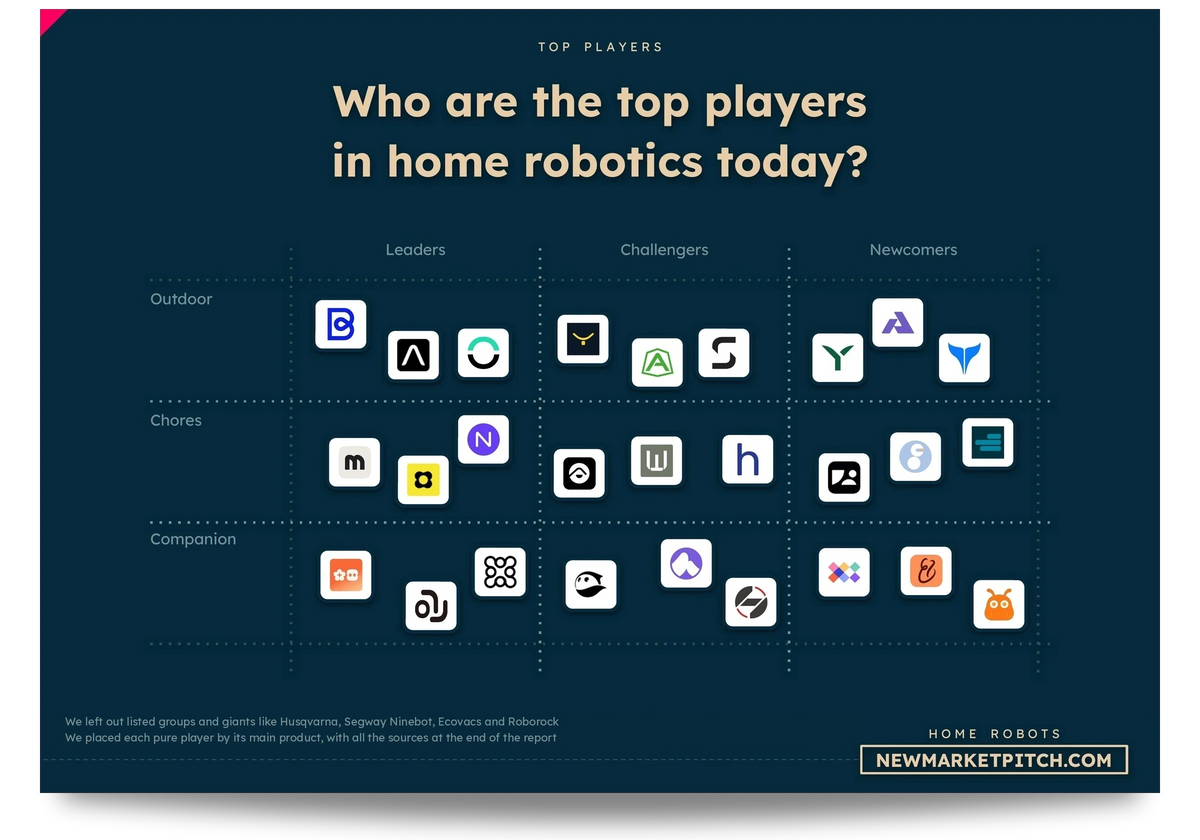
In our research about home robots, we turn what is vague and complex into simple, useful visuals. Market maps like this one show you at a glance where every startup stands.
Is home robotics really a billion-dollar startup funding market?
Yes, home robotics startups have attracted at least $1.6B across the 98 deals we track, involving 49 funded companies.
Those numbers include very different machines. A robot that cleans a swimming pool is already solving a job people pay for. A robot that folds laundry or carries dishes faces a less predictable room, more objects and more chances to get stuck. Treating both as home robotics is useful, as long as we don't pretend that both businesses are equally mature.
The International Federation of Robotics reported in September 2026 that sales of consumer service robots grew 37% in 2025. Most are domestic machines, although that global product-sales category is broader than the startup financings we count. The distinction helps explain why investors are interested even while the most ambitious home helpers are far from routine.
Look at the startups themselves. The Bot Company is building general chore robots, while Weave Robotics raised a $500K seed round in October 2024 for domestic laundry and tidying. Both have a place in the market. They clearly need sharply different amounts of money to try to make their products work.
Are a handful of giant rounds driving home robot funding?
A few giant home robotics checks do most of the work: 11 deals accounted for $1.2B, and removing rounds above $50M leaves $435M+.
The contrast is hard to miss. Sunday Robotics raised a $165M Series B in March 2026 for a general household assistant. Beatbot announced a ~$140M Series A in September 2025 for pool-cleaning robots. Aiper closed a $100M round of undisclosed stage in December 2025. Those are different products and companies, but each round is large enough to reshape the headline total.
Smaller funding is still very real. Excluding deals above $100M leaves $1.0B+ of disclosed financing. Among deals with known amounts, 21 were under $5M and 16 were between $5M and under $20M. Many investors are financing early product experiments while a few are writing checks that could support years of hardware development.
Sunday's March announcement said its new funding would help move Memo beyond demonstrations and into a household beta. That's the useful test for the biggest rounds: whether the spending eventually produces robots that work outside carefully prepared videos.

Your time is limited. In our market report about home robots, we put numbers on each part of the market, so you can see where it makes sense to focus.
How much does a home robotics startup usually raise?
The typical home robotics check is much smaller than the headline rounds: the median disclosed deal was $11M, and the median raised per funded company was $14M.
A round and a company total are not interchangeable. A founder can take a small first check to build a prototype, then raise again to improve the machine or prepare production. The company total adds up the rounds we track for each startup, not a single investor's check or its entire history.
Syncere illustrates the smaller end with its $3.5M seed round in August 2025 for laundry-folding robotic furniture. Posha raised an $8M Series A in May 2025 to develop a countertop cooking robot. Both aim to automate one fairly specific job. Their path is different from that of a company promising a robot that can handle almost anything around the house.
The International Federation of Robotics still identifies manipulation, cost and safety as obstacles for general-purpose robots. So an ordinary-sized check can be enough to test one chore, while a much larger program may be needed to build a versatile household helper. Neither amount tells us how many customers will buy the finished product.
Are robots that handle household chores getting most of the funding?
Startups building household manipulation robots attracted $775M+ across 33 deals and 17 companies, accounting for 48% of disclosed home robotics capital. Companion robots recorded more deals, 35, but raised less than half as much money.
These robots are meant to handle things rather than follow a cleaning route. That could mean folding clothes, moving objects, preparing food or doing several chores. The appeal is obvious. The difficulty is making a machine deal with objects and rooms it has never seen before, without asking someone to rescue it.
Four companies show how different the bets are. The Bot Company wants robots that tackle household chores broadly. Sunday Robotics is developing Memo as a household assistant. Syncere is putting the robot into laundry furniture, while Posha narrows the job to cooking on a countertop. They all belong to the same category, but their products ask customers to trust very different capabilities.
Sunday described using its Skill Capture Gloves to gather human demonstrations in March 2026. Weave Robotics, meanwhile, describes remote help alongside autonomy. Both make the remaining challenge visible: how much of the chore can the machine actually finish by itself? Investors have put serious money behind that question. Reliable autonomy in ordinary homes still has to be demonstrated.

In our document detailing everything you need to know about home robot, we always try to gather several sources and make estimates that make sense, so you can work with solid numbers.
Can a home robot startup raise $100M without shipping a finished product?
A home robotics startup can raise $100M before selling a finished consumer robot, as investors have repeatedly backed ambitious machines still in development.
The Bot Company raised a $150M seed round in May 2024 after former Cruise chief Kyle Vogt announced his move into chore robots. Another $150M arrived in its March 2025 Series B. Investors were backing the founding team and its plan to solve a hard hardware problem, not a proven mass-market consumer appliance.
1X Technologies followed another route. Its $100M Series B in January 2024 came before the company's October 2025 NEO ordering announcement. NEO is sold as a general household robot, but 1X also describes an Expert Mode that allows remote human help with more complicated tasks. Ordering a robot and owning a completely autonomous household helper are different things.
Sunday Robotics has talked about a household beta rather than declaring Memo widely available. These companies can attract large financing because investors believe useful domestic automation could become a major business. Whether it does will depend on what the machines can repeatedly do in customers' homes, and how much help they still need.
Did Sunday Robotics raise the biggest home robot round?
Sunday Robotics did raise the largest individual home robotics round: a $165M Series B in March 2026, led by Coatue.
Sunday said the financing would take its Memo robot from demonstrations into a household beta. Its March announcement also described expanding engineering, research and data operations, and collecting examples of chores using Skill Capture Gloves. The company is trying to train a robot for the messiness of actual houses rather than one carefully arranged room.
The distinction between the biggest deal and the most-funded company is important here. Sunday raised $200M across 2 qualifying rounds. One giant financing does not make its recipient the startup that raised the most in total: that is The Bot Company, with $300M across 2 rounds. Deal size and company totals answer different questions.
And a record check is not a record number of deployed robots. For Memo, we would rather know how often a beta household can leave a task to the robot, how often a person steps in, and whether the machine can repeat that job tomorrow. Sunday's financing buys the chance to answer those questions.
Are robot vacuum startups still getting serious funding?
Robot vacuum startups are still getting serious funding: floor-cleaning companies raised $161M+ in 6 deals involving 4 companies.
Narwal Robotics raised a $100M Growth Equity round in April 2025, led by Tencent and the Beijing Robot Industry Development Investment Fund. South China Morning Post reported in April 2025 that Narwal was developing a mobile household robot with arms, with a launch expected in about two years. That would push it beyond ordinary floor cleaning, where buyers already know what to expect.
Matic took a different approach with its $60M Series C in January 2026: make an existing vacuum-and-mop robot better in real homes. Its November 2026 release notes cover wall collisions, pet-waste avoidance and false blockage warnings. The November 16 update specifically reports fewer bumps during edge cleaning. These small fixes are exactly what consumers notice after the excitement of buying a robot has worn off.
So mature chores are still attracting venture money. The difference is that a cleaning robot can be judged against a routine household job right now. New money can make that job more dependable, rather than paying entirely for the possibility of a future product.

Our report covering the home robot market gets updated several times a month, so you always get the latest view of where things stand.
Why are investors putting so much money into pool-cleaning robots?
Pool-cleaning startups are raising serious money because they already sell a useful product: the category attracted $253M+ across 10 deals and 5 companies.
Beatbot announced a ~$140M Series A in September 2025, led by Meituan DragonBall Capital. Its robots clean swimming pools, a job with a clear customer and a clear result. Reporting around the round described Beatbot's plans to expand sales and keep improving its products, rather than inventing an entirely new kind of household work.
Aiper offers another test. Fluidra, a listed pool-equipment company, closed a $100M investment in Aiper through a round of undisclosed stage in December 2025, taking a 27% stake. Fluidra had already announced the partnership earlier that year. Its existing distribution channels give Aiper a practical way to get machines in front of buyers.
Pool-cleaning robots received 16% of disclosed home robotics capital. That's meaningful for a category devoted to a single task. The appeal is fairly simple: investors can examine the cleaners, the sales channels and the buyers today. They still have to decide whether these companies can keep growing in a specialized market.
Are robotic lawnmowers getting the same huge checks as home humanoids?
Lawn and outdoor robot startups are getting much smaller typical checks than household humanoids, with 13 deals worth $66M+ and a median round of $2.8M.
That doesn't mean the machines are trivial. Lawns can be uneven, wet or full of obstacles, and a mower has to work outdoors without constant supervision. Yarbo sells a modular machine with mowing and snow-clearing attachments, trying to make the same robot useful in different seasons. Airseekers and TerraMow work on autonomous lawn maintenance with their own designs.
Lymow offers a more concrete customer signal. The company says it had shipped more than 5,000 units by August 2025 after a Kickstarter launch. Its financing includes a ~$2.8M seed round in June 2025 and a $2.8M+ Series A in November 2025. Even a product already reaching customers may need repeated money for production and support.
Outdoor robots can be tested against a job people understand: maintain the yard. A home humanoid has a much harder promise to prove. The funding difference says more about how much each project needs to build and test its machine than about whether a lawn is worth automating.

In our research about home robots, we look at what the winners do differently, so you can learn from the best instead of guessing.
Are companion robots getting real funding, or are they just toys?
Companion robots are getting real venture funding: the category recorded 35 deals worth $356M+ across 18 companies, from robotic pets to helpers for older adults.
Some products are sold for entertainment or emotional engagement. Others have a specific care setting in mind. LeXiang Technology (Zeroth) raised a $28M seed round in September 2025 for mobile home companions. Tombot raised a $6.1M Series A in June 2025 for realistic robotic animals, followed by a $7M Series A in June 2026. Those products have different customers from a robot that folds towels.
Intuition Robotics gives us a useful real-world case. A February 2026 report by the New York State Office for the Aging counted 834 older adults enrolled in its ElliQ program in May 2025 and more than 3,500 applicants. Participants averaged 41 interactions a day with the robot, and 29 a day in their second year. Tombot, meanwhile, says its robotic puppy Jennie is intended to provide companionship for people living with dementia and related conditions. Its medical-device plans should not be mistaken for an approval.
The hard question is whether people still want these robots after the novelty fades. A physical companion can offer something a screen cannot, but funding announcements do not tell us the retention rate or prove a therapeutic benefit.
Will home humanoid robots make specialized cleaners obsolete?
Home humanoids won't make specialized cleaning robots obsolete anytime soon, because dedicated machines already perform chores that versatile robots still struggle to do reliably.
1X presents NEO as a robot for different chores, while acknowledging that difficult tasks may need remote Expert Mode help. Sunday Robotics is developing Memo with a different training system and plans for household trials. Neither has shown that one versatile machine can clean every floor, maintain every pool and handle every garden as well as dedicated products.
Specialists have much clearer benchmarks. Matic has to vacuum and mop; Beatbot has to clean a pool; Yarbo has to maintain outdoor spaces. They can improve one task, sell the result and learn from customer complaints. General-purpose robots have to recognize many different objects, manipulate them safely and cope with endless variations in homes.
The International Federation of Robotics' 2026 service-robots report still points to robust manipulation, programming, safety and cost as obstacles for humanoids. We can see why investors like the idea of a robot that does several chores. For now, the simpler machines have the advantage of a job they can already complete.

In our market report about home robots, we don't want to repeat what boring consulting reports say. Instead, we show you the real and latest market signals that matter.
How young are home robot startups when big checks arrive?
Young home robotics startups can attract big checks: the median age at financing was 2 years, even for rounds above $50M.
It was also 2 years for rounds under $5M. So an expensive check doesn't necessarily go to an older company with years of household sales. Investors sometimes back a very young team with a large budget to build something that will take time to make and test.
In our research, 96% of funded companies were founded since 2015, 73% since 2020 and 69% since 2022. The Bot Company's large founding financing shows what an experienced robotics team can attract quickly. Syncere took the narrower approach of automating laundry, while Weave Robotics started with domestic tidying and folding.
These companies still have to build mechanisms, collect training data, deal with safety and learn how the machines behave in messy houses. Sunday's glove-based demonstrations and 1X's plan for consumer delivery show how much work comes before a robot becomes ordinary household equipment. Company age helps explain the risks, but it doesn't predict which robot people will actually keep using.
Can home robot startups really make it to Series C?
Some home robotics startups have reached Series C, but most financing is still early: 57 Seed deals raised $583M+, and only 16% of deals with a named stage were later stage.
Some seed checks are remarkably large, which makes the label less useful than it sounds. The Bot Company's founding-stage round funded an ambitious household robot program. At the smaller end, Weave Robotics raised a $500K seed round in October 2024, Swish Robotics raised a $2.5M seed round in March 2025, and Tau Robotics raised a $2.6M seed round in July 2026. All were seed rounds, but hardly comparable bets.
Later funding does exist. Matic raised a $60M Series C in January 2026 after getting floor-cleaning robots into homes, while Intuition Robotics raised a $20M Series C in August 2024 for its older-adult companion robot. But just 4 deals reached Series C, and the market also recorded only 1 Series D+ and 2 Growth Equity deals. Most startups haven't reached those stages yet.
The table below shows financing by stage, including deals whose stage was not published.
| Stage | Deals | Capital | Capital share |
|---|---|---|---|
| Seed | 57 | $583M+ | 36% |
| Series B | 8 | $471M+ | 29% |
| Series A | 19 | $206M+ | 13% |
| Unknown | 7 | $156M+ | 10% |
| Growth Equity | 2 | $100M+ | 6% |
| Series C | 4 | $83M+ | 5% |
| Series D+ | 1 | $16M | 1% |
Capital share means share of disclosed capital; “+” means at least.

Learning from others' mistakes is the cheapest lesson there is. In our document detailing everything you need to know about home robot, we look at what broke startups before you, so you don't repeat it.
How big is a home robot startup's first round?
A first home robot round can bring in anything from $500K to $150M: 19 first financings raised $272M+ for 19 companies.
Getting that first round can mean different things. Weave Robotics received a $500K seed in October 2024 to work on household laundry and tidying. Futuring Robot raised a $29M seed in January 2026 to develop general-purpose household service robots. The Bot Company's founding check was bigger still. An opening round does not tell us how close the product is to working in a real home.
Most financing activity, however, comes from startups that have already raised. Follow-ons accounted for 63 deals worth $1.3B+, representing 80% of disclosed capital. Of the 49 funded companies, 29 raised more than once: 20 had only 1 recorded round, 16 had 2 and 13 had 3 or more. Repeated funding is a central feature of this business.
The figures suggest that investors are still trying new home robotics ideas, while much of the money goes back to projects already underway. That makes sense for hardware that needs several rounds of testing and production. It doesn't tell us whether the returning companies have happier customers or merely bigger development bills.
Why do some home robot startups raise twice in a year?
Some home robotics startups come back for money within months, often to pay for another expensive phase of building the robot: the median time between two rounds is 7.5 months.
Among the gaps we could measure, 68% were under 12 months, 87% under 18 months and 94% under 24 months. Those are shares of round-to-round gaps, not shares of companies. Our timing information covers 63% of eligible gaps, so it gives a useful pattern rather than a timetable every founder can follow.
The individual sequences explain the speed. Sunday Robotics raised a $35M seed round in November 2025 and its Series B the following March. LeXiang Technology raised a $28M seed round in September 2025 and a ~$70M seed round in July 2026. Yarbo received a $28M Series B in March 2025 and another $14M+ Series B in July 2025. Even the stage name can stay the same while a company raises again.
That rapid return may follow a breakthrough, a factory order or another expensive phase of product development. It may also mean the machines are consuming cash before sales cover the work. The funding dates tell us how quickly companies found investors again, not how well the robots perform.
Why do Chinese home robot startups announce so many rounds?
Chinese home robotics startups announce many more rounds because many of them go back to investors again and again: China had 73 deals and $743M+, against 19 deals and $819M+ in the United States.
China's 32 funded companies include outdoor, pool-cleaning, companion and household-assistance developers. LeXiang Technology, Knowin AI and Yarbo all returned to investors repeatedly. The United States had 13 funded companies, with enormous checks for The Bot Company and Sunday Robotics alongside specialized firms such as Matic and Aiper.
The regional view tells a similar story. Asia-Pacific had 78 deals worth $775M+, while North America attracted more disclosed money from fewer deals. An American startup can raise a much larger check while Chinese companies announce many more rounds. Each figure answers a different question.
These figures use company headquarters, not where robots are manufactured or sold. Beatbot and Aiper reach customers abroad, and 1X has discussed plans beyond its initial U.S. rollout. So the more useful conclusion is that China has the broader flow of deals, while the most expensive American bets push its total higher.

If you build or invest in the home robot market, you need to know which business models pay off now and which ones are fading. That's why our report covering it has a whole section on it.
Does money for home robots arrive steadily or in bursts?
Funding for home robotics arrives in bursts rather than at a steady pace: the median completed month had 3 deals and $15M in disclosed capital.
We recorded 4 months with no qualifying deal, and 10 months above the median deal count. November 2025 and September 2025 tied for the most deals, with 7 each. September 2025 also recorded the highest disclosed monthly amount, $181M+, helped by Beatbot's large pool-cleaning round.
Look at what happened during 2025. The Bot Company's new financing made March unusually large; Narwal's growth round helped April; and September's pool-cleaning news sat alongside smaller companion and outdoor rounds. Then October passed without a qualifying deal. So one headline is not enough to say the market is booming or collapsing.
The table below shows how deal activity and announced capital varied from month to month in 2025.
| Month | Deals | Capital |
|---|---|---|
| January 2025 | 3 | $14M+ |
| February 2025 | 3 | $38M+ |
| March 2025 | 4 | $180M+ |
| April 2025 | 3 | $114M+ |
| May 2025 | 2 | $8M+ |
| June 2025 | 4 | $8.9M+ |
| July 2025 | 2 | $17M+ |
| August 2025 | 1 | $3.5M |
| September 2025 | 7 | $181M+ |
| October 2025 | no deal | no deal |
| November 2025 | 7 | $54M+ |
| December 2025 | 3 | $104M+ |
“+” means at least; deals without public amounts are still counted. 3 deals of 2025 are dated only by the year, so they appear in no month.
Are investors ignoring home security robots?
Investors have barely funded home security and patrol robots: we recorded no qualifying startup deal in this home robotics category.
That's a narrow claim about venture-backed machines that move around the home or perform a physical patrol. It says nothing about how many people buy ordinary cameras, alarms or smart-home systems. Those products generally don't qualify as domestic robots under our definition.
Window cleaning is another overlooked application. Jingjie Xunhang raised a $2.7M+ seed round in September 2025, and the window-cleaning category recorded 1 deal involving 1 company. The International Federation of Robotics treats window cleaning as a distinct domestic robot task, so the limited funding cannot be explained away by saying the product category doesn't exist.
By contrast, founders developing robotic companions, versatile household assistants and outdoor machines have managed to raise repeated rounds. There may be plenty of customers who would like safer homes or cleaner windows, but our records do not show investors building many standalone home-security or window-cleaning startups around those jobs. Low funding is not the same thing as no demand.

In our research about home robots, we like to show you the big picture. We know your time is precious, so we make every page quick to read and packed with as much learning as possible per minute.
Do the same investors keep backing home robotics startups?
A few home robotics investors return, but no single fund dominates the market: we identified 155 unique investors, and only 21 appeared in more than one round.
Lead investors were disclosed for 57% of deals. Among those announced leads, we found 76 distinct names but only 5 that led repeatedly. Those repeat leaders accounted for 18% of deals with a named lead. The money is coming from many different sources rather than a single group writing every important check.
Matrix Partners China, Zhongding Capital, Accel, Cathay Capital and HongShan each led 2 rounds. Matrix Partners China comes first because the rounds it led were the largest, $74M+ in combined round sizes, against $28M+ for Zhongding Capital. These figures describe the full size of the rounds they led, not how much of their own money each investor contributed.
The biggest financings also show the variety: Coatue led Sunday Robotics' major round, Greenoaks led The Bot Company's follow-on, and Meituan DragonBall Capital led Beatbot's pool-cleaning financing. The practical question for a founder is finding an investor willing to pay for the next hardware milestone. A famous fund's name doesn't replace a working product.
So, where is home robot startup funding actually going?
Home robot startup funding is going mainly to expensive household-assistance projects, while specialized cleaners and companion robots provide different ways to reach customers.
We found a real market rather than a stream of isolated press releases. But a robot that can clean a pool today and a robot that might handle every household chore in the future are not equally close to proving their business. The Bot Company raised the most capital in the period; Sunday Robotics secured the largest single financing. Matrix Partners China tops the lead investors on round size, in a five-way tie at 2 led rounds, so no fund has a commanding share.
China produces the most financings, while American startups attract more disclosed money. Early rounds are common, and the few later-stage deals often involve machines that have a clearer job and customer. For now, funding tells us where investors are prepared to take risks. It tells us much less about which robots will become everyday household equipment.
The table below shows what we found.
| Question | Answer |
|---|---|
| Has home robotics become a billion-dollar business bet? | Yes, startups attracted at least $1.6B in qualifying home robotics financing. We counted 98 deals across the market in under three years. That includes saleable specialist robots and much less proven household helpers. |
| Does the typical robot round match the headlines? | No, the famous checks are much larger than normal financings. The median disclosed home robotics round was $11M during this period. Most founders work with budgets well below the celebrated giant rounds. |
| Can a few investors' checks move the total? | Absolutely, a few giant home robotics rounds explain the headline. Just 11 deals together accounted for $1.2B in financing. Smaller checks still support a long list of focused products. |
| Does one startup take the biggest overall share? | The Bot Company raised the most eligible money during this period. Its 2 qualifying rounds brought in $300M for household chores. Sunday held the single-deal record instead of the company-total lead. |
| Are flexible household robots winning the funding race? | Yes, household manipulation attracted the largest disclosed category investment. Its $775M+ represented 48% of disclosed home robotics capital. That money still buys development time rather than proven broad autonomy. |
| Do simple pool cleaners still attract big money? | Yes, investors have backed pool cleaners with meaningful commercial ambitions. The category raised $253M+, or 16% of disclosed capital. Established customers and distribution give companies practical tests of demand. |
| Could companion robots become more than novelty toys? | Companion robots are already a real part of startup financing. They accounted for 35 deals across 18 different companies. Whether people keep using them remains the more difficult question. |
| Is China also collecting the biggest dollar checks? | China dominates home robotics deal activity, especially repeated local financings. Its startups announced 73 deals, while American companies received more disclosed money. Headline checks and the number of financings tell different stories. |
| Must robotics founders spend years before raising big? | No, major home robotics checks can go to young teams. The median company age at financing was just 2 years. That makes product reliability an important test after fundraising success. |
| Do later rounds come easily to home robotics? | No, the sector still has relatively few mature financings. Just 4 Series C deals appeared alongside 2 Growth Equity deals. Startups have a route forward, but most remain earlier stage. |
| Are all home robot chores equally attractive to investors? | Hardly, several familiar household tasks receive almost no qualifying financing. Window cleaning recorded 1 deal worth $2.7M+ during this period. Home security and patrol robots had no qualifying deal at all. |

When you build or invest in the home robot market, you need clarity, not confusion. In our market report about home robots, we always try to put numbers on and quantify whatever is usually vague and confusing.
Our methodology
Our data runs through November 19, 2026. We then reviewed this article and updated its answers on November 24, 2026, the date shown under the title. We cover qualifying home robotics financings announced from January 1, 2024 to November 19, 2026, using one continuous period rather than mixing current deals with companies' complete funding histories.
We include equity financings of private companies at or above $300K. We exclude debt, grants, loans, unconverted convertibles, SAFEs and public offerings. Each qualifying financing counts once, duplicate reporting is merged, and different announcements of the same transaction are not treated as successive rounds.
We define home robots as machines built to perform tasks or assist people in residential settings. This includes floor, pool, window and outdoor cleaning, household manipulation, physical companion robots and mobile home security. We retain borderline companies when there is documented home-first design and a credible commercialization plan; enterprise-only robots, general-purpose robotic hardware for developers, and appliances without meaningful robotic behavior are excluded. A humanoid qualifies only when domestic assistance or companionship is central to its actual positioning, not a distant use case.
Every company counted is a startup under our definition: independently established in 2007 or later, designed for rapid growth around new technology, and backed by founders, venture capital, angels or other startup funding. We also include companies recently acquired or recently listed under the specific recency limits of this definition. Famous robot makers outside those boundaries can appear for context, but not as eligible financed startups.
We count undisclosed-amount rounds in deal totals but exclude them from dollar sums and medians requiring a public amount. This makes several capital figures minimums. We group rounds into Seed, Series A, Series B, Series C, Series D+, Growth Equity and Unknown; headquarters determine country and region, and our application categories reflect each company's primary home robotics use case. First versus follow-on status is assigned only where the financing history can support it.
Rounds confirmed by a company announcement, a press article or a regulatory filing are counted in full. Where no article exists, a round is counted only when at least two recognised databases agree on its date (within one month) and amount (within 5%), and it is marked as low confidence; a round found in a single database stays in the company's history but is left out of totals. For companies that have raised more than $100M, every round counted is backed by an article.
Our first references are company announcements, regulatory documents and reliable press reporting; database-only evidence is subject to the verification rule above. A press headline about all robotics, an entire company's lifetime funding, or an announced commercial partnership can therefore differ from this home robotics deal total without indicating that either report has been added incorrectly. Recent months also remain incomplete until more financings are publicly documented, and a transaction announced earlier can close later without becoming a second round.
Key sources include International Federation of Robotics, September 2026 consumer service robot sales and practical hurdles for humanoids, International Federation of Robotics classification of domestic cleaning, companions and care robots, Sunday Robotics, March 2026 Series B and Memo household beta plans, Sunday Robotics, Memo training with Skill Capture Gloves and home deployment design, The Bot Company launch and May 2024 founding financing, The Bot Company March 2025 follow-on funding report, 1X Technologies, October 2025 NEO announcement, pricing and delivery plans, 1X Technologies, NEO ordering terms and remote Expert Mode, Weave Robotics, home laundry-folding device and field use, Weave Robotics, household robot offering and autonomy with remote assistance, Matic, January 2026 funding announcement and product deployment, Matic, November 2026 home cleaning software improvements, Narwal Robotics April 2025 financing and planned robotic arms, Fluidra, December 2025 closing of Aiper equity investment, Fluidra, April 2025 Aiper partnership announcement, Beatbot, September 2025 funding and commercial expansion, Lymow, Kickstarter launch and shipment timeline, Yarbo, modular residential mowing and snow clearing products, New York State Office for the Aging, February 2026 ElliQ project update, Tombot, Jennie companion robot positioning and intended medical-device pathway, and Posha, May 2025 financing and consumer kitchen robot.

A good product starts with a real problem. In our document detailing everything you need to know about home robot, we show you the ones customers still live with.
Written by the New Market Pitch teamWe track new markets so founders and investors can move faster. About us