What’s the latest funding news in the medical imaging AI market? (October 2026)
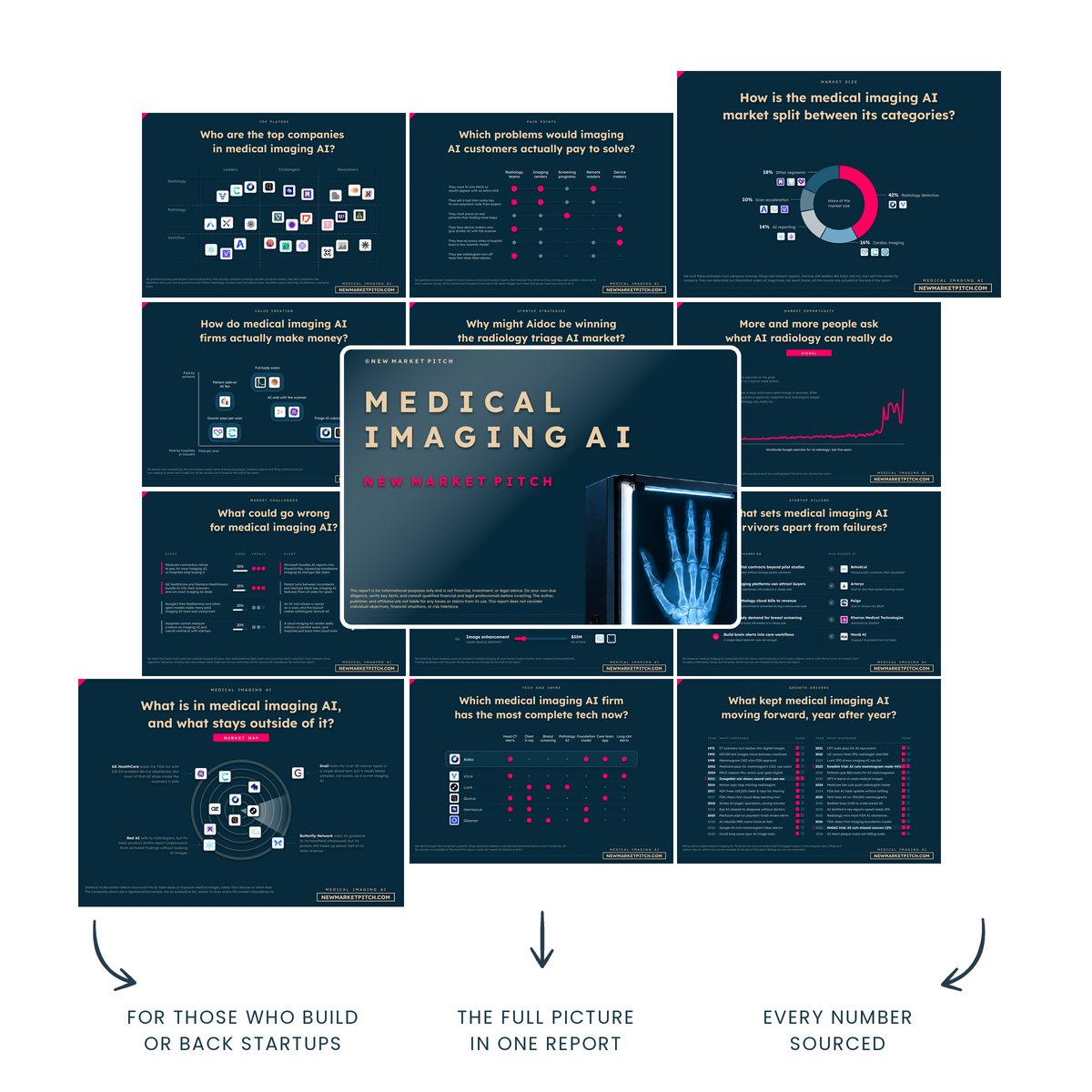
Whether you're building or investing in the medical imaging AI market, our report covers everything you need to know: the players, the money, and what's coming next.
Medical imaging AI funding has remained active in 2026, with investors backing companies that help clinicians interpret scans, improve image quality, and manage radiology workflows.
The latest announcements cover everything from AI-powered cardiovascular diagnostics to automated MRI scanning and enterprise platforms that bring imaging algorithms into hospitals.
As of October 2026, our selection covers 12 companies, while distinguishing traditional venture rounds from public equity placements and crowdfunding campaigns.
And if you want to better understand this new industry, you can download our pitch covering the medical imaging AI market.
Insights
- Aidoc's $150 million Series E is the largest private financing in this selection. It exceeds the combined $128 million raised by Elucid, Sirona Medical, and Subtle Medical, illustrating the scale established clinical AI companies can reach.
- Cardiovascular imaging stands out as an investment theme. Elucid, UltraSight, and Echo IQ secured financing for three different applications: coronary CT analysis, AI-guided cardiac ultrasound acquisition, and echocardiography-based disease assessment.
- Medical imaging AI investors are increasingly backing deployment infrastructure alongside diagnostic algorithms. Sirona Medical, Incepto Medical, and CARPL.ai focus on bringing multiple AI capabilities into everyday radiology workflows rather than selling a single disease-detection model.
- Echo IQ's approximately A$110 million placement illustrates an important distinction in medical imaging AI funding. Capital raised by a publicly traded company is not directly comparable with venture rounds completed by private startups.
- Image acquisition and reconstruction are attracting meaningful investment. UltraSight, Subtle Medical, and Vista AI develop technologies that improve how diagnostic images are captured or produced, addressing operational problems before radiologists interpret them.
- Seven of the 12 financing announcements fall between July and September 2026. This concentration suggests that investor activity across radiology AI, cardiovascular imaging, and clinical workflow automation was already substantial before October.
- Strategic healthcare relationships are becoming part of the financing story. Vista AI attracted hospital-system investors, while RevealDx paired its $3.4 million investment with a distribution agreement covering several international markets.
- Not every funding headline represents a new standalone round. Epsilon Health's $27.6 million was announced as total funding, while Koios Medical's approximately $3.28 million reflects a crowdfunding tally rather than a confirmed institutional financing.
- The pure-play distinction matters when comparing medical imaging AI businesses. Companies selling diagnostic algorithms have different revenue models from radiology practices and software platforms that also provide PACS, reporting, or integration services.

Written by the New Market Pitch teamWe track new markets so founders and investors can move faster. About us

In our report covering the medical imaging AI market, you will always find fresh funding data, taken straight from our own verified funding database.
Summary table of the latest funding deals in the medical imaging AI market as of October 2026
We define the medical imaging AI market as AI software that analyzes or improves medical images for clinical use.
We include image interpretation, triage, measurement, reconstruction and workflow tools for radiology and other medical imaging.
We exclude general image storage, non-medical computer vision and diagnostic products that do not use imaging.
The table below presents the 12 companies in our research, ordered from the most recent reported financing to the oldest, subject to the unverified October announcement day for Koios Medical.
Amounts are expressed in US dollars unless noted otherwise, and several entries require special treatment because their financing structures or exact round amounts differ from conventional venture capital transactions.
| Name | When | Amount in $ | Round Type | Category |
|---|---|---|---|---|
| Sirona Medical | October 15, 2026 | $40M | Series D | Radiology Workflow AI & Enterprise Imaging |
| Koios Medical | October 2026, day unverified | Approx. $3.28M | Equity Crowdfunding | Breast & Thyroid Ultrasound AI |
| UltraSight | September 23, 2026 | $24M | Series B2 | AI-Guided Cardiac Ultrasound |
| Incepto Medical | September 22, 2026 | $16M | Growth Financing | Medical Imaging AI Deployment & Orchestration |
| Epsilon Health | September 10, 2026 | $27.6M announced total | Stealth Funding & Reported Series A | AI-Assisted Radiology Services |
| Elucid | September 2, 2026 | $55M | Series D | Cardiovascular CT Analysis |
| RevealDx | August 3, 2026 | $3.4M | Strategic Investment | Lung Nodule Analysis & Cancer Risk Assessment |
| CARPL.ai | July 23, 2026 | $10M | Series A | Radiology AI Marketplace & Deployment |
| Echo IQ | July 1, 2026 | Approx. $70M to $75M (A$110M) | Institutional Equity Placement | Echocardiography AI & Cardiac Screening |
| Subtle Medical | June 2, 2026 | $33M | Series C-Led Growth Financing | AI Image Reconstruction & Enhancement |
| Aidoc | April 29, 2026 | $150M | Series E | Radiology AI Triage & Clinical Decision Support |
| Vista AI | January 14, 2026 | $29.5M | Series B | Automated MRI Acquisition |
This selection reflects the available fundraising announcements through October 16, 2026, rather than a verified exhaustive census of every global medical imaging AI transaction. Koios Medical's crowdfunding date remains uncertain, while several platform and service businesses have not publicly established that proprietary image analysis accounts for 70% to 80% of their business.
All the latest funding deals in the medical imaging AI market as of October 2026
Sirona Medical raised $40 million in Series D funding in October 2026 to expand its radiology software platform.
When was it?
Sirona Medical announced its latest funding round on October 15, 2026.
Who are they?
Sirona Medical develops RadOS, a cloud-based radiology platform combining medical image viewing, reporting, worklist management, and AI-powered workflow automation.
Geographical focus?
Based in San Francisco, Sirona Medical primarily serves radiology groups across the United States and is preparing to expand into international healthcare markets.
Why do we include them in the medical imaging AI market?
Sirona Medical integrates AI-powered reporting and algorithm orchestration into clinical imaging workflows, although its broader platform also provides conventional PACS and radiology software.
What is the company stage?
Sirona Medical is in commercial growth, with more than 12 million annual imaging examinations under contract and an expanding customer base across radiology practices.
How much did they raise?
Sirona Medical secured $40 million, led by Avidity Partners with participation from 8VC, GreatPoint Ventures, KLT Holdings, and other investors.
What round is it?
The financing was a Series D round supporting Sirona Medical's next phase of commercial expansion.
Why did they raise?
Sirona Medical plans to strengthen customer support, commercialize its Cortex AI orchestration technology, and launch the Sirona Global international expansion program.
Koios Medical reported approximately $3.28 million in community equity funding during October 2026.
When was it?
Koios Medical's crowdfunding records identify October 2026 as the latest funding month, but an exact announcement or closing day could not be independently confirmed.
Who are they?
Koios Medical develops FDA-cleared AI software that analyzes breast and thyroid ultrasound images to help clinicians assess suspicious lesions and evaluate cancer risk.
Geographical focus?
Headquartered in the United States, Koios Medical serves hospitals and imaging providers internationally, including customers across North America and other healthcare markets.
Why do we include them in the medical imaging AI market?
Koios Medical is a specialist in clinical ultrasound interpretation, using image-analysis algorithms to support breast and thyroid diagnostic decisions.
What is the company stage?
Koios Medical is in commercial growth, with FDA-cleared products, recurring software revenue, and deployments across multiple countries.
How much did they raise?
Koios Medical's crowdfunding campaign reported approximately $3.28 million from more than 1,200 investors, although the precise final amount requires independent confirmation.
What round is it?
The financing was a community equity crowdfunding campaign rather than a conventional institutional Series round, with a $90 million pre-money valuation advertised in campaign materials.
Why did they raise?
Koios Medical sought additional capital to expand hospital adoption, strengthen its commercial operations, and continue developing AI-assisted ultrasound diagnostics.

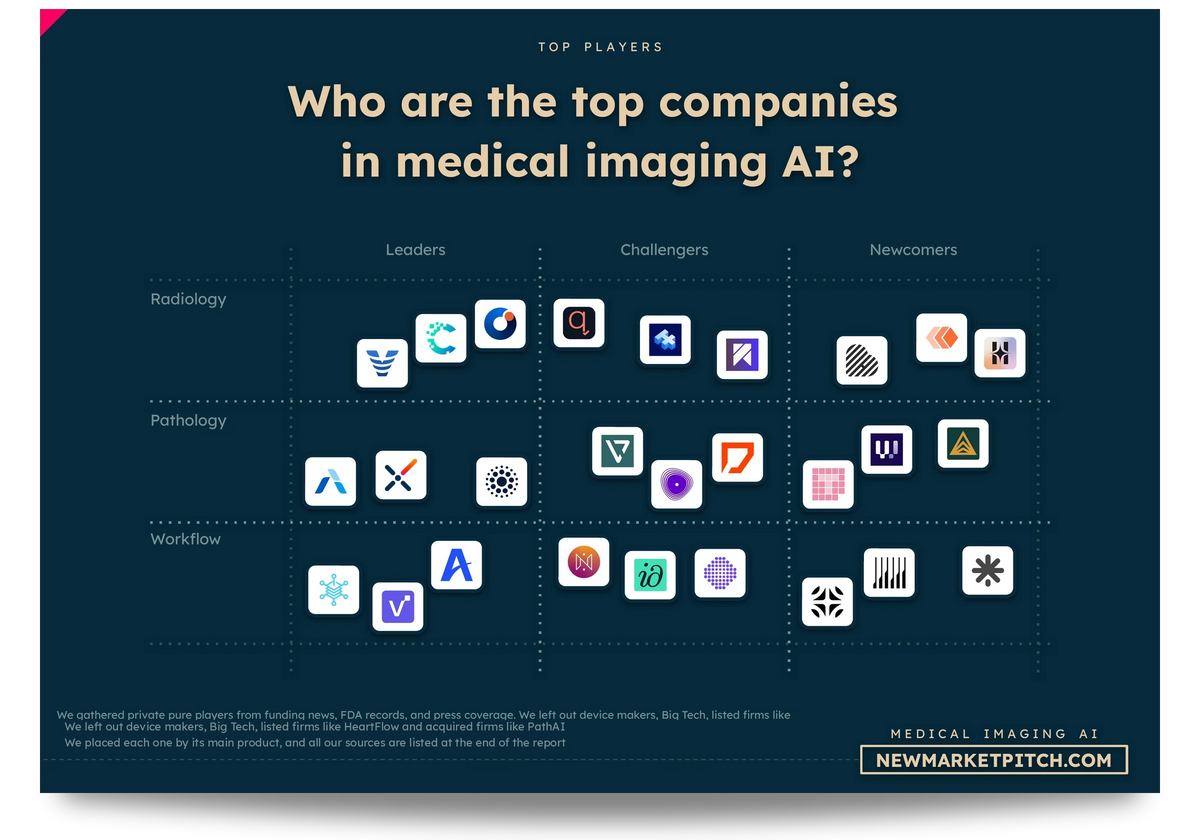
In our research about AI for medical imaging, we turn what is vague and complex into simple, useful visuals. Market maps like this one show you at a glance where every startup stands.
UltraSight raised $24 million in September 2026 to expand AI-guided cardiac ultrasound across American hospitals.
When was it?
UltraSight announced its Series B2 financing on September 23, 2026.
Who are they?
UltraSight develops AI software that guides medical professionals through cardiac ultrasound examinations, helping users capture useful heart images even with limited ultrasound experience.
Geographical focus?
Operating from the United States with Israeli roots, UltraSight is concentrating its commercial expansion on American health systems and cardiovascular care providers.
Why do we include them in the medical imaging AI market?
UltraSight specializes in AI-guided medical image acquisition, particularly real-time assistance for cardiac ultrasound examinations performed in clinical settings.
What is the company stage?
UltraSight is scaling commercially, supported by FDA-cleared technology, clinical validation, and growing partnerships with healthcare organizations.
How much did they raise?
UltraSight secured $24 million in new financing led by Alive HealthTech Growth Fund, alongside investors including Deep Insight, Star51 Capital, and Connecticut Innovations.
What round is it?
The investment was a Series B2 financing round, building on UltraSight's previous development and commercialization funding.
Why did they raise?
UltraSight plans to expand adoption in US hospitals and develop additional ultrasound workflows for intensive care and circulatory support patients.
Incepto Medical raised $16 million in September 2026 to expand access to clinical imaging AI across Europe.
When was it?
Incepto Medical dated its English financing announcement September 22, 2026, with its French announcement following on September 23.
Who are they?
Incepto Medical operates a platform that allows radiologists to select, integrate, and monitor medical imaging AI applications within their existing diagnostic workflows.
Geographical focus?
Headquartered in France, Incepto Medical primarily serves European healthcare providers while developing additional opportunities in the United States.
Why do we include them in the medical imaging AI market?
Incepto Medical specializes in clinical imaging AI deployment and orchestration, including third-party diagnostic algorithms and its own imaging and reporting applications.
What is the company stage?
Incepto Medical is in the growth stage, with a platform supporting approximately six million patient examinations annually across its healthcare network.
How much did they raise?
Incepto Medical secured $16 million, approximately €14 million, in financing led by Impactivist with participation from LBO France, Karista, Bpifrance, and Wille Finance.
What round is it?
The financing was a growth equity round, sometimes described as Series C in funding databases, although that designation was not prominently used in the company's announcement.
Why did they raise?
Incepto Medical intends to expand its TANGO AI reporting assistant, improve clinical monitoring, extend its algorithm portfolio, and accelerate international adoption.

Your time is limited. In our market report about AI for medical imaging, we put numbers on each part of the market, so you can see where it makes sense to focus.
Epsilon Health announced $27.6 million in funding in September 2026 as it emerged from stealth.
When was it?
Epsilon Health publicly announced its financing and emergence from stealth on September 10, 2026.
Who are they?
Epsilon Health operates an AI-native radiology practice that combines proprietary software with board-certified radiologists to interpret diagnostic imaging studies.
Geographical focus?
Based in San Francisco, Epsilon Health focuses on the United States, working with imaging providers and radiology organizations facing growing examination volumes.
Why do we include them in the medical imaging AI market?
Epsilon Health embeds diagnostic AI directly into radiology interpretation workflows, although its physician-delivered services make it broader than a pure medical imaging software company.
What is the company stage?
Epsilon Health is in early commercial growth, reporting more than 250,000 patients served and over 2,500 imaging examinations processed daily at its funding announcement.
How much did they raise?
Epsilon Health announced $27.6 million in total funding led by AlleyCorp, although this figure should not be interpreted as the amount of one newly completed round.
What round is it?
The announcement accompanied Epsilon Health's emergence from stealth, while venture databases separately reported a Series A component of approximately $20 million.
Why did they raise?
Epsilon Health plans to expand clinical operations, recruit radiologists and other staff, establish more healthcare partnerships, and invest in its AI-supported diagnostic infrastructure.
Elucid raised $55 million in September 2026 to commercialize its AI-powered cardiovascular imaging technology.
When was it?
Elucid announced its latest financing on September 2, 2026.
Who are they?
Elucid develops AI software that analyzes cardiovascular CT scans to measure arterial plaque and help physicians assess coronary artery disease.
Geographical focus?
Headquartered in the United States, Elucid primarily targets American cardiovascular healthcare providers while establishing partnerships with medical technology manufacturers.
Why do we include them in the medical imaging AI market?
Elucid is a dedicated cardiovascular imaging AI company, applying advanced image analysis to CT-based plaque characterization and noninvasive disease assessment.
What is the company stage?
Elucid is in late-stage commercial growth, with clinically validated imaging software and an expanding portfolio of cardiovascular diagnostic applications.
How much did they raise?
Elucid secured $55 million from investors including IAG Capital Partners, Elevage Medical Technologies, and an undisclosed publicly traded medical technology company.
What round is it?
The investment was an oversubscribed Series D financing, bringing Elucid's reported cumulative funding to approximately $185 million.
Why did they raise?
Elucid intends to accelerate commercial adoption, advance regulatory development, and strengthen strategic partnerships supporting its cardiovascular imaging platform.

In our document detailing everything you need to know about medical imaging AI, we always try to gather several sources and make estimates that make sense, so you can work with solid numbers.
RevealDx secured a $3.4 million strategic investment in August 2026 alongside an international distribution agreement.
When was it?
RevealDx announced its strategic investment on August 3, 2026, with additional industry coverage appearing later that month.
Who are they?
RevealDx develops RevealAI-Lung, software that analyzes lung nodules on CT scans and calculates a malignancy similarity score to support clinical decisions.
Geographical focus?
Based in Seattle, RevealDx is expanding beyond the United States through distribution arrangements covering Europe, Australia, and New Zealand.
Why do we include them in the medical imaging AI market?
RevealDx focuses directly on lung CT image interpretation, using AI-based radiomic measurements to help radiologists evaluate potentially malignant nodules.
What is the company stage?
RevealDx is in early commercial growth, with regulatory authorizations in several markets and software available for use in clinical imaging workflows.
How much did they raise?
RevealDx received a $3.4 million strategic equity investment from Australian medical imaging company 4DMedical.
What round is it?
The financing was a strategic investment associated with a commercial distribution agreement, rather than a clearly designated Series A or Series B round.
Why did they raise?
RevealDx is using the partnership to expand distribution of RevealAI-Lung and make AI-assisted lung nodule assessment available to more healthcare providers internationally.
CARPL.ai raised $10 million in July 2026 to accelerate international adoption of radiology AI software.
When was it?
CARPL.ai announced its Series A financing on July 23, 2026.
Who are they?
CARPL.ai develops an enterprise platform that helps hospitals evaluate, integrate, deploy, and monitor medical imaging AI applications from different software developers.
Geographical focus?
Operating across the United States and India, CARPL.ai serves international healthcare markets including North America, Latin America, Europe, and Asia-Pacific.
Why do we include them in the medical imaging AI market?
CARPL.ai specializes in the deployment and management of radiology AI algorithms, making its software a dedicated infrastructure layer for clinical imaging applications.
What is the company stage?
CARPL.ai is in commercial growth, with adoption among major radiology groups and healthcare organizations deploying multiple diagnostic AI solutions.
How much did they raise?
CARPL.ai secured $10 million led by International Finance Corporation, with Stellaris Venture Partners and other investors participating.
What round is it?
The financing was a Series A round intended to support CARPL.ai's expansion beyond its established enterprise customer base.
Why did they raise?
CARPL.ai plans to improve its platform, expand relationships with AI developers, and help more hospitals adopt medical imaging algorithms across different clinical specialties.

Our report covering the medical imaging AI market gets updated several times a month, so you always get the latest view of where things stand.
Echo IQ announced an approximately A$110 million institutional equity placement in July 2026 to accelerate cardiovascular AI expansion.
When was it?
Echo IQ announced firm commitments for its institutional placement on July 1, 2026.
Who are they?
Echo IQ develops EchoSolv, an AI-powered platform that analyzes echocardiography measurements to help clinicians identify and evaluate structural heart disease.
Geographical focus?
Headquartered in Sydney, Echo IQ is concentrating its commercial expansion on the United States through healthcare partnerships and hospital deployments.
Why do we include them in the medical imaging AI market?
Echo IQ specializes in AI-assisted echocardiography analysis, helping cardiology teams interpret ultrasound-derived measurements and assess cardiovascular conditions.
What is the company stage?
Echo IQ is in commercial scaling, with regulatory progress, expanding US healthcare partnerships, and a growing portfolio of cardiovascular AI applications.
How much did they raise?
Echo IQ received commitments for approximately A$110 million, equivalent to an indicative US$70 million to US$75 million, from existing and new institutional investors.
What round is it?
The transaction was a primary institutional equity placement by an ASX-listed company, priced at A$1.45 per share, rather than a private venture capital round.
Why did they raise?
Echo IQ intends to accelerate US commercialization of EchoSolv, increase hospital deployment capacity, and develop additional AI applications for cardiovascular diagnosis.
Subtle Medical raised $33 million in June 2026 to expand its AI-powered medical image enhancement platform.
When was it?
Subtle Medical announced its new growth financing on June 2, 2026.
Who are they?
Subtle Medical develops AI software that improves MRI, PET, and CT image quality while helping imaging providers shorten scan times and increase scanner efficiency.
Geographical focus?
Based in California, Subtle Medical serves healthcare providers internationally, with software deployed across more than 1,300 medical imaging scanners worldwide.
Why do we include them in the medical imaging AI market?
Subtle Medical is a dedicated provider of AI-based image reconstruction and enhancement technology used directly in clinical radiology examinations.
What is the company stage?
Subtle Medical is in commercial growth, with established products, international deployments, and an expanding portfolio covering several imaging modalities.
How much did they raise?
Subtle Medical secured $33 million, led by Morgan Stanley Expansion Capital with participation from Shinhan Venture Investment, Fusion Fund, EnvisionX, BRV, and Samsung Ventures.
What round is it?
The financing was a growth capital transaction anchored by a Series C round, bringing Subtle Medical's reported total funding to approximately $86 million.
Why did they raise?
Subtle Medical plans to accelerate product development, expand international sales, and increase adoption of its vendor-neutral AI technology across imaging equipment manufacturers.

In our research about AI for medical imaging, we look at what the winners do differently, so you can learn from the best instead of guessing.
Aidoc raised $150 million in April 2026 to scale its enterprise clinical AI platform for medical imaging.
When was it?
Aidoc announced its Series E financing on April 29, 2026.
Who are they?
Aidoc develops AI software that analyzes CT scans and other medical images to detect urgent findings, prioritize radiology cases, and support clinical decision-making.
Geographical focus?
Founded in Israel with a significant US presence, Aidoc serves healthcare systems internationally, particularly hospitals deploying AI across multiple clinical departments.
Why do we include them in the medical imaging AI market?
Aidoc is an established provider of diagnostic imaging AI, with algorithms for abnormality detection, clinical triage, and radiology workflow prioritization.
What is the company stage?
Aidoc is in late-stage commercial scaling, supported by an extensive hospital customer base and numerous FDA-cleared imaging AI applications.
How much did they raise?
Aidoc secured $150 million led by Goldman Sachs Alternatives, with participation from General Catalyst, SoftBank Vision Fund 2, and NVentures.
What round is it?
The transaction was a Series E financing round, taking Aidoc's reported cumulative capital raised beyond $500 million.
Why did they raise?
Aidoc plans to expand its clinical foundation model capabilities, develop broader AI-based diagnostic applications, and strengthen enterprise deployments across hospital networks.
Vista AI raised $29.5 million in January 2026 to expand automated MRI scanning across healthcare providers.
When was it?
Vista AI announced the closing of its Series B financing on January 14, 2026.
Who are they?
Vista AI develops AI software that automates MRI scan setup and acquisition, helping technologists capture standardized diagnostic images with less manual configuration.
Geographical focus?
Based in California, Vista AI focuses on American hospital systems and diagnostic imaging centers seeking more efficient MRI operations.
Why do we include them in the medical imaging AI market?
Vista AI specializes in clinical imaging acquisition automation, applying artificial intelligence directly to MRI scanning rather than general hospital administration.
What is the company stage?
Vista AI is in commercial scaling, with an FDA-cleared cardiac MRI solution and plans to expand into additional anatomical applications.
How much did they raise?
Vista AI secured $29.5 million from investors including Cedars-Sinai, Intermountain Health, University of Utah Health, Tampa General Hospital, Khosla Ventures, and Bold Brain Capital.
What round is it?
The investment was a Series B financing that included strategic participation from several major US health systems.
Why did they raise?
Vista AI intends to automate additional MRI examinations, including brain, prostate, and spine imaging, while developing remote scanning capabilities to address staffing constraints.
Written by the New Market Pitch teamWe track new markets so founders and investors can move faster. About us