What’s the latest funding news in the clinical decision support market? (October 2026)
Whether you're building or investing in the clinical decision support market, our report covers everything you need to know: the players, the money, and what's coming next.
Clinical decision support software helps physicians and nurses use patient data to make clearer diagnostic and treatment decisions.
The 12 financings selected here range from small seed rounds to major growth investments, with the latest announcement in October 2026.
They span medical evidence search, imaging guidance, cardiac alerts and patient-risk screening in several regions.
And if you want to better understand this new industry, you can download our pitch covering the clinical decision support market.
Insights
- The 12 selected clinical decision support market companies raised $717M in their latest reported rounds. That total uses Healthleap's $30M Series A, not the $38M figure covering two separate financings.
- OpenEvidence alone accounted for nearly 35% of this selected capital, with a $250M growth round and a reported $15B valuation. Evidence retrieval is attracting financing at platform scale.
- OpenEvidence, Aidoc and Tandem Health captured $500M, or almost 70% of the $717M selected total. Investor interest is concentrated in clinical AI platforms with established distribution rather than evenly spread across startups.
- Three companies, UltraSight, Implicity and Elucid, received $119M combined for cardiovascular workflows. Their approaches differ: guided ultrasound acquisition, remote cardiac risk triage and CT-based plaque analysis.
- Clinical decision support is moving closer to hospital systems: Healthleap writes risk scores into records, Avo proposes actions inside EHR workflows, and Implicity prioritizes alerts from implanted cardiac devices.
- OpenEvidence and Almanac Health both translate published medical evidence into clinician-facing answers, yet their September growth and April seed rounds totaled $260M. The same product category spans very different maturity levels.
- The category boundary matters: Tandem Health and Telepatia combine clinical guidance with documentation, while CARPL.ai distributes diagnostic AI tools. Their inclusion reflects the broader ecosystem, not verified 70% to 80% CDS revenue exposure.
- Latin America appears through Telepatia's $33M Series A, while European expansion features in Tandem Health's $100M financing and Implicity's $40M raise. This is not solely a US software investment story.

Written by the New Market Pitch teamWe track new markets so founders and investors can move faster. About us

In our report covering the clinical decision support market, you will always find fresh funding data, taken straight from our own verified funding database.
Summary table of the latest funding deals in the clinical decision support market as of October 2026
We define the clinical decision support market as software that helps clinicians make patient-specific diagnostic or treatment decisions.
We include clinical evidence tools, care recommendations, risk alerts and decision support integrated into clinical workflows.
We exclude administrative automation, general wellness advice and systems that only store patient records.
The table reports each company's latest round, rather than adding together separate rounds announced on the same day.
| Name | When | Amount in $ | Round Type | Category |
|---|---|---|---|---|
| Healthleap | October 7, 2026 | $30M | Series A | Inpatient Risk Alerts |
| OpenEvidence | September 28, 2026 | $250M | Growth | Clinical Evidence & Treatment Guidance |
| UltraSight | September 23, 2026 | $24M | Series B2 | Cardiac Imaging Guidance |
| Tandem Health | September 14, 2026 | $100M | Series B | Clinical AI Copilots |
| Implicity | September 9, 2026 | $40M | Growth Equity | Cardiac Monitoring & Risk Triage |
| Elucid | September 2, 2026 | $55M | Series D | Cardiovascular Imaging Diagnostics |
| CARPL.ai | July 23, 2026 | $10M | Series A | Diagnostic AI Integration |
| Telepatia | June 17, 2026 | $33M | Series A | Clinical Protocols & AI Assistance |
| Aidoc | April 29, 2026 | $150M | Series E | Acute-Care Diagnostic Alerts |
| Almanac Health | April 23, 2026 | $10M | Seed | Evidence-Based Clinical Guidance |
| Ambient Clinical Analytics | March 31, 2026 | $5M | Strategic Investment | Sepsis & Critical-Care Alerts |
| Avo | March 31, 2026 | $10M | Series A | EHR-Integrated Care Recommendations |
The selected rounds total $717M; Healthleap also disclosed an earlier $8M seed, bringing the total of all amounts discussed in these announcements to $725M.
All the latest funding deals in the clinical decision support market as of October 2026
Healthleap announced $38M across seed and Series A financing in October 2026.
When was it?
Healthleap disclosed the two financings on October 7, 2026.
Who are they?
Healthleap analyzes hospital records to identify inpatients at risk of overlooked conditions such as malnutrition and delirium.
Geographical focus?
Healthleap serves US hospitals and was founded by entrepreneurs from South Africa.
Why do we include them in the clinical decision support market?
Healthleap turns patient data into risk scores for care teams, placing it in inpatient clinical alerts and diagnostic risk screening.
What is the company stage?
Healthleap is in commercial growth, with deployments in more than 50 hospitals.
How much did they raise?
The newly disclosed Series A was $30M; the same announcement also included an earlier $8M seed round, for $38M combined.
What round is it?
Healthleap raised a Series A led by Hummingbird Ventures after a seed round backed by Sequoia Capital and First Round Capital.
Why did they raise?
Healthleap plans to hire product and commercial teams, add more conditions and expand beyond inpatient settings.
OpenEvidence confirmed a $250M growth financing in September 2026.
When was it?
OpenEvidence confirmed the financing on September 28, 2026, after reports earlier that month.
Who are they?
OpenEvidence answers physicians' clinical questions using findings from medical research and professional guidelines.
Geographical focus?
OpenEvidence focuses on physicians and health systems across the United States.
Why do we include them in the clinical decision support market?
OpenEvidence helps doctors assess evidence when choosing diagnoses and treatments, placing it in clinical evidence decision support.
What is the company stage?
OpenEvidence is a late-stage growth business with broad physician adoption and integrations into clinical workflows.
How much did they raise?
OpenEvidence secured $250M and was reported to have reached a $15B company valuation.
What round is it?
OpenEvidence secured a growth financing co-led by Andreessen Horowitz and Byers Capital; a numbered series was not confirmed.
Why did they raise?
OpenEvidence intends to widen physician access, strengthen evidence retrieval and deepen healthcare integrations.

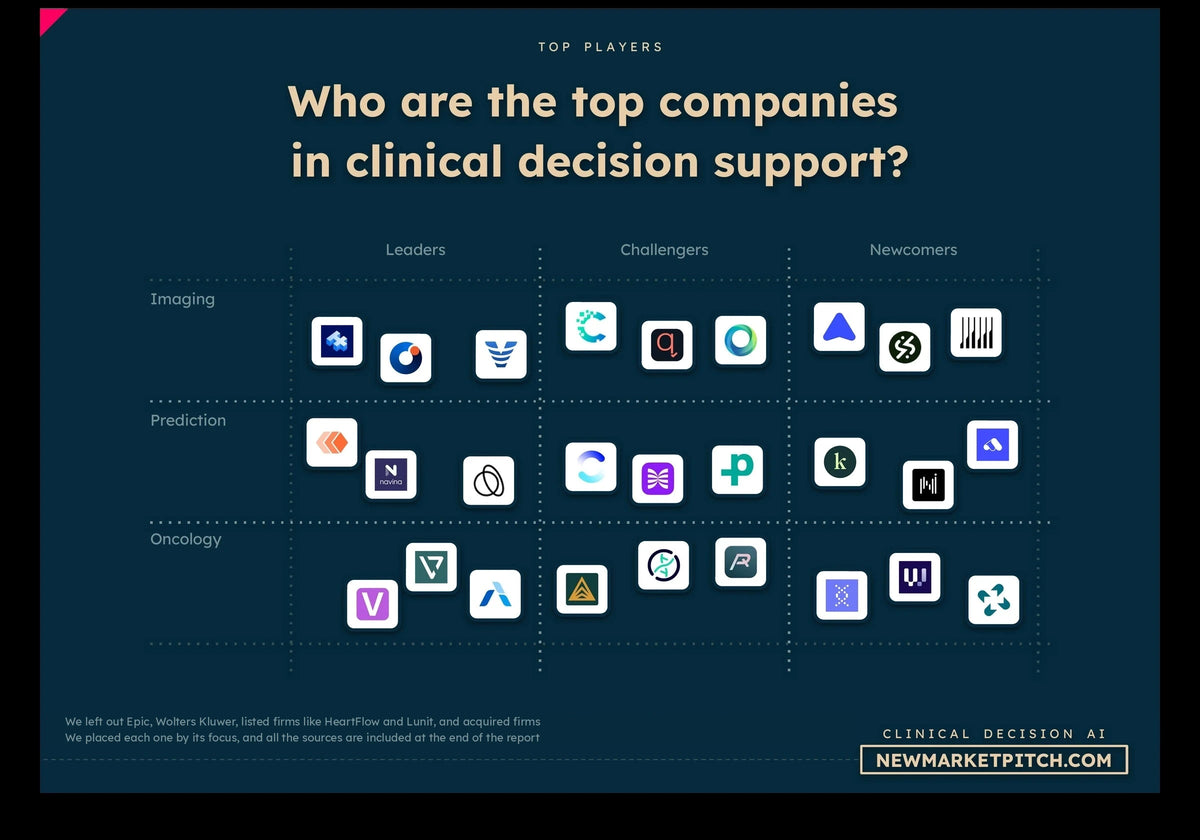
In our research about clinical decision support tools, we turn what is vague and complex into simple, useful visuals. Market maps like this one show you at a glance where every startup stands.
UltraSight raised $24M in Series B2 funding in September 2026.
When was it?
UltraSight announced the financing on September 23, 2026.
Who are they?
UltraSight guides healthcare professionals as they capture cardiac ultrasound images for bedside heart assessments.
Geographical focus?
UltraSight has Israeli roots and is expanding mainly in US health systems.
Why do we include them in the clinical decision support market?
UltraSight helps clinicians acquire diagnostic images for heart-care decisions, fitting cardiac imaging guidance within the broader CDS market.
What is the company stage?
UltraSight is scaling commercialization of its FDA-cleared cardiac imaging software.
How much did they raise?
UltraSight raised $24M in the new financing.
What round is it?
UltraSight completed a Series B2 led by Alive HealthTech Growth Fund, with Deep Insight and other investors participating.
Why did they raise?
UltraSight will expand US sales and develop imaging workflows for intensive care and circulatory support.
Tandem Health raised $100M in Series B funding in September 2026.
When was it?
Tandem Health announced the raise on September 14, 2026.
Who are they?
Tandem Health offers clinicians an AI assistant for visit notes, medical coding and guideline-based clinical questions.
Geographical focus?
Tandem Health works across European healthcare markets, including 14 countries at the time of the announcement.
Why do we include them in the clinical decision support market?
Tandem Health offers point-of-care clinical answers, although documentation and workflow tools also make up its broader product suite.
What is the company stage?
Tandem Health is a growth-stage business used by around 10,000 care organizations.
How much did they raise?
Tandem Health raised $100M in the round.
What round is it?
Tandem Health completed a Series B led by the EQT-managed Scaleup Europe Fund.
Why did they raise?
Tandem Health plans to enter more European markets and develop an AI-native operating system for clinics.

Your time is limited. In our market report about clinical decision support tools, we put numbers on each part of the market, so you can see where it makes sense to focus.
Implicity secured $40M in growth equity in September 2026.
When was it?
Implicity announced the investment on September 9, 2026.
Who are they?
Implicity uses AI to review data from implanted heart devices and flag patients needing cardiology attention.
Geographical focus?
Implicity serves clinics in France, Germany and the United States, with new growth focused on the US.
Why do we include them in the clinical decision support market?
Implicity prioritizes patient-specific cardiac alerts for physicians, placing it in cardiology risk triage and monitoring.
What is the company stage?
Implicity is in commercial growth, supporting more than 250 medical centers and monitoring over 120,000 patients daily.
How much did they raise?
Implicity secured $40M in growth funding.
What round is it?
Implicity announced a growth equity investment led by IRIS alongside Five Arrows.
Why did they raise?
Implicity will hire US sales staff, expand in Europe and improve its cardiac AI algorithms.
Elucid raised $55M in Series D financing in September 2026.
When was it?
Elucid disclosed the financing on September 2, 2026.
Who are they?
Elucid uses AI to analyze cardiovascular CT scans and help physicians assess dangerous arterial plaque.
Geographical focus?
Elucid is based in the United States and is building strategic relationships for wider use.
Why do we include them in the clinical decision support market?
Elucid provides patient-specific plaque analysis for cardiac diagnosis and treatment choices, within cardiovascular imaging diagnostics.
What is the company stage?
Elucid is commercializing clinically validated imaging software while developing further diagnostic capabilities.
How much did they raise?
Elucid raised $55M in its Series D.
What round is it?
Elucid completed an oversubscribed Series D with IAG Capital Partners, Elevage Medical Technologies and a strategic MedTech investor.
Why did they raise?
Elucid will widen commercialization, work with MedTech partners and advance its FFR-CT technology.

In our document detailing everything you need to know about clinical decision support, we always try to gather several sources and make estimates that make sense, so you can work with solid numbers.
CARPL.ai raised $10M in Series A funding in July 2026.
When was it?
CARPL.ai announced its new funding on July 23, 2026.
Who are they?
CARPL.ai lets hospitals and radiology groups test, install and manage different AI imaging applications through one platform.
Geographical focus?
CARPL.ai develops technology in India and serves imaging providers across the Americas, Europe and Asia-Pacific.
Why do we include them in the clinical decision support market?
CARPL.ai brings diagnostic AI into radiology workflows, though its main role is integration rather than building every algorithm.
What is the company stage?
CARPL.ai is a commercial growth company serving international radiology groups and healthcare organizations.
How much did they raise?
CARPL.ai raised $10M.
What round is it?
CARPL.ai completed a Series A led by International Finance Corporation, with Stellaris Venture Partners participating.
Why did they raise?
CARPL.ai will develop its platform, add imaging AI partners and grow across international markets.
Telepatia raised $33M in Series A funding in June 2026.
When was it?
Telepatia's funding was publicly reported by June 17, 2026, with further coverage on June 19.
Who are they?
Telepatia combines medical records, clinical guidelines and AI assistants to help hospital staff review patient care.
Geographical focus?
Telepatia concentrates on Latin America, especially Brazil, Colombia and Mexico.
Why do we include them in the clinical decision support market?
Telepatia provides guideline-based clinical recommendations, although it also sells documentation and hospital automation tools.
What is the company stage?
Telepatia is in early commercial growth, with reported deployments at more than 25 hospital systems.
How much did they raise?
Telepatia raised $33M in the announced financing.
What round is it?
Telepatia closed a Series A led by Andreessen Horowitz, with participation from healthcare and technology executives.
Why did they raise?
Telepatia will deploy its clinical AI platform at more hospitals and expand its AI healthcare assistants.

Our report covering the clinical decision support market gets updated several times a month, so you always get the latest view of where things stand.
Aidoc raised $150M in Series E funding in April 2026.
When was it?
Aidoc announced its funding on April 29, 2026.
Who are they?
Aidoc scans medical images for urgent findings and alerts hospital teams to cases that may need faster action.
Geographical focus?
Aidoc was founded in Israel and serves US hospital systems alongside other international healthcare providers.
Why do we include them in the clinical decision support market?
Aidoc flags patient-specific imaging abnormalities and supports urgent clinical decisions, fitting acute-care diagnostic alerts.
What is the company stage?
Aidoc is a late-stage commercial company with multiple cleared clinical AI applications in hospital use.
How much did they raise?
Aidoc raised $150M in the Series E.
What round is it?
Aidoc completed a Series E led by Goldman Sachs Alternatives, with General Catalyst, SoftBank and NVentures participating.
Why did they raise?
Aidoc will scale its enterprise clinical AI platform and expand its clinical foundation-model capabilities.
Almanac Health raised $10M in seed funding in April 2026.
When was it?
Almanac Health announced the seed round on April 23, 2026.
Who are they?
Almanac Health gives clinicians evidence-grounded answers and specialist knowledge through a clinical AI platform.
Geographical focus?
Almanac Health is focused on US clinicians and health systems.
Why do we include them in the clinical decision support market?
Almanac Health is designed for treatment and diagnostic questions at the point of care, putting it directly in evidence-based CDS.
What is the company stage?
Almanac Health is at seed-stage commercialization, moving its research-validated platform into healthcare systems.
How much did they raise?
Almanac Health raised $10M.
What round is it?
Almanac Health completed a seed round led by F-Prime, alongside General Catalyst and Lightspeed Venture Partners.
Why did they raise?
Almanac Health will expand its medical and AI teams and bring its evidence-based assistant to more clinicians.

In our research about clinical decision support tools, we look at what the winners do differently, so you can learn from the best instead of guessing.
Ambient Clinical Analytics announced $5M in strategic funding in March 2026.
When was it?
Ambient Clinical Analytics' financing was announced on March 31, 2026 and appeared in further coverage in April.
Who are they?
Ambient Clinical Analytics monitors changing hospital patient data and gives teams real-time guidance for urgent care, including sepsis cases.
Geographical focus?
Ambient Clinical Analytics primarily serves hospitals and critical-care teams in the United States.
Why do we include them in the clinical decision support market?
Ambient Clinical Analytics supports clinical decisions around patient deterioration and sepsis response, placing it in critical-care CDS.
What is the company stage?
Ambient Clinical Analytics is in commercial expansion with established clinical software and regulatory-cleared technology.
How much did they raise?
Ambient Clinical Analytics secured $5M in strategic funding.
What round is it?
Ambient Clinical Analytics announced a strategic investment from Mairs & Power Venture Capital and an unnamed major MedTech company.
Why did they raise?
Ambient Clinical Analytics will expand hospital adoption and improve its real-time clinical intelligence platform.
Avo raised $10M in Series A funding in March 2026.
When was it?
Avo announced the round on March 31, 2026.
Who are they?
Avo uses patient records and clinical guidelines to suggest care plans, diagnoses and next actions within electronic records.
Geographical focus?
Avo works primarily with US healthcare organizations and clinicians using electronic health records.
Why do we include them in the clinical decision support market?
Avo connects patient information to specific clinical recommendations, fitting EHR-integrated care decision support.
What is the company stage?
Avo is at an early commercial growth stage, with health-system integrations and clinical knowledge partnerships.
How much did they raise?
Avo raised $10M in its Series A.
What round is it?
Avo completed a Series A led by Noro-Moseley Partners with participation from existing and new investors.
Why did they raise?
Avo will expand its clinical AI features and integrate evidence-based guidance into more patient-care workflows.
Written by the New Market Pitch teamWe track new markets so founders and investors can move faster. About us