
Which MedTech startups are building the next category leaders?
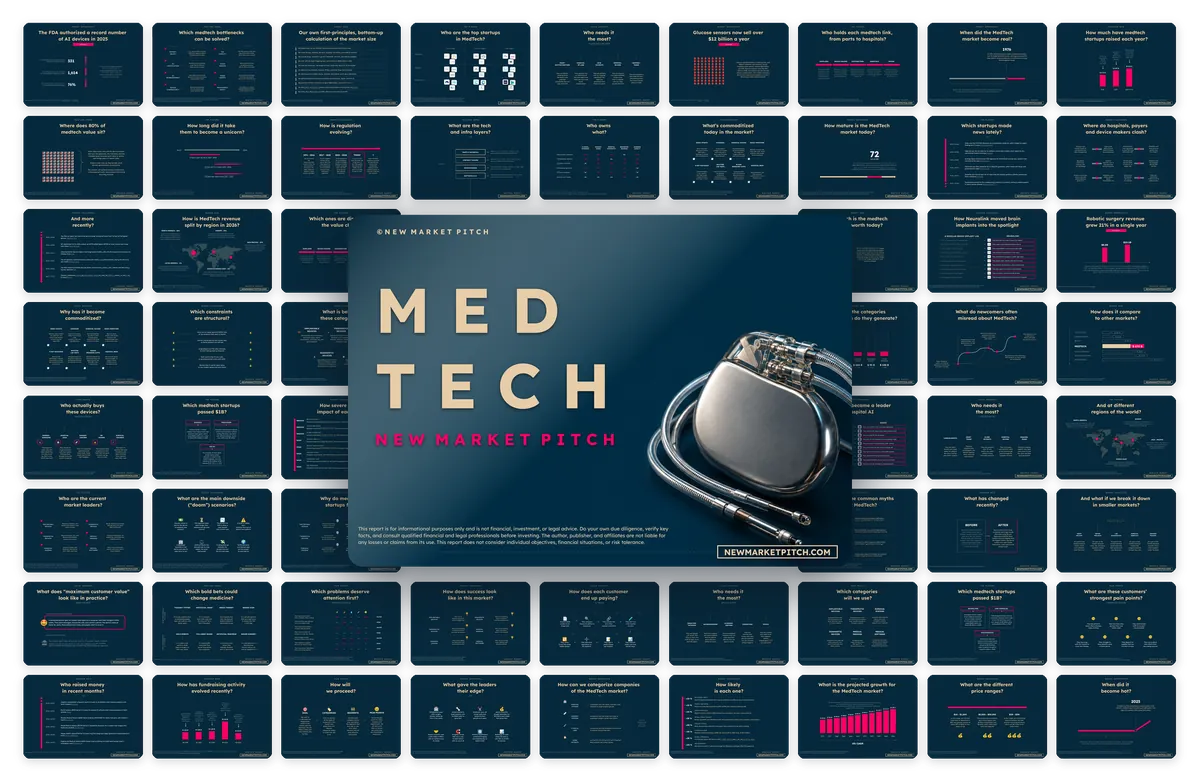
Building a startup or looking for your next investment in MedTech? Our report gives you the full picture.
Summary
The MedTech startups building the next category leaders are Viz.ai, Aidoc, CMR Surgical, Cleerly and Qure.ai, with Mendaera standing out as the strongest earlier-stage bet.
The dividing line is no longer whether the technology works in a study. The strongest companies have turned regulatory access into repeated use, reimbursement, workflow integration and a reason for hospitals to keep the product in place.
Clinical AI is becoming an infrastructure market. Viz.ai and Aidoc are both approaching 2,000 hospitals, so the competition is moving away from individual algorithms and toward who owns the broader operating layer around detection, alerts, care coordination and enterprise deployment.
Viz.ai currently has the cleanest proof that scale can become a real business. Its hospital footprint, reach across major U.S. health systems and disclosed healthcare profitability put it slightly ahead of Aidoc, even though Aidoc may be pursuing the broader technical platform.
Qure.ai is easy to underrate if U.S. hospital counts are the only benchmark. Its thousands of deployments across more than 90 countries show a different kind of defensibility: the ability to make the same core technology work across healthcare systems with very different economics and infrastructure.
Cleerly shows how quickly a MedTech story can change once payment catches up with the product. Broad payer coverage, a permanent CPT code and new FDA clearances make coronary plaque analysis much more commercially credible than it looked when reimbursement was still uncertain.
CMR Surgical is the clearest hardware-heavy challenger in the group. More than 45,000 treated patients give Versius a clinical history that newer robotic platforms cannot shortcut, and the U.S. launch is now the test that could materially change the company's scale.
The more interesting early-stage opportunities are not necessarily trying to replace a giant incumbent head-on. Mendaera's handheld robotics approach could create a new procedural layer around needle placement and image-guided interventions, which gives it a wider path than a single specialist application.
Element Science and Moon Surgical have crossed important regulatory or early-use milestones, but their next proof point is much more basic: sustained utilization. For both, the question is now whether cleared products turn into repeatable clinical volume rather than isolated early deployments.
Neuralink and Synchron belong in a different bucket. They may help create one of the largest future MedTech categories, but implanted BCI is still an investigational field, so calling either company a commercial category leader today would be premature.
The broader pattern is that the best new MedTech businesses are rarely "just software" or "just hardware." The strongest companies combine intelligence with regulation, workflow, reimbursement, proprietary clinical data or physical devices in ways that make them harder to remove once they are embedded in care.

Written by the New Market Pitch teamWe track new markets so founders and investors can move faster. About us

In our report covering the medtech market, we turn what is vague and complex into simple, useful visuals. Market maps like this one show you at a glance where every startup stands.
What actually makes a MedTech startup a category leader today?
The MedTech startups closest to becoming category leaders today are the ones that have already turned good technology into something hospitals can approve, pay for and use repeatedly.
That sounds simple, but it cuts out a surprisingly large part of the sector. A startup can publish excellent clinical data and still struggle because hospitals refuse to change workflow. FDA clearance can open the door without creating demand. A clever device can also become a weak business when training, servicing or manufacturing costs eat away at the economics.
So we need a tougher definition of leadership. We want to see clinical evidence, regulatory access, a workable payment model, repeated deployment and enough product breadth to keep growing after the first indication.
That standard immediately separates several companies from the wider MedTech field. Viz.ai and Aidoc already run inside roughly 2,000 hospitals each. CMR Surgical has passed 45,000 treated patients with Versius. Cleerly has gained broad commercial coverage and a permanent CPT code for coronary plaque analysis. Qure.ai has deployed across thousands of sites in more than 90 countries. Mendaera remains much earlier, but it has now added prospective peer-reviewed human data to its FDA clearance.
The timing also helps explain why these companies look more credible now. According to Silicon Valley Bank's latest healthcare investment report, total healthcare investment remains well below the 2021 peak, while AI absorbs an unusually large share of current funding. Investors are becoming more selective at the same time that the FDA has authorized more than 1,600 AI-enabled medical devices. Simply having an AI product or a clearance carries far less weight than it did a few years ago.
Today, repeated clinical use is the stronger dividing line.
| What we look for | What would convince us | Why it matters |
|---|---|---|
| Clinical evidence | Real patients and useful outcomes | Shows the product works beyond a demo |
| Regulatory access | FDA or equivalent authorization | Allows routine commercial use |
| Payment | Reimbursement or obvious hospital ROI | Gives adoption an economic reason |
| Distribution | Repeated deployment across providers | Shows the product can escape pilot mode |
| Usage | Rising scans, procedures or treated patients | Confirms that installed products are actually used |
| Expansion | More indications or workflows | Creates room for a much larger business |
| Defensibility | Data, workflow integration, hardware or evidence | Makes replacement harder |
| Economics | Recurring revenue or strong utilization | Turns product leadership into business leadership |
Are radiology AI startups finally becoming real businesses?
Yes. Radiology and clinical imaging AI have moved further into real hospital infrastructure than almost any other AI-heavy MedTech category.
Viz.ai and Aidoc are the clearest examples. Both have reached close to 2,000 hospitals, which puts them far beyond the old model of selling one algorithm to a handful of radiology departments.
Viz started around stroke detection and now says it supports more than 50 AI-enabled care pathways across neurology, cardiology, oncology, pulmonology and other specialties. Its software can detect suspected disease, alert specialists and coordinate what happens next.
Aidoc has followed a similarly broad path. The company currently says its technology has analyzed more than 150 million patient cases and runs in nearly 2,000 hospitals, supporting around 60 million patients each year. Aidoc is also increasingly selling the infrastructure around the algorithms through its aiOS platform.
The FDA now lists more than 1,600 authorized AI-enabled medical devices, so a single detection algorithm has become much easier to compete with. A hospital-wide system connected to imaging, alerts, care teams, security controls and clinical workflow is harder to displace.
Recent reimbursement developments reinforce the change. Aidoc's CARE Body CT Multi-Triage system has become eligible for Medicare's New Technology Add-on Payment under the upcoming inpatient payment rules. Viz had already shown years earlier that clinical AI could qualify for this type of reimbursement support.
Radiology AI has moved into a more serious phase. The leaders are competing over who becomes part of the hospital's operating infrastructure rather than who has the cleverest individual model.

Our research about medical devices gets updated several times a month, so you always get the latest view of where things stand.
Is Viz.ai already a MedTech category leader?
Yes. Viz.ai already looks like a category leader in clinical AI rather than a startup still trying to prove that its market exists.
Viz now reports deployment across about 2,000 hospitals serving an estimated 230 million patients. It also says the majority of the 50 largest U.S. health systems use its technology, while its healthcare business reached profitability during 2025.
Those three facts together carry much more weight than another financing round would. Viz has scale, large-enterprise adoption and evidence that the core healthcare operation can support itself.
Its expansion pattern is equally revealing. Viz started with stroke, where speed matters and specialist coordination can directly change patient outcomes. It has since expanded into more than 50 care pathways across several specialties. That gives the company more ways to make money from an integration that a health system has already completed.
The hospital footprint also creates real switching friction. Replacing Viz inside a large health system can involve imaging systems, electronic health records, physician alerts, mobile workflows, cybersecurity reviews and clinician habits. A competitor needs to replace a working process, not merely outperform one algorithm.
Viz has built another business around pharmaceutical companies looking for patients who may qualify for particular therapies. The company said that life-sciences activity doubled over roughly 18 months. That gives Viz a second way to monetize the same clinical network.
There is still a competitive fight ahead, especially against Aidoc. But the question around Viz has changed. We are now asking how large its category can become rather than whether Viz can create a serious MedTech business.
If you want more recent data on this point, please see our latest MedTech market report.
Can Aidoc actually beat Viz.ai in clinical AI?
Yes. Aidoc has a credible chance of becoming the broader clinical-AI platform, even though Viz.ai currently has the cleaner proof of mature business economics.
Aidoc's recent numbers keep getting harder to dismiss. The company now reports more than 150 million analyzed patient cases across nearly 2,000 hospitals. That case count was around 120 million earlier in the year, so the installed platform is continuing to accumulate real-world volume rather than simply adding logos.
The bigger bet is CARE, Aidoc's clinical foundation model. The company wants one underlying architecture to support many conditions and imaging workflows instead of building each application almost independently.
Aidoc has already received FDA clearance for a multi-condition triage system built on CARE. It also received Breakthrough Device Designation for First Read, a system designed to analyze chest X-rays and draft preliminary radiology report text. Another breakthrough program covers broad multi-condition CT interpretation.
If these products work as intended, Aidoc gets closer to helping with a larger share of the radiologist's workflow. That would be a much bigger business than prioritizing individual scans.
Investors are financing Aidoc as though that expansion has a real chance. Goldman Sachs Alternatives led a $150 million Series E, bringing Aidoc's total funding above $500 million. More recently, 12 U.S. health systems joined an Aidoc-backed diagnostic AI consortium designed around enterprise-wide deployment rather than isolated algorithms.
Aidoc still has to prove that this technical breadth produces strong long-term economics. Viz has already disclosed profitability in its healthcare business; Aidoc has not given us equivalent evidence.
For now, we put Viz slightly ahead as a proven business and Aidoc slightly ahead in platform ambition. The gap is small enough that either company could emerge as the defining private clinical-AI company.

In our market report about medical devices, we look at what the winners do differently, so you can learn from the best instead of guessing.
Is Qure.ai being underestimated because most of its scale came outside the U.S.?
Yes. Qure.ai belongs in the top group of clinical-AI startups, and its international footprint is one of its biggest strengths.
When Qure.ai raised its $65 million Series D, the company said its technology had already reached more than 3,000 sites across over 90 countries. It built much of that footprint around chest X-rays, tuberculosis screening, lung disease and neuroimaging, where imaging volumes can be very high and radiologist shortages are often severe.
The U.S. regulatory portfolio has caught up quickly. Qure.ai added six more FDA-cleared indications to its qXR chest X-ray system this year, bringing its stated total to 26 FDA-cleared indications.
Chest X-ray is a particularly useful market for that breadth. Roughly 70 million chest radiographs are taken each year in U.S. emergency departments, outpatient settings and routine care, according to figures cited around Qure's latest FDA clearance. One product that can reliably detect several common findings can therefore address an enormous flow of routine imaging.
The weakness is easier to see. A deployment in a national tuberculosis screening program can generate huge clinical volume while producing less revenue per site than a broad enterprise contract with a major U.S. hospital system.
That makes Qure harder to compare directly with Viz or Aidoc using hospital counts alone.
Still, the company has already solved a problem that many American MedTech startups never solve: deploying the same underlying technology across dozens of healthcare systems, countries and economic environments. If Qure can pair that international reach with deeper U.S. hospital penetration, it could become one of the few truly global medical-AI platforms.
If you want more recent data on this point, please see our latest MedTech market report.
Is Cleerly becoming the next big cardiovascular diagnostics company?
Cleerly is now one of the strongest MedTech category-leader candidates because reimbursement is finally catching up with its technology.
Cleerly uses coronary CT angiography to quantify and characterize atherosclerotic plaque. The goal is to measure the disease directly rather than waiting until narrowing becomes severe enough to dominate the diagnosis.
The clinical idea has looked interesting for years. Payment was the harder commercial question.
That problem has eased substantially. Aetna joined UnitedHealthcare, Cigna, Humana and several other payers in covering Cleerly's plaque analysis, taking reported commercial coverage above 86 million lives. A permanent Category I CPT code for coronary plaque quantification also became effective this year.
Under the current Medicare Physician Fee Schedule, code 75577 carries an office payment of roughly $1,000 for the complete service, with the exact amount depending on the setting and locality. That gives physicians and imaging providers a much clearer economic route for using advanced plaque analysis.
The regulatory story has kept moving as well. The FDA cleared updated versions of Cleerly LABS and Cleerly Plaque this summer, and the Plaque clearance includes an authorized Predetermined Change Control Plan. More recent clinical data presented around the European Society of Cardiology meeting also linked AI-quantified plaque burden with long-term cardiovascular risk.
Heartflow provides a useful reality check on the opportunity. Heartflow, which has already gone public, generated $176 million in revenue last year after $126 million the year before and $87 million a year earlier. Its latest quarterly revenue reached $64.1 million, up 48% year over year, with an 83% gross margin.
That tells us cardiovascular imaging software can become a substantial, high-margin business once reimbursement and physician usage line up.
Cleerly has much less commercial proof than Heartflow today. But the company has now cleared several of the barriers that used to make its upside highly theoretical. The next thing we need to see is a sharp rise in paid clinical volume.

In our document detailing everything you need to know about medtech, you will always find fresh funding data, taken straight from our own verified funding database.
Can CMR Surgical really challenge Intuitive Surgical?
CMR Surgical is currently the most credible independent challenger to Intuitive Surgical in soft-tissue robotic surgery, although Intuitive remains vastly larger.
Versius has now been used to treat more than 45,000 patients globally. CMR reported around 30,000 patients roughly a year earlier, so the installed system added about 15,000 treated patients over that period.
That is meaningful because surgical robotics becomes more convincing as procedure history accumulates. Each additional operation gives hospitals more evidence about reliability, workflow, surgeon training and the types of cases the system can handle.
CMR has also crossed the U.S. regulatory barrier. Versius Plus received FDA clearance for cholecystectomy, and the company has started its U.S. commercial launch. It has also submitted an application to expand the system into benign gynecological procedures.
The scale gap with Intuitive remains enormous. Intuitive's da Vinci systems perform millions of procedures each year, and the company has spent decades building surgeon familiarity, service infrastructure and instrument revenue.
CMR can still build a very large business without catching Intuitive overall. Versius uses a compact modular setup designed to fit more easily into existing operating rooms and move between them. That proposition could appeal to hospitals that want robotic surgery without reorganizing an entire theatre around one large platform.
The U.S. launch is now the critical test. If CMR turns its international clinical history into sustained American installation and procedure growth, it should become the first serious new global soft-tissue robotics platform in years.
If you want more recent data on this point, please see our latest MedTech market report.
Is Moon Surgical building something hospitals actually need?
Moon Surgical has a credible idea: give ordinary laparoscopic surgery some of the benefits of robotics without requiring hospitals to buy a full-scale surgical robot.
Its Maestro platform provides robotic assistance around laparoscopic procedures while keeping the surgeon close to the patient. The system received FDA clearance and CE marking earlier in its development, then moved into early commercial use.
Moon's recent software work makes the product more interesting. Maestro can now support AI applications around the operation itself, including automated generation of surgical reports from laparoscopic video.
The first 20 clinical cases using this automated reporting workflow were completed this summer at Institut Arnaud Tzanck in France. Draft operative reports were generated directly from the live procedure video within minutes of surgery.
Twenty cases obviously tell us very little about long-term commercial adoption. The interesting part is the direction. Moon is trying to turn Maestro into a platform that assists during surgery and captures useful information from the procedure at the same time.
That could give hospitals several benefits from one relatively light robotic system: steadier instrument control, procedural data, documentation and eventually more automation.
CMR is far ahead on clinical scale, with more than 45,000 treated patients. Moon therefore belongs in the challenger group today. The company becomes much more interesting if procedure volumes start increasing quickly across several hospitals rather than a small number of early sites.

Learning from others' mistakes is the cheapest lesson there is. In our report covering the medtech market, we look at what broke startups before you, so you don't repeat it.
Why is Mendaera one of the MedTech startups worth watching most closely?
Mendaera is one of the most interesting earlier-stage MedTech companies because handheld robotics could open a much wider set of procedures than conventional surgical robots usually address.
Its Focalist system combines ultrasound, guidance software and handheld robotic positioning to help clinicians place needles and other instruments during minimally invasive procedures.
The newest evidence is stronger than the early demonstrations. A peer-reviewed prospective study published this summer covered 61 ultrasound-guided procedures across urology, nephrology and anesthesiology. Physicians achieved technical success in 60 of the 61 procedures, with no device-related adverse events reported.
The training requirement is equally interesting. The 11 doctors in the study were first-time Focalist users and received a single 45-minute training session.
That is a tiny study compared with the evidence base behind an established medical device, so we should avoid reading too much into a 98% success rate. What it does test directly is whether clinicians from several specialties can pick up the system quickly enough for handheld robotics to fit into normal procedural medicine.
Focalist received FDA clearance last year and is now in the early stages of U.S. commercialization. Mendaera has already raised a $73 million Series B, acquired Avail Medsystems' telepresence technology and brought in investors with deep robotic-surgery experience, including Fred Moll.
The addressable procedure pool could become very large. Ultrasound-guided needle placement appears in vascular access, biopsies, pain procedures, kidney access and many other interventions. These procedures happen far more often than the highly specialized operations usually associated with large surgical robots.
Mendaera still has a lot to prove commercially. Among the younger companies in this article, though, it has one of the clearest chances to create a new MedTech category rather than take a small share of an existing one.
Can Element Science turn the Jewel patch into a major medical-device business?
Element Science has a real shot because Jewel improves a product category that already has patients, physicians and reimbursement rather than asking healthcare providers to invent a completely new workflow.
Jewel is a wearable cardioverter defibrillator for adults at risk of sudden cardiac arrest who either cannot receive an implanted defibrillator or decline one. The major design difference is its adhesive patch format.
The FDA granted Jewel premarket approval last year, and the agency's database remains current with several subsequent PMA supplements. PMA is the FDA's most demanding major device pathway and is used for high-risk devices where direct safety and effectiveness evidence is required.
That substantially reduces Element's technical and regulatory risk.
The commercial challenge now becomes much easier to understand. Existing wearable defibrillators have already established a market. Element needs to show that patients will wear Jewel consistently, doctors will prescribe it and payers will support enough use for the company to build a large recurring business.
A patch could improve the experience for patients who otherwise have to wear a bulkier external system for weeks or months. Better adherence would be clinically and commercially valuable because a wearable defibrillator provides protection only while the patient is actually wearing it.
Element has begun a limited U.S. commercial launch, so we still lack the utilization and revenue numbers needed to rank it with CMR or Viz.
For now, we see Element as a strong second-tier category-leader candidate: the hardest regulatory milestone is behind it, while the most important commercial evidence is still ahead.

In our research about medical devices, we always try to gather several sources and make estimates that make sense, so you can work with solid numbers.
What does Roche's $1 billion PathAI deal tell us about successful MedTech startups?
Roche's agreement to buy PathAI shows how valuable a MedTech software company can become when it owns an important part of clinical workflow rather than one isolated AI feature.
Roche agreed to pay $750 million upfront for PathAI, with another $300 million tied to milestones. The companies expect PathAI to become part of Roche Diagnostics once the transaction clears its remaining closing conditions.
PathAI built its position around digital pathology. Its AISight platform manages pathology images and workflow, while its AI tools also support biomarker research, clinical trials and companion diagnostics for pharmaceutical companies.
That combination explains much of the strategic value.
Roche already has one of the world's largest diagnostics businesses. It already sells pathology and oncology products. Yet it still chose an acquisition worth as much as $1.05 billion because PathAI could add AI analysis, workflow software and deep biopharma relationships faster than Roche could apparently reproduce them internally.
The deal also gives us a useful clue about where defensibility is forming in medical AI. Hundreds of algorithms can analyze an image. Far fewer companies sit inside the daily workflow of pathologists while also working with drug developers and diagnostic manufacturers.
PathAI is therefore becoming less useful as an independent startup candidate for our ranking, but more useful as evidence that the platform model can produce large strategic outcomes in MedTech.
If you want more recent data on this point, please see our latest MedTech market report.
Are Neuralink and Synchron already MedTech category leaders?
No. Neuralink and Synchron are leading brain-computer interface companies today, but implanted BCIs are still too early to have a true commercial category leader.
Neuralink has accelerated its human work substantially. The company announced 21 participants in its Telepathy program early this year, compared with only a handful previously. Its trials have also expanded beyond the original U.S. study.
Synchron has taken a different route. Its Stentrode is implanted through a blood vessel, avoiding open-skull surgery. The company previously completed the six-person U.S. COMMAND feasibility study and raised a $200 million Series D. It now lists active clinical studies in the United States and Australia.
The important word here is clinical.
Synchron explicitly describes its system as investigational and says it has no commercial approval in any geography. Neuralink is also still running investigational human studies rather than selling a routinely approved medical device.
That puts both companies several steps behind Viz, CMR or Cleerly when we judge current category leadership. We still need larger trials, longer safety histories, regulatory approval, reimbursement and evidence that implantation can scale beyond specialist research centers.
The upside could eventually be much larger than several categories covered here. A reliable BCI that restores computer control or communication to people with severe paralysis would create a major new medical-device market.
Today, though, Neuralink and Synchron are helping build the category itself. Commercial leadership comes later.

If you build or invest in the medtech market, you need to know which business models pay off now and which ones are fading. That's why our report covering it has a whole section on it.
Are the best new MedTech businesses mostly software now?
No. The strongest MedTech startups increasingly combine software with a clinical workflow, a regulated device or a piece of healthcare infrastructure that makes the software harder to replace.
Pure software can produce fantastic economics. Heartflow's latest quarterly gross margin reached 83%, which would look strong even next to many conventional software companies.
Competition is also becoming much denser. The FDA currently lists more than 1,600 authorized AI-enabled medical devices, with radiology representing a large share of them. A company whose entire advantage is one imaging model therefore has to assume that similar models will keep arriving.
The strongest private companies are building wider systems around the intelligence.
Viz connects disease detection with care coordination. Aidoc provides the infrastructure for running multiple clinical AI applications. Cleerly ties AI analysis to a reimbursable cardiovascular imaging workflow. Mendaera puts guidance software inside a handheld robotic device. CMR owns the surgical hardware, software and instruments around each procedure.
These models create several layers of protection at once. Regulation slows replacement. Clinical evidence builds trust. Workflow integration raises switching costs. Hardware can create proprietary data. Reimbursement encourages repeated use.
The winning MedTech model today increasingly looks like software embedded deeply enough in healthcare that customers treat it as part of delivering care.
So which MedTech startups are actually building the next category leaders?
Viz.ai, Aidoc, CMR Surgical, Cleerly and Qure.ai currently have the strongest evidence of becoming major MedTech category leaders, while Mendaera is the earlier-stage company we would watch most closely.
Viz gets the top position today because the evidence is unusually complete. It reaches roughly 2,000 hospitals and 230 million patients, sits inside most of the largest U.S. health systems and has already reported profitability in its healthcare business. Its move from stroke into more than 50 care pathways also gives it room to keep expanding through infrastructure hospitals already use.
Aidoc is almost level with Viz. Nearly 2,000 hospitals, more than 150 million analyzed cases, growing reimbursement support and an increasingly broad foundation-model strategy make Aidoc the strongest candidate to turn clinical AI into a hospital-wide platform. We rank it just behind Viz because the public evidence around its business economics remains thinner.
CMR Surgical is the strongest hardware-heavy candidate. More than 45,000 treated patients provide a depth of clinical experience that newer robotic companies cannot quickly recreate. FDA clearance and the U.S. launch now give CMR access to the market that could change its scale completely.
Cleerly has probably seen the biggest improvement in its commercial setup. Broad payer coverage, a permanent CPT code, roughly $1,000 of Medicare office reimbursement under applicable circumstances and new FDA clearances make coronary plaque analysis much easier to integrate into real clinical practice. Heartflow's rapid growth provides a useful proof that reimbursed cardiovascular imaging software can support a large business.
Qure.ai deserves the same top-tier status because its deployment footprint stretches across thousands of sites and more than 90 countries. Its latest FDA expansion strengthens the one part of the story that had lagged behind its global distribution.
Mendaera sits one level earlier. The combination of FDA clearance, early commercialization and a new peer-reviewed 61-procedure study gives handheld interventional robotics more substance than it had a year ago. If Focalist starts spreading across multiple specialties, Mendaera could create one of the more interesting new device categories in MedTech.
Element Science and Moon Surgical have credible paths as well, although both still need much more usage data. Neuralink and Synchron have enormous long-term upside, but implanted BCIs remain an investigational market today.
The ranking becomes clearer once we stop rewarding companies simply for impressive technology. The companies pulling ahead currently have evidence that physicians can use the product, regulators will allow it, hospitals can integrate it and someone can pay for it.
| Company | Category | What makes it credible today | Our view now | Main thing still missing |
|---|---|---|---|---|
| Viz.ai | Clinical AI and care coordination | ~2,000 hospitals, 230M patients, healthcare business profitable | Current category leader | Keep its lead as enterprise AI gets more crowded |
| Aidoc | Enterprise clinical AI | Nearly 2,000 hospitals, 150M+ analyzed cases, broad CARE platform | Very close to Viz | Stronger proof of business economics |
| CMR Surgical | Surgical robotics | 45,000+ treated patients, FDA-cleared U.S. platform | Strong category-leader candidate | Fast U.S. adoption |
| Cleerly | Cardiovascular imaging AI | 86M+ covered lives, permanent CPT code, new FDA clearances | Strong category-leader candidate | Large jump in paid clinical volume |
| Qure.ai | Medical imaging AI | 3,000+ sites, 90+ countries, 26 FDA-cleared indications | Strong global candidate | Deeper U.S. monetization |
| Mendaera | Handheld interventional robotics | FDA clearance plus 60/61 successful procedures in prospective study | Best earlier-stage category bet | Repeat commercial deployment |
| Element Science | Wearable defibrillation | FDA PMA and early U.S. launch | Promising | Adoption, adherence and revenue |
| Moon Surgical | Robotic-assisted laparoscopy | Cleared platform plus early clinical AI applications | Promising but early | Much higher procedure volume |
| Synchron | Endovascular BCI | Human trials and $200M Series D | Frontier category builder | Approval and commercial scale |
| Neuralink | Implantable BCI | 21 announced participants and large capital base | Frontier category builder | Larger trials, approval and scalable implantation |
If you want more recent data on this point, please see our latest MedTech market report.
Our methodology
This analysis asks which MedTech startups are building the next category leaders. We did not rank companies by funding, reputation or FDA clearances alone. We looked for the combination of clinical evidence, regulatory access, reimbursement or an obvious payment model, real-world deployment, utilization, product expansion, workflow integration and business economics.
We gave the most weight to evidence of what is already happening in healthcare settings. Hospital deployments, procedures performed, patients or cases processed, payer coverage, reimbursement decisions and repeated clinical use generally carried more weight than technical announcements or financing rounds on their own.
We also adjusted the evidence to the category. A surgical-robotics company, an imaging-AI platform and a cardiovascular diagnostics company should not be judged by the same operating metric. The relevant question was whether each company had enough proof that its product is moving from validation into routine use, and whether that use can support a defensible business.
Investigational companies were treated differently from commercially approved businesses. Neuralink and Synchron can rank very highly on long-term potential while still sitting below companies already deployed across hospitals, because category leadership today requires more than promising clinical results.
We prioritized regulators, reimbursement authorities, peer-reviewed clinical publications, company disclosures and public-company filings. Key sources include the FDA's AI-enabled medical device overview, the FDA's searchable AI-device list, Silicon Valley Bank's healthcare investment report, Viz.ai's 2025 scale and profitability update, Aidoc's Series E and CARE update, Aidoc's Diagnostic AI Consortium announcement, Qure.ai's Series D and deployment update, Qure.ai's latest FDA expansion, and Cleerly's payer-coverage update.
For commercial benchmarks and hardware-heavy categories, we also used Heartflow's full-year 2025 results, Heartflow's Q2 2026 filing, CMR Surgical's 45,000-patient update, CMR Surgical's U.S. FDA clearance, Mendaera's prospective Focalist study, Element Science's Jewel product update, and Roche's PathAI acquisition announcement.
For brain-computer interfaces, we used Neuralink's Telepathy program update and Synchron's company and regulatory-status materials. The final ranking is a judgment across all of these dimensions, not a mechanical score: the stronger the evidence of routine use, payment, scale and defensibility, the higher the company ranks today.

Theory only gets you so far. In our document detailing everything you need to know about medtech, we dig up the real signals from the field and show you the ones worth watching.
Written by the New Market Pitch teamWe track new markets so founders and investors can move faster. About us