Can neoclouds make money while competing with hyperscalers?
Building a startup or looking for your next investment in neocloud? Our report gives you the full picture.
Summary
Yes. Neoclouds can make money while competing with hyperscalers, but the strongest businesses are not trying to become smaller versions of AWS. They are specializing in AI infrastructure where speed, cluster quality, scarce capacity and long-term contracts can matter more than having the broadest cloud catalog.
The core economic tension is already visible. CoreWeave and Nebius can produce very high adjusted EBITDA margins from heavily utilized AI infrastructure, yet depreciation, interest and constant reinvestment can absorb much of that apparent profitability.
Utilization is the fulcrum of the model. A GPU cluster that stays full can generate excellent operating leverage; the same hardware becomes ugly economics very quickly when demand softens because most of the cost was committed before the workload arrived.
That makes long-term contracts more important than headline GPU prices. The strongest neoclouds are increasingly securing large customers before or alongside infrastructure construction, turning future demand into something that can support financing and reduce idle-capacity risk.
Customer concentration is therefore both a weakness and a financing tool. A hyperscaler or frontier-AI customer representing a huge share of revenue creates renewal risk later, but a multi-year commitment from that same customer can make a multi-billion-dollar build-out much safer today.
The fact that Microsoft buys capacity from companies that also compete with Azure is not a contradiction. It shows how valuable time-to-capacity has become: when internal construction cannot keep up with AI demand, renting specialist infrastructure can be economically rational even for a hyperscaler.
Low GPU prices alone are not a durable moat. AWS, Microsoft and Google can discount aggressively, bundle compute with broader enterprise relationships and increasingly use their own accelerators, so neoclouds need advantages in deployment speed, networking, orchestration, power access and workload performance.
The leading companies are already moving away from pure GPU rental. CoreWeave is adding software around training, inference and agents, Nebius is pushing deeper into production inference, and Crusoe is integrating power, data centers, cloud infrastructure and managed AI services.
Debt is not automatically fatal, but it changes the failure mode. Software companies can slow hiring when growth disappoints; a neocloud may already have committed billions to GPUs, power and data-center capacity, so contract quality and asset payback matter as much as revenue growth.
The real test comes when AI capacity is easier to find. Providers that mainly benefited from scarcity will face falling prices and stronger hyperscaler competition, while those with contracted demand, efficient financing, secured power, strong cluster operations and useful software have a much better chance of remaining profitable.

Written by the New Market Pitch teamWe track new markets so founders and investors can move faster. About us

A good product starts with a real problem. In our report covering the neocloud market, we show you the ones customers still live with.
Are neoclouds really competing with AWS, Azure and Google Cloud?
Neoclouds are competing with AWS, Azure and Google Cloud for AI workloads today, but they are fighting over a specific part of cloud computing rather than trying to replace the hyperscalers outright.
Synergy Research Group's latest cloud-market data makes the gap clear. Global spending on cloud infrastructure services reached about $143 billion in the latest reported quarter, up $43 billion from a year earlier. AWS still controlled roughly 28% of the market, Microsoft 20% and Google 15%. Together, the three hyperscalers accounted for almost two-thirds of worldwide spending.
Neoclouds are tiny beside them, yet they are growing fast enough to show up in the same market data. Synergy now counts nine neocloud companies among the world's 40 largest cloud providers and lists CoreWeave, Crusoe and Nebius among the fastest-growing second-tier providers.
The overlap is also unusual because hyperscalers can be both competitors and customers. Microsoft has bought large amounts of capacity from CoreWeave and Nebius while continuing to expand Azure aggressively. Crusoe is building infrastructure for hyperscale customers while running its own AI cloud.
So competing with hyperscalers does not require neoclouds to take over the general-purpose cloud market. A specialist can build a very large business by capturing a relatively small share of the hundreds of billions of dollars now being spent on AI-heavy cloud infrastructure.
| Provider | Approx. global cloud position | Recent scale | Main advantage |
|---|---|---|---|
| AWS | No. 1 | Tens of billions of dollars per quarter | Scale and broad cloud ecosystem |
| Microsoft Azure | No. 2 | Tens of billions of dollars per quarter | Enterprise distribution and software stack |
| Google Cloud | No. 3 | Tens of billions of dollars per quarter | AI stack, TPUs and data products |
| CoreWeave | Leading neocloud | $2.58B quarterly revenue | Large AI clusters and fast GPU deployment |
| Nebius | Fast-growing neocloud | $575M quarterly AI-cloud revenue | Full-stack AI infrastructure |
| Crusoe | Vertically integrated AI infrastructure | Private | Power, data centers and cloud |
| Lambda | GPU-focused AI cloud | Private | Developer access and AI specialization |
| Neocloud group | Nine providers in global top 40 | Still small collectively | Focused AI infrastructure |
Why did neoclouds get so big so quickly?
Neoclouds grew so quickly because AI demand arrived faster than the hyperscalers could build enough suitable infrastructure.
The shortage goes well beyond Nvidia chips. Large AI clusters need power, transformers, land, cooling, networking, storage and thousands of accelerators working together. Every layer has its own lead time, and the slowest one can delay an entire project.
Microsoft gives us a good idea of how tight the market still is. In its latest earnings call, the company said it had added another gigawatt of capacity during the quarter and was on track to roughly double total capacity in two years. It also spent about $41 billion on capital expenditure in a single quarter, with roughly two-thirds going to shorter-lived assets such as CPUs and GPUs.
A company spending at that scale would normally be expected to swamp much smaller infrastructure providers. Yet Microsoft had already said that cloud capacity would remain constrained through 2026.
That shortage opened a window for specialists willing to focus almost entirely on accelerated computing. CoreWeave grew annual revenue from $229 million in 2023 to $1.9 billion in 2024 and $5.1 billion in 2025. Nebius has followed an even steeper early trajectory.
The recent cloud-market numbers suggest this window has not closed yet. Synergy says worldwide cloud infrastructure spending is now growing at its fastest rate in eight years, with GenAI driving much of the acceleration. Neocloud growth therefore comes from a genuine expansion in demand rather than a simple redistribution of old cloud workloads.

If you build or invest in the neocloud market, you need to know which business models pay off now and which ones are fading. That's why our report covering it has a whole section on it.
Can neoclouds actually make money today?
Leading neoclouds can already produce strong operating profits from AI infrastructure, although the full economics remain much tougher once depreciation and financing costs enter the picture.
CoreWeave's latest results capture the contradiction. The company generated $2.58 billion of quarterly revenue and $1.51 billion of adjusted EBITDA, giving it a 59% adjusted EBITDA margin. Yet CoreWeave still lost $626 million on a GAAP basis during the same quarter.
Nebius offers another useful case. Its AI-cloud segment generated $574.9 million of quarterly revenue, up from $93.7 million a year earlier, and produced $285.7 million of adjusted EBITDA. The segment's adjusted EBITDA margin was therefore close to 50%.
That settles one part of the debate. AI infrastructure can generate substantial cash earnings while the equipment is heavily used.
It does not settle whether shareholders eventually earn attractive returns. CoreWeave's depreciation, interest expense and constant need for new equipment consume enormous amounts of capital. Nebius is also raising billions to fund its expansion.
For now, the best neoclouds have proved they can make money at the operating level. They are still proving that those earnings can comfortably cover the full cost of building and financing the infrastructure underneath them.
| Metric | CoreWeave | Nebius AI Cloud |
|---|---|---|
| Latest quarterly revenue | $2.58B | $574.9M |
| YoY growth | ~113% | ~514% |
| Adjusted EBITDA | $1.51B | $285.7M |
| Adjusted EBITDA margin | 59% | ~50% |
| GAAP operating income | -$49M | Segment figure not directly comparable |
| Net result | -$626M | Group structure not directly comparable |
| Main pressure | Depreciation and interest | Heavy expansion spending |
| Main positive | Huge contracted demand | Rapid utilization and margin ramp |
How can CoreWeave have a 59% EBITDA margin and still lose money?
CoreWeave's 59% adjusted EBITDA margin looks spectacular until we include the two costs that define this business: depreciating hardware and the money borrowed to finance it.
CoreWeave recorded about $1.39 billion of depreciation and amortization in its latest quarter. Net interest expense added another $640 million.
Together, those two expenses were equal to almost four-fifths of quarterly revenue.
The gap between adjusted EBITDA and operating profit is therefore huge. CoreWeave produced $1.51 billion of adjusted EBITDA but only $128 million of adjusted operating income. On a GAAP basis, operating income was negative $49 million.
This is where EBITDA needs to be handled carefully. GPUs are expensive assets whose economic value can fall quickly as newer generations arrive. Excluding depreciation helps us understand how the installed infrastructure performs operationally, but it can also make a capital-intensive business look much lighter than it really is.
CoreWeave had accumulated roughly $46.7 billion of net property and equipment by the end of its latest reported quarter, compared with about $30.6 billion six months earlier.
The real test is whether those assets generate enough revenue over their useful lives to cover the hardware, financing, electricity, data-center costs and future replacement cycle. EBITDA alone cannot answer that.
If you want more recent data on this point, please see our latest neocloud market report.

Learning from others' mistakes is the cheapest lesson there is. In our market report about neoclouds, we look at what broke startups before you, so you don't repeat it.
How much does GPU utilization decide whether a neocloud is profitable?
GPU utilization can make or break a neocloud because an idle accelerator keeps costing money while bringing in no revenue.
Most of the cost is committed before the workload arrives. The provider needs GPUs, networking, data-center space, cooling, electricity infrastructure and financing. Lower utilization barely changes many of those costs.
Revenue changes immediately.
Nebius gives us a clean example of the operating leverage involved. AI-cloud quarterly revenue rose from $93.7 million to $574.9 million year over year while adjusted EBITDA climbed from $9.5 million to $285.7 million.
Revenue increased by about $481 million and adjusted EBITDA by roughly $276 million. More than half of the additional revenue therefore flowed through to incremental adjusted EBITDA.
That is why contracted capacity matters so much in the sector. Keeping an expensive cluster busy can produce excellent economics. Building the same cluster and leaving a meaningful share unused can destroy them.
Utilization also explains why the winners may eventually look more like infrastructure operators than ordinary cloud startups. They need good software and fast hardware, but they also need the boring discipline of filling expensive capacity almost continuously.
Do giant AI contracts make neoclouds much safer?
Long-term AI contracts make neocloud economics far safer because they allow companies to build expensive infrastructure around demand that is already committed.
CoreWeave reported about $104 billion of revenue backlog after its latest quarter, excluding more than $25 billion of additional customer commitments signed shortly afterward. The company had generated only $5.1 billion of revenue during the previous full year, so the backlog represented many years of historical revenue.
Nebius has also locked in large commitments. Its Microsoft agreement can be worth up to roughly $17.4 billion through 2031. Separate Meta arrangements include billions of dollars of dedicated capacity, with one structure giving Meta rights over some capacity that Nebius does not sell elsewhere.
That last detail is useful. Unsold capacity is one of the biggest risks in a neocloud model, and an agreement that partly protects against it directly improves the economics of a planned build-out.
Crusoe is following the same direction at infrastructure level. When it announced its latest major financing round, the company said it had more than $140 billion of total contracted value across its platform.
We can now see a recurring pattern across the largest players: sign large customers, use those commitments to support construction and financing, then bring the infrastructure online. That is much safer than buying GPUs first and hoping enough customers appear afterward.

When you build or invest in the neocloud market, you need clarity, not confusion. In our document detailing everything you need to know about neocloud, we always try to put numbers on and quantify whatever is usually vague and confusing.
Is customer concentration a serious problem for neoclouds?
Customer concentration is still one of the biggest weaknesses in the neocloud model, even though those giant customers also make the expansion possible.
CoreWeave earned roughly 67% of its 2025 revenue from Microsoft. Concentration has since improved, but the latest filing still showed the three largest customers accounting for roughly 72% of quarterly revenue.
For a normal software company, those numbers would look alarming.
The picture is more complicated for infrastructure. A five-year commitment from an investment-grade customer can help a neocloud secure financing, decide where to build and keep expensive capacity occupied from day one. One large contract may therefore be more useful than hundreds of uncertain smaller accounts during the construction phase.
The risk appears later.
A customer responsible for tens of percent of revenue has enormous negotiating power when the contract comes up for renewal. If several competing clouds can suddenly offer comparable capacity, the provider may have to accept lower prices to keep that customer.
Nebius is also becoming more exposed to large counterparties as Microsoft and Meta take significant amounts of capacity. Crusoe's expansion increasingly involves very large hyperscale customers too.
Concentration is tolerable while supply is scarce and contracts are long. It becomes much less comfortable once customers have several equivalent providers to choose from.
Why does Microsoft buy AI compute from companies that compete with Azure?
Microsoft buys neocloud capacity because getting additional AI infrastructure online quickly is currently more valuable than insisting that every workload runs on Microsoft-owned hardware.
Microsoft has the capital, engineering teams and supplier relationships to build huge data centers itself. Its latest quarterly capital spending was about $41 billion, and the company added roughly one gigawatt of capacity during the quarter.
Even at that pace, demand has been difficult to satisfy.
Power connections, permitting, construction, transformers, networking equipment and accelerator deliveries all slow expansion. If a neocloud can put a working cluster online sooner, Microsoft can use that capacity immediately rather than wait for another Azure facility to finish.
Neoclouds can therefore coexist with hyperscalers for longer than a simple competitor analysis would suggest. Hyperscalers do not necessarily want to own every physical asset required to meet peak AI demand.
For a neocloud, the opportunity is strongest when it can provide capacity sooner, in a better location or with better cluster performance than the hyperscaler could achieve internally at that moment.

In our report covering the neocloud market, we look at what the winners do differently, so you can learn from the best instead of guessing.
Are neoclouds actually cheaper than AWS, Azure and Google Cloud?
Neoclouds can offer cheaper GPU compute than hyperscalers, but price differences alone are too easy to erase to become a lasting advantage.
Public pricing shows why customers look at specialists. Depending on GPU generation, contract structure and cluster size, providers such as Lambda and CoreWeave can undercut comparable hyperscaler configurations or make large blocks of capacity easier to reserve.
Hourly prices are only part of the bill, though.
A training job that finishes faster on a better network can cost less overall despite a higher hourly rate. Storage, data movement, support, commitment periods and idle capacity can also move the effective price by far more than a small difference in the advertised GPU rate.
Hyperscalers also have room to respond. AWS, Microsoft and Google can cut prices, bundle services or discount compute as part of much larger enterprise agreements.
That leaves neoclouds with a more useful pitch: better access to large clusters, faster deployment of new hardware, strong distributed-training performance and a platform built specifically around demanding AI workloads.
A company competing mainly on cheap GPU hours will eventually face a price war. A company that saves a customer weeks of training time has much more room to make money.
If you want more recent data on this point, please see our latest neocloud market report.
Can neoclouds stay ahead when every cloud gets the same new Nvidia GPUs?
Neoclouds can stay ahead on deployment speed and cluster quality, but they cannot assume permanent access to better chips than AWS, Azure and Google Cloud.
CoreWeave has made early hardware deployment part of its identity. Lately, it has been bringing Nvidia Vera Rubin NVL72 infrastructure online and says it has already run production-scale workloads on the new systems. Nebius is preparing its own next-generation infrastructure, while the hyperscalers are doing the same.
That puts everyone on a treadmill.
A few months of earlier access can be commercially valuable when demand is intense. It can help a provider win a large training contract or charge attractive prices before supply broadens.
The advantage fades once the hardware becomes widely available.
AWS also has Trainium. Google has TPUs. Microsoft is expanding Maia. Those companies can therefore reduce their dependence on Nvidia over time, while most neoclouds remain heavily tied to the Nvidia roadmap.
The durable advantage has to come from what surrounds the chips: networking, storage, orchestration, reliability, deployment speed and how efficiently the whole cluster runs.
Hardware gets copied every generation. Operational quality is harder to reproduce.

Your time is limited. In our research about neoclouds, we put numbers on each part of the market, so you can see where it makes sense to focus.
Are neoclouds becoming software companies too?
Neoclouds are moving aggressively into software because pure GPU rental leaves too little protection against falling compute prices.
CoreWeave's latest product moves make that strategy unusually explicit. The company recently launched CoreWeave Forge, a layer covering training, inference, evaluation and agent development. Canva and MasterClass were already named as users at launch.
Forge also brings together capabilities CoreWeave has accumulated through acquisitions and internal development. The aim is to stay involved throughout the model-development cycle rather than disappear after providing a block of compute.
Nebius is doing something similar around production inference. It recently acquired Inferize, whose technology is designed to shorten model launch times, improve elasticity and increase capacity utilization inside Nebius Token Factory.
Crusoe has also moved further up the stack. Its recent multi-year agreement with Perplexity covers both frontier-model training and managed inference, meaning the customer can use Crusoe across the full model lifecycle rather than for a single GPU cluster.
These moves show where the competitive pressure is pushing the industry. Renting GPUs can attract customers during a shortage, while software gives providers more ways to keep those customers when capacity becomes easier to find.
The harder question is whether customers will genuinely depend on these software layers. AWS, Azure and Google Cloud already offer enormous AI software ecosystems, so simply adding more products will not create a moat by itself.
Will cheaper AI compute crush neocloud margins?
Cheaper AI compute will hurt weaker neoclouds badly, especially those that bought expensive hardware without locking in enough long-term demand.
Every accelerator generation changes the economics of the previous one. New chips can deliver more tokens, training throughput or memory per dollar, forcing rental prices for older GPUs downward.
Spot markets make that effect visible already. Older accelerators rent for a fraction of the price charged for new high-end systems, and even recent GPUs can trade well below standard on-demand rates when providers have spare capacity.
A neocloud therefore takes two bets whenever it buys hardware: customers must use the equipment enough, and rental income must remain high enough before the hardware becomes economically outdated.
Long-term contracts reduce the second risk. A provider that secures several years of revenue before buying the equipment knows much more about its expected payback period.
The dangerous version of the business is easy to picture: borrow heavily, buy the newest GPUs during a shortage, rent them at high spot prices, then watch both utilization and hourly rates fall when the next generation arrives.
That type of operator could disappear quickly.
The stronger neoclouds are increasingly structuring capacity around contracted customers precisely because they know today's shortage pricing will not last forever.
If you want more recent data on this point, please see our latest neocloud market report.

In our market report about neoclouds, we always try to gather several sources and make estimates that make sense, so you can work with solid numbers.
Is AI demand growing fast enough to support all these neoclouds?
AI infrastructure demand is currently growing fast enough to support several large neoclouds, but probably not every provider now racing to build capacity.
The market growth is hard to dismiss. According to Synergy Research Group, worldwide cloud infrastructure spending rose 43% year over year in the latest quarter, the fastest growth rate in eight years. The market has roughly doubled across the previous 11 quarters.
Generative AI has been the main driver of that acceleration.
Recent commercial activity points the same way without relying on the same financial figures again. Hudson River Trading signed a multi-billion-dollar CoreWeave agreement for next-generation infrastructure. Harell Data signed CoreWeave for training, fine-tuning and inference. Crusoe recently added Perplexity on a multi-year deal spanning training through production inference.
Demand is therefore broadening beyond a small group of frontier-model labs.
Still, fast market growth can hide weak operators. During a shortage, even mediocre capacity can find a buyer. Once supply improves, customers can become much more selective about price, reliability, location and performance.
The current boom gives neoclouds time to establish themselves. It does not guarantee that today's entire field will survive.
Can neoclouds ever earn margins like AWS?
Neoclouds can become highly profitable, but matching AWS-style operating margins will be difficult unless they sell much more than raw computing capacity.
AWS earns money across databases, storage, networking, cybersecurity, analytics, serverless computing, AI services and dozens of other products. Many of those services build on infrastructure that Amazon already operates for the customer.
A neocloud starts from a narrower base dominated by expensive accelerators.
CoreWeave's 59% adjusted EBITDA margin shrinks to a 5% adjusted operating margin once major non-cash infrastructure costs enter the calculation, while its GAAP operating margin is slightly negative.
AWS, by comparison, has recently produced operating margins around the high-30% range.
A neocloud does not necessarily need to reach that level to build a good business. Infrastructure can generate attractive returns with lower accounting margins if utilization stays high, financing is sensible and the assets are paid back quickly.
But the comparison explains why CoreWeave, Nebius and Crusoe are moving into software, managed inference and broader AI services. The more revenue they can generate from the same physical infrastructure, the less their economics depend on reselling GPU hours.

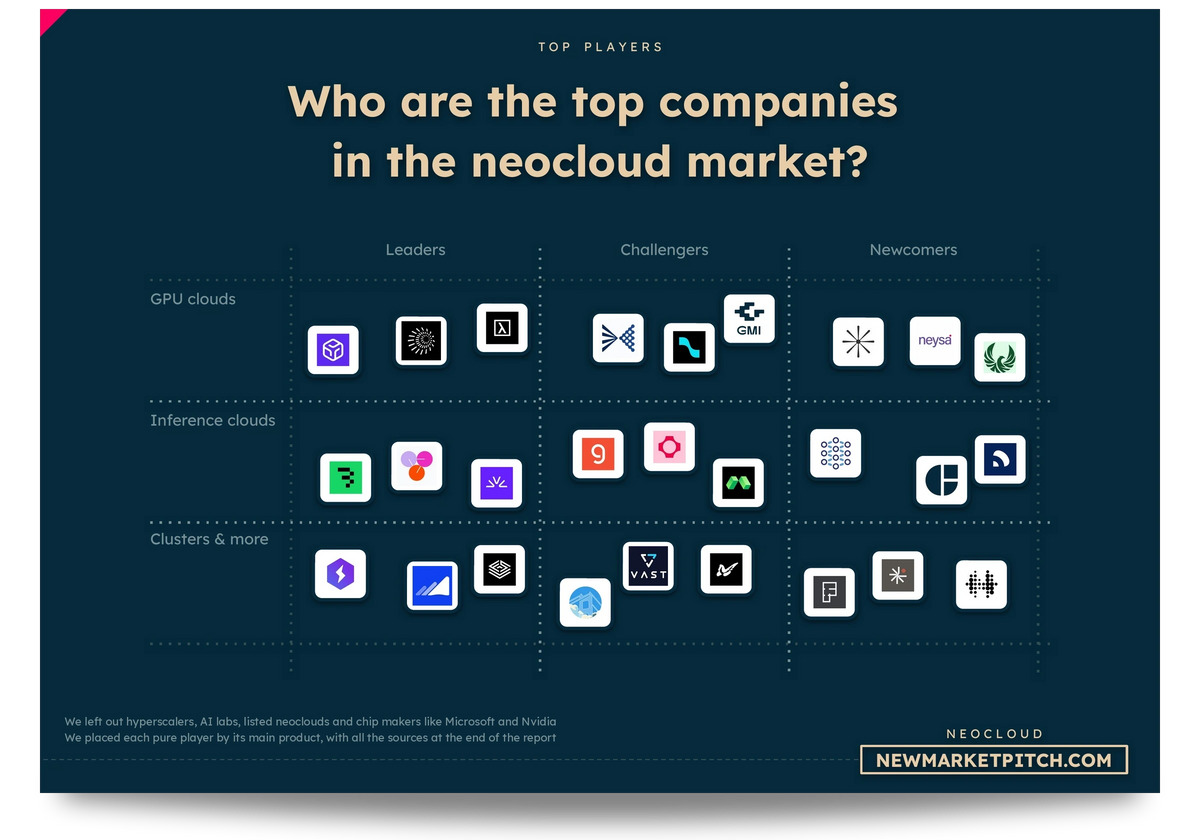
In our document detailing everything you need to know about neocloud, we turn what is vague and complex into simple, useful visuals. Market maps like this one show you at a glance where every startup stands.
Is all the debt making neoclouds too risky?
Heavy financing makes neoclouds much riskier than software companies, although debt backed by long-term customer contracts is far less dangerous than debt used to speculate on future GPU demand.
CoreWeave shows how extreme the capital requirements can become. During the first half of 2026, it spent about $14.1 billion on property and equipment while generating $4.65 billion of revenue.
Nebius recently raised roughly $5.75 billion through convertible notes after previously arranging its first secured debt financing. The company is using that capital to accelerate a global infrastructure build-out.
Crusoe has chosen a different mix but needs equally serious capital. Its latest Series F brought in $3.9 billion at a $30.9 billion post-money valuation, with the proceeds earmarked for vertically integrated AI infrastructure.
The financing model changes the downside.
A software company can slow hiring when demand disappoints. A neocloud may already have committed billions to a data center, power agreement and GPU fleet.
That makes contract quality just as important as revenue growth. Capacity financed against a strong multi-year customer commitment has a visible path to repayment. Capacity financed mainly on the assumption that AI demand will stay hot carries much more risk.
| Infrastructure strategy | Utilization risk | Pricing risk | Financing risk | Likely durability |
|---|---|---|---|---|
| Mostly spot GPU rental | Very high | Very high | High | Weak |
| Short reserved contracts | High | High | High | Weak to moderate |
| Multi-year capacity contracts | Low | Moderate | Moderate | Stronger |
| Capacity contracted before construction | Low | Low | Moderate | Strong |
| Hyperscaler-backed projects | Very low | Moderate | Lower | Strong |
| Contracted compute plus software | Low | Lower | Moderate | Potentially very strong |
| Power + data center + cloud integration | Lower | Lower | High execution risk | Potentially strong |
| Diverse enterprise AI platform | Moderate | Lower | Moderate | Strong if adoption develops |
What happens to neoclouds when AWS, Azure and Google have enough AI capacity?
Neocloud profitability will become much harder to defend once hyperscaler capacity catches up with demand, and that will probably separate the lasting businesses from the temporary GPU landlords.
Today, scarcity still helps specialists. Microsoft has been adding capacity at an extraordinary pace and continues to spend tens of billions of dollars every quarter on infrastructure. At the same time, it has relied on external capacity.
That situation will gradually change.
AWS, Microsoft and Google are all expanding data-center fleets, buying accelerators and developing their own silicon. More power projects are also reaching construction. The amount of available AI compute should keep rising sharply.
Customers will gain leverage as supply improves.
AWS can combine compute with S3, databases, networking, Bedrock and enterprise discounts. Microsoft can bundle Azure with its huge corporate software relationships. Google can combine cloud infrastructure with TPUs, Gemini and its data stack.
A specialist trying to sell an interchangeable H100 or Rubin cluster will struggle in that environment.
The neoclouds with a better chance are those that arrive with something harder to compare directly: a particularly efficient cluster, cheap and secured power, sovereign infrastructure, unusual deployment speed, useful software or a contract that locked in attractive economics years earlier.
The industry was created by scarcity. Its long-term winners will be chosen after scarcity becomes less generous.
If you want more recent data on this point, please see our latest neocloud market report.

Our report covering the neocloud market gets updated several times a month, so you always get the latest view of where things stand.
Does owning power and data centers make a neocloud stronger?
Control over power and data-center capacity can give neoclouds a stronger advantage than simply owning GPUs because electricity and suitable sites are becoming major bottlenecks in AI infrastructure.
Crusoe has pushed furthest in this direction. The company said earlier this year that it had contracted 4.9 GW of AI infrastructure capacity and had a development pipeline exceeding 40 GW.
More recent projects show how broad that strategy has become. Crusoe and Lancium announced a 1 GW AI data-center campus in Texas, while Crusoe separately signed an agreement covering roughly 750 MW of on-site generation. It has also partnered on 5 GW of AI-focused power-management systems.
Nebius is moving toward greater control too. The company has been securing large power positions for owned AI factories, including a site in Pennsylvania that can scale to 1.2 GW.
This approach gives providers more control over when capacity comes online and what it costs to operate.
It also raises the stakes. A bad GPU purchase hurts. A poorly planned gigawatt-scale campus can tie up billions for years.
Vertical integration therefore works best when the capacity already has a clear customer, or when demand is strong enough to keep the site occupied soon after launch.
Which neocloud business model has the best chance of making money?
The strongest neocloud model today combines contracted capacity, high utilization, efficient financing, control over scarce infrastructure and enough software to stop the service becoming a pure GPU commodity.
We can already see the market moving toward that combination.
CoreWeave has huge committed workloads, keeps pushing onto new Nvidia generations and is now building Forge as a software layer across training, inference and agent development.
Nebius combines rapid capacity expansion with long-term hyperscaler contracts and is adding software specifically designed to improve inference economics and GPU utilization.
Crusoe is approaching the problem from underneath the cloud layer by controlling more of the power and data-center stack, while its Perplexity agreement shows that it also wants customers to stay from model training through production inference.
Those strategies differ, but all three are moving away from simple GPU rental.
The weakest model is much easier to identify: borrow heavily, buy expensive GPUs, expose most of them to short-term pricing and hope the shortage continues.
That can produce spectacular revenue during a boom. It offers little protection once hardware supply catches up.
If you want more recent data on this point, please see our latest neocloud market report.

In our research about neoclouds, we don't want to repeat what boring consulting reports say. Instead, we show you the real and latest market signals that matter.
Can neoclouds make money while competing with hyperscalers?
Yes. Neoclouds can make real money while competing with AWS, Azure and Google Cloud, but the profitable opportunity is much narrower than the phrase “new cloud competitor” suggests.
The evidence is already strong enough to answer the basic question. Leading neoclouds have reached billions of dollars of revenue, AI-cloud operations can produce EBITDA margins near 50%, hyperscalers themselves are signing capacity deals with specialists, and long-term infrastructure contracts now run into tens of billions of dollars.
CoreWeave also shows why revenue growth and high EBITDA margins are not enough. The company can generate enormous operating cash earnings while depreciation and interest still push the bottom line deeply into the red.
That tension will decide the sector.
Neoclouds have the best economics when expensive infrastructure is contracted before or soon after it is built, utilization stays very high, financing costs remain manageable and each cluster produces more valuable services than basic GPU rental.
The latest moves from CoreWeave, Nebius and Crusoe suggest that the leading companies understand this. CoreWeave is building a broader development platform, Nebius is improving its inference stack, and Crusoe is tying together power, data centers, training and managed inference.
Competing head-on with AWS across the entire cloud would be an expensive mistake. Neoclouds have a much better business when they specialize in AI workloads that need huge clusters, fast deployment and infrastructure engineered specifically for accelerated computing.
Some of these companies can become very profitable.
Others will discover that buying GPUs during a shortage was much easier than earning an attractive return on them once the shortage fades.
Our methodology
This analysis tests whether neoclouds can build durable economics while competing with AWS, Azure and Google Cloud. Rather than judging the model from revenue growth or one headline margin, we broke the question into the factors that decide whether an infrastructure business actually works: market demand, utilization, operating profitability, depreciation, financing costs, contract visibility, customer concentration, infrastructure control, software differentiation and what happens as AI capacity becomes less scarce.
For each dimension, we used the freshest evidence that could tell us something concrete. That includes company financial results and regulatory filings, revenue backlog, customer agreements, financing disclosures, power and data-center commitments, product launches, public pricing and market-wide cloud data. We assessed those pieces together instead of allowing any single number to carry the conclusion.
We treated adjusted EBITDA as an operating indicator, not as proof of full profitability. For capital-heavy providers such as CoreWeave, depreciation, interest expense and the replacement cycle of expensive accelerators are central to the economics, so we compared headline EBITDA with operating income, net results, property and equipment growth and capital spending.
Utilization and contract structure received particular weight because much of a neocloud's cost is committed before the customer workload arrives. Long-term commitments, backlog and dedicated-capacity agreements were used to judge how much infrastructure is being built against visible demand rather than speculative spot-market demand.
Customer concentration was assessed in both directions. Large customers can create dependency and renewal risk, but multi-year commitments from Microsoft, Meta or other large counterparties can also support financing, lower utilization risk and make new capacity much easier to underwrite.
We used AWS, Azure and Google Cloud as the main competitive benchmark where they reveal market scale, mature cloud economics, bundling power and the alternatives available to customers. We compared CoreWeave, Nebius and Crusoe more directly when their different approaches to financing, software, power, data centers and customer contracts helped show which neocloud models look more durable.
For sourcing, we prioritized regulatory filings, investor-relations materials, official earnings disclosures, direct company announcements and first-party pricing pages. For market-wide figures, we used specialist industry data where it offered a clearer aggregate view than individual company disclosures. Older figures were retained only when they were needed to establish a trend or explain how the current economics developed.
Key sources used for this analysis include: Synergy Research Group on global cloud infrastructure spending and provider shares, Microsoft's FY2026 Q4 earnings materials on capacity and capital expenditure, CoreWeave's quarterly financial results, CoreWeave's detailed Q2 2026 results, CoreWeave's SEC filing on customer concentration, CoreWeave's pricing page, CoreWeave on NVIDIA Vera Rubin NVL72 deployment, CoreWeave on Forge, CoreWeave on its Hudson River Trading agreement, CoreWeave on its Harell Data agreement, Nebius's Q2 2026 financial results, Nebius on its Microsoft infrastructure agreement, Nebius's regulatory disclosure on the Microsoft contract, Nebius on its Meta agreement, Nebius on its secured debt financing, Nebius on its convertible-note financing, Nebius on its Pennsylvania AI factory and power capacity, Nebius on the Inferize acquisition, Crusoe on its Series F financing and contracted value, Crusoe on contracted AI infrastructure capacity, Crusoe on its Perplexity partnership, Crusoe and Lancium on the 1 GW Texas data-center campus, and Crusoe and Bergen Engines on the approximately 750 MW power agreement.

In our market report about neoclouds, you will always find fresh funding data, taken straight from our own verified funding database.
Written by the New Market Pitch teamWe track new markets so founders and investors can move faster. About us