How do AI data center operators make money from the compute boom?
Whether you're building or investing in the AI data center market, our report covers everything you need to know: the players, the money, and what's coming next.
Summary
AI data center operators make money by controlling whichever part of the compute stack is hardest to secure: powered land, long-term capacity, GPU compute, connectivity, software, or the financing structure tying those assets together.
The cleanest economics currently sit at the infrastructure layer. Long leases on scarce powered capacity can lock in years of revenue while leaving much of the GPU-obsolescence risk with the tenant.
GPU clouds can generate far more revenue from the same megawatt because they sell compute rather than just space and power. The trade-off is brutal capital intensity: expensive accelerators, fast depreciation, heavy financing costs, and a constant need to keep utilization high.
The shortage is not simply about data center buildings. Power has become the harder asset to secure, which means an operator with grid access and a credible delivery schedule can have more pricing power than one with a better building but no electricity.
Backlogs now do more than indicate demand. Large take-or-pay contracts and long leases increasingly function as financing tools, allowing operators to borrow against future customer payments and build infrastructure before the revenue starts.
That makes customer quality almost as important as customer demand. A giant contract from an investment-grade hyperscaler can lower financing risk, while a similarly large commitment from a weaker counterparty can leave the operator with specialized assets and an ugly balance-sheet problem.
The landlord and the neocloud are therefore making different bets. The landlord is betting that scarce powered capacity stays valuable; the neocloud is also betting on GPU economics, utilization, financing costs, hardware refresh cycles, and future compute pricing.
Software, storage, networking and connectivity are becoming more important because raw infrastructure will not stay differentiated forever. The operators with the strongest long-term position should be the ones that add higher-margin services without taking on the same proportional increase in physical capital.
Falling GPU prices are much more dangerous to compute sellers than to long-term landlords. A tenant can keep paying contractual rent even if the economics of an older accelerator deteriorate, while the cloud operator eventually has to remarket that hardware.
The best current model looks surprisingly close to infrastructure finance: secure power early, sign a strong customer, use that contract to fund construction, and keep only the technology risk that can be priced well enough to justify it. The biggest upside is in compute, but the cleanest money is still in scarce powered capacity.

Written by the New Market Pitch teamWe track new markets so founders and investors can move faster. About us

A good product starts with a real problem. In our report covering the AI data center market, we show you the ones customers still live with.
What do AI data center operators actually sell?
AI data center operators currently make money from two very different products: some rent scarce powered capacity, while others sell the GPU compute running inside it.
Applied Digital sits close to the infrastructure end. It secures land and large blocks of electricity, builds facilities designed for dense AI workloads and signs long leases with companies that need the capacity. Digital Realty and Equinix also make most of their money from physical infrastructure, although their portfolios include broader colocation and connectivity services.
CoreWeave and Nscale sit much closer to the compute layer. Customers pay them for GPU capacity, networking, storage and software. Nscale says access to its platform is priced mainly per GPU-hour, with services such as storage charged separately.
Crusoe spans more of the chain. It develops AI campuses, works on the energy infrastructure behind them and operates Crusoe Cloud.
The landlord avoids much of the risk that a GPU becomes obsolete. The GPU-cloud operator can extract far more revenue from the same megawatt, but it has to buy expensive accelerators, finance them and keep them busy.
| Model | What customers pay for | Typical revenue structure | Main risk |
|---|---|---|---|
| Powered-land developer | Energized site | Development agreement | Power and permitting delays |
| Hyperscale landlord | Data center capacity | Long-term rent | Construction and tenant concentration |
| Colocation operator | Space, power, connectivity | Recurring leases | Utilization and development costs |
| GPU cloud | GPU compute | GPU-hour + commitments | Hardware cost and utilization |
| Full-stack AI cloud | Compute + software | Compute, storage, software | Capital intensity and competition |
| Vertically integrated operator | Power through cloud | Multiple revenue streams | Execution complexity |
| Asset-light AI platform | Third-party capacity + software | Revenue share, licensing, services | Partner dependence |
Why is AI data center capacity so valuable right now?
AI data center capacity is unusually valuable today because operators are adding huge amounts of supply and still cannot catch up with demand.
CBRE's latest North American market study makes that unusually clear. Supply across the eight main data center markets grew 33.7% year over year to 10.9 GW in the first half of 2026. Despite that enormous increase, vacancy still fell to a record 1.4%.
Construction is running even harder. Around 7.5 GW was under construction, up 24.8% from a year earlier. More than 80% of that capacity had already been preleased, versus 74.3% one year earlier. CBRE calculated that less than 1.5 GW remained available for preleasing, roughly six months of supply at the current pace of demand.
Prices are responding exactly as we would expect in a shortage. Average rents rose across every capacity bracket CBRE tracks, including 8.3% for 3-to-10-MW deployments and 6.7% for requirements above 10 MW.
That combination is stronger evidence than another hyperscaler announcement. Supply is growing by one-third, construction is at record levels, most unfinished capacity already has a customer, vacancy is still falling and rents are still rising.
For operators that can deliver electricity quickly, the compute boom is currently a seller's market.

If you build or invest in the AI data center market, you need to know which business models pay off now and which ones are fading. That's why our report covering it has a whole section on it.
Are AI data centers basically becoming very expensive landlords?
For operators such as Applied Digital and Digital Realty, the AI boom has created an unusually attractive landlord business: customers commit billions of dollars years in advance to secure powered buildings they may occupy for a decade or more.
Applied Digital is the clearest example. It has signed long-term leases covering roughly 1.4 GW of critical IT load across five AI campuses. The initial 15-year terms represent about $36 billion of contracted revenue.
The scale becomes easier to grasp when we compare it with the business Applied Digital had only recently. The company generated $229 million of total revenue in fiscal 2025. Its contracted future lease revenue is now more than 150 times that annual figure.
Digital Realty is seeing the same rush at a much larger and more established company. It ended its latest reported quarter with a record $1.9 billion of annualized base rent already signed but not yet started.
Customers are also reserving capacity surprisingly early. Digital Realty said the average gap between signing a new lease and commencement reached 19 months in the first quarter before falling to nine months in the second.
The attraction for operators is straightforward: a long contract makes an expensive project much easier to finance, while the customer secures scarce capacity years before it needs all of it.
If you want more recent data on this point, please see our latest AI data center market report.
How much money can one megawatt of AI data center capacity make?
Recent large AI data center contracts suggest that a landlord can generate roughly $1.5 million to $2 million of annual rent from one contracted megawatt, while the computing equipment installed inside that megawatt can cost many times more.
Applied Digital's 210 MW Delta Forge 2 lease carries approximately $5.2 billion of contracted revenue over 15 years. That works out to roughly $1.65 million per MW per year.
Its earlier 400 MW CoreWeave agreement represented around $11 billion over about 15 years, or approximately $1.8 million per MW annually.
Now compare that rent with what has to be built.
JLL estimates that the shell and core of a data center costs about $11.3 million per MW globally in 2026. For an AI facility, tenant technology such as GPUs, servers and networking can add as much as another $25 million per MW.
A 100 MW AI site can therefore contain more than $1 billion of real estate and electrical infrastructure plus as much as $2.5 billion of computing equipment.
This is why a GPU cloud can produce far more revenue than its landlord. The landlord is monetizing the powered building. The neocloud is trying to earn a return on the much more expensive machines running inside it.

Learning from others' mistakes is the cheapest lesson there is. In our market report about AI data centers, we look at what broke startups before you, so you don't repeat it.
How do GPU clouds turn the same data center into much more revenue?
GPU cloud operators make much more revenue per megawatt because they sell actual computing time instead of stopping at rent and electricity.
CoreWeave shows how large that model can become. Its latest quarterly revenue reached $2.575 billion, up from $1.212 billion a year earlier. Revenue for the first six months of the year was $4.653 billion.
Nscale explains the model more directly in its filings. Customers pay primarily per GPU-hour for compute and separately for services such as storage. Larger clients can instead commit to huge blocks of capacity through multiyear take-or-pay contracts.
By the end of April, Nscale had approximately $50.2 billion of committed contract value supporting about 284,000 deployed or contracted GPUs.
The arithmetic scales very quickly. Tens of thousands of accelerators running around the clock produce billions of billable GPU-hours over a multiyear contract.
A landlord may earn around $1 million to $2 million annually from one MW. A cloud operator can generate several layers of revenue from the compute, storage, networking and software sitting on top of that same physical capacity.
That extra revenue comes with a much heavier balance sheet.
Is selling GPU compute actually a good business?
Selling GPU compute is a huge revenue business today, but CoreWeave's accounts show why we should be careful about calling it an easy profit machine.
CoreWeave generated $2.575 billion of revenue in its latest quarter. Its direct cost of revenue was $879 million, which looks very strong at first glance.
The expensive part sits elsewhere in the accounts. Technology and infrastructure expense reached $1.507 billion. Depreciation and amortization alone was $1.393 billion, while net interest expense added another $640 million.
CoreWeave finished the quarter with a $626 million net loss.
Across the first six months, the company produced $4.653 billion in revenue while recording $2.54 billion of depreciation and amortization and $1.176 billion of net interest expense.
Adjusted EBITDA was still $1.51 billion for the quarter, or 59% of revenue. The infrastructure throws off plenty of cash before depreciation, financing and other costs; the harder question is how much remains after paying for the hardware and the debt used to buy it.
If you want more recent data on this point, please see our latest AI data center market report.
Why does GPU utilization matter so much?
GPU utilization can make or break an AI cloud because most of the costs keep running whether the accelerator is earning money or sitting idle.
The operator has already bought or financed the GPU. Data center rent, electricity reservations, networking equipment and much of the staffing are also committed.
Imagine two otherwise identical clusters. One sells 90% of its available GPU-hours and another sells 55%. The first cluster spreads much of the same fixed infrastructure cost across roughly 64% more billable hours.
This explains the industry's obsession with take-or-pay contracts and giant backlogs.
Nscale's roughly $50.2 billion of committed contract value reduces the risk that its planned fleet arrives without enough customers. CoreWeave had about $104 billion of revenue backlog at the end of its latest reported quarter, before more than $25 billion of additional commitments added shortly afterward.
Lambda offers an even fresher example. Its reported order backlog has jumped from roughly $15 billion in June to about $50 billion by September, with a $35 billion Anthropic agreement accounting for most of the increase.
For neoclouds, high utilization increasingly starts with selling the capacity before the GPUs arrive.

When you build or invest in the AI data center market, you need clarity, not confusion. In our document detailing everything you need to know about AI data center, we always try to put numbers on and quantify whatever is usually vague and confusing.
Why are AI compute contracts becoming financing tools?
Large AI compute contracts now act much like financing collateral because operators can use committed future payments to borrow the billions needed to build the infrastructure behind them.
CoreWeave has pushed this model further than almost anyone. In March, it closed an $8.5 billion delayed-draw term loan tied to infrastructure supporting a customer contract. Another $3.1 billion financing followed in May, backed by HPC assets supporting two customer agreements. In August, CoreWeave added another $2.6 billion facility.
Those three financings alone total $14.2 billion.
The landlord model works similarly. Applied Digital has financed projects with debt supported by long leases, including $1.59 billion of senior secured notes tied to one facility.
TeraWulf offers an even cleaner example of customer credit changing project economics. Its 200-plus-MW Fluidstack agreements represent roughly $3.7 billion over their first ten years, while Google agreed to backstop $1.8 billion of Fluidstack's obligations to help support the project's debt financing.
The next step is to move some of the asset ownership off the operator's balance sheet entirely. Nebius introduced a partnership model this summer under which outside investors can finance and own data centers and hardware while Nebius provides the architecture, software, supply-chain access and customers. Possible payment structures include licensing fees, commissions, revenue sharing and committed-capacity agreements.
Amazon is reportedly exploring a related structure that could place around $8 billion of Nvidia chips in an outside investment vehicle and lease them back.
The direction is becoming clear: operators want access to the compute without necessarily owning every building and GPU that produces it.
Who has the better business: the data center landlord or the GPU cloud?
The AI data center landlord currently has the cleaner risk profile, while the GPU cloud offers much more revenue upside if utilization stays high.
Applied Digital's recent results show both sides of the infrastructure model. Its HPC hosting segment produced $203 million of quarterly revenue, including $44.1 million of base rent and $152.4 million of tenant fit-out services.
Those fit-out services carried $145.6 million of associated expense, so most of that revenue passes through at a thin spread. Rental revenue is much more attractive once a facility is running.
CoreWeave gets far more revenue by owning or financing the compute itself, but the trade-off appears immediately in its accounts. As seen above, $2.575 billion of quarterly revenue came with $1.393 billion of depreciation and $640 million of net interest expense.
Equinix shows what the mature infrastructure model can eventually become. Its monthly recurring revenue grew 11% year over year in its latest reported quarter, while it added a record 9,700 net interconnections.
The choice is basically between cleaner infrastructure returns and much larger but more volatile compute economics.
| Operator/model | Main source of revenue | Typical contract | Biggest capital burden | Economic profile |
|---|---|---|---|---|
| Equinix | Colocation + interconnection | Recurring | Data centers + network | Mature infrastructure |
| Digital Realty | Colocation + hyperscale leases | Multi-year | Data centers | Large-scale landlord |
| Applied Digital | AI campus leases | Often 15 years | Campuses | Long-duration infrastructure |
| CoreWeave | GPU compute + cloud | Usage + multiyear | GPUs + facilities | Very high growth, capital heavy |
| Nscale | GPU compute + software | Take-or-pay + usage | GPUs + facilities | Contract-backed neocloud |
| Lambda | GPU compute | Large commitments + usage | GPUs + facilities | Rapidly scaling neocloud |
| Crusoe | Campuses + AI cloud | Infrastructure + cloud | Power, facilities, GPUs | Vertically integrated |
If you want more recent data on this point, please see our latest AI data center market report.

In our report covering the AI data center market, we look at what the winners do differently, so you can learn from the best instead of guessing.
Is electricity now more valuable than the AI data center building?
For large AI projects, access to electricity has become the harder asset to secure, and that increasingly determines where operators can make money.
JLL now ranks "speed to power" as the main data center site-selection criterion. That ranking fits what operators are doing on the ground.
AI campuses are moving from tens of megawatts toward hundreds of megawatts and sometimes gigawatts. Crusoe said earlier this year that it had contracted 4.9 GW across its data center projects and cloud capacity, with a wider development pipeline above 40 GW.
Applied Digital's five contracted campuses require roughly 1.4 GW of critical IT capacity and around 2.15 GW of grid-connected utility power.
Projects of this size cannot simply move into an available commercial building. They require enough generation, transmission, substations, cooling and grid infrastructure to support a small city's worth of electricity demand.
That changes where data centers get built. North Dakota, Texas, Pennsylvania, Louisiana and the Nordic countries become much more attractive when they can provide power faster or more cheaply than established hubs.
The data center shell can often be built in a couple of years. Getting several hundred megawatts through the grid can take much longer. Operators able to secure that electricity early have something competitors cannot quickly copy.
Why don't Microsoft, Google, Amazon and Meta just build their own AI data centers?
Hyperscalers still build enormous amounts of infrastructure themselves, but AI demand is growing fast enough that they are also renting capacity from specialist operators.
JLL expects hyperscalers to keep following this dual strategy through the current buildout: build internally and lease externally at the same time.
Recent contracts show what that looks like. Microsoft has signed major capacity agreements with CoreWeave and Nscale. Nscale's disclosed Microsoft program spans roughly 200,000 Nvidia GB300 GPUs across Europe and the United States.
Crusoe is building large infrastructure for Microsoft workloads, including the Abilene campus in Texas. Google has supported Fluidstack-linked capacity through the TeraWulf financing structure.
Outsourcing lets hyperscalers deploy compute in parallel across more locations, developers and financing vehicles instead of forcing every project through their own construction pipeline.
Is customer concentration the biggest hidden risk in AI data centers?
Customer concentration is one of the clearest weaknesses in today's AI infrastructure boom because some enormous backlogs ultimately depend on only a few hyperscalers and frontier AI labs.
Applied Digital says roughly 70% of its contracted revenue is backed by U.S.-based investment-grade hyperscalers. That makes the contracts highly financeable, but several campuses can still depend on the same customer.
Lambda provides a more extreme illustration. Its reported backlog recently rose to roughly $50 billion after Anthropic signed an agreement worth around $35 billion. One transaction therefore accounts for about 70% of the reported backlog.
Nscale's contracts are also concentrated around large, predominantly investment-grade customers because those are the companies capable of committing to hundreds of thousands of GPUs.
CoreWeave has been broadening its enterprise base with companies including Caterpillar, Bentley Systems and Grammarly, alongside AI-native customers such as Databricks and Runway. Yet the largest infrastructure requirements still come from a small number of very large clients.
A concentrated customer base can still work very well when counterparties are strong. The danger is having billions of dollars of specialized infrastructure exposed to a customer that changes plans.

In our research about AI data centers, we always try to gather several sources and make estimates that make sense, so you can work with solid numbers.
Can AI data center operators make more money than just rent and GPU-hours?
Yes. The better-positioned AI data center operators are already adding connectivity, storage, networking, orchestration and software because raw infrastructure alone will become harder to differentiate over time.
Equinix built this playbook long before the generative-AI boom. Customers pay for physical capacity, but they also pay to connect directly with cloud providers, networks and other companies inside the Equinix ecosystem. The company added a record 9,700 net interconnections in its latest quarter.
Neoclouds are building their own version of that stack.
Nscale sells storage separately from compute and bundles networking and software services around the infrastructure. CoreWeave has expanded its software position through businesses including Weights & Biases and OpenPipe, giving it exposure to model development and deployment workflows beyond pure GPU rental.
Crusoe now offers products around inference and fine-tuning in addition to raw compute. Nebius has been moving in the same direction through software and tools serving AI developers and agentic applications.
Every extra software or connectivity layer gives operators another revenue stream without requiring the same proportional increase in physical capacity.
What happens to AI data center operators when GPU prices fall?
Falling compute prices should hurt GPU-cloud operators more than long-term data center landlords because the neocloud has direct exposure to how much customers will pay for each unit of computing power.
A landlord such as Applied Digital can continue collecting contractual rent even if a new generation of GPUs suddenly delivers twice the performance for the same price, provided the tenant remains solvent and keeps paying.
CoreWeave, Lambda and Nscale face a more complicated equation.
Every major accelerator generation gives customers more performance per dollar and usually more performance per watt. Cloud providers therefore have to lower prices on older hardware or find workloads that still make economic sense on it.
Inference can extend the useful life of previous-generation GPUs, as can smaller training jobs and less latency-sensitive workloads. Long take-or-pay contracts also protect pricing temporarily.
The real risk appears when contracts expire and the operator has to remarket older hardware while debt or depreciation is still running.
If you want more recent data on this point, please see our latest AI data center market report.
How expensive is it to keep building AI data centers?
The AI data center boom requires so much capital that financing capacity may eventually matter as much as computing capacity.
JLL estimates average global shell-and-core construction at about $11.3 million per MW in 2026. AI technology fit-outs can cost another $25 million per MW.
Using those estimates, a 100 MW AI facility can require around $1.13 billion for the physical data center and as much as another $2.5 billion for GPUs, servers and networking.
Scale that toward 1 GW and the economics move into tens of billions of dollars.
JLL expects roughly 100 GW of additional global data center capacity by 2030. It estimates around $1.2 trillion of real-estate asset creation, approximately $870 billion of new debt financing and another $1 trillion to $2 trillion of tenant spending on technology.
Total investment could therefore approach $3 trillion.
Cheap capital is becoming a competitive advantage. Two operators can secure similar customers and power, yet the one able to finance the project at a lower cost can make a much better return.
| Cost layer | Approximate scale | Main payer |
|---|---|---|
| Shell and core | ~$11.3M per MW | Developer/operator |
| AI technology fit-out | Up to ~$25M per MW | Tenant/cloud operator |
| 100 MW shell and core | ~$1.13B | Developer/operator |
| 100 MW AI technology | Up to ~$2.5B | Tenant/cloud operator |
| New global capacity through 2030 | ~100 GW | Entire ecosystem |
| Expected real-estate asset creation | ~$1.2T | Infrastructure investors |
| Potential total ecosystem investment | Approaching ~$3T | Operators, tenants, lenders |

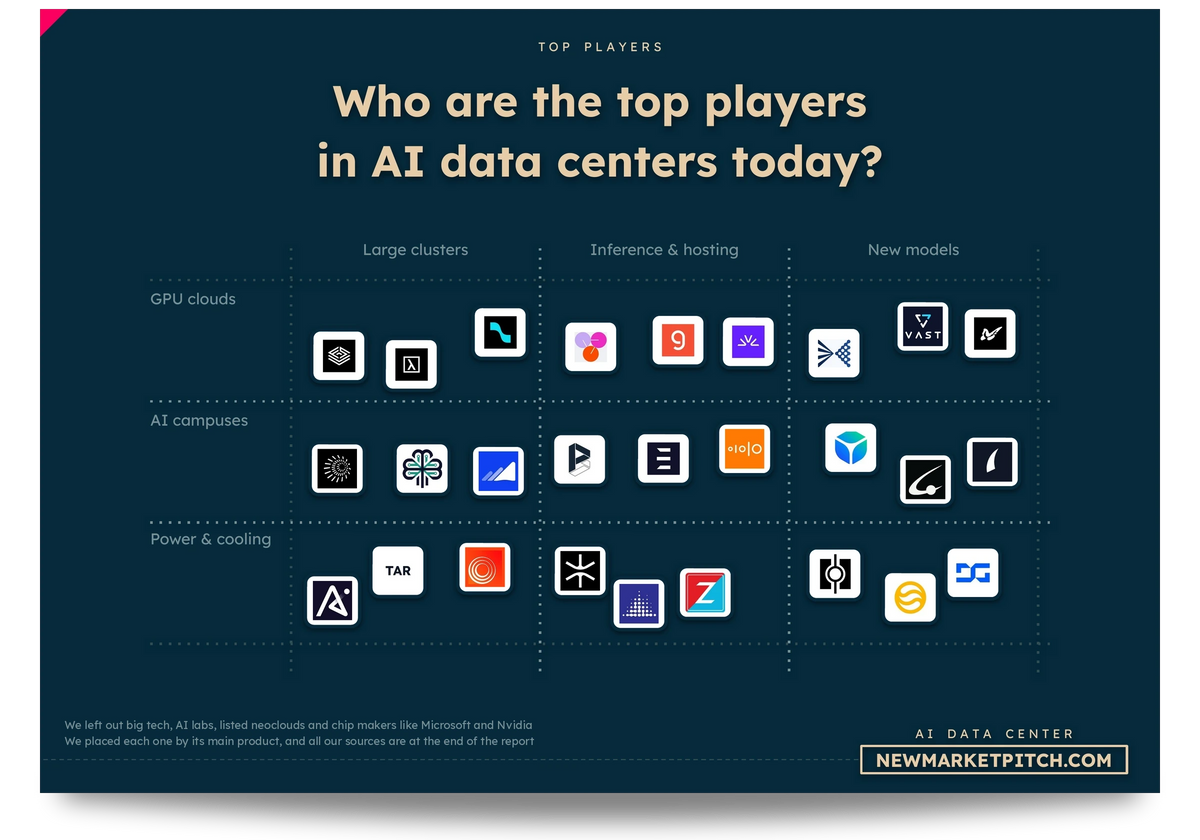
In our market report about AI data centers, we turn what is vague and complex into simple, useful visuals. Market maps like this one show you at a glance where every startup stands.
Can we trust these enormous AI data center backlogs?
The giant AI infrastructure backlogs increasingly represent real signed commitments, but they tell us much more about future demand than about future profit.
The scale is remarkable. CoreWeave reported about $104 billion of revenue backlog at the end of its latest quarter, excluding more than $25 billion of additional commitments added shortly afterward.
Nscale had approximately $50.2 billion of committed contract value by the end of April. Lambda's reported backlog has reached roughly $50 billion. Crusoe says total contracted value across its platform exceeds $140 billion.
As seen above, Applied Digital has also built a multidecade contracted lease book around its new AI campuses.
We should not add those figures together and call the result "AI data center demand." The companies use different definitions, durations and accounting treatments. Some figures represent cloud services, others leases, and others a wider platform contract value.
Still, one conclusion survives those differences: customers are reserving extraordinary amounts of compute years before they expect to consume all of it.
The next test is execution. Operators have to deliver the electricity, buildings and GPUs on schedule. Customers then have to remain willing and able to use the contracted capacity.
A $50 billion backlog attached to an unfinished fleet carries much more risk than $50 billion of revenue already earned.
So the contracts make today's demand credible. They do not make tomorrow's margin guaranteed.
Can AI data center operators keep raising prices?
Data center landlords still have pricing power today, while GPU compute prices face much stronger long-term pressure.
CBRE found rent increases across every deployment size in the main North American markets during the first half of 2026. Rates rose 8.3% for 3-to-10-MW requirements and 6.7% for deployments above 10 MW.
Digital Realty's latest renewal data was even stronger. Cash rental rates on renewed leases increased 25.4% during the quarter, although one quarter can be distorted by the specific contracts that happen to expire.
The broader market data is harder to dismiss. Construction is at record levels, more than 80% of unfinished capacity is already preleased and primary-market vacancy sits around 1.4%.
That gives owners of scarce powered sites room to push rents higher.
GPU compute follows a different curve. New Nvidia accelerators, custom hyperscaler chips and software improvements keep increasing the amount of useful compute customers receive from each dollar and each watt.
Cloud operators will therefore struggle to raise the price of standardized compute indefinitely.
Their answer has to come from elsewhere: cheaper hardware, higher utilization, lower electricity costs, better software or more valuable services around the GPU.
Right now, scarcity favors the physical megawatt more clearly than the individual GPU-hour.

Our document detailing everything you need to know about AI data center gets updated several times a month, so you always get the latest view of where things stand.
Will AI inference make data center demand even bigger?
AI inference is likely to become a larger and more persistent source of data center demand than training, although better hardware and software will keep reducing the compute needed for each individual task.
JLL estimates that AI represented about one-quarter of data center workloads in 2025 and could reach half by 2030. Its current outlook expects inference to overtake training as the main AI workload around 2027.
The distinction matters.
Frontier-model training creates massive but concentrated bursts of demand. A single cluster can involve tens of thousands of GPUs working on one model.
Inference spreads compute consumption across millions or billions of requests generated by search, coding assistants, customer-service systems, autonomous agents and other applications.
Operators are already preparing for that change. Crusoe has launched self-service inference services. CoreWeave is building software around production AI workloads. Nebius is targeting companies deploying AI products and agents. Equinix benefits when enterprises need low-latency connections between their own data and outside AI infrastructure.
Inference can also favor a broader geographic footprint because response time becomes more important when people or software agents are interacting with models continuously.
The big unknown is efficiency. Models are getting cheaper to run, accelerators keep improving and inference software is becoming much better at squeezing useful work from every GPU.
For operators, the bullish case depends on usage growing faster than the cost per inference falls. Today, that still looks plausible, but it is one of the assumptions worth testing rather than treating as settled.
Who is making the best money from the AI data center boom right now?
The strongest AI data center economics currently sit with operators that control scarce power, have strong customers signed for years and can finance the infrastructure cheaply without taking more GPU risk than necessary.
Digital Realty and Equinix show why the physical layer remains attractive. Demand is strong, rents are rising and connectivity adds recurring revenue on top of basic capacity.
Specialized developers such as Applied Digital can move faster into giant AI campuses and lock in 10- or 15-year contracts before construction is finished.
Neoclouds capture much more revenue from the same infrastructure. CoreWeave has already reached multibillion-dollar quarterly revenue, while Nscale and Lambda have accumulated tens of billions of dollars in commitments.
Their economics are also harsher. GPUs depreciate quickly, financing is expensive and every growth wave requires another round of capital spending.
The sweet spot today looks surprisingly close to infrastructure finance: secure power early, sign a customer with excellent credit, borrow against the contract and avoid owning technological risk that the customer is better placed to carry.
GPU clouds can still become much more valuable businesses. They simply have more things that need to go right.
If you want more recent data on this point, please see our latest AI data center market report.

Theory only gets you so far. In our report covering the AI data center market, we dig up the real signals from the field and show you the ones worth watching.
So how do AI data center operators really make money from the compute boom?
AI data center operators make money by monetizing whichever part of the AI infrastructure stack is scarcest: powered land, long-term capacity, GPU-hours, connectivity, software or the financing structure connecting all of them.
The safest version currently looks like long-term infrastructure. An operator secures power, builds the facility and signs a strong tenant for ten or fifteen years. That produces relatively predictable rent without requiring the landlord to guess which GPU generation will still command premium pricing five years from now.
GPU clouds pursue a bigger prize. By financing the accelerators and selling compute directly, they can turn the same physical megawatt into far more revenue. CoreWeave's growth shows how powerful that model can be.
The cost is much higher exposure to depreciation, debt, utilization and falling compute prices.
A third model is now emerging around the two. Companies such as Nebius are trying to let outside investors own more of the expensive infrastructure while the cloud platform keeps the customer and software relationship. Even very large technology companies are experimenting with similar financing ideas.
That direction makes sense. With global AI data center investment potentially approaching trillions of dollars, few operators can keep every building, GPU and power asset on their own balance sheet.
The companies best placed to capture the compute boom are therefore unlikely to be those that simply build the most data centers or buy the most GPUs. We would favor operators that can repeatedly assemble four things: scarce power, contracted customers, cheap capital and a profitable layer of services above the infrastructure.
For now, powered capacity remains the cleanest place to make money. Selling the compute itself offers more upside, but it also carries far more ways for the economics to go wrong.
Our methodology
This analysis asks how AI data center operators are actually making money from the compute boom. We broke the question into the economic dimensions that most directly shape the answer: what each operator sells, how scarce the underlying capacity is, how much capital the model requires, how utilization and contracts affect returns, where pricing power sits, and which risks remain with the operator.
For each dimension, we prioritized recent operating evidence over broad narratives about AI infrastructure. The core inputs were signed leases and compute contracts, reported revenue and cost structures, vacancy and preleasing data, construction economics, committed capacity, financing structures, customer concentration, and disclosures showing how these companies are trying to move capital on or off their balance sheets.
Backlog and contracted-value figures are not treated as interchangeable. CoreWeave, Nscale, Lambda, Crusoe and Applied Digital disclose commitments with different definitions, durations and accounting treatment, so we use each figure to understand the strength and shape of future demand rather than adding them together into one market total.
We also separate the economics of the physical megawatt from the economics of the compute installed inside it. Landlords are judged mainly on power access, lease duration, tenant quality, construction cost and financing. GPU-cloud operators are judged on those factors plus hardware cost, depreciation, utilization, financing expense, refresh cycles and the price customers will pay for compute.
The final judgment comes from comparing those layers together rather than picking one headline metric. The objective is to identify which combinations of scarce power, strong customer commitments, financing access, utilization and higher-margin services currently produce the strongest economics.
Key sources used for this analysis include CBRE's North America Data Center Trends H1 2026, CBRE's H1 2026 demand and construction update, JLL's 2026 global data center outlook, Applied Digital's fiscal 2026 results, Applied Digital's Delta Forge 2 lease announcement, Applied Digital's 2026 Form 10-K, Digital Realty's Q1 2026 results, Digital Realty's Q2 2026 filing, and Equinix's Q2 2026 results.
We also used CoreWeave's Q2 2026 results, CoreWeave's quarterly-results disclosures, CoreWeave's $8.5 billion financing announcement, CoreWeave's $2.6 billion loan-facility announcement, Nscale's SEC registration filing, Nscale's Microsoft infrastructure agreement, Crusoe's contracted-capacity disclosure, Crusoe's Series F announcement, TeraWulf's Fluidstack hosting announcement, TeraWulf's Q2 2026 Form 10-Q, and Nebius's infrastructure-partnership model.

In our research about AI data centers, we don't want to repeat what boring consulting reports say. Instead, we show you the real and latest market signals that matter.
Written by the New Market Pitch teamWe track new markets so founders and investors can move faster. About us