What are the most valuable neocloud startups?
Building a startup or looking for your next investment in neocloud? Our report gives you the full picture.
Summary
Crusoe is the most valuable neocloud startup, valued at $30.9B. Fluidstack follows at $18.0B, and the market now has 10 startups in the decacorn tier. The top tier has moved well beyond small companies renting out GPUs.
Crusoe leads by 1.7x. Its advantage is the combination of energy, data centers, and an AI cloud that customers can actually use. That combination is hard to build, even with plenty of investment money.
Yet companies building enormous campuses are not the only ones attracting giant valuations. Fireworks AI is valued at $17.5B, and fal at $16.0B. Both make money from running models for customers rather than selling access to a particular building.
That helps explain Modal's $15.75B valuation and Baseten's $13.0B. Their software makes GPU-powered applications easier to deploy and scale. Buyers increasingly pay for a working AI service rather than a bare machine.
Large physical operators still matter enormously. Nscale is valued at $14.6B, and Lambda at $14.5B. Their major customer agreements show how much demand exists, although grid connections and construction can delay delivery.
The United States is home to 43 of the startups we track. Nscale in the United Kingdom and Firmus in Australia show that valuable neocloud businesses can also emerge outside the US.
The rest of the field looks very different from the leaders. We count 25 neocloud unicorns, while 37 of the 64 startups are worth less than $1B and two more sit on either side of that line. Being an AI cloud company does not automatically make a business worth billions.
A few headline prices need special care. Groq's valuation reflects its business after a major technology-licensing agreement with NVIDIA. Some other companies have estimated ranges based on their last equity round rather than a price announced by investors.
There are also companies testing unusual approaches. SambaNova Systems offers cloud inference on its own chips, and Starcloud is trying to put AI computing in orbit. Those ambitions are far apart in how much they have proved commercially.
Our conclusion is clear: Crusoe leads neocloud startup valuations today. The bigger story is that investors now value two different businesses highly, the operators supplying huge amounts of physical compute and the platforms making AI models easy to run.

Written by the New Market Pitch teamWe track new markets so founders and investors can move faster. About us

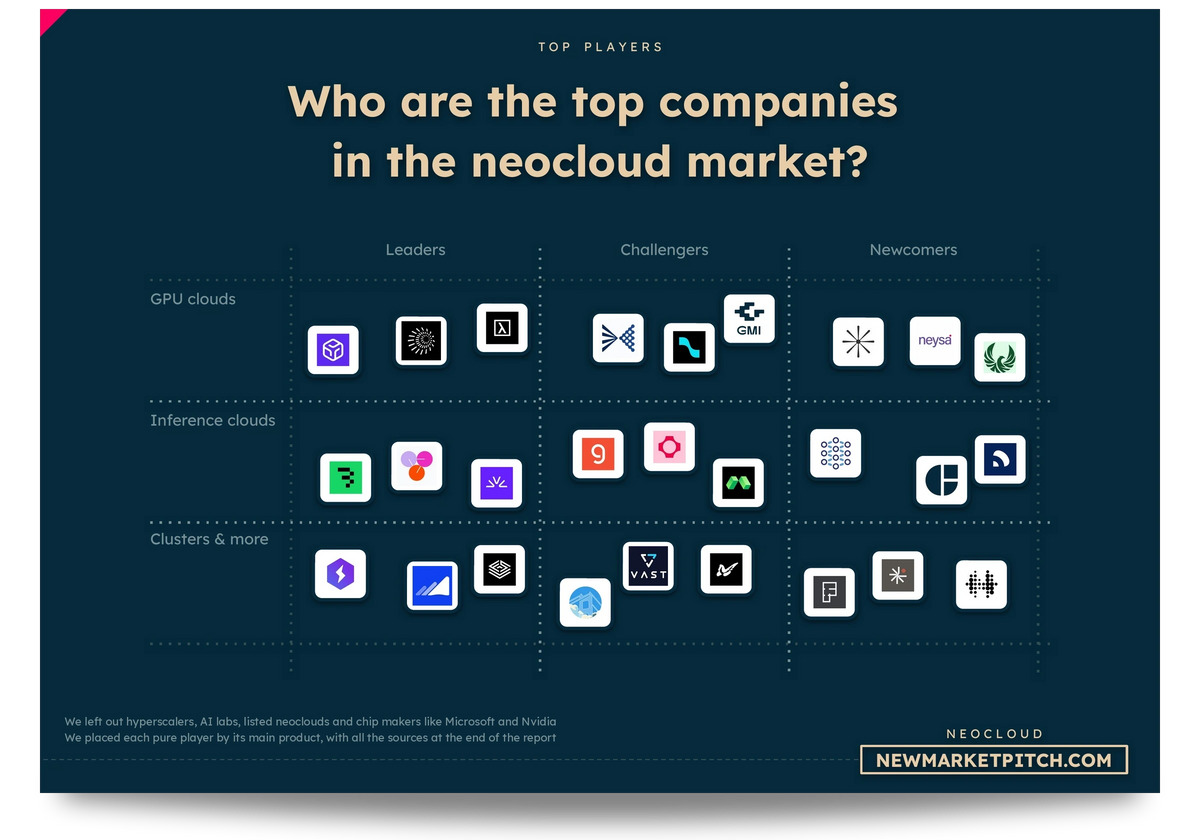
In our report covering the neocloud market, we turn what is vague and complex into simple, useful visuals. Market maps like this one show you at a glance where every startup stands.
Top startups in the neocloud market ranked by valuation
Here is the current ranking of the most valuable neocloud startups. For each one you will also find our confidence level and the valuation basis we used.
If you want to go deeper into the neocloud startup landscape, check our report covering the neocloud market.
| # | Startup | Valuation | Confidence | Valuation basis | Last round | Total funding |
|---|---|---|---|---|---|---|
| Private startups | ||||||
| 1 | CrusoeVertically integrated AI cloud infrastructure | $30.9Bas of Sep 2026 | Full | Announced private round valuation | $3.9BSeries F · Sep 2026 | $6.4Bvalued at 4.8× this |
| 2 | FluidstackHyperscale AI compute infrastructure | $18.0Bas of Sep 2026 | Full | Announced private round valuation | $1.5BSeries B · Sep 2026 | $2.3Bvalued at 7.7× this |
| 3 | Fireworks AIEnterprise AI inference and fine-tuning | $17.5Bas of Jul 2026 | Full | Announced private round valuation | $1.5BSeries D · Jul 2026 | $1.8Bvalued at 9.6× this |
| 4 | falGenerative media inference infrastructure | $16.0Bas of Nov 2026 | Full | Announced private round valuation | $1.3BSeries F · Nov 2026 | $2.0Bvalued at 8.1× this |
| 5 | ModalServerless AI compute and execution | $15.75Bas of Oct 2026 | Full | Announced private round valuation | $750MSeries D · Oct 2026 | $1.2Bvalued at 13.0× this |
| 6 | NscaleHyperscale GPU cloud and datacenters | $14.6Bas of Mar 2026 | Full | Announced private round valuation | $2.0BSeries C · Mar 2026 | $3.3B+valued at 4.4× this |
| 7 | LambdaGPU cloud and AI factories | $14.5Bas of Oct 2026 | Strong | Reported private round valuation | $1.5BSeries E · Nov 2025 | $2.3Bvalued at 6.2× this |
| 8 | BasetenProduction AI model inference platform | $13.0Bas of Jun 2026 | Full | Announced private round valuation | $1.5BSeries F · Jun 2026 | $2.1Bvalued at 6.2× this |
| 9 | SambaNova SystemsBuilds AI inference chips and systems | $11.0Bas of Jul 2026 | Full | Announced private round valuation | $1.0BSeries F · Jul 2026 | $2.5B+valued at 4.4× this |
| 10 | FirmusEnergy-efficient hyperscale AI factories | $10.5Bas of Aug 2026 | Full | Announced private round valuation | $2.0BStrategic equity · Aug 2026 | $3.1B+valued at 3.4× this |
| 11 | Together AIOpen-model training and inference cloud | $8.3Bas of Jul 2026 | Full | Announced private round valuation | $800MSeries C · Jul 2026 | $1.3Bvalued at 6.2× this |
| 12 | GroqProvides specialized AI inference infrastructure | $3.5Bas of Aug 2026 | Full | Announced private round valuation | $350MSeries A · Aug 2026 | $2.8B+valued at 1.2× this |
| 13 | VultrCloud compute GPUs and infrastructure services | $3.5Bas of Dec 2024 | Full | Announced private round valuation | $333MGrowth equity · Dec 2024 | $333Mvalued at 10.5× this |
| 14 | PaleBlueDot AIEnterprise GPU cloud and inference | $3.2Bas of Oct 2026 | Full | Announced private round valuation | $200MSeries C · Oct 2026 | $350M+valued at 9.1× this |
| 15 | Infinigence AICloud computing infrastructure for AI | $2.1B–$4.0Bas of Oct 2026 | Low | Estimated from last round | ~$320MSeries C · Oct 2026 | $591Mvalued at 5.2× this |
| 16 | Gimlet LabsMulti-silicon AI inference cloud | $3.0Bas of Sep 2026 | Full | Announced private round valuation | $300MSeries B · Sep 2026 | $392Mvalued at 7.7× this |
| 17 | Lightning AIIntegrated GPU cloud and AI development | $2.5B+as of Jan 2026 | Strong | Reported private round valuation | $50MSeries C · Nov 2024 | $105Mvalued at 23.8× this |
| 18 | VoltaDevelops and finances AI compute infrastructure | $2.4Bas of Aug 2026 | Strong | Reported private round valuation | UndisclosedSeries A · Aug 2026 | Undisclosed |
| 19 | StarcloudOrbital data centers for AI | $2.3Bas of Aug 2026 | Full | Announced private round valuation | $250MSeries A · Aug 2026 | $433Mvalued at 5.3× this |
| 20 | GMI CloudGPU infrastructure and inference services | $1.5B–$2.8Bas of Oct 2026 | Low | Estimated from last round | $223MSeries B · Oct 2026 | $238Mvalued at 9.0× this |
| 21 | TensorWaveAMD-powered AI GPU cloud | $1.6B | Full | Announced private round valuation | $350MSeries B · Jun 2026 | $450Mvalued at 3.6× this |
| 22 | AndromedaAI GPU capacity procurement marketplace | $1.5Bas of Mar 2026 | Strong | Reported private round valuation | $60MSeries A · Mar 2026 | $60M+valued at 25.0× this |
| 23 | VerdaEuropean sovereign AI cloud infrastructure | $1.0B–$2.0Bas of Nov 2026 | Partial | Comparables-based estimate | $189MSeries B · Sep 2026 | $262Mvalued at 5.7× this |
| 24 | SiliconFlowAI model inference cloud platform | $833M–$1.6Bas of Sep 2026 | Low | Estimated from last round | $125MSeries C · Sep 2026 | $440M+valued at 2.7× this |
| 25 | DeepInfraLow-cost AI model inference APIs | $840M–$1.4Bas of Nov 2026 | Partial | Comparables-based estimate | $107MSeries B · May 2026 | $133M+valued at 8.3× this |
| 26 | RunPodDeveloper GPU cloud and serverless inference | $1.0Bas of Jun 2026 | Full | Announced private round valuation | $100MSeries A · Jun 2026 | $120Mvalued at 8.3× this |
| 27 | Prime IntellectDistributed AI training infrastructure | $1.0B | Full | Announced private round valuation | $130MSeries A · Jul 2026 | $150M+valued at 6.6× this |
| 28 | Hydra HostDistributed GPU infrastructure cloud | ~$800Mas of Jun 2026 | Strong | Reported private round valuation | $100MSeries A · Jun 2026 | $118Mvalued at 6.8× this |
| 29 | General ComputeSpecialized-chip low-latency inference cloud | $800M | Full | Announced private round valuation | $100MSeries A · Oct 2026 | $115Mvalued at 7.0× this |
| 30 | NavaSovereign enterprise AI cloud | $300M–$1.0Bas of Nov 2026 | Partial | Comparables-based estimate | $22MSeries A · Apr 2026 | $32Mvalued at 20.6× this |
| 31 | NexGen CloudEuropean sovereign GPU cloud | $220M–$750Mas of Nov 2026 | Partial | Comparables-based estimate | $45MSeries A · Apr 2025 | $45M+valued at 10.8× this |
| 32 | PolariseEuropean sovereign AI factories | $200M–$600Mas of Nov 2026 | Partial | Comparables-based estimate | Undisclosed | |
| 33 | MithrilAI compute orchestration cloud | $300M–$500Mas of Mar 2024 | Low | Estimated from last round | $60MSeries A · Mar 2024 | $80Mvalued at 5.0× this |
| 34 | RunwareHigh-speed generative AI inference | $250M–$417Mas of Dec 2025 | Low | Estimated from last round | $50MSeries A · Dec 2025 | $66Mvalued at 5.1× this |
| 35 | San Francisco ComputeTradable GPU compute marketplace | $300M | Full | Announced private round valuation | $40MSeries A · Nov 2025 | $52Mvalued at 5.8× this |
| 36 | KONSTProvides metered GPU cloud and bare-metal AI compute across its managed data-center network. | $200M–$375Mas of Oct 2026 | Low | Estimated from last round | $30MSeries B · Oct 2026 | $30Mvalued at 9.6× this |
| 37 | ParasailDistributed AI inference supercloud | $160M–$267Mas of Apr 2026 | Low | Estimated from last round | $32MSeries A · Apr 2026 | $42Mvalued at 5.1× this |
| 38 | NebulSovereign GPU cloud for AI workloads | $147M–$275Mas of Jun 2024 | Low | Estimated from last round | ~$22MGrowth equity · Jun 2024 | $22Mvalued at 9.6× this |
| 39 | HyperbolicDistributed GPU compute marketplace | $150M–$250Mas of Oct 2026 | Low | Estimated from last round | $30MSeries A1 · Oct 2026 | $50Mvalued at 4.0× this |
| 40 | io.netDecentralized GPU computing infrastructure network | $150M–$250Mas of Mar 2024 | Low | Estimated from last round | $30MSeries A · Mar 2024 | $40Mvalued at 5.0× this |
| 41 | FlexAIHeterogeneous AI compute cloud platform | $120M–$200Mas of Apr 2024 | Low | Estimated from last round | $30MSeed · Apr 2024 | $30Mvalued at 5.3× this |
| 42 | Kluisz.aiGPU cloud infrastructure for AI workloads | $110M–$183Mas of Apr 2026 | Low | Estimated from last round | $22MSeries A · Apr 2026 | $32Mvalued at 4.6× this |
| 43 | Featherless.aiServerless open-source AI model inference | $100M–$167Mas of Apr 2026 | Low | Estimated from last round | $20MSeries A · Apr 2026 | $25Mvalued at 5.3× this |
| 44 | SaladCloudDistributed consumer GPU cloud | $85M–$142Mas of Apr 2022 | Low | Estimated from last round | $17MSeries A · Apr 2022 | $20M+valued at 5.6× this |
| 45 | FriendliAIOptimized enterprise AI inference | $80M–$133Mas of Aug 2025 | Low | Estimated from last round | $20MSeed extension · Aug 2025 | $26M+valued at 4.1× this |
| 46 | Hosted.aiGPU cloud infrastructure for AI workloads | $76M–$127Mas of Mar 2026 | Low | Estimated from last round | $19MSeed · Mar 2026 | $19Mvalued at 5.3× this |
| 47 | HIGHRESOJapanese GPU cloud data centers | $30M–$145Mas of Nov 2026 | Partial | Comparables-based estimate | UndisclosedLater-stage equity · May 2026 | $15M+valued at 6.0× this |
| 48 | Thunder ComputeGPU virtualization and utilization software | $65M–$108Mas of Aug 2026 | Low | Estimated from last round | $13MSeries A · Aug 2026 | $18Mvalued at 5.0× this |
| 49 | VESSL AIAI training and GPU orchestration | $60M–$100Mas of Oct 2024 | Low | Estimated from last round | $12MSeries A · Oct 2024 | $16M+valued at 5.1× this |
| 50 | ProdiaDistributed generative AI inference infrastructure | $60M–$100Mas of Jul 2024 | Low | Estimated from last round | $15MSeed · Jul 2024 | $16Mvalued at 5.0× this |
| 51 | Sapience AIEuropean sovereign GPU cloud infrastructure | $35M–$88Mas of Jan 2026 | Low | Estimated from last round | $8.8MStrategic equity · Jan 2026 | $8.8Mvalued at 7.0× this |
| 52 | AethirDecentralized enterprise GPU cloud network | $45M–$75Mas of Jul 2023 | Low | Estimated from last round | UndisclosedSeed · Apr 2024 | $9Mvalued at 6.7× this |
| 53 | LyceumEuropean sovereign AI cloud | $40M–$70M | Partial | Comparables-based estimate | $11MPre-Seed · Jun 2025 | $11Mvalued at 4.9× this |
| 54 | TensorXSovereign European AI inference infrastructure | $35M–$59Mas of Jun 2026 | Low | Estimated from last round | $8.8MSeed · Jun 2026 | $8.8Mvalued at 5.3× this |
| 55 | CerebriumServerless AI application deployment platform | $34M–$57Mas of Jul 2025 | Low | Estimated from last round | $8.5MSeed · Jul 2025 | $8.6M+valued at 5.3× this |
| 56 | Berkeley ComputeDistributed affordable GPU compute marketplace | $20M–$33Mas of Sep 2024 | Low | Estimated from last round | $5MSeed · Sep 2024 | $5Mvalued at 5.3× this |
| 57 | Vast.aiDecentralized GPU rental marketplace | $16M–$27Mas of Jul 2024 | Low | Estimated from last round | $4MSeed · Jul 2024 | $4Mvalued at 5.3× this |
| 58 | Inference AIModel inference and GPU cloud platform | $16M–$27Mas of Jan 2024 | Low | Estimated from last round | $4MSeed · Jan 2024 | $4Mvalued at 5.3× this |
| 59 | BeamServerless GPU application deployment platform | $14M–$23Mas of May 2022 | Low | Estimated from last round | $3.5MSeed · May 2022 | $3.5Mvalued at 5.3× this |
| 60 | NodeShiftDecentralized sovereign cloud computing marketplace | $13M–$21Mas of Feb 2024 | Low | Estimated from last round | UndisclosedStrategic equity · Mar 2026 | $3.2M+valued at 5.3× this |
| 61 | The Cloud MindersGPU cloud infrastructure for AI workloads | $12M–$20Mas of Aug 2024 | Low | Estimated from last round | $3MSeed · Aug 2024 | $3Mvalued at 5.3× this |
| 62 | Morgenrot1Distributed GPU and HPC cloud | $4.5M–$8.5Mas of Jul 2026 | Low | Estimated from last round | $680KSeries B extension · Jul 2026 | $9.2M+valued at 0.7× this |
| 63 | KuzcoDistributed GPU inference network | $2M–$3.3Mas of Sep 2024 | Low | Estimated from last round | $500KSeed · Sep 2024 | $500Kvalued at 5.3× this |
| 64 | AIEEVGPU cloud infrastructure for AI workloads | $1.7M–$2.8Mas of Jan 2026 | Low | Estimated from last round | ~$415KSeed · Jan 2026 | $415Kvalued at 5.3× this |
| Listed in the last 5 years or acquired in the last 3 years · not ranked | ||||||
| Cerebras Systems2Builds wafer-scale AI computing systems | $21.82Bas of Nov 2026 | Full | Public market cap | $6.4BIPO · May 2026 | $9.3Bvalued at 2.3× this | |
| IREN2GPU cloud and AI data centers | $8.56Bas of Nov 2026 | Full | Public market cap | $232MIPO · Nov 2021 | $232Mvalued at 37.0× this | |
| Sharon AI2GPU cloud infrastructure services | $874Mas of Nov 2026 | Full | Public market cap | $125MIPO · Feb 2026 | $125Mvalued at 7.0× this | |
| QumulusAIDedicated GPU cloud infrastructure | $116Mas of Nov 2026 | Full | Public market cap | Undisclosed | ||
No startups match this search.
- Total funding: approximate USD conversion of at least ¥1.35B raised in 2026.
- Total funding includes the primary proceeds of its IPO.

Our research about neoclouds gets updated several times a month, so you always get the latest view of where things stand.
How far ahead is Crusoe of other neocloud startups?
Crusoe leads neocloud startup valuations by a clear margin, and no other private specialist AI cloud has caught up.
Crusoe is valued at $30.9B and Fluidstack at $18.0B. That gives Crusoe a 1.7x lead. Crusoe develops power infrastructure, builds AI facilities, and sells cloud computing capacity. A customer can buy more than a bare GPU instance from the company, which is why its business looks different from a conventional GPU rental service.
In its September 2026 funding announcement, Crusoe described a large portfolio of contracted projects and said it had already delivered operating capacity. It also offered managed inference and cloud services to companies such as Perplexity. Those details put something concrete behind the valuation. They show demand for both the facilities and the software running on them.
Fluidstack and Nscale can also win large customer commitments. Crusoe's edge comes from managing more of the work required to bring that compute online, especially power. We think that makes the lead credible today. It still leaves Crusoe exposed to delays, financing costs, and the difficult job of turning promised capacity into dependable service.
Could Fluidstack catch Crusoe in AI cloud valuations?
Fluidstack is Crusoe's closest neocloud valuation challenger, but its biggest customer wins have not closed the gap yet.
Fluidstack is valued at $18.0B. In November 2025, Anthropic named it as a partner for custom AI computing facilities in Texas and New York. That is a meaningful customer endorsement. Anthropic needs substantial training and inference capacity, and the facilities are intended for its own demanding workloads.
The deal also shows what Fluidstack is selling. Rather than mainly serving developers who rent GPUs by the hour, it can build capacity around a major buyer's requirements. Lambda has pursued a similar business with Microsoft, while Nscale has contracted large AI infrastructure projects. A long-term customer helps a project secure financing, but the provider still has to bring the facility online.
That last part matters now. Neocloud operators must obtain chips, finish construction, and connect power before contracted capacity can earn its full value. Fluidstack could narrow the gap by delivering those projects reliably and winning more long-term buyers. Its customer agreements give that possibility substance, but Crusoe remains ahead on the valuations we can actually compare.
Do the most valuable neoclouds all own giant data centers?
No. Several of the highest-valued neocloud startups sell managed inference and serverless compute alongside the big data center operators.
Nscale and Lambda supply large GPU installations for customers that want dedicated computing power. Fireworks AI, fal, Modal, and Baseten sell a different experience. Their customers can train, deploy, or run models without buying or managing a cluster themselves. The service might use GPUs in someone else's facility, but the customer pays for an outcome such as reliable model execution.
Both approaches solve expensive problems. Large facility operators must obtain land, power, cooling, and hardware. An inference provider must keep models fast, available, and affordable as usage changes. NVIDIA's case study of Baseten shows how the inference layer can coordinate capacity from several cloud providers. That work can be valuable even when the provider does not own every underlying machine.
SambaNova Systems combines its own hardware with hosted inference, so the divide is not absolute. We would be careful about assuming one business model has better margins. The prices show what investors are willing to back today; actual profits still depend on utilization, power costs, and how much customers will keep paying.
The table below shows valuable neocloud startups using different ways to deliver AI compute.
| Startup | Valuation | Cloud focus |
|---|---|---|
| Fireworks AI | $17.5B | Enterprise inference |
| fal | $16.0B | Media inference |
| Modal | $15.75B | Serverless compute |
| Nscale | $14.6B | GPU cloud campuses |
| Lambda | $14.5B | GPU cloud clusters |
| Baseten | $13.0B | Production inference |
| SambaNova Systems | $11.0B | Chip-based inference |
| Firmus | $10.5B | AI factories |
Is Fireworks AI now the most valuable inference neocloud?
Fireworks AI currently leads specialist neocloud inference platforms by valuation, although that does not make it the leader in every type of AI workload.
Fireworks AI is valued at $17.5B. In July 2026, the company reported more than $1B in annualized revenue while announcing its financing. It named Uber and Shopify among the businesses using its platform to train and run specialized models. That makes the valuation more convincing than a story based entirely on a future market opportunity. Customers are paying to execute real models.
Fireworks competes across several kinds of inference. fal focuses on media generation, Baseten on deploying and managing production models, and Together AI on training and running open models. SambaNova Systems approaches inference through its own accelerator technology. A company serving text models for an enterprise chatbot may need different hardware, latency, and privacy controls from a company generating videos.
Fireworks has shown that inference can support a very large private valuation without the company being chiefly known for building data centers. Fireworks still has to show how much revenue it can keep after paying for GPU access and model-serving software. That will matter more over time than winning another valuation headline.

In our market report about neoclouds, we look at what the winners do differently, so you can learn from the best instead of guessing.
Why is fal worth so much in AI cloud computing?
fal has become one of the most valuable neocloud startups because image and video models need a reliable place to run at scale.
fal is valued at $16.0B. Companies building visual AI products use its APIs to generate images, video, audio, and other content. Those customers need models to start quickly and survive sudden bursts of requests. Running the models and making them available to developers is the service fal sells.
One useful example is Bria, which described its deployment work with fal in a 2026 customer account. Bria brought new visual models into production in days rather than weeks and served tens of millions of generations through the platform. That tells us more than a model announcement alone: it shows both a working distribution channel and sustained compute use. Fireworks AI has a broader specialization in enterprise models, while Baseten emphasizes controlled production deployments.
fal also helps model makers reach developers who might never discover them on their own. That combination of distribution and inference is difficult to replace with a cheaper GPU price alone. Still, an API provider has to stay useful as models change and customers compare alternatives. The valuation is easier to understand once we look at repeat usage rather than the excitement around generative media.
Why is Modal worth billions without building AI data centers?
Modal can justify a major neocloud valuation by making GPU computing much easier to use, even without owning the largest facilities.
Modal is valued at $15.75B. Developers use it to run model inference and other compute-heavy code without reserving a fixed fleet of GPU servers. For applications with unpredictable traffic, that means paying for compute when work arrives instead of keeping expensive machines idle all day. RunPod sells a related service through serverless GPU endpoints, although it also gives developers direct access to GPU instances.
Modal published an engineering account in May 2026 explaining how it speeds up the startup of AI workloads. It described snapshots, caching, and other work designed to get models serving requests quickly. This is useful engineering, because customers will notice if an AI feature takes too long to respond after a quiet period. Fireworks AI and Baseten tackle parts of the same problem through their model-serving systems.
We think the valuation reflects the value of that software and the developers who keep returning to it. Modal faces stiff competition. Other cloud providers can improve their tools, and falling GPU prices could make customers less willing to pay extra for convenience. Modal needs to keep saving its users real time and money to defend its position.
Can Nscale or Lambda catch Crusoe among the biggest neoclouds?
Nscale and Lambda are already in the top tier of neocloud valuations, but catching Crusoe requires more than signing enormous compute deals.
Nscale, based in the United Kingdom, is valued at $14.6B. US-based Lambda is valued at $14.5B. Both have worked with Microsoft on large AI computing deployments. Microsoft is an especially important partner because it operates its own Azure cloud and still buys capacity from specialist providers. That tells us large cloud customers can need more compute than they can build quickly themselves.
The problem is delivery. Reuters reported in October 2026 that Microsoft left Nscale's planned Loughton project after delays in obtaining power. The companies said their broader relationship continued. A signed deal therefore has real value, but it does not guarantee that a particular building will start serving customers on schedule.
Lambda also has to deliver the GPU capacity it promises, while Crusoe tries to manage energy and facilities together. We put Nscale and Lambda among the serious contenders because they have recognizable customers and concrete plans. Neither has yet matched Crusoe's private valuation, and a power connection or construction schedule can still change a project materially.

In our document detailing everything you need to know about neocloud, you will always find fresh funding data, taken straight from our own verified funding database.
Can Baseten catch Fireworks AI in enterprise inference?
Baseten is a serious neocloud rival to Fireworks AI in enterprise inference, especially when customers want more control over how their models run.
Baseten is valued at $13.0B. Its main job is to take a trained AI model and make it work reliably inside a production application. Customers care about how fast the model responds, what each request costs, and whether the system can keep running when demand jumps. Those questions become more important once a model moves beyond a demo.
NVIDIA has described how Baseten uses its serving software to coordinate GPU capacity across several cloud providers. That lets customers use available hardware without organizing every deployment themselves. Fireworks AI also focuses on efficient model serving, while Together AI supports training and inference for open models. Customers can compare these providers on cost, privacy, availability, and model performance rather than choosing one purely by reputation.
Baseten can close the gap if it keeps customers as their inference workloads grow. Inference platforms will increasingly compete for the same production workloads. A strong valuation tells us investors like Baseten's position; it cannot tell us which provider an enterprise will choose after testing them side by side.
Is SambaNova Systems really an AI cloud company?
Yes. SambaNova Systems belongs among valuable neocloud startups because customers can buy hosted AI inference directly from it, alongside its specialized chips.
SambaNova Systems is valued at $11.0B. Its SambaCloud service lets developers and businesses run AI models through a hosted API. That is the key difference between a hardware supplier and a neocloud. A chip manufacturer sells equipment to someone else; SambaNova also operates a service where customers pay to have models executed.
The business combines chip design, systems, and inference operations. Fireworks AI and Together AI also sell hosted model execution, but they rely on different hardware and software arrangements. TensorWave offers another route, selling GPU cloud capacity built around AMD accelerators rather than depending entirely on NVIDIA. These examples show that valuable AI clouds can be built around more than one type of processor.
Owning specialized chips could help SambaNova deliver fast inference at an attractive cost. It could also become a burden if customers move to models the hardware handles poorly. We count SambaNova as a neocloud because the cloud product is real. Whether the hardware makes that product better is the commercial test that matters now.
Can an Australian neocloud startup really be worth $10B?
Firmus shows that an Australian neocloud startup can get there, with a place in the top tier of neocloud valuations built from Australia.
Firmus is valued at $10.5B. It develops what it calls AI factories, with the facilities, power arrangements, and accelerated computing needed by major AI customers. In September 2026, Firmus announced that OpenAI would become an anchor customer for dedicated computing capacity in Malaysia. Later that month, it announced agreements with Meta for AI factories across Asia-Pacific.
Those customers are important because they need very large amounts of compute for real model development. The announcements also show that an Australian company can develop facilities in several countries while serving customers based elsewhere. Crusoe follows a different path through its integrated energy and cloud model in the United States, while Nscale is building across borders from a British base.
Firmus still has to finish and operate the facilities covered by its agreements. Building a plant, connecting it to power, and installing expensive hardware are separate challenges. We think its valuation has identifiable commercial support, but the outcome depends on turning the contracted capacity into reliable, occupied AI infrastructure.

Learning from others' mistakes is the cheapest lesson there is. In our report covering the neocloud market, we look at what broke startups before you, so you don't repeat it.
How many neocloud decacorns are there today?
There are 10 neocloud startups worth at least $10B today, and the group includes more than the familiar GPU campus builders.
Firmus sits at the bottom of this valuation tier, while Crusoe leads it. In between are companies selling huge clusters, including Fluidstack and Lambda, and companies selling inference and serverless execution, including Fireworks AI, fal, Modal, and Baseten. SambaNova Systems adds its own-chip approach. We found that all 10 leading valuations are based on figures stated by a source, rather than estimates from a last funding round.
That mix is revealing. Investors are paying large sums for direct access to scarce physical compute, but they are also paying for software that makes AI models usable. The second business can sell a service without developing every data center it needs. The first may secure large contracts but faces the cost and difficulty of putting each facility into operation.
A high valuation is still a financing price, not a promise of future profits. We would expect the leaders to be judged increasingly by working capacity, repeat customer demand, and the cost of running their services. The decacorn count tells us how far the industry has come; it does not mean those businesses face equal risks.
How many neocloud startups are unicorns today?
Billion-dollar neocloud startups are now a big group, with 25 worth at least $1B even at the low end of their range.
We track 64 specialist AI compute startups. To qualify as a unicorn, the whole valuation range must clear the billion-dollar line. A company with a broad estimate that merely reaches that figure at its upper end does not qualify. Nava, for example, has a $300M–$1.0B estimated range, which is not enough to call it a unicorn under this rule. Another 37 sit below $1B, while SiliconFlow and DeepInfra have ranges that start below $1B and end above it.
The unicorn group includes several kinds of businesses. Large GPU operators share it with inference platforms and developer-oriented services. RunPod is valued at $1.0B and sells GPU instances alongside serverless inference. Prime Intellect is also valued at $1.0B but focuses on distributed training. Both have a different offer from Crusoe's huge physical projects.
RunPod's current product documentation emphasizes autoscaling, container deployment, and billing tied to actual use. That is useful for developers whose traffic is unpredictable. The lesson from the unicorn count is that customers will pay for more than one way to access compute. It says less about which companies will eventually become profitable or hold their valuations.
Are the most valuable neocloud startups mostly American?
Yes. The United States dominates the list of valuable neocloud startups, across both physical AI infrastructure and inference software.
Of the companies we track, 43 are based in the United States. They include Crusoe and Fluidstack, which focus on large compute infrastructure, along with Fireworks AI, fal, Modal, and Baseten, which serve AI workloads through software-led platforms. That breadth makes the American position harder to dismiss as the success of a single financing strategy.
Non-American businesses still matter. Nscale has a British base and sells large AI deployments. Australia's Firmus has secured customers for facilities in Asia-Pacific. China has Infinigence AI and SiliconFlow, while Finland's Verda is selling GPU cloud services with an emphasis on European control of data and infrastructure. The location of the startup also tells us little about where all its facilities and customers are.
Access to power, chips, and large buyers increasingly determines where these businesses can expand. US startups currently set most of the highest private prices, but the services themselves cross borders. We see clear American leadership in startup valuations without assuming the United States will host every important AI compute project.
Are Chinese neocloud startups worth billions yet?
Chinese neocloud startups may be worth billions, but none has an announced price at that level yet, only estimated ranges.
We estimate Infinigence AI at $2.1B–$4.0B. We base this range on the size of its last equity round, in October 2026, because neither the company nor its investors has announced a valuation. It sits beside directly announced prices such as TensorWave's $1.6B, but those figures have different levels of certainty. SiliconFlow carries a $833M–$1.6B range, also our estimate from the size of its September 2026 last equity round rather than a disclosed valuation.
SiliconFlow operates paid inference services, including serverless and dedicated endpoints. Its product materials describe support for different accelerator types and model ecosystems, including domestic Chinese hardware. That gives customers another route to deploy AI models when access to particular chips or cloud services is difficult. Fireworks AI, Together AI, and Baseten sell related services to their own customer groups.
Chinese providers have real cloud products, and their potential value should not be ignored. We would still avoid treating an estimated range as proof that a Chinese neocloud has matched the biggest American businesses. The difference between an estimated financing value and an announced price remains important here.

Your time is limited. In our research about neoclouds, we put numbers on each part of the market, so you can see where it makes sense to focus.
Can European AI clouds catch the biggest neocloud startups?
European neocloud providers have a credible market, but most are still far smaller by valuation than the leading global AI cloud businesses.
Verda, formerly DataCrunch, is valued at an estimated $1.0B–$2.0B based on comparable companies. NexGen Cloud in the United Kingdom has an estimated $220M–$750M range, while Germany's Polarise has an estimated $200M–$600M range. These are our comparable-based estimates, not company-announced values. Nscale operates on a much larger scale, so we would not assume a European company has to remain small.
Verda's November 2025 rebrand made its commitment to European AI infrastructure more explicit while keeping its GPU cloud services. NexGen Cloud's Hyperstack product also emphasizes cloud computing that customers can deploy with control over data location. That is appealing to organizations worried about sovereignty, procurement rules, or reliance on foreign cloud infrastructure.
Local control can win customers, but suppliers still need enough GPUs and electrical power. The very largest neoclouds have major buyers and large construction programs. European specialists can build valuable businesses by solving local needs even if they never reach the same private valuation. The next test is whether those customers keep buying enough compute to support expansion.
Is Groq still worth as much after its NVIDIA deal?
Groq is worth less as a neocloud than its earlier headline valuation, but NVIDIA's licensing deal changed what investors were valuing.
Groq is valued at $3.5B, compared with its $6.9B valuation in September 2025. In December 2025, NVIDIA licensed Groq's chip technology on a non-exclusive basis and hired its founder and other employees. Much of the licensing proceeds went to Groq investors. The company continued separately with GroqCloud, and the new price values that post-licensing business, so it is not a like-for-like comparison with the old one.
That distinction is important. The earlier price included technology and people that later became part of a major licensing arrangement. The current company sells fast hosted inference, competing for AI model workloads with SambaNova Systems, Together AI, and Fireworks AI. Its cloud operations still have to attract paying customers, but they are now the main focus of the business.
Groq's current valuation therefore tells us more about its remaining inference cloud than about a collapse in demand for AI computing. We would judge the company on its ongoing cloud service rather than compare two prices as though its products, intellectual property, and team had stayed unchanged.
Is Starcloud really worth billions before space data centers work?
Starcloud has a billion-dollar neocloud valuation, but it has not yet proved that computing in orbit can compete economically with a terrestrial AI cloud.
Starcloud is valued at $2.3B. The company launched Starcloud-1 in November 2025 with an NVIDIA H100 GPU onboard. It later demonstrated AI computation in orbit, showing that the concept goes beyond a rendering of a satellite-based data center. A small experiment still needs to become a dependable service that customers want to buy.
Traditional providers such as Crusoe and Fluidstack struggle to find enough power and build facilities quickly. Putting more compute in orbit could avoid some of those constraints, but space brings new problems. Hardware must survive radiation, cooling is difficult, communication links can limit data transfer, and replacing a failed machine is complicated and costly.
We see genuine technical progress at Starcloud, along with a valuation that assumes much more progress is coming. A demonstration is useful evidence, yet it does not establish the cost of sustained inference or training for a commercial customer. Starcloud needs repeatable service at a competitive price before its business can be compared with an operating terrestrial neocloud.
Can GPU marketplaces become billion-dollar neoclouds?
Yes. Marketplaces that connect GPU owners with customers can reach billion-dollar neocloud valuations, although access to spare hardware alone is not enough.
Andromeda is reportedly valued at $1.5B. It helps customers source and coordinate AI computing capacity from providers. Hydra Host is reportedly valued at ~$800M and uses its Brokkr platform to make bare-metal GPU infrastructure available. We estimate Hyperbolic at $150M–$250M from the size of its last equity round, in October 2026, since investors have not announced a valuation.
These businesses tackle a real problem. A company can have idle accelerators while another is unable to find suitable hardware at an affordable price. A marketplace can make those resources easier to discover, book, and operate. It can also avoid much of the construction work faced by large campus developers. Hyperbolic and Hydra Host approach that opportunity through different combinations of GPU access and operating tools.
The question is how much control the marketplace keeps. Customers need machines that actually exist, perform reliably, and stay available. They may also decide to work directly with suppliers once they know them. The most valuable marketplaces will have to prove that their service remains useful after the first match between buyer and seller.

In our market report about neoclouds, we always try to gather several sources and make estimates that make sense, so you can work with solid numbers.
Is CoreWeave still a neocloud startup after going public?
CoreWeave is still a major AI cloud operator, but its public listing means it belongs in a different valuation comparison from private neocloud startups.
CoreWeave began trading on Nasdaq in March 2025. It continues to sell specialized AI computing services, so it fits the product definition of a neocloud. The change is financial. Investors now put a price on its shares every trading day, while private companies such as Crusoe and Fluidstack get headline valuations from occasional financing events.
That difference matters for readers expecting CoreWeave at the top of a private startup list. A public market price can react immediately to earnings, debt, capital spending, and investors' expectations. A private funding price may remain the reference point until another priced round occurs. They are both useful pieces of information, but mixing them without explanation makes the comparison confusing.
Listed neocloud companies such as Cerebras Systems, IREN, Sharon AI, and QumulusAI are compared on market value, apart from private startups, and CoreWeave belongs with them. CoreWeave remains an important competitor to the large AI compute operators in this article. It simply cannot be treated as a currently private startup when deciding which neocloud startups carry the highest private valuations.
Do the biggest neocloud valuations follow the most equity funding?
No. Among neocloud startups, a higher valuation does not consistently mean more equity has been raised.
Lightning AI has the highest valuation-to-equity-raised multiple in the group where both figures are directly comparable, at 23.8x. TensorWave has the lowest at 3.6x. Those ratios compare a company's valuation with its disclosed lifetime equity funding. They do not tell us its revenue, profit, or return to shareholders.
The reasons become clearer when we compare the business models. A company building GPU campuses often needs large sums before its equipment can start earning money. An inference provider may rely on rented capacity and software that helps customers use it efficiently. That can mean less money raised relative to the private valuation, but renting GPUs is still expensive. Modal, Fireworks AI, and Vultr occupy different positions in this comparison for that reason.
We restrict the comparison to valuations stated by a source and companies whose total raised is complete. Companies with minimum-only funding totals are left out, because the missing amounts could change the ratio. We also keep RunPod and TensorWave here even though their businesses look different: that contrast makes the limits of the metric easier to see.
The table below shows selected valuation-to-equity-raised multiples, from highest to lowest.
| Startup | Value/raised | Equity raised |
|---|---|---|
| Lightning AI | 23.8x | $105M |
| Modal | 13.0x | $1.2B |
| Vultr | 10.5x | $333M |
| Fireworks AI | 9.6x | $1.8B |
| RunPod | 8.3x | $120M |
| fal | 8.1x | $2.0B |
| Fluidstack | 7.7x | $2.3B |
| Gimlet Labs | 7.7x | $392M |
| TensorWave | 3.6x | $450M |
So, which neocloud startups are worth the most today?
Crusoe is the most valuable neocloud startup today, ahead of Fluidstack and Fireworks AI.
Crusoe combines access to power, physical AI infrastructure, and its own computing services. Fluidstack builds dedicated capacity for demanding customers, while Fireworks AI and other inference companies sell a way to run models without managing the underlying machinery. Investors are now putting very high prices on both kinds of business. The leading company's advantage is clear, but the market offers more than one route to a large valuation.
The tougher question is what those prices will mean later. A signed capacity contract still needs power and working hardware. An inference platform needs customers willing to keep paying when competitors get faster or cheaper. Our estimates also carry less certainty than directly announced valuations. For now, Crusoe leads, and the variety of companies behind it is the most important thing to understand about neocloud startup valuations.
The table below shows what we found.
| Question | Answer |
|---|---|
| Does Crusoe have a meaningful lead? | Crusoe leads neocloud valuations by a substantial, measurable margin today. Our comparison puts its advantage over Fluidstack at 1.7x. That lead rewards an integrated power, facilities, and cloud business. |
| Can inference clouds reach giant valuations too? | Yes, investors price some inference providers alongside major GPU operators. Modal is valued at $15.75B, above Nscale and Lambda. Customers pay for model execution without managing the underlying machines. |
| Are decacorn neoclouds only huge GPU campuses? | No, the neocloud decacorns mix GPU campuses and inference platforms. We count 10 startups valued at or above $10B. Fireworks AI, fal, Modal and Baseten sit there beside Crusoe. |
| Does every AI cloud startup clear $1B? | No, plenty of specialist clouds remain outside the unicorn tier. Our research puts 37 startups in the lower valuation bracket. That group includes younger compute platforms with room to grow. |
| Is American leadership wider than GPU campuses? | Yes, American firms lead in physical capacity and inference software. Our selection includes 43 startups based in the United States. That breadth helps explain the country's strong valuation position. |
| Are Chinese cloud valuations fully disclosed yet? | No, some high Chinese neocloud valuations remain informed estimates today. Infinigence AI carries an estimated $2.1B–$4.0B range. The figure comes from its last round, not a disclosure. |
| Can a Microsoft deal guarantee delivery? | No, large AI compute contracts still depend on available power. Microsoft withdrew from a planned Nscale site in October 2026. Other partnerships continued while that site's grid problem remained unresolved. |
| Did Groq simply fall after NVIDIA licensing? | No, Groq became a different business after licensing its technology. Its current neocloud valuation is $3.5B for the remaining operation. Comparing that with the earlier price misses the restructuring. |
| Can orbital computing rival Earth-based AI clouds? | Starcloud has made progress but remains far from commercial parity. Starcloud's neocloud valuation is $2.3B. A satellite experiment still needs to become affordable customer service. |
| Can a GPU marketplace reach unicorn value? | Yes, coordinating scarce GPU supply can create a valuable company. Andromeda is reportedly valued at $1.5B. Reliability and repeat customers will determine how durable that is. |
| Do funded dollars closely follow neocloud values? | No, equity raised and private valuations follow different business histories. Lightning AI reaches 23.8x in our comparable group. That ratio says nothing directly about the quality of revenue. |
| Can developer-focused GPU clouds become unicorns? | Yes, a specialist developer cloud can succeed without giant campuses. RunPod is valued at $1.0B for its GPU cloud business. Keeping customers as they grow is its next test. |

If you build or invest in the neocloud market, you need to know which business models pay off now and which ones are fading. That's why our report covering it has a whole section on it.
Our methodology
Our data runs through November 12, 2026. We define neocloud as specialist providers that commercially supply AI-optimized compute, whether through GPU instances, dedicated training clusters, managed model inference, or distributed capacity marketplaces. We include companies near the boundary with chip infrastructure, data centers, and AI software when they genuinely deliver customer-accessible compute, rather than exclude them for having a hybrid business. Every main-ranking company is an independent, fast-growing startup founded in 2000 or later under our venture-built or founder-funded definition; companies already acquired or publicly listed are displayed apart.
Every startup in this ranking has raised equity funding, and each valuation comes with a confidence level that shows how it was obtained. A Full rating means the company announced the valuation itself, or several independent sources report the same figure. A Strong rating means a credible press report gives the valuation, or it follows directly from the terms of a funding round, such as the amount raised and the stake sold.
When no valuation has been disclosed, it is estimated. A Partial rating means the startup was compared with similar companies at the same stage, using indicators such as revenue, deal terms or recent transactions in the sector. A Low rating means the only reliable data point is the last equity round: the valuation is then derived from the amount raised and the share of the company that startups usually give up at that stage, which is why it is shown as a range and dated to that round.
Several safeguards keep these figures honest. Valuations that appear only in commercial databases, with no article or company statement behind them, are not used, and neither are share sales between existing shareholders, which often take place at a discount or a premium. Rounds older than five years are not used to estimate a valuation, debt and grants never count as equity, and companies whose claims are disputed are left out of the ranking. Startups that have since been acquired or have gone public are listed separately, valued at their acquisition price or market capitalization rather than at a past private round.
We order companies by the midpoint of an estimated valuation range and use only equity in lifetime funding totals, excluding debt, grants, and post-IPO offerings; a "+" total is a disclosed minimum, not a final amount. We count a round when a company announcement, filing, or credible press report confirms it, or when two recognized databases independently agree on its date and amount. A round supported only by those databases receives low confidence and is never used for a company that has raised more than $100M; single-database rounds are excluded. Valuation figures themselves come from company statements, filings, and reliable press rather than a database value alone. These rankings cover each company's full funding history, unlike period-specific market deal trackers.
The most important comparison caveat is that an estimate can appear above a smaller announced valuation. Infinigence AI's range reflects the size and date of its last equity round; TensorWave's figure was explicitly announced. We still order companies by the midpoint of each full range, then show confidence separately so readers can distinguish a Low estimate from an observed price. Groq remains a special case: its present valuation applies to the company after NVIDIA licensed its chip technology and hired key staff, so its current and earlier prices describe different businesses. Public operators such as CoreWeave are discussed as market context, never silently inserted into the private-company ordering.
Key sources include Crusoe's September 2026 financing announcement and integrated infrastructure contracts, Anthropic's November 2025 announcement of its Fluidstack-built computing facilities, Fireworks AI's July 2026 financing, enterprise customers, and annualized revenue milestone, Bria's 2026 generative-media model deployment and usage through fal, Modal's May 2026 engineering account of serverless GPU execution, Groq valuation comparison and post-licensing restructuring, Reuters reporting on the Loughton cancellation and remaining Nscale partnership, Lambda's November 2025 Microsoft AI compute agreement, NVIDIA's account of Baseten's inference optimization and multicloud capacity, SambaCloud's hosted inference services and customer-facing billing, Firmus and OpenAI's September 2026 dedicated AI compute arrangement, Firmus and Meta's September 2026 compute agreement, Groq and NVIDIA's December 2025 licensing transaction, Groq's August 2026 financing and ongoing cloud operations, SiliconFlow's serverless inference, dedicated endpoints, and paid computing services, Verda's November 2025 rebrand and European AI cloud offering, NexGen Cloud's sovereign AI cloud positioning and GPU services, TensorWave's AMD-powered GPU cloud infrastructure, Starcloud-1's orbital GPU demonstration and planned space computing architecture, Andromeda's GPU capacity sourcing and coordination business, Hydra Host's Brokkr infrastructure and provisioning marketplace, RunPod's GPU serverless products and billing model, and CoreWeave's March 2025 public listing.

In our report covering the neocloud market, we don't want to repeat what boring consulting reports say. Instead, we show you the real and latest market signals that matter.
Written by the New Market Pitch teamWe track new markets so founders and investors can move faster. About us