What are the top neocloud startups by revenue today?
Whether you're building or investing in the neocloud market, our report covers everything you need to know: the players, the money, and what's coming next.
Summary
CoreWeave is the number-one neocloud startup by revenue today, with $5.13B of fiscal-year revenue in 2025. Fireworks AI and Modal each report >$1B of annualized revenue run-rate, which measures their recent selling pace rather than sales earned over a completed year.
That difference tells us a lot about this market. Companies can make money by renting dedicated AI clusters or by charging developers each time their models run.
CoreWeave has already built a huge business supplying GPU infrastructure. Fireworks AI and Modal show how quickly demand is growing for cloud services that run models and the software around them.
Together AI also appears to have reached major scale, although its $1.15B figure is bookings, not revenue. fal has a press-reported run-rate, so the evidence behind these two businesses is not equally strong.
Baseten is part of the same shift. Companies are paying specialists to keep AI models working inside real products, without managing all the computing infrastructure themselves.
Hardware-heavy neoclouds still have customers. Lambda sells sustained computing capacity, while Lightning AI brings together developer tools and GPU infrastructure.
RunPod shows another route: developers start with GPU rentals and can grow into larger production workloads. Its recurring-revenue disclosure points to a business beyond one-off experiments.
Outside the United States, IREN reports AI cloud segment revenue, Aethir reports annual revenue and Finland's Verda reports an annualized selling pace. These businesses offer different products and publish different measures.
Big infrastructure deals also create confusion. Bookings, contract values and revenue forecasts may point to future demand, but they cannot tell us which startup has earned the most money today.
Our conclusion is clear: CoreWeave leads on completed-year sales, while inference clouds are building large annualized businesses. The next test is whether those fast-growing run-rates become steady sales with healthy margins.

Written by the New Market Pitch teamWe track new markets so founders and investors can move faster. About us

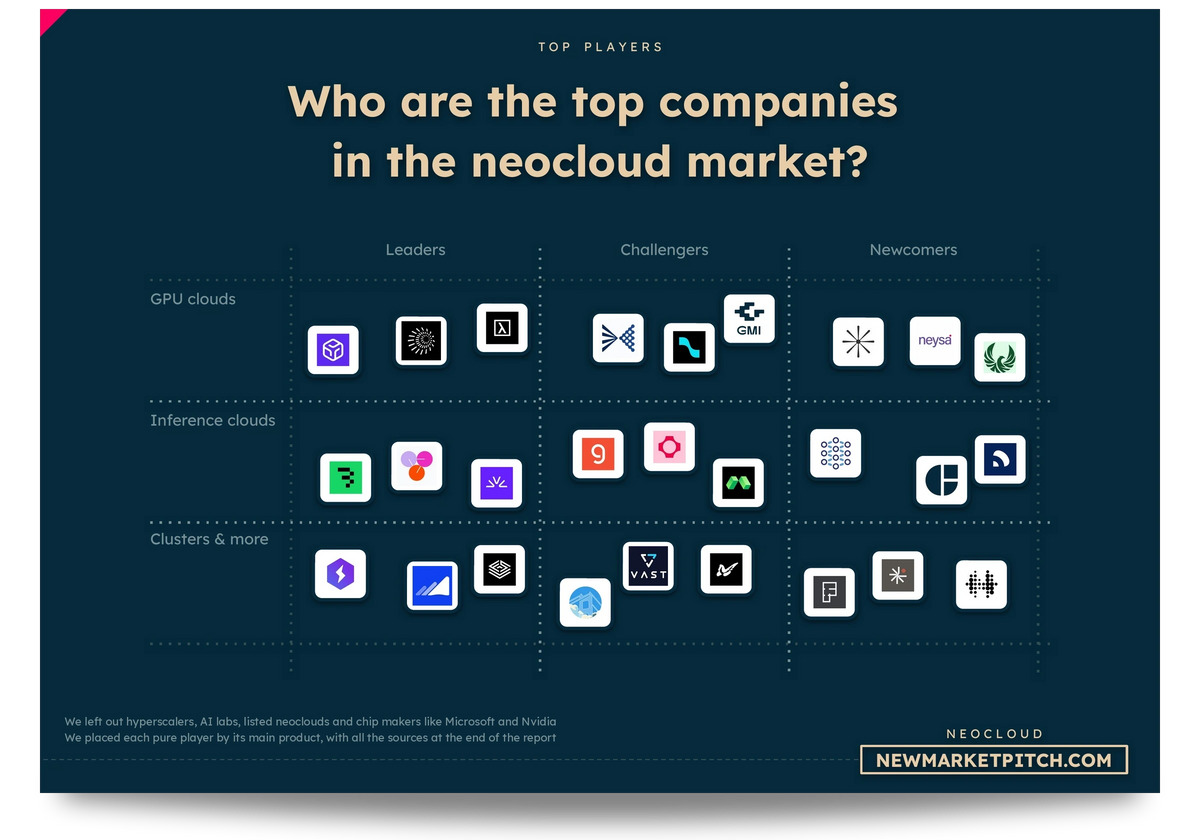
In our report covering the neocloud market, we turn what is vague and complex into simple, useful visuals. Market maps like this one show you at a glance where every startup stands.
The ranking of top startups in the neocloud market by revenue
Below is a table ranking the startups of this market by their current revenue scale. You can find our methodology at the end of this page.
If you want a deeper understanding of the market and its current dynamics, get our report on the neocloud market.
| Ranking | Company | Latest Metric | Metric Type | Freshness | Disclosed When | Source Quality | Confidence | Segment | Why This Ranking | Local Metric | Country |
|---|---|---|---|---|---|---|---|---|---|---|---|
| 1 | CoreWeave | $5.13B | Fiscal-Year Revenue | Fresh · 11mo | Mar 2, 2026 | Filed / Audited | High | GPU Cloud Compute | A regulatory filing records $5.13B of fiscal-year revenue for 2025. This completed-year measure is stronger evidence than the annualized figures used by many inference competitors. | us | |
| 2 | Fireworks AI | >$1B | Revenue Run-Rate | Very Fresh · 4mo | Jul 15, 2026 | Company Disclosed | Medium | Inference Cloud Services | The company disclosed >$1B of annualized revenue run-rate in July 2026. It indicates current selling pace, not completed-year recognized revenue. | us | |
| 3 | Modal | >$1B | Revenue Run-Rate | Very Fresh · 1mo | Oct 14, 2026 | Company Disclosed | Medium | Inference Cloud Services | Annualized revenue run-rate as of Oct 2026 disclosed by the company. ARR and run-rates annualize current sales; they are not recognized revenue. Close to Fireworks AI, at >$1B against >$1B. | us | |
| 4 | fal | $800M | Revenue Run-Rate | Very Fresh · 2mo | Sep 25, 2026 | Credible Reported | Medium | Inference Cloud Services | Annualized revenue run-rate as of Sep 2026 reported by the press. ARR and run-rates annualize current sales; they are not recognized revenue. | us | |
| 5 | Baseten | $600M | Revenue Run-Rate | Fresh · 8mo | May 26, 2026 | Credible Reported | Medium | Inference Cloud Services | Annualized revenue run-rate as of Mar 2026 reported by the press. ARR and run-rates annualize current sales; they are not recognized revenue. | us | |
| 6 | Lambda | >$520M | TTM Revenue | Fresh · 14mo | Jan 8, 2026 | Credible Reported | Medium | GPU Cloud Compute | Trailing twelve-month revenue for the year to Sep 2025 reported by the press. Ahead of Lightning AI, whose smaller figure is better documented. | us | |
| 7 | Lightning AI | >$500M | ARR | Fresh · 10mo | Jan 21, 2026 | Company Disclosed | Medium | Managed AI Training Platforms | Annual recurring revenue (ARR) as of Jan 2026 disclosed by the company. ARR and run-rates annualize current sales; they are not recognized revenue. Close to Lambda, at >$500M against >$520M. | us | |
| 8 | RunPod | >$325M | ARR | Very Fresh · 1mo | Oct 13, 2026 | Company Disclosed | Medium | GPU Cloud Compute | Annual recurring revenue (ARR) as of Oct 2026 disclosed by the company. ARR and run-rates annualize current sales; they are not recognized revenue. | us | |
| 9 | Fluidstack | $200M | Annual Revenue | Fresh · 11mo | Sep 3, 2026 | Credible Reported | Medium | Dedicated AI Clusters | Annual revenue for the year to Dec 2025 reported by the press. Ahead of Cerebras Systems, whose smaller figure is better documented. | us | |
| 10 | Cerebras Systems | $152M | Segment Revenue | Fresh · 11mo | May 4, 2026 | Company Disclosed | Medium | Inference Cloud Services | Revenue of one segment for 2025 disclosed by the company. Only the neocloud part of its revenue is ranked; the company also sells outside this market. | us | |
| 11 | IREN | $129M | Segment Revenue | Very Fresh · 3mo | Aug 27, 2026 | Company Disclosed | Medium | GPU Cloud Compute | Revenue of one segment for the year to Aug 2026 disclosed by the company. Only the neocloud part of its revenue is ranked; the company also sells outside this market. | au | |
| 12 | Aethir | >$128M | Annual Revenue | Fresh · 11mo | Jan 15, 2026 | Company Disclosed | Medium | GPU Cloud Compute | Annual revenue for the year to Dec 2025 disclosed by the company. Close to IREN, at >$128M against $129M. Ahead of Verda, whose figure is an annualized run-rate. | sg | |
| 13 | Verda | ~$120M | Revenue Run-Rate | Very Fresh · 5mo | Aug 6, 2026 | Company Disclosed | Medium | GPU Cloud Compute | Annualized revenue run-rate as of Jun 2026 disclosed by the company. ARR and run-rates annualize current sales; they are not recognized revenue. Close to Aethir, at ~$120M against >$128M. | fi | |
| 14 | DeepInfra | >$105M | Revenue Run-Rate | Very Fresh · 2mo | Sep 29, 2026 | Company Disclosed | Medium | Inference Cloud Services | Annualized revenue run-rate as of Sep 2026 disclosed by the company. ARR and run-rates annualize current sales; they are not recognized revenue. | us | |
| 15 | Prime Intellect | >$100M | Revenue Run-Rate | Very Fresh · 4mo | Jul 8, 2026 | Company Disclosed | Medium | Sovereign & Distributed AI Cloud | Annualized revenue run-rate as of Jul 2026 disclosed by the company. ARR and run-rates annualize current sales; they are not recognized revenue. Close to DeepInfra, at >$100M against >$105M. | us | |
| 16 | Andromeda | >$100M | Revenue Run-Rate | Period not stated · collected 8mo ago | Period not stated | Company Disclosed | Low | GPU Cloud Compute | Annualized revenue run-rate, period not stated (collected Mar 2026) disclosed by the company. ARR and run-rates annualize current sales; they are not recognized revenue. Close to Prime Intellect, at >$100M against >$100M. | us | |
| 17 | Ori Industries (now Radiant) | $40M | ARR | Historical · 32mo | Oct 2024 | Credible Reported | Low | GPU Cloud Compute | Annual recurring revenue (ARR) as of Mar 2024 reported by the press. ARR and run-rates annualize current sales; they are not recognized revenue. The figure is more than 30 months old. Ahead of Nscale, whose smaller figure is better documented. | gb | |
| 18 | Nscale | $33M | Fiscal-Year Revenue | Fresh · 11mo | Sep 18, 2026 | Filed / Audited | High | Dedicated AI Clusters | Fiscal-year revenue for the year to Dec 2025 from a regulatory filing. A more recent partial figure is $141M for the six months to Jun 2026. Ranks below Ori Industries (now Radiant), whose larger figure is an annualized run-rate. | gb | |
| 19 | Gimlet Labs | >$10M | Partial-Period Revenue | Period not stated · collected 8mo ago | Period not stated | Company Disclosed | Low | Inference Cloud Services | Revenue for part of a year, period not stated (collected Mar 2026) disclosed by the company. It covers only part of the year or of the business, so it is ranked as a minimum. | us | |
| 20 | TensorX | ~$5.68M | ARR | Very Fresh · 2mo | Sep 24, 2026 | Company Disclosed | Medium | Sovereign & Distributed AI Cloud | Annual recurring revenue (ARR) as of Sep 2026 disclosed by the company. ARR and run-rates annualize current sales; they are not recognized revenue. | EUR 5M | ie |
| 21 | SiliconFlow | ~$4.18M | Segment Revenue | Fresh · 11mo | Jul 2026 | Filed / Audited | Medium | Inference Cloud Services | Revenue of one segment for the year to Dec 2025 from a regulatory filing. Only the neocloud part of its revenue is ranked; the company also sells outside this market. | CNY 29.3M | cn |
| NR | Crusoe | $124M | Segment Revenue | Aging · 23mo | Dec 17, 2024 | Third-Party Estimate | Low | GPU Cloud Compute | Analyst estimate of revenue of one segment for the year to Dec 2024, not a company figure; a single analyst estimate with no second independent source, so it is shown without a rank. | us | |
| NR | Firmus | $50.8M | Fiscal-Year Revenue | Very Fresh · 5mo | Oct 29, 2026 | Credible Reported | Medium | Dedicated AI Clusters | Fiscal-year revenue for the year ended Jun 2026 reported by the press; the company also sells outside this market and its neocloud share is not published (share not published), so it is shown without a rank. | au | |
| NR | Groq | >$40M | Segment Revenue | Fresh · 11mo | 2026 | Third-Party Estimate | Low | Inference Cloud Services | Analyst estimate of revenue of one segment for the year to Dec 2025, not a company figure; a single analyst estimate with no second independent source, so it is shown without a rank. | us | |
| NR | Together AI | $1.15B (bookings, not revenue) | Bookings | Very Fresh · 5mo | Jul 1, 2026 | Company Disclosed | Medium | Managed AI Training Platforms | Bookings as of Jun 2026 disclosed by the company; not revenue, so it is not ranked against revenue figures. | us | |
| NR | TensorWave | >$100M (forecast, not revenue) | Revenue Forecast | Forecast | May 14, 2025 | Company Disclosed | Medium | GPU Cloud Compute | Revenue forecast for the year to May 2025 disclosed by the company; not revenue, so it is not ranked against revenue figures. | us | |
| NR | PaleBlueDot AI | >$5B (contract value, not revenue) | Contract Value | Very Fresh · 2mo | Oct 1, 2026 | Company Disclosed | Medium | GPU Cloud Compute | Contract value for the year to Sep 2026 disclosed by the company; not revenue, so it is not ranked against revenue figures. | us | |
| NR | Volta | $10B (contract value, not revenue) | Contract Value | Period not stated · collected 3mo ago | Period not stated | Company Disclosed | Medium | Dedicated AI Clusters | Contract value, period not stated (collected Aug 2026) disclosed by the company; not revenue, so it is not ranked against revenue figures. | us | |
| NR | GMI Cloud | >$600M (bookings, not revenue) | Bookings | Very Fresh · 1mo | Oct 1, 2026 | Company Disclosed | Medium | GPU Cloud Compute | Bookings as of Oct 2026 disclosed by the company; not revenue, so it is not ranked against revenue figures. | us | |
| NR | Sharon AI | $1.93M | Quarterly Revenue | Very Fresh · 5mo | Aug 6, 2026 | Company Disclosed | Medium | GPU Cloud Compute | The company disclosed $1.93M of quarterly revenue for the second quarter of 2026. A single quarter is not annualized into a yearly rank. | au | |
| NR | Hydra Host | >$300M (GMV, not revenue) | GMV | Fresh · 12mo | Nov 4, 2025 | Credible Reported | Medium | GPU Capacity Marketplaces | GMV (gross merchandise value) for the year to Nov 2025 reported by the press; not revenue, so it is not ranked against revenue figures. | us | |
| NR | General Compute | $100M (bookings, not revenue) | Bookings | Very Fresh · 1mo | Oct 27, 2026 | Credible Reported | Medium | Inference Cloud Services | Bookings as of Oct 2026 reported by the press; not revenue, so it is not ranked against revenue figures. | us | |
| NR | Replicate | >2M users | Users | Historical · 35mo | Dec 5, 2023 | Credible Reported | Medium | Inference Cloud Services | The press reported >2M users in December 2023. Cloudflare later acquired Replicate; users are not a revenue measure. | us | |
| NR | San Francisco Compute | $245M (contract value, not revenue) | Contract Value | Period not stated · collected 2mo ago | Period not stated | Company Disclosed | Medium | GPU Capacity Marketplaces | Contract value, period not stated (collected Sep 2026) disclosed by the company; not revenue, so it is not ranked against revenue figures. | us |

Our research about neoclouds gets updated several times a month, so you always get the latest view of where things stand.
Why are neocloud startups making so much money now?
Neocloud startups are making real money because AI companies need computing power every time they train a model or serve a customer.
The need has grown beyond the occasional research experiment. CoreWeave sells dedicated GPU clusters for large jobs. Lambda rents GPUs and whole clusters. Modal lets developers run code and AI workloads without setting up servers, while Fireworks AI serves models through an API. These products meet different needs, so customers can buy from several providers at once.
The more interesting change is what happens after an AI product launches. A training job eventually ends, but a popular application keeps sending inference requests. Fireworks AI said in its 2026 funding announcement that its infrastructure was processing more than 40 trillion tokens a day. That is evidence of continuing usage, although token volume alone tells us nothing about profit.
We see a bigger market for both long-running GPU capacity and on-demand execution. The companies collecting the most revenue are those that turn that computing need into a service customers repeatedly pay for.
Is CoreWeave still the biggest neocloud startup by revenue?
Yes, CoreWeave is still the number-one neocloud startup by revenue, with $5.13B of fiscal-year sales in 2025.
That figure records a completed financial year. Fireworks AI and Modal have impressive annualized run-rates, but neither measure represents the same thing as a full year of recognized sales. We would not call one of them the biggest on that basis.
CoreWeave's annual filings show how the company got here: it supplies purpose-built AI clusters and signs substantial commitments with customers that need dependable capacity. The other side of that business is expensive. Servers, data-center space and financing consume cash well before every dollar of contracted work turns into sales.
CoreWeave went public in 2025, so it is still young enough as a public company to count as a startup. Amazon, Microsoft and Google sell cloud computing too, but they are established groups, not startups in this comparison. CoreWeave leads the startup revenue race; its losses show why leading on sales is a different achievement from leading on profits.

In our market report about neoclouds, we look at what the winners do differently, so you can learn from the best instead of guessing.
Are Fireworks AI and Modal already billion-dollar neocloud businesses?
Fireworks AI and Modal are billion-dollar neocloud businesses on a run-rate basis, each with >$1B of annualized revenue disclosed, though neither has published an equivalent completed-year figure yet.
Fireworks AI disclosed its milestone in July 2026, and Modal disclosed its own in October. Both amounts describe current sales annualized, and both are minimums. They cannot establish an exact gap between the companies.
Their products also differ. Fireworks AI focuses on hosting and serving AI models for developers, including customized ones. Modal runs serverless code, AI workloads and isolated sandboxes used by agent software. In its October announcement, Modal said usage had tripled over five months; Fireworks AI pointed to the scale of daily model execution.
We think these announcements show two ways for inference companies to grow: charge for each model request, or charge for the computing work around that request. What remains unproven is how much of either annualized pace will appear in the next completed financial year.
Has Together AI really reached a billion dollars in sales?
Together AI has disclosed $1.15B of bookings, which are not revenue, but it has not established billion-dollar recognized annual sales through a company filing.
The figure is bookings as of June 2026, disclosed by the company. That makes it different from a revenue number. Together AI sells computing for training, fine-tuning and serving open models, so there is a real commercial service behind the figure. The uncertainty lies in how much revenue that service has actually produced during a completed reporting period.
The distinction becomes important when we compare Together AI with fal. fal's annualized figure comes from press reporting, while Together AI's is a company-disclosed bookings figure, not revenue. Both suggest substantial demand for hosted AI models, but we have stronger evidence for one than the other.
There is no reason to treat a bookings figure as a verified customer invoice. Together AI may be a very large neocloud business, but a neat headline number is not the same thing as an audited result.

In our document detailing everything you need to know about neocloud, you will always find fresh funding data, taken straight from our own verified funding database.
Are AI inference startups making more money than GPU cloud providers?
No, current neocloud revenue figures do not show inference providers out-earning GPU cloud operators.
Inference startups report large annualized run-rates, while dedicated GPU clouds still produce enormous completed-year sales.
Inference services charge customers for running models or code. GPU cloud providers usually charge for accelerator instances or reserved clusters. The businesses overlap: the inference company may itself pay a GPU cloud to supply the machines behind its API. Adding their sales together would double-count parts of the same spending chain.
Fireworks AI, fal and Baseten show that inference is already a serious business. CoreWeave and Lambda show that customers continue to pay for direct access to computing capacity. Those numbers cover different periods and accounting measures, so they cannot settle which category earns more across the market.
The practical difference is what the customer wants to manage. A research team with a long training job may rent a dedicated cluster. An app developer sending occasional model requests may prefer an inference endpoint. Both can grow as AI use increases.
The table below shows how selected neoclouds describe their sales, without treating ARR and run-rates as completed-year revenue.
| neocloud | Figure | Measure | Period |
|---|---|---|---|
| Together AI | $1.15B | Bookings | Jun 2026 |
| fal | $800M | Revenue run-rate | Sep 2026 |
| Baseten | $600M | Revenue run-rate | Mar 2026 |
| Lambda | >$520M | TTM revenue | Sep 2025 |
| Lightning AI | >$500M | ARR | Jan 2026 |
| RunPod | >$325M | ARR | Oct 2026 |
| Crusoe | $124M | Segment estimate | 2024 |
Why is fal making so much money from AI images and video?
fal is making money by running image, video and audio models for other businesses, with $800M of revenue run-rate reported for September 2026.
A video-editing app, for example, can call fal's infrastructure to generate clips rather than buy GPUs and manage model servers. fal is paid for that underlying execution. It does not need every end user to download a fal-branded app.
That makes the company different from a model developer selling access to one proprietary model. A hosted inference platform can add new models as customers ask for them. It can also serve several different applications with the same underlying infrastructure. The Information reported the annualized figure as demand for inference grew, and TechCrunch later described another large financing linked to that demand.
Strong sales do not automatically mean strong margins. The computing needed to generate media is expensive, and customers can compare providers on speed and price. fal has shown that creative AI can support a large cloud business. Its next challenge is keeping enough of each customer payment after paying to run the models.

Learning from others' mistakes is the cheapest lesson there is. In our report covering the neocloud market, we look at what broke startups before you, so you don't repeat it.
Why are companies paying Baseten to run their AI models?
Companies pay Baseten for reliable AI inference without having to build and operate the serving infrastructure themselves.
The Information reported $600M of annualized revenue run-rate for March 2026. This measures a current pace, not sales earned across an audited financial year. It tells us the business is large; it does not reveal margins or customer retention.
Baseten handles model deployment and the work needed to keep applications responding when traffic changes. A team running customer-facing AI cares about latency, uptime and how much each response costs. Those problems get more difficult once a prototype becomes a product used all day.
Competition is serious. Fireworks AI, Modal and cloud infrastructure providers offer overlapping ways to run models. We think Baseten's strongest argument is the engineering work it saves customers. Switching away from a deployed model service may require rebuilding workflows and testing reliability, even if another provider offers cheaper GPUs.
That advantage has limits. We cannot infer how long contracts last from a run-rate alone, and falling inference prices may put pressure on everyone. The reason Baseten earns revenue is clear; how much profit it can keep is less clear.
Is Lambda still making serious money from GPU rentals?
Yes, Lambda is still earning substantial neocloud revenue from GPU capacity, with >$520M of trailing-twelve-month sales through September 2025.
Press reports gave that figure for a completed twelve-month period. It is a different kind of evidence from an inference startup's current annualized pace.
Lambda's product offering ranges from on-demand GPUs to dedicated, interconnected clusters and single-tenant supercomputers. A team training a large model may need uninterrupted access to the same machines for days or weeks. Renting a managed model endpoint would not solve that problem in the same way.
Lightning AI offers an interesting comparison because it joins developer software with computing infrastructure. Both sell access to AI compute, but their published financial measures differ. We cannot tell which is currently growing faster just by placing the two figures side by side.
The bigger point is that serverless inference has not made dedicated GPU capacity irrelevant. Some customers want a simple API; others need direct control over hardware, networking and long jobs. Lambda earns money from that second group, and those workloads are unlikely to disappear just because AI applications are becoming easier to deploy.

Your time is limited. In our research about neoclouds, we put numbers on each part of the market, so you can see where it makes sense to focus.
Is Lightning AI really a half-billion-dollar cloud business?
Lightning AI is a large neocloud business on an annual recurring revenue basis, with >$500M of ARR disclosed in January 2026.
ARR is a measure of recurring annualized sales, not a complete year's recognized revenue. There is another important detail: Lightning AI merged with GPU infrastructure operator Voltage Park in January 2026.
The combination joined software for developing and deploying models with access to the GPUs that run them. Developers no longer need to manage as many separate tools and infrastructure suppliers. That is a practical reason customers might spend more with one provider.
It also makes the financial story harder to compare with a pure software startup. Some payments cover software, while others reflect costly equipment and computing services. Hardware costs can be much larger even when the recurring-sales headline sounds like a SaaS business.
We include Lightning AI because it sells actual AI computing capacity. The merger makes its current scope broader, and it means a simple before-and-after revenue comparison would be misleading without separate numbers for the combined businesses.
Is RunPod growing beyond its original GPU rental business?
RunPod is growing into a broader AI cloud, with >$325M of ARR disclosed in October 2026.
The company began with a developer-friendly way to rent GPUs, but its current products also serve teams deploying production AI workloads. RunPod said it had more than 1.2 million registered developers when it announced the recurring-sales figure. That is a useful sign of reach, although registered users are not the same as paying customers.
Its September 2026 compute report described developers choosing hardware more carefully and using quantization or smaller models to control costs. A company built only on selling the most expensive GPU by the hour would find that trend uncomfortable. RunPod can also benefit when customers need flexible infrastructure for different kinds of workloads.
The company still has to turn experimentation into long-term usage. Enterprise customers want networking, reliability and security as well as cheap GPU hours. RunPod has moved toward those needs, which explains why it now looks more like an AI infrastructure platform than a simple rental marketplace.

In our market report about neoclouds, we always try to gather several sources and make estimates that make sense, so you can work with solid numbers.
Has Crusoe's data-center boom turned into real cloud sales?
Crusoe is selling real GPU cloud services, but the public revenue figure is older and less certain than its recent infrastructure announcements.
Sacra estimated $276M of annual revenue for 2024. That is an analyst estimate covering the wider business, not a fresh, audited result for GPU cloud alone.
Crusoe offers customer-facing GPU instances and longer-term computing capacity. It also builds the physical facilities needed to run those machines. A data-center construction agreement, however, does not prove that customers have already paid for completed cloud work. First the site needs power and equipment; then the service must be delivered.
Crusoe and Fluidstack raise the same issue for anyone reading their headline contracts. Both can announce large facilities before the resulting revenue appears in a completed reporting period. Until those sales show up, a published revenue figure says more than a guess about how busy the new sites will be.
Crusoe's cloud business is genuine. What we cannot claim from the available figure is how quickly its newer data-center projects have increased earned cloud revenue.
Has Fluidstack earned as much as its huge AI contracts suggest?
No, Fluidstack has earned substantial neocloud revenue, but its biggest infrastructure contracts describe much more work than it has already recognized as sales.
Press reports put Fluidstack's annual revenue at $200M for 2025. That is a completed-year figure. A long-term agreement to deliver computing capacity across future years is not the same kind of number.
Fluidstack supplies large AI computing installations, often with significant networking and dedicated hardware. Delivering such projects takes time. Equipment must be financed and installed, and customers must begin receiving the service before the company can recognize the corresponding revenue.
Compare that with an inference platform such as fal. Model requests can start generating revenue as soon as customers use the service. Fluidstack's biggest deals may take longer to reach a reported financial statement, even when the eventual contract value is much larger.
The difference also applies to Nscale, which is expanding dedicated AI infrastructure while reporting sales from an earlier fiscal year. We think these operators are worth watching because their contracts may support future business. For a revenue ranking today, though, completed service matters more than the size of the announcement.

If you build or invest in the neocloud market, you need to know which business models pay off now and which ones are fading. That's why our report covering it has a whole section on it.
Are Cerebras Systems and Groq actually neocloud companies?
Yes, Cerebras Systems and Groq both sell cloud inference, although each also makes specialized AI hardware.
Cerebras Systems disclosed $152M of fiscal-2025 segment revenue tied to its cloud inference business. Groq has an analyst-estimated >$40M of fiscal-2025 segment revenue. These are neocloud-related amounts, not the full revenue of either company.
Cerebras builds wafer-scale computing systems as well as offering cloud execution. Groq makes inference processors and lets customers run models on its infrastructure. A chip sale and a paid cloud request serve different buyers and appear differently in revenue accounts.
We therefore focus on the cloud-service share when it is available. A hardware company can earn heavily from equipment sales while operating a smaller service business. Another provider may sell less hardware but have constant inference usage. Mixing both streams would make the cloud comparison meaningless.
The products are real; the financial question is narrower. Cerebras and Groq belong in neocloud because customers can pay them to run workloads, but neither should receive credit here for unrelated hardware sales.
Is IREN becoming an AI cloud company instead of a bitcoin miner?
IREN is now selling AI cloud computing, but its neocloud revenue still needs to be separated from its other activities.
IREN disclosed $129M of AI Cloud Services segment revenue for fiscal 2026. We use that segment because group-wide figures would include business outside accelerator cloud services.
The company's August 2026 results show a business repurposing infrastructure and targeting customers such as Cohere, Perplexity and Figure AI. These names matter because they point to actual demand for computing services, not only plans for future server buildings.
IREN has also discussed future contracted annualized income. Those commitments may help explain its expansion, but contracted future work is not the same as services already delivered. That distinction is especially important when a company is changing the way it earns money.
We see IREN as a working example of a power-and-infrastructure operator moving into the cloud market. Its AI service revenue is real, and its remaining business lines are real too. Only the first belongs in this neocloud comparison.

In our report covering the neocloud market, we don't want to repeat what boring consulting reports say. Instead, we show you the real and latest market signals that matter.
Can decentralized GPU clouds actually make money?
Yes, Aethir has shown that decentralized GPU cloud computing can generate completed-year revenue, with >$128M reported for 2025.
Aethir aggregates GPU resources across a distributed network. Customers still need reliable access to functioning machines, so operating a decentralized service involves much more than collecting hardware pledges. Its January 2026 review described commercial compute delivery across regions and uses.
Prime Intellect offers a related but different model. It combines distributed computing access with training and post-training tools, and its July 2026 announcement described customers using that stack. These are ways to sell computing without relying on one traditional, centralized cloud design.
DeepInfra has also disclosed meaningful annualized inference sales, and Andromeda sells flexible GPU capacity through a marketplace. The business models differ: model execution, distributed training and matching buyers with available hardware do not have the same cost structure.
None of these examples proves that decentralization automatically makes computing cheaper. What they do establish is that customers will pay for alternative ways to get AI capacity, provided the service actually works.
Are European neocloud startups catching up with US companies in revenue?
European neocloud startups are making real sales, but the largest disclosed US businesses are still far bigger on their stated measures.
Finland's Verda reports ~$120M of revenue run-rate as of June 2026. The British provider Nscale reported $33M of fiscal-2025 revenue. These are different kinds of figures and cannot be added into a meaningful regional total.
Verda sells AI cloud capacity and said in August 2026 that its business had grown tenfold over the preceding 18 months. Nscale sells dedicated AI infrastructure and has reported newer partial-period activity in its filings, though its latest full-year figure is older. Ireland's TensorX focuses on inference cloud, where recurring annualized sales are another common measure.
The US comparison is hard to avoid: CoreWeave has completed-year revenue on a scale none of these European disclosures matches. Still, a smaller reported figure does not automatically mean weak demand. Large sovereign and dedicated cluster projects can take time to turn into earned sales.
The table below shows selected non-US neocloud startups and the financial measures they have actually published.
| neocloud | Figure | Measure | Period | Country |
|---|---|---|---|---|
| IREN | $129M | Segment revenue | FY2026 | Australia |
| Aethir | >$128M | Annual revenue | 2025 | Singapore |
| Verda | ~$120M | Revenue run-rate | Jun 2026 | Finland |
| Firmus | $50.8M | Fiscal-year revenue | FY2026 | Australia |
| NexGen Cloud | ~$50.1M | Fiscal-year estimate | FY2025 | UK |
| Nscale | $33M | Fiscal-year revenue | FY2025 | UK |
| SiliconFlow | ~$4.18M | Segment revenue | 2025 | China |
| TensorX | ~$5.68M | ARR | Sep 2026 | Ireland |

In our research about neoclouds, we like to show you the big picture. We know your time is precious, so we make every page quick to read and packed with as much learning as possible per minute.
Are GPU marketplaces making money or just processing transactions?
Andromeda reports annualized neocloud revenue, while other GPU marketplaces disclose transactions that are not the operator's own sales.
Andromeda has disclosed >$100M of revenue run-rate, although it did not state the measurement period. San Francisco Compute reported $245M of contract value. Hydra Host reported >$300M of gross merchandise value. A contract and the total value traded through a platform are not equivalent to the amount the company recognizes as revenue.
A marketplace may connect someone who owns GPUs with a customer who needs them. Depending on how the contract works, the platform may earn a fee rather than the entire value of the computing delivered. San Francisco Compute has also discussed resale of unused reserved capacity, which adds another layer between the original machine owner and the final user.
Flexible marketplaces can reduce idle GPUs and help companies buy capacity for unpredictable workloads. That gives them a useful commercial role. But we would exaggerate their sales if we treated every dollar of booked or traded compute as money earned by the platform itself.
Why do neoclouds announce billions in contracts without showing the same revenue?
Neocloud contracts often cover computing that will be delivered in the future, so big deal values do not mean equally big revenue today.
Volta disclosed $10B of contract value for a planned AI factory, while GMI Cloud reported >$600M of bookings. Those amounts may signal serious customer demand, but neither is completed-year sales. General Compute has also reported bookings, and San Francisco Compute has disclosed future contract value.
Infrastructure projects make this gap especially visible. A customer signs for capacity, the supplier arranges financing and equipment, and construction or installation begins. Revenue comes later, as the contracted computing service is actually supplied. The same basic distinction applies to a smaller service business that signs a customer before all the work is done.
TensorWave's forecast and Sharon AI's quarterly revenue show two more reasons not to treat every headline as a yearly result. A forecast is about the future; a single quarter is a shorter period that we do not multiply into a fictitious annual amount.
These companies may develop substantial businesses. Right now, the clearest answer to who earns the most is based on revenue already recognized, not what customers have promised to spend.

When you build or invest in the neocloud market, you need clarity, not confusion. In our market report about neoclouds, we always try to put numbers on and quantify whatever is usually vague and confusing.
Will cheaper AI computing hurt neocloud revenue growth?
Cheaper AI computing could hurt the revenue of neoclouds selling raw GPU hours, but it could also bring more customers to managed inference services.
CoreWeave and Lambda must keep expensive hardware busy. Fireworks AI, fal and Baseten charge for services built on top of computing, so the impact of cheaper hardware depends on whether they lower prices, keep some savings or attract more usage.
Falling prices are not a straight-line trend. RunPod's September 2026 compute report described pressure on some flagship GPU prices while developers were also using smaller models and quantization to spend less. A customer can therefore face scarce, costly hardware in one workload and find big efficiency gains in another.
A GPU renter may lose pricing power if similar machines become widely available. An inference platform might gain from cheaper execution, provided rivals do not force all savings into lower prices. A dedicated-cluster operator has to manage equipment and financing commitments over longer periods.
We think the next financial test is straightforward: which companies keep customers using their capacity, and which retain healthy margins as the cost per AI task changes?
So, which neocloud startups make the most money today?
CoreWeave makes the most money among neocloud startups today on completed fiscal-year revenue.
Fireworks AI and Modal follow CoreWeave, each on a large annualized revenue run-rate rather than completed-year sales. fal appears next on a press-reported run-rate, which is less certain than a company disclosure. That difference in evidence matters as much as the displayed order.
Inference providers such as fal and Baseten are collecting substantial fees for serving models. Lambda shows that GPU rental and dedicated clusters still earn real revenue. Lightning AI blends developer software with direct compute; RunPod serves developers and larger production teams. Different customer needs support more than one cloud model.
We would not treat bookings from GMI Cloud, Volta or General Compute as revenue, no matter how large the announced deals become. And we would not assume that a fast run-rate guarantees profit. CoreWeave's lead is well established; the next big question is whether the fastest-growing inference providers can keep that pace through a full financial year.
The table below shows what we found.
| Question | Answer |
|---|---|
| Has the biggest GPU cloud made a profit? | No, CoreWeave still reported losses alongside enormous sales. Its reported fiscal-year revenue reached $5.13B in 2025. The infrastructure needed to earn those sales remains costly. |
| Have serverless inference companies reached major scale? | Yes, Fireworks AI and Modal report substantial annualized activity. Each disclosed >$1B in annualized revenue run-rate recently. Neither figure is completed-year recognized revenue for the same period. |
| Could an estimated sales pace mislead readers? | Yes, bookings are less certain than a filed result. Together AI disclosed $1.15B of bookings, which is not revenue and is shown without a rank. That amount cannot be treated as an audited financial year. |
| Is creative AI producing serious cloud revenue? | Yes, fal charges developers to run image and video models. Its reported revenue run-rate reached $800M in September 2026. Computing costs still shape what fal can keep. |
| Is enterprise model hosting already a big business? | Baseten earns money by running models for production applications. Its reported annualized revenue run-rate was $600M in March 2026. Contract retention and profit remain separate questions for investors. |
| Do customers still pay for dedicated GPUs? | Yes, Lambda continues selling reserved AI computing capacity. It recorded >$520M of trailing-twelve-month revenue through September 2025. That measure differs from an inference provider's current run-rate. |
| Can one company sell software and GPUs? | Yes, Lightning AI combines development tools with direct computing capacity. It disclosed >$500M of ARR after joining Voltage Park. That business carries hardware costs as well as software income. |
| Are developer GPU clouds moving into enterprise use? | Yes, RunPod serves developers and growing production workloads. It disclosed >$325M of ARR in October 2026. Registered users still cannot be equated with paying customers. |
| Can distributed GPU networks earn real sales? | Yes, Aethir reported revenue from its distributed computing network. Aethir's annual revenue was >$128M for 2025. Reliability still matters as much as where GPUs are located. |
| Is Europe building a serious AI cloud business? | Yes, Verda is selling AI computing across Europe. It disclosed ~$120M of revenue run-rate as of June 2026. That figure remains below the biggest US disclosures in scale. |
| Are giant compute agreements equal to sales? | No, a signed contract can cover years of future service. Volta disclosed $10B of contract value tied to infrastructure. Money is earned only as the computing gets delivered. |

It's easy to get lost in the details. In our report covering the neocloud market, we give you some perspective first, so you see the whole market before you make a move.
Our methodology
Our data runs through November 12, 2026. We define neocloud as the commercial supply of AI-optimized compute, including rented accelerators, dedicated training clusters and managed inference that executes customer models. We include credible adjacent providers when they actually sell AI computing, rather than excluding them over narrow product boundaries. Every ranked company satisfies our startup definition: founded in 2000 or later, built for rapid technological growth and founder-, venture-, angel- or grant-backed, with recent public listings and recently acquired businesses retained. Established technology groups remain outside the ranking.
We examined company announcements, annual reports, regulatory filings, investor materials and reputable media spanning the past ten years. Providers disclose financial scale as fiscal-year revenue, annual recurring revenue, current revenue run-rate, segment sales or partial-period revenue. We never silently convert one into another. Bookings, gross merchandise value, total contracts, financing, forecasts and customer counts are not treated as revenue, and we do not invent sales from product pricing or user estimates.
We retain one figure per company: first favoring a figure no older than 18 months, then the strongest evidence, from filings and direct company disclosures to reporting, analyst estimates and finally automated third-party estimates. Among comparable-quality disclosures we favor complete annual revenue over ARR and run-rate, and those over partial periods or segment figures. Companies are ordered by the retained figure, with the midpoint used for a range and the lower bound for a minimum. A disclosure more than three years old, or one that is not actual revenue or its explicitly annualized recurring equivalent, receives no rank. For diversified companies, we use a published neocloud segment; if the relevant share is not published, we do not rank whole-company revenue as neocloud sales.
Our freshness labels are Very Fresh, Fresh, Aging and Historical, based on elapsed months since the financial period ended; period-unspecified disclosures are labeled separately. High confidence means a recent, exact fiscal-year amount from a filing or company. Medium covers ARR, run-rates, partial periods, press-reported figures, minimums and older disclosures around 18 to 30 months. Low covers all estimates, wide ranges and figures older than 30 months. Non-dollar amounts are translated at fixed exchange rates while preserving their original currencies. A very large automated estimate cannot be ranked without a corroborating source.
The central objection is that a large estimated run-rate may appear above a smaller audited sales figure, and the measures may cover different dates. We keep that difference visible rather than pretend all the figures are the same kind: each amount states its type, period, source quality and confidence. The ordered list shows the strongest currently available indication of commercial scale, not a ledger of equally audited yearly revenues. That makes comparisons more useful while preventing forecasts, bookings and whole-company sales from taking credit for neocloud revenue they have not established.
Key sources include CoreWeave fiscal-year revenue and infrastructure costs, CoreWeave financial release and contract backlog, Fireworks AI revenue run-rate and inference volume, Modal revenue run-rate and expansion into agent workloads, Together AI analyst run-rate estimate, fal revenue run-rate reporting, fal funding, model serving and inference margin context, Baseten annualized sales reporting, Lambda's commercial GPU instances and dedicated clusters, Lightning AI and Voltage Park merger details, RunPod ARR and developer growth, RunPod study of GPU pricing and workload patterns, Crusoe customer-facing GPU compute offering, Cerebras hardware and cloud segment distinctions, IREN AI cloud services revenue and operating transition, Aethir annual sales and distributed GPU operations, Prime Intellect revenue pace, customers and services, Verda annualized revenue and growth, Nscale annual revenue, partial-period sales and commitments, San Francisco Compute contract values and resale model, Volta strategic contract and infrastructure commitments, DeepInfra annualized pace and token demand, and Ori Industries combination with Brookfield-backed Radiant.

In our research about neoclouds, we try to remove everything that could confuse you, especially if you're investing or building in this market.
Written by the New Market Pitch teamWe track new markets so founders and investors can move faster. About us