Physical AI: what are the biggest unsolved problems?
Whether you're building or investing in the physical AI market, our report covers everything you need to know: the players, the money, and what's coming next.
Summary
The biggest unsolved problems in physical AI are generalization, long-task reliability and dexterous manipulation. Robots can already perform valuable work in factories, warehouses and autonomous vehicles, but adapting to unfamiliar tasks, recovering from mistakes and handling unpredictable objects remain the biggest barriers to general-purpose autonomy.
The gap between laboratory performance and everyday competence is enormous. Robotic systems have reached 89.4% average success on RLBench, while the leading system on the more demanding BEHAVIOR-1K household benchmark completes only 12.4% of its activities. Progress on individual movements has outpaced the ability to finish complex jobs.
Generalization is the clearest technical bottleneck. Google DeepMind's Gemini Robotics 1.5 scored 0.83 on familiar tasks but only 0.54 when required to generalize to new actions. Changing the physical movement is considerably harder than changing the appearance of the scene.
Reliability deteriorates rapidly as tasks become longer. Even with a 99% success rate per action, a robot has only a 36.6% chance of completing 100 consecutive actions without failure under a simplified independent-action model. Successful commercial systems need to prevent mistakes from becoming complete workflow failures.
Training data is expanding much faster than physical experience. Shared datasets contain over a million recorded robot trajectories, while NVIDIA generated 780,000 synthetic trajectories in approximately 11 hours. The remaining challenge is getting enough diversity into that data, particularly failures, recoveries and interactions involving unfamiliar materials.
Dexterous manipulation exposes the difference between understanding a task and executing it. A model may correctly plan how to fold laundry or handle fragile objects, but the robot still needs to control grip, friction, pressure and movement as physical conditions change.
Commercial deployments show that physical AI has moved beyond demonstrations, although the scope of successful work remains narrow. Figure AI reported more than 90,000 components loaded at BMW, while Agility Robotics reported over 100,000 totes moved at GXO. These are meaningful operational achievements, but neither establishes general-purpose competence.
Autonomous vehicles offer a different path to maturity. Waymo accumulated approximately 271.3 million fully driverless miles through June 2026, showing that large-scale autonomy is commercially possible when operating environments and tasks are sufficiently constrained. Household robotics cannot rely on the same degree of standardization.
Hardware durability, human supervision and economics are becoming decisive as deployment expands. More sophisticated AI has limited commercial value if the machine breaks frequently, requires repeated operator intervention or delivers fewer productive hours than its cost can justify.
Humanoid robots also face competition from established automation. More than five million industrial robots were operating worldwide in 2025, and conventional robotic arms, mobile platforms and specialized equipment can often perform repetitive jobs with less mechanical complexity.
Our ranking prioritizes obstacles according to how directly they prevent a robot from completing unfamiliar work independently. Generalization comes first, followed by long-task reliability and manipulation; data diversity, simulation transfer, error recovery, durability, safety, economics and evaluation complete the top ten.
The breakthrough that would change the industry's trajectory is a single robot platform that can switch between substantially different tasks, recover from unexpected situations and deliver competitive costs over thousands of operating hours. Independent customer evidence of that combination would be far more convincing than another impressive demonstration.

Written by the New Market Pitch teamWe track new markets so founders and investors can move faster. About us
Why is physical AI improving so fast while robots still struggle with everyday tasks?
Physical AI is advancing quickly in factories, warehouses and autonomous vehicles, but robots still struggle with the unpredictable tasks that humans handle without much thought.
The gap is striking in Stanford University's 2026 AI Index Report. Robotic systems reached 89.4% average success on the RLBench simulation benchmark, up from approximately 48% in 2022. Yet the leading system in the BEHAVIOR-1K household benchmark completed only 12.4% of its assigned activities. Both evaluations involve simulation, but BEHAVIOR-1K tests much longer and more complicated household workflows.
Meanwhile, commercial robotics has reached an entirely different scale. The International Federation of Robotics reported that 5.079 million industrial robots were operating worldwide in 2025, up 9% from the previous year. Annual installations reached a record 603,000 units, an 11% increase.
Those are mostly specialized industrial machines rather than general-purpose AI robots. Still, the contrast tells us a lot about where robotics actually works: automation is already highly effective when the work is predictable.
The biggest challenge today is getting robots to handle the variability that comes with ordinary human environments. A robot that repeatedly moves the same component in a factory can be extremely useful. Asking that same robot to unload a dishwasher, sort irregular laundry and repair an unfamiliar object creates a much harder problem.
Can physical AI robots actually learn tasks they have never seen before?
Generalization is currently the biggest unsolved problem in physical AI because robots still lose much of their reliability when the task, object or required movement changes.
Google DeepMind's Gemini Robotics 1.5 provides unusually clear evidence. The company reported a progress score of 0.83 on familiar tasks and 0.81 when visual conditions changed. Performance fell to 0.70 when the task itself changed and 0.54 when robots had to generalize to new actions.
These scores come from Google's own evaluation framework, so they should not be interpreted as universal success rates. Within that framework, however, adapting physical actions was substantially harder than recognizing objects under different visual conditions.
That helps explain why commercial deployments remain so narrowly focused.
In 2025, Figure AI's humanoid robots worked on loading sheet-metal components at BMW's Spartanburg factory. Agility Robotics' Digit has concentrated on moving totes in logistics facilities. Both companies have demonstrated useful physical work, but success in one defined workflow says relatively little about how quickly the machines could learn something unrelated.
The deeper problem is that physical tasks change in ways that language instructions cannot fully describe. Two objects that look identical may have different weights, textures or friction. A robot can understand what someone wants and still choose the wrong grip or movement.
If you want more recent data on this point, please see our latest physical AI market report.

A good product starts with a real problem. In our report covering the physical AI market, we show you the ones customers still live with.
Why do physical AI robots still need so much training data and simulation?
Physical AI robots still need enormous amounts of training data, and simulation helps fill the gap, but neither synthetic environments nor existing datasets can fully reproduce the diversity of real-world physical interactions.
A language model can learn from documents explaining how to fold clothes. A robot needs to understand where to grip the fabric, how hard to pull, how the material responds and what to do when a fold goes wrong.
Several large research efforts have tried to address this problem.
Google's Open X-Embodiment project brought together data from 22 robot embodiments and more than one million robotic trajectories across hundreds of tasks. The DROID dataset, introduced in 2024, collected approximately 76,000 trajectories covering 350 hours of robot manipulation across hundreds of scenes. Stanford's BridgeData V2 contributed another large collection of robot interaction examples.
These initiatives represent an important shift toward shared training data. Historically, robot datasets were often collected for one machine, laboratory or task, making them difficult to reuse.
But a million recorded trajectories do not necessarily represent a million genuinely different physical situations. Datasets may contain many variations of relatively similar movements.
Simulation offers a way to generate far more examples without physically operating robots.
NVIDIA demonstrated the potential in March 2025. Using its Isaac GR00T synthetic-motion workflow, the company generated 780,000 synthetic movement trajectories in approximately 11 hours, equivalent to around 6,500 hours of human demonstrations. NVIDIA also reported a 40% improvement in GR00T N1 performance when synthetic training data was combined with real data rather than using real data alone.
That is a substantial result within NVIDIA's reported evaluation. Developers can produce useful training material much faster than physical demonstrations alone would allow.
But simulation introduces its own errors.
Consider a robot learning to pick up a plastic bottle. The simulated object has predefined friction, weight and deformation properties. The real bottle may be partially filled, slightly crushed or covered in condensation. A grip that works perfectly in simulation might fail immediately.
Researchers use techniques such as domain randomization to expose robots to many simulated variations. This helps, but it cannot guarantee that the real environment will behave like the training environment.
Human video is another promising source. It contains vastly more examples of everyday interaction, but converting those examples into precise robot motor commands remains difficult.
We see the biggest data opportunity in collecting examples of failures and recoveries. Knowing how to grasp an object correctly is useful; learning how to recognize and correct a slipping object is what makes a robot dependable.
Why is picking up ordinary objects still so hard for robots?
Dexterous manipulation remains one of physical AI's hardest problems because ordinary objects require a level of touch, force control and coordination that today's robotic hands cannot consistently match.
The challenge becomes obvious when we compare different materials.
A rigid metal component can be grasped at a predictable point. A towel folds differently depending on how it is held. A cable twists, a glass can slip and an egg can break with excessive pressure.
Google DeepMind has demonstrated Gemini Robotics completing tasks involving origami, food preparation and coordinated movements with two arms. These demonstrations show that increasingly complex manipulation is technically possible, but there is little public evidence that such performance remains dependable across thousands of unfamiliar objects and repeated shifts.
Hardware developers are working on the same problem from another direction.
Companies such as Shadow Robot, Tesollo and Sharpa are developing robotic hands with increasingly sophisticated actuation and sensing. Some designs prioritize high degrees of freedom, while others focus on robust grasping and practical industrial use.
The trade-off is difficult. More articulated fingers can improve flexibility, but they also introduce additional actuators, cables, sensors and possible failure points.
Humans solve much of this problem through touch. We continuously adjust our grip using tiny changes in pressure and movement, often without consciously thinking about it.

If you build or invest in the physical AI market, you need to know which business models pay off now and which ones are fading. That's why our report covering it has a whole section on it.
Can physical AI robots finish long tasks without human help?
Physical AI robots still struggle to finish long tasks independently because small mistakes accumulate, and many systems need human intervention when something goes wrong.
Suppose a robot succeeds at every individual action 99% of the time. Under a simplified model where action outcomes are independent and no mistakes can be recovered, its chance of completing 100 consecutive actions successfully is only 36.6%.
That is a mathematical illustration rather than a measured industry failure rate. Real robots can sometimes recover, while other failures can affect several actions at once.
A household robot preparing breakfast might need to open storage, identify ingredients, pick them up, move utensils, handle containers and clean the workspace. A mistake early in that sequence can make later actions impossible.
The BEHAVIOR-1K challenge captures some of this difficulty. Its 1,000 activities are designed around real household needs and include long sequences of interaction. Even leading systems struggle to complete entire workflows.
Robotics developers are responding by introducing planning models, feedback loops and recovery mechanisms. Google DeepMind's Gemini Robotics architecture, for example, separates higher-level reasoning from physical action generation.
Human operators still provide another layer of support. They may intervene when a robot becomes stuck, authorize safety-sensitive actions or troubleshoot mechanical problems.
Waymo uses remote assistance while maintaining the distinction between support and direct vehicle control. Warehouse robotics companies also use fleet-management platforms to monitor machine status, coordinate assignments and handle interruptions. Agility's Arc platform, for example, provides tools for managing Digit deployments across industrial operations.
The problem is that companies rarely publish intervention rates using standardized definitions.
One provider might count every remote interaction. Another might report only interruptions that stop production. A third might distinguish mechanical faults from AI-related errors.
That makes commercial comparisons difficult. A robot needing remote intervention once every several weeks has a very different economic profile from one needing help multiple times per shift.
We would place substantial weight on independent customer data showing how many complete jobs a robot finishes without assistance and how much paid human supervision remains necessary.
| Success rate per action | 10 actions completed | 50 actions completed | 100 actions completed |
|---|---|---|---|
| 90% | 34.87% | 0.52% | 0.003% |
| 95% | 59.87% | 7.69% | 0.59% |
| 97% | 73.74% | 21.81% | 4.76% |
| 98% | 81.71% | 36.42% | 13.26% |
| 99% | 90.44% | 60.50% | 36.60% |
| 99.5% | 95.11% | 77.83% | 60.58% |
| 99.9% | 99.00% | 95.12% | 90.48% |
| 99.99% | 99.90% | 99.50% | 99.00% |
If you want more recent data on this point, please see our latest physical AI market report.
Are humanoid robots reliable enough to work in factories today?
Humanoid robots can already perform useful factory and warehouse work, but their reliability has been demonstrated mainly in specific tasks rather than across the full range of jobs performed by human employees.
Figure AI's deployment at BMW offers one of the clearest examples.
According to Figure's November 2025 report, its Figure 02 robots accumulated more than 1,250 operating hours, loaded over 90,000 sheet-metal components and supported the production of more than 30,000 BMW X3 vehicles.
The robots operated on ten-hour weekday shifts during the deployment. Dividing the reported component count by operating hours gives roughly 72 parts handled per hour.
That calculation provides a sense of actual work performed, although it cannot establish the robots' maximum throughput, labor savings or overall profitability.
Agility Robotics has accumulated broader operating experience across several customers.
In September 2026, the company reported that Digit 4 had logged more than 65,000 operational hours across customer sites, including GXO, Schaeffler, Amazon and Toyota Motor Manufacturing Canada. At GXO's Flowery Branch facility, Digit had moved more than 100,000 totes with approximately 98% accuracy while on-task.
The two deployments demonstrate different things. Figure's evidence concerns a particular manufacturing task, while Agility's figures show accumulated experience across a commercial fleet.
Agility also reported more than $300 million in multiyear orders for Digit 5 as of May 2026, subject to contractual milestones. This indicates customer interest extending beyond isolated research projects, although orders should not be confused with recognized revenue.

Learning from others' mistakes is the cheapest lesson there is. In our market report about physical AI, we look at what broke startups before you, so you don't repeat it.
Is robot hardware holding physical AI back more than software?
Robot hardware is already limiting physical AI deployments, even as foundation models get better at understanding instructions and planning physical actions.
Figure AI discovered this during its BMW deployment.
The company identified the forearm as Figure 02's main hardware failure point. The subsystem had to accommodate three degrees of freedom, electronics, moving cables and tight thermal constraints.
For Figure 03, the company redesigned the wrist electronics and removed elements of the internal communications and cabling architecture.
Every additional motor, sensor, joint and cable introduces engineering constraints. Energy consumption creates another problem.
A mobile robot has to power its computing hardware, perception systems and physical movement using a limited onboard energy supply. More powerful models may require greater computing resources, while heavier batteries can increase the energy needed to move the machine.
Boston Dynamics' electric Atlas and Unitree's humanoid platforms illustrate how different manufacturers are experimenting with actuator design, mobility and mechanical architecture.
Meanwhile, Google DeepMind's Gemini Robotics and NVIDIA's GR00T models are helping developers reuse knowledge across tasks instead of programming every behavior independently.
But understanding an instruction and physically completing it involve different capabilities.
A robot may correctly reason that a heavy object requires two hands. It still has to estimate the weight, position its body, control the grip and maintain balance while lifting.
Current architectures often address this by separating high-level reasoning from faster control systems. The planning model decides what should happen, while lower-level controllers manage the movements and respond to changing conditions.
For commercial customers, both limitations have financial consequences. Repairs and unexpected downtime can erase the value of better software performance, while unreliable control can make otherwise capable hardware unusable.
Can physical AI robots work safely next to people?
Physical AI robots can already operate near people in carefully designed environments, but allowing them to make increasingly autonomous movements creates safety problems that still require strict controls.
Industrial robotics has a long history of safety engineering.
The ISO 10218 industrial robot safety standards were revised in 2025, covering requirements for robots and their integration into industrial applications. These standards address hazards involving mechanical movement, unexpected operation and the interaction between robots and surrounding equipment.
As robots become more flexible, safety engineering becomes harder.
A conventional robot repeating a fixed movement can operate within a clearly defined working area. A mobile humanoid may walk through shared spaces, carry unfamiliar objects and adjust its behavior in response to people.
Manufacturers are adapting their machines accordingly. Agility introduced Digit 5 in September 2026 with an emphasis on cooperative safety, while collaborative robot manufacturers such as Universal Robots and ABB have built businesses around machinery intended for controlled human-robot interaction.
But safe collaboration involves more than preventing direct collisions.
A robot carrying a heavy object could drop it. A manipulator could damage equipment or trap a person's hand. A navigation system might choose a physically possible route that creates an unacceptable risk.

When you build or invest in the physical AI market, you need clarity, not confusion. In our document detailing everything you need to know about physical AI, we always try to put numbers on and quantify whatever is usually vague and confusing.
Can autonomous vehicles show how physical AI could finally work at scale?
Autonomous vehicles already demonstrate that physical AI can operate commercially at large scale, although their success has depended on carefully defined driving environments.
Waymo is the strongest example with extensive public operating data.
According to its September 2026 safety update, Waymo had accumulated approximately 271.3 million fully driverless miles through June 2026. Compared with location-adjusted human-driver benchmarks, the company reported 82% fewer injury-causing crashes and 95% fewer crashes involving serious injury or worse.
Waymo also estimated that its systems had been involved in 841 fewer injury-causing crashes than would be expected under the human-driver comparison.
Those results are meaningful because they combine a large operating sample with measurable real-world safety outcomes. They still depend on Waymo's defined service areas and published comparison methodology.
China offers another example. Stanford's 2026 AI Index reported that Baidu's Apollo Go had completed 11 million fully driverless rides, up 175% year over year.
The growth of these services suggests that physical AI can reach mass adoption without first solving every possible physical task.
Driving has several useful constraints: road rules are relatively standardized, the vehicle has a defined range of movements, and operators can limit service to supported locations.
Household robots face far more varied forms of physical interaction.
Are humanoid robots really better than traditional industrial robots?
Humanoid robots have a real advantage in workplaces designed around people, but traditional industrial robots remain better suited to many repetitive and highly specialized jobs.
The latest industrial robotics data supports that distinction.
The International Federation of Robotics reported record installations in 2025, with demand rising particularly strongly in electronics, automotive production and metalworking. Installations in the metal and machinery sector grew 22%, while electronics and automotive each increased 10%.
Those industries are continuing to buy conventional automation at scale despite the growing attention surrounding humanoids.
A fixed industrial arm can perform a specific movement rapidly without needing legs, whole-body balance or humanlike hands. Automated mobile robots can transport materials without the mechanical complexity of walking.
Humanoids become more interesting when flexibility has enough value to justify that complexity.
A factory might eventually use the same humanoid to move materials, tend different machines and assist with assembly. A warehouse could change tasks without replacing its entire automation system.
BMW's newer robotics experiments are revealing in this respect. In 2026, the company began testing Hexagon's AEON humanoid in Leipzig, including potential work involving high-voltage battery assembly and component manufacturing. The platform uses a mobile design with interchangeable tools rather than relying exclusively on a conventional two-legged humanoid body.
Industrial buyers are clearly interested in different physical architectures. There is no reason to assume that every useful robot should resemble a person.
If you want more recent data on this point, please see our latest physical AI market report.

In our report covering the physical AI market, we look at what the winners do differently, so you can learn from the best instead of guessing.
Are physical AI robots already cheap enough to replace human workers?
Physical AI robots are not yet proven to be cheaper than human workers across general-purpose jobs, because public deployment reports rarely provide enough cost information to make that comparison properly.
Robot purchase prices receive considerable attention, but they tell only part of the story.
Customers also have to pay for integration, electricity, maintenance, software, supervision, downtime and replacement components.
Utilization can completely change the economics.
Consider a hypothetical $100,000 robot depreciated over five years. Its annual depreciation would be $20,000. If it performs 2,000 productive hours annually, depreciation alone costs $10 per hour. At 1,000 productive hours, the figure doubles to $20.
This calculation excludes every operating expense and uses an illustrative purchase price rather than an industry average.
The difference between productive hours and available hours is particularly important. A robot that spends much of its shift waiting for assistance or performing tasks too slowly may deliver little economic benefit.
We also need to compare robots with existing automation rather than only with human employees.
A specialized sorting system might handle the same workload faster and more cheaply than a humanoid. In that situation, replacing workers with a humanoid offers little advantage.
Without consistent public data on total cost per completed task, claims that humanoids can broadly replace human labor at lower cost remain premature.
How can we tell whether a physical AI robot is actually getting better?
Physical AI progress is still difficult to compare because companies report different measures of success, and many of those measures reveal little about how useful a robot is.
A research laboratory might report benchmark accuracy. A manufacturer might count completed movements. A warehouse operator might measure operating hours, while an autonomous vehicle company reports miles driven.
All of these measurements can be informative, but they answer different questions.
The most revealing data combines successful task completion, task diversity, operating time, intervention frequency and cost.
For example, a robot completing 100,000 identical movements has demonstrated something valuable about repetition and durability. Another robot completing 100 unfamiliar activities might reveal more about adaptability, even if its total output is much smaller.
The industry also needs clearer distinctions between full autonomy and assisted operation.
A robot completing 95% of a workflow independently but requiring an operator for the final 5% could still deliver substantial value. But the intervention cost must be included when comparing productivity.
The table below shows what several widely reported results actually establish.
| Evidence | Reported result | What we can conclude |
|---|---|---|
| RLBench, Stanford AI Index | 89.4% average success | Short simulated manipulation tasks have improved considerably |
| BEHAVIOR-1K | 12.4% full-task success for the leader | Complex household workflows remain difficult even in simulation |
| Figure AI at BMW | Over 90,000 parts loaded | Humanoids can handle repeated factory work |
| Agility Robotics at GXO | Over 100,000 totes handled | Humanoids can perform sustained logistics tasks |
| Agility Digit 4 fleet | More than 65,000 operating hours | Real-world experience is accumulating across customers |
| IFR World Robotics 2026 | 5.079 million industrial robots operating | Specialized industrial automation is already established |
| Waymo autonomous driving | 271.3 million fully driverless miles | Physical autonomy can operate at substantial commercial scale |
| Gemini Robotics 1.5 | 0.54 action-generalization score | Learning genuinely new physical actions remains difficult |
If you want more recent data on this point, please see our latest physical AI market report.

In our research about physical AI, we always try to gather several sources and make estimates that make sense, so you can work with solid numbers.
Which physical AI problems are closest to being solved?
Physical AI is making the fastest practical progress in repetitive industrial work, structured navigation and the tools needed to train robots more efficiently. Unfamiliar manipulation and complex household autonomy remain much further behind.
Three developments help explain where the industry stands.
First, more companies are moving from demonstrations into customer operations. These deployments produce information about actual wear, maintenance, integration and productivity that research benchmarks cannot provide.
Second, robotics developers increasingly have access to shared foundation models, simulation tools and datasets. NVIDIA, Google DeepMind and a growing ecosystem of robotics companies are reducing the amount of specialized software that developers need to build from scratch.
Third, commercial customers are expanding the range of tasks they are willing to test.
The automotive and logistics industries are natural starting points because they have established automation infrastructure and repeatable workflows. Applications involving variable objects, unstructured environments and close human interaction remain harder.
In September 2026, the International Federation of Robotics reported nearly 250,000 professional service robots shipped worldwide in 2025, up 24%. Transport and logistics accounted for approximately 117,000 units.
That broader growth shows that useful physical robotics is spreading beyond traditional industrial robot arms, even though the numbers cover different types of service machines rather than general-purpose humanoids.
What would prove that general-purpose physical AI finally works?
General-purpose physical AI will be convincing when a single robot platform can perform many different jobs reliably, with limited retraining, little human assistance and a cost that makes commercial sense.
The evidence should come from ordinary customer operations rather than carefully selected demonstrations.
Imagine a distribution center deploying the same robot platform to unload containers, sort packages, pick orders and move inventory. If those robots could switch between jobs without extensive engineering changes, the result would demonstrate genuine flexibility.
We would then want to see how often the robots finish complete workflows independently, how their performance changes when new products arrive and how frequently employees need to intervene.
Factory deployments could provide similar evidence. A robot capable of moving between assembly, materials handling and inspection would be much more compelling than a machine repeatedly performing one operation.
A particularly strong milestone would be independent customers renewing and expanding general-purpose robot deployments after measuring the actual cost per completed task.

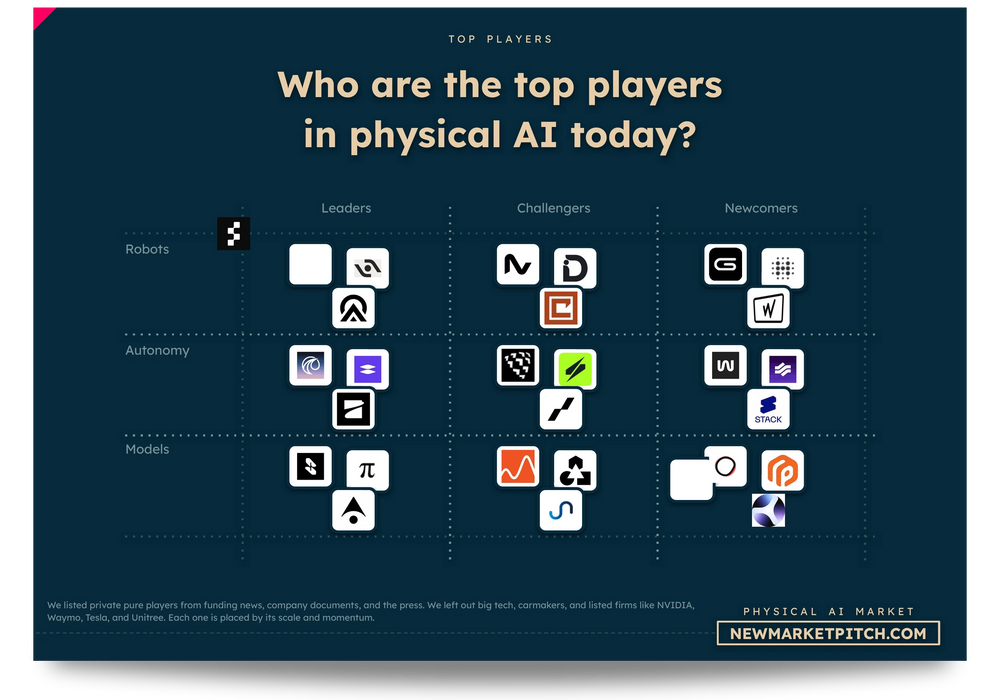
In our market report about physical AI, we turn what is vague and complex into simple, useful visuals. Market maps like this one show you at a glance where every startup stands.
Physical AI: what are the biggest unsolved problems today?
The biggest unsolved problems in physical AI are generalization, long-task reliability and dexterous manipulation. These three limitations currently do the most to prevent robots from handling unfamiliar work independently, while data shortages, hardware durability, safety and operating costs make the challenge harder.
We can now separate problems that are mainly technical from those that are increasingly commercial.
Generalization remains the biggest technical obstacle. A robot must learn to apply existing skills to unfamiliar objects and activities without extensive new training.
Long-task reliability is closely related. Even highly accurate individual movements are insufficient when a robot has to execute hundreds of actions, respond to mistakes and reach a complete result.
Dexterous manipulation adds the physical difficulty of handling real objects with uncertain properties.
Other barriers are becoming clearer as deployments expand. Hardware must survive thousands of hours, safety systems must work around people and customers need convincing evidence that robotic labor can deliver useful output at a competitive cost.
The latest industry data makes it difficult to dismiss physical AI as a purely experimental technology. Millions of specialized robots already operate commercially, professional service robot shipments are growing and autonomous systems have demonstrated substantial real-world performance.
Yet genuinely general-purpose physical intelligence remains a much harder problem.
Our ranking reflects which obstacles most directly prevent robots from handling a wide range of unfamiliar jobs, rather than how much research attention each one receives.
| Rank | Unsolved problem | Main obstacle |
|---|---|---|
| 1 | Generalization | Learning unfamiliar tasks without extensive retraining |
| 2 | Long-task reliability | Completing entire workflows without accumulating errors |
| 3 | Dexterous manipulation | Handling irregular, flexible and fragile objects |
| 4 | Real-world training data | Learning from sufficiently diverse physical experiences |
| 5 | Simulation-to-reality transfer | Applying virtual training reliably to real equipment |
| 6 | Autonomous error recovery | Detecting and fixing mistakes without human assistance |
| 7 | Hardware durability | Maintaining dependable operation over thousands of hours |
| 8 | Safety | Working autonomously around people and valuable equipment |
| 9 | Operating economics | Producing useful work at a competitive total cost |
| 10 | Standardized evaluation | Measuring autonomy and progress consistently |
The most important conclusion is that physical AI already works in many specialized applications, and those applications are expanding.
What remains unproven is the flexible robot that can move between different jobs, deal with unexpected situations and keep working with minimal supervision.
For now, the decisive breakthrough would be a robot that can handle genuinely unfamiliar work as reliably as it handles a carefully rehearsed task. That is where physical AI still has the most to prove.
If you want more recent data on this point, please see our latest physical AI market report.
Our methodology
We approached the question of physical AI's biggest unsolved problems by breaking it into seven analytical dimensions: adaptability, task execution, manipulation, training data, hardware, safety and commercial viability. For each, we examined recent research, benchmark results, technical advances and real-world deployments, then brought the most relevant evidence together to identify where progress is substantial and where fundamental obstacles remain.
We placed particular weight on the difference between demonstrated capability and repeatable performance. Research benchmarks helped establish what robots can accomplish under defined evaluation conditions, while industrial deployments provided evidence of operating hours, completed work, durability and autonomy in customer environments. We assessed these findings together rather than treating any individual demonstration or performance figure as decisive.
For our final ranking, we prioritized obstacles according to how directly they prevent robots from completing unfamiliar work independently. This distinguishes foundational limitations, such as generalization and dexterous manipulation, from deployment constraints, such as hardware durability, safety and operating economics. We also looked at how failures compound across longer workflows, using a simplified independent-action probability model to illustrate the importance of end-to-end reliability.
We relied primarily on original research, official datasets, industry statistics, technical standards and direct operational reports. Manufacturer-reported results were used to assess demonstrated capabilities and deployment experience, while independent research and customer evidence provided additional context. Our conclusions reflect the convergence of recent technical and commercial findings, with the greatest weight given to evidence of consistent performance beyond controlled demonstrations.
Key research and benchmark sources include Stanford HAI's 2026 AI Index, Stanford's BEHAVIOR-1K research, Google DeepMind's Gemini Robotics evaluations, Gemini Robotics 1.5 research, Google DeepMind's dexterous manipulation research, Open X-Embodiment, the DROID dataset, and BridgeData V2.
For training methods, commercial deployments and real-world autonomy, we examined NVIDIA's Isaac GR00T N1 research, Figure AI's BMW production report, BMW Group's humanoid robotics update, Agility Robotics' Digit 5 announcement, Agility's GXO deployment results, Waymo's safety impact data, and Waymo's explanation of remote assistance.
Industry adoption and safety assessments draw on the International Federation of Robotics' World Robotics 2026 statistics, its professional service robotics report, and the ISO 10218-1:2025 and ISO 10218-2:2025 industrial robot safety standards.

Our document detailing everything you need to know about physical AI gets updated several times a month, so you always get the latest view of where things stand.
Written by the New Market Pitch teamWe track new markets so founders and investors can move faster. About us