Who are the top investors in physical AI?
Whether you're building or investing in the physical AI market, our report covers everything you need to know: the players, the money, and what's coming next.
Summary
NVIDIA is the top overall investor in physical AI today for breadth and strategic influence. Alphabet leads in identifiable capital commitment, while Khosla Ventures and Eclipse stand out among independent venture capital firms for their investment activity and repeated financing leadership.
Physical AI funding has accelerated much faster than dealmaking. Startups raised $47.4 billion across 521 deals in the first half of 2026, an increase of nearly 80% in capital but only 19.5% in deal count from a year earlier. Investors are writing considerably larger checks.
The market's growth is exceptionally concentrated. Waymo, Skild AI and Wayve accounted for $18.6 billion in announced financing during the first half of 2026, equivalent to approximately 39% of reported sector funding from just three transactions.
Investment frequency and financing leadership produce different rankings. NVIDIA participated in nine tracked robotics rounds but led only one. Khosla Ventures participated in seven and led four, while Eclipse led four of its six. That gives the independent venture firms a stronger claim when it comes to repeatedly driving transactions.
Alphabet's capital position operates on a different scale. It supplied the significant majority of Waymo's $16 billion equity round, with pre-announcement reporting suggesting a contribution of approximately $13 billion. However, that exposure is largely concentrated in a company Alphabet already controls.
SoftBank is making some of the largest bets on transferable robotic intelligence. It led Skild AI's $1.4 billion financing and co-led Wayve's $1.2 billion round, backing companies whose AI systems are intended to operate across different machines or environments rather than depending on a single hardware design.
The strongest specialist investors have distinct strategies. Eclipse concentrates on industrial autonomy, Lux Capital backs technically ambitious robotics and manufacturing companies, and Parkway Venture Capital has repeatedly led financings for Figure AI. A broad portfolio is not the only way to establish influence.
Humanoid robotics is attracting striking valuations before comparable commercial scale has been demonstrated. Figure AI reached a reported $39 billion valuation in 2025, fifteen times its 2024 financing valuation, while Apptronik's cumulative Series A funding exceeded $935 million by February 2026.
China is now competing in similarly large transactions. XPENG's robotics business announced more than $900 million in financing in August 2026, led by IDG Capital, showing that billion-dollar-scale embodied AI investment is no longer confined to U.S. companies and investors.
Commercial maturity is emerging as an important dividing line. Waymo reported 15 million paid rides in 2025 and subsequently obtained $5 billion in debt financing, while many leading robotics developers remain dependent on future deployment growth and technology commercialization.
Our ranking therefore separates breadth, capital scale, financing leadership and strategic influence instead of treating all investor participation as equivalent. NVIDIA leads overall, Alphabet leads on identifiable capital scale, and Khosla Ventures and Eclipse lead the independent venture activity comparison. Future investment performance will depend much more on commercial adoption and entry valuations than on today's funding headlines.

Written by the New Market Pitch teamWe track new markets so founders and investors can move faster. About us
Why is so much money going into physical AI right now?
Physical AI has become one of the hottest areas for venture capital, with investors pouring tens of billions of dollars into autonomous vehicles, intelligent robots and the AI systems that control them.
According to Crunchbase, physical AI startups raised $47.4 billion across 521 deals in the first half of 2026. That compares with $26.4 billion across 436 deals a year earlier and just $12 billion across 470 deals in the preceding six months.
We calculate that investment increased nearly 80% year over year, while deal volume grew only 19.5%. The average amount raised per deal jumped from approximately $60.6 million to $91 million.
A handful of exceptionally large financings account for much of that increase. Waymo secured $16 billion in February 2026, Skild AI raised $1.4 billion in January, and Wayve announced a $1.2 billion round in February. Figure AI had already secured more than $1 billion in committed capital in September 2025.
Investors are increasingly willing to finance physical AI companies at valuations once reserved for the biggest software startups. But their strategies differ considerably. Some are betting on humanoid robots, others on general-purpose robotic intelligence, and others on autonomous vehicles that already carry paying customers.
That makes the identity of the leading investors more interesting than a simple ranking by total funding.
What counts as a physical AI investor?
The physical AI investors worth tracking are those financing companies that use artificial intelligence to make machines understand and interact with the real world.
We include investors in humanoid robotics, industrial autonomy, robotics foundation models and autonomous vehicles. These are related markets, although their technologies and business models differ.
Figure AI and Apptronik develop humanoid robots. Physical Intelligence and Skild AI focus on software capable of controlling different robotic systems. Waymo and Wayve apply AI to autonomous driving.
Traditional industrial equipment manufacturers are outside our definition unless intelligent autonomy is a substantial part of the business.
The boundary around autonomous vehicles is particularly important. Including Waymo makes Alphabet one of the world's largest physical AI capital providers. Looking only at independent robotics startups gives much more weight to firms such as Khosla Ventures, Eclipse, Lux Capital and Parkway Venture Capital.
There is also a difference between investing and supplying technology. NVIDIA sells computing infrastructure to many robotics developers, but those customers are not automatically NVIDIA portfolio companies.
For this comparison, we focus on disclosed equity investments, the number of companies backed, repeated participation in financing rounds and the investor's role in leading those rounds. We examine strategic relationships separately.

In our report covering the physical AI market, you will always find fresh funding data, taken straight from our own verified funding database.
Who are the biggest physical AI investors today?
NVIDIA currently leads physical AI investing by the breadth of its documented robotics exposure and its wider influence on the industry. Alphabet leads on identifiable capital commitment, while Khosla Ventures and Eclipse are particularly active among traditional venture firms.
SoftBank, Sequoia Capital, Lux Capital and Parkway Venture Capital complete the group of investors with especially strong positions.
The differences become clearer when we compare actual financing activity.
The AI Funding robotics investor database, updated through October 27, 2026, identifies NVIDIA as the most active tracked investor, with nine qualifying funding rounds. Khosla Ventures follows with seven, while Eclipse, Lux Capital and Sequoia Capital each have six.
The lead-investor figures tell a different story. Khosla and Eclipse each led four tracked rounds, compared with three for Lux, two for Sequoia and one for NVIDIA.
Alphabet's position is harder to capture through deal counts because most of its capital exposure comes through Waymo, its majority-owned autonomous driving company.
Parkway is another important exception. Its repeated leadership of Figure AI financings gives it substantial influence over one of the most highly valued humanoid robotics startups, despite a narrower portfolio.
We therefore identify different leaders depending on whether we measure investment frequency, capital committed, lead roles or strategic influence.
| Investor | Representative physical AI investments | Strongest position |
|---|---|---|
| NVIDIA / NVentures | Figure AI, Skild AI, Wayve, Waabi, Nuro | Broad strategic exposure |
| Alphabet / CapitalG / GV | Waymo, Physical Intelligence, Apptronik | Capital scale and research links |
| Khosla Ventures | Physical Intelligence, Waabi, Field AI | Active AI robotics venture investing |
| Eclipse | Wayve, Mind Robotics, Mytra | Industrial and autonomous systems |
| SoftBank | Skild AI, Wayve | Leading large financing rounds |
| Sequoia Capital | Waymo, Skild AI, Physical Intelligence | Exposure across robotics and autonomy |
| Lux Capital | Physical Intelligence, Collaborative Robotics, Hadrian | Early and specialist investments |
| Parkway Venture Capital | Figure AI | Repeated financing leadership |
| Andreessen Horowitz | Waymo, Mind Robotics, Saronic | Autonomous systems |
| Bezos Expeditions | Physical Intelligence, Skild AI, Field AI | Frontier robotics |
| B Capital | Apptronik | Humanoid robotics |
| Amazon Industrial Innovation Fund | Agility Robotics, Skild AI, Dyna Robotics | Industrial and warehouse robotics |
Is NVIDIA the most active physical AI investor?
NVIDIA is currently the most active investor in the AI Funding robotics ranking, although its deal count alone understates how much influence it has over physical AI.
The database records nine qualifying rounds involving NVIDIA, including investments associated with humanoid robotics, autonomous driving and robotic intelligence.
Its portfolio spans companies pursuing very different markets. Figure AI is building humanoid robots, Waabi develops autonomous trucking technology, and Nuro works on autonomous vehicles. NVIDIA has also participated in financing for companies developing more general-purpose robotic intelligence.
This gives NVIDIA exposure to several possible winners without requiring one robot design to become the industry standard.
The company's technology business adds another advantage. Its Isaac platform supports robotics development, Omniverse provides simulation tools, and Cosmos offers models and resources for physical AI development.
Those platforms reach well beyond NVIDIA's direct investment portfolio. A robotics startup can become an NVIDIA customer without giving NVIDIA equity, and the two relationships should be counted separately.
That is what makes NVIDIA an unusual investor in this market. Its financial investments provide upside if particular startups succeed, while its computing business can benefit from spending across the wider sector.
NVIDIA is our leading overall choice for breadth and strategic influence. Its position does not establish that it has committed the most equity capital or generated the highest investment returns.
If you want more recent data on this point, please see our latest physical AI market report.

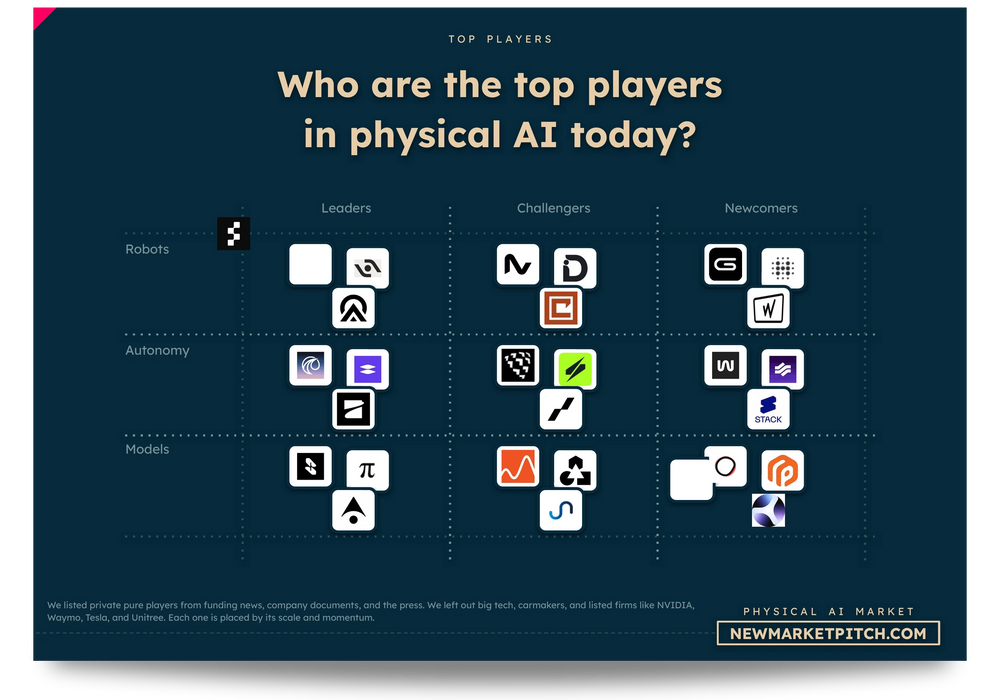
In our research about physical AI, we turn what is vague and complex into simple, useful visuals. Market maps like this one show you at a glance where every startup stands.
Has Alphabet invested more in physical AI than anyone else?
Alphabet has the strongest documented claim to being the largest strategic capital provider in physical AI, mainly through its ownership and financing of Waymo.
Bloomberg reported before Waymo's February 2026 round that Alphabet was expected to contribute approximately $13 billion of the $16 billion financing. That would amount to roughly 81% of the total.
The final company announcement confirmed the full financing but did not publish Alphabet's exact contribution. Alphabet's first-quarter financial filing subsequently stated that the significant majority of the round came from its parent company.
That is an enormous capital commitment. The expected $13 billion contribution alone would be larger than the entire funding rounds of several leading robotics startups combined.
Alphabet's physical AI interests extend beyond autonomous transportation. CapitalG led Physical Intelligence's reported $600 million financing in November 2025, while Google participated in Apptronik's humanoid robotics funding.
Waymo is also becoming a different kind of business from most venture-backed robotics startups. In October 2026, it closed a $5 billion term loan, led by lenders including PIMCO, Blackstone and Sixth Street.
That debt financing allows Waymo to supplement shareholder capital with borrowing. We exclude the loan from equity investment totals, although it adds to the company's available financing.
Alphabet's dominance comes with one qualification: most of its identifiable capital is concentrated in a company it already controls. It leads on capital scale under a broad physical AI definition, but it is not the most active independent venture investor.
Is SoftBank making the biggest bets on robot intelligence?
SoftBank has become one of the most aggressive investors in large physical AI financing rounds, particularly among companies developing intelligence that could operate across different machines.
Its investment in Skild AI is the clearest example.
SoftBank led Skild's January 2026 Series C, which raised $1.4 billion and valued the company at more than $14 billion. Bloomberg reported that Skild had been valued at approximately $4.5 billion just seven months earlier.
That represents a valuation increase of more than threefold in a relatively short period.
SoftBank Vision Fund 2 also co-led Wayve's $1.2 billion Series D alongside Eclipse and Balderton. The autonomous driving software company reached an $8.6 billion valuation through that financing.
Combined, the two rounds raised $2.6 billion. That is the total raised by the companies, not the amount invested by SoftBank, because both transactions involved syndicates whose individual contributions were not fully disclosed.
There is a technological overlap between the two bets.
Skild aims to develop general-purpose intelligence for robotic systems. Wayve is developing an AI driving system that can be deployed across different vehicles and operating environments.
Both companies are trying to build intelligence that becomes more valuable as it learns to handle a wider range of real-world situations.
SoftBank is one of the clearest large-round leaders in this part of physical AI. Whether those investments become profitable depends on the commercial value of the underlying technology, which is much harder to establish than their funding announcements.
If you want more recent data on this point, please see our latest physical AI market report.

In our market report about physical AI, we always try to gather several sources and make estimates that make sense, so you can work with solid numbers.
Which venture capital firms invest in the most physical AI startups?
Khosla Ventures and Eclipse currently stand out among traditional venture capital firms because both combine frequent robotics investments with repeated lead-investor roles.
The AI Funding database provides a comparison of investors appearing in publicly reported AI robotics financings.
Khosla has seven tracked rounds, including four as lead investor. Eclipse has six rounds and four leads. Lux Capital follows with six rounds and three leads, while Sequoia has six rounds and two leads.
Andreessen Horowitz has five tracked rounds and three lead positions.
These numbers put Khosla and Eclipse ahead on the combination of activity and leadership. NVIDIA has a higher participation count, but it led only one of its nine tracked rounds.
Appearing as a participant in a large syndicate does not carry the same significance as repeatedly leading financing rounds.
The database contains 66 qualifying deals and does not represent an exhaustive history of every robotics investment worldwide. It also counts funding-round participation rather than the number of unique portfolio companies or the capital invested.
Even within that defined sample, the recurring names are revealing.
| Investor | Tracked robotics rounds | Lead rounds |
|---|---|---|
| NVIDIA | 9 | 1 |
| Khosla Ventures | 7 | 4 |
| Eclipse | 6 | 4 |
| Lux Capital | 6 | 3 |
| Sequoia Capital | 6 | 2 |
| Andreessen Horowitz | 5 | 3 |
| Bezos Expeditions | 4 | 1 |
| General Catalyst | 3 | 2 |
| SoftBank Vision Fund | 3 | 2 |
| T. Rowe Price | 3 | 2 |
| 8VC | 3 | 1 |
| Amazon Industrial Innovation Fund | 3 | 0 |
Why is Khosla Ventures investing in so many different robotics companies?
Khosla Ventures is building one of the broadest physical AI portfolios among traditional venture firms, with investments that span robotic manipulation, autonomous transportation and navigation.
Physical Intelligence develops general-purpose models for robots. Waabi uses AI for autonomous trucking. Field AI builds software intended to help robots navigate and operate in unpredictable environments.
These businesses face different commercial challenges, but their technologies share a fundamental requirement: machines must learn to deal with situations that cannot all be anticipated and programmed individually.
Khosla's tracked investment activity also extends to companies such as Glydways and Rhoda.
Its approach is broader than a bet on humanoids alone. It has exposure to several ways AI could change transportation and industrial automation.
Khosla's four tracked lead roles are especially relevant. They show repeated willingness to take a central position in financings rather than merely joining larger investors.
We would rank Khosla among the strongest independent financial investors in physical AI today, particularly for its mix of investment frequency and exposure to AI-native robotics.
Financial performance is a separate question. Public information about purchase prices, ownership stakes and exits is insufficient to compare Khosla's realized returns with those of other venture firms.

Our document detailing everything you need to know about physical AI gets updated several times a month, so you always get the latest view of where things stand.
Is Eclipse becoming the leading investor in industrial physical AI?
Eclipse is one of the strongest specialist investors in industrial physical AI, with a portfolio that focuses heavily on putting intelligent systems into commercial operations.
The firm has backed Wayve, Mind Robotics, Genesis AI and Mytra, giving it exposure to autonomous transportation, industrial robotics and automation.
Its investment in Mytra is especially relevant to warehouse automation. The company develops systems intended to move and organize materials using software-controlled robotic infrastructure.
Mind Robotics, meanwhile, is pursuing intelligent industrial robots that can work across manufacturing environments.
These investments fit Eclipse's broader focus on physical industries rather than consumer software.
Eclipse also has an unusually high share of lead-investor roles. According to AI Funding, it led four of its six tracked robotics rounds, or approximately 67%.
For comparison, Lux led half of its six tracked rounds, while Sequoia led one-third.
These are small samples, and lead percentages tell us nothing about investment returns. They do, however, reveal which firms are repeatedly taking charge of financing rounds.
Eclipse has one of the clearest investment profiles in industrial autonomy. Its narrower focus could become an advantage if factories and warehouses adopt AI-controlled systems faster than general-purpose humanoid robots.
If you want more recent data on this point, please see our latest physical AI market report.
Is Lux Capital making better early robotics investments than its rivals?
Lux Capital has built a strong early-stage physical AI portfolio, although there is still no reliable public evidence that its returns are better than those of Khosla, Eclipse or Sequoia.
Lux has invested in Physical Intelligence, Collaborative Robotics and Hadrian, among other companies developing advanced industrial technologies.
Physical Intelligence is a particularly important holding. The company develops general-purpose robot foundation models and attracted a reported $600 million financing led by CapitalG at a $5.6 billion valuation in November 2025.
Lux's involvement predates that later financing, giving it exposure to the company before its valuation reached several billion dollars.
Its other holdings provide different kinds of exposure. Collaborative Robotics focuses on robots intended to work alongside people, while Hadrian develops highly automated manufacturing systems.
Lux therefore has positions across robotics software, collaborative machines and industrial production technologies.
The firm also appears repeatedly in financing data, with six tracked robotics rounds and three lead positions.
Lux has consistently financed technically ambitious companies in this market. Whether those deals outperform rival portfolios will ultimately come down to ownership, entry prices and exits, not just how far the companies' headline valuations have climbed.

In our report covering the physical AI market, we look at what the winners do differently, so you can learn from the best instead of guessing.
Is Sequoia Capital becoming a major physical AI investor?
Sequoia Capital is already a major physical AI investor, with exposure that spans early robotic intelligence companies and much larger autonomous transportation businesses.
Its portfolio includes Physical Intelligence, Skild AI and Collaborative Robotics. These companies are developing technologies at different stages of maturity, from general-purpose AI systems to machines intended for commercial use.
Sequoia also joined Dragoneer Investment Group and DST Global as a lead investor in Waymo's major financing.
That transaction brought Sequoia into a business with considerably more operating history than most emerging humanoid robotics developers.
Waymo reported 15 million paid rides during 2025, more than triple its previous annual volume. By early 2026, it was providing more than 400,000 rides per week across six major U.S. metropolitan areas.
This gives Sequoia exposure to both companies still developing their core robotics technologies and an autonomous driving company with an established commercial service.
The contrast is striking. One company can attract a multibillion-dollar valuation based largely on expectations about its future market, while another can point to substantial customer usage today.
Sequoia owns positions across both situations. Its individual investment amounts and ownership stakes, however, remain insufficiently disclosed for a precise capital ranking.
Who is putting the most money behind humanoid robot companies?
Parkway Venture Capital, B Capital and several major technology companies are among the investors most closely associated with the largest humanoid robotics financings.
Parkway's relationship with Figure AI is one of the clearest examples of repeated financing leadership.
The firm led Figure's $70 million Series A in 2023 and returned as the lead investor in its September 2025 Series C. That later round exceeded $1 billion in committed capital and valued Figure at $39 billion.
The increase from Figure's $2.6 billion valuation during its 2024 financing to $39 billion represents a fifteenfold jump in approximately 18 months.
Parkway therefore backed Figure across several stages of unusually rapid valuation growth, although those private-market valuations do not establish realized investment profits.
B Capital has played a comparable early financing role at Apptronik. The humanoid developer's Series A was initially co-led by B Capital and Capital Factory, with Google and Mercedes-Benz among the strategic investors.
Apptronik subsequently announced a $520 million Series A extension in February 2026, bringing its cumulative Series A funding above $935 million.
Other companies have drawn large international investment groups. NEURA Robotics announced a Series C of up to $1.4 billion with participation associated with investors including Tether and major industrial technology companies.
The announced maximum for NEURA should be distinguished from capital actually closed when comparing that transaction with completed financings.
The leading humanoid investors are quite different from those dominating the wider physical AI market. Parkway has an exceptionally strong claim around Figure, while B Capital has an important position around Apptronik.
Neither necessarily needs the largest number of robotics investments to benefit enormously if its principal humanoid bet succeeds. But the individual amounts these firms have invested remain less transparent than the funding totals announced by their portfolio companies.
If you want more recent data on this point, please see our latest physical AI market report.

In our research about physical AI, we don't want to repeat what boring consulting reports say. Instead, we show you the real and latest market signals that matter.
Are big technology companies taking over physical AI investing?
Technology companies are increasingly important to physical AI financing, but traditional venture capital firms still lead many of the biggest startup rounds.
Google, Microsoft, Salesforce, Qualcomm, Intel and several automotive manufacturers have all participated in physical AI investments.
Their involvement often comes with a commercial relationship that an ordinary financial investor cannot easily provide.
Brookfield, for example, announced a strategic agreement with Figure AI involving access to its real estate portfolio, including more than 100,000 residential units. The arrangement could help Figure collect data and test humanoid robots in different environments.
Mercedes-Benz has participated in Apptronik financing while exploring industrial applications for humanoid robots. At Wayve, investors have included automakers such as Nissan and Stellantis alongside Microsoft and Uber.
Physical AI developers need computing resources, real-world environments and customers willing to test new machines. A corporate investor can sometimes offer all three.
But a large corporate name on the capitalization table does not mean a startup has secured substantial recurring revenue. Pilot deployments, investment agreements and production contracts are different milestones.
Technology companies have growing influence over the development and commercialization of physical AI. Venture investors remain central to deciding which early companies get funded, particularly in markets where revenues are still limited.
Are Chinese investors catching up in physical AI?
Chinese investors are already competing at the same financing scale as major Western physical AI investors, particularly in embodied AI and humanoid robotics.
A major example came in August 2026, when XPENG announced that its robotics business had secured more than $900 million at a post-money valuation above $6.3 billion.
The round was led by IDG Capital, with participation from Gaorong Ventures and support from Tencent and Alibaba.
XPENG described it as the largest single private financing round in China's embodied AI industry at the time.
China Mobile has also appeared in the AI Funding investor database through its involvement in robotics companies such as Unitree Robotics and Galbot.
The broader Chinese market includes specialist robotics developers, industrial technology companies and large domestic investment groups.
One difference from Western financing is the role played by industrial and technology corporations that may also have manufacturing capabilities or commercial relationships with robotics developers.
That can give startups access to production infrastructure, although the financial value of such relationships is difficult to compare across companies.
Chinese physical AI investors are now participating in transactions approaching or exceeding $1 billion. That part is clear.
Whether they are deploying more total capital than their U.S. counterparts remains unresolved. Public databases do not offer sufficiently complete and consistent coverage of individual investor contributions across both markets.

Learning from others' mistakes is the cheapest lesson there is. In our market report about physical AI, we look at what broke startups before you, so you don't repeat it.
Is physical AI funding becoming too concentrated in a few companies?
Physical AI investment has become heavily concentrated in a small number of giant deals, which helps explain why headline funding totals have risen so quickly.
Using Crunchbase's first-half 2026 figures, we can calculate the effect of three of the largest widely reported transactions during that period.
Together, the financings involving Waymo, Skild AI and Wayve totaled $18.6 billion.
That would represent approximately 39.2% of the $47.4 billion raised by physical AI companies in the period, assuming all three are included in the same Crunchbase category and counted at their full announced amounts.
These three financings represent only about 0.6% of the reported 521 deals.
Removing their combined value leaves $28.8 billion across 518 transactions. The average deal size falls from approximately $91 million to $55.6 million.
In other words, just three transactions increase the reported average by roughly 64% compared with the remaining deals.
That is a huge distortion for anyone trying to understand how much money the typical physical AI startup is raising.
It also affects investor rankings. Alphabet's financial exposure to one unusually large company can outweigh the combined disclosed funding of numerous smaller robotics businesses.
We therefore place more weight on repeated investment behavior when assessing venture investors, while using capital commitment separately to identify the largest financial backers.
Are physical AI investors backing real businesses or mostly future potential?
Physical AI investors are financing a mix of established commercial operations and companies whose valuations still depend heavily on future technological progress.
Autonomous transportation currently provides some of the clearest evidence of commercial use.
As discussed earlier, Waymo has already reported millions of completed rides. Its ability to raise both equity and debt also shows a financing structure that differs from most earlier-stage robotics startups.
General-purpose robot developers are at a different point.
Physical Intelligence is developing models intended to control many types of robots. Figure and Apptronik are working toward larger-scale humanoid deployments. Skild is developing robotic intelligence that could potentially operate across different machines.
These businesses have attracted substantial investment, but their publicly disclosed operating figures do not yet demonstrate commercial activity comparable to Waymo's passenger volumes.
That gap explains some of the tension in physical AI investing today.
Investors are willing to pay very high prices for companies whose technologies could eventually serve enormous markets. Yet many of the most valuable robotics startups have not publicly demonstrated the deployment volumes, revenue or unit economics needed to confirm those expectations.
For venture investors, the next important milestones will be paid deployments, repeat customers, manufacturing costs and evidence that robots can operate reliably outside controlled demonstrations.
The companies reaching those milestones first could change the relative attractiveness of today's portfolios considerably.

If you build or invest in the physical AI market, you need to know which business models pay off now and which ones are fading. That's why our report covering it has a whole section on it.
Who are the top investors in physical AI overall?
NVIDIA is currently our top overall physical AI investor for breadth and strategic influence, followed by a group of leaders with different strengths: Alphabet for capital commitment, Khosla Ventures and Eclipse for active venture investing, and SoftBank for large robotics intelligence financings.
Sequoia Capital and Lux Capital also belong among the most important investors, while Parkway Venture Capital stands out for its repeated leadership at Figure AI.
The evidence gives us three relatively firm conclusions.
NVIDIA has the broadest documented participation among investors in the tracked AI robotics database, and its computing platforms give it commercial exposure across the industry.
Alphabet has committed capital on a scale that independent robotics venture firms cannot easily match, although most of that position is tied to Waymo.
Among traditional venture firms, Khosla Ventures and Eclipse have the strongest combination of tracked investment activity and lead roles. Their portfolios also cover multiple applications rather than depending on the success of a single robot manufacturer.
The ranking is less certain when we try to compare actual dollars invested by each firm or financial returns. Most private companies do not disclose individual investor check sizes, ownership percentages or realized proceeds.
For now, we place NVIDIA first in an overall strategic ranking, Khosla Ventures and Eclipse at the top of the independent venture activity comparison, and Alphabet first for identifiable capital scale.
The more consequential ranking may emerge as physical AI companies begin turning their funding into substantial recurring revenue. Investors who backed those businesses before their largest valuation increases could ultimately outperform the firms writing the biggest checks today.
If you want more recent data on this point, please see our latest physical AI market report.
Our methodology
Identifying the leading investors in physical AI requires more than looking at the largest funding rounds or the most recognizable names. We approached the question by breaking investor leadership into four dimensions: investment activity, financing leadership, capital commitment, and strategic influence. Each captures a different aspect of market positioning, and together they provide a more reliable basis for comparison.
We examined recent financing announcements, investor participation records, company disclosures, regulatory filings, and commercial developments. We then aggregated the most relevant evidence across these dimensions, looking for consistent patterns rather than isolated headline transactions. Particular weight went to repeated investment activity, documented lead roles, attributable capital, and evidence of influence beyond individual portfolio companies.
For investment frequency and financing leadership, we used the AI Funding Top AI Robotics Investors 2026 database, updated through October 27, 2026, covering 66 qualifying deals. Its participation counts and lead-investor records provide a consistent comparison within that sample. We treated these as funding-round appearances rather than unique portfolio-company counts or disclosed investment amounts. The broader physical AI definition also includes autonomous vehicles, which gives strategic investors such as Alphabet a different capital profile from independent robotics venture firms.
For capital concentration, we used Crunchbase's first-half 2026 physical AI funding figures and compared them with the announced financing sizes of Waymo, Skild AI and Wayve. We calculated their combined share of reported sector funding and the effect of removing those transactions from average deal size. This provides a clearer picture of how much the largest rounds influence market-wide totals.
We distinguished completed equity financings from debt, announced maximum commitments and strategic commercial partnerships. Individual investor commitments were used when supported by company or regulatory disclosures; syndicated round totals were not attributed in full to lead investors. We examined commercial adoption separately through reported operating activity, including Waymo's paid rides, rather than treating private-market valuations as evidence of financial performance.
Our conclusions reflect this combination of evidence. Rather than forcing investors with fundamentally different strategies into a single financial ranking, we assessed where each demonstrates the strongest position. This separates the most active venture investors from the largest capital providers and the companies shaping physical AI's wider development.
Key market and financing sources include Crunchbase's physical AI funding analysis, Waymo's $16 billion financing announcement, Alphabet's first-quarter 2026 SEC filing, Waymo's October 2026 debt financing announcement, Skild AI's Series C announcement, and Wayve's Series D announcement.
For humanoid robotics and company valuations, we used Figure AI's Series C announcement, Apptronik's Series A extension announcement, NEURA Robotics' Series C announcement, XPENG's robotics financing announcement, CapitalG's Physical Intelligence investment information, and Bloomberg's reporting on Physical Intelligence's financing and valuation.
Additional investor and strategic relationship disclosures include Waabi's financing announcement, FieldAI's funding announcement, NVIDIA's physical AI ecosystem announcement, Figure AI's Brookfield partnership announcement, Brookfield Asset Management's shareholder letter, and Agility Robotics' Series B announcement.

In our report covering the physical AI market, we like to show you the big picture. We know your time is precious, so we make every page quick to read and packed with as much learning as possible per minute.
Written by the New Market Pitch teamWe track new markets so founders and investors can move faster. About us