Regenerative Agriculture Funding Tracker (70+ deals)
Building a startup or looking for your next investment in regenerative agriculture? Our report gives you the full picture.
Summary
Regenerative agriculture startups raised at least $665M in 76 deals involving 64 companies from January 2024 to November 2026. Terradot raised the most during that period, with $58M across 2 rounds. There is a real venture market here, but its biggest funding stories can give a misleading picture of ordinary checks.
The median round was $6.7M. Founders usually raise enough to develop a farm product, prove their results or reach more customers, rather than announce an enormous climate-technology round.
Biological input platforms came first with 22 deals and $208M, or 31% of disclosed capital. Microbes, algae and other soil treatments give investors something growers can test against fertilizer costs and crop yields.
Carbon removal and soil measurement attract plenty of money too. Rock weathering, biochar, soil sensors and monitoring software have different customers, but all need convincing evidence from working farms.
The biggest check shows the upper limit more clearly than the typical deal does. Terradot's December 2024 Series A raised $54M, a sum that most startups will never see in one round.
Most funding also went to startups that had raised before. Follow-on financing accounted for 57 deals, while only 11 deals were identified as first financings. Investors want results they can see beyond a promising first trial.
Plenty of startups get to Seed or Series A. Far fewer secure a Series B, and a later round does not automatically mean the company has paying customers at scale.
North American companies took 50% of disclosed capital across 28 deals. Europe and Asia-Pacific still contribute substantial funding, often for businesses working with farmers well beyond their headquarters countries.
Money arrives unevenly. One month can be full of small checks. Another can be dominated by a soil technology or carbon-removal announcement. A single busy month tells us little about the typical startup's options.
Regenerative agriculture is attracting investors because more businesses can sell measurable farm services today. Financing the cost of changing practices on the farms themselves is still the thin spot, even as companies selling biology, data and carbon outcomes get backed.

Written by the New Market Pitch teamWe track new markets so founders and investors can move faster. About us

In our report covering the regenerative agriculture market, you will always find fresh funding data, taken straight from our own verified funding database.
Our funding tracker covering the regenerative agriculture market
Below is the table listing all the deals. You can find our methodology at the end of this page.
If you want a deeper understanding of the market and its current dynamics, get our regenerative agriculture market report.
| Company | Category | Date | Stage | Deal size | What they do | Region | Lead investors | Country | Rank |
|---|---|---|---|---|---|---|---|---|---|
| IMIO | Biological Input Platforms | October 2026 | Seed | $12M | Produces soil microbial inputs to improve nutrient cycling and crop residue management. | North America | Sofinnova Partners | United States | |
| CarbonFarm | Farm Measurement Software | October 2026 | Series A | ~$8.2M | Uses digital monitoring and verification to help rice growers reduce methane and improve water management. | Europe | Colam Impact | France | |
| BioConsortia | Biological Input Platforms | October 2026 | Unknown | $15M | Microbial seed treatments and biofertilizers | North America | John Pasquesi | United States | |
| Cotierra | Farm-Based Carbon Removal Inputs | September 2026 | Seed | $3M | Biochar systems for regenerative agriculture | Europe | PINC, Carbon Removal Partners | Switzerland | |
| Mafix | Farm-Based Carbon Removal Inputs | August 2026 | Seed | $5.4M | Carbon-negative silicon fertilizer made in cement kilns | North America | Azolla Ventures | United States | |
| Mitti Labs | Soil Carbon Platforms | August 2026 | Series A | $9.5M | Methane reduction for rice farming | North America | Aramco Ventures | United States | |
| Rize | Regenerative Advisory Services | July 2026 | Series B | $20M | Climate-smart rice farming platform | Asia-Pacific | BNP Paribas Asset Management Alts | Singapore | |
| Stenon | Farm Measurement Software | July 2026 | Series B | $21M | Real-time soil analysis sensors for farms | Europe | Pymwymic | Germany | |
| Seqana | Farm Measurement Software | June 2026 | Seed | Undisclosed | Satellite soil carbon measurement software | Europe | Pymwymic | Germany | |
| Agrorobótica | Farm Measurement Software | April 2026 | Seed | $2.2M | Soil carbon analysis for regenerative farming | Latin America | VOX Capital | Brazil | |
| Prithu | Farm-Based Carbon Removal Inputs | April 2026 | Seed | $1.1M | Biochar and soil carbon products | Asia-Pacific | Transition VC | India | |
| Pehle Jaisa | Biological Input Platforms | March 2026 | Seed | $1.3M | Regenerative farming inputs and services | Asia-Pacific | Unicorn India Ventures | India | |
| Miraterra | Farm Measurement Software | March 2026 | Seed | $11M | Soil sensing and carbon measurement platform | North America | At One Ventures | Canada | |
| ucrop.it | Farm Measurement Software | February 2026 | Unknown | $1.3M | Verified farm practice and regenerative crop traceability | Latin America | Not disclosed | Argentina | |
| UBEES | Regenerative Advisory Services | February 2026 | Series A | $9.4M | Bee pollination and crop monitoring services | Europe | Starquest, CapAgro | France | |
| MYCOPHYTO | Biological Input Platforms | January 2026 | Series A | $19M | Mycorrhizal fungi products for regenerative agriculture | Europe | Innovacom, BNP Paribas, Deep Tech 2030 (Bpifrance) | France | |
| Varaha | Soil Carbon Platforms | January 2026 | Series B | $20M | Carbon credits from regenerative agriculture projects | Asia-Pacific | WestBridge Capital | India | |
| ReSoil | Regenerative Finance Platforms | December 2025 | Seed | $4.7M | Soil carbon measurement and farmer financing | Europe | Not disclosed | France | |
| Veragrow | Biological Input Platforms | December 2025 | Unknown | $5.3M | Biostimulants from earthworm compost | Europe | Odyssée Venture | France | |
| Kula Bio | Biological Input Platforms | November 2025 | Series A | $15M | Nitrogen-fixing microbial crop fertilizer | North America | Not disclosed | United States | |
| EarthOptics | Farm Measurement Software | October 2025 | Unknown | $38M | Soil health sensing and agronomy analytics | North America | Not disclosed | United States | |
| BioSorra | Farm-Based Carbon Removal Inputs | October 2025 | Seed | $3.5M | Biochar carbon removal from agricultural waste | Africa | atmosfair, Fondo Nimbus | Kenya | |
| Rock Flour Company | Farm-Based Carbon Removal Inputs | September 2025 | Seed | $7.2M | Mineral soil amendment for carbon removal | Europe | EIFO, Novo Holdings | Denmark | |
| Terraton | Farm-Based Carbon Removal Inputs | August 2025 | Seed | $12M | Biochar production and carbon removal credits for agribusiness | North America | Lowercarbon Capital, Gigascale Capital | United States | |
| Soil Action | Regenerative Advisory Services | August 2025 | Seed | $5.3M | Regenerative agriculture project development | North America | R7 Partners | United States | |
| BioConsortia | Biological Input Platforms | August 2025 | Unknown | $15M | Microbial seed treatments and biofertilizers | North America | Otter Capital | United States | |
| Faeger | Soil Carbon Platforms | July 2025 | Series A | $16M | Agricultural carbon credit generation and sales | Asia-Pacific | Suzuyo Shoji, JIC Venture Growth Investments, Sumisho Venture Partners, Norinchukin Capital, Mizuho Capital | Japan | |
| NetZeroNitrogen | Biological Input Platforms | July 2025 | Seed | $6.6M | Nitrogen-fixing bacteria for crop fertilization | Europe | World Fund, Azolla Ventures | United Kingdom | |
| Pehle Jaisa | Biological Input Platforms | June 2025 | Seed | $300K | Regenerative farming inputs and services | Asia-Pacific | Pantnagar Capital, Climate Angels | India | |
| Alt Carbon | Farm-Based Carbon Removal Inputs | May 2025 | Seed | $12M | Enhanced rock weathering for carbon removal | Asia-Pacific | Lachy Groom | India | |
| Jizoku | Soil Carbon Platforms | May 2025 | Seed | $494K | Agricultural carbon credits from farm emission cuts | Asia-Pacific | Not disclosed | Japan | |
| PES Technologies | Farm Measurement Software | May 2025 | Seed | $1.8M | Soil health measurement technology | Europe | TSP Ventures | United Kingdom | |
| ucrop.it | Farm Measurement Software | May 2025 | Seed | $500K | Verified farm practice and regenerative crop traceability | Latin America | Not disclosed | Argentina | |
| AdvancedAg | Biological Input Platforms | March 2025 | Seed | $1.4M | Microbial crop and soil products | North America | Raven Indigenous Capital Partners | Canada | |
| Grow Indigo | Soil Carbon Platforms | March 2025 | Unknown | $9.7M | Carbon farming and agricultural sustainability platform | Asia-Pacific | British International Investment | India | |
| Puna Bio | Biological Input Platforms | March 2025 | Series A | $13M | Biological crop inputs for harsh soils | Latin America | Corteva Catalyst | Argentina | |
| Zentide | Biological Input Platforms | March 2025 | Seed | $525K | Seaweed biostimulants for crop growth | Asia-Pacific | Wavemaker Impact | Indonesia | |
| Regrow Ag | Farm Measurement Software | March 2025 | Growth Equity | Undisclosed | Agricultural carbon monitoring software | North America | SE Ventures | United States | |
| Jord BioScience | Biological Input Platforms | February 2025 | Series B | $7M | Microbial products for crop performance | North America | Silver Blue | United States | |
| Carbon Zero | Farm-Based Carbon Removal Inputs | February 2025 | Seed | $3.5M | Biochar production from agricultural waste | North America | Not disclosed | United States | |
| MyLand | Biological Input Platforms | January 2025 | Unknown | $23M | Live microalgae soil health systems | North America | Proterra Investment Partners | United States | |
| Sound Agriculture | Biological Input Platforms | December 2024 | Series D+ | $25M | Soil microbial treatments reducing fertilizer use | North America | BMO Impact Investment Fund, S2G Investments | United States | |
| Terradot | Farm-Based Carbon Removal Inputs | December 2024 | Series A | $54M | Enhanced rock weathering carbon removal | North America | John Doerr | United States | |
| Everest Carbon | Farm-Based Carbon Removal Inputs | December 2024 | Seed | $3M | Carbon removal through enhanced weathering | North America | Carbon Removal Partners | United States | |
| Klim | Regenerative Advisory Services | November 2024 | Series A | $22M | Regenerative agriculture platform and carbon program | Europe | BNP Paribas | Germany | |
| NetZero | Farm-Based Carbon Removal Inputs | October 2024 | Unknown | Undisclosed | Biochar carbon removal projects | Europe | Not disclosed | France | |
| Soil Benchmark | Farm Measurement Software | October 2024 | Seed | ~$705K | Farm soil and manure management software | Europe | Not disclosed | United Kingdom | |
| BioPrime Agrisolutions | Biological Input Platforms | October 2024 | Series A | $6M | Biostimulants and biological crop inputs | Asia-Pacific | Edaphon | India | |
| Eion | Farm-Based Carbon Removal Inputs | September 2024 | Series A | $3M | Enhanced rock weathering carbon removal | North America | AgFunder | United States | |
| Soil Capital | Soil Carbon Platforms | September 2024 | Series B | $17M | Carbon farming payments for farmers | Europe | Trill Impact Ventures | Belgium | |
| HabiTerre | Farm Measurement Software | August 2024 | Series A | $10M | Farm carbon measurement and soil analytics | North America | John Deere | United States | |
| Boomitra | Soil Carbon Platforms | August 2024 | Unknown | $500K | Satellite and AI soil carbon credits for farmers | North America | Global Innovation Fund | United States | |
| B4A | Biological Input Platforms | August 2024 | Seed | $523K | Microbiome products for regenerative agriculture | Latin America | Rural Ventures | Brazil | |
| Applied Carbon | Farm-Based Carbon Removal Inputs | July 2024 | Series A | $22M | Mobile biochar production for farmland | North America | TO VC | United States | |
| Bio-Logical | Farm-Based Carbon Removal Inputs | July 2024 | Seed | $1.3M | Biochar production for regenerative agriculture | Africa | Not disclosed | Kenya | |
| Mitti Labs | Soil Carbon Platforms | July 2024 | Seed | $3M | Methane reduction for rice farming | North America | Lightspeed Venture Partners, Voyager Ventures | United States | |
| Regenified | Regenerative Advisory Services | July 2024 | Unknown | $3.4M | Regenerative agriculture verification and farmer programs | North America | Not disclosed | United States | |
| eAgronom | Soil Carbon Platforms | July 2024 | Series A | $11M | Carbon programs and software for farmers | Europe | Swedbank AB | Estonia | |
| Gaiago | Biological Input Platforms | July 2024 | Growth Equity | $5.4M | Soil-biological inputs for soil restoration | Europe | Not disclosed | France | |
| Downforce Technologies | Farm Measurement Software | June 2024 | Unknown | $4.2M | Natural capital measurement for farmland | Europe | Equator VC | United Kingdom | |
| Gênica Inovação Biotecnológica | Biological Input Platforms | June 2024 | Series C | $12M | Biological crop protection and biostimulant products | Latin America | Mitsubishi Corporation | Brazil | |
| Terradot | Farm-Based Carbon Removal Inputs | June 2024 | Seed | $4.2M | Enhanced rock weathering carbon removal | North America | Not disclosed | United States | |
| Seqana | Farm Measurement Software | May 2024 | Seed | $2.3M | Satellite soil carbon measurement software | Europe | HTGF, Counteract | Germany | |
| HUSK Ventures | Farm-Based Carbon Removal Inputs | May 2024 | Growth Equity | $5M | Rice-husk biochar and organic fertilizers | Asia-Pacific | Mekong Enterprise Fund IV | Cambodia | |
| Rize | Regenerative Advisory Services | May 2024 | Series A | $14M | Climate-smart rice farming platform | Asia-Pacific | Breakthrough Energy Ventures, GenZero, Temasek, Wavemaker Impact | Singapore | |
| Advancing Eco Agriculture | Regenerative Advisory Services | April 2024 | Unknown | $2.6M | Regenerative crop nutrition products | North America | Not disclosed | United States | |
| CroBio | Biological Input Platforms | April 2024 | Seed | $1.6M | Microbes for drought-resistant agriculture | Europe | Grantham Foundation | United Kingdom | |
| BioConsortia | Biological Input Platforms | April 2024 | Growth Equity | $15M | Microbial seed treatments and biofertilizers | North America | Not disclosed | United States | |
| NetZero | Farm-Based Carbon Removal Inputs | March 2024 | Unknown | ~$20M | Biochar carbon removal projects | Europe | STOA | France | |
| Planboo | Farm-Based Carbon Removal Inputs | March 2024 | Seed | $1.1M+ | Biochar carbon removal for agriculture | Europe | Not disclosed | Sweden | |
| Cotierra | Farm-Based Carbon Removal Inputs | March 2024 | Seed | $1M | Biochar systems for regenerative agriculture | Europe | Not disclosed | Switzerland | |
| Varaha | Soil Carbon Platforms | February 2024 | Series A | $8.7M | Carbon credits from regenerative agriculture projects | Asia-Pacific | RTP Global | India | |
| Trace Genomics | Farm Measurement Software | February 2024 | Series B | $11M | Soil microbiome testing for agriculture | North America | S2G Investments, Ajax Strategies | United States | |
| Ruumi | Regenerative Advisory Services | February 2024 | Unknown | Undisclosed | Software for regenerative grazing management | Europe | People Ventures | Germany | |
| Grow Indigo | Soil Carbon Platforms | January 2024 | Series A | $8M+ | Carbon farming and agricultural sustainability platform | Asia-Pacific | Indigo Ag, Mahyco | India | |
| FA Bio | Biological Input Platforms | January 2024 | Series A | ~$6.7M | Microbial crop inputs for regenerative farming | Europe | Clean Growth Fund, Pymwymic | United Kingdom |

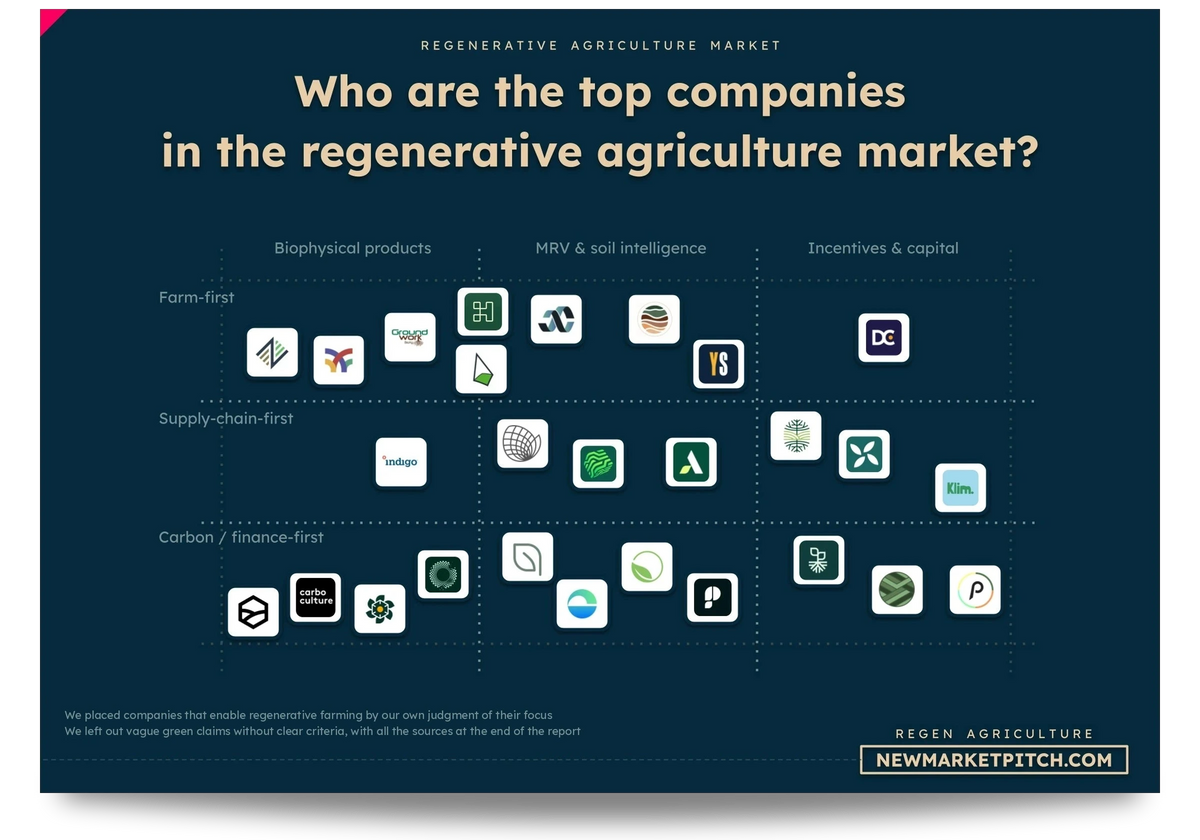
In our research about regenerative farming, we turn what is vague and complex into simple, useful visuals. Market maps like this one show you at a glance where every startup stands.
How much money are regenerative agriculture startups actually raising?
Regenerative agriculture startups raised at least $665M in 76 deals involving 64 companies since January 2024.
This is real venture activity, although the total covers businesses that make money in very different ways. BioConsortia sells microbial crop products. EarthOptics measures soil health and nutrients. Rize works with rice farmers and buyers, while Terradot uses crushed rock on farms to remove carbon dioxide. A successful sales cycle for a seed treatment looks little like one for a verified carbon-removal contract, so we should not treat them as one kind of startup.
Public amounts were available for 72 deals, representing 95% of the financing count. Another 4 deals had no disclosed amount. The dollar total is therefore a floor, not an estimate of what undisclosed investors paid. What is already clear is that several kinds of regenerative agriculture businesses can get funded, and the real differences emerge when we look at the size of the checks and who pays for the product.
Are $100M rounds happening in regenerative agriculture?
Not lately: no regenerative agriculture startup has closed a funding round of $100M or more since 2023.
The largest financing was Terradot's $54M Series A in December 2024, and only 1 deal was above $50M. Without that unusually large deal, at least $611M remains. That leaves a meaningful funding market even without its standout transaction, although a $100M check is clearly not the norm.
The reason Terradot could raise a large round is worth understanding. In December 2024, Google agreed to buy 200,000 tons of future carbon removal from the company, and Frontier announced a separate rock-weathering purchase tied to its work in Brazil. Those agreements gave the startup buyers for what it hoped to deliver. They were purchases of carbon removals, not extra venture rounds, and delivering them still requires rock supply, spreading, soil sampling and verification. A major customer contract can help a company raise money, but it cannot tell us how much a typical founder should expect.
How big is a normal regenerative agriculture funding round?
A typical regenerative agriculture startup raised $6.7M in a financing round, much less than the industry's largest announcements.
Among deals with a published amount, 29 deals were under $5M and accounted for 40% of disclosed-size transactions. Another 34 deals fell in the $5M to under $20M range, representing 47%. Only 8 deals were $20M to under $50M. The ordinary check pays for testing, production, distribution or a bigger field team, rather than an instant global rollout.
What the money buys depends on the product. MyLand's $23M round of undisclosed stage in January 2025 backed an algae-based service for improving soil. Stenon develops instruments that measure available nitrogen in the field. Applied Carbon builds mobile machinery that turns crop residues into biochar. Each business has real work to finance before a farm or corporate buyer can rely on it. Founders should compare their needs with companies that sell in the same way, not with the single biggest carbon-removal deal.
Can regenerative agriculture startups raise big checks without selling carbon credits?
Yes, regenerative agriculture startups selling soil tests and crop inputs can raise substantial money without relying on carbon-credit sales.
EarthOptics raised $38M in October 2025, in a round of undisclosed stage, for a soil measurement business, while Sound Agriculture's $25M Series D+ in December 2024 backed products aimed at how crops use nutrients. Stenon's field sensors help growers decide when and how much nitrogen to apply. These are businesses with customers who can compare the product with existing farming costs.
EarthOptics offered an unusually concrete update in November 2026: it had measured more than 8 million acres, including more than 3 million acres added since July 2025. Its services cover soil carbon, biology, nutrients and compaction. The figures describe acreage measured, not revenue or profit, but they show work beyond a handful of trial fields. Meanwhile, Stenon's July 2026 announcement described customer deployments across several million acres and plans for sensors integrated into farm machinery. Buyers can use that information even when they are not selling carbon credits.

In our market report about regenerative farming, we always try to gather several sources and make estimates that make sense, so you can work with solid numbers.
Which regenerative agriculture businesses get the most funding?
Biological input platforms get the most regenerative agriculture venture money, leading both the deal count and disclosed capital.
Biological input platforms recorded 22 deals worth $208M, or 31% of disclosed capital. Farm-based carbon removal inputs followed with 19 deals and at least $161M, while farm measurement software had 15 deals and at least $112M. Soil carbon platforms recorded 11 deals and at least $103M. These are mainly businesses that provide a product or service to a farm, a supplier or a corporate buyer.
The customer is different in each case. A seed supplier can distribute BioConsortia treatments. Applied Carbon needs farms and carbon-removal buyers to use its biochar equipment. EarthOptics sells soil information to growers, advisers and large agricultural businesses. Farmers could eventually use all these services on the same land, but the startups still need to win separate budgets. That helps explain why a broad label such as regenerative agriculture hides several quite different markets.
Why are investors backing so many microbial fertilizer startups?
Microbial fertilizer startups draw regenerative agriculture funding because growers can test their products against fertilizer use, crop performance and cost.
BioConsortia raised $45M across 3 rounds during the period. Its $15M round of undisclosed stage in October 2026 was tied to selling more of its Always N nitrogen-fixing seed treatment and preparing its Zaffre biostimulant for launch. BioConsortia reported that Zaffre improved corn yields by an average of 4.4 bushels per acre across three seasons of trials. Those are the company's trial results, not a promise for every farm. It also described commercial work with Mosaic in the Americas and seed-treatment partners in New Zealand.
Sound Agriculture's microbial products and MyLand's living-algae soil service show how broad this category can be. The hard part comes after the laboratory: products must survive storage, work across soils and weather, clear any relevant regulatory steps and reach growers through distributors they trust. BioConsortia says the latest investment will help build manufacturing and commercial capacity. Investors are putting money behind that practical work, not just the claim that healthier soil is good for farming.
Are investors actually funding biochar and crushed rock for regenerative farms?
Yes, biochar and rock-weathering businesses are getting regenerative agriculture funding, although most still raise relatively small checks.
Farm-based carbon removal inputs accounted for 19 deals worth at least $161M, with a median round of $3.9M. Applied Carbon raised a $22M Series A in July 2024 to expand machinery that converts crop waste into biochar near the farm. Alt Carbon raised a $12M Seed round in May 2025 to develop rock-weathering projects in India. Both companies need agricultural land and field operations, but the materials and logistics are very different.
Carbon-removal buyers also have to trust the measurement. Spreading crushed rock is only one step. A project must show how much carbon actually leaves the atmosphere. Producing biochar involves processing waste, placing the material where it can be used and accounting for its durability. Terradot's customer agreements show why investors will finance this work, but the sector's small median check is a reminder that field projects remain costly to build and verify. The business succeeds when delivery and measurement hold up, not when a credit sale is merely announced.
Are farmers really getting paid for soil-carbon credits?
Soil-carbon programs already pay some farmers for regenerative practices, but getting those payments to farms takes real verification work.
Soil carbon platforms raised at least $103M across 11 deals involving 8 companies. Varaha's $20M Series B in January 2026 backed carbon projects linked to Indian farmers. Soil Capital's $17M Series B in September 2024 supported a program connecting food businesses with growers changing their farming methods. Grow Indigo has pursued a similar goal in India, with a focus on documenting what happens on participating farms.
In July 2026, Soil Capital said cumulative farmer payments were set to reach £17.6 million across more than 1,600 farmers managing 385,000 hectares. In September 2026, Grow Indigo reported initial payments to more than 2,500 smallholders in Punjab and Haryana, averaging ₹11,478. The company paid farmers ahead of selling all the credits and offered a choice between an immediate amount or waiting for 75% of net carbon revenue. There is a working payment model here, but someone still has to enroll growers, verify changes and keep finding buyers.

Our document detailing everything you need to know about regenerative agriculture gets updated several times a month, so you always get the latest view of where things stand.
Is soil testing becoming a real regenerative agriculture business?
Farm soil measurement is now a meaningful regenerative agriculture business because growers need nutrient and soil-health information even without carbon-credit buyers.
Farm measurement software attracted 15 deals involving 13 companies and at least $112M, or 17% of disclosed capital. EarthOptics combines samples, lab work and models to map soil conditions. Stenon's FarmLab measures plant-available nitrogen in the field so a grower can adjust fertilizer decisions without waiting for laboratory results. CarbonFarm's ~$8.2M Series A in October 2026 backed monitoring of emissions from rice farming, where change is difficult to verify across small fields.
The latest EarthOptics acreage update shows that measurement can support both farm management and carbon reporting. Stenon went further in its July 2026 company announcement, reporting customer cases with 20 to 40% less nitrogen fertilizer use and 2 to 8% higher yields across several crops. Those are Stenon's reported customer results, not guaranteed outcomes. They explain why retailers and growers might pay for soil data before a carbon credit ever changes hands. The need is immediate: use fewer unnecessary inputs while keeping crops productive.
Will food companies pay for regenerative farming without buying offsets?
Yes, food companies are already paying regenerative agriculture businesses to change how crops are grown within their own supply chains.
Regenerative advisory services attracted 8 deals involving 7 companies and at least $77M, with a median round of $9.4M. Klim's $22M Series A in November 2024 backed a business that helps food companies and farmers adopt and document new practices. Rize's $14M Series A in May 2024 supported lower-emission rice production in Southeast Asia. These services can help a food producer improve its own supply chain rather than buy a credit from an unrelated project.
Rize's July 2026 announcement is unusually tangible. It said its work had reached 17,000 smallholder farmers and more than 50,000 hectares in Vietnam and Indonesia. The company had also shipped low-emission rice to buyers in Europe, Canada, Australia and Singapore. Those details show the extra work involved: farms must change their methods, and someone still needs to purchase and move the crop. Getting a corporate buyer to pay for the actual supply is a stronger business test than signing up farmers alone.
Who actually pays for farms to switch to regenerative practices?
Dedicated financing for farmers to change their practices remains one of the weakest parts of the regenerative agriculture venture market.
Regenerative finance platforms had 1 deal, or 1% of disclosed capital. ReSoil's $4.7M Seed round in December 2025 is the clear example. Most other equity checks go to startups selling soil treatments, data, advice or verified environmental outcomes. They may help farmers adopt new practices, but backing a service provider is different from paying a farmer's transition costs.
Rize's July 2026 financing shows the distinction in practice. Its announced package included a $20M Series B in equity and $11M in debt to support its rice business. The equity portion is what counts here. A farmer switching practices may need help with inputs, equipment or the time it takes to see results. USDA soil-health guidance describes methods such as reducing tillage and keeping soil covered, which can require changes across growing seasons. Venture-backed tools can make that switch easier, but they do not by themselves provide all the money farmers need to make it.
Can regenerative agriculture startups get past Series A?
Yes, regenerative agriculture startups can raise Series B and later rounds, but very few make it that far.
There were 32 Seed deals and 18 Series A deals, compared with 6 Series B deals, 1 Series C deal and 1 Series D+ deal. The median round rose from $2.3M at Seed to $10M at Series A and $18M at Series B. Investors can provide bigger checks once a company has proven its product, but the number of deals drops sharply after Series A. Another 14 deals, including EarthOptics' $38M round, have no disclosed stage.
The stage label can hide big differences. MYCOPHYTO raised a $19M Series A in January 2026 for its mycorrhizal fungi products, while Rize's $14M Series A in May 2024 helped build a rice-farming network. At Seed, Prithu's $1.1M round in April 2026 funded agricultural biochar, and Mafix's $5.4M round in August 2026 backed a silicon fertilizer process. Each product needs a different route from testing to sales. Among deals with a named stage, early-stage rounds made up 81% of deals and 70% of disclosed capital.
The table below shows regenerative agriculture deal counts and disclosed capital by stage, ordered by capital raised.
| Stage | Deals | Disclosed capital | Median round |
|---|---|---|---|
| Series A | 18 | $256M+ | $10M |
| Unknown | 14 | $138M+ | $7.5M |
| Seed | 32 | $114M+ | $2.3M |
| Series B | 6 | $95M | $18M |
| Series D+ | 1 | $25M | – |
| Growth Equity | 4 | $25M+ | $5.4M |
| Series C | 1 | $12M | – |
"+" means at least. Some round amounts were not disclosed.
How old are regenerative agriculture startups when they raise money?
The median regenerative agriculture startup is 4 years old when it raises a round, so investors are often backing businesses that have already spent time in the field.
Of the funded companies, 89% were founded since 2015, 53% since 2020 and 34% since 2022. Startups receiving rounds under $5M were also a median of 4 years old. A small check does not necessarily mean the business was founded last week. It may have been through several growing seasons, product tests or attempts to build a reliable group of farm customers.
Stenon was founded in 2018, according to its July 2026 financing announcement. Before investors backed its field-testing hardware at a later stage, the company had to build sensors, agronomic models and support for different soils. BioConsortia has had to formulate live microbes and make them work through commercial seed-treatment channels. CarbonFarm must measure emissions changes across many rice farms. Agriculture gives some startups a slow feedback loop: a disappointing harvest can take a season to understand and another to test again. That helps explain why even smaller financings often go to companies with a few years behind them.

In our report covering the regenerative agriculture market, we look at what the winners do differently, so you can learn from the best instead of guessing.
Does a second funding round prove a regenerative agriculture startup works?
No, another venture round proves that investors still back a regenerative agriculture startup, not that farmers keep buying its product.
Only 11 companies raised more than once during the period, a repeat-company rate of 17%. The distribution was 53 companies with 1 round, 10 with 2 rounds and 1 with 3 or more. BioConsortia raised $45M across 3 financings, Varaha raised $29M across 2, and Rize raised $34M across 2. New funding tells us something about investor confidence, but it does not establish revenue or customer retention.
There is better evidence to look for. BioConsortia describes commercial seed-treatment partners and products moving toward launch. Rize has delivered rice to export markets, while Varaha's investor OCTAVE Capital has described contracts with corporate carbon-removal buyers. These details show that the businesses are working on real sales and deliveries. Yet a signed contract, a measured result and money in the bank are different tests. The next question for a repeat-funded startup is whether it can keep delivering without having to raise again every time it expands.
Can a new regenerative agriculture startup still get its first check?
Yes, investors still back new regenerative agriculture startups, although first financings attract a small share of the money.
We identified 11 first-financing deals involving 11 companies, worth $49M and accounting for 7% of disclosed capital. Follow-ons accounted for 57 deals involving 51 companies and at least $578M, or 87% of disclosed capital. Another 8 deals had unknown financing status, so we do not label them as either group. The median first check was $3.4M, against $8.5M for follow-ons.
The newcomers are not all chasing the same customers. Terraton's $12M Seed round in August 2025 backed biochar production for agribusiness. Soil Action raised a $5.3M Seed round in August 2025 to develop regenerative projects, while Mafix financed a new fertilizer process. Investors will still fund a new idea when the team has a credible product and a way to test it. But much of the sector's available money already goes to companies that have found earlier backers. A first check opens the door, and the harder job is getting enough paying customers to justify the next one.
Is most regenerative agriculture venture money going to American startups?
US regenerative agriculture startups get the largest share of funding, but companies elsewhere are raising meaningful money and sometimes larger typical checks.
North America recorded 28 deals across 24 companies, worth at least $329M and 50% of disclosed capital. Europe had 25 deals and at least $178M, and Asia-Pacific had 15 deals and at least $123M. Latin America recorded 6 deals and $30M, while Africa had 2 deals and $4.8M. The market stretches across 18 countries, yet investors do not write checks of the same size everywhere.
In the United States, 26 deals raised at least $316M, with a $10M median. Germany's median was $21M despite a smaller deal count, while France's was $8.2M and India's $8M. A headquarters address also says little about where a company works. Terradot is American but operates rock-weathering projects in Brazil, and Singapore-based Rize works with farmers in Vietnam and Indonesia. So the US leads in total dollars, while farm projects and some of the businesses serving them are much more widely spread.
The table below shows countries with at least 3 regenerative agriculture financing deals, ordered by disclosed capital.
| Country | Deals | Disclosed capital | Median round |
|---|---|---|---|
| United States | 26 | $316M+ | $10M |
| France | 8 | $72M+ | $8.2M |
| India | 9 | $67M+ | $8M |
| Germany | 5 | $45M+ | $21M |
| United Kingdom | 6 | $22M | $3M |
| Argentina | 3 | $15M | $1.3M |
| Brazil | 3 | $15M | $2.2M |
"+" means at least. Some round amounts were not disclosed.
Is India becoming a big regenerative agriculture startup market?
India is already an important place for regenerative agriculture startups, especially businesses that work with farmers to earn money from soil and carbon improvements.
Indian companies raised at least $67M across 9 deals involving 6 companies. Varaha raised an $8.7M Series A in February 2024 and a $20M Series B in January 2026. Grow Indigo's Series A was at least $8M in January 2024, while Alt Carbon raised a $12M Seed round in May 2025 to work with rock weathering. The approaches differ, but all depend on getting results across real farms rather than staying in a research lab.
In March 2026, Grow Indigo's Aadi project received its first issuance of 57,463 credits under Verra's agricultural land-management methodology, after the project's approval in January. Varaha's backers have also described agreements with corporate buyers. Those are signs of routes to payment, although enrolling smaller farms, collecting data and meeting verification rules take work. The opportunity is not simply the number of farmers in India. Startups have to convince farmers to change practices and buyers to pay for the result, often when those groups have different priorities.

In our research about regenerative farming, we don't want to repeat what boring consulting reports say. Instead, we show you the real and latest market signals that matter.
Can European carbon-farming rules create paying customers?
European carbon-farming rules can help regenerative agriculture startups sell verified results, but a certification rule does not make a customer appear.
European companies raised at least $178M across 25 deals involving 22 companies. In July 2026, the European Commission adopted methods for certifying carbon farming, including practices on agricultural and agroforestry mineral soils. Verra had also updated its improved agricultural land-management methodology in October 2025 and clarified parts of it in June 2026. Clearer standards make it easier for buyers to compare claims, but they still have to choose to pay.
Soil Capital offers a test of that demand. Its July 2026 announcement described payments to farmers in France, Belgium, the United Kingdom and Ireland, supported by participating food businesses. Klim connects farms changing their methods with companies trying to improve their supply chains. Stenon, meanwhile, sells field measurements that help with fertilizer choices whether or not a farm qualifies for a carbon program. Regulation can make verification easier to trust. The companies that win customers still need to solve a problem those customers care enough to buy.
Does regenerative agriculture funding arrive every month, or in bursts?
Regenerative agriculture funding comes in bursts, with quiet months between larger groups of deals.
Across 34 completed months, the median month recorded 2 deals and $17M in disclosed funding. There were 2 completed months with no deal. July 2024 had the most activity, at 6 deals, including Applied Carbon's $22M Series A, Mitti Labs' $3M Seed and eAgronom's $11M Series A. But December 2024 brought the most money, $82M, driven by larger financings rather than the largest number of transactions.
April 2025 and May 2026 had no recorded deals. That does not mean soil testing or crop biologicals stopped selling. Funding announcements often follow trials, product launches, customer agreements or the need to finance another growing season. A founder can close in a quiet month while buyers remain active, and a busy month can depend on just one large transaction. We learn more from the sizes and uses of several deals than from treating each month's total as a verdict on the market.
Are the same investors coming back to regenerative agriculture startups?
Some investors are returning to regenerative agriculture, but most backers appear in only one recorded deal.
We identified 126 unique investors, with 18 appearing more than once. There were 74 distinct disclosed lead investors and only 6 led more than one round. Pymwymic led the most rounds, with 3 deals worth at least $27M combined, a minimum because Seqana's June 2026 Seed round has no disclosed amount. BNP Paribas comes next with 2 rounds, even though the rounds it led were larger, at a combined $41M, because we rank leads by the number of rounds they led. Those combined figures are the total size of the rounds, not the amount of each investor's own check. S2G Investments, Wavemaker Impact and Azolla Ventures also led 2 rounds each.
The investors are not all backing the same product. Pymwymic led rounds for FA Bio's microbes, Stenon's soil-measurement hardware and Seqana's satellite soil-carbon software, while BNP Paribas led rounds for Klim's farmer-transition platform and MYCOPHYTO's fungi products. A reported lead was available for 78% of deals, so some backers may have been missed. Still, only 22% of led rounds had a repeat lead investor. Founders can find specialized backers, but they should not assume that a broad pool of funds will keep writing follow-on checks for every agricultural technology.
So, what does regenerative agriculture funding really look like today?
Regenerative agriculture funding is now a real venture market with specialist checks, a few large winners and a much smaller pool of late-stage money.
Terradot raised the most during the period, at $58M across 2 rounds, and its $54M Series A in December 2024 was the biggest single deal. Pymwymic led the most rounds, with 3 financings worth at least $27M combined. Those are useful landmarks, but the market is made up of businesses selling microbial inputs, soil data, farmer advice, carbon verification and farm-linked removal. They need different customers, equipment and proof.
The main gap is still between financing a company that serves farms and paying for farms to change. We find plenty of money for a product growers can test or a carbon outcome a buyer can verify. Direct farmer-transition finance is much harder to find, and only a small set of startups reaches later funding rounds. For now, a convincing business case means repeat customers, useful field results and enough cash to deliver what was sold.
The table below shows what we found.
| Question | Answer |
|---|---|
| Can this market support more than one model? | Yes, regenerative agriculture already supports several kinds of venture-backed businesses. We tracked 76 financing deals involving 64 different companies. That range includes biological inputs, soil data and carbon projects. |
| Do giant rounds dominate every funding conversation? | No, most regenerative agriculture checks stay well below headline sizes. Excluding rounds above $50M leaves at least $611M. One big announcement cannot explain the many smaller financings. |
| Should new founders expect very large checks? | No, normal regenerative agriculture rounds are much smaller than that. The median regenerative agriculture deal size was $6.7M. Founders typically raise for testing, distribution and reaching more farms. |
| Are biological products getting serious investor backing? | Yes, soil biologicals lead the funded regenerative agriculture business categories. The category raised $208M across 22 financing deals. Their farm benefits can be tested against yield and fertilizer spending. |
| Can soil measurement sell beyond carbon credits? | Yes, soil information also helps farmers manage costly inputs. Measurement software raised at least $112M across 15 deals. That gives it customers beyond those selling environmental credits. |
| Do soil-carbon programs really pay farmers? | Yes, farmer payments have moved beyond promises and pilot presentations. Soil carbon platforms attracted at least $103M across 11 deals. Verifying changes and finding repeat buyers remain the difficult parts. |
| Can startups raise money beyond Series A? | Yes, later rounds happen but become much less common. Seed recorded 32 deals against 6 at Series B. Few companies find money for the journey from tests to expansion. |
| Are first-time fundraising opportunities disappearing entirely? | No, investors still give newer regenerative agriculture businesses first checks. First financings included 11 deals worth $49M in total. Most disclosed dollars nevertheless went to companies already backed before. |
| Does the United States control all investment? | No, regenerative agriculture startups also raise money across other regions. North America recorded 28 deals and at least $329M. Europe and Asia-Pacific have their own active groups of companies. |
| Does repeat investment prove real customer demand? | No, another investor check alone cannot establish a successful business. Only 11 companies raised money more than once. Repeated sales and field results remain much better tests. |
| Is direct funding for farm transitions widespread? | No, very little venture funding goes directly to that function. Regenerative finance platforms had 1 deal worth $4.7M. Startups serving farms attract far more money than transition finance. |

Learning from others' mistakes is the cheapest lesson there is. In our market report about regenerative farming, we look at what broke startups before you, so you don't repeat it.
Our methodology
Our data runs through November 19, 2026. We then reviewed this article and updated its answers on November 24, 2026, the date shown under the title. We examined qualifying private-company equity financings from January 1, 2024 to November 19, 2026, with a minimum disclosed transaction size of $300K. Debt, grants, loans, unconverted convertible securities, SAFEs, and public offerings do not count as equity deals. The transaction date is the disclosed financing date, not the later date on which a news site happens to mention it.
We define regenerative agriculture as productive farming businesses and enabling companies whose principal offer implements, measures, finances, or commercializes changes intended to restore soil health, biodiversity, and water function. That includes specialist biological inputs, transition advice, soil measurement, farmer-linked soil carbon, and farm-based biochar or rock-weathering products where soil outcomes and actual farm practice are central. We include defensible borderline companies rather than quietly deleting them, but exclude generic agricultural software, unconnected offset brokers, and consumer brands relying only on regenerative marketing.
Every company counted is a startup under our definition: an independent venture-style company founded in 2007 or later, developed around a scalable product or technology, and either unlisted or listed within the last 5 years. A company acquired within the last 3 years can remain in the coverage as part of its acquirer. These rules explain why some established agricultural corporations appear as customers or partners but not as startup deals.
We count each financing once, merge duplicate reporting of the same announcement, and retain the stage and amount supported by the strongest available evidence. Our first preference is the company announcement, a regulatory filing, or reliable original reporting. Investor announcements provide additional context. We do not add a customer contract, a carbon-credit offtake, a loan, or another announcement about the same transaction to the equity total.
Rounds confirmed by a company announcement, a press article or a regulatory filing are counted in full. Where no article exists, a round is counted only when at least two recognised databases agree on its date (within one month) and amount (within 5%), and it is marked as low confidence; a round found in a single database stays in the company's history but is left out of totals. For companies that have raised more than $100M, every round counted is backed by an article.
Undisclosed financing amounts are counted as deals but excluded from capital totals, so a figure carrying "+" is a minimum rather than an estimate of missing cash. Stage shares describe all recorded deals unless we explicitly restrict the comparison to deals with a named stage. Country and region refer to headquarters, not the farm where a product is used. Categories reflect our own division of the regenerative agriculture market. We preserve published currency conversions and reported amounts rather than making new adjustments to the underlying deals.
A broad agritech press total may be higher because it includes other farm software, ordinary crop inputs, grants, or debt. A current-month total may look light because the month is incomplete. Neither difference requires changing the market boundary after seeing the result. We keep the same eligibility rules across the entire period, separate unknown amounts from zero financings, and report a qualified minimum wherever disclosure is incomplete.
Key sources include USDA soil-health practices and farm-management implications, Google's Terradot carbon-removal purchase and field approach, Frontier's Terradot agricultural enhanced-weathering agreement, BioConsortia's October 2026 financing and commercial products, MyLand's soil-service business and January 2025 financing, Sound Agriculture's products and December 2024 financing, Applied Carbon's farm biochar machinery and July 2024 financing, Rize's equity-and-debt distinction and rice program scale, EarthOptics' November 2026 measured-acreage disclosure, Stenon's soil sensing products and July 2026 financing, CarbonFarm's rice monitoring programs and October 2026 financing, Soil Capital's July 2026 farmer payments and program scope, Grow Indigo's agricultural soil-credit issuance, Grow Indigo's September 2026 payments to Indian smallholders, Verra soil-carbon methodology and farming practice eligibility, Verra's June 2026 soil-carbon monitoring clarifications, European Commission's July 2026 carbon-farming methodologies, BNP Paribas on Klim's platform and regenerative farming participation, Varaha's Series B and corporate carbon-removal relationships, Klim's Nestle farmer-enrollment and insetting operations, and EarthOptics' October 2025 regulatory disclosure.

If you build or invest in the regenerative agriculture market, you need to know which business models pay off now and which ones are fading. That's why our report covering it has a whole section on it.
Written by the New Market Pitch teamWe track new markets so founders and investors can move faster. About us