Why is Genesis AI worth $3.5B before selling robots?


Every funding round, every investor, and who is really ahead in robot foundation models, in one document. Have a look ↓
Summary
Genesis AI has earned a $3.5 billion price from investors, but it has yet to earn that price through publicly reported robot sales. We think the bet is on a company that can build the robot brain, the training data and the machine around it, then sell reliable work to factories that still rely on people.
Investors have just put $500 million behind that plan. Genesis previously raised $105 million, so nearly 83% of its announced funding arrived in this latest round. That is a huge commitment to getting from research to working equipment at customer sites.
And Genesis now has equipment of its own. It started with a general robot foundation model and simulation software, then built GENE-26.5, a robotic hand and Eno, a wheeled machine with two arms. The company is betting that designing everything together will help its robots learn difficult physical tasks faster.
The hands are the interesting part. More than 100 workers wear sensor gloves and head cameras to record how people grip and move objects. Genesis trains its software on those examples and uses virtual environments to practise more movements without wearing out real machines.
But the hardest part still happens in the real world. TechCrunch watched Genesis-controlled arms pack and label a box successfully, then fumble the task on a repeat attempt. The flagship Eno was not ready for that demonstration. Genesis also said its robotic hands wear out after a few weeks of regular use.
For now, Genesis has built a small Eno fleet and is testing machines with a handful of unnamed customers. An LG CNS partnership could open factory doors, although it has no disclosed purchase volume. Revenue, paid customer counts and long-running fleet results remain unpublished.
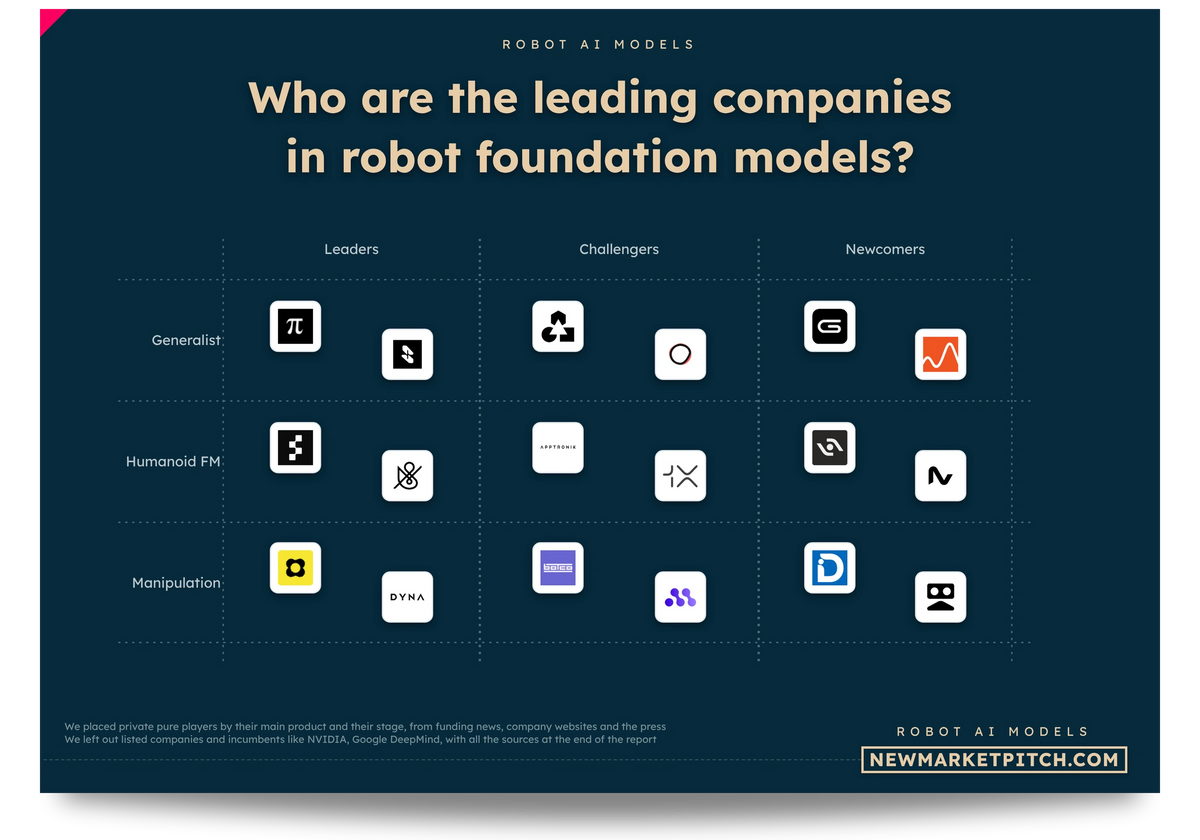
That gap matters when we compare Genesis with Skild AI. Skild reports more than 60 paying customers and over $100 million in annual recurring revenue. Physical Intelligence and Generalist are developing models for other companies' robots, while Genesis is making the robot itself. Those are different ways to build a business, with different bills to pay.
The wider factory market is large: the International Federation of Robotics counted 603,000 industrial robot installations in 2025. Existing industrial robots mostly do fixed, repeated jobs. Genesis has to find changing tasks where its hands, software and mobile platform beat those established machines on both performance and cost.
Nvidia's investment adds a well-connected backer, although Nvidia also develops models and works with competing robotics companies. The new money can pay for data, computing, manufacturing and trials; it cannot tell us whether a factory will rent dozens of Enos and keep them running across shifts. Nvidia's money adds a well-connected backer. Who backs Genesis AI, and why it matters, is a question we take up in our report on who's ahead in robot brains.
That leaves us with a clear judgment. Genesis has made enough technical progress to attract serious capital, and its approach could turn into a valuable business. The price is still a bet on future deployments. Durable hands, repeated task success and customers who renew paid contracts will decide whether the wager pays off.

Written by the New Market Pitch teamWe track new markets so founders and investors can move faster. About us


This is just a preview page. Don’t worry if a number looks old: the report gets refreshed, and you’ll always get the latest version.
Who just put $500 million into Genesis AI?
A new $500 million Series A gives Genesis AI the money to bring its robot foundation model into customer sites, at a $3.5 billion post-money valuation.
Premji Invest, Khosla Ventures and Eclipse co-led the November 17, 2026 round. Nvidia, AMD Ventures, Samsung Next, Ericsson, Bpifrance and several other financial and strategic investors participated. Reuters independently reported the deal and its valuation. This is a priced financing, not a speculative estimate from an investor database.
A post-money valuation includes the new investment. Subtracting the fresh capital gives an implied $3.0 billion pre-money value, assuming the announced amount is all new primary funding on the stated terms. The new investment represents about one-seventh of the post-money value. That is a lot to commit while the first robot is still being tested with customers. The money gives Genesis a chance to make the design work at scale.
What has Genesis AI built since its first funding round?
Genesis AI has moved from research software to a complete robot design in little more than a year, with early trials now following the product launches.
The company emerged from stealth in July 2025 with a $105 million seed round. The research goal was broad: train software that could help many kinds of robots perform physical work. By May 2026 it was showing GENE-26.5 and a robotic hand. The same month it released Genesis World 1.0, building on an earlier academic simulator. June brought Eno and a partnership with LG CNS. Reuters then confirmed Nvidia's investment in October, before the much larger November financing.
Across those announcements and reports we count eight milestones, mostly new technology, partners and financing. The last one, TechCrunch's factory visit, supplies the clearest outside account of how those prototypes behave.
The table below shows the main events we could date from company announcements and independent reporting.
| Date | Genesis AI event | What changed |
|---|---|---|
| July 2025 | $105M seed announced | Research company came out of stealth |
| May 6, 2026 | GENE-26.5 introduced | Robot foundation model shown with dexterous hands |
| May 27, 2026 | Genesis World 1.0 released | Updated simulation platform made available |
| June 16, 2026 | Eno unveiled | First Genesis robot body presented |
| June 16, 2026 | LG CNS partnership | Industrial evaluations planned |
| October 13, 2026 | Nvidia investment confirmed | Chipmaker became strategic investor |
| November 17, 2026 | Series A announced | Larger deployment and production budget |
| November 17, 2026 | Eno fleet described to TechCrunch | 30 to 40 units built; limited pilots |
Which factory jobs could Genesis AI's Eno do first?
Genesis AI is aiming Eno at factory and warehouse handling jobs where the objects or steps can change from one task to the next.
The company has described supplying production lines, handling objects and preparing work areas for the next shift. Eno combines a wheeled base with adjustable body sections, two arms and human-shaped hands. Genesis chose wheels to move across flat industrial floors while putting more engineering work into gripping objects. Stairs and uneven ground will be harder for this design. In a factory, the immediate prize is a machine that can use tools and workstations already designed for people.
Genesis's June announcement put manufacturing, logistics and laboratories first. Hotels, hospitals and homes appeared as later possibilities. The first buyers will want to see Eno finish a sequence of handling tasks safely through a whole shift, not just pick up one object in a short test. First buyers will want a full shift of handling tasks, so we ask how well robot brains handle new tasks in our robot brains market report.

How many Genesis AI robots are working with customers?
Between 30 and 40 Genesis AI Enos have been built, with only a handful of disclosed customer pilots and no installed fleet count.
During a visit reported on November 17, TechCrunch was told that 30 to 40 Eno units had been built. The company described pilots with a handful of customers but did not name those customers or provide the number of machines installed at each site. Those are units built; Genesis did not say how many were sold or working at customer sites.
Genesis has selected a contract manufacturer to begin work in the United States next year, according to the same report. The production design is said to be finished, but the company did not give a production target. Genesis still needs to learn how the Enos perform over weeks of customer use.
Did Genesis AI's packing demo hold up when repeated?
Not really. On a second attempt, Genesis AI's robot model struggled with the box-packing task it had just completed for TechCrunch.
TechCrunch watched a pair of off-the-shelf robotic arms collect and scan boxes, pack them into a larger carton, close and tape it, then apply a printed label. The reporter asked Genesis to run the task again. On the repeat, the arms fumbled a box and had trouble peeling the label away. The company controlled the setup and did not allow the journalist to rearrange the objects for a separate test.
The demonstration used standard robot arms, because Genesis said Eno was not ready for the visit. TechCrunch saw the software carry out several useful actions in sequence. The failed repeat also exposed a practical weakness: factories need to know how often a task succeeds, how fast it runs and how the robot recovers when something goes wrong.
Can Genesis AI's robotic hands survive factory shifts?
Not yet. Just a few weeks of regular use is the current lifespan of Genesis AI's robotic hands, a serious problem for factory buyers.
Hands are central to the company's approach, and they touch everything from boxes to cables. They will wear out in the work they are designed to do. A factory needs a machine available across shifts, with predictable repairs and few interruptions.
We would want to know the cost of a replacement hand, how quickly a technician can swap it, and whether grip accuracy falls before the repair. Genesis has not published those figures. A few minutes of downtime might be manageable; an unreliable hand that repeatedly stops a production line would be much harder to sell.
How does Genesis AI teach robots using human hands?
Genesis AI is training its robot hands on real workers' movements and grip forces, using sensor gloves that closely match the machine's hands.
TechCrunch reported that more than 100 workers around the world wear sensor gloves and head cameras during their normal activities. The company says the proportions of the human hand, data glove and robotic hand match closely. Its aim is to reduce the gap between an example performed by a person and the action a robot is supposed to copy. Force information matters because lifting a flexible object or pulling a label off paper depends on contact, not only what a camera can see.
That method could make learning hand movements easier. Its value will depend on the variety of tasks recorded, including failures and unfamiliar objects. The worker count tells us the collection effort has begun, although Genesis has not published total training hours or a measured success rate on unseen factory tasks. Genesis has not published total training hours. How much data robot brains learn from is something we look into in our report on who's ahead in robot brains.
The table below shows Genesis's training tools and the practical tests each one faces.
| Part of the system | What Genesis collects or builds | Test that matters |
|---|---|---|
| Worker gloves | Hand motion and contact signals | Variety of real work |
| Head cameras | Visual context around tasks | Changing object positions |
| Human-shaped robot hands | Close match to glove movements | Accurate contact and grip |
| Shared hand geometry | Easier transfer from people to machines | Fewer new demonstrations |
| GENE-26.5 | Model trained to act on tasks | New tasks without scripting |
| Genesis World | Virtual physics and robot scenes | Transfer to actual hardware |
| Eno robot | Mobile arms and hands | Reliable full workflows |
| Customer feedback | Failures and outcomes from pilots | Better results over time |

This is a preview page. Spotted an outdated number? That’s normal here. The report you get is always the freshest version.
Can Genesis World make robot training much faster?
With Genesis World, Genesis AI can practise robot movements in software before testing them on costly physical machines.
The platform combines a physics engine, a photorealistic renderer called Nyx and a computing compiler called Quadrants. Its published documentation describes software that runs from a laptop to data-center GPUs and can be installed by outside developers. Genesis released version 1.0 in May 2026.
Teams can test thousands of hand movements, contact conditions or box positions in software without wearing out a physical robot. The trouble comes when flexible packaging, friction or faulty sensors behave differently on a workbench. The repeated packing demo reported by TechCrunch gives us a concrete example of a real-world task that still needs work.
Does Genesis AI's GENE model work beyond Eno?
Genesis AI has run GENE on standard robot arms as well as designing it for Eno, although large-scale use across different machines remains untested publicly.
The independent TechCrunch demonstration used off-the-shelf arms, while Genesis has designed GENE to run its own Eno hardware. The shared software can operate in more than one hardware setting. Each new arm, hand and workspace may still require its own training. The company also changed its strategy after initially pitching a broad software platform: it moved toward developing the brain, hands, simulator and body together.
Physical Intelligence and Generalist are building models for other companies' machines. Genesis has tighter control over its sensors and hardware, so it can change the hand when the model struggles. In return it has to manufacture, service and sell the robot body as well as the software.
Has LG CNS ordered Genesis AI robots yet?
LG CNS has agreed to test how Genesis AI robots could work in industrial sites, with no disclosed bulk order or contract value.
The companies announced a strategic partnership on June 16, 2026. They said the first phase would identify suitable manufacturing and logistics tasks among LG operations and LG CNS customers in the United States. The next phase would test robots and work out how to gather data, adapt models, validate results and run equipment. Larger deployment would follow if those stages succeeded.
LG CNS has experience installing industrial automation and access to businesses that Genesis would struggle to reach alone. The agreement gives Genesis a practical route into those sites. Buyers will still decide what they need, how well Eno performs and whether the economics work. Corporate partners can open factory doors. In our robot brains market report, we look at what tech giants and other big players bet on.
Is Genesis AI making money from robots yet?
Genesis AI has not disclosed robot revenue, paid customer counts or confirmed sales volumes, even as early pilots begin.
When Crunchbase News asked about the company's business in November, CEO Zhou Xian declined to give revenue or a paying customer count. The funding announcement named investors and technology, but did not state booked robot orders, shipments to paying customers or annual recurring revenue. TechCrunch's report about a handful of pilots does not establish that they are paid.
Some pilots could be paid, and the company has not said whether they are. Until it gives a revenue figure or named commercial contract, we have to judge Genesis chiefly on its technology, customer tests and manufacturing progress.

Preview only. Some numbers may have changed since we made this page, but your report will be up to date.
Would customers rent an Eno robot instead of buying it?
Genesis AI is considering an Eno rental service, which would let customers test a working robot without paying the full purchase price upfront.
Crunchbase News reported that the company was exploring a rental service. A customer could pay for access to a working machine instead of buying the hardware outright and separately arranging software support. This could suit a warehouse that wants to test repetitive work before making a large capital purchase. It also gives the supplier a reason to keep updating the robot after installation.
For Genesis, renting means paying to make the machine before collecting most customer payments. Installation, monitoring, repairs and hand replacements might also sit on its own books. The missing figures are the rental price, manufacturing cost, average working hours and service cost per machine. A short hand life could make an otherwise attractive monthly fee expensive to deliver.
Can Genesis AI manufacture Eno robots at scale in 2027?
For 2027, Genesis AI has a U.S. contract manufacturer and a finished Eno production design, but no published production target.
TechCrunch reported that the company had chosen a U.S. contract manufacturer to begin work in 2027. Genesis would not say how many robots it intended to produce. Its June announcement had targeted production and initial customer deployments by the end of 2026, so the later report should be read as a distinction between targeted early deployments and the following year's larger manufacturing effort.
A manufacturer now has to assemble the same machine consistently, source the components and test each finished unit. It must also build up spare parts and field service. Genesis's hands still need better durability, so producing more units alone will not solve every customer problem. We would look next for repeatable output and a verified count of machines working in customer sites.
Why does Genesis AI need so much money before robot sales?
Genesis AI needs a large budget because it is training robot intelligence while also designing hands, building machines and preparing customer installations.
Its November funding announcement explicitly named more data collection, large-scale model training, improvements in manipulation, customer deployment and hiring. A software company can deliver a new model over the internet. Genesis has to build a machine with moving parts, keep it working and provide support on site. That extra control is the appeal of its approach and a large part of its cost.
Its Series A is about 4.8 times the size of its seed round, based on the two company announcements. Most of the funding has arrived just as Genesis takes on the expensive part: producing robots and making them work outside the lab. If every factory needs weeks of custom engineering, selling more Enos could remain costly. A Series A almost five times the seed is a lot of money, and we compare which physical AI startups raised the most in our robot brains report.

This is just a preview page. Don’t worry if a number looks old: the report gets refreshed, and you’ll always get the latest version.
Is there a large enough factory market for Genesis AI?
Yes, Genesis AI is entering a huge industrial automation market, although most robots bought today are built for fixed jobs.
The International Federation of Robotics counted roughly 603,000 new industrial robots installed globally in 2025, up 11%, and more than five million already working in factories. Most of those machines repeat programmed tasks. Genesis wants to handle work where objects change or people currently step in to solve small problems. We still need customer prices and working-hour data to estimate how many of those jobs Eno could win.
The geographic split also matters. China installed 354,000 robots, close to 59% of the world total. The United States installed about 38,500 and Japan 36,219. For a company starting with U.S. industrial partners, that leaves a clear opening in harder multi-step manual work, even though China buys the most traditional industrial robots.
The table below shows selected 2025 industrial robot installation markets reported by the IFR, not prospective Genesis orders.
| Country | New industrial robots in 2025 | Change from 2024 |
|---|---|---|
| China | 354,000 | +20% |
| United States | About 38,500 | +12% |
| Japan | 36,219 | -19% |
| South Korea | 30,000 | -1% |
| Germany | Fewer than 25,000 | -8% |
| India | Almost 10,500 | +15% |
| Italy | About 7,800 | -11% |
| France | Almost 4,500 | -8% |
| Brazil | Almost 4,300 | +38% |
Is Genesis AI cheaper than Skild AI for a reason?
In large part, yes. Skild AI has reported paying robot-model customers and recurring revenue; Genesis AI has not given comparable sales figures.
Skild announced a January 2026 funding round at a valuation above $14 billion. More importantly, in September it said it had passed $100 million in annual recurring revenue, had recognized $50 million of revenue and served more than 60 paying customers in ten months of commercial deployment. These are company-reported figures, not audited financial statements. Skild named work with Nvidia and Foxconn, along with projects involving Sumitomo Wiring Systems and Mitsui.
Genesis is developing a combined robot and AI system; Skild supplies intelligence for different robot bodies. Set against its disclosed recurring revenue, Skild's January valuation works out to roughly 140 times that annualized figure. That price also assumes a lot of growth, although customers are already paying for its software. Genesis has no public revenue number to put into the same calculation.
How does Genesis AI compare with Physical Intelligence?
Physical Intelligence is testing model access for robot developers, whereas Genesis AI is building the model and its own robot together.
Bloomberg reported a $600 million Physical Intelligence round at a $5.6 billion valuation in November 2025. TechCrunch later described the company as valued around $11 billion in August 2026. Bloomberg reported talks in October to raise at least $1 billion at roughly $20 billion; that later figure was a proposed price, not a completed financing in the report. We keep those talks separate from completed deals.
Physical Intelligence introduced an API beta in October that allows outside developers to upload robot data, fine-tune its models and run them through a hosted service. It described collaborations across equipment and settings, including an autonomous wheel loader. Genesis is using a closer link between its own model and its own hands. Physical Intelligence can spread its software across other makers' robots. Genesis could earn more from each Eno installation, while carrying the manufacturing and repair bills. Generalist offers a third comparison: TechCrunch reported an August 2026 extension of nearly $200 million at a $3 billion valuation. That company is building models for different robot bodies and had only a handful of reported early customers. Genesis and Physical Intelligence take opposite routes. Who leads among Genesis AI, Skild AI and Physical Intelligence is what we ask in our robot brains market report.
The table below shows reported robot-model financing deals and one proposed deal, listed by announcement date.
| Company and event | Funding amount | Reported valuation | Status |
|---|---|---|---|
| Genesis AI, July 2025 seed | $105M | Not disclosed | Announced |
| Physical Intelligence, November 2025 | $600M | $5.6B | Reported completed |
| Skild AI, January 2026 Series C | $1.4B | Above $14B | Announced |
| Generalist, June 2026 Series B | $400M | $2B | Reported completed |
| Generalist, August 2026 extension | Nearly $200M | $3B | Reported completed |
| Physical Intelligence, October 2026 talks | At least $1B proposed | Around $20B proposed | Talks, not a closed deal |
| Genesis AI, November 2026 Series A | $500M | $3.5B post-money | Announced |
The proposed Physical Intelligence round is separate from closed deals; the products and commercial stages differ.

Does Nvidia's investment prove Genesis AI has the best robot brain?
No. Nvidia has invested in Genesis AI, but it also develops robot models and works with other companies trying to win the same factory customers.
Reuters confirmed in October that Nvidia had agreed to invest in Genesis. Nvidia then appeared among the investors listed in the Series A announcement. A major computing supplier sees potential in the company. Nvidia has announced no Eno purchase order or exclusive technology deal.
Nvidia's own products illustrate the overlap. In March it announced Isaac GR00T N1.7, a commercially usable robot model, along with Cosmos tools for generating and testing physical AI data. In September it described work with Skild on the S1 model. Nvidia can sell computing and software tools whichever robot maker wins. Genesis will have to compete on what its hands and integrated machines accomplish for customers.
Could open robot models make Genesis AI's software less valuable?
Yes, robot models from Nvidia and other developers could put pressure on Genesis AI if they deliver similar abilities on cheaper hardware.
Nvidia has published model weights and development tools for its GR00T platform, and Physical Intelligence is offering an API beta to help developers adapt models to their own hardware. Generalist and Skild also work on robot intelligence that is not tied to an Eno body. We have yet to see a controlled factory comparison of how well those systems handle the same gripping and packing jobs.
Genesis has designed its hands, training data, simulator, model and robot body together. Buyers might pay more for that combination if it handles tricky work with less setup and fewer failures. If competitors adapt accessible models to simpler, cheaper machines, Genesis will need an unusually good operating record to justify its extra hardware cost.
What would Genesis AI need to prove to keep this valuation?
Genesis AI needs paid industrial deployments, reliable robotic hands and clear customer savings to support its current valuation.
The next useful disclosures would come from an actual factory or laboratory: how many robots are installed, which tasks they complete, how often they fail, how long they run between repairs and how much their work costs the buyer. A factory trial lasting months would let buyers compare costs, failures and completed tasks over many shifts. Renewed paid contracts would give us a much firmer basis for judging the business. Renewed paid contracts would count most. How far each robot brain is from paying customers is what our report on who's ahead in robot brains measures.
There is a useful comparison outside Genesis. BMW said its Figure 02 test at its Spartanburg plant ran for about 1,250 operating hours and moved more than 90,000 sheet-metal parts over the 2025 program. BMW gave the sort of operating numbers we would like to see from a Genesis customer.
The table below shows the operating data Genesis customers could publish to help us assess its business.
| Question for Genesis | What is public today | Stronger evidence to watch |
|---|---|---|
| Are machines installed? | Small built fleet, limited pilots | Verified customer-site counts |
| Are buyers paying? | Revenue undisclosed | Named paying contracts |
| Can tasks repeat? | Mixed repeat demo | Measured success over full shifts |
| Do hands last? | Replacements needed after weeks | Documented service life and repair cost |
| Can machines stay available? | No fleet uptime figures | Uptime and recovery data |
| Does setup get easier? | Training approach described | Shorter setup across customer sites |
| Is production repeatable? | Contractor selected | Sustained factory output and quality |
| Do customers save money? | Pricing and unit costs undisclosed | Cost per completed task versus alternatives |
Is Genesis AI worth $3.5B before selling robots?
Genesis AI can attract that valuation as a bet on future factory robots, but today's public evidence falls short of proving a business worth that much on sales.
We can see what the buyers of its shares are paying for. Genesis has built a model, a simulator, a human-data pipeline and an original robot body. It has brought in major investors and found an industrial partner. Building those pieces together takes expertise and money. Existing factory demand for automation gives Genesis a place to try to sell them.
The hard evidence still stops at early pilots. The hands need replacement after weeks of regular work, and TechCrunch watched the packing demo stumble on a repeat run. Eno itself was unavailable for that test. Revenue, uptime, unit costs and large paid orders remain undisclosed, while a rival such as Skild can already point to paying users.
We think investors are paying for the possibility of a complete robotics platform that learns from human hands and sells useful work. It could be a strong investment if customers eventually run Enos every day and renew contracts for more machines. As of now, the headline price rests on that expectation.

This is a preview page. Spotted an outdated number? That’s normal here. The report you get is always the freshest version.
Our methodology
We reviewed Genesis AI's original funding, model, robot and partnership announcements, the public Genesis World documentation, and on-site reporting by TechCrunch. We cross-checked the November 17, 2026 financing against Reuters and Crunchbase News. For commercial claims we distinguished a built machine from a delivered one, a pilot from a paid deployment, and an announced partner from a purchase contract. We used only explicitly disclosed amounts and counts. The pre-money estimate and financing comparisons use simple arithmetic based on the company-announced funding amounts and post-money valuation.
For comparisons, we used Skild AI's own funding and revenue posts, Physical Intelligence's product announcement, Bloomberg's funding reporting and TechCrunch's coverage of Generalist. We retained the completed Physical Intelligence valuation reported in 2025 separately from the later 2026 estimates and October financing talks, rather than presenting a proposed deal as closed. Revenue and customer figures from private companies are attributed to those companies rather than treated as audited. Industrial robot installation figures come from the International Federation of Robotics and cover conventional industrial robots, not Eno's addressable market specifically. BMW's deployment figures describe Figure robots, not Genesis. The research runs through November 18, 2026. The recent financing is a priced investor transaction; private robot sales, paid deployments and operating costs remain less visible in the public record.
Written by the New Market Pitch teamWe track new markets so founders and investors can move faster. About us