Who are the top investors in robot foundation models?
Whether you're building or investing in the robot foundation models market, our report covers everything you need to know: the players, the money, and what's coming next.
Summary
NVIDIA is the most active investor in robot foundation models, joining 12 rounds across 11 startups in our coverage. HongShan and Meituan follow with 6 rounds each, but the names at the top change when we distinguish joining a financing from leading it.
NVIDIA was never named lead in the rounds where a lead was published. HongShan, by contrast, was named lead in 5 rounds, while Meituan was named lead in 4. The investor who joins the most rounds is not necessarily the one driving them.
Big technology companies are also deeply involved. Amazon, Alibaba, SAIC Capital, BAIC Capital and Lenovo Capital appear among the active backers alongside established venture firms and newer specialist funds.
For corporate investors, these robot models could also support their existing businesses. NVIDIA sells the computing and training infrastructure these systems need; Amazon operates logistics infrastructure; automotive and industrial groups can provide environments in which adaptable robots might become useful.
The investors also show up when companies need much bigger checks. SoftBank Vision Fund was named lead in 4 rounds, including financing for Skild AI and Agile Robots. Its participation shows that the biggest rounds can attract an investor willing to back both robot intelligence and industrial deployment.
This year NVIDIA joined 7 rounds. HongShan joined 4, and Andreessen Horowitz joined 3, showing that prominent investor activity continues even as some earlier participants have slowed or stopped appearing.
Different names dominate different funding stages. Legend Capital joined 4 seed rounds, the most of any investor at that stage, while NVIDIA appeared in 3 Series B rounds and 3 Series C rounds. A founder raising a seed round will meet different backers from a company preparing a Series C.
Some investors keep showing up in the same deals. Amazon and NVIDIA joined 3 rounds together, backing Figure AI, NEURA Robotics and Dyna Robotics, while NVIDIA and SoftBank Vision Fund appeared together in Skild AI and Agile Robots financings.
Overall, we identified 291 distinct named investors, but coverage remains incomplete because not every announcement names every participant. The published names are a minimum: some financings never reveal everyone who joined.
The robot foundation models market draws money from big technology companies and mainstream VCs, not only dedicated robotics funds. NVIDIA appears most often, while HongShan leads more rounds. Which investor matters most depends on the company and stage.

Written by the New Market Pitch teamWe track new markets so founders and investors can move faster. About us

In our report covering the robot foundation models market, you will always find fresh funding data, taken straight from our own verified funding database.
Which VCs invest the most in robot foundation models right now?
NVIDIA is the most active named investor in robot foundation models right now, with 12 rounds joined; HongShan and Meituan follow, tied at 6 rounds each. NVIDIA is a technology company, not a traditional VC. HongShan leads most often among the venture firms in our coverage.
NVIDIA has appeared alongside Figure AI, Skild AI, Agile Robots, Physical Intelligence and NEURA Robotics. HongShan is especially active in Chinese embodied robotics, while Meituan has joined financings for companies such as Galbot, X Square Robot and TARS Robotics. Legend Capital and Amazon come next with 5 rounds each, again illustrating the mixture of financial funds and companies with direct industrial interests.
NVIDIA's recent physical-AI announcements explained a broader context for its relationships: the company supplies robot-model training tools, simulation systems and computing platforms to the same market it backs financially. Investing in customers and technology partners gives NVIDIA a different role from a traditional fund.
The table below ranks the 20 most active robot foundation models investors by the number of equity rounds they joined, with the rounds they led, their main stages, the startups they backed and the biggest round they joined.
If you want to go more into detail and get more data to understand what investors are betting on now, please check our robot foundation models report.
| # | Investor | Rounds | Led | Main stages | Robot foundation models startups backed | Biggest round joined | Latest round |
|---|---|---|---|---|---|---|---|
| 1 | NVIDIA ▲ | 12 | 0Never led (lead known for 11 of 12 rounds) |
Series B 3Series C 3 | Figure AI, Skild AI, Agile Robots, Physical Intelligence, NEURA Robotics + 6 more | $1.4BSkild AI · 2026 | Nov 2026 |
| 2 | HongShan ▲ | 6 | 5Named as lead in every round found (lead known for 5 of 6 rounds) |
Series A 2Seed 1 | AgiBot, X Square Robot, RobotEra, TARS Robotics, Noematrix | $455MTARS Robotics · 2026 | Apr 2026 |
| 3 | Meituan ▲ | 6 | 4Usually leads (67% of its rounds) |
Seed 3Series A 2 | Galbot, X Square Robot, Galaxea AI, TARS Robotics | $455MTARS Robotics · 2026 | Apr 2026 |
| 4 | Legend Capital ▼ | 5 | 2Leads half its rounds (lead known for 4 of 5 rounds) |
Seed 4Series A 1 | X Square Robot, Dexmal, Manifold AI | $28MDexmal · 2025 | Mar 2026 |
| 5 | Amazon ▼ | 5 | 0Never led | Series A 2Seed 1 | Figure AI, NEURA Robotics, Dyna Robotics, Archetype AI | $675MFigure AI · 2024 | Jun 2026 |
| 6 | SoftBank Vision Fund ▲ | 4 | 4Named as lead in every round found | Series A 1Series B 1 | Skild AI, Agile Robots | $1.4BSkild AI · 2026 | Nov 2026 |
| 7 | Andreessen Horowitz ▲ | 4 | 3Named as lead in every round found (lead known for 3 of 4 rounds) |
Series A 2Seed 1 | World Labs, Mind Robotics, Eka Robotics, Tutor Intelligence | $500MMind Robotics · 2026 | Nov 2026 |
| 8 | Khosla Ventures ▼ | 4 | 3Usually leads (75% of its rounds) |
Seed 2Series A 1 | General Intuition, FieldAI, Genesis AI | $320MGeneral Intuition · 2026 | Jun 2026 |
| 9 | Alibaba ▼ | 4 | 2Named as lead in every round found (lead known for 2 of 4 rounds) |
Series A 3 | X Square Robot, LimX Dynamics, Dexmal | $140MX Square Robot · 2025 | Jun 2026 |
| 10 | SAIC Capital ▲ | 4 | 1Leads half its rounds (lead known for 2 of 4 rounds) |
Series A 3Series D+ 1 | AgiBot, Galbot, X Square Robot, LimX Dynamics | $350MGalbot · 2026 | Mar 2026 |
| 11 | BAIC Capital ▲ | 4 | 0Never led | Seed 1Series A 1 | Galbot, Galaxea AI, RobotEra, Manifold AI | $140MGalaxea AI · 2026 | Jun 2026 |
| 12 | Lenovo Capital ▼ | 4 | 0Never led (lead known for 2 of 4 rounds) |
Series A 3Seed 1 | LimX Dynamics, DexForce, TARS Robotics, Dexmal | $120MTARS Robotics · 2025 | Nov 2025 |
| 13 | Union Square Ventures ▲ | 3 | 2Usually leads (67% of its rounds) |
Seed 1Series A 1 | Tutor Intelligence, Machenta | $75MTutor Intelligence · 2026 | Nov 2026 |
| 14 | Hitachi Ventures | 3 | 1Mostly follows (led 33% of its rounds) |
Seed 1Series A 1 | Agile Robots, Archetype AI | $500MAgile Robots · 2026 | Nov 2026 |
| 15 | Shangqi Capital | 3 | 1Named as lead in every round found (lead known for 1 of 3 rounds) |
Series A 1Series B 1 | LimX Dynamics | $200MLimX Dynamics · 2026 | Jul 2026 |
| 16 | Guozhong Capital ▲ | 3 | 1Named as lead in every round found (lead known for 1 of 3 rounds) |
Seed 2Series B 1 | PsiBot, GigaAI | $140MGigaAI · 2026 | Jun 2026 |
| 17 | Wuxi Venture Capital | 3 | 1Mostly follows (led 33% of its rounds) |
Seed 2Series A 1 | Galaxea AI, Dexmal, Manifold AI | $28MGalaxea AI · 2024 | Mar 2026 |
| 18 | JD.com ▼ | 3 | 1Named as lead in every round found (lead known for 1 of 3 rounds) |
Series B 2Seed 1 | AgiBot, LimX Dynamics, Spirit AI | $200MLimX Dynamics · 2026 | Feb 2026 |
| 19 | Qiming Venture Partners ▼ | 3 | 1Leads half its rounds (lead known for 2 of 3 rounds) |
Seed 2Series A 1 | TARS Robotics, Dexmal | $120MTARS Robotics · 2025 | Nov 2025 |
| 20 | China Merchants Venture Capital | 3 | 1Leads half its rounds (lead known for 2 of 3 rounds) |
Series A 2Seed 1 | LimX Dynamics, Spirit AI | $74MSpirit AI · 2025 | Mar 2025 |
No investors match this search.
Data from January 2024 through 12 November 2026, which is enough to show who is active today and who has been for years. Rounds: equity rounds in which the investor is named. Led: rounds it led or co-led. ▲ more rounds in 2026 so far than its 2025 pace, ▼ fewer.

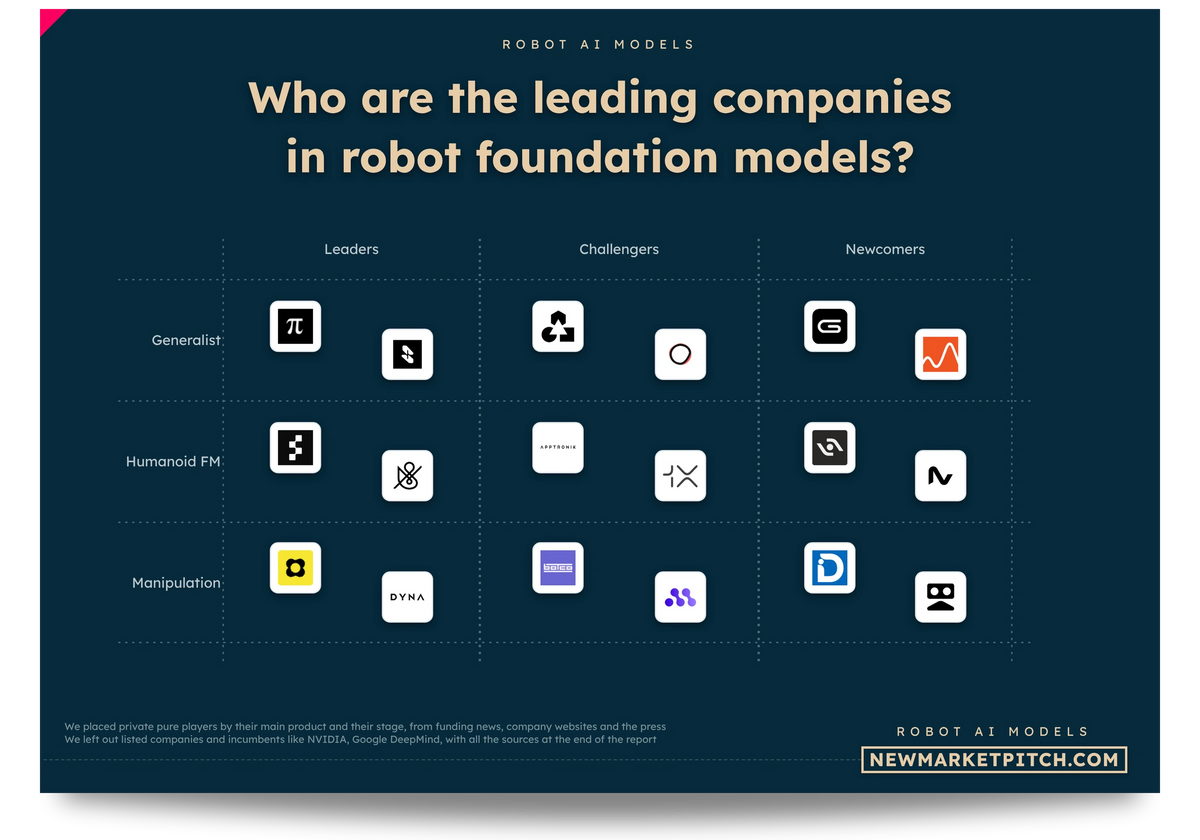
In our research about robot foundation models startups, we turn what is vague and complex into simple, useful visuals. Market maps like this one show you at a glance where every startup stands.
Is NVIDIA investing in robot AI like a normal venture fund?
No, NVIDIA joins more robot foundation models rounds than any other named investor, but traditional VCs more often lead the financings.
NVIDIA was named as lead in no round among the 11 for which a lead was published. Its portfolio relationships include Figure AI, Skild AI and Physical Intelligence, as well as robotics companies whose products can use accelerated computing and simulation. By contrast, HongShan led 5 of its 6 recorded rounds, which demonstrates a different role in bringing companies through financings.
NVIDIA sells the hardware and software that more robot model developers need to train their systems. At its March 2026 developer event, NVIDIA described Skild AI, World Labs and other robotics companies as users of Cosmos world models, Isaac simulation and related systems. NVIDIA can invest, sell computing systems and work on technical projects with the same startup without leading the financing. Our count tracks participation, not how much NVIDIA itself put in.
Is HongShan now leading China's robot foundation models funding?
Yes, HongShan has led more robot foundation models rounds than any other named investor, with 5 led financings among 6 rounds joined.
Its portfolio in this market spans AgiBot, X Square Robot, RobotEra, TARS Robotics and Noematrix. HongShan backs several different routes to embodied intelligence. Its backings connect a broader set of Chinese efforts to combine robot bodies with learned control, perception and action models. Meituan matches HongShan on rounds joined but was named lead fewer times.
HongShan was one of the leads of RobotEra's April 2026 round, alongside SF Group and IDG Capital. The same robotics market contains X Square Robot's transferable embodied-control work and TARS Robotics' industrial automation focus. Each company is trying to teach robots something different. HongShan keeps taking the lead on those financings. That tells us more about its role than a long list of portfolio logos, though not the size of its own checks.

In our market report about robot foundation models startups, we always try to gather several sources and make estimates that make sense, so you can work with solid numbers.
How big a robot AI investor is Meituan now?
Meituan is now one of the busiest Chinese robot foundation models backers, joining 6 rounds and leading 4.
Meituan backed Galbot, X Square Robot, Galaxea AI and TARS Robotics. The companies are training machines for different kinds of movement and manipulation. NVIDIA joined more rounds across the whole market, while HongShan led more.
Meituan's interest also makes business sense: better robots could eventually help automate physical services. TARS Robotics' April 2026 financing named Meituan alongside HongShan and other backers, while Galbot's activity shows the continued capital demand around embodied robotics in China. None of those investments proves that Meituan is buying robots from the startups. Backing several competing approaches makes Meituan hard to ignore in Chinese robot-model fundraising.
Does SoftBank Vision Fund prefer robot brains or robot hardware?
Both. SoftBank Vision Fund backs robot brains and physical machines in the robot foundation models market.
SoftBank Vision Fund joined 4 robot foundation models rounds and was named as lead in 4. The portfolio in our investor ranking is concentrated in Skild AI and Agile Robots. Skild pursues broadly transferable robot policies, while Agile Robots brings physical-AI systems into industrial production. Both must turn learned robot behavior into reliable physical work.
Skild's January 2026 announcement described its ambition to run one intelligent system across different robot types. Agile Robots' November 2026 financing announcement emphasized installed robotic solutions and manufacturing expansion. SoftBank helped lead those large financings. The public totals are the full rounds, not the size of SoftBank's own checks.
Are Andreessen Horowitz and Khosla Ventures still backing robot AI?
Yes, both Andreessen Horowitz and Khosla Ventures still back robot foundation models, although Andreessen Horowitz has been more active recently.
Andreessen Horowitz joined 4 rounds, with 3 rounds this year and none last year in our coverage. Khosla Ventures joined 4, with 1 round this year after 3 last year. They have backed different businesses: Andreessen Horowitz backed World Labs, Mind Robotics, Eka Robotics and Tutor Intelligence, while Khosla Ventures backed General Intuition, FieldAI and Genesis AI.
Andreessen Horowitz's March 2026 article on Mind Robotics described industrial manipulation as a bridge between AI research and real factories. Khosla Ventures led General Intuition's Series A financing, which Axios described as a bet on learning spatial actions from gaming data. Both firms invest in robot intelligence, but not necessarily in the same kind of training data, machine or customer. Andreessen Horowitz has recently leaned toward companies doing factory work. Khosla Ventures has also backed teams trying to understand movement and action from unusual data.
Is Amazon funding robot AI beyond its warehouses?
Yes, Amazon backs robot foundation model startups working on general robot intelligence as well as industrial automation.
Amazon joined 5 recorded rounds involving Figure AI, NEURA Robotics, Dyna Robotics and Archetype AI. Its Industrial Innovation Fund publicly lists physical-AI developers such as Archetype AI, Dyna Robotics, Physical Intelligence and Skild AI within its wider portfolio. That goes well beyond traditional warehouse hardware.
The fund's published mandate supports emerging technologies across stages, and its portfolio includes companies developing general intelligence for robot actions. Archetype AI's November 2025 release described its Newton model as a system for understanding physical environments, while Dyna Robotics' September 2025 release focused on foundation models for deployed manipulation tasks. Both are teaching robots how to handle unfamiliar tasks. Amazon may learn from these companies, but participation does not prove their products are deployed in its warehouses.

Our document detailing everything you need to know about robot foundation models gets updated several times a month, so you always get the latest view of where things stand.
Which robot foundation models investors are still investing this year?
NVIDIA remains the busiest investor in robot foundation models this year, joining 7 rounds, compared with 4 last year. Among the 20 most active investors in our ranking, 17 have joined a round this year and 3 have not.
HongShan remains active with 4 rounds this year, while Meituan and Andreessen Horowitz joined 3 each. Lenovo Capital, Qiming Venture Partners and China Merchants Venture Capital have not joined a recorded round this year, even though they appear in the wider ranking. Some may be investing elsewhere. We recorded no qualifying round from them this year.
The latest examples show the range of current activity. Andreessen Horowitz described its backing of Tutor Intelligence as a bet on productive industrial robots; SoftBank Vision Fund has also backed large robot-model and industrial-robotics financings. Some investors keep coming back, while others have been quieter.
The table below shows, year by year, how many rounds 12 of the most active robot foundation models investors joined, so it is easy to see who is still investing and who has slowed down.
If you want to go more into detail and see which investors are still writing checks and which have slowed down, please check our robot foundation models report.
| Investor | 2024 | 2025 | 2026* | Total |
|---|---|---|---|---|
| NVIDIA | 1 | 4 | 7 | 12 |
| HongShan | 2 | 4 | 6 | |
| Meituan | 1 | 2 | 3 | 6 |
| Andreessen Horowitz | 1 | 3 | 4 | |
| Legend Capital | 3 | 2 | 5 | |
| SoftBank Vision Fund | 1 | 1 | 2 | 4 |
| SAIC Capital | 1 | 1 | 2 | 4 |
| BAIC Capital | 1 | 1 | 2 | 4 |
| Union Square Ventures | 1 | 2 | 3 | |
| Shangqi Capital | 1 | 2 | 3 | |
| Guozhong Capital | 1 | 2 | 3 | |
| Amazon | 2 | 2 | 1 | 5 |
* 2026: January to 12 November. Darker cells mean more rounds that year. Data from January 2024 through 12 November 2026.
Which Chinese investors are still funding robot AI now?
HongShan and Meituan are still active Chinese robot foundation models investors, while Lenovo Capital and Qiming Venture Partners have been quiet this year.
HongShan joined 4 rounds this year and Meituan joined 3, while Legend Capital and SAIC Capital each joined 2. Lenovo Capital recorded no round this year after 4 last year, and Qiming Venture Partners recorded no round after 3 last year. These counts cover only robot foundation models, not everything the funds buy.
Their investments also reflect different business interests. Some backers continue to fund integrated humanoids, others support transferable models for robotic manipulation, and automotive-linked funds can be interested in production equipment as well as end-user robots. LimX Dynamics' February 2026 financing announcement, for example, named both automotive-linked investors and other venture firms, describing motion-control foundation models as part of its technology. The Chinese investor market is still active, but the busiest backers have changed.
Do robot AI investors really need billion-dollar funds?
No, a billion-dollar fund does not automatically make an investor important to robot foundation models startups.
NVIDIA leads by participation, followed by HongShan and Meituan, then Legend Capital and Amazon. Amazon's Industrial Innovation Fund describes itself as a $1 billion corporate venture capital fund, but the amount of that fund is not the amount invested in robot foundation-model startups. A public fund announcement also rarely tells us its exact check in a particular startup.
Amazon funds many types of industrial technology. HongShan repeatedly leads rounds in a narrower group of robot-model startups. A large fund can deploy capital across areas outside the market definition, including sensors, safety, mobility and conventional automation. A smaller investor may understand a niche and keep appearing in its financings. For a founder, the useful screening questions are which startups the investor backed, at what stage, and whether it was explicitly named as lead. A fund size alone tells a founder very little.
Which robot foundation models investors back seed rounds, and which back growth rounds?
Legend Capital is the busiest seed-stage investor in robot foundation models, joining 4 seed rounds, while NVIDIA is most active at Series C with 3 rounds. Seed is also the most common known stage in the market, accounting for 56 of the 124 rounds with a known stage.
Stage changes which investors are worth calling. Alibaba, SAIC Capital and Lenovo Capital are tied at Series A with 3 joined rounds each, while NVIDIA stands alone at Series B with 3. Only 11 known-stage rounds are Series C or later, so the pool of investors repeatedly appearing in larger, later financings is much thinner than the early-stage network.
Skild AI and Agile Robots illustrate how much capital mature robot-model companies need. Legend Capital also backed X Square Robot, Dexmal and Manifold AI early, when their learned-action technology still needed proving. A seed investor and a later-stage backer do different jobs.
The table below shows, for 12 of the most active robot foundation models investors, how many rounds they joined at each stage, from seed to growth.
If you want to go more into detail and see where each investor places its bets, from seed to growth, please check our robot foundation models report.
| Investor | Seed | Series A | Series B | Series C | Series D+ | Growth |
|---|---|---|---|---|---|---|
| NVIDIA | 2 | 2 | 3 | 3 | 1 | · |
| HongShan | 1 | 2 | 1 | · | · | 1 |
| Meituan | 3 | 2 | 1 | · | · | · |
| Legend Capital | 4 | 1 | · | · | · | · |
| Amazon | 1 | 2 | 1 | 1 | · | · |
| SoftBank Vision Fund | · | 1 | 1 | 1 | 1 | · |
| Andreessen Horowitz | 1 | 2 | 1 | · | · | · |
| Khosla Ventures | 2 | 1 | · | · | · | 1 |
| Alibaba | · | 3 | · | · | · | · |
| SAIC Capital | · | 3 | · | · | 1 | · |
| BAIC Capital | 1 | 1 | 1 | · | · | · |
| Lenovo Capital | 1 | 3 | · | · | · | · |
Most active at each stage, among all robot foundation models investors: Seed, Legend Capital · Series A, Alibaba, SAIC Capital and Lenovo Capital · Series B, NVIDIA · Series C, NVIDIA · Series D+, no investor joined more than one round · Growth, no investor joined more than one round. Bigger dots mean more rounds. Data from January 2024 through 12 November 2026.

In our report covering the robot foundation models market, we look at what the winners do differently, so you can learn from the best instead of guessing.
Who is funding Chinese robot AI startups at Series A?
Alibaba, SAIC Capital and Lenovo Capital are tied for the most robot foundation models Series A rounds, with 3 each.
The tie brings together a technology platform, a carmaker-linked fund and a computing business. At Series A, investors want to see a robot repeat more than one carefully staged demo. Different corporations can see different downstream benefits from that transition.
Alibaba's recorded robotics investments include X Square Robot, LimX Dynamics and Dexmal. SAIC Capital appears in companies including AgiBot, Galbot, X Square Robot and LimX Dynamics. Lenovo Capital backed LimX Dynamics, DexForce, TARS Robotics and Dexmal. LimX's published financing announcement stressed the combination of hardware, motion-control models and a physical-world operating system. The investors have different businesses, but each has a reason to see robot learning improve beyond the lab.
Does NVIDIA back robot AI startups when they get bigger?
Yes, NVIDIA is the busiest investor in later robot foundation models rounds, joining 3 Series B financings and 3 Series C financings.
Joining these rounds is different from leading them. NVIDIA has not been named lead in the rounds with published leads in our record. Its late-stage participation instead puts it alongside companies that have progressed beyond an initial technical pitch and now need larger deployment and training capacity.
Backing larger robot-model companies also fits NVIDIA's computing business. Figure AI, Skild AI and other robot-model teams need large-scale accelerated computing, but they also require data from real interactions and reliable policy execution. NVIDIA does not have to control a startup to benefit from a larger market for robot training.
Do robot AI investors keep backing the same startups?
Yes, some robot foundation models investors join several rounds involving the same startups, although nobody is obliged to keep funding them.
Examples include SoftBank Vision Fund's activity in Skild AI and Agile Robots, and recurring Amazon and NVIDIA connections to companies such as Figure AI and NEURA Robotics. The companies change their funding needs as they move from model research toward testing, manufacturing and customer deployment.
Dyna Robotics' September 2025 announcement named NVIDIA's venture arm and Amazon Industrial Innovation Fund alongside its other investors, while Figure's fundraising announcement named a broad group of technology and financial backers. When a robot company raises again, existing participants may maintain an interest because subsequent deployments can generate training data and better hardware-software integration. These companies need more money as they grow, and familiar investors can follow. Public announcements tell us who joined, but not what anyone promised to invest next.

Learning from others' mistakes is the cheapest lesson there is. In our research about robot foundation models startups, we look at what broke startups before you, so you don't repeat it.
Which robot foundation models investors most often invest together?
Amazon and NVIDIA are the most frequent named co-investor pair in robot foundation models, appearing in 3 rounds together across Figure AI, NEURA Robotics and Dyna Robotics. Other recurring pairs include NVIDIA with SoftBank Vision Fund and NVIDIA with Qualcomm Ventures, each on 2 rounds.
Other recurring pairings tell a different story. NVIDIA and SoftBank Vision Fund participated together in Skild AI and Agile Robots, while NVIDIA and Qualcomm Ventures overlapped in Figure AI and NEURA Robotics. In China, BAIC Capital and Meituan appear together in Galaxea AI and Galbot. These relationships tie compute suppliers, industrial participants and venture firms to some of the same difficult robot-learning problems.
Backing the same round does not mean the investors agreed on a joint strategy. Amazon's industrial fund focuses on real-world operations, while NVIDIA sells AI training and simulation tools. Their overlap fits those businesses, but does not prove an exclusive partnership or a customer contract.
The table below lists the pairs of robot foundation models investors named together in at least two equity rounds, with the startups they backed together.
If you want to go more into detail and see which investor networks back the same startups, please check our robot foundation models report.
| Investor pair | Rounds together | Startups backed together |
|---|---|---|
| Amazon + NVIDIAFigure AI, NEURA Robotics, Dyna Robotics | 3 | Figure AI, NEURA Robotics, Dyna Robotics |
| NVIDIA + SoftBank Vision FundSkild AI, Agile Robots | 2 | Skild AI, Agile Robots |
| NVIDIA + Qualcomm VenturesFigure AI, NEURA Robotics | 2 | Figure AI, NEURA Robotics |
| BAIC Capital + MeituanGalaxea AI, Galbot | 2 | Galaxea AI, Galbot |
| Legend Capital + Wuxi Venture CapitalDexmal, Manifold AI | 2 | Dexmal, Manifold AI |
| Lenovo Capital + Qiming Venture PartnersDexmal, TARS Robotics | 2 | Dexmal, TARS Robotics |
| Hongtai Fund + Lenovo CapitalDexForce, Dexmal | 2 | DexForce, Dexmal |
| Lenovo Capital + NIO CapitalLimX Dynamics, Dexmal | 2 | LimX Dynamics, Dexmal |
Pairs of investors named in the same equity round. Data from January 2024 through 12 November 2026.
Are Chinese robot AI investors teaming up with each other?
Yes, Chinese robot foundation models investors repeatedly back some of the same companies together.
BAIC Capital and Meituan joined 2 rounds together involving Galaxea AI and Galbot. Legend Capital and Wuxi Venture Capital also appeared together in 2 rounds involving Dexmal and Manifold AI. Lenovo Capital and Qiming Venture Partners overlapped in Dexmal and TARS Robotics. Such repeated combinations show that the Chinese financing network spans robotics developers, industrial groups and venture funds.
Galbot and Galaxea AI focus on embodied systems, while Dexmal and Manifold AI explore robot manipulation or physical-world intelligence. Meituan and automotive-related capital may look toward practical robotics applications, whereas an early-stage fund can prioritize research teams and technological differentiation. We cannot assign a motive to a specific check merely because a familiar partner appears beside it. The recurring pairs show that Chinese investors often have familiar local partners.
Are big technology companies crowding VCs out of robot AI?
No, corporate giants are highly visible in robot foundation models funding, but traditional venture funds still lead many important rounds.
NVIDIA is the most active participant by rounds joined. Amazon joined 5, and Alibaba, SAIC Capital, BAIC Capital and Lenovo Capital each joined 4. Yet HongShan recorded 6 rounds, Legend Capital recorded 5, and firms such as SoftBank Vision Fund, Andreessen Horowitz and Khosla Ventures are prominent too.
The interests behind these investments are varied. An automotive-related fund may care about factory tasks and robot hardware; an AI computing company may care about models that require training chips and simulation tools; a financial venture fund may focus on a research team's ability to build an enduring software business. Amazon's industrial fund and NVIDIA's technical partnerships show how these investments can connect to an existing business. Financial VCs still take the lead on many rounds, even when big corporate names make the headlines.
Can new VCs still get into robot foundation models investing?
Yes, new venture firms can still get into robot foundation models investing, even with NVIDIA and large funds already active.
We identified 291 named investors in 140 rounds with at least one published investor, covering 89% of the rounds we tracked. The market has plenty of smaller investors beyond NVIDIA and SoftBank Vision Fund.
Machenta's October 2026 seed announcement named Creandum and Union Square Ventures as leads, illustrating how investors can enter a specific technical niche around robots learning from a demonstration. Sereact's April 2026 financing brought existing and new investors behind an operating warehouse-picking platform. New VCs can back ambitious research or teams already doing customer work. It would be wrong to conclude from a lower ranking position that a firm cannot finance an important company.

If you build or invest in the robot foundation models market, you need to know which business models pay off now and which ones are fading. That's why our report covering it has a whole section on it.
Can robotics-focused funds compete with NVIDIA and SoftBank?
Yes, robotics-focused investors can compete on specific deals, even if NVIDIA and established funds appear more often overall.
The busiest investors include NVIDIA, HongShan, Meituan and SoftBank Vision Fund. Round counts cannot measure which fund understands robot learning best.
Specialist funds may focus on individual tasks, stages or countries that larger institutions do not prioritize. For instance, Dyna Robotics' September 2025 Series A was led by RoboStrategy, CRV and First Round Capital, while Tutor Intelligence's published Series A named Union Square Ventures and Fundomo. Founders need backers who understand their model, data needs and customers. Someone financing seed-stage manipulation software has a different job from a firm assembling a billion-dollar growth round.
So, who are the biggest robot foundation models investors now?
NVIDIA is the biggest robot foundation models investor by round participation, with 12 joined financings; HongShan leads by rounds led, with 5.
The right name depends on what the startup needs next. At seed stage Legend Capital is a recurring name; at Series B and Series C NVIDIA appears frequently; SoftBank Vision Fund is visible in major company-building rounds. Amazon and NVIDIA also form the most frequent co-investor pair. A founder should therefore separate the investor that appears most often, the one that leads a round, the one that knows a particular stage and the one whose industrial context could matter after financing.
Robot foundation model startups draw money from technology giants, regional VCs and firms investing across AI. The companies being backed still need to prove that their learning systems can repeat real work in homes, warehouses and factories. These rounds show who is betting on useful robots. They do not tell us who will win.
The table below shows what we found.
| Question | Answer |
|---|---|
| Is NVIDIA truly the most active backer? | Yes, NVIDIA leads robot foundation models by rounds joined. It participated across 11 startups in the covered market. That reflects documented activity, but not corporate control. |
| Does participation mean leading the financing? | No, joining and leading a round are different roles. NVIDIA was named lead in no recorded round. A participant need not set the terms of financing. |
| Who repeatedly organizes robotics funding rounds? | HongShan stands out by repeatedly leading robot-model financings. It was named lead in 5 recorded funding rounds. That distinguishes HongShan from more frequent minority investors elsewhere. |
| Is Meituan just a casual backer? | No, Meituan has become a recurring Chinese robotics investor. It joined 6 rounds across several separate model developers. The involvement extends beyond any single robot hardware platform. |
| Does SoftBank fund hardware rather than models? | SoftBank Vision Fund backs both approaches in physical AI. It joined 4 rounds involving Skild AI and Agile Robots. The common investment bet is broadly deployable robot intelligence. |
| Have famous American venture firms disappeared? | No, established American venture investors still back robot learning. Andreessen Horowitz joined 4 recorded robot foundation model rounds. The companies span manufacturing robotics and general intelligence systems. |
| Do Chinese investors dominate every stage? | No, the busiest investor changes substantially across funding stages. Legend Capital joined 4 robot foundation model seed financings. NVIDIA becomes more prominent in larger, later financing rounds. |
| Is the Series A investor race settled? | No, several corporate groups share the Series A lead. Alibaba, SAIC Capital and Lenovo Capital each joined 3 rounds. However, their underlying commercial priorities can differ substantially. |
| Are Amazon and NVIDIA investing together? | Yes, their overlap is the strongest recorded investor pairing. They joined 3 rounds together across different companies. Shared participation does not imply an exclusive alliance. |
| Is the market closed to newcomers? | No, many investors participate beyond the headline names. We identified 291 distinct named investors across recorded rounds. Repeat activity is concentrated without eliminating new entrants. |
| Should founders choose solely by investor rank? | No, the right backer depends on stage and business. NVIDIA joined 3 Series B robot foundation model rounds. An early-stage laboratory may need another investor entirely. |

In our document detailing everything you need to know about robot foundation models, we like to show you the big picture. We know your time is precious, so we make every page quick to read and packed with as much learning as possible per minute.
Our methodology
Our data runs through November 12, 2026. We then reviewed this article and updated its answers on November 13, 2026, the date shown under the title. We track robot foundation models equity rounds systematically from January 2024, deal by deal, to show who has been active in a consistent recent window. The market includes independent startups building reusable robot-control, transferable manipulation, embodied world/action and learned field-autonomy models, including integrated robot makers whose core thesis is a transferable model. We include borderline model-centered companies rather than silently discard them; every company qualifies under our startup definition.
We count each equity round an investor joined and separately count the rounds it was publicly named as leading. When two investors joined the same number of rounds, the one named lead more often ranks higher. The amount reported for a financing belongs to the entire round, not any particular investor. IPOs and post-listing offerings do not qualify. We normalize the names of firms that appear under different labels, exclude vague descriptions such as "existing investors" or "angel investors," and merge duplicate reports of a financing. Our current-year investor activity view begins in March once sufficient months are available.
Announcements name lead investors more reliably than smaller participants, so rounds that an investor joined without leading are undercounted and lead rates are an upper bound.
Rounds confirmed by a company announcement, a press article or a regulatory filing are counted in full. Where no article exists, a round is counted only when at least two recognised databases agree on its date (within one month) and amount (within 5%), and it is marked as low confidence; a round found in a single database stays in the company's history but is left out of totals. For companies that have raised more than $100M, every round counted is backed by an article.
We do not use commercial database investor lists as standalone proof of participation because they can add investors from earlier rounds or mix grants and debt with equity. Some financings name no investor at all; those rounds remain in the deal count but cannot contribute to individual investor rankings. A round with several named backers counts once for each of those investors, which is why joined-round totals across investors do not equal the number of funding deals.
A familiar specialist fund can sit below a corporate investor without the ranking being misleading. We rank documented qualifying rounds joined, not a fund's overall assets, reputation, amount committed, ability to secure board seats or technical influence. This makes the comparison reproducible and preserves the distinction between a lead investor and a participant whose individual check may be undisclosed.
Key sources include Skild AI's investor announcement naming SoftBank and NVIDIA, Agile Robots financing and its named participants, NVIDIA's robotics platform and industry relationships, NVIDIA's physical-AI data and simulation infrastructure, Figure's investor roster and physical-AI investment plans, Video-model research and funding context for industrial robotics, Andreessen Horowitz's investment rationale for Mind Robotics, Andreessen Horowitz's investment rationale for Tutor Intelligence, Machenta's round and named investors, Union Square Ventures portfolio confirmation for Tutor Intelligence, Tutor Intelligence's Series A leads and company strategy, Generalist AI's announcement naming its investors, Sereact's Series B participants and commercial deployments, Archetype AI's funding participants and physical model, Dyna Robotics' Series A and its investor roster, Amazon's robotics and physical-AI portfolio, Amazon fund mandate and scale, LimX Dynamics' financing participants and technical strategy, Hitachi Ventures physical-AI investment portfolio, and General Intuition's Series A, lead investor and technical focus.

When you build or invest in the robot foundation models market, you need clarity, not confusion. In our report covering the robot foundation models market, we always try to put numbers on and quantify whatever is usually vague and confusing.
Written by the New Market Pitch teamWe track new markets so founders and investors can move faster. About us