What are the top robot foundation model startups by revenue?
Whether you're building or investing in the robot foundation models market, our report covers everything you need to know: the players, the money, and what's coming next.
Summary
AgiBot is the number one robot foundation model startup by revenue, with ~$157M of annual revenue for 2025. Skild AI follows with $100M of annual recurring revenue (ARR) as of September 2026, a different measure from full-year sales. General Intuition is third with ~$40M of annual revenue for 2025.
AgiBot's lead comes from selling humanoid and other embodied robots that run on its own Genie Operator models. Its reported shipments show a real sales operation growing alongside those models.
Agile Robots reports more, ~$352M of annual revenue for 2025, but that total covers a wider factory-automation business and the company does not publish how much comes from robot foundation models. We therefore show it without a rank rather than let conventional automation sales decide the top spot.
Skild AI is trying to sell the robot brain across several kinds of machines. Its recurring contracts and manufacturing partnerships test whether one model can earn money without relying on sales of a single robot design.
The difference matters when comparing the figures. A shipped humanoid, an installed factory system and a recurring software contract may all generate sales, but the costs and timing are very different.
AI² Robotics and Dobot Robotics complete the ranking. AI² Robotics combines its AI with wheeled humanoids, while Dobot Robotics is ranked only on the small embodied AI segment it breaks out of a much larger collaborative-arm business.
Some famous companies still cannot be compared on revenue. Figure AI has documented BMW factory work, while RobotEra and NEURA Robotics disclose orders or backlog. None of those measures tells us how much revenue those companies recognized.
FieldAI reports revenue together with contracts, making the sales portion unclear. World Labs, which AMD agreed to acquire in September 2026, also lacks a confirmed sales figure. Automated estimates for Mind Robotics and Sereact need more than a single company-data website before they can support a rank.
The customers paying today mostly want specific jobs done reliably: picking objects, loading parts, assembling equipment and moving through difficult work sites. General intelligence matters commercially when it makes those jobs easier to run.
For now, AgiBot leads on reported annual sales, and Skild AI offers the clearest recurring-sales example. What remains hard to see is how much customers pay for the reusable AI itself, separate from hardware and installation.

Written by the New Market Pitch teamWe track new markets so founders and investors can move faster. About us

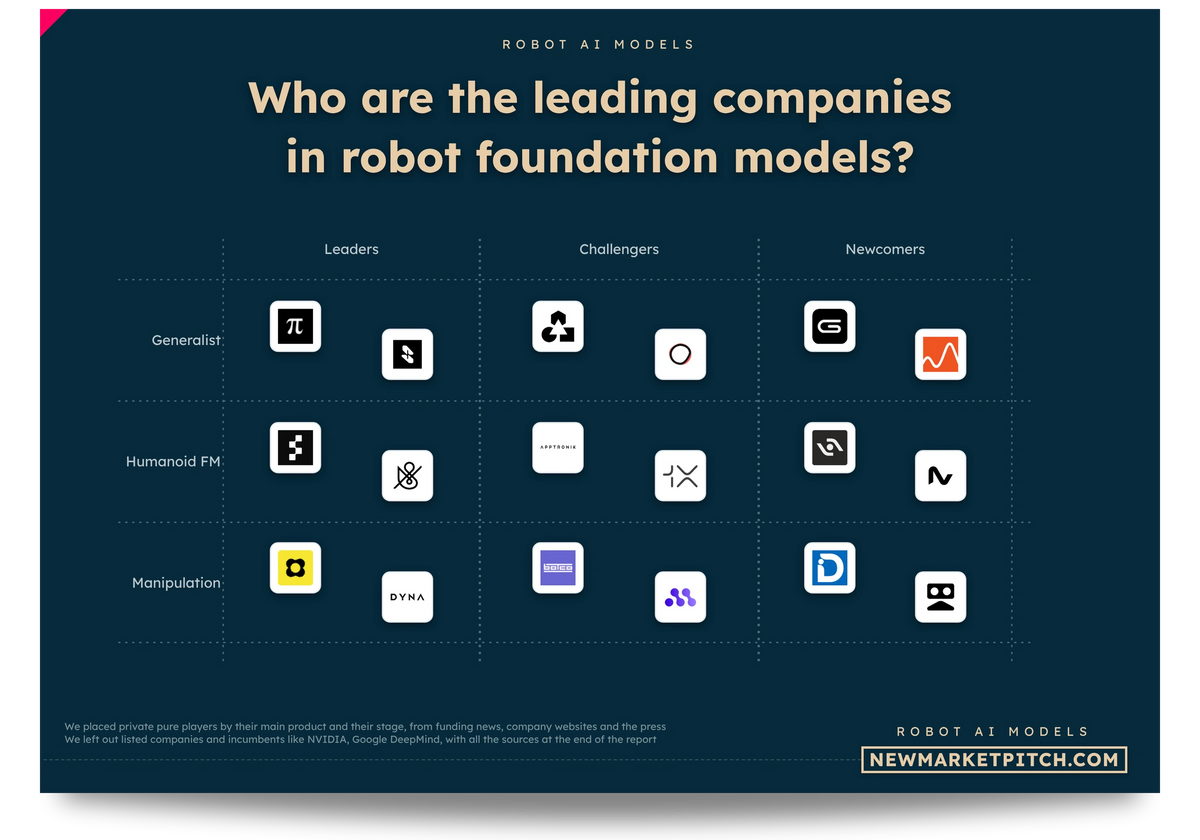
In our report covering the robot foundation models market, we turn what is vague and complex into simple, useful visuals. Market maps like this one show you at a glance where every startup stands.
The ranking of top startups in the robot foundation models market by revenue
Below is a table ranking the startups of this market by their current revenue scale. You can find our methodology at the end of this page.
If you want a deeper understanding of the market and its current dynamics, get our report on the robot foundation models market.
| Ranking | Company | Latest Metric | Metric Type | Freshness | Disclosed When | Source Quality | Confidence | Segment | Why This Ranking | Local Metric | Country |
|---|---|---|---|---|---|---|---|---|---|---|---|
| 1 | AgiBot | ~$157M | Annual Revenue | Fresh · 11mo | Apr 20, 2026 | Company Disclosed | High | Integrated humanoid robot foundation models | Annual revenue for the year to Dec 2025 disclosed by the company. Ahead of Skild AI, whose figure is an annualized run-rate. | CNY 1.1B (~$147M per Yicai) | cn |
| 2 | Skild AI | $100M | ARR | Very Fresh · 2mo | Sep 10, 2026 | Company Disclosed | Medium | Cross-embodiment robot foundation models | The company disclosed $100M of ARR as of September 2026. Very fresh, but ARR annualizes recurring sales rather than reporting a completed year's revenue. | us | |
| 3 | General Intuition | ~$40M | Annual Revenue | Fresh · 11mo | Sep 30, 2026 | Company Disclosed | High | Embodied world-action foundation models | Its CEO disclosed ~$40M of annual revenue for 2025, reported in September 2026. The fresh figure comes from early model-partner business, not robot hardware shipments. | us | |
| 4 | AI² Robotics | $15M | Half-Year Revenue | Fresh · 17mo | Sep 11, 2025 | Company Disclosed | Medium | Cross-embodiment robot foundation models | The company disclosed $15M of half-year revenue for the first half of 2025 to Reuters. This is a partial-period amount, not a full-year sales total. | cn | |
| 5 | Dobot Robotics | ~$2.86M | Segment Revenue | Fresh · 11mo | Mar 30, 2026 | Filed / Audited | Medium | Integrated humanoid robot foundation models | Revenue of one segment for the year to Dec 2025 from a regulatory filing. Only the robot foundation models part of its revenue is ranked; the company also sells outside this market. | CNY 20M | cn |
| NR | Agile Robots | ~$352M | Annual Revenue | Fresh · 11mo | Aug 3, 2026 | Company Disclosed | Medium | Integrated humanoid robot foundation models | Annual revenue for the year to Dec 2025 disclosed by the company; the company also sells outside this market and its robot foundation models share is not published (share not published), so it is shown without a rank. | EUR 300M | de |
| NR | World Labs | $50M | ARR | Fresh · 12mo | Nov 28, 2025 | Third-Party Estimate | Low | Embodied world-action foundation models | An automated website estimated $50M of ARR as of November 2025. With no second independent estimate or company disclosure, it cannot receive a revenue rank. | us | |
| NR | Mind Robotics | $41M | Annual Revenue | Period not stated · collected 8mo ago | Period not stated | Third-Party Estimate | Low | Industrial and manipulation foundation models | A company-data website estimated $41M in annual revenue without stating its period. An undated, uncorroborated automated estimate does not qualify for a rank. | us | |
| NR | Sereact | $6.4M | Annual Revenue | Fresh · 14mo | Sep 18, 2025 | Third-Party Estimate | Low | Industrial and manipulation foundation models | A company-data website estimated $6.4M of annual revenue for 2025. The estimate lacks independent corroboration, so it is unranked despite reported deployments. | de | |
| NR | Figure AI | >30K BMW vehicles supported | Other Scale Signal | Fresh · 12mo | Nov 19, 2025 | Company Disclosed | Medium | Integrated humanoid robot foundation models | Figure AI reported >30K BMW vehicles supported during 2025. This is a production-deployment measure, not recognized revenue, so no revenue rank applies. | us | |
| NR | RobotEra | >$72.5M (bookings, not revenue) | Bookings | Fresh · 8mo | Mar 23, 2026 | Company Disclosed | Medium | Integrated humanoid robot foundation models | Bookings as of Mar 2026 disclosed by the company; not revenue, so it is not ranked against revenue figures. | CNY 500M | cn |
| NR | FieldAI | >$100M (other measure, not revenue) | Other Financial Metric | Period not stated · collected 5mo ago | Period not stated | Company Disclosed | Medium | Field autonomy foundation models | FieldAI disclosed >$100M (other measure, not revenue) without a standalone recognized-sales period. The combined commercial milestone cannot establish a revenue rank. | us | |
| NR | Covariant | $380M (contract value, not revenue) | Contract Value | Aging · 27mo | Jan 18, 2025 | Credible Reported | Medium | Industrial and manipulation foundation models | The press reported $380M (contract value, not revenue) for an arrangement in August 2024. Contract value cannot be presented as annual turnover. | us | |
| NR | NEURA Robotics | >$1.1B (backlog, not revenue) | Backlog | Very Fresh · 1mo | Oct 19, 2026 | Company Disclosed | Medium | Integrated humanoid robot foundation models | The company disclosed >$1.1B (backlog, not revenue) as of October 2026. Undelivered orders are not recognized sales, so the figure stays unranked. | de | |
| NR | Scout AI | $11M (bookings, not revenue) | Bookings | Period not stated · collected 7mo ago | Period not stated | Company Disclosed | Medium | Field autonomy foundation models | Scout AI disclosed $11M (bookings, not revenue) without a stated period. Booked business has not been shown as recognized revenue. | us |

Our research about robot foundation models startups gets updated several times a month, so you always get the latest view of where things stand.
Are robot foundation model startups making real sales yet?
Robot foundation model startups now earn real money from automation systems, embodied robots and AI software sold to businesses.
AgiBot and Agile Robots disclosed annual sales for 2025, while Skild AI reported an annualized recurring-sales rate in September 2026. These are commercial results, though they measure different things.
Look at what customers are doing. Agile Robots says it has installed more than 20,000 automation solutions. Skild AI says more than 60 customers pay for its technology. AgiBot is shipping humanoid robots rather than keeping its machines inside a research lab. The companies are getting paid through factory systems, software and hardware, respectively.
We still need to separate sales of a whole robot business from sales of a foundation model. A factory-automation provider may earn revenue from robotic arms, installation and maintenance, without reporting how much it charges for the model running them. That is why the current commercial success of these startups does not yet tell us the size of the standalone robot-brain software market.
Why isn't Agile Robots ranked first on robot AI revenue?
Agile Robots has the largest sales total in this group, ~$352M of annual revenue for 2025, but we show it without a rank because the company does not publish how much of it comes from robot foundation models.
The Wall Street Journal reported the German company's EUR 300M result in August 2026, along with management's plan to double sales. Agile Robots had spent years selling industrial machines and helping customers put them into operation before its latest push into foundation models.
That history is exactly the problem for a revenue ranking. Factories pay Agile Robots to install equipment, pass safety checks, keep machines working and fix problems when production stops. In April 2026 it completed the purchase of thyssenkrupp Automation Engineering assets, adding more factory engineering work. Most of that money is conventional automation, not payment for a robot model.
The company has not disclosed the revenue earned specifically from robot foundation models. Ranking the whole EUR 300M would let an industrial-automation business outrank startups whose sales come from their models and the robots built on them. A published share for its foundation-model business would bring Agile Robots back into the ranking.

In our market report about robot foundation models startups, we look at what the winners do differently, so you can learn from the best instead of guessing.
Is AgiBot now the top robot foundation model startup by revenue?
Yes. AgiBot ranks first among robot foundation model startups by revenue, with ~$157M of annual revenue for 2025, ahead of Skild AI's $100M of ARR.
AgiBot reported ~$157M of annual revenue for 2025, according to founder Deng Taihua in an April 2026 Yicai report. Unlike Agile Robots, it built its commercial story around new humanoid and embodied-robot products running on its own models, which is why we count its whole figure. Its Genie Operator platform is meant to let robots turn visual and language inputs into actions.
Sales appear to be moving beyond small batches. In September 2026, AgiBot cited IDC findings that it shipped more than 8,600 humanoid robots during the first half of the year. Those shipments show how much equipment the company is getting into the market, although the number alone does not reveal revenue, repeat orders or profit.
AgiBot's founder also told Yicai that growth takes priority over near-term profitability. Building robots at higher volumes can bring in more money, but it also means paying for parts, assembly and support. We see a serious hardware business taking shape. Whether its reusable robot intelligence becomes a separately lucrative product remains open.
Has Skild AI really reached $100M in robot AI sales?
Only in ARR terms. Skild AI reached $100M in ARR as of September 2026, enough for second place in our ranking, but it has not reported that amount as recognized annual robot AI revenue.
ARR describes the annualized value of recurring payments at a particular point in time. Skild AI said so explicitly when it announced the milestone. We should not treat that figure as the same thing as a completed year's sales.
The customers are real, however. In the same update, Skild reported more than 60 paying customers within ten months of its first deployment. It described paying work in factories, warehouses, data centers, food preparation and security. Customers use the model for different jobs rather than buying a separate piece of AI for each movement.
Skild also bought Zebra Technologies' robotics automation business, previously Fetch Robotics, in April 2026. Its partnerships with ABB Robotics and Universal Robots give it routes into machines customers already own. The question now is whether these relationships turn into years of renewals and growing deployments. The recurring-sales milestone gives Skild a strong start, but the company has not published retention rates or a full-year recognized-revenue equivalent.
Why is Figure AI missing from the top robot AI revenue names?
Figure AI has put humanoid robots to work at BMW, but it has not disclosed a qualifying revenue figure for robot foundation models.
Figure's November 2025 factory update said its Figure 02 robots had supported more than 30,000 BMW vehicles in Spartanburg. The robots loaded parts on long production shifts. The company later described a more complex BMW logistics application using its Helix model, giving us evidence of a developing manufacturing program.
A production milestone does not reveal the price of the robots, how much BMW paid for the work or whether Figure has recognized revenue under a customer contract. It also tells us nothing about the cost of operating and supporting those machines. A useful factory deployment and a large sales business are two different claims.
This is why Figure AI remains unranked on revenue despite its visibility. We can see its machines doing real factory work, but we cannot assign it annual sales from vehicle counts or videos. A company disclosure of recognized revenue would change that; another deployment milestone would not.

In our document detailing everything you need to know about robot foundation models, you will always find fresh funding data, taken straight from our own verified funding database.
Is robot AI making more money from hardware or software?
Hardware and industrial installations currently account for the most visible sales among robot foundation model startups; software-only revenue is harder to identify.
AgiBot sells embodied robots. Agile Robots, which has no rank, installs factory systems. Dobot Robotics has an established collaborative-arm business. By contrast, Skild AI tries to run the same intelligence across machines from different manufacturers, and General Intuition sells access to models built from action-rich data.
A robot sale pays for components, manufacturing, installation and often service. Software can bring recurring payments, but developers still spend heavily on training and adapting models to real machines. No consistent set of published costs lets us say which model makes the most profit.
A startup also does not have to build every robot it controls. Skild works with established manufacturers, while General Intuition can sell model access without running a humanoid factory. Those partnerships still require engineering to make the software work on each manufacturer's hardware. We can see where the reported sales come from, but no company has published a full marketwide split between hardware and foundation-model software.
The table below shows the commercial focus and revenue measure of the five ranked startups, plus Agile Robots, shown without a rank.
| Company | Model scope | Revenue type |
|---|---|---|
| AgiBot | Integrated humanoid | Annual Revenue |
| Skild AI | Cross-embodiment | ARR |
| General Intuition | Embodied world-action | Annual Revenue |
| AI² Robotics | Cross-embodiment | Half-Year Revenue |
| Dobot Robotics | Embodied AI robots | Segment Revenue |
| Agile Robots | Integrated humanoid | Annual Revenue |
Can Agile Robots make Google DeepMind's AI pay off in factories?
Agile Robots has a credible way to sell smarter industrial machines through its Google DeepMind partnership, but it has not disclosed sales from that deal.
The companies announced their work together in March 2026. The plan is to bring Gemini Robotics models into Agile Robots' industrial hardware. For a factory customer, the potential benefit is practical: a machine that can adapt to changing parts or jobs could need less manual programming.
Agile Robots already knows how to sell and install industrial equipment. That puts it inside plants where new AI features can be tested against real production needs. A software-only startup must often persuade a manufacturer or system integrator to help it reach the same machines.
Still, a technology partnership does not automatically make money. Customers would need to buy new systems, pay for upgrades or expand existing installations. We have not seen a separate revenue disclosure tied to Gemini Robotics. The company has a strong route to adoption, and that is a more useful commercial advantage than a demonstration video. The actual sales payoff is yet to be reported.

Learning from others' mistakes is the cheapest lesson there is. In our report covering the robot foundation models market, we look at what broke startups before you, so you don't repeat it.
Do AgiBot's humanoid shipments turn into repeat sales?
AgiBot can manufacture and ship humanoid robots, but it has not disclosed how many customers come back for more.
Its Genie Operator foundation-model family aims to make the same underlying intelligence useful across different machines. That could help customers expand an installation without training a completely different system each time. It could also give AgiBot more data from robots working in varied settings.
The difficulty is what happens after delivery. A robot may need maintenance, updated software, new hands or more engineering to handle the customer's real tasks. A large initial purchase tells us much less about the business than repeat orders from a factory that has used the machines for months.
AgiBot's own comments on prioritizing growth suggest this question will matter more as deliveries increase. We would look for follow-on factory orders, longer deployments and evidence that existing customers are adding robots. Without those figures, shipment growth supports real demand but cannot establish recurring income or healthy margins.
Is Skild AI making most of its money from robot manipulation?
Skild AI says the vast majority of its robot foundation model revenue currently comes from manipulation tasks rather than mobility.
In its September 2026 commercial update, the company described work involving robots that grasp and move objects. That is a useful clue about what customers will pay for. Moving parts, loading equipment and handling materials are jobs factories and warehouses need done every day.
Skild's collaboration with NVIDIA and Foxconn goes after an especially demanding case: dual-arm assembly of Blackwell systems. Product designs change frequently, so a robot that can adjust without weeks of new programming could solve a costly problem. Its agreements with ABB Robotics and Universal Robots could put that kind of software into more industrial machines.
The company also described S1, a model trained to take on unfamiliar tasks after watching a video demonstration. The model is ambitious. For now, Skild's paying customers appear especially interested in robots that can handle useful objects on a work shift. We would expect repeat demand to depend on reliability on real shifts, not the number of tasks in a demonstration.

In our research about robot foundation models startups, we always try to gather several sources and make estimates that make sense, so you can work with solid numbers.
Is Dobot Robotics making most of its money from AI robots?
No. Dobot Robotics still makes nearly all of its sales from collaborative industrial arms, and its embodied AI robots brought in only ~$2.86M in 2025.
Dobot's audited annual report, filed in Hong Kong in March 2026, breaks out embodied AI robots as a separate product category: CNY 20M of segment revenue, about 4.1% of the group's sales. Six-axis collaborative arms alone made up 61.4%.
That is the only part we rank, which puts Dobot fifth, behind AI² Robotics' half-year figure. Ranking the whole group would credit Dobot with sales of conventional arms that have nothing to do with foundation models.
The existing business still matters. Dobot already makes machines, reaches industrial buyers and supports them after installation. It can introduce more adaptable AI to those customers without starting a hardware operation from scratch. For now, though, its customers are paying overwhelmingly for arms, not for robot intelligence.
Are AI² Robotics' factory contracts turning into sales?
AI² Robotics has recorded real robot sales, though its large industrial contract cannot all be counted as revenue today.
The company told Reuters it earned $15M of half-year revenue in the first half of 2025. In the same September 2025 interview, chief executive Eric Guo discussed an order from display maker HKC Corporation for more than 1,000 humanoid robots over three years.
AI² Robotics builds the wheeled AlphaBot2 around its Alpha Brain foundation model, targeting assembly, testing and inspection. Those are practical factory jobs, but signing an order is only the beginning. The robots must be built, installed and accepted before the work can count as earned sales under the applicable accounting rules.
We do not double a half-year number into a hypothetical annual result. Nor do we put a multiyear order into the current revenue figure. What makes AI² Robotics worth watching is that an actual manufacturer has a reason to deploy its product. The next proof will be completed deliveries and repeat orders, rather than a larger contract announcement.
Can General Intuition make money without building robots?
General Intuition already earns money from action and world models without manufacturing its own humanoid robots.
The company disclosed ~$40M of annual revenue for 2025, according to a September 2026 report quoting chief executive Pim de Witte. Its first commercial partnerships sell model access, not finished robots rolling off an assembly line.
General Intuition grew from Medal, the video-game clipping service. It uses recordings of play and the actions attached to them to train models that predict what happens next. That gives it a different starting point from companies collecting demonstrations with industrial arms. Such models may help robots learn, but the company can also sell to customers working on adjacent applications.
This makes the revenue figure interesting and easy to misread. General Intuition has a model-centered business with paying partners. It has not published how much of its turnover comes specifically from physical robots. We should credit the commercial progress without claiming that all those sales are robot deployments. Its approach shows that selling the intelligence itself can work before a developer owns a robot factory.

If you build or invest in the robot foundation models market, you need to know which business models pay off now and which ones are fading. That's why our report covering it has a whole section on it.
Are factories buying robot AI faster than households?
Factories currently offer clearer paying demand for robot foundation models than homes do.
Agile Robots installs equipment on industrial lines, Skild AI works on manufacturing manipulation, and AI² Robotics has a contract with a display producer. Customers in these settings can define the job, supervise the machines and measure whether a deployment saves time or improves output.
A home robot would encounter unfamiliar rooms, clutter, children, pets and people moving without warning. It would need to work safely with limited technical support from the owner. These are harder conditions to standardize than a production line, even if household robots could become a large business later.
Some of the strongest AI advances are aimed at making robots adapt to unfamiliar tasks. Skild's S1 model and Google DeepMind's robot-control work both pursue that goal. But research progress has not given us a comparable disclosed sales base for general-purpose household robots. Looking at where companies are getting paid today, industrial work is still the better-established market.
Is World Labs already making money from robot AI?
World Labs has no company-confirmed robot AI revenue figure, despite AMD's announced agreement to acquire it in September 2026.
World Labs develops models that represent and predict physical environments. AMD said the planned acquisition could help it develop and optimize AI computing systems for new workloads, including robotics and simulation. That gives World Labs a plausible role in physical AI without making it a robot manufacturer.
GetLatka lists a $50M ARR estimate as of November 2025. That figure comes from an automated company-data service, not World Labs' financial reporting. One uncorroborated estimate does not establish the company's sales well enough to assign a rank.
There is also a difference between a valuable model developer and a company with confirmed revenue from robot customers. AMD's interest supports the strategic importance of the technology, but it does not reveal how much World Labs earned. Until a better financial disclosure appears, its sales position remains unverified.

In our document detailing everything you need to know about robot foundation models, we like to show you the big picture. We know your time is precious, so we make every page quick to read and packed with as much learning as possible per minute.
Do big robot AI orders mean startups have already earned the money?
Big robot AI orders show demand for foundation models, but bookings, signed contracts and backlog are not recognized revenue.
RobotEra disclosed more than $72.5M (bookings, not revenue) in cumulative orders through March 2026. Covariant's deal with Amazon was also reported as a contract rather than recognized revenue. Scout AI also disclosed $11M (bookings, not revenue). These announcements can involve work that will be completed over time.
A factory might sign a contract months before delivery. Robots still need to be built, installed, tested and accepted. Some payments depend on later milestones. That is why a company with a large order book cannot automatically be placed ahead of one reporting actual annual sales.
We treat the following measures separately. They say something useful about demand or progress, but they cannot all answer the same revenue question.
The table below shows the different noncomparable measures disclosed for prominent robot foundation model startups.
| Company | Reported figure | Measure |
|---|---|---|
| World Labs | $50M | ARR estimate |
| Figure AI | >30K BMW vehicles supported | Other Scale Signal |
| RobotEra | >$72.5M (bookings, not revenue) | Bookings |
| FieldAI | >$100M (other measure, not revenue) | Other Financial Metric |
| Covariant | $380M (contract value, not revenue) | Contract Value |
| NEURA Robotics | >$1.1B (backlog, not revenue) | Backlog |
| Scout AI | $11M (bookings, not revenue) | Bookings |
Does NEURA Robotics' billion-dollar backlog mean huge sales?
NEURA Robotics has reported >$1.1B (backlog, not revenue), but that does not establish a billion-dollar robot foundation model sales business.
Forbes reported the backlog in October 2026. It also described a company whose commercial operation still relies heavily on established collaborative robots, even as NEURA builds humanoids and a wider cognitive-robotics platform.
The backlog shows that customers have committed to buying products or services. It does not reveal how much NEURA has already delivered, which products make up the commitments or when the work will become recognized revenue. Some orders may stretch across several future periods.
NEURA has a real industrial base and serious demand. Its sales position, though, cannot be inferred from outstanding commitments. A report of annual revenue, with a clear period and scope, would tell us more about its current business than another increase in the order book.

When you build or invest in the robot foundation models market, you need clarity, not confusion. In our report covering the robot foundation models market, we always try to put numbers on and quantify whatever is usually vague and confusing.
Has FieldAI really earned $100M from robots?
FieldAI has reported a milestone combining revenue with contracts, not >$100M in recognized robot foundation model sales.
Business Insider described that combined figure in June 2026. FieldAI develops reusable autonomy models for robots that move through complex locations. Its customer work spans multiple regions and settings where a conventional factory robot would struggle, such as industrial and outdoor work sites.
There is plenty of commercial potential in that approach. Mines, construction areas and large industrial sites change frequently. Software that lets different robots navigate them with less hand-built programming could save customers a lot of work.
The amount disclosed still mixes two stages of business: money already earned and work customers have agreed to purchase. FieldAI did not publish a separate recognized-revenue amount or period that we can use here. Until it does, we cannot say it has crossed the same sales milestone as a startup reporting full-year revenue. The company may be growing fast, but its public headline does not settle the revenue question.
Did Amazon's Covariant deal produce $380M in revenue?
Covariant's Amazon deal was reported at $380M (contract value, not revenue), so it does not establish that Covariant earned that amount in sales.
The Washington Post described the arrangement in January 2025. Amazon had recruited key Covariant staff and licensed its robotics technology, giving the company an unusual path to distributing its foundation-model work. The reported financial amount covered an agreement rather than a year's recognized operating revenue.
Covariant develops AI that helps robots understand and manipulate objects, particularly in warehouse settings. An arrangement with Amazon is a substantial sign that an established operator values that work. It may also mean the technology reaches more real-world systems than a standalone startup could deploy quickly.
We cannot translate a licensing agreement into annual revenue without knowing how and when payments are recognized. That distinction is especially important when a large company signs a complex technology and talent deal. Covariant belongs in the commercial conversation, but the reported contract value cannot earn it a revenue rank.
Are the top robot foundation model startups profitable yet?
Profitability remains unproven across the best-known robot foundation model startups, even where sales are substantial.
AgiBot's founder told Yicai that growth came before near-term profit. Skild AI has reported recurring sales and paying customers but not an audited net-income result. Agile Robots has a much older installation business, yet its disclosed annual revenue does not by itself show the profitability of its foundation-model work.
Robot hardware is expensive to produce, deliver and maintain. Model developers also spend on training, real-world data and engineering support. A company can increase sales while still spending more on each new deployment than it earns from it.
The public information is not enough to rank these startups by profit or margin. That is a narrower conclusion than saying the market has no viable businesses. Paying customers and published revenue already exist. The missing financial test is whether the companies can keep more of those sales after covering the cost of the machines, models and support.

A good product starts with a real problem. In our research about robot foundation models startups, we show you the ones customers still live with.
Is China or the US ahead in robot AI sales?
China holds the top spot for now. China's AgiBot leads robot foundation model startups by disclosed revenue, while US firms Skild AI and General Intuition take second and third place.
China's three ranked names, AgiBot, AI² Robotics and Dobot Robotics, all make embodied or industrial machines. The American firms Skild AI and General Intuition are more closely tied to reusable AI and model access. Germany's Agile Robots reports the largest sales total of all, but its foundation-model share is not published, so it has no rank.
That difference limits what a country comparison can prove. China's lead rests on robot hardware sales. The US has Skild's ARR disclosure, which is not identical to annual recognized sales, and General Intuition's model-partner business.
We cannot calculate a reliable national market share from companies that report unlike measures and leave many figures undisclosed. Figure AI and FieldAI, for example, have strong US commercial activity without eligible standalone sales disclosures. The current evidence gives China the leading named seller, rather than proving that one country has won the entire robot AI business.
So, which robot foundation model startups make the most money now?
AgiBot is the number one robot foundation model startup by revenue, with ~$157M of annual revenue for 2025.
Skild AI ranks second on $100M of ARR as of September 2026, which annualizes recurring payments rather than reporting a completed year's revenue. General Intuition is third with ~$40M of annual revenue for 2025. The different measures need to stay visible.
AI² Robotics comes fourth on $15M of half-year revenue for the first half of 2025, a shorter reporting period rather than a projected annual total. Dobot Robotics is fifth on ~$2.86M of segment revenue for 2025, the embodied AI part of a much larger arm business. Agile Robots reports ~$352M of annual revenue for 2025, more than any of them, but without a published foundation-model share it stays unranked.
The ordering tells us who has disclosed the strongest current sales evidence, not which company earns the most from foundation-model licenses alone. Industrial systems still bring in much of the visible money. Skild's recurring contracts and General Intuition's model-access business point to another route, but both need more time to prove how far software revenue can grow. Famous names with bookings, backlog or factory milestones remain commercially relevant without being assigned invented sales figures.
The table below shows what we found.
| Question | Answer |
|---|---|
| Does the biggest seller get a rank? | No, Agile Robots mostly sells and installs industrial automation equipment. It reported ~$352M of annual revenue for 2025. Its foundation-model share is not published, so it has no rank. |
| Are humanoid shipments turning into a real business? | Yes, AgiBot already sells embodied robots to commercial customers. It reported more than 8,600 humanoid shipments in H1 2026. Deliveries show scale, although repeat purchases remain undisclosed. |
| Can one robot brain attract recurring customers? | Yes, Skild AI sells adaptable intelligence across different robot types. It reported more than 60 paying customers after initial deployments. Renewals will show how durable those contracts become. |
| Is industrial arm revenue the same as AI revenue? | No, Dobot Robotics mostly sells conventional collaborative arms. Its embodied AI segment made ~$2.86M in 2025. Only that segment counts in our ranking. |
| Can world models earn money without robot factories? | Yes, General Intuition sells model access to commercial partners. It disclosed ~$40M in annual revenue for 2025. The share from physical robot applications remains unknown. |
| Do half-year sales reveal a whole year's income? | No, AI² Robotics has only disclosed a shorter period. It reported $15M of half-year revenue in H1 2025. A reliable full-year result would require a further company disclosure. |
| Does BMW production prove Figure AI's annual sales? | No, Figure AI has documented production work without revenue figures. Its machines supported >30K BMW vehicles in 2025. That vehicle count tells us nothing about actual contract payments. |
| Can a large order be counted as earned revenue? | No, RobotEra reported commitments rather than recognized sales. Its >$72.5M (bookings, not revenue) covered cumulative orders. Recognized sales will depend on actual delivery and accounting rules. |
| Does backlog reveal NEURA Robotics' current turnover? | No, NEURA Robotics disclosed orders awaiting fulfillment, not annual revenue. Its disclosed figure was >$1.1B (backlog, not revenue). Future deliveries and contract terms will determine recognized sales. |
| Does an acquisition prove World Labs' current revenue? | No, AMD agreed to acquire the spatial-model developer. A website listed a $50M ARR estimate for November 2025. That single automated figure cannot establish confirmed sales. |

In our market report about robot foundation models startups, we try to remove everything that could confuse you, especially if you're investing or building in this market.
Our methodology
Our data runs through November 5, 2026. We then reviewed this article and updated its answers on November 13, 2026, the date shown under the title. We define robot foundation models as reusable pretrained AI systems that learn perception, action, manipulation or physical-world prediction across multiple tasks, settings or robot bodies. We include adjacent embodied-model developers rather than excluding borderline cases. Every ranked company is a startup under a consistent rule: founded in 2000 or later, built for rapid growth around a new product or technology, funded independently, and either private or listed within the past five years; recently acquired companies can remain included. Established groups do not enter this startup ranking.
We reviewed company releases, annual reports, regulatory filings, investor materials and reputable press coverage across each company's history, including the past ten years. Startups disclose different measures: full-year revenue, annual recurring revenue, run-rates, partial-period sales and specialized product sales. We keep each measure as stated. We do not convert bookings, gross merchandise value, contract value, backlogs, user counts or projections into revenue, nor manufacture sales estimates from customer counts and prices.
We choose one figure per company, prioritizing a period ending within 18 months, then the reliability of the source, then the completeness of the measure. Filings and company disclosures take precedence over press reporting, analyst work and automated company-data estimates; full-year revenue is preferable to ARR or run-rate, then a partial period or segment. The ranking orders the selected figures as published. For a range, we use its proportional midpoint, the geometric mean, rather than a high-end-skewed arithmetic midpoint; a minimum is evaluated at its lower bound. Figures older than 36 months and non-revenue measures have no rank. The ranking covers each company's history, not just deals or deployments in one calendar window.
Freshness is classified as Very Fresh, Fresh, Aging or Historical using months since the reported period ended. High confidence means a recent exact full-year figure from a filing or the company. Medium covers recurring or annualized rates, partial periods, minimums, press reports or figures from 18 to 30 months ago. Low covers estimates, wide ranges or older figures. When converting currencies to US dollars, we use fixed rates and retain original amounts. One automated or analyst estimate is shown without a rank; two independent estimates that agree can be ranked with Low confidence, and conflicting estimates remain an unranked range. A company-reported figure with no stated period can be ranked with Low confidence, but an undated estimate cannot.
We also exclude forecasts and figures for businesses whose broader company totals cannot be attributed to the market without a published segment. This is especially important where a robotics manufacturer sells conventional automation alongside its foundation-model products. Our recorded figures preserve the original scope and reporting period; they should not be read as standalone software-only revenue unless the source identifies that scope. Such differences deserve to be visible rather than silently smoothed away.
The obvious objection is that a mixed ranking includes ARR next to full-year revenue, while famous startups with contracts or automated estimates have no rank. We make that choice deliberately. A current recurring-sales rate provides useful evidence of commercial scale when marked correctly, but a booking or backlog does not. Keeping the measures explicit is more defensible than either inventing equivalent annual sales or removing a startup simply because its accounting disclosure differs. The result is a ranked comparison of evidenced sales scale, not a claim that each dollar has identical timing, margin or source.
Key sources include Agile Robots 2025 company revenue disclosure and outlook reported by the Wall Street Journal, Agile Robots and Google DeepMind foundation-model partnership and installed systems, Agile Robots completion of industrial automation acquisition, AgiBot annual revenue, sales trajectory and management comments, AgiBot first-half humanoid shipments attributed to IDC, AgiBot Genie Operator embodied foundation-model platform, Skild AI recurring revenue, customer count, product applications and recognized revenue distinction, Skild AI model learning tasks from video demonstrations, Skild AI acquisition of the former Fetch Robotics business, Skild AI industrial partnerships and physical manipulation deployments, Dobot Robotics audited annual revenue and product-category breakdown, General Intuition annual sales disclosure and action/world model commercialization, Reuters account of AI² Robotics half-year revenue and industrial contract, Figure AI BMW production deployment figures, Figure AI subsequent BMW logistics deployment, RobotEra disclosed cumulative orders, FieldAI combined revenue and contracts milestone, Covariant and Amazon contract-value reporting, NEURA Robotics order backlog and commercial activity, AMD's announced agreement to acquire World Labs, Sereact industrial deployment and partnership evidence, and Scout AI company announcement and financial context.
In our document detailing everything you need to know about robot foundation models, we turn what is vague and complex into simple, useful visuals. Market maps like this one show you at a glance where every startup stands.
Written by the New Market Pitch teamWe track new markets so founders and investors can move faster. About us