Who are the top investors in robotics?
Whether you're building or investing in the robotics market, our report covers everything you need to know: the players, the money, and what's coming next.
Summary
Khosla Ventures is the top traditional robotics investor today, followed by Sequoia Capital, Lux Capital and Eclipse. NVIDIA leads among corporate technology investors, while Eclipse stands out for its unusually strong concentration in industrial robotics.
Khosla's lead comes from repeated investments across robot intelligence and autonomy. It participated in seven qualifying robotics deals and led four, according to AI Funding's October 2026 database. Eclipse also led four rounds, despite appearing in only six deals.
NVIDIA actually appears in more tracked robotics deals than any traditional VC, with nine investments. But it led just one of those rounds. Its influence comes as much from supplying the computing and simulation infrastructure behind robotics as from its equity investments.
Sequoia is Khosla's strongest all-around challenger because it combines investments in emerging robot intelligence companies with Waymo, which raised $16 billion at a $126 billion valuation in February 2026. Waymo's millions of commercial rides give Sequoia exposure to something most robotics portfolios still lack: proven large-scale adoption.
The biggest financing rounds are increasingly concentrated around a few companies. Figure, Skild AI and Apptronik announced funding programs exceeding $3.3 billion combined, even though mass-market deployment of general-purpose humanoids remains at an early stage.
Investors are splitting into two camps. Khosla, Lux and Sequoia are heavily exposed to AI models that could control many kinds of robots, while Eclipse and Amazon are more focused on applying automation to manufacturing, warehouses and logistics. Both approaches are attracting substantial capital, but their commercial risks differ.
Industrial robotics has a clearer path to proving its economics. Companies such as Mytra and Agility Robotics can measure productivity, labor savings and equipment utilization, while general-purpose robot intelligence companies are often valued on what their technology might eventually make possible.
Corporate investors bring advantages that traditional VCs cannot easily replicate. Amazon has its own logistics network, Toyota understands manufacturing, and NVIDIA supplies much of the technology used to train and simulate robotic systems. Still, an investment from a potential customer does not automatically translate into commercial orders.
China is already producing serious robotics competitors, not just prototypes. Unitree reported more than 1.7 billion yuan in 2025 revenue and has attracted backing from Meituan, HSG, Tencent and other major investors. Its commercial progress makes a purely Silicon Valley-focused ranking incomplete.
The biggest unresolved question is investment returns. Private valuations have climbed dramatically, but we cannot establish which robotics VC has generated the highest realized profits. For now, Khosla leads on investment activity and portfolio breadth, while Waymo's commercial scale and Agility's growing deployments suggest where the next meaningful evidence of success may come from.

Written by the New Market Pitch teamWe track new markets so founders and investors can move faster. About us
Why are investors putting so much money into robotics right now?
Robotics is attracting record investment because AI is making robots more capable, and investors are betting that the next wave of AI companies will operate in the physical world.
According to CB Insights' State of Venture 2025 report, robotics companies raised $40.7 billion in 2025, roughly 9% of global venture funding. That includes autonomous vehicles, industrial robots, humanoids, drones and the software controlling them.
The largest rounds show how dramatically the market has changed. Figure announced more than $1 billion in Series C commitments in September 2025 at a $39 billion valuation. Skild AI raised another $1.4 billion in January 2026 at a valuation above $14 billion. Waymo then raised $16 billion in February at a $126 billion valuation.
These companies are attracting very different investors. Sequoia, Khosla Ventures and Lux Capital are backing robot intelligence. Eclipse focuses heavily on industrial automation. NVIDIA and SoftBank are financing companies that could become major platforms for physical AI.
The interesting change is how many large investors are now willing to finance robotics companies before they have reached mass-market production. Some are investing in commercially proven applications, while others are paying billions for technologies whose biggest markets are still theoretical.
Who actually counts as a top robotics investor?
The best robotics investors are the firms that repeatedly back important robotics companies, lead financing rounds and help those businesses grow. By those measures, Khosla Ventures, Sequoia Capital, Lux Capital and Eclipse stand out today.
There are three things that often get mixed together: the number of robotics companies an investor has backed, the amount of capital it has committed, and the commercial success of those investments.
A firm participating in ten small seed rounds may be more active than one leading two $500 million rounds. But the second investor could have much greater influence over the industry's largest companies.
There is also a problem with the definition of robotics. A ranking including Waymo, autonomous military vehicles and industrial automation will look different from one limited to humanoids or robot foundation models.
We include companies developing physical AI, autonomous machines, industrial robots and humanoids, while identifying when adjacent markets such as robotaxis or defense systems affect the results.

In our report covering the robotics market, you will always find fresh funding data, taken straight from our own verified funding database.
Which venture capital firms invest the most in robotics?
Khosla Ventures is currently the strongest traditional VC by repeated robotics investments, followed closely by Eclipse, Lux Capital and Sequoia Capital.
AI Funding's robotics investor database, updated through October 27, 2026, records seven qualifying deals for Khosla Ventures, six each for Eclipse, Lux Capital and Sequoia, and five for Andreessen Horowitz. NVIDIA appears in nine deals, although it belongs in a separate category as a corporate technology investor.
The ranking becomes more interesting when we examine financing leadership. Khosla and Eclipse each led four of their tracked rounds. Lux led three, Sequoia two and Andreessen Horowitz three.
That gives Eclipse a particularly high proportion of lead investments: four out of six, or 67%. By comparison, Sequoia led two out of six, or 33%.
A separate Startupfundraising analysis of 120 robotics companies identifies Khosla on nine verified cap tables, compared with five each for Sequoia, Lux and Toyota Ventures. The databases track different company groups, so their counts cannot be combined, but Khosla leads both comparisons.
The investment priorities also differ. Khosla backs robot intelligence and autonomy, Eclipse concentrates on industrial systems, and Sequoia combines AI robotics with autonomous mobility.
| Investor | Tracked AI robotics deals | Rounds led | Representative companies |
|---|---|---|---|
| NVIDIA | 9 | 1 | Figure, Skild AI, Waabi |
| Khosla Ventures | 7 | 4 | Physical Intelligence, Field AI, Waabi |
| Eclipse | 6 | 4 | Mytra, Mind Robotics, Genesis AI |
| Lux Capital | 6 | 3 | Physical Intelligence, Collaborative Robotics, Hadrian |
| Sequoia Capital | 6 | 2 | Physical Intelligence, Skild AI, Collaborative Robotics |
| Andreessen Horowitz | 5 | 3 | Mind Robotics, Saronic, Hadrian |
| Bezos Expeditions | 4 | 1 | Physical Intelligence, Skild AI, Field AI |
| General Catalyst | 3 | 2 | Skild AI, Standard Bots, Collaborative Robotics |
| SoftBank Vision Fund | 3 | 2 | Skild AI, Wayve |
| Amazon Industrial Innovation Fund | 3 | 0 | Skild AI, Agility Robotics, Dyna Robotics |
Is Khosla Ventures the best robotics VC today?
Khosla Ventures has the strongest claim to being the leading robotics VC because it has repeatedly backed companies developing different kinds of robotic intelligence, rather than betting everything on humanoids.
Its portfolio includes Physical Intelligence, which develops AI models for robotic manipulation; Field AI, which builds software for robots navigating difficult environments; and Waabi, which develops autonomous-driving technology. Khosla has also backed Bear Robotics and Square Robot.
These investments cover several approaches to machine autonomy. Physical Intelligence is trying to develop intelligence that transfers across different robots. Field AI focuses on making machines operate in changing real-world environments. Waabi applies AI to autonomous transportation.
The industry still has no proven universal model for building intelligent robots. A company selling general-purpose AI software could eventually serve dozens of manufacturers, while another might succeed by building complete machines for one application.
Khosla is well represented in both AI Funding's deal ranking and Startupfundraising's cap-table analysis. Its four lead positions across seven tracked AI robotics deals also show that it is frequently helping organize financings rather than simply joining them.
We would put Khosla first among traditional venture firms. Its portfolio has the breadth, technical ambition and repeated investment activity to support that position. Realized returns are a different question, and one that public funding records cannot yet settle.
If you want more recent data on this point, please see our latest robotics market report.

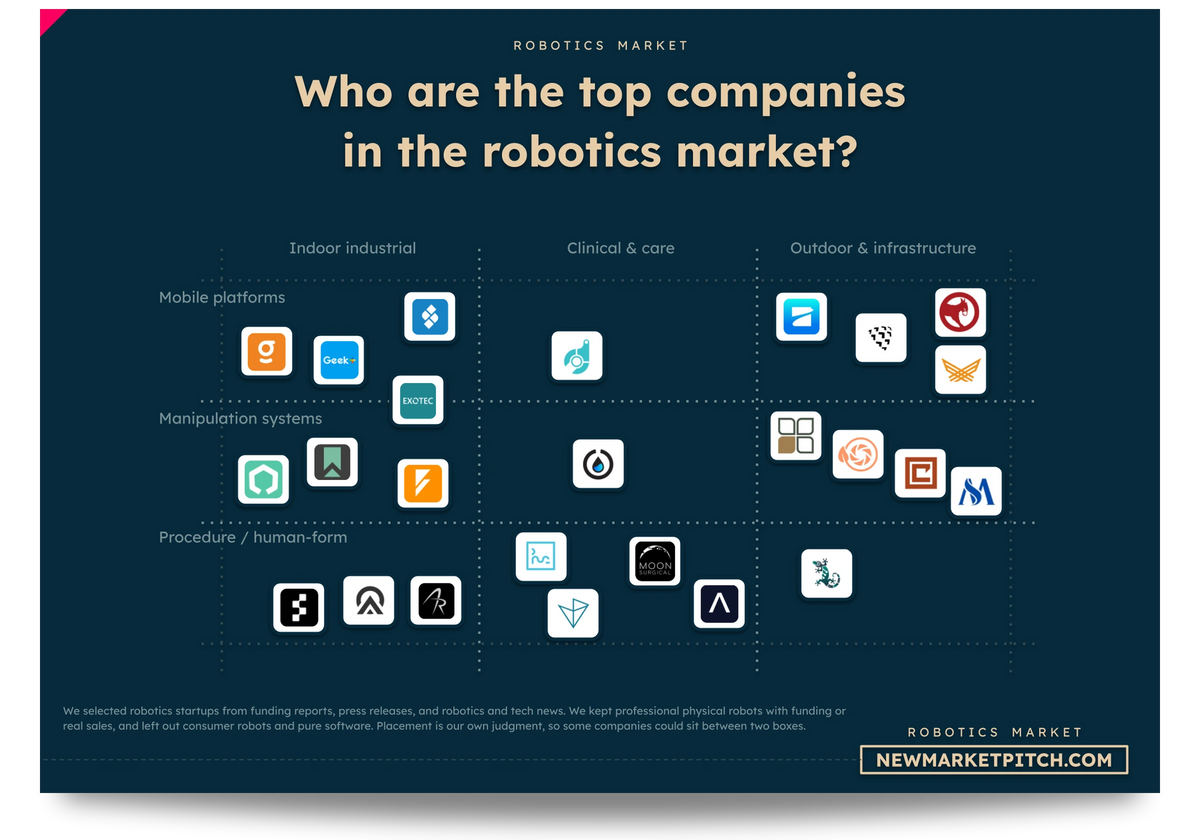
In our research about robots, we turn what is vague and complex into simple, useful visuals. Market maps like this one show you at a glance where every startup stands.
Has Sequoia Capital caught up with Khosla in robotics?
Sequoia Capital is now one of Khosla Ventures' closest competitors in robotics investing, and its position becomes even stronger when we include Waymo.
Sequoia has backed Physical Intelligence, Skild AI and Waymo. These companies cover three major opportunities: robot foundation models, general-purpose robotic intelligence and commercially deployed autonomous vehicles.
Its participation in Waymo's February 2026 financing is particularly important. Sequoia was one of three lead investors, alongside Dragoneer and DST Global, in the $16 billion round valuing Waymo at $126 billion.
Waymo already has a scale that most newer robotics companies cannot match. The company reported 15 million rides during 2025, more than three times its volume the previous year, and over 400,000 weekly rides when it announced the financing.
Khosla still leads on repeated investment activity within the specialist robotics databases we examined. But Sequoia has a major advantage in exposure to an autonomous technology company operating at commercial scale.
For breadth across emerging robotics startups, we favor Khosla. For a combination of frontier AI investments and a major commercial autonomous-systems business, Sequoia is arguably just as compelling.
Why is Lux Capital one of the biggest names in robotics?
Lux Capital is one of the strongest specialist investors in robotics because it has spent years backing difficult hardware and engineering companies, long before humanoids became fashionable.
Its portfolio includes Physical Intelligence, Collaborative Robotics, Hadrian, Machina Labs and companies developing industrial sensing and automation technologies.
These businesses work on different problems. Physical Intelligence builds general-purpose robot models, Collaborative Robotics develops collaborative automation, and Hadrian is automating the production of precision components.
Lux's technical background is valuable in a sector where software performance alone rarely determines commercial success. Robotics companies also need reliable hardware, affordable manufacturing, safety systems and machines that can operate for thousands of hours.
AI Funding records six qualifying robotics deals for Lux, including three lead positions. The firm's repeated participation in Physical Intelligence financings also shows a willingness to keep supporting technically ambitious companies as valuations rise.
Lux deserves a place near the top because its robotics investing goes well beyond the recent surge in AI funding. It is especially relevant for founders working on technologies that require years of engineering before meaningful revenue appears.

In our market report about robots, we always try to gather several sources and make estimates that make sense, so you can work with solid numbers.
Is Eclipse the top investor in industrial robotics?
Eclipse is our leading specialist pick for industrial robotics, particularly for startups trying to automate manufacturing, warehouses and supply chains.
Its portfolio includes Mytra, Mind Robotics and Genesis AI. Mytra develops warehouse automation, Mind Robotics focuses on AI-powered industrial robots, and Genesis AI is working on general-purpose physical intelligence.
Eclipse's investment strategy is unusually focused on the industries where robots can solve expensive, measurable problems. A warehouse operator can compare automated handling against existing labor and equipment costs. A manufacturer can measure production speed, downtime and the cost of each completed operation.
That gives industrial robotics companies clearer commercial targets than businesses promising robots that can eventually perform almost any human task.
The financing data reinforces Eclipse's position. It led four of its six qualifying AI robotics rounds in AI Funding's database, matching Khosla's number of lead investments despite participating in fewer tracked deals.
Eclipse also has a broader industrial portfolio, which can help founders connect robotics technology to manufacturing businesses and supply-chain customers.
For a startup developing industrial robots rather than a general-purpose humanoid, we would place Eclipse alongside Khosla and Lux as one of the first investors worth approaching.
If you want more recent data on this point, please see our latest robotics market report.
Is NVIDIA now the most influential investor in robotics?
NVIDIA is currently the most influential corporate technology investor in AI robotics, with a combination of equity investments and computing platforms that no traditional VC can easily replicate.
Its investment portfolio includes Figure, Skild AI, Waabi and Nuro. It participated in Figure's September 2025 financing and Skild AI's $1.4 billion Series C in January 2026.
NVIDIA also ranked first in AI Funding's tracked investor activity, appearing in nine qualifying robotics deals. However, it led only one of them, compared with four lead investments each for Khosla and Eclipse.
NVIDIA is spreading investments across companies developing robotic intelligence and autonomous systems, while traditional VCs are more frequently taking the lead in organizing rounds.
Its wider influence comes from the technology robotics companies use. NVIDIA Isaac provides development tools for robotics, Omniverse supports simulation, and Cosmos is designed for developing world models used in physical AI.
For NVIDIA, robotics could become an enormous future market for chips, simulation and AI software. It has commercial reasons to support several competing robotics platforms rather than concentrate on one winner.
This puts NVIDIA firmly ahead among corporate technology investors in our ranking, even though Khosla remains our preferred traditional venture investor.

Our document detailing everything you need to know about robotics gets updated several times a month, so you always get the latest view of where things stand.
Are SoftBank and Amazon becoming bigger robotics investors than VCs?
SoftBank and Amazon are now major robotics investors, but their strategies are quite different. SoftBank is financing big AI robotics companies, while Amazon is backing technology closely connected to industrial and logistics automation.
SoftBank led Skild AI's $1.4 billion Series C in January 2026, at a valuation above $14 billion. It has also backed Wayve, the autonomous-driving AI company.
Amazon takes a more operational approach through its $1 billion Industrial Innovation Fund. Its robotics investments include Agility Robotics, Standard Bots, Dyna Robotics, Skild AI, Physical Intelligence and Contoro Robotics.
There is a clear pattern in Amazon's choices. Agility builds humanoids for physical work, Standard Bots develops robotic arms, and Contoro focuses on unloading trucks. Skild AI and Physical Intelligence work on intelligence that could eventually power different kinds of machines.
Amazon is therefore investing both in robots that address specific logistics problems and in software that could make future machines more adaptable.
The corporate-investor advantage becomes clearer when we examine actual deployments. Amazon operates large logistics networks, Toyota brings manufacturing experience, and companies such as NVIDIA and Google provide critical AI technology.
Still, an investment from a potential customer does not guarantee a purchase contract. Corporate investors can bring commercial opportunities, but the startup still has to prove that its robots are reliable and economical.
SoftBank is among the most influential financiers when robotics companies need very large rounds. Amazon is particularly important for companies developing machines that could operate in warehouses and industrial facilities.
Who is financing the biggest humanoid robotics startups?
Parkway Venture Capital, SoftBank, B Capital and several corporate investors are among the most important financiers of humanoid robotics, with their influence concentrated around Figure, Skild AI and Apptronik.
Figure's September 2025 financing was led by Parkway Venture Capital and included Brookfield, NVIDIA and Intel Capital. The company announced more than $1 billion in commitments at a $39 billion post-money valuation.
Skild AI raised $1.4 billion in January 2026, led by SoftBank, with participation from NVentures, Macquarie Capital, Bezos Expeditions and returning investors including Lightspeed, Coatue, Felicis and Sequoia.
Apptronik's funding followed a different path. Its February 2026 financing extension brought its Series A above $935 million, with backing from B Capital, Google, Mercedes-Benz and PEAK6, alongside investors including John Deere, AT&T Ventures and Qatar Investment Authority.
Together, these three financing programs exceeded $3.3 billion in announced funding. The figure represents total round sizes rather than the personal commitments of individual investors.
The companies also have distinct technology strategies. Figure develops its own humanoid robot platform, Skild builds intelligence intended to operate across different robotic bodies, and Apptronik develops humanoids aimed at commercial and industrial applications.
Investors are dividing their bets between companies that build entire robots and those that hope to supply the intelligence behind many future robots.
A successful robot model provider might eventually serve several competing manufacturers, while a vertically integrated company would need to build and sell its own machines at scale. It's a pretty big difference in what investors are actually buying.

In our report covering the robotics market, we look at what the winners do differently, so you can learn from the best instead of guessing.
Are robotics investors backing software more than hardware?
The biggest AI robotics investors are increasingly backing software that could control many different robots, although complete robotic systems still attract enormous amounts of capital.
Physical Intelligence and Skild AI are examples of the software-oriented approach. Their goal is to develop AI that can handle physical tasks across different machines and environments.
Figure, Apptronik and Agility Robotics are closer to the integrated hardware approach, developing robots designed for specific commercial applications or broader physical work.
The valuation gap is becoming striking. Physical Intelligence raised $400 million in November 2024 at a reported $2.4 billion valuation and another $600 million in November 2025 at approximately $5.6 billion. A subsequent reported financing in May 2026 valued the company around $11 billion.
Skild AI's January 2026 funding valued it above $14 billion, more than three times the valuation reported approximately seven months earlier.
These increases show how much investors are willing to pay for robot intelligence that could become widely used. The attraction is straightforward: one successful software platform might support many hardware manufacturers.
Yet physical-world AI faces problems that language models do not. Robots need to handle contact, force, unfamiliar objects, moving people and unpredictable environments. Reliability also depends on sensors, motors and mechanical design.
That helps explain why the leading investors maintain different portfolios. Khosla, Lux and Sequoia have substantial exposure to general-purpose intelligence, while Eclipse and Amazon are more focused on applying robotics to industrial work.
We still cannot say which approach will produce better financial returns. Software companies have achieved impressive valuations, but commercial deployment remains a stronger test than private funding prices.
If you want more recent data on this point, please see our latest robotics market report.
Are robotics investors funding real businesses or expensive experiments?
Robotics investors are funding both genuine commercial growth and technologies that still need years of development. Waymo and Agility Robotics provide some of the clearest evidence that parts of the industry are already moving beyond demonstrations.
Waymo completed 15 million rides in 2025, more than triple its previous annual volume. By February 2026, it had exceeded 20 million cumulative rides and was providing over 400,000 rides every week across six major U.S. metropolitan areas.
That means roughly three-quarters of Waymo's lifetime rides through that point occurred during 2025 alone. The company has moved well beyond its early testing phase, even though profitability and the economics of wider expansion remain important questions.
Agility Robotics provides another useful comparison. In October 2026, GXO announced plans to expand Digit deployments into two additional U.S. logistics facilities in 2027.
Agility also reported more than 65,000 hours of real-world operation across commercial activities and customer programs. Its original GXO deployment had already handled more than 100,000 totes, and the company reported over $300 million in committed multi-year Digit 5 orders.
Those orders are encouraging, but Agility explicitly distinguishes commitments from recognized revenue. Manufacturing and deployment milestones still need to be met.
Agility's planned public-market transaction is another notable development. The company is preparing to combine with Churchill Capital Corp XI, with a proposed Nasdaq listing under the ticker AGLT. That could provide investors with a more visible public-market benchmark for humanoid robotics.
The contrast with newer robot intelligence companies is substantial. Physical Intelligence and Skild AI have attracted multibillion-dollar valuations, but the same level of independently measurable commercial deployment is not yet publicly established.
The next major test is how many robotics companies can turn technical progress into recurring sales, reliable operations and sustainable customer demand. Funding rounds alone won't answer that.

In our research about robots, we don't want to repeat what boring consulting reports say. Instead, we show you the real and latest market signals that matter.
Are Chinese robotics investors catching up with Silicon Valley?
Chinese robotics investors are already financing serious competitors to American startups, particularly in humanoids and commercially manufactured robots.
Unitree is a strong example. Its investor base includes Meituan, HSG, Tencent, Alibaba, Ant Group, China Mobile and Geely through various direct or affiliated investment vehicles.
According to Reuters' reporting on Unitree's 2026 listing disclosures, Meituan held 9.65% of the company, making it the largest external shareholder. HSG followed with 7.11%, while MPCi held 5.45%.
Those ownership figures are more informative than a list of funding-round participants because they show the relative size of several investors' actual stakes at the time of the disclosures.
Unitree also reported commercial figures that compare favorably with the limited revenue information available for many American humanoid startups. Its 2025 revenue exceeded 1.7 billion yuan, approximately $252 million, more than four times the previous year's level. Adjusted net profit was around 600 million yuan.
Unitree sells several kinds of robots, so its revenue should not be interpreted as humanoid-only sales. Still, the company demonstrates that Chinese manufacturers are generating substantial revenue from robotics products.
China Mobile has also backed Galbot, while major Chinese technology groups are investing across autonomous systems, robotics AI and manufacturing.
The American venture firms we identified remain strong leaders in their own investment markets, but a worldwide ranking must include Chinese corporate investors and institutions.
We would place Meituan and HSG among the notable Chinese robotics backers, while China Mobile deserves attention for its recurring exposure to physical AI companies. Their precise global positions are harder to establish because the available databases do not cover Chinese and American private investments equally.
Which investors should an early-stage robotics startup approach?
Toyota Ventures, Lux Capital, Khosla Ventures and Eclipse are among the strongest investors to approach for early-stage robotics, although the best choice depends heavily on the product.
Toyota Ventures has invested in SLAMcore, Realtime Robotics, Pickle Robot and Freedom Robotics. These companies work on robot perception, motion planning, logistics automation and software infrastructure.
That history makes Toyota Ventures particularly relevant for startups developing practical robotic technologies rather than trying to build a general-purpose humanoid from scratch.
Lux is a strong fit for companies with difficult engineering problems. Khosla is especially relevant for autonomy and robot intelligence, while Eclipse has a clear focus on industrial systems.
Andreessen Horowitz also deserves attention. AI Funding's Series A robotics ranking places it among the leaders, with two qualifying investments and two lead positions. Its American Dynamism strategy covers manufacturing, defense, autonomous systems and other physical-world technologies.
Other notable early-stage investors include CRV, which has backed Dyna Robotics, and B Capital, an important investor in Apptronik.
The financing requirements of robotics companies can differ sharply from those of software startups. Teams may need to build prototypes, develop custom components, improve reliability and manufacture hardware before reaching substantial revenue.
An investor experienced with those costs can be more useful than a larger fund without relevant technical knowledge. For industrial startups, we would prioritize Eclipse and Toyota Ventures; for foundational robot intelligence, Khosla and Lux are especially strong candidates.
If you want more recent data on this point, please see our latest robotics market report.

Learning from others' mistakes is the cheapest lesson there is. In our market report about robots, we look at what broke startups before you, so you don't repeat it.
Have robotics investors actually made money from their investments?
Some robotics investments have produced major acquisitions and successful public companies, but the newest generation of AI robotics startups has not yet delivered enough exits to identify the most profitable investors.
The industry has several important historical examples. Amazon acquired Kiva Systems for approximately $775 million in 2012, while Teradyne bought Universal Robots for $285 million in 2015.
These acquisitions established that industrial automation could create businesses valuable enough to attract major corporate buyers. More recently, Symbotic has demonstrated that warehouse automation can support a substantial publicly traded company.
The current funding boom is operating at a much higher valuation level.
Figure's September 2025 financing valued it at $39 billion. Skild AI reached a valuation above $14 billion in January 2026, and Physical Intelligence reportedly reached $11 billion in May 2026.
At those valuations, investors need extraordinary future growth to generate the kinds of returns traditionally associated with successful venture investments. An investor buying shares at a $39 billion valuation needs the company to become much more valuable before achieving a large multiple on the investment.
There are also reminders of how difficult robotics businesses can be. Embodied, which developed the Moxie companion robot, announced the end of its operations in 2024 after struggling to sustain the business.
For the newest robotics funds, the distinction between valuation gains and realized returns is crucial. Private valuations can rise dramatically without investors having sold their shares.
We therefore cannot credibly claim that Khosla, Sequoia or Lux has generated the highest robotics investment returns based only on public funding announcements. Their investment activity is visible; comparable fund-level returns generally are not.
Who are the top robotics investors overall?
Khosla Ventures leads our ranking of traditional robotics VCs, followed by Sequoia Capital, Lux Capital, Eclipse and Andreessen Horowitz. NVIDIA takes first place among corporate technology investors.
We place Khosla first because it has a broad portfolio covering robot intelligence and autonomy, alongside strong repeat investment activity in multiple robotics datasets.
Sequoia is a close competitor. Its investments in Physical Intelligence and Skild AI give it exposure to frontier robot intelligence, while Waymo provides unusually strong evidence of commercial scale.
Lux ranks highly for its technical specialization and history in deep-tech investing. Eclipse is particularly strong in industrial automation, and Andreessen Horowitz has a meaningful portfolio spanning manufacturing, autonomous systems and defense technology.
NVIDIA has the broadest strategic influence among the corporate technology investors we examined. It participates in major financing rounds while also supplying AI computing, robotics development tools and simulation infrastructure.
SoftBank, Amazon and Toyota Ventures occupy important positions for different reasons. SoftBank can lead enormous financings, Amazon has direct connections to logistics automation, and Toyota Ventures brings established early-stage robotics experience.
The table below summarizes our assessment based on repeated investment activity, financing leadership, relevant portfolios and strategic influence. The ordering is our research judgment rather than a published ranking of verified financial returns.
| Investor | Our assessment | Strongest robotics focus |
|---|---|---|
| Khosla Ventures | Top traditional robotics VC | Physical AI and autonomy |
| Sequoia Capital | Top multi-stage contender | Robot intelligence and autonomous mobility |
| Lux Capital | Top technical specialist | Deep-tech robotics and hardware |
| Eclipse | Top industrial robotics VC | Manufacturing and logistics automation |
| Andreessen Horowitz | Major diversified robotics VC | Industrial and autonomous systems |
| NVIDIA / NVentures | Top corporate technology investor | Robotics AI, computing and simulation |
| SoftBank | Major large-round investor | General-purpose robotic intelligence |
| Amazon Industrial Innovation Fund | Major strategic investor | Warehouse and logistics robots |
| Lightspeed Venture Partners | Important AI robotics backer | Skild AI and intelligent automation |
| Toyota Ventures | Established early-stage specialist | Robotics infrastructure and industrial technology |

If you build or invest in the robotics market, you need to know which business models pay off now and which ones are fading. That's why our report covering it has a whole section on it.
Final verdict: Who are the top investors in robotics?
Khosla Ventures is currently our top traditional robotics investor, NVIDIA leads among corporate technology investors, and Eclipse stands out as the strongest specialist in industrial robotics.
Khosla's advantage comes from repeatedly backing different approaches to machine intelligence and autonomy. Sequoia is its closest all-around competitor, especially when we include Waymo and commercially deployed autonomous vehicles.
Lux Capital deserves its reputation for investing in technically difficult robotics businesses, while Eclipse has built one of the clearest investment strategies around practical industrial automation.
Among strategic investors, NVIDIA has a particularly strong position because it backs robotics companies and supplies technology that many of them use. SoftBank and Amazon are also major names, although their investments reflect very different priorities.
The ranking could change considerably as robotics companies move toward larger commercial deployments and public-market listings. Waymo already has substantial real-world usage, and Agility Robotics is making progress with industrial customers. Many highly valued robot intelligence companies still have much more to prove commercially.
For now, we would choose Khosla Ventures as the leading traditional robotics VC based on investment breadth and repeated financing activity. But the most profitable robotics investor is a different question, and the industry still lacks enough realized returns to answer it confidently.
If you want more recent data on this point, please see our latest robotics market report.
Our methodology
This analysis identifies the leading robotics investors based on the evidence available through October 28, 2026. We compare traditional venture capital firms, specialist robotics investors and corporate backers using investment frequency, financing leadership, portfolio breadth, exposure to important robotics technologies and evidence of commercial progress.
We include companies developing physical AI, autonomous machines, industrial robots, humanoids and robotics software. Adjacent markets such as autonomous vehicles and defense systems are considered when relevant, but we distinguish their influence from investments in general-purpose robotics. This distinction matters because including Waymo or defense technology can substantially change an investor's apparent robotics exposure.
Investment activity is assessed using AI Funding's robotics deal records, updated through October 27, 2026, and Startupfundraising's analysis of 120 robotics companies, alongside company announcements and official investor portfolios. These datasets cover different company populations, so we compare their rankings separately rather than adding their investment counts together. We also distinguish between participation in a financing round and a lead-investor position, since these represent different levels of involvement.
Portfolio composition and investment strategy are assessed through disclosed investments in companies such as Physical Intelligence, Skild AI, Figure, Field AI, Waabi, Mytra, Agility Robotics and Apptronik. We examine whether investors focus on robot foundation models, integrated robotic hardware, industrial automation or autonomous mobility, and whether they have supported companies across multiple financing stages.
We also examine commercial progress where operating evidence is available. Waymo's ride volumes, Agility Robotics' deployment hours and customer commitments, and Unitree's reported revenue and shareholder disclosures provide useful comparisons between commercial adoption and private-market valuations. Announced orders, financing commitments and reported valuations are treated separately from recognized revenue, profitability and realized investment returns.
Our final ranking is an editorial assessment based on these combined measures. It gives greater weight to repeated investment activity, meaningful lead positions, relevant portfolios and demonstrated company progress. It does not claim to rank investors by financial returns, since comparable realized returns and detailed fund-level performance are generally unavailable for the latest generation of robotics companies.
Key market and investor sources include CB Insights' State of Venture 2025, Khosla Ventures' official portfolio, Field AI's financing announcement, Waabi's 2026 financing announcement, Sequoia Capital's Physical Intelligence portfolio, Sequoia's investment thesis on Skild AI, and Toyota Ventures' official portfolio.
For major financing rounds and valuations, we use Figure's September 2025 Series C announcement, Skild AI's January 2026 Series C announcement, Apptronik's February 2026 financing update, and Waymo's February 2026 investment announcement.
Corporate investment and technology sources include Amazon's Industrial Innovation Fund announcement, NVIDIA's Isaac Sim documentation, and NVIDIA's Isaac GR00T platform documentation.
For commercial deployments and historical investment outcomes, we use GXO and Agility Robotics' October 2026 partnership expansion, Agility Robotics' commercial update, Amazon's Kiva Systems acquisition announcement, and Teradyne's SEC filing covering its acquisition history.

In our report covering the robotics market, we like to show you the big picture. We know your time is precious, so we make every page quick to read and packed with as much learning as possible per minute.
Written by the New Market Pitch teamWe track new markets so founders and investors can move faster. About us