What’s the latest funding news in the stablecoin payments market? (October 2026)
Whether you're building or investing in the stablecoin payments market, our report covers everything you need to know: the players, the money, and what's coming next.
Stablecoin payment startups are attracting fresh investment as businesses look for faster and more practical ways to move money across borders.
As of October 2026, our selection of 12 recent funding announcements represents $171.6 million in separately disclosed new financing, excluding one extension whose individual amount remains undisclosed.
From stablecoin payment APIs to international payouts and merchant cards, these deals show where investors currently see commercial opportunities beyond cryptocurrency trading.
And if you want to better understand this new industry, you can download our pitch covering the stablecoin payments market.
Insights
- The 11 individually quantified financings total $171.6 million, with a median raise of $13.5 million. This suggests stablecoin payments investment now supports more than experimental projects, although funding remains concentrated among a handful of larger infrastructure providers.
- HIFI and Latitude alone raised $72 million, representing approximately 42% of the disclosed new funding in this selection. Both companies connect stablecoin settlement to established financial systems, rather than competing to issue new digital currencies.
- Nine of the 12 announcements arrived in September, while three appeared in early October. The short reporting window reflects an active fundraising period, but it should not be interpreted as proof of accelerating investment across the entire market.
- Cross-border payment infrastructure stands out because sending stablecoins is only part of the transaction. Companies such as Noah, Fin.com and Latitude are investing in local banking connections that make those funds useful to recipients.
- Walapay reported $2.5 billion in annualized payment volume alongside a relatively modest $4.6 million seed round. Its example shows why transaction throughput, financing size and underlying profitability need to be assessed separately when comparing payment startups.
- Strategic investors are becoming increasingly visible in stablecoin payment infrastructure. Visa Ventures backed Velocity, PayPal Ventures backed Atum, and Coinbase Ventures participated in several financings, bringing established financial-network relationships into an emerging sector.
- Cards offer another route to adoption: Limited, Infini and dtcpay connect stablecoin-funded balances to familiar spending tools. Their commercial challenge is making digital settlement useful without asking customers or merchants to manage blockchain technology directly.
- Funding labels reveal relatively little about commercial maturity. Noah reported more than 150 new customers during 2026 despite closing a seed round, while Fin.com announced seed financing after building a sizable international payment operation.
- Extensions require particular care when measuring stablecoin funding. Noah disclosed $16 million in new capital, Velocity disclosed $10 million, but dtcpay did not separate its September investment from its $25 million completed Series A.
- Not every stablecoin-enabled FinTech is a pure-play payments business. HIFI also serves tokenized capital markets, while Limited and Infini offer wider financial products, making revenue concentration an important qualification for market comparisons.

Written by the New Market Pitch teamWe track new markets so founders and investors can move faster. About us

In our report covering the stablecoin payments market, you will always find fresh funding data, taken straight from our own verified funding database.
Summary table of the latest funding deals in the stablecoin payments market as of October 2026
We define the stablecoin payments market as products and services that use stablecoins to move, settle or spend money.
We include payment rails, merchant acceptance, cross-border transfers, stablecoin cards and payment-focused conversion infrastructure.
We exclude speculative crypto trading, non-payment token projects and stablecoin issuance without a payment-service offering.
| Name | When | Amount in $ | Round Type | Category |
|---|---|---|---|---|
| Anyflo | Oct 8, 2026 | $1M | Initial funding | Stablecoin Payment Orchestration |
| Noah | Oct 7, 2026 | $16M | Seed Extension | Cross-Border Payments |
| Walapay | Oct 1, 2026 | $4.6M | Seed | Payment APIs & FX Infrastructure |
| HIFI | Sep 24, 2026 | $37M | Series A | Stablecoin Settlement & Payment APIs |
| Limited | Sep 24, 2026 | $18.5M | Seed | Corporate Payments & Stablecoin Cards |
| Atum | Sep 22, 2026 | $13.5M | Initial funding | Open Payment Networks |
| Infini | Sep 22, 2026 | $6M | Seed | Stablecoin Accounts & Cards |
| dtcpay | Sep 18, 2026 | Undisclosed new tranche ($25M Series A total) | Series A Completion | Merchant Acceptance & Stablecoin Cards |
| Fin.com | Sep 15, 2026 | $20M | Seed | Stablecoin Conversion & Global Payouts |
| Velocity | Sep 15, 2026 | $10M | Series A Extension | Institutional Settlement & Treasury |
| Latitude | Sep 9, 2026 | $35M | Series A | Local Currency Payout Rails |
| Diameter Pay | Sep 3, 2026 | $10M | Series A | Dollar Payment Accounts & Stablecoin On-Off Ramps |
All the latest funding deals in the stablecoin payments market as of October 2026
Anyflo secured $1 million in initial funding in October 2026 to develop enterprise stablecoin payment orchestration.
When was it?
Anyflo announced its $1 million investment on October 8, 2026, alongside its public launch in Singapore.
Who are they?
Anyflo develops an API that lets businesses send, receive and route payments through stablecoins and traditional financial networks.
Geographical focus?
Based in Singapore, Anyflo is developing global payment infrastructure for companies handling international suppliers, marketplaces and financial transactions.
Why do we include them in the stablecoin payments market?
Anyflo directly addresses enterprise stablecoin payments through multichain routing, settlement orchestration and integrated transaction checks.
What is the company stage?
Anyflo is at the pre-commercial testing stage, with selected partner trials underway and broader beta availability planned for the first quarter of 2027.
How much did they raise?
Anyflo received $1 million in investment from Mysten Labs, which had also incubated the business.
What round is it?
The investment represents initial strategic funding, without a confirmed conventional seed or Series A designation.
Why did they raise?
Anyflo is using the financing to develop payment-routing infrastructure that simplifies liquidity access, network selection and compliance for enterprise customers.
Noah added $16 million to its seed round in October 2026 as enterprise demand for stablecoin payments increased.
When was it?
Noah announced the additional financing on October 7, 2026, after attracting new and existing investors.
Who are they?
Noah provides payment APIs connecting bank accounts, stablecoin settlement and local payout networks for international businesses.
Geographical focus?
Headquartered in the United Kingdom, Noah serves international payment providers, marketplaces, payroll businesses and financial institutions across multiple markets.
Why do we include them in the stablecoin payments market?
Noah specializes in cross-border stablecoin payment infrastructure, including currency conversion, enterprise collections and transfers into local financial systems.
What is the company stage?
Noah is in commercial growth, having reported more than 150 new customers and significant revenue expansion during 2026.
How much did they raise?
Noah secured an additional $16 million, bringing its completed seed financing to $38 million.
What round is it?
The transaction was a seed extension, rather than a new Series A round.
Why did they raise?
Noah plans to expand its international payments coverage, strengthen regulated market access and support rising enterprise transaction volumes.

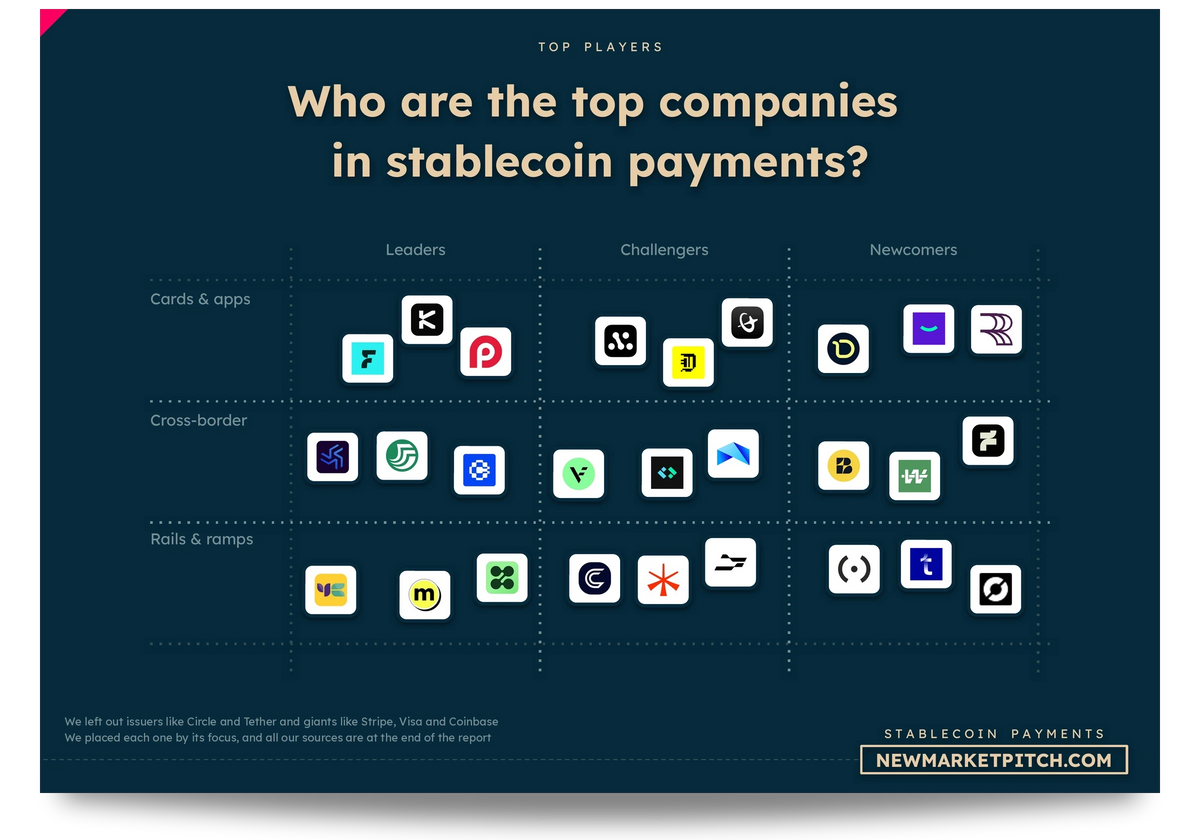
In our research about stablecoin payments, we turn what is vague and complex into simple, useful visuals. Market maps like this one show you at a glance where every startup stands.
Walapay raised $4.6 million in seed funding in October 2026 to expand its cross-border payments infrastructure.
When was it?
Walapay announced its seed financing on October 1, 2026.
Who are they?
Walapay offers a single API for issuing payment accounts, collecting money, converting currencies and making local or stablecoin-funded payouts.
Geographical focus?
Walapay operates globally, with payment-network coverage focused on Latin America, Africa and Asia.
Why do we include them in the stablecoin payments market?
Walapay combines traditional banking connections with stablecoin conversion and settlement, placing cross-border business payments at the center of its offering.
What is the company stage?
Walapay is commercially active and reported approximately $2.5 billion in annualized payment volume at the time of its financing.
How much did they raise?
Walapay secured $4.6 million from investors led by Generative Ventures.
What round is it?
The financing was announced as a seed round.
Why did they raise?
Walapay intends to obtain additional payment licenses, strengthen banking partnerships and hire staff to broaden its international payment coverage.
HIFI secured $37 million in Series A funding in September 2026 to expand stablecoin settlement and tokenized financial infrastructure.
When was it?
HIFI announced the financing on September 24, 2026.
Who are they?
HIFI builds APIs that connect banking networks, stablecoin settlement, card infrastructure and tokenized financial transactions.
Geographical focus?
Based in the United States, HIFI serves international financial businesses and reported annualized processing activity spanning 87 countries.
Why do we include them in the stablecoin payments market?
HIFI provides stablecoin payment and settlement infrastructure, although its expansion into tokenized capital markets makes it broader than a strict payments-only provider.
What is the company stage?
HIFI is in commercial growth, reporting more than $7 billion in annualized transaction-processing volume before the financing.
How much did they raise?
HIFI raised $37 million in a round led by Left Lane Capital.
What round is it?
The investment was a Series A and the company's first priced financing round.
Why did they raise?
HIFI plans to scale its settlement infrastructure, expand card-related products and develop additional services for tokenized capital markets.

Your time is limited. In our market report about stablecoin payments, we put numbers on each part of the market, so you can see where it makes sense to focus.
Limited raised $18.5 million in seed funding in September 2026 to expand its stablecoin-enabled corporate payments platform.
When was it?
Limited's seed financing was publicly reported on September 24, 2026.
Who are they?
Limited combines international business accounts, payment cards, cross-border transfers and stablecoin balances within one corporate finance platform.
Geographical focus?
Limited serves internationally operating companies and is expanding payment corridors across Latin America, Asia-Pacific and the Middle East and North Africa.
Why do we include them in the stablecoin payments market?
Limited uses stablecoin settlement to support international transfers and business spending, although its wider corporate banking services extend beyond payments.
What is the company stage?
Limited is in commercial growth, with active banking and payment products designed for companies operating across multiple countries.
How much did they raise?
Limited secured $18.5 million from a group of venture investors including North Island Ventures, The House Fund and Collab+Currency.
What round is it?
The investment was announced as a seed round.
Why did they raise?
Limited intends to recruit experienced staff, build additional local payment connections and expand its corporate treasury offering.
Atum secured $13.5 million in initial funding in September 2026 to build an interoperable global payments network.
When was it?
Atum announced its funding on September 22, 2026, when it emerged from stealth.
Who are they?
Atum provides an open coordination network that connects payment providers and developers across stablecoins, blockchains and other settlement systems.
Geographical focus?
Headquartered in San Francisco, Atum is building payment infrastructure for companies and financial technology providers operating internationally.
Why do we include them in the stablecoin payments market?
Atum focuses on interoperable payment routing and settlement, enabling businesses to move stablecoins without adopting one specific blockchain or currency.
What is the company stage?
Atum is in early commercialization, having launched its developed payment network following a period of private development.
How much did they raise?
Atum secured $13.5 million from investors including Variant, PayPal Ventures and Abstract Ventures.
What round is it?
The financing was initial institutional funding, with some reporting describing it as seed investment but no consistently confirmed formal round label.
Why did they raise?
Atum is developing a shared payment layer that connects settlement providers while simplifying transaction routing, authorization and payment confirmation.

In our document detailing everything you need to know about stablecoin payments, we always try to gather several sources and make estimates that make sense, so you can work with solid numbers.
Infini raised $6 million in seed funding in September 2026 to expand its stablecoin accounts and payment services.
When was it?
Infini announced its financing on September 22, 2026, alongside the launch of a new mobile application.
Who are they?
Infini offers stablecoin-enabled financial accounts, payment cards, international transfers and automated financial management tools.
Geographical focus?
Based in Hong Kong, Infini targets international consumers and businesses and reported users across more than 180 countries.
Why do we include them in the stablecoin payments market?
Infini enables stablecoin-funded spending, transfers and payment acceptance, while also offering broader treasury and yield-related financial services.
What is the company stage?
Infini is in early commercial growth, having reported more than 100,000 users and introduced a mobile application for its expanding product range.
How much did they raise?
Infini raised $6 million from investors including Reforge, Fortwest Capital, Enlight Capital, SNZ Capital and others.
What round is it?
The financing was a seed round.
Why did they raise?
Infini plans to expand its payment rails, strengthen licensing and compliance, and develop automated financial tools for consumers and corporate customers.
dtcpay completed its $25 million Series A in September 2026 after securing an additional strategic investment.
When was it?
dtcpay announced the completion of its Series A financing on September 18, 2026.
Who are they?
dtcpay provides stablecoin payment accounts, merchant acceptance, digital-asset conversion and payment cards for businesses and consumers.
Geographical focus?
Headquartered in Singapore, dtcpay has international operations and regulatory relationships, including European market coverage and commercial links to Japan.
Why do we include them in the stablecoin payments market?
dtcpay directly enables merchants and consumers to accept, convert and spend stablecoins through established payment channels.
What is the company stage?
dtcpay is in commercial growth, with operating payment products and regulatory permissions supporting its international expansion.
How much did they raise?
dtcpay completed a $25 million Series A that included an earlier $10 million tranche, but the amount newly invested in September was not separately disclosed.
What round is it?
The announcement marked the completion of a Series A with strategic participation from Japan's SBI Group.
Why did they raise?
dtcpay intends to expand its merchant network, improve enterprise payment tools and strengthen payment connections between Japan and Southeast Asia.

Our report covering the stablecoin payments market gets updated several times a month, so you always get the latest view of where things stand.
Fin.com secured $20 million in seed funding in September 2026 to scale its global stablecoin payout infrastructure.
When was it?
Fin.com announced its financing on September 15, 2026, after completing the round in August.
Who are they?
Fin.com helps businesses convert stablecoins into local currencies and distribute payments to bank accounts and digital wallets.
Geographical focus?
Headquartered in the United States, Fin.com operates across international payment corridors, with a particular focus on South Asia, Africa and the Middle East.
Why do we include them in the stablecoin payments market?
Fin.com provides stablecoin conversion and payment infrastructure that connects blockchain-based transfers to conventional financial accounts.
What is the company stage?
Fin.com is scaling an established operation and reported profitability, more than 200 employees and several completed acquisitions when it emerged from stealth.
How much did they raise?
Fin.com secured $20 million from investors led by Expa and Garrett Camp, with participation from Coinbase Ventures and others.
What round is it?
The transaction was announced as a seed round, despite the company's substantial operating footprint.
Why did they raise?
Fin.com intends to expand its global payment network and simplify the conversion of stablecoins into spendable local money for enterprise customers.
Velocity added $10 million to its Series A in September 2026, bringing the completed financing to $48 million.
When was it?
Velocity announced the new investment on September 15, 2026.
Who are they?
Velocity builds infrastructure that lets financial institutions, payment providers and businesses manage stablecoin settlement, liquidity and treasury operations.
Geographical focus?
Based in London, Velocity targets banks, merchants, payment networks and financial technology businesses operating internationally.
Why do we include them in the stablecoin payments market?
Velocity connects stablecoin settlement with established institutional payment systems, helping financial businesses transfer money without replacing their existing infrastructure.
What is the company stage?
Velocity is in early commercial growth, with institutional payment infrastructure and partnerships involving established financial-network participants.
How much did they raise?
Velocity secured $10 million in fresh funding, bringing its Series A total to $48 million at a reported $200 million post-money valuation.
What round is it?
The investment was a Series A extension supported by Visa Ventures, Circle Ventures, Ripple and several other investors.
Why did they raise?
Velocity plans to integrate stablecoin settlement and liquidity management into more institutional payment systems and treasury workflows.

In our research about stablecoin payments, we look at what the winners do differently, so you can learn from the best instead of guessing.
Latitude raised $35 million in Series A funding in September 2026 to connect stablecoins with local payment networks.
When was it?
Latitude announced its Series A financing on September 9, 2026.
Who are they?
Latitude connects stablecoin transfers to local bank accounts and digital wallets so businesses can pay recipients in their preferred currencies.
Geographical focus?
Based in the United States, Latitude serves international payment customers and is expanding its local payout connectivity across emerging and developed markets.
Why do we include them in the stablecoin payments market?
Latitude specializes in stablecoin-to-local-currency conversion and payout infrastructure, addressing the practical final step of cross-border transfers.
What is the company stage?
Latitude is in commercial growth, with existing payment integrations serving international businesses, payroll platforms, marketplaces and financial service providers.
How much did they raise?
Latitude secured $35 million in new funding, bringing its cumulative announced financing to $43 million.
What round is it?
The financing was a Series A led by Oak HC/FT, with participation from NEA, Coinbase Ventures, Lightspeed Faction and OpenFX.
Why did they raise?
Latitude intends to expand local banking partnerships, strengthen compliance and licensing capabilities, and make more currencies accessible through its payout network.
Diameter Pay secured $10 million in Series A funding in September 2026 to expand its dollar and stablecoin payment infrastructure.
When was it?
Diameter Pay announced its financing on September 3, 2026.
Who are they?
Diameter Pay provides financial institutions with APIs for U.S. dollar accounts, traditional transfers and stablecoin deposits and withdrawals.
Geographical focus?
Based in the United States, Diameter Pay serves banks, FinTech companies and digital-asset businesses seeking international access to dollar payment infrastructure.
Why do we include them in the stablecoin payments market?
Diameter Pay enables stablecoin on-ramps, off-ramps and international dollar settlement through integrations with banking and payment networks.
What is the company stage?
Diameter Pay is in commercial growth, having operated without outside equity funding and reported more than $10 billion in payment volume during 2026.
How much did they raise?
Diameter Pay raised $10 million in its first institutional financing, co-led by CMT Digital and Lightspeed Faction.
What round is it?
The transaction was announced as a Series A round.
Why did they raise?
Diameter Pay intends to expand international dollar payment coverage, strengthen foreign-exchange capabilities and improve compliance infrastructure for financial institutions.
Written by the New Market Pitch teamWe track new markets so founders and investors can move faster. About us