What are the top surgical robotics startups by revenue?
Whether you're building or investing in the surgical robotics market, our report covers everything you need to know: the players, the money, and what's coming next.
Summary
PROCEPT BioRobotics ranks first among the surgical robotics startups we tracked, with $308M in FY2025 revenue, followed by Shenzhen Edge Medical with CNY 456M (approximately $63.4M) and CMR Surgical with £38.2M in FY2024 revenue.
Only four companies in our ranking have credible annual revenue evidence at or above $25M. PROCEPT earns nearly five times as much as Edge Medical, while Distalmotion is the fourth company in this group, based on a third-party revenue estimate rather than audited financial statements.
The biggest revenue generators have very different businesses. PROCEPT specializes in robotic prostate treatment, Edge Medical and CMR Surgical target broader soft-tissue surgery, and Distalmotion offers robotic assistance designed to work alongside existing laparoscopic equipment.
PROCEPT's strongest business is now its recurring consumables revenue. Handpieces and consumables generated $181.4M in 2025, about 59% of total sales, compared with $106.1M from robotic systems and rentals. Its installed equipment creates years of potential repeat purchases.
Shenzhen Edge Medical is the standout growth story. Its revenue jumped from CNY 48M in 2023 to CNY 456M in 2025, nearly a tenfold increase in two years, while China's laparoscopic surgical robot market expanded by approximately 46% in unit sales during 2025.
CMR Surgical has a broader international presence than its older revenue figure might suggest. Its Versius platform has treated more than 45,000 patients in over 30 countries, and new U.S. regulatory clearances in 2025 and 2026 have opened additional opportunities for commercial expansion.
Below the four largest revenue figures, the financial scale drops sharply. eCential Robotics recorded €6.96M in FY2024 sales, Quantum Surgical €2.08M and Robocath €931K in FY2025. These are specialized businesses with real sales, but they remain much smaller commercially.
Several companies without public revenue figures have already achieved considerable clinical adoption. Harbin Sagebot reported nearly 15,000 surgeries and more than 100 robot orders, Neocis passed 100,000 robotic dental osteotomies, and both THINK Surgical and Surgerii Robotics exceeded 5,000 procedures.
Acquisitions show that established manufacturers are willing to buy surgical robotics technology before it reaches substantial revenue. Enovis made a €155M upfront enterprise-value offer for eCential Robotics, Stereotaxis acquired Robocath, and Zimmer Biomet acquired Monogram Technologies despite its very limited historical sales.
Intuitive Surgical puts the opportunity into perspective: its approximately $10.1B FY2025 revenue was roughly 33 times PROCEPT's. The next winners will be the companies that turn hospital installations into sustained procedure volumes and recurring instrument sales, rather than simply accumulating regulatory clearances or clinical milestones.

Written by the New Market Pitch teamWe track new markets so founders and investors can move faster. About us

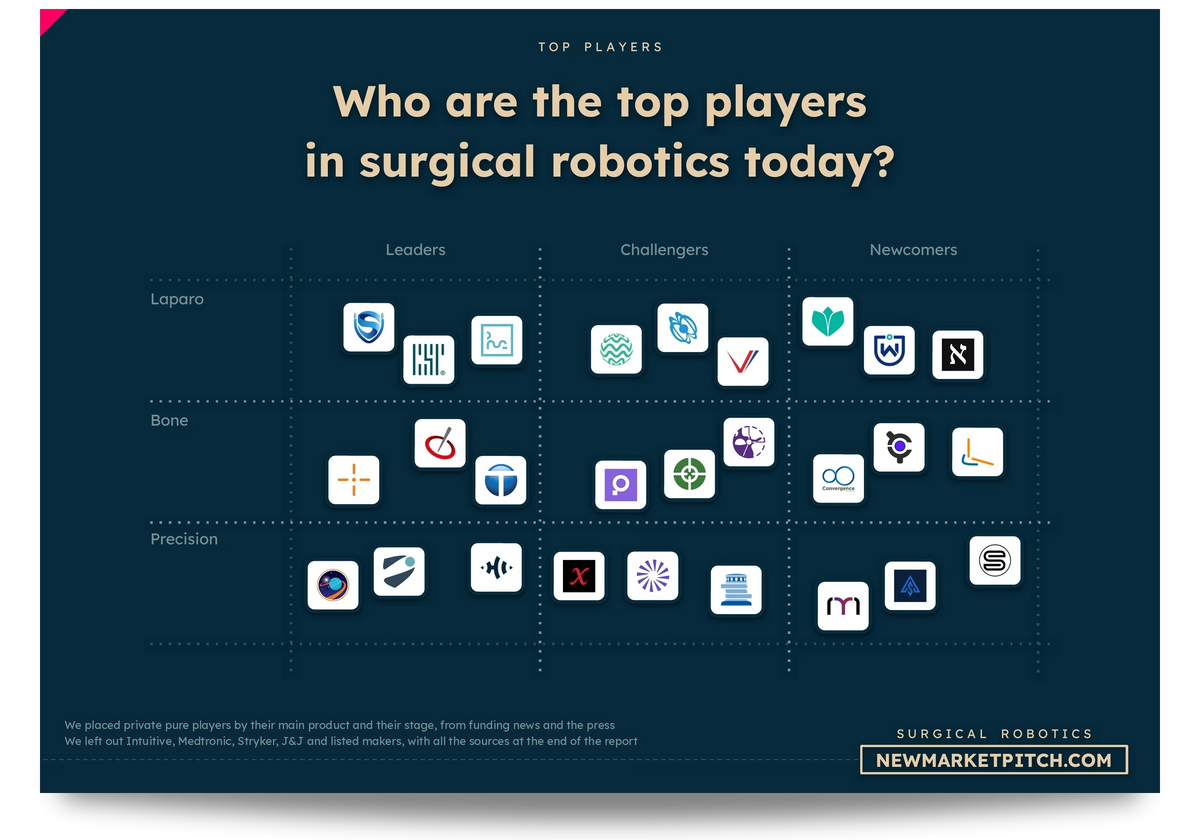
In our report covering the surgical robotics market, we turn what is vague and complex into simple, useful visuals. Market maps like this one show you at a glance where every startup stands.
The ranking of top startups in the surgical robotics market by revenue
Below is a table ranking the startups of this market by their current revenue scale. You can find our methodology at the end of this page.
If you want a deeper understanding of the market and its current dynamics, get our report on the surgical robotics market.
| Ranking | Company | Latest Metric | Metric Type | Freshness | Disclosed When | Source Quality | Confidence | Segment | Why This Ranking | Local Metric | Country |
|---|---|---|---|---|---|---|---|---|---|---|---|
| 1 | PROCEPT BioRobotics | $308M | Fiscal-Year Revenue | Fresh · 10mo | Feb 26, 2026 | Filed / Audited | High | Urologic Robotics | Revenue is highly concentrated in robotic urology and directly comparable to smaller robotic specialists; listed since September 2021. | us | |
| 2 | Shenzhen Edge Medical | ~$63.4M | Fiscal-Year Revenue | Fresh · 10mo | Mar 27, 2026 | Filed / Audited | High | Soft-Tissue Robotics | Recent recognized annual sales put the 2026-listed robotic-surgery manufacturer ahead of private peers with older or less direct figures. | CNY 456M | cn |
| 3 | CMR Surgical | ~$48.9M | Fiscal-Year Revenue | Aging · 22mo | Apr 14, 2025 | Credible Reported | Medium | Soft-Tissue Robotics | Audited-period revenue establishes meaningful scale, but the older FY2024 number receives less weight than Edge Medical FY2025 revenue. | £38.2M | gb |
| 4 | Distalmotion | >$25M | Annual Revenue | Undated | Oct 13, 2026 | Third-Party Estimate | Low | Soft-Tissue Robotics | The broad third-party revenue band indicates meaningful commercialization, but is less trustworthy than the filed sales of companies above. | ch | |
| 5 | eCential Robotics | ~$7.52M | Fiscal-Year Revenue | Aging · 22mo | 2025 | Filed / Audited | Medium | Orthopedic Robotics | Verified French-entity sales beat Quantum Surgical, but the figure is historical and may not represent every group entity. | €6.96M | fr |
| 6 | Quantum Surgical | ~$2.25M | Fiscal-Year Revenue | Aging · 22mo | 2025 | Filed / Audited | Medium | Interventional Ablation Robotics | Registered operating turnover provides stronger revenue evidence than procedure-count-only competitors, though it is two fiscal years old. | €2.08M | fr |
| 7 | Robocath | ~$1.05M | Fiscal-Year Revenue | Fresh · 10mo | Jul 8, 2026 | Filed / Audited | Medium | Endovascular Robotics | FY2025 recognized sales are newer than Quantum Surgical results but lower; the legal-entity scope is not the acquirer group. | €931K | fr |
| 8 | Harbin Sagebot | >100 robot orders | Other Scale Signal | Very Fresh · 2mo | Aug 1, 2026 | Credible Reported | Low | Soft-Tissue Robotics | The reported order count is more commercial than procedure totals alone; no order value or company revenue is disclosed. | cn | |
| 9 | Neocis | >100K osteotomies | Other Scale Signal | Fresh · 9mo | Jan 7, 2026 | Company Disclosed | Low | Dental Surgery Robotics | Large cumulative procedure-step volume indicates adoption, but osteotomies are not paying customer counts or recognized company sales. | us | |
| 10 | THINK Surgical | 5K procedures | Other Scale Signal | Very Fresh · 5mo | May 27, 2026 | Company Disclosed | Low | Orthopedic Robotics | The defined 2026 TMINI procedure milestone is current evidence of deployment, but not a dollar measure or company-wide sales. | us | |
| 11 | Surgerii Robotics | >5K procedures | Other Scale Signal | Very Fresh · 5mo | Jul 13, 2026 | Company Disclosed | Low | Soft-Tissue Robotics | A verified company-reported procedure count places the platform among deployed systems, but utilization does not establish revenue. | cn | |
| 12 | Medical Microinstruments | ~50 installed systems | Other Scale Signal | Very Fresh · 0mo | Oct 8, 2026 | Company Disclosed | Low | Microsurgery Robotics | Very recent installed-base disclosure shows commercial penetration, but installation is not proof of payment or annual revenue. | it | |
| 13 | Levita Magnetics | 1K procedures | Other Scale Signal | Fresh · 15mo | Jul 15, 2025 | Company Disclosed | Low | Soft-Tissue Robotics | Clinical procedure milestone is evidence of product use, but no financial sales or paid system installed-base total is given. | us | |
| 14 | iotaMotion | >1K procedures | Other Scale Signal | Fresh · 13mo | Sep 25, 2025 | Company Disclosed | Low | Cochlear Implant Robotics | Documented implantation procedures are more useful than funding size, but do not determine company revenue. | us | |
| 15 | Moon Surgical | 200 procedures | Other Scale Signal | Aging · 30mo | Apr 2024 | Company Disclosed | Low | Soft-Tissue Robotics | The historical case count shows clinical use but provides a much weaker indication of present sales than newer deployment reports. | fr | |
| 16 | Cornerstone Robotics | 1 Singapore installation | Other Scale Signal | Very Fresh · 6mo | May 25, 2026 | Company Disclosed | Low | Soft-Tissue Robotics | The disclosed installation proves cross-border deployment, but represents one geography rather than the total installed base. | hk | |
| 17 | Monogram Technologies | $0 | Fiscal-Year Revenue | Aging · 22mo | Mar 2025 | Filed / Audited | Low | Orthopedic Robotics | The latest verified annual amount is zero following a one-off 2023 sale; acquisition in 2025 does not establish subsequent sales. | us | |
| NR | EndoQuest Robotics | Not disclosed | Other Scale Signal | Undated | Company Disclosed | Low | Endoluminal Surgery Robotics | GI robot is in clinical and regulatory development; no verified company sales or revenue figure. | us | ||
| NR | Ronovo Surgical | Not disclosed | Other Scale Signal | Undated | Company Disclosed | Low | Soft-Tissue Robotics | Carina platform commercialization is reported but no comparable annual company sales metric. | cn | ||
| NR | Virtual Incision | Not disclosed | Other Scale Signal | Undated | Company Disclosed | Low | Soft-Tissue Robotics | MIRA robotic surgery platform has regulatory clearance, without a verified company-wide sales figure. | us | ||
| NR | Capstan Medical | Not disclosed | Other Scale Signal | Undated | Company Disclosed | Low | Structural Heart Robotics | Robotic cardiac-valve intervention remains development-stage without confirmed commercial revenue. | us | ||
| NR | Synaptive Medical | Not disclosed | Other Scale Signal | Undated | Company Disclosed | Low | Neurosurgical Robotics | Robotic surgical visualization products are deployed, but revenue is not public. | ca | ||
| NR | Momentis Surgical | Not disclosed | Other Scale Signal | Undated | Company Disclosed | Low | Soft-Tissue Robotics | Anovo transvaginal robotic surgery platform; no attributable annual revenue figure. | il | ||
| NR | ForSight Robotics | Not disclosed | Other Scale Signal | Undated | Company Disclosed | Low | Ophthalmic Surgery Robotics | Ophthalmic robot remains developmental; large fundraising is not evidence of sales. | il | ||
| NR | LEM Surgical | Not disclosed | Other Scale Signal | Undated | Company Disclosed | Low | Orthopedic Robotics | Dynamis spinal robot is at commercialization stage but revenue has not been verified. | ch |

Our research about surgical robots gets updated several times a month, so you always get the latest view of where things stand.
Which surgical robotics startups make the most revenue today?
PROCEPT BioRobotics currently ranks first among the surgical robotics startups we tracked, with $308M in FY2025 revenue, followed by Shenzhen Edge Medical with CNY 456M and CMR Surgical with £38.2M.
The gap between these companies is substantial. PROCEPT's annual sales are nearly five times those of Shenzhen Edge Medical in dollar terms and more than six times CMR Surgical's FY2024 revenue. PROCEPT focuses on robotic urological treatment, while Edge Medical and CMR sell robotic platforms used across several soft-tissue surgical specialties.
Distalmotion follows with reported annual revenue above $25M, although the figure comes from a third-party estimate rather than audited accounts. The remaining companies with disclosed monetary revenue are eCential Robotics, Quantum Surgical and Robocath, all based in France.
We also include startups with measurable clinical or commercial activity when revenue is unavailable. Their figures are identified as orders, procedures or installations rather than sales.
| Rank | Surgical robotics startup | Revenue or commercial scale | Period |
|---|---|---|---|
| 1 | PROCEPT BioRobotics | $308M | FY2025 revenue |
| 2 | Shenzhen Edge Medical | CNY 456M | FY2025 revenue |
| 3 | CMR Surgical | £38.2M | FY2024 revenue |
| 4 | Distalmotion | >$25M | Annual revenue, period unspecified |
| 5 | eCential Robotics | €6.96M | FY2024 revenue |
| 6 | Quantum Surgical | €2.08M | FY2024 revenue |
| 7 | Robocath | €931K | FY2025 revenue |
Why are surgical robotics startups getting so much attention now?
Surgical robotics startups are getting more attention because several have finally reached meaningful sales, thousands of clinical procedures and regular hospital deployments.
PROCEPT BioRobotics increased annual revenue by 37% in 2025, while Shenzhen Edge Medical nearly tripled its revenue in the same year. CMR Surgical has treated more than 45,000 patients worldwide with its Versius platform, according to the company's March 2026 announcement.
These developments are taking place in a market where hospitals have historically depended on a small number of established surgical robotics manufacturers.
China shows how quickly the industry is changing. MedRobot's market tracking recorded 229 laparoscopic robotic systems sold in China in 2025, compared with 157 in 2024, an increase of approximately 46%.
The growth is spreading across different specialties. Urological surgery, robotic-assisted knee replacement, dental implantation and microsurgery are all attracting startups with products already used in hospitals.
But the commercial picture remains uneven. A company performing thousands of procedures may still generate far less revenue than another selling expensive robotic systems and disposable instruments. That difference explains much of the financial gap across the industry.

In our market report about surgical robots, we look at what the winners do differently, so you can learn from the best instead of guessing.
How much revenue does PROCEPT BioRobotics make?
PROCEPT BioRobotics generated $308M in FY2025 revenue, making it the highest-ranked company in our surgical robotics ranking and one of the clearest examples of a younger robotics manufacturer reaching substantial commercial scale.
The American company develops robotic technology for treating benign prostatic hyperplasia, a common condition involving enlargement of the prostate. Its AquaBeam and HYDROS systems support Aquablation therapy.
According to PROCEPT's FY2025 financial statements, robotic system sales and rentals generated $106.1M, handpieces and consumables contributed $181.4M, and services brought in another $20.5M.
Consumables therefore accounted for approximately 59% of revenue. Hospitals purchase the robotic equipment, then continue buying single-use instruments as they perform procedures.
PROCEPT also reported a 64% gross margin in FY2025, up from 61% in FY2024. However, it recorded a net loss of approximately $95.6M, reflecting continued spending on commercial expansion and product development.
The company has built a sizable revenue base. Profitability is still another matter.
Is Shenzhen Edge Medical catching up with PROCEPT BioRobotics?
Shenzhen Edge Medical is growing much faster than PROCEPT BioRobotics in percentage terms, but PROCEPT still generates considerably more revenue.
Edge Medical reported CNY 456M in FY2025 sales, equivalent to approximately $63.4M. PROCEPT generated $308M over the same fiscal year.
The Chinese company's growth has nevertheless been extraordinary. According to its 2025 annual report filed with the Hong Kong Stock Exchange, revenue increased from CNY 48M in 2023 to CNY 160M in 2024 and CNY 456M in 2025.
That's approximately 9.5 times more revenue in two years, including growth of roughly 185% in 2025 alone.
Edge Medical develops laparoscopic surgical robots and has benefited from growing demand for Chinese-made surgical systems. Its domestic commercial expansion has been particularly strong as Chinese hospitals adopt locally manufactured equipment.
The company's 2026 Hong Kong listing also gives investors a clearer view of its financial development.
PROCEPT remains far ahead in absolute revenue, but Edge Medical has one of the strongest recent growth records among the companies we examined.

In our document detailing everything you need to know about surgical robotics, you will always find fresh funding data, taken straight from our own verified funding database.
How big is CMR Surgical today?
CMR Surgical ranks third in surgical robotics startup revenue, with £38.2M in FY2024 turnover, and its Versius platform has already treated more than 45,000 patients globally.
The British company has built a substantial international presence, with Versius used in hospitals across more than 30 countries.
Its technology is designed for minimally invasive soft-tissue operations, including general surgery, urology, gynecology and colorectal procedures. Unlike some larger robotic systems, Versius uses modular robotic arms that hospitals can position around the operating table.
CMR's American expansion is particularly interesting. The company received FDA clearance for its next-generation Versius Plus platform for gallbladder-removal procedures in December 2025. It subsequently announced a broader U.S. rollout in March 2026.
In October 2026, CMR also announced FDA clearance for specified benign gynecological procedures, expanding the range of operations its technology can address in the United States. The same month, CMR announced a strategic alliance with Stryker.
The £38.2M revenue figure comes from FY2024 accounts, while these newer announcements show how the business has continued developing since that reporting period. Its revenue scale may therefore have changed, but the selected financial figure remains the basis of our ranking.
Has Distalmotion built a real surgical robotics business?
Distalmotion has reached meaningful commercial scale, with third-party estimates placing its annual revenue above $25M, although the precise amount and reporting period remain undisclosed.
The Swiss company develops Dexter, a robotic platform designed to work alongside existing laparoscopic equipment and operating-room setups.
Dexter takes a somewhat different approach from fully integrated robotic systems. Hospitals can use their existing laparoscopic workflows while adding robotic assistance when surgeons need it.
That could appeal to facilities looking for robotic capabilities without completely reorganizing their operating rooms.
Distalmotion has expanded its commercial activity in Europe and the United States, where its system received FDA clearance in 2024.
The >$25M revenue indication comes from Dealroom's surgical equipment company estimates. It suggests meaningful commercial activity but is less precise than the audited annual sales figures available for PROCEPT, Edge Medical and CMR Surgical.
We therefore retain Distalmotion in fourth place without treating its revenue band as an exact annual financial result.

Learning from others' mistakes is the cheapest lesson there is. In our report covering the surgical robotics market, we look at what broke startups before you, so you don't repeat it.
Which orthopedic surgical robotics startups are making money?
eCential Robotics is the highest-ranked orthopedic surgical robotics startup with disclosed monetary revenue, reporting €6.96M in FY2024 sales.
The French company develops technology combining robotic assistance, imaging and navigation for orthopedic and spinal surgery. Its revenue comes from statutory financial accounts for the operating entity, so the figure does not necessarily capture every activity across the wider corporate group.
Two other orthopedic robotics startups illustrate how different commercial development can look.
THINK Surgical has built significant clinical usage with its TMINI system, which passed 5,000 knee-replacement procedures in May 2026. Its annual revenue, however, has not been publicly established.
Monogram Technologies followed a different path. The company received FDA clearance for its semi-autonomous orthopedic robotic system in March 2025, but its latest verified annual revenue figure was $0 for FY2024, after recognizing $365K in 2023.
Monogram was subsequently acquired by Zimmer Biomet in 2025.
The contrast is striking. eCential has verified sales, THINK Surgical has measurable clinical adoption, and Monogram's regulatory progress eventually led to an acquisition despite its very limited historical revenue.
How much revenue do Quantum Surgical and Robocath generate?
Quantum Surgical reported €2.08M in FY2024 revenue, while Robocath generated €931K in FY2025 sales. Both French companies have built specialized surgical robotics businesses, although neither has reached large-scale annual sales.
Quantum Surgical develops Epione, a robotic platform that assists physicians with image-guided tumor ablation. The system supports precise placement of instruments used to treat tumors, particularly in minimally invasive cancer interventions.
Robocath develops robotic technology for endovascular procedures, including interventions performed inside blood vessels. Its R-One platform assists physicians during complex catheter-based operations.
Their financial figures come from French statutory company accounts, giving us direct evidence of recognized sales rather than estimates based on funding or clinical procedures.
Robocath's ownership has also changed. Stereotaxis completed its acquisition of the company in July 2026 for approximately $20M in initial cash and stock consideration, with additional payments possible if specified milestones are reached.
Robocath remains seventh in our ranking using its own FY2025 revenue. The acquisition price is a separate financial measure and does not change its recorded sales.

Your time is limited. In our research about surgical robots, we put numbers on each part of the market, so you can see where it makes sense to focus.
Which surgical robotics startups have more than $25 million in revenue?
Four surgical robotics startups have credible revenue evidence at or above $25M: PROCEPT BioRobotics, Shenzhen Edge Medical, CMR Surgical and Distalmotion.
The concentration is obvious. PROCEPT generated $308M in FY2025, Edge Medical reported CNY 456M during the same period, CMR Surgical recorded £38.2M in FY2024, and Distalmotion has a reported annual revenue category above $25M.
Below those four, the next disclosed figure is eCential Robotics' €6.96M.
There is therefore a substantial gap between the companies already generating tens or hundreds of millions and those reporting only a few million euros.
We should also distinguish the quality of the disclosures. The first three companies have defined fiscal-year figures, while Distalmotion's revenue threshold comes from a third-party estimate without a specified period.
Only a small group of startups has publicly demonstrated this level of revenue. Many other developers are scaling their commercial operations without releasing comparable financial results.
Is PROCEPT BioRobotics still growing quickly?
PROCEPT BioRobotics is still growing at a strong pace, although its latest quarterly growth is slower than its full-year 2025 rate.
The company increased annual revenue from $224.5M in 2024 to $308M in 2025, a rise of approximately 37%.
Its August 2026 financial release showed second-quarter revenue of $94.5M, up 19% year over year.
The same quarter, PROCEPT reported more than 13,100 U.S. procedures, an increase of approximately 21%. Its HYDROS systems also achieved stronger procedure utilization per account than the older AquaBeam installed base.
That continued use helps explain why PROCEPT's revenue can keep growing after the initial equipment sale.
However, the company has also experienced changes in purchasing patterns and its commercial organization. It completed a sales-force realignment in 2026 and continued working on its strategy for replacing older AquaBeam systems with newer HYDROS equipment.
PROCEPT has moved beyond its earliest hypergrowth phase, but demand for its treatment technology is still rising at a healthy rate.

In our market report about surgical robots, we always try to gather several sources and make estimates that make sense, so you can work with solid numbers.
Do surgical robotics startups make more money from robots or procedures?
The most developed surgical robotics businesses can earn more from repeat instrument purchases than from selling the robots themselves. PROCEPT BioRobotics provides the clearest financial example.
The company generated $181.4M from handpieces and consumables in FY2025, compared with $106.1M from system sales and rentals.
Its consumables revenue increased approximately 49% year over year, while equipment revenue grew around 18%. Services increased 61%, though from a much smaller base.
A robot generates an initial sale or rental payment, but every additional procedure can create demand for disposable instruments and related products.
CMR Surgical and Distalmotion also sell systems in markets where hospital utilization and instruments contribute to the commercial model, although their publicly available financial breakdowns are less detailed.
For younger companies, the challenge is often getting enough robots installed. For a more mature manufacturer, the number of procedures performed on those robots can become just as important as the number of new systems shipped.
Are Chinese surgical robotics startups growing faster than Western companies?
Chinese surgical robotics startups are growing very quickly, especially Shenzhen Edge Medical, but we do not have enough comparable financial disclosures to conclude that every Chinese developer is outperforming Western competitors.
Edge Medical's revenue growth is the strongest example. Its FY2025 sales were approximately 185% higher than in 2024.
Chinese hospitals are also buying more robotic systems. According to MedRobot's market tracking, laparoscopic robotic system sales increased from 157 units in 2024 to 229 in 2025.
Beyond Edge Medical, Harbin Sagebot has reported more than 100 KangDuo robot orders, while Surgerii Robotics has performed more than 5,000 operations using its SHURUI platform.
These companies are benefiting from broader adoption of domestic robotic technologies, regulatory progress and the expansion of Chinese hospital procurement.
Western startups are growing through different routes. PROCEPT's revenue comes primarily from a specialized U.S. urology business, while CMR Surgical has built a multi-country hospital network and is expanding in the American market.
China's progress in system deployment and domestic commercialization is impressive. Edge Medical provides the strongest disclosed financial evidence, but the other companies' procedure and order milestones cannot establish comparable revenue growth rates.

If you build or invest in the surgical robotics market, you need to know which business models pay off now and which ones are fading. That's why our report covering it has a whole section on it.
Which surgical robotics startups have the most activity without disclosing revenue?
Harbin Sagebot, Neocis, THINK Surgical, Surgerii Robotics and Medical Microinstruments have some of the most substantial published commercial or clinical milestones among surgical robotics startups without comparable revenue disclosures.
Their achievements differ considerably. Harbin Sagebot reports robot orders, Neocis reports dental osteotomies, THINK Surgical and Surgerii Robotics report completed procedures, and Medical Microinstruments discloses installed systems alongside operations.
A hospital order may generate equipment revenue, while a clinical procedure might produce consumable income, service payments or no separately identifiable manufacturer revenue.
The remaining startups in this part of the ranking have smaller or narrower published milestones. Monogram Technologies is a special case because it has a verified $0 revenue figure for FY2024.
| Rank | Surgical robotics startup | Reported scale | Period |
|---|---|---|---|
| 8 | Harbin Sagebot | >100 robot orders | As of Aug 2026 |
| 9 | Neocis | >100K osteotomies | As of Jan 2026 |
| 10 | THINK Surgical | 5K procedures | As of May 2026 |
| 11 | Surgerii Robotics | >5K procedures | As of May 2026 |
| 12 | Medical Microinstruments | ~50 installed systems | As of Oct 2026 |
| 13 | Levita Magnetics | 1K procedures | As of Jul 2025 |
| 14 | iotaMotion | >1K procedures | As of Sep 2025 |
| 15 | Moon Surgical | 200 procedures | As of Apr 2024 |
| 16 | Cornerstone Robotics | 1 Singapore installation | As of Apr 2026 |
| 17 | Monogram Technologies | $0 FY2024 revenue | FY2024 |
How big is Harbin Sagebot's surgical robotics business?
Harbin Sagebot has built a substantial clinical presence with its KangDuo surgical robot, reporting more than 100 orders and nearly 15,000 surgeries by August 2026.
The figures were reported through a Chinese government publication covering the company's robotic surgery technology.
The order count is especially interesting. It indicates commercial demand from hospitals, while the cumulative procedure count shows that the technology has already been used extensively.
However, we cannot translate the orders into a revenue total. Contract prices, deliveries, installation schedules and payment terms are not disclosed in sufficient detail.
The nearly 15,000 procedures also represent cumulative clinical activity rather than annual sales.
Harbin Sagebot therefore has convincing evidence of hospital adoption and remains an important Chinese surgical robotics startup, even though its revenue is not public.

In our report covering the surgical robotics market, we don't want to repeat what boring consulting reports say. Instead, we show you the real and latest market signals that matter.
Is Neocis making serious money from robotic dental surgery?
Neocis has achieved substantial adoption of robotic dental implantation, but the company has not disclosed annual revenue, so we cannot establish how much money it makes.
In January 2026, Neocis announced that its Yomi platform had surpassed 100,000 robotic osteotomies.
An osteotomy in this context involves preparing bone for a dental implant. The figure does not represent 100,000 separate patients, since individual patients can receive multiple implants.
The company has also begun introducing Yomi S, its second-generation system. Neocis confirmed that the first clinical cases with the newer platform had been completed when it announced the osteotomy milestone.
Dental surgery offers a different commercial opportunity from large hospital robotic systems. Implant procedures are performed across specialist practices as well as larger clinical centers, potentially creating a broader customer base.
Yet without disclosed system sales, recurring revenue or financial statements, the clinical milestone cannot tell us whether Neocis generates a few million dollars or a substantially larger amount.
The company's adoption is well established. Its financial scale remains an open question.
Are THINK Surgical and Surgerii Robotics already being used at scale?
THINK Surgical and Surgerii Robotics have both passed 5,000 procedures on their respective robotic platforms, giving them credible evidence of real clinical adoption.
THINK Surgical reached its 5,000th TMINI-assisted knee replacement in May 2026, approximately one year after reaching 1,000 procedures.
That means roughly 4,000 additional procedures took place between those two milestones, a sharp increase in cumulative usage.
The company's commercial strategy includes partnerships with major orthopedic implant manufacturers. Its TMINI system supports Zimmer Biomet's Persona knee implants, and compatibility with Stryker's Triathlon system was announced in February 2026.
In October 2026, THINK Surgical also extended its distribution agreement with Zimmer Biomet.
Surgerii Robotics has followed a different path. Its SHURUI single-port robotic system surpassed 5,000 operations across more than 100 clinical centers by May 2026.
The Chinese company has also started entering international markets, including an installation at Vall d'Hebron University Hospital in Barcelona.
Both companies have moved beyond isolated clinical trials. THINK Surgical has established repeat use in knee replacement, while Surgerii has expanded across surgical specialties and countries.
Their annual revenue remains undisclosed, however, so we cannot compare their financial scale.

In our research about surgical robots, we like to show you the big picture. We know your time is precious, so we make every page quick to read and packed with as much learning as possible per minute.
Can Medical Microinstruments become a major surgical robotics company?
Medical Microinstruments has established an international presence in robotic microsurgery, with approximately 50 installed Symani systems and 3,500 completed procedures worldwide as of October 2026.
The Italian-founded company develops robotics for extremely delicate operations involving small blood vessels, nerves and lymphatic structures.
Its Symani platform received FDA authorization in 2024, opening the U.S. market to a technology already being used internationally.
In October 2026, Medical Microinstruments announced a $125M Series D funding round to support commercial expansion and new product development.
The round followed a $110M Series C in 2024, meaning the company had announced $235M across these two financings alone.
That's a substantial amount of capital for a company addressing a specialized surgical field. Still, the funding totals reveal little about current sales.
The more useful measure is the installed base. Approximately 50 systems give Medical Microinstruments a foundation for expanding procedure volume, instrument consumption and hospital relationships.
The biggest unanswered question is how widely hospitals will adopt robotic microsurgery beyond specialist centers.
Are smaller surgical robotics startups finding customers?
Specialized surgical robotics startups are already finding clinical users in areas such as magnetic-assisted surgery, cochlear implantation and flexible soft-tissue procedures, although their financial scale remains unclear.
Levita Magnetics announced that its MARS platform had been used in 1,000 procedures by July 2025. The technology uses magnetic assistance to reduce the need for additional surgical access points.
iotaMotion reported more than 1,000 cochlear implant procedures with its iotaSOFT system in September 2025. Earlier that year, the company had disclosed installations at 25 clinical centers.
Moon Surgical reported 200 procedures involving its Maestro system during an early European rollout in 2024. Maestro provides robotic assistance while allowing surgeons to retain familiar laparoscopic workflows.
Cornerstone Robotics reached another type of milestone in April 2026, installing its Sentire surgical robot at Woodlands Hospital in Singapore. The installation supported clinical evaluation, training and workflow development.
Together, these examples show how surgical robotics is spreading into smaller specialties and more targeted applications.
The companies have demonstrated clinical use, but their published milestones do not establish annual revenue. The next challenge is expanding these deployments into larger, repeatable commercial businesses.

When you build or invest in the surgical robotics market, you need clarity, not confusion. In our market report about surgical robots, we always try to put numbers on and quantify whatever is usually vague and confusing.
Are bigger medical-device companies buying surgical robotics startups?
Large medical-device manufacturers are actively acquiring surgical robotics startups, particularly companies with specialized technologies that can strengthen existing surgical platforms.
Three transactions stand out.
In September 2026, Enovis announced a binding offer to acquire eCential Robotics for an upfront enterprise value of €155M. The deal also included potential contingent consideration and was expected to close by the end of 2026.
Stereotaxis completed its acquisition of Robocath in July 2026 for approximately $20M in upfront cash and shares. The agreement includes up to $25M in additional payments tied to regulatory and commercial milestones.
Zimmer Biomet acquired Monogram Technologies in 2025, adding its semi-autonomous orthopedic robotics technology to an existing portfolio of knee implants and robotic surgical systems.
The three acquisitions concern different technologies, but all involve capabilities that established manufacturers can combine with their broader commercial networks.
The purchase prices are also revealing. eCential's agreed €155M upfront enterprise value is more than 22 times its €6.96M FY2024 operating-entity revenue. That's an indicative comparison using different financial periods and corporate scopes, rather than a precise valuation multiple.
Buyers are willing to pay for technology, regulatory progress and future potential well before every startup reaches large annual sales.
Which promising surgical robotics startups still don't disclose revenue?
Several well-known surgical robotics startups remain without a reliable public revenue figure, including EndoQuest Robotics, Ronovo Surgical, Virtual Incision, Capstan Medical, Synaptive Medical, Momentis Surgical, ForSight Robotics and LEM Surgical.
EndoQuest Robotics develops an endoluminal robotic platform designed for procedures performed through natural body openings. Ronovo Surgical is building the Carina soft-tissue surgical robot, while Virtual Incision develops MIRA, a compact robotic platform for minimally invasive surgery.
Capstan Medical focuses on robotic-assisted structural-heart procedures. Synaptive Medical develops robotic surgical visualization technology used in neurosurgery.
Momentis Surgical has developed the Anovo system for transvaginal robotic surgery, while ForSight Robotics is pursuing ophthalmic surgical automation. LEM Surgical is working on robotic technology for spinal procedures.
Some of these companies have achieved regulatory clearances, raised substantial capital or begun commercial deployment. Others remain closer to clinical development.
We cannot give them credible revenue positions without comparable financial disclosures. Their absence from the numbered ranking should therefore not be interpreted as evidence that they earn less than every company with a published figure.

A good product starts with a real problem. In our document detailing everything you need to know about surgical robotics, we show you the ones customers still live with.
How big are surgical robotics startups compared with Intuitive Surgical?
Even PROCEPT BioRobotics, the highest-ranked company in our surgical robotics ranking, remains much smaller than Intuitive Surgical, the established manufacturer behind the da Vinci robotic surgery platform.
Intuitive generated approximately $10.1B in FY2025 revenue, compared with PROCEPT's $308M.
That makes Intuitive roughly 33 times larger by annual revenue.
According to Intuitive's 2025 annual report, its customers performed approximately 3.15 million da Vinci procedures during the year, up 18% from 2024.
The company also reported approximately $6.02B in instruments and accessories revenue and $2.47B in systems revenue.
This is what a mature surgical robotics business can look like after building a large installed base and recurring instrument demand over decades.
Intuitive was founded in 1995 and first listed publicly in 2000, so it is excluded from our startup ranking.
The financial gap is enormous, but it helps explain why investors and established manufacturers continue backing younger surgical robotics companies. The business can become very large when hospitals adopt the equipment widely and continue using it for years.
What are the top surgical robotics startups by revenue overall?
PROCEPT BioRobotics is the top surgical robotics startup by revenue in our ranking, followed by Shenzhen Edge Medical and CMR Surgical. Distalmotion, eCential Robotics, Quantum Surgical and Robocath complete the group with identifiable monetary sales figures.
PROCEPT's $308M FY2025 revenue gives it a substantial lead. Shenzhen Edge Medical is particularly notable for its rapid growth, while CMR Surgical combines an established international hospital presence with expanding U.S. regulatory approvals.
Among companies without comparable revenue disclosures, Harbin Sagebot, Neocis, THINK Surgical and Surgerii Robotics have demonstrated meaningful adoption through robot orders or large cumulative procedure counts.
The market remains highly concentrated financially. Only four startups have credible revenue evidence at or above $25M, while many other promising companies still rely on clinical milestones to demonstrate commercial progress.
PROCEPT currently has the strongest revenue position among the younger surgical robotics companies tracked here. Shenzhen Edge Medical is closing the gap rapidly in percentage growth terms, and CMR Surgical is building a business with broad international reach.
For the next group of competitors, the decisive step will be turning existing hospital installations and procedure volumes into sustained annual sales.

In our report covering the surgical robotics market, we try to remove everything that could confuse you, especially if you're investing or building in this market.
Our methodology
This ranking compares the commercial scale of younger surgical robotics manufacturers using publicly attributable financial and operational evidence available as of November 2026. We focus on independent companies founded in 2000 or later, including newer public-market manufacturers and businesses acquired within the previous three years. Established manufacturers such as Intuitive Surgical are excluded from the numbered ranking.
PROCEPT BioRobotics is retained as a recent public-market manufacturer, although its September 15, 2021 IPO is now slightly more than five years old. Its commercial scale makes it a useful benchmark for the younger surgical robotics sector, and its inclusion is explicit rather than treating it as a private startup.
We prioritized recognized annual revenue from financial statements, annual reports, regulatory filings and statutory company accounts. Where those figures were unavailable, we considered credible annual revenue estimates, followed by commercial indicators such as robot orders, installed systems and completed procedures. Revenue, orders, installations and cumulative clinical activity are identified separately throughout the ranking.
We retained one primary metric per company and checked its reporting period and corporate scope. For example, PROCEPT's and Edge Medical's figures refer to FY2025 financial results, CMR Surgical's figure refers to FY2024 turnover, and eCential Robotics' revenue comes from its French operating entity. Distalmotion's revenue threshold comes from a third-party estimate with an unspecified reporting period. We did not convert procedure counts or robot orders into assumed sales.
Our ranking also includes recently acquired businesses such as Robocath and Monogram Technologies using their own historical figures. Acquisition consideration and financing rounds are discussed separately from revenue. Companies without a sufficiently attributable monetary figure are assessed through published clinical or commercial milestones, while those without comparable figures remain unranked.
Key financial sources include PROCEPT BioRobotics' FY2025 financial results, its annual report, its Q2 2026 results, Shenzhen Edge Medical's FY2025 annual report, CMR Surgical's UK company accounts, eCential Robotics' statutory financial information, Quantum Surgical's company accounts and Robocath's statutory financial information.
For commercial adoption and industry developments, we used CMR Surgical's patient milestone announcement, the Chinese government publication on Harbin Sagebot, Neocis' clinical milestone, THINK Surgical's procedure announcement, Surgerii Robotics' clinical update, Medical Microinstruments' financing and installation announcement, and iotaMotion's procedure milestone.
Acquisition and benchmark information comes from Enovis' offer for eCential Robotics, Stereotaxis' Robocath acquisition announcement, Monogram Technologies' FY2024 SEC filing, Intuitive Surgical's FY2025 annual report and PROCEPT's investor information on its public listing.
Written by the New Market Pitch teamWe track new markets so founders and investors can move faster. About us