What are the most valuable surgical robotics startups?
Whether you're building or investing in the surgical robotics market, our report covers everything you need to know: the players, the money, and what's coming next.
Summary
CMR Surgical and HistoSonics are the most valuable private surgical robotics startups today, valued at $3.5B–$4.1B and $3.7B–$3.8B, respectively. They lead a market where only a handful of companies have reached or approached billion-dollar valuations.
The two leaders are betting on very different futures. CMR Surgical is building a general-purpose robotic platform for soft-tissue surgery, while HistoSonics uses focused ultrasound to destroy targeted tissue without making surgical incisions.
There are five companies at or potentially above unicorn status, but only two have valuation ranges entirely above $1 billion. Medical Microinstruments, Sagebot and Surgerii Robotics make up the next group, with valuation ranges that extend beyond that threshold.
CMR Surgical has an advantage that many competitors still lack: substantial clinical use. More than 45,000 patients had been treated with Versius by March 2026, and additional FDA clearances in 2026 have expanded the procedures it can perform in the United States.
HistoSonics has a different kind of advantage. Its June 2026 financing valued the company at $3.75 billion, up from approximately $2.25 billion in August 2025. Investors are paying for the possibility that histotripsy could become a treatment option across several organs, although further clinical studies and regulatory approvals remain important.
Intuitive Surgical remains in a different league commercially. It performed approximately 3.15 million da Vinci procedures in 2025, operated more than 11,000 installed systems and generated $10.1 billion in revenue. Its recurring instruments and accessories business makes the gap particularly difficult for younger competitors to close.
Chinese companies are becoming increasingly competitive. Cornerstone Robotics has obtained international certifications and secured a major strategic partnership with Medtronic, giving it a potential route into overseas hospitals. Sagebot, Surgerii Robotics and Ronovo Surgical are also developing platforms for different surgical specialties.
Some of the most interesting opportunities are in narrower markets. Medical Microinstruments is building a business around microsurgery, ForSight Robotics is targeting eye operations, Distalmotion is pursuing outpatient surgery centers, and Neocis has already demonstrated substantial clinical use in dental implant procedures.
Funding requirements are enormous. The eight major financing announcements discussed in our analysis represent more than $1.15 billion in announced capital and credit facilities, illustrating how much money is needed to develop hardware, obtain regulatory approvals, train surgeons and establish international distribution.
There is also a wide gap between technological ambition and commercial maturity. Autonomous surgical systems remain largely developmental, while companies such as ZAP Surgical and Neocis have already demonstrated meaningful patient or procedure volumes in specialist markets.
Our view is that the strongest investment cases combine regulatory approvals, repeat procedures, installed systems and commercial partnerships. A promising surgical robot can attract hundreds of millions in funding, but building a lasting medical-device business requires hospitals to keep using it and buying its instruments. That's ultimately what will separate the next generation of billion-dollar companies from the rest.

Written by the New Market Pitch teamWe track new markets so founders and investors can move faster. About us

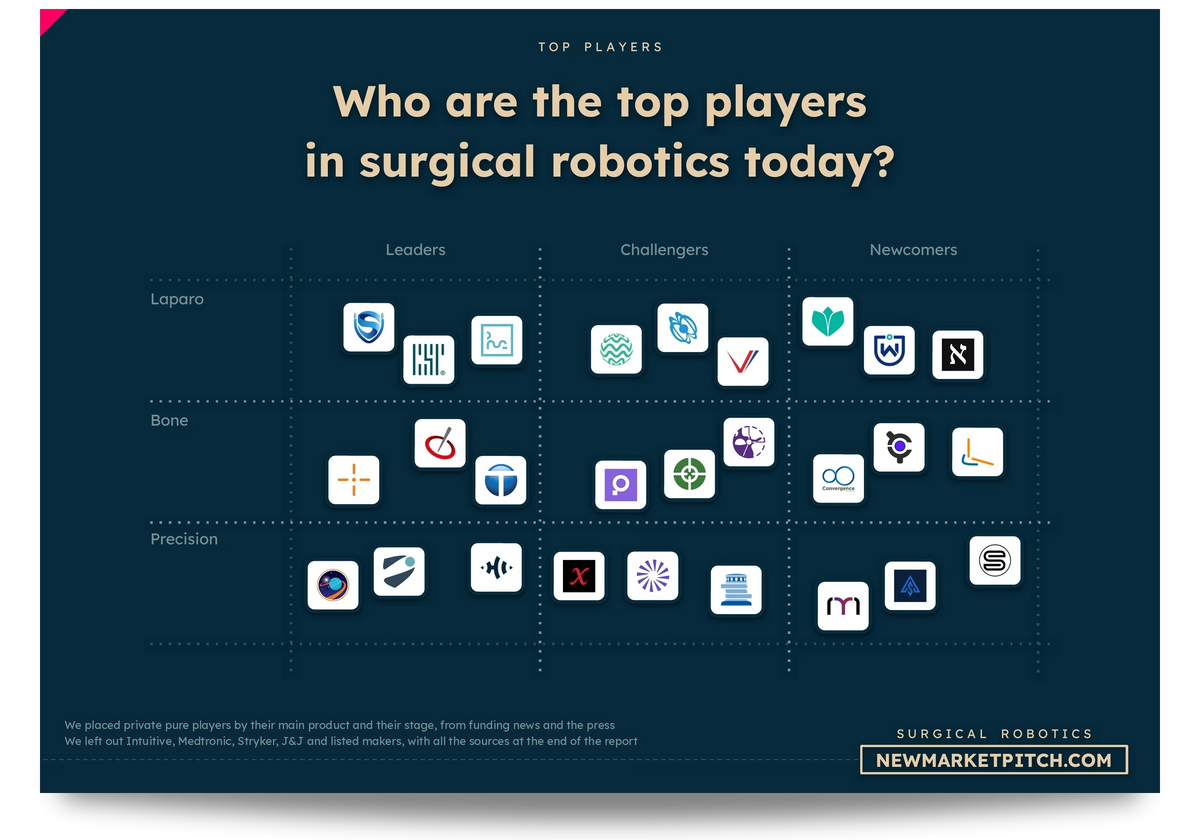
In our report covering the surgical robotics market, we turn what is vague and complex into simple, useful visuals. Market maps like this one show you at a glance where every startup stands.
Top startups in the surgical robotics market ranked by valuation
Here is an updated table that ranks the top startups in the surgical robotics market based on their latest reported or estimated valuations.
If you need to dig deeper and get more detailed data, please check our report covering the surgical robotics market.
| # | Startup Name | What They Do | Current Valuation ($) | Valuation Confidence Level | Valuation Type | Evidence Status | Total Funding ($) | Funding Confidence Level | Country |
|---|---|---|---|---|---|---|---|---|---|
| 1 | CMR Surgical | Modular robotic-assisted soft-tissue surgery | $3.5B–$4.1B | Strong Confidence | Active Raise Valuation | Estimated | $1.1B1 | Partial Confidence | United Kingdom |
| 2 | HistoSonics | Robotic focused-ultrasound tumor ablation | $3.7B–$3.8B | Strong Confidence | Implied Valuation from Raise | Estimated | $584.6M | - | United States |
| 3 | Medical Microinstruments | Robotic precision microsurgery systems | $830M–$1.6B | Partial Confidence | Implied Valuation from Raise | Implied | $346M1 | Strong Confidence | United States |
| 4 | Sagebot | Multi-specialty laparoscopic surgical robotic systems | $800M–$1.2B | Partial Confidence | IPO or Listing Range Valuation | Estimated | Undisclosed | - | China |
| 5 | Surgerii Robotics | Single-port minimally invasive surgical robots | $670M–$1.1B | Partial Confidence | Implied Valuation from Raise | Implied | $146M1 | - | China |
| 6 | ForSight Robotics | Robotic ophthalmic surgery platforms | $650M–$950M | Partial Confidence | Comparables-Based Estimate | Estimated | $190M | Strong Confidence | Israel |
| 7 | Distalmotion | Outpatient soft-tissue robotic surgery | $650M–$900M | Partial Confidence | Comparables-Based Estimate | Estimated | $240M1 | Partial Confidence | Switzerland |
| 8 | Cornerstone Robotics | Multiport robotic-assisted laparoscopic surgery | $694M | Partial Confidence | Implied Valuation from Raise | Implied | $475M1 | Partial Confidence | Hong Kong |
| 9 | Ronovo Surgical | Modular robotic soft-tissue surgery | $450M–$850M | Partial Confidence | Implied Valuation from Raise | Implied | $100M+1 | Partial Confidence | China |
| 10 | Tuodao Medical | Multi-specialty surgical robotics platforms | $350M–$650M | Low Confidence | Comparables-Based Estimate | Estimated | Undisclosed | - | China |
| 11 | Capstan Medical | Robotic transcatheter heart valve replacement | $300M–$450M | Partial Confidence | Implied Valuation from Raise | Implied | $153M | Strong Confidence | United States |
| 12 | Remebot | Neurosurgical and dental robotic systems | $250M–$500M | Low Confidence | Comparables-Based Estimate | Estimated | $90M1 | - | China |
| 13 | ZAP Surgical Systems | Non-invasive robotic brain radiosurgery | $300M–$450M | Partial Confidence | Implied Valuation from Raise | Implied | $281.5M | - | United States |
| 14 | EndoQuest Robotics | Flexible robotic endoluminal surgery | $280M–$420M | Partial Confidence | Implied Valuation from Raise | Implied | $207M | Partial Confidence | United States |
| 15 | Neocis | Robotic dental implant surgery | $260M–$440M | Partial Confidence | Comparables-Based Estimate | Estimated | ~$183M | Strong Confidence | United States |
| 16 | Levita Magnetics | Magnetic-assisted minimally invasive surgery | $280M–$350M | Strong Confidence | Implied Valuation from Raise | Estimated | $72.9M | - | United States |
| 17 | Moon Surgical | Robotic laparoscopic surgical assistance | $230M–$390M | Partial Confidence | Comparables-Based Estimate | Estimated | ~$90M | Strong Confidence | France |
| 18 | THINK Surgical | Robotic knee replacement assistance | $275M–$310M | Strong Confidence | Implied Valuation from Raise | Implied | $249M1 | Partial Confidence | United States |
| 19 | Momentis Surgical | Miniaturized robotic surgical arms | $180M–$300M | Low Confidence | Comparables-Based Estimate | Estimated | $128M1 | Partial Confidence | Israel |
| 20 | XCath | Robotic neurovascular catheter interventions | $200M–$270M | Strong Confidence | Implied Valuation from Raise | Implied | $92M | - | United States |
| 21 | Quantum Surgical | Robotic image-guided tumor ablation | $150M–$290M | Partial Confidence | Comparables-Based Estimate | Estimated | Undisclosed | - | France |
| 22 | Synaptive Medical | Robotic neurosurgical imaging and navigation | $120M–$300M | Low Confidence | Comparables-Based Estimate | Estimated | Undisclosed | - | Canada |
| 23 | Sinovation Medical | Robotic neurosurgical navigation and guidance | $160M–$260M | Partial Confidence | Comparables-Based Estimate | Estimated | $56M1 | - | China |
| 24 | eCential Robotics | Robotic navigation for orthopedic surgery | $175M–$220M | Strong Confidence | Acquisition Value | Estimated | $155M | - | France |
| 25 | Ganymed Robotics | Computer-vision orthopedic surgery robotics | $130M–$220M | Partial Confidence | Comparables-Based Estimate | Estimated | ~$43.5M | - | France |
| 26 | HURWA Robotics | Robotic orthopedic surgical systems | $120M–$220M | Low Confidence | Comparables-Based Estimate | Estimated | ~$71M | - | China |
| 27 | LEM Surgical | Robotic spinal surgery platforms | $130M–$200M | Partial Confidence | Comparables-Based Estimate | Estimated | $35.2M | - | Switzerland |
| 28 | Rob Surgical | Minimally invasive surgical robotic systems | $110M–$220M | Partial Confidence | Comparables-Based Estimate | Estimated | Undisclosed | - | Spain |
| 29 | Microsure | Robot-assisted reconstructive microsurgery | $120M–$190M | Partial Confidence | Comparables-Based Estimate | Estimated | $43.1M | - | Netherlands |
| 30 | Robeauté | Minimally invasive brain microrobots | $105M–$155M | Partial Confidence | Comparables-Based Estimate | Estimated | $31.2M1 | - | France |
| 31 | Biobot Surgical | Robotic prostate biopsy and treatment | $105M–$140M | Strong Confidence | Implied Valuation from Raise | Implied | ~$53M | - | Singapore |
| 32 | EndoRobotics | Flexible robotic gastrointestinal surgery | $100M–$140M | Partial Confidence | Implied Valuation from Raise | Implied | $64.4M | - | South Korea |
| 33 | Bionaut Labs | Microscale robotic targeted drug delivery | $85M–$145M | Low Confidence | Comparables-Based Estimate | Estimated | $69.2M | - | United States |
| 34 | Lancet Robotics | AI-guided orthopedic surgical robots | $75M–$150M | Low Confidence | Revenue or ARR Multiple Estimate | Estimated | ~$6M | - | China |
| 35 | Horizon Surgical Systems | Autonomous robotic cataract surgery | $80M–$125M | Partial Confidence | Comparables-Based Estimate | Estimated | $30M | - | United States |
| 36 | Virtual Incision | Miniaturized robotic abdominal surgery | $90M–$115M | Partial Confidence | Implied Valuation from Raise | Implied | $109M1 | Partial Confidence | United States |
| 37 | Riverfield | Pneumatic robotic surgery assistance | $85M–$115M | Strong Confidence | Proxy-Based Estimate | Estimated | Undisclosed | - | Japan |
| 38 | Yuanhua Robotics | Orthopedic joint replacement robotic systems | $65M–$125M | Partial Confidence | Comparables-Based Estimate | Estimated | $45M | - | China |
| 39 | Sovato | Remote robotic surgery connectivity platform | $75M–$115M | Partial Confidence | Implied Valuation from Raise | Implied | $41M | - | United States |
| 40 | Nanoflex Robotics | Magnetic robotic vascular interventions | $65M–$95M | Partial Confidence | Implied Valuation from Raise | Implied | $27M1 | - | Switzerland |
| 41 | Andromeda Surgical | AI-assisted autonomous urological surgery | $60M–$95M | Partial Confidence | Implied Valuation from Raise | Implied | $30M | - | United States |
| 42 | Borns Medical Robotics | Minimally invasive robotic surgery systems | $55M–$100M | Low Confidence | Comparables-Based Estimate | Estimated | ~$16M | - | China |
| 43 | Galen Robotics | Cooperative robotic microsurgical assistance | $55M–$95M | Low Confidence | Comparables-Based Estimate | Estimated | $22.7M | - | United States |
| 44 | Yakebot | Robotic dental implant placement systems | $45M–$95M | Low Confidence | Comparables-Based Estimate | Estimated | Undisclosed | - | China |
| 45 | Oculotronics | Robotic precision retinal surgery | $55M–$85M | Partial Confidence | Implied Valuation from Raise | Implied | ~$14M | - | China |
| 46 | Point Robotics MedTech | Robotic orthopedic surgical guidance | $45M–$95M | Low Confidence | Comparables-Based Estimate | Estimated | Undisclosed | - | Taiwan |
| 47 | Dessight Biomedical | Robotic ophthalmic microsurgery systems | $50M–$85M | Partial Confidence | Implied Valuation from Raise | Implied | Undisclosed | - | China |
| 48 | iotaMotion | Robotic cochlear implant insertion | $55M–$80M | Partial Confidence | Comparables-Based Estimate | Estimated | $29.8M | - | United States |
| 49 | ROEN Surgical | Robotic kidney stone removal | $40M–$90M | Low Confidence | Comparables-Based Estimate | Estimated | Undisclosed | - | South Korea |
| 50 | Petal Surgical | Incisionless robotic ultrasound surgery | $45M–$85M | Partial Confidence | Implied Valuation from Raise | Implied | $25M1 | - | United States |
| 51 | Puncture Robotic | Robotic hair transplantation systems | $45M–$85M | Partial Confidence | Implied Valuation from Raise | Implied | $30.8M | - | China |
| 52 | Rossum Robotics | Robotic pelvic fracture reduction systems | $45M–$85M | Partial Confidence | Comparables-Based Estimate | Estimated | $14.3M | - | China |
| 53 | Qubot Technology | Autonomous magnetic neurovascular robotics | $45M–$75M | Partial Confidence | Implied Valuation from Raise | Implied | ~$14M | - | China |
| 54 | DeepSurgery | Intelligent microsurgical robotic equipment | $40M–$75M | Partial Confidence | Implied Valuation from Raise | Implied | Undisclosed | - | China |
| 55 | Interventional Systems | Modular image-guided intervention robotics | $35M–$75M | Low Confidence | Proxy-Based Estimate | Estimated | Undisclosed | - | Austria |
| 56 | Ariemedi | Surgical navigation and robotic guidance | $35M–$70M | Low Confidence | Comparables-Based Estimate | Estimated | ~$32M | - | China |
| 57 | CAScination | Robotic image-guided tumor ablation | $30M–$75M | Low Confidence | Proxy-Based Estimate | Estimated | Undisclosed | - | Switzerland |
| 58 | Great Robotics | Minimally invasive surgical robot development | $35M–$70M | Low Confidence | Implied Valuation from Raise | Implied | ~$15M | - | China |
| 59 | Agilis Robotics | Flexible endoluminal surgical robotic instruments | $35M–$55M | Partial Confidence | Comparables-Based Estimate | Estimated | $16M–$18M | - | Hong Kong |
| 60 | AiM Medical Robotics | MRI-compatible robotic neurosurgical guidance | $35M–$55M | Partial Confidence | Implied Valuation from Raise | Implied | $11.3M+2 | - | United States |
| 61 | Zeta Surgical | AI-powered neurosurgical navigation and robotics | $30M–$50M | Partial Confidence | Comparables-Based Estimate | Estimated | $8.51M | - | United States |
| 62 | Aleph Surgical | Autonomous AI-powered surgical robots | $30M–$45M | Strong Confidence | Implied Valuation from Raise | Implied | $7.5M | - | Israel |
| 63 | AcuSurgical | Robotic precision retinal microsurgery | $25M–$45M | Partial Confidence | Comparables-Based Estimate | Estimated | ~$7M | - | France |
| 64 | Virtuoso Surgical | Flexible robotic endoscopic microsurgery systems | $20M–$40M | Partial Confidence | Implied Valuation from Raise | Implied | $15M+ | - | United States |
| 65 | TIROMU | Robotic ophthalmic microsurgery and injections | $15M–$30M | Partial Confidence | Implied Valuation from Raise | Implied | $14M1 | - | China |
| 66 | NDR Medical Technology | Automated robotic needle targeting | $12M–$30M | Low Confidence | Comparables-Based Estimate | Estimated | $5.95M | - | Singapore |
| 67 | Perfint Healthcare | Image-guided interventional robotic systems | $12M–$28M | Partial Confidence | Revenue or ARR Multiple Estimate | Estimated | $34.9M1 | - | India |
Which startups in the surgical robotics market have been acquired or gone public?
These startups no longer have a private-market valuation of their own, so we list them separately, using their acquisition price or their current market capitalization.
| # | Startup Name | What They Do | Current Valuation ($) | Valuation Confidence Level | Valuation Type | Evidence Status | Total Funding ($) | Funding Confidence Level | Country |
|---|---|---|---|---|---|---|---|---|---|
| 1 | Edge Medical Robotics | Minimally invasive surgical robotic systems | $1.5B | Strong Confidence | Public Market Cap | Observed | ~$462M | Partial Confidence | China |
| 2 | SS Innovations International | Affordable robotic soft-tissue surgery systems | $489M | Full Confidence | Public Market Cap | Observed | $19M1 | Partial Confidence | India |
| 3 | TrueHealth Medical | Percutaneous surgical navigation robotic systems | $232M | Full Confidence | Public Market Cap | Observed | Undisclosed | - | China |
| 4 | Robocath | Robotic cardiovascular catheter navigation | $20M | Full Confidence | Acquisition Value | Observed | $74M | - | France |
- Minimum: some round amounts are undisclosed.
- Series A equity only; earlier equity amounts are not included.

Our research about surgical robots gets updated several times a month, so you always get the latest view of where things stand.
Which surgical robotics startups are worth the most today?
CMR Surgical and HistoSonics lead the private surgical robotics market, with valuations of $3.5B–$4.1B and $3.7B–$3.8B, respectively.
CMR Surgical develops Versius, a modular robotic system used in soft-tissue operations. HistoSonics takes a very different approach with Edison, which uses focused ultrasound to destroy targeted tissue without surgical incisions. Their valuation ranges overlap, although CMR Surgical occupies first place in our ranking.
There is then a fairly steep drop. Medical Microinstruments is valued at $830M–$1.6B, Sagebot at $800M–$1.2B, and Surgerii Robotics at $670M–$1.1B. These companies work across microsurgery, multi-specialty laparoscopic robotics and single-port procedures.
The two leaders are also pursuing different markets. CMR Surgical is competing for operating-room procedures already performed with conventional surgical robots. HistoSonics, meanwhile, wants to make a non-invasive treatment method available to more cancer patients.
General surgical platforms can serve many procedures, while a successful specialist technology could create an entirely new market. Both approaches have attracted multibillion-dollar valuations, even though their commercial opportunities look quite different.
How many surgical robotics startups are worth more than $1 billion?
There are currently two surgical robotics startups valued comfortably above $1 billion and three others whose estimated ranges cross that threshold.
CMR Surgical and HistoSonics are the two clear cases. Medical Microinstruments, Sagebot and Surgerii Robotics have ranges extending above $1 billion, while Cornerstone Robotics' last disclosed valuation was $694 million.
That gives us five companies at or potentially above unicorn status, depending on where their actual valuations fall within the estimated ranges. Only two have valuation ranges entirely above the threshold.
The concentration becomes clearer further down the ranking. ForSight Robotics, at $650M–$950M, and Distalmotion, at $650M–$900M, are approaching the same level, but most surgical robotics startups remain valued below $500 million.
The market therefore has a small group of multibillion-dollar businesses, several companies that could reach unicorn status, and a much larger collection of specialist developers. Surgical robotics attracts enormous investment, but billion-dollar valuations remain relatively rare.

In our market report about surgical robots, we look at what the winners do differently, so you can learn from the best instead of guessing.
Why is CMR Surgical worth up to $4.1 billion?
CMR Surgical's $3.5B–$4.1B valuation has substantial support from real surgical usage, international installations and expanding U.S. regulatory approvals.
CMR reported more than 30,000 operations completed with Versius in April 2025. By March 2026, the company said more than 45,000 patients had been treated globally. That represents at least 15,000 additional procedures over roughly 12 months, a meaningful increase for a company still expanding its commercial presence.
Its U.S. progress has also become more convincing. Versius received FDA De Novo authorization in October 2024, followed by 510(k) clearance for Versius Plus in December 2025 for gallbladder removal. In October 2026, the FDA cleared Versius Plus for several benign gynecological procedures, including hysterectomy, ovarian cystectomy and salpingectomy.
That latest clearance expands the number of operations CMR can address in the world's largest medical-device market. The supporting clinical study involved 45 procedures, all completed without conversion to another surgical method.
There is a clear commercial advantage in having tens of thousands of completed procedures behind a product before entering more U.S. hospitals. Surgeons can assess an established clinical record rather than relying mainly on early trials.
CMR still has a long way to go before reaching the scale of Intuitive Surgical, but it has progressed well beyond the stage where a surgical robot is valued largely on what its developers promise it might accomplish.
Is HistoSonics really worth almost as much as CMR Surgical?
HistoSonics' $3.7B–$3.8B valuation is backed by a remarkable increase in investor valuations, although its future depends heavily on expanding histotripsy into more medical treatments.
The company's recent financing history is particularly interesting. In August 2025, a management-led majority-stake acquisition valued HistoSonics at approximately $2.25 billion. Two months later, the company raised another $250 million.
In June 2026, HistoSonics announced a financing round valuing the business at $3.75 billion. Compared with the August transaction, that represents an increase of approximately 67% in less than a year. The transactions had different structures, so this is a change between stated company valuations rather than a directly measured investment return.
The attraction is Edison, a robotic system that delivers focused ultrasound to destroy tissue. It received FDA authorization for liver tissue destruction in 2023. At the time of the August 2025 transaction, the company's legal advisers reported more than 2,000 patients treated and use at over 50 U.S. medical centers.
HistoSonics is also developing applications involving other organs and conditions, including kidney tumors and benign prostate enlargement.
Its valuation is ambitious because much of the potential market still depends on further clinical studies and regulatory approvals. Yet the $3.75 billion financing provides unusually direct evidence that investors are willing to pay for that opportunity.
HistoSonics could become a major medical-device company without ever competing for the same procedures as CMR Surgical.

In our document detailing everything you need to know about surgical robotics, you will always find fresh funding data, taken straight from our own verified funding database.
Can CMR Surgical or Cornerstone Robotics actually challenge Intuitive Surgical?
CMR Surgical and Cornerstone Robotics are credible competitors in robotic-assisted surgery, but Intuitive Surgical remains far ahead in commercial scale.
Intuitive's 2025 annual report recorded approximately 3.15 million da Vinci procedures during the year, compared with 2.68 million in 2024. The company finished 2025 with 11,106 installed da Vinci systems and generated approximately $10.1 billion in revenue.
The gap is enormous. Intuitive performed about 70 times as many procedures in a single year as CMR Surgical had reported cumulative patients treated by March 2026. The measures are not perfectly comparable, since one is annual procedures and the other is cumulative patients, but the difference in commercial scale is still striking.
Intuitive also generated $6.02 billion from instruments and accessories in 2025, representing nearly 60% of its revenue. Hospitals buy the systems, then keep purchasing instruments and paying for services as procedures continue.
CMR offers an alternative through Versius, while Cornerstone Robotics develops the Sentire platform. Cornerstone made a particularly important move in September 2026 when Medtronic announced an approximately $700 million strategic investment and distribution partnership involving Sentire, without disclosing a new valuation.
The deal gives Cornerstone access to a major medical-device company's international distribution infrastructure. It also shows that established industry players see value in offering hospitals more than one type of robotic platform.
Competition should increase, especially in markets where hospitals want lower-cost or more flexible systems. But replacing Intuitive's installed base and recurring instrument business is a much bigger challenge than winning individual customers.
Are Chinese surgical robotics startups catching up with Western companies?
Chinese surgical robotics startups have made real progress toward international competition, with Cornerstone Robotics providing the clearest recent example.
Cornerstone's Sentire system received approval in China in 2024. In May 2026, it obtained European CE marking and Singapore regulatory certification covering general surgery, gynecology, thoracic surgery and urology. A few months later came the Medtronic partnership.
That sequence is worth examining. Cornerstone moved from domestic approval to international certifications and then secured backing from one of the world's major medical-device companies. The Medtronic announcement also gives Sentire a potential route into overseas hospitals through an established sales network.
Other Chinese developers are targeting different segments. Sagebot works on multi-specialty laparoscopic robotics, Surgerii Robotics focuses on single-port systems, and Ronovo Surgical develops modular soft-tissue robots. Tuodao Medical and Remebot address additional surgical specialties.
The valuations reflect that growing ambition. Sagebot stands at $800M–$1.2B, Surgerii Robotics at $670M–$1.1B, Cornerstone Robotics at $694M, its last disclosed valuation, and Ronovo Surgical at $450M–$850M.
Western companies still have major advantages in international installed bases, clinical experience and recurring revenue. Chinese challengers also need to prove that their products can be sold, serviced and regularly used across different healthcare systems.
Nevertheless, Cornerstone's progress shows that Chinese surgical robotics companies are already moving beyond domestic competition. Their ability to establish lasting overseas businesses is now the more interesting test.

Learning from others' mistakes is the cheapest lesson there is. In our report covering the surgical robotics market, we look at what broke startups before you, so you don't repeat it.
Which surgical robotics startups have raised the most funding?
CMR Surgical leads surgical robotics fundraising with at least $1.1 billion, followed by HistoSonics at $584.6 million, Cornerstone Robotics at $475 million and Medical Microinstruments at $346 million.
These amounts show how expensive it is to turn a surgical robot into a product hospitals can use routinely. Companies must finance hardware development, clinical trials, regulatory approvals, manufacturing, surgeon training and years of commercial expansion.
The funding is also concentrated among companies with broader commercial ambitions. CMR is building an international soft-tissue surgery platform. Cornerstone is entering overseas markets. Medical Microinstruments is expanding robotic microsurgery, while HistoSonics is developing new applications for its ultrasound technology.
Several recent financings help explain why the cumulative totals are so large.
| Startup | Financing announced | Period | What the money supports |
|---|---|---|---|
| CMR Surgical | More than $200M in equity and debt | April 2025 | Global expansion and U.S. launch |
| ForSight Robotics | $125M Series B | June 2025 | Ophthalmic robotics development |
| HistoSonics | $250M financing | October 2025 | International expansion and clinical applications |
| Cornerstone Robotics | Approximately $200M | November 2025 | Commercialization and overseas expansion |
| Distalmotion | $150M Series G | November 2025 | U.S. ambulatory surgery centers |
| Medical Microinstruments | $125M Series D | October 2026 | Commercial growth and clinical studies |
| ZAP Surgical Systems | $36M financing | October 2026 | Production capacity and global deployment |
| Distalmotion | Up to $70M debt facility | October 2026 | Further U.S. expansion |
Together, these announcements represent more than $1.15 billion in financing and credit capacity. The aggregate includes debt facilities, so it should not be interpreted as equity already invested or cash fully drawn.
A useful pattern emerges from the purposes of these rounds. Investors are funding commercial launches, new procedures and international distribution as much as they are funding new robotic technologies.
Is Medical Microinstruments about to become a surgical robotics unicorn?
Medical Microinstruments is a serious unicorn candidate at $830M–$1.6B, particularly after its latest financing and growing use of the Symani microsurgery system.
In October 2026, the company raised $125 million in a Series D round led by BioStar Capital. It also reported approximately 50 installed Symani systems and 3,500 completed microsurgical procedures worldwide.
Symani helps surgeons work on tiny blood vessels, lymphatic structures and nerves. Its instruments and motion-scaling technology are designed for operations where movements measured in fractions of a millimeter matter.
The company received FDA De Novo authorization in 2024 and has since expanded its instrument portfolio. Its latest investment will also help fund clinical research, including the REMIND study examining possible applications involving lymphatic drainage.
The installed-system numbers are encouraging, although more information about procedure growth will help show how quickly adoption is accelerating. Dividing 3,500 cumulative procedures by roughly 50 installed systems gives 70 procedures per system, but that calculation doesn't account for different installation dates.
Medical Microinstruments has already established a commercial presence in a demanding surgical specialty. The next challenge is getting hospitals to use Symani frequently enough to justify continued investment and broader deployment.

Your time is limited. In our research about surgical robots, we put numbers on each part of the market, so you can see where it makes sense to focus.
Could smaller surgical robots take business away from da Vinci?
Compact surgical robots could win a meaningful share of operations currently performed with larger systems, especially in outpatient centers where space and operating costs matter.
Distalmotion is one of the more interesting companies pursuing this opportunity. Its DEXTER system is designed for flexible use in ambulatory surgery centers, which perform operations without requiring patients to stay overnight.
The company obtained additional U.S. FDA clearances in 2026, including indications involving gynecological procedures and ventral hernia repair. It also secured a debt facility of up to $70 million from Perceptive Advisors in October 2026 to expand in the U.S.
Moon Surgical and Virtual Incision are approaching the same broad opportunity differently. Moon Surgical's Maestro provides robotic assistance for laparoscopic surgery, while Virtual Incision's MIRA uses a miniaturized system designed for abdominal procedures.
Their valuations differ considerably. Distalmotion stands at $650M–$900M, Moon Surgical at $230M–$390M, and Virtual Incision at $90M–$115M.
Smaller hardware could make robotics attractive to facilities that cannot accommodate a large traditional system. However, the economics still depend on instruments, maintenance, staffing and how many procedures each center performs.
Distalmotion's concentration on ambulatory surgery centers gives it a specific commercial market to pursue. That focus could prove more useful than trying to challenge larger systems across every surgical specialty.
Why are investors putting so much money into robotic eye surgery?
Robotic eye surgery is attracting significant investment because the potential procedure volume is enormous, particularly in cataract treatment, although most new platforms still have limited commercial experience.
ForSight Robotics is the largest specialist ophthalmic developer in our ranking, valued at $650M–$950M. In June 2025, it raised $125 million in a Series B round, bringing its total announced funding to $195 million at that time.
Its ORYOM platform is being developed for cataract operations and other ophthalmic procedures. ForSight announced the funding while preparing for initial human clinical trials.
Other developers focus on more specialized applications. Horizon Surgical Systems is working on autonomous cataract surgery, while Oculotronics, Dessight Biomedical, AcuSurgical and TIROMU target retinal surgery, microsurgery or ophthalmic injections.
Cataract operations offer particularly attractive scale because they are performed frequently across the world. Retinal surgery can involve more delicate procedures and more specialized operating environments.
The difficult part is convincing surgeons and clinics that robotics improves results or efficiency enough to justify buying the equipment.
ForSight has already attracted considerable capital, but the commercial opportunity remains largely ahead of it. Stronger clinical results and real deployment numbers will be needed before ophthalmic robotics can be considered an established mass market.

In our market report about surgical robots, we always try to gather several sources and make estimates that make sense, so you can work with solid numbers.
Which surgical robotics startups are doing the most in cancer treatment?
HistoSonics is the most highly valued private startup in robotic and image-guided tumor treatment, while ZAP Surgical Systems is showing particularly interesting recent commercial progress.
HistoSonics develops focused-ultrasound histotripsy. Quantum Surgical builds robotic assistance for tumor ablation, while CAScination focuses on image-guided interventions. ZAP Surgical Systems uses its ZAP-X platform for non-invasive brain radiosurgery.
These treatments serve different clinical needs. HistoSonics destroys targeted tissue through ultrasound, while ZAP-X uses focused radiation. Quantum Surgical and CAScination help physicians perform image-guided interventions.
In October 2026, ZAP Surgical announced $36 million in new financing and reported that it had shipped its 50th ZAP-X system. The company also stated that nearly 10,000 patients had been treated worldwide.
Those numbers deserve attention. ZAP has established a meaningful installed base and patient-treatment history while operating at a substantially lower valuation than HistoSonics. It is valued at $300M–$450M, compared with HistoSonics' $3.7B–$3.8B.
The valuation difference reflects more than current patient volumes. HistoSonics has the potential to expand a newer treatment method across several organs and indications, which gives investors a much larger opportunity to price in.
ZAP's commercial record shows that specialist robotic systems can build real medical businesses without reaching billion-dollar valuations. HistoSonics has the larger investor valuation today, but both companies demonstrate that cancer treatment is becoming an important field for specialist robotics.
Is robotic dental surgery already a real business?
Robotic dental implant surgery is already being used at substantial scale, with Neocis providing some of the clearest commercial evidence among specialist surgical robotics startups.
Neocis develops Yomi, a robotic system that assists dentists with implant planning and placement. In January 2026, the company announced that clinicians had completed more than 100,000 robotic osteotomies using the platform.
An osteotomy is a bone preparation procedure, so that milestone should not be confused with the number of patients treated. Still, it demonstrates repeated clinical use across dental practices.
Neocis has also introduced Yomi S, its second-generation system. More recently, the company reported over 125,000 implants placed with Yomi robotic assistance and additional FDA clearance covering pterygoid implant placement.
The dental robotics market is quite different from hospital-based abdominal surgery. Dentists must decide whether the system helps them perform enough implant procedures, improve precision and make their practices more productive.
Neocis is valued at $260M–$440M. Other companies working in related areas include Yakebot at $45M–$95M and Remebot at $250M–$500M, although Remebot also develops neurosurgical systems.
Neocis is particularly interesting because it has demonstrated substantial routine use while remaining well below unicorn valuation levels. Its next opportunity comes from increasing the number of practices using Yomi and the frequency of procedures performed on those systems.

If you build or invest in the surgical robotics market, you need to know which business models pay off now and which ones are fading. That's why our report covering it has a whole section on it.
Can autonomous surgical robots actually operate without a surgeon?
Fully autonomous surgical robots are not yet a mainstream commercial reality, although startups are already developing systems capable of handling more surgical tasks automatically.
Horizon Surgical Systems is pursuing autonomous cataract surgery, Andromeda Surgical is developing AI-assisted autonomous urological surgery, and Aleph Surgical focuses on AI-powered surgical robots.
Zeta Surgical is also developing intelligent navigation technology that can help guide surgical procedures.
The distinction between different levels of automation is important. A robot that automatically positions an instrument or follows a preplanned path is performing a very different task from one that independently completes an operation and responds to unexpected complications.
Current commercial systems such as da Vinci, Versius and Yomi continue to depend on surgeons for procedural control.
There are good reasons to develop more automation. Certain operations involve repeated steps and precise movements that computers may eventually perform consistently. But surgical systems must also handle anatomical differences, bleeding, unexpected tissue behavior and other complications.
The strongest near-term opportunity is in automating specific, well-defined tasks. Claims about robots independently conducting complex operations remain well ahead of routine clinical practice.
Which surgical robotics startups could be worth $1 billion next?
ForSight Robotics, Distalmotion and Ronovo Surgical are among the most plausible candidates to reach billion-dollar valuations, although their routes to that level are very different.
ForSight Robotics is valued at $650M–$950M, putting the upper end of its range closest to $1 billion. Its opportunity depends on proving that ophthalmic surgery can support a large robotic platform.
Distalmotion, at $650M–$900M, has a more immediate commercial focus. It is expanding DEXTER in U.S. ambulatory surgery centers and has obtained multiple regulatory clearances for additional procedures.
Ronovo Surgical, at $450M–$850M, is developing modular soft-tissue robotics. Its future valuation will depend on regulatory approvals, hospital deployment and its ability to compete in a market already served by larger manufacturers.
Several other companies could eventually reach the same level, but they need more substantial commercial or clinical milestones first.
| Startup | Main product area | Progress worth watching |
|---|---|---|
| ForSight Robotics | Ophthalmic surgery | Human clinical trials and regulatory authorization |
| Distalmotion | Outpatient soft-tissue surgery | U.S. installations and annual procedure volumes |
| Ronovo Surgical | Modular soft-tissue surgery | Commercial expansion and hospital adoption |
| Capstan Medical | Robotic heart valve interventions | Human clinical studies and regulatory progress |
| ZAP Surgical Systems | Brain radiosurgery | Installations beyond its first 50 systems |
| EndoQuest Robotics | Flexible endoluminal surgery | Pivotal clinical evidence and FDA authorization |
| Neocis | Dental implant robotics | Additional practices adopting Yomi S |
| Quantum Surgical | Robotic tumor ablation | Wider hospital adoption and procedure growth |
Repeat procedures and expanding installed bases deserve more attention than another financing announcement alone. A company that steadily increases clinical use has a much stronger argument for a sustained billion-dollar valuation.

In our report covering the surgical robotics market, we don't want to repeat what boring consulting reports say. Instead, we show you the real and latest market signals that matter.
Why are some surgical robotics startups worth less than they raised?
Some surgical robotics startups are valued below their cumulative funding because years of product development can consume substantial capital without producing a business worth more than the money invested.
Virtual Incision illustrates the issue. Its valuation stands at $90M–$115M, while its reported minimum funding is $109M. The lower end of its valuation range falls below its cumulative funding, reflecting the cost and risk of bringing a miniaturized surgical system to market.
Perfint Healthcare presents an even clearer difference. The company is valued at $12M–$28M against at least $34.9M in reported funding. Its entire estimated valuation range is below the money raised, reflecting the possibility that commercial progress has not matched earlier expectations.
This does not tell us exactly how much any individual investor gained or lost. Different financing rounds may involve different prices, ownership rights, debt arrangements and liquidation preferences.
The distinction is particularly important in medical robotics, where a company can spend years obtaining regulatory clearance before generating substantial recurring revenue.
The gap between funding and valuation deserves attention. A large historical funding total can indicate strong investor support, but it can also reveal how expensive the company's development has been.
Which surgical robotics startups have gone public or been acquired?
Several surgical robotics companies have already reached the public market or completed acquisition transactions, with outcomes ranging from $20 million to $1.5 billion.
Edge Medical Robotics is the largest public-company entry in our separate exit ranking, with a market capitalization of $1.5B. SS Innovations International follows at $489M, while TrueHealth Medical is valued at $232M.
Robocath is recorded with an acquisition value of $20M, well below its reported $74M in cumulative funding.
That difference is striking. Robocath's acquisition value is approximately 27% of its recorded lifetime funding. The comparison does not establish what shareholders ultimately received, but it illustrates how a surgical robotics company can complete an exit without recovering an amount equivalent to all the capital previously raised.
We also include eCential Robotics in the main valuation analysis at $175M–$220M, using an acquisition-value approach. As an acquisition-related valuation, it should be understood differently from the price established through a conventional independent private financing round.
Public market capitalizations can change daily, while completed acquisitions provide transaction values from a particular point in time. Neither is automatically comparable to a startup's latest private financing.
The spread in outcomes is considerable. Investors have seen evidence that large exits are possible, but the sector also produces transactions far below earlier funding commitments.

In our research about surgical robots, we like to show you the big picture. We know your time is precious, so we make every page quick to read and packed with as much learning as possible per minute.
Are surgical robotics startups actually worth their valuations today?
Surgical robotics startup valuations are broadly credible at the top of the market, but the picture becomes much less convincing for companies still waiting to prove commercial demand.
CMR Surgical offers a strong example of real adoption. It has completed tens of thousands of procedures, expanded internationally and recently obtained additional U.S. FDA clearance for gynecological operations.
HistoSonics has a different investment case, supported by a $3.75 billion financing valuation and growing clinical use of its non-invasive tumor treatment system. Medical Microinstruments has established a smaller but measurable installed base in microsurgery, while Cornerstone Robotics has secured an important international partnership with Medtronic.
These companies have achieved more than engineering milestones. Their technologies are entering clinical practice, attracting commercial partners and receiving regulatory approvals.
The harder question is how much revenue they can eventually generate. Intuitive Surgical's approximately $10.1 billion in 2025 revenue shows what a mature surgical robotics business can look like, but it also highlights how far most startups still have to grow.
Our ranking contains only a small number of companies above or near $1 billion, followed by dozens of businesses operating in narrower specialties. Many of these smaller developers could establish successful medical-device businesses without ever matching the scale of the leading general surgical platforms.
The largest valuations have enough commercial and clinical progress behind them to deserve serious attention. For earlier-stage companies, future approvals, clinical adoption and funding conditions will have a much greater impact.
The strongest future performers will be those that turn surgical technology into regular procedures, repeat customer purchases and sustainable revenue. That's where the biggest differences between today's valuations will eventually become clear.
Our methodology
This analysis examines independent startups whose businesses are centered on surgical robotics across the surgical robotics market. Large established medical-device groups and their divisions are excluded from the private-startup ranking, even where their products are important competitors.
We assess company valuations using financing rounds, investor transactions, operating metrics, regulatory approvals, clinical adoption and commercial progress. A recently announced financing with a disclosed valuation provides the clearest private-market benchmark. Where no direct valuation is available, we estimate a range using financing history, comparable companies and the startup's progress toward commercial adoption. Public companies and acquired businesses are treated separately using their market capitalizations or acquisition values.
A company can appear in this ranking even when its total funding is undisclosed: its position depends on its valuation, not on the capital it has raised.
Key sources include CMR Surgical's financing announcement, CMR Surgical's global patient-treatment figures, CMR Surgical's FDA clearance announcement, Fox Rothschild's HistoSonics transaction announcement, MassDevice's HistoSonics financing coverage, MassDevice's report on HistoSonics' 2026 valuation, and Intuitive Surgical's 2025 annual report.
We also use Cornerstone Robotics' financing announcement, Medtronic's strategic partnership announcement, Medical Microinstruments' Series D announcement, Distalmotion's Series G announcement, Distalmotion's U.S. expansion financing, ForSight Robotics' Series B announcement, Neocis' clinical-use milestone, Neocis' additional FDA clearance, and ZAP Surgical Systems' financing and installation announcement.

When you build or invest in the surgical robotics market, you need clarity, not confusion. In our market report about surgical robots, we always try to put numbers on and quantify whatever is usually vague and confusing.
Written by the New Market Pitch teamWe track new markets so founders and investors can move faster. About us