What are the top MedTech startups by revenue today?
Whether you're building or investing in the medtech market, our report covers everything you need to know: the players, the money, and what's coming next.
Summary
United Imaging Healthcare is the top MedTech startup by revenue today, with CNY 13.8 billion (approximately $1.92 billion) in FY2025 sales, followed by Tempus AI at $1.27 billion and PROCEPT BioRobotics at $308 million.
Revenue is heavily concentrated at the top. United Imaging and Tempus AI account for approximately 76.5% of the combined $4.17 billion generated by the 11 ranked companies. Adding PROCEPT BioRobotics, HeartFlow, and GRAIL brings the top five's share to roughly 91.6%.
The largest MedTech business in our ranking is a medical imaging manufacturer, not an AI software developer. United Imaging's MRI, CT, and PET equipment business is considerably bigger than the younger companies attracting attention for AI-assisted diagnosis.
Tempus AI is growing faster, with revenue up 83.4% in 2025, but acquisitions explain a substantial part of that increase. Excluding Ambry Genetics, organic growth was closer to 30%, slightly below United Imaging's reported 33.98% expansion.
Diagnostics still generate approximately three-quarters of Tempus AI's revenue. Despite the company's AI positioning, medical testing produced around $955 million in 2025, compared with $316 million from data and applications.
Surgical robotics offers a different route to scale. PROCEPT BioRobotics generated $308 million by combining robotic system installations with repeat sales of surgical handpieces, showing how a focused medical procedure can support a substantial commercial business.
The gap between revenue growth and profitability remains striking. United Imaging earned CNY 1.87 billion in attributable net profit, while Tempus AI lost $245 million and GRAIL lost approximately $408 million. Commercial demand alone has not made most of these businesses profitable.
Medical AI does not automatically deliver better margins than physical medical devices. Sight Sciences reported an 86% gross margin, above HeartFlow's 76.8% and SOPHiA GENETICS' 67.4%, even though Sight Sciences' annual revenue declined.
Hospital adoption can be impressive without establishing financial scale. Viz.ai and Aidoc each reported deployments across approximately 2,000 hospitals, but those figures cannot be translated into reliable annual revenue without contract and pricing information.
The ranking is international, although six of the 11 companies are American. China holds first place through United Imaging, while South Korea's Lunit and VUNO and India's Qure.ai show that specialized medical AI businesses are establishing meaningful sales outside the United States.
The next billion-dollar MedTech businesses will probably be distinguished by recurring clinical usage, reliable reimbursement, repeat equipment or instrument purchases, and improving profitability. The strongest evidence of progress will come from revenue and margins rather than funding rounds or installation announcements.

Written by the New Market Pitch teamWe track new markets so founders and investors can move faster. About us

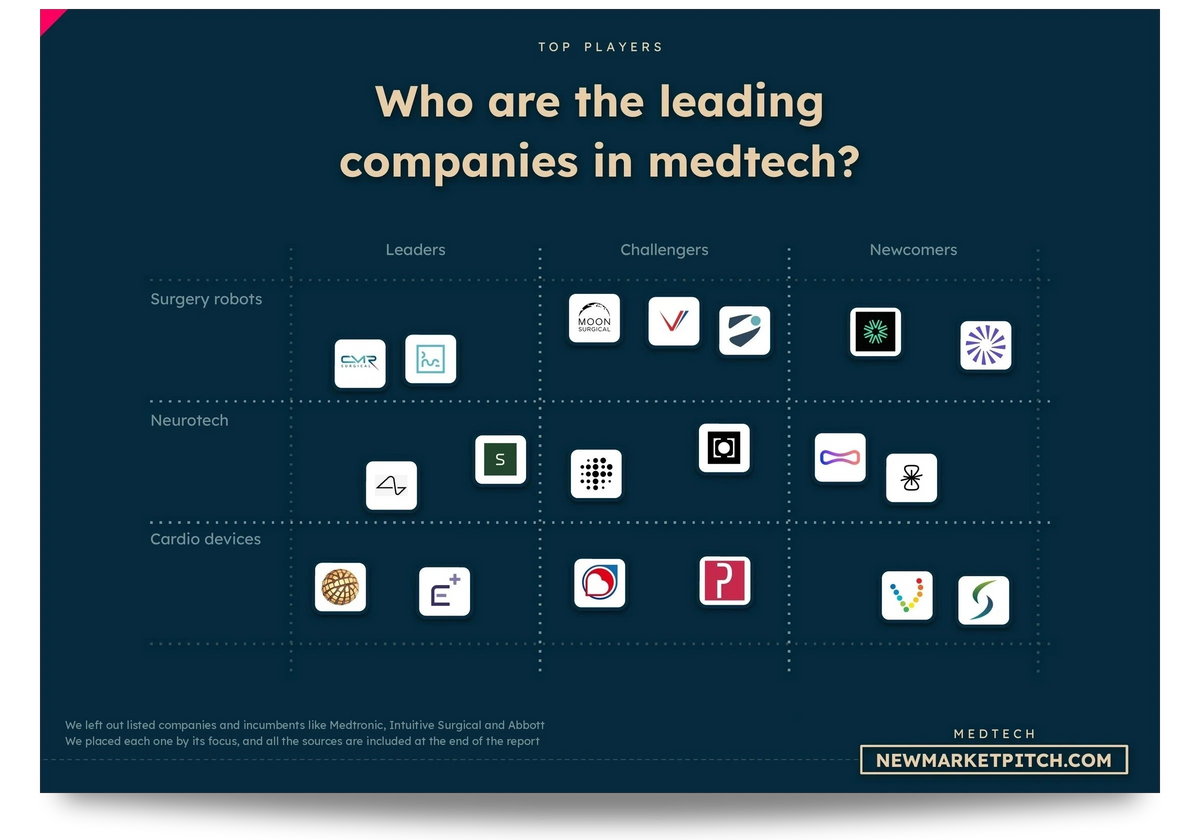
In our report covering the medtech market, we turn what is vague and complex into simple, useful visuals. Market maps like this one show you at a glance where every startup stands.
The ranking of top startups in the MedTech Market by revenue
Below is a table ranking the startups of this market by their current revenue scale. You can find our methodology at the end of this page.
If you want a deeper understanding of the market and its current dynamics, get our report on the MedTech market.
| Ranking | Company | Latest Metric | Metric Type | Freshness | Disclosed When | Source Quality | Confidence | Segment | Why This Ranking | Local Metric | Country |
|---|---|---|---|---|---|---|---|---|---|---|---|
| 1 | United Imaging Healthcare | ~$1.92B | Fiscal-Year Revenue | Fresh · 10mo | Apr 28, 2026 | Company Disclosed | Medium | Medical Imaging | Leads the startups on reported annual sales, above Tempus AI's $1.27B, though the cross-currency position is indicative only. Maker of CT, MRI, PET and related imaging systems. | CNY 13.8B | cn |
| 2 | Tempus AI | $1.27B | Fiscal-Year Revenue | Fresh · 10mo | Feb 24, 2026 | Company Disclosed | Medium | Cancer Molecular Diagnostics | Below United Imaging Healthcare's ~$1.92B and far above PROCEPT BioRobotics' $308M. Company-wide revenue includes approximately $316M data/applications besides ~$955M diagnostic sales, a mixed medical data perimeter. | us | |
| 3 | PROCEPT BioRobotics | $308M | Fiscal-Year Revenue | Fresh · 10mo | Feb 2026 | Filed / Audited | High | Surgical Robotics | Below Tempus AI, above HeartFlow on reported annual sales. | us | |
| 4 | HeartFlow | $176M | Fiscal-Year Revenue | Fresh · 10mo | Mar 18, 2026 | Company Disclosed | High | Diagnostic AI & Cardiac Imaging | Below PROCEPT BioRobotics ($308M) and above GRAIL ($147M) on reported annual sales. Direct recognized FY revenue of $176M is preferred to newer isolated quarterly revenue. | us | |
| 5 | GRAIL | $147M | Fiscal-Year Revenue | Fresh · 10mo | Feb 19, 2026 | Company Disclosed | High | Cancer Molecular Diagnostics | Below HeartFlow's $176M, above Butterfly Network's $97.6M on reported annual sales. | us | |
| 6 | Butterfly Network | $97.6M | Fiscal-Year Revenue | Fresh · 10mo | Feb 2026 | Filed / Audited | High | Portable Ultrasound | Fresh audited $97.6M revenue places it below GRAIL's $147M and above Sight Sciences' $77.4M on reported annual sales. | us | |
| 7 | Sight Sciences | $77.4M | Fiscal-Year Revenue | Fresh · 10mo | Mar 4, 2026 | Filed / Audited | High | Ophthalmic Devices | Below Butterfly Network, above SOPHiA GENETICS on reported annual sales. | us | |
| 8 | SOPHiA GENETICS | $77.3M | Fiscal-Year Revenue | Fresh · 10mo | Mar 3, 2026 | Filed / Audited | High | Clinical Genomics Software | Just below Sight Sciences, above Lunit on reported annual sales. | ch | |
| 9 | Lunit | ~$58.5M | Fiscal-Year Revenue | Fresh · 10mo | Jan 30, 2026 | Company Disclosed | Medium | Diagnostic AI & Oncology Imaging | Indicative cross-currency position: the KRW-based ~$58.5M sits below SOPHiA GENETICS ($77.3M) and above VUNO (~$24.5M) on reported annual sales. Oncology and radiology medical AI. | KRW 83.1B | kr |
| 10 | VUNO | ~$24.5M | Fiscal-Year Revenue | Fresh · 10mo | Feb 4, 2026 | Company Disclosed | Medium | Diagnostic AI & Monitoring | Indicative cross-currency position only; below Lunit's ~$58.5M, above Qure.ai's older ~$20.3M on reported annual sales. Preliminary disclosed sales; source and currency not treated as audited. | KRW 34.8B | kr |
| 11 | Qure.ai | ~$20.3M | Fiscal-Year Revenue | Aging · 19mo | 2026 | Filed / Audited | Medium | Diagnostic AI & Radiology | Below VUNO; smallest company with a verified financial figure in this set. Revenue from operations of Qure.ai Technologies Private Limited, extracted from audited consolidated financial statements in the Fractal group-company report. Corporate perimeter may differ from all branded operations. | INR 1.75B | in |
| NR | Viz.ai | 2,000 hospitals | Locations | Very Fresh · 3mo | Jul 28, 2026 | Company Disclosed | Low | Diagnostic AI & Clinical Decision Support | No defensible dollar ranking: Number of hospitals, not paid accounts or revenue; drug-company partnerships also reported. | us | |
| NR | Eko Health | 750K devices sold | Cumulative Units Sold | Very Fresh · 5mo | May 31, 2026 | Company Disclosed | Low | Digital Stethoscopes & Cardiac AI | No defensible dollar ranking: 750K devices is a cumulative sales count across years and should not be multiplied by device price, so it cannot be ranked numerically. | us | |
| NR | Subtle Medical | >600 sites | Locations | Aging · 27mo | Jul 24, 2024 | Company Disclosed | Low | Diagnostic AI & Medical Imaging | No defensible dollar ranking: Company also said 2.5M patients annually; sites are not customers or revenue; now aging. | us | |
| NR | Mediwhale | 111 medical institutions | Locations | Fresh · 11mo | Nov 4, 2025 | Company Disclosed | Low | Retinal Diagnostic AI | No defensible dollar ranking: Institutional adoption and >40,000 cumulative exams do not establish annual sales. | kr | |
| NR | Aidoc | ~2,000 hospitals | Locations | Very Fresh · 2mo | Aug 11, 2026 | Company Disclosed | Low | Diagnostic AI & Radiology | No defensible dollar ranking: Hospitals reached by clinical AI; no direct corporate annual sales selected. | il |

Our research about medical devices gets updated several times a month, so you always get the latest view of where things stand.
Which MedTech startups make the most revenue today?
United Imaging Healthcare currently ranks first among MedTech startups by revenue, followed by Tempus AI and PROCEPT BioRobotics. The three companies operate in very different parts of healthcare, but all have turned their technology into hundreds of millions of dollars in annual sales.
United Imaging reported CNY 13.8B in FY2025 revenue, equivalent to approximately $1.92B. Tempus AI generated $1.27B, while PROCEPT BioRobotics recorded $308M. The gap between second and third place alone is roughly $962M.
HeartFlow and GRAIL follow with $176M and $147M, respectively. Below them, Butterfly Network is approaching the $100M mark, while Sight Sciences and SOPHiA GENETICS both generate around $77M annually.
The ranking also includes three Asian medical AI specialists: Lunit, VUNO, and Qure.ai. Their revenue figures are reported in Korean won and Indian rupees, so we keep the original currencies rather than presenting converted estimates as company disclosures.
All 11 ranked companies have credible financial figures. Their businesses range from hospital imaging systems and surgical robotics to cancer testing, clinical software, and AI-assisted diagnosis.
| Rank | MedTech startup | Revenue | Period |
|---|---|---|---|
| 1 | United Imaging Healthcare | CNY 13.8B | FY2025 |
| 2 | Tempus AI | $1.27B | FY2025 |
| 3 | PROCEPT BioRobotics | $308M | FY2025 |
| 4 | HeartFlow | $176M | FY2025 |
| 5 | GRAIL | $147M | FY2025 |
| 6 | Butterfly Network | $97.6M | FY2025 |
| 7 | Sight Sciences | $77.4M | FY2025 |
| 8 | SOPHiA GENETICS | $77.3M | FY2025 |
| 9 | Lunit | KRW 83.1B | FY2025 |
| 10 | VUNO | KRW 34.8B | FY2025 |
| 11 | Qure.ai | INR 1.75B | FY2025, ended March 2025 |
Why are MedTech startups making so much money now?
MedTech startups are generating serious revenue today because several companies have moved beyond clinical trials and early hospital deployments into large-scale commercial sales. But the money is flowing very unevenly.
United Imaging Healthcare, for example, reported 33.98% revenue growth in 2025. Tempus AI grew approximately 83%, partly through acquisitions, while HeartFlow grew 40% and PROCEPT BioRobotics 37%.
Those growth rates reflect different commercial markets. Hospitals purchase United Imaging's expensive MRI, CT, and PET systems. Tempus AI sells diagnostic testing and data services. HeartFlow earns revenue when physicians order cardiac analyses, while PROCEPT sells robotic equipment and instruments used in surgical procedures.
The big change is that these companies now have enough commercial history to judge their financial progress. We can examine recognized sales, product volumes, recurring purchases, and margins instead of relying mainly on approvals or fundraising announcements.
Still, the entire MedTech startup market is hardly growing at the same pace. Some companies are expanding rapidly, others remain below $25M in annual revenue, and several prominent medical AI developers have yet to disclose a useful revenue figure.

In our market report about medical devices, we look at what the winners do differently, so you can learn from the best instead of guessing.
How much revenue does United Imaging Healthcare make?
United Imaging Healthcare generates approximately $1.92B in annual revenue and currently holds the top position in our MedTech startup ranking. Its success comes from selling advanced medical imaging systems to healthcare providers worldwide.
According to its annual results released in April 2026, the Chinese manufacturer recorded CNY 13.8B in FY2025 sales, alongside CNY 1.87B in net profit attributable to shareholders.
Revenue increased 33.98% from 2024, while attributable net profit rose 48.14%. Using the disclosed growth rate, we calculate that the company generated approximately CNY 10.3B the previous year.
United Imaging also spent CNY 2.62B on R&D in 2025, equivalent to about 19% of revenue. That's a considerable investment, reflecting the technical complexity of manufacturing high-end scanners and developing critical components.
Its portfolio includes MRI scanners, CT equipment, PET systems, and related imaging technology. These are major hospital purchases, and a single installation can represent far more revenue than an individual software subscription.
United Imaging's scale is particularly striking when medical AI receives so much of the attention around younger healthcare companies. For now, a manufacturer of physical imaging equipment is ahead of every AI-focused business in our ranking.
Is Tempus AI catching United Imaging Healthcare in revenue?
Tempus AI is growing faster than United Imaging Healthcare, but United Imaging remains ahead in annual revenue. The gap between the two is still approximately $650M using the selected FY2025 figures.
Tempus reported 83.4% revenue growth in 2025, compared with United Imaging's 33.98%. On the surface, the American diagnostics-and-data company is expanding considerably faster.
However, Tempus AI's headline growth included the acquisition of Ambry Genetics. The company reported approximately 30% organic growth excluding Ambry, which gives a better indication of expansion in its existing business.
Acquisitions can add significant revenue immediately. Repeating that level of growth through existing operations is much harder.
United Imaging, meanwhile, has already demonstrated that its imaging equipment business can support substantial revenue and profit. Its annual results showed growth in both sales and attributable net income.
Tempus AI has the stronger headline growth rate, but continued organic expansion and improving profitability would make a far more convincing case that it can eventually overtake United Imaging.

In our document detailing everything you need to know about medtech, you will always find fresh funding data, taken straight from our own verified funding database.
Is Tempus AI mostly making money from AI or medical testing?
Tempus AI currently makes about three-quarters of its revenue from medical diagnostics, despite being one of the most prominent AI companies in healthcare.
Its February 2026 financial results showed approximately $955M in diagnostics revenue and $316M from data and applications during FY2025.
The diagnostics business includes oncology testing and hereditary testing, supported by laboratory operations and clinical relationships. Data and applications include information products, software, and services used by healthcare and pharmaceutical customers.
Diagnostics revenue grew approximately 111%, while data and applications grew about 31%. Much of the faster diagnostics growth came from the addition of Ambry Genetics.
The revenue mix tells us more about Tempus AI's business than its branding alone. The company uses AI and data to improve precision medicine, but most of the money currently comes through established diagnostic services.
The data business remains attractive. Tempus reported 126% net revenue retention and more than $1.1B in remaining total contract value at the end of 2025. Those figures suggest expansion among existing customers and meaningful contracted business, although contract value is different from recognized annual revenue.
How far ahead are the biggest MedTech startups?
The two largest MedTech startups account for roughly 76.5% of the combined revenue represented by our 11 ranked companies. The rest of the field is much smaller than the top positions suggest.
Using indicative dollar conversions, the 11 startups together generated approximately $4.17B in selected annual revenue.
The first two contributed about $3.19B. The other nine companies generated approximately $980M combined, less than the annual revenue of Tempus AI alone.
The concentration continues below the top two. PROCEPT BioRobotics, HeartFlow, and GRAIL together generated $631M. Adding them to the first two brings the top five to roughly 91.6% of total ranked revenue.
There is also a sharp divide around $100M. Only five companies exceed that level, while six remain below it.
These calculations describe the companies with credible revenue figures in our ranking. They do not represent the total revenue of every MedTech startup worldwide, particularly because some prominent private companies do not publish financial results.
| Revenue group | Number of startups | Combined revenue, USD equivalent | Share of ranked revenue |
|---|---|---|---|
| United Imaging Healthcare | 1 | ~$1.92B | ~46.0% |
| Tempus AI | 1 | $1.27B | ~30.5% |
| PROCEPT BioRobotics, HeartFlow, GRAIL | 3 | $631M | ~15.1% |
| Butterfly Network, Sight Sciences, SOPHiA GENETICS | 3 | $252.3M | ~6.0% |
| Lunit, VUNO, Qure.ai | 3 | ~$103.3M | ~2.5% |
| Total | 11 | ~$4.17B | 100% |

Learning from others' mistakes is the cheapest lesson there is. In our report covering the medtech market, we look at what broke startups before you, so you don't repeat it.
How much money does PROCEPT BioRobotics make from surgical robots?
PROCEPT BioRobotics generated $308M in FY2025 revenue, making it the third-largest startup in our MedTech revenue ranking and a substantial commercial player in surgical robotics.
The company develops robotic systems used to treat benign prostatic hyperplasia, a condition involving enlargement of the prostate.
Its Aquablation technology is used in procedures designed to remove excess prostate tissue while preserving surrounding structures. PROCEPT earns revenue through the sale of robotic systems and surgical handpieces used during procedures.
According to its February 2026 financial release, annual revenue grew 37%, primarily because of additional U.S. robotic system placements and increased handpiece sales.
Once a hospital installs a robotic system, future procedures can generate additional demand for compatible instruments. The business benefits from both equipment sales and procedure volumes.
PROCEPT's gross margin improved from 61% in 2024 to 64% in 2025, partly because higher sales helped absorb manufacturing overhead and because of a favorable U.S. handpiece mix.
The company has built a $300M-plus annual business around a relatively narrow surgical application. That's impressive commercialization for a specialized medical robotics company.
Is HeartFlow one of the biggest medical AI startups?
HeartFlow is currently one of the biggest medical AI startups by recognized revenue, with a commercial business built around analyzing coronary CT scans.
The company generated $176M in FY2025 revenue, an increase of 40% from approximately $126M in 2024, according to its March 2026 financial results.
HeartFlow's software helps physicians assess coronary artery disease and understand whether narrowing in coronary arteries is restricting blood flow. Customers generally pay for analyses performed in clinical care.
The United States contributed $160.6M in 2025, or about 91% of the company's revenue. Its dependence on the American healthcare market is substantial.
HeartFlow also reported 1,465 U.S. installed accounts at year-end and 489 accounts for its Plaque Analysis product. Its established FFRCT Analysis continued to generate almost all revenue.
That product concentration deserves attention. A highly focused application has helped HeartFlow reach meaningful scale, but future growth depends heavily on demand, reimbursement, and competition in coronary artery disease assessment.
HeartFlow's reported 2026 revenue guidance of $218M–$222M, announced in March, pointed to another year of expected double-digit growth. The guidance is a forecast, not achieved revenue.

In our research about medical devices, we always try to gather several sources and make estimates that make sense, so you can work with solid numbers.
Is GRAIL making real money from its cancer detection test?
GRAIL has built a substantial cancer-screening business, but its annual losses remain far larger than its revenue.
Its Galleri blood test is designed to detect signals associated with multiple cancers from a single blood sample.
GRAIL reported selling more than 185,000 Galleri tests during 2025. U.S. Galleri revenue grew 26% to $136.8M, accounting for most of the company's total $147M annual revenue.
The company is clearly generating real commercial demand. Yet its financial results also showed a net loss of approximately $408M for the year.
That loss was nearly 2.8 times annual revenue. Even allowing for unusual accounting expenses and the heavy investments involved, the gap illustrates how expensive it can be to develop and commercialize a new screening category.
GRAIL has also invested heavily in clinical evidence. Its NHS-Galleri trial involved approximately 142,000 participants in England, while the PATHFINDER 2 study examined performance in another large population.
These studies are important because routine multi-cancer screening requires strong clinical evidence and broad reimbursement support.
GRAIL's commercial progress is meaningful, but reaching $100M in revenue is clearly only one stage of building a sustainable medical diagnostics business.
Will Butterfly Network reach $100 million in revenue?
Butterfly Network is very close to $100M in annual revenue, although its recent financial results reveal a tougher margin picture than its sales growth suggests.
The portable ultrasound developer generated $97.6M in FY2025 revenue, up approximately 19% from $82.1M in 2024.
Its annual SEC filing offers a useful breakdown. Product revenue reached $63.4M, while software and other services generated $34.2M.
Software and services therefore represented about 35% of total revenue. Butterfly has developed a meaningful software-related business alongside its ultrasound hardware.
However, the economics of the hardware operation became less attractive during the year. Total gross margin declined from approximately 60% in 2024 to 47% in 2025, as product costs rose faster than product revenue.
Gross profit actually fell despite higher sales.
That is more concerning than whether Butterfly crosses the $100M milestone. The company is selling more, but it still needs to show that growing demand can translate into stronger profits.

If you build or invest in the medtech market, you need to know which business models pay off now and which ones are fading. That's why our report covering it has a whole section on it.
Is Sight Sciences bigger than SOPHiA GENETICS?
Sight Sciences remains slightly ahead of SOPHiA GENETICS in annual revenue, but SOPHiA GENETICS has the stronger recent growth rate.
The two companies generated almost identical FY2025 sales. Sight Sciences recorded $77.4M and SOPHiA GENETICS $77.3M, a difference of only about $100,000 using rounded figures.
Their businesses are quite different.
Sight Sciences sells ophthalmic technologies, primarily for glaucoma treatment. Its interventional glaucoma business produced approximately $75.7M in 2025, while dry-eye revenue fell from $4M in 2024 to about $1.6M.
The decline contributed to a 3% reduction in total company sales.
SOPHiA GENETICS operates a clinical data analysis platform used in genomic medicine and related applications. Its annual revenue grew 19%.
The contrast is also visible in gross margins. Sight Sciences reported an 86% gross margin, while SOPHiA GENETICS reported 67.4%. Despite the stronger gross margin, Sight Sciences experienced a decline in revenue.
SOPHiA GENETICS therefore has the faster-growing business today, while Sight Sciences still holds the higher revenue position in the ranking. With only $100,000 separating their rounded annual figures, the positions could easily reverse.
How much revenue are Lunit, VUNO, and Qure.ai making from medical AI?
Lunit, VUNO, and Qure.ai are generating tens of millions of dollars in annual sales from medical AI, although their financial results show that the industry remains much smaller than its public attention sometimes suggests.
Lunit ranks ninth with KRW 83.1B in FY2025 revenue, approximately $58.5M. The South Korean company develops AI for radiology and oncology imaging.
One particularly important detail is the contribution of Volpara, the breast-imaging software business Lunit acquired in 2024. Renamed Lunit International, it contributed approximately KRW 50.1B in 2025 revenue.
That represents roughly 60% of Lunit's consolidated annual sales. The acquisition has become central to the company's financial scale.
VUNO ranks tenth with KRW 34.8B in FY2025 sales, approximately $24.5M. Its DeepCARS cardiac arrest prediction product generated KRW 25.7B, representing around 74% of the company's revenue.
Qure.ai ranks eleventh with INR 1.75B in FY2025 revenue, approximately $20.3M, for the fiscal year ended March 2025. The figure comes from audited financial information for Qure.ai Technologies Private Limited and may not cover every operation associated with the broader brand.
The three companies demonstrate different approaches to commercialization. Lunit combines acquired imaging software with its own AI products, VUNO has developed a major hospital monitoring product, and Qure.ai focuses on radiology analysis.
All three have established paying clinical markets. But their revenue remains modest compared with the largest imaging equipment and diagnostic testing companies.

Theory only gets you so far. In our document detailing everything you need to know about medtech, we dig up the real signals from the field and show you the ones worth watching.
Which MedTech startups are growing the fastest?
Tempus AI reported the fastest headline FY2025 revenue growth among the major startups we examined, although acquisitions explain part of its exceptional performance.
Its approximately 83% growth was considerably faster than the reported increases at HeartFlow, PROCEPT BioRobotics, and United Imaging Healthcare.
Lunit also recorded a strong year, with revenue rising 53% in Korean won. Its growth was supported by its international imaging software operations.
VUNO's revenue grew approximately 35%, reflecting demand for its DeepCARS monitoring product. SOPHiA GENETICS expanded 19%, while Butterfly Network grew at a similar rate.
There were weaker results too. Sight Sciences experienced a 3% annual revenue decline, primarily as its dry-eye business contracted.
Total company growth and organic growth are worth separating. A business that buys another company can increase consolidated revenue quickly, but that does not necessarily mean existing customers are purchasing much more.
HeartFlow's growth, for example, was largely associated with additional U.S. FFRCT analysis volume. PROCEPT's expansion reflected more robotic systems and surgical handpieces. Both show rising demand for established products.
| Startup | FY2025 revenue | Reported annual growth |
|---|---|---|
| United Imaging Healthcare | CNY 13.8B | +33.98% |
| Tempus AI | $1.27B | ~+83% |
| PROCEPT BioRobotics | $308M | +37% |
| HeartFlow | $176M | +40% |
| GRAIL | $147M | +17% |
| Butterfly Network | $97.6M | ~+19% |
| Sight Sciences | $77.4M | -3% |
| SOPHiA GENETICS | $77.3M | +19% |
| Lunit | KRW 83.1B | +53% |
| VUNO | KRW 34.8B | ~+35% |
Are the biggest MedTech startups profitable yet?
Most of the high-revenue MedTech startups we examined are still losing money, although United Imaging Healthcare has already demonstrated substantial profitability.
United Imaging reported CNY 1.87B in attributable net profit for 2025, corresponding to a margin of approximately 13.6%.
Tempus AI's results looked very different. The company reported a net loss of $245M, despite its strong sales growth. Its adjusted EBITDA loss narrowed to approximately $7.4M, suggesting improving operating economics, but the company remained unprofitable on a GAAP basis.
GRAIL and SOPHiA GENETICS provide two further examples of the financial burden associated with developing specialized healthcare technology.
GRAIL's net loss reached approximately $408M, while SOPHiA GENETICS reported a $79M net loss on $77.3M of revenue.
PROCEPT BioRobotics also continued spending heavily on product development, commercialization, and business expansion. Its operating expenses reached approximately $300M in 2025.
Medical technology businesses face costs that extend well beyond developing the original product. Clinical evidence, regulatory work, manufacturing, sales teams, and reimbursement support can require substantial continuing investment.
Commercial demand is now well established across the ranking. Profitability is another story.

In our report covering the medtech market, we don't want to repeat what boring consulting reports say. Instead, we show you the real and latest market signals that matter.
Are medical AI companies more profitable than medical device companies?
Medical AI companies can have attractive gross margins, but current results do not show that software-heavy MedTech startups are consistently more profitable than specialized device manufacturers.
HeartFlow reported a 76.8% gross margin for FY2025. That's relatively high for a healthcare technology company and reflects the economics of its clinical analysis services.
Sight Sciences, which sells ophthalmic devices, reported an even higher 86% gross margin.
Meanwhile, SOPHiA GENETICS recorded a 67.4% reported gross margin, compared with PROCEPT BioRobotics's 64%.
The gap between these companies is smaller than a simple software-versus-hardware comparison might suggest.
Gross margins also tell us little about the full cost of running the business. SOPHiA GENETICS, for example, continued reporting sizable losses because operating expenses exceeded gross profit.
HeartFlow's annual operating expenses reached $199.3M against $135.2M in gross profit.
Medical AI may allow companies to scale some services without manufacturing additional equipment, but clinical studies, regulatory requirements, hospital integration, and commercial support can still be expensive.
For now, the numbers favor judging each company's financial model individually. An AI label is no guarantee of superior margins.
Are medical AI startups with thousands of hospitals already making huge revenue?
Several medical AI startups now operate across thousands of hospitals, but their public adoption figures do not establish how much money they make.
Viz.ai reported deployment across 2,000 hospitals in July 2026. The company also described a clinical reach extending to approximately 230 million patients.
Aidoc reported a footprint of approximately 2,000 hospitals in August 2026, while Subtle Medical had disclosed more than 600 sites in July 2024.
These are substantial commercial footprints. However, one hospital might use a single application under a limited agreement, while another might buy several products through a large enterprise contract.
The number of hospitals therefore tells us little about average contract value or annual recognized sales.
Mediwhale offers a smaller but interesting example. The company reported adoption by 111 medical institutions in November 2025, alongside more than 40,000 cumulative examinations using its retinal AI technology.
That establishes real-world clinical usage without revealing annual revenue.
We keep these companies unranked because assigning them financial positions would require assumptions about contract pricing, deployment models, and revenue recognition that their disclosures do not support.
| Startup | Commercial milestone | Period | Revenue position |
|---|---|---|---|
| Viz.ai | 2,000 hospitals | July 2026 | Unranked |
| Eko Health | 750K devices sold | Through May 2026 | Unranked |
| Subtle Medical | >600 sites | July 2024 | Unranked |
| Mediwhale | 111 medical institutions | November 2025 | Unranked |
| Aidoc | ~2,000 hospitals | August 2026 | Unranked |

In our research about medical devices, we like to show you the big picture. We know your time is precious, so we make every page quick to read and packed with as much learning as possible per minute.
How much revenue does Eko Health make from digital stethoscopes?
Eko Health has sold hundreds of thousands of digital stethoscopes, but the company has not disclosed annual revenue that we can reliably compare with the ranked MedTech startups.
In May 2026, Eko announced that it had sold 750,000 devices worldwide since launching its digital stethoscope technology.
That's an important commercial achievement. It indicates that connected auscultation devices have attracted substantial demand beyond isolated clinical trials.
Eko also develops AI algorithms designed to help clinicians identify cardiac abnormalities using heart sounds and related measurements.
However, the 750,000-device figure is cumulative. It covers sales over several years, and the company does not offer a revenue breakdown by device model, distribution channel, software subscription, or sales period in that milestone.
Multiplying the cumulative count by a current retail price would produce an unreliable estimate. Products may have been sold at different prices, through different channels, and with varying software arrangements.
Eko deserves attention as a commercial MedTech company, but there isn't enough public financial information to assign it an annual revenue position.
Are American startups dominating the MedTech market?
American startups account for most companies in our revenue ranking, although the highest-ranked MedTech startup is based in China.
Six of the 11 ranked businesses are headquartered in the United States. They cover diagnostics, surgical robotics, cardiac imaging, cancer screening, portable ultrasound, and ophthalmic devices.
United Imaging Healthcare gives China the top position by individual company revenue.
Switzerland is represented by SOPHiA GENETICS, while South Korea contributes Lunit and VUNO. India is represented by Qure.ai.
The geographic picture also reflects different areas of specialization. The American businesses include several companies built around clinical procedures and diagnostic testing. South Korea has produced medical AI developers with commercially established radiology and hospital monitoring products.
Lunit's results are particularly interesting because overseas sales accounted for approximately 92% of its FY2025 revenue. Its commercial reach is far broader than its home market.
So the United States dominates the company count, but the highest-revenue business is Chinese, and several Asian medical AI developers are building serious international operations.

When you build or invest in the medtech market, you need clarity, not confusion. In our market report about medical devices, we always try to put numbers on and quantify whatever is usually vague and confusing.
How do MedTech startups compare with Medtronic and other medical device giants?
Even the largest MedTech startups currently generate far less revenue than established medical device companies such as Medtronic, Johnson & Johnson MedTech, and Stryker.
The 2026 Medtech Big 100 compilation from Medical Design & Outsourcing reported $36.4B in sales for Medtronic and $33.8B for Johnson & Johnson's MedTech business. Stryker recorded $25.1B.
Compared with United Imaging's roughly $1.92B dollar-equivalent revenue, Medtronic operates at approximately 19 times the scale.
These companies have decades of manufacturing experience, large product portfolios, international distribution networks, and established hospital relationships.
Medtronic, Johnson & Johnson MedTech, and Stryker are established businesses and remain outside our startup ranking. Their figures are useful for understanding the scale difference.
The comparison also shows why a startup can become commercially important without approaching the size of a diversified medical device manufacturer.
HeartFlow can build a substantial business around coronary analysis, for example, while PROCEPT can generate hundreds of millions from a focused surgical application. Neither needs to sell every category of medical equipment to succeed.
Can medical AI startups overtake traditional medical device companies?
Medical AI startups could eventually become much larger businesses, but current revenue figures do not suggest they are close to replacing the biggest traditional medical device manufacturers.
The strongest medical AI businesses are often closely connected to existing clinical products and services.
Tempus AI earns most of its revenue through diagnostics. HeartFlow analyzes medical images created by CT scanners. Lunit's applications work within radiology and cancer imaging, while VUNO's monitoring software supports hospital care.
AI helps these companies improve existing medical workflows, and the revenue opportunities are real.
But the infrastructure around those workflows remains essential. Hospitals still purchase scanners, surgical equipment, diagnostic systems, and physical medical supplies. AI does not remove the need for those products.
The more interesting opportunity may be the amount of additional revenue that software can generate from existing clinical infrastructure.
Imaging analysis can create a new service around scans that hospitals already perform. Cardiac monitoring algorithms can become part of continuous patient care, while genomic software can support increasingly complex diagnostic decisions.
Over time, the distinction between medical software and medical devices may become less useful. The biggest commercial successes could come from companies combining the two, rather than competing in separate categories.

A good product starts with a real problem. In our document detailing everything you need to know about medtech, we show you the ones customers still live with.
What will make the next MedTech startup worth billions?
The next MedTech startups to achieve billion-dollar commercial scale will need reliable demand, repeat purchases, and financial models that work beyond the initial product launch.
The existing leaders offer several possible paths.
A medical imaging manufacturer can grow by expanding its equipment installations and international distribution. A diagnostics company can increase testing volumes and add new clinical applications. A surgical robotics developer can build recurring instrument revenue around an installed system base.
Medical AI companies have another opportunity: earning revenue repeatedly as hospitals use software during everyday clinical care.
However, the industry has a difficult commercial constraint. A product can be clinically effective and still struggle to become a large business if hospitals lack the budget, reimbursement is limited, or adoption requires expensive training and workflow changes.
The latest results also show that rapid growth does not automatically solve profitability. Some startups have impressive revenue trajectories while continuing to spend heavily on clinical development, sales, and product expansion.
We would therefore pay more attention to rising procedure volumes, recurring clinical usage, better gross profit, and improving operating losses than to funding rounds or hospital announcements alone.
Those are the numbers that reveal whether a company is building a durable medical technology business.
Final judgment: What are the top MedTech startups by revenue today?
United Imaging Healthcare is currently the highest-ranked MedTech startup by revenue, ahead of Tempus AI and PROCEPT BioRobotics. The ranking establishes a clear leader, while the financial results reveal an enormous divide between the largest commercial businesses and the rest of the field.
United Imaging's advantage comes from established medical imaging equipment sales. Tempus AI has built a billion-dollar diagnostics-and-data business, while PROCEPT has demonstrated that specialized surgical robotics can support hundreds of millions in annual revenue.
The next tier includes HeartFlow and GRAIL, followed by Butterfly Network, Sight Sciences, SOPHiA GENETICS, Lunit, VUNO, and Qure.ai.
The first five companies account for more than 90% of the combined financial scale of the ranked businesses.
Medical AI's visibility has moved ahead of its commercial revenue in many areas. Several companies are reaching large numbers of hospitals, but only some have converted that reach into publicly documented sales.
Profitability remains a separate challenge. Even companies generating hundreds of millions of dollars annually can spend more than they earn while building clinical evidence, products, and international distribution.
For now, United Imaging holds first place. Tempus AI is the closest challenger, and the wider MedTech startup market remains fragmented across diagnostics, imaging, robotics, and specialized clinical software.

In our report covering the medtech market, we try to remove everything that could confuse you, especially if you're investing or building in this market.
Our methodology
We ranked MedTech startups by their latest credible annual revenue figures, prioritizing recognized sales over valuations, fundraising announcements, projected income, or clinical adoption milestones. The ranking covers medical imaging, diagnostic testing, surgical robotics, medical devices, and AI-powered clinical technology, using FY2025 financial results as the main comparison period.
For consistency, we classify companies as startups if they were founded in 2000 or later, have never been publicly listed or first listed within the past five years, and remain independent. Businesses acquired within the previous three years can remain eligible when their financial performance is identifiable. Long-established manufacturers such as Medtronic, Johnson & Johnson MedTech, and Stryker are included only as industry benchmarks.
We selected each company's principal financial figure based on metric relevance, source quality, and freshness. Recognized annual revenue takes precedence over ARR, run-rates, bookings, contract values, and cumulative commercial milestones. We also distinguish consolidated company revenue from sales attributable to an individual subsidiary, product, or geographic market.
Revenue figures are retained in their original reporting currencies. Dollar conversions for Chinese, Korean, and Indian companies are indicative and used only for scale comparisons and revenue concentration calculations. Percentage shares are approximate because the underlying currency conversions and some reported financial figures are rounded.
Companies such as Viz.ai, Aidoc, Eko Health, Subtle Medical, and Mediwhale are discussed through their published commercial milestones but remain unranked without comparable financial disclosures. We do not estimate revenue by multiplying hospital installations, cumulative devices sold, patient reach, or clinical examinations by assumed prices.
We also compared revenue growth, gross margins, profitability, and business models to distinguish financial scale from operating performance. Acquisition-driven growth is identified where relevant, particularly for Tempus AI and Lunit. Historical financial results are kept separate from management guidance and future commercial targets.
Key financial sources include United Imaging Healthcare's 2025 annual results, Tempus AI's FY2025 financial results, PROCEPT BioRobotics' annual financial release, HeartFlow's FY2025 results, GRAIL's annual financial results, Butterfly Network's SEC Form 10-K, Sight Sciences' FY2025 results, and SOPHiA GENETICS' annual financial release.
For Asian medical AI companies, we used Lunit's official 2025 revenue announcement, VUNO's FY2025 performance announcement, and Fractal's audited group-company financial information for Qure.ai.
Additional commercial milestones come from Viz.ai's hospital deployment announcement, Eko Health's device sales milestone, Subtle Medical's deployment announcement, Mediwhale's clinical adoption update, and Aidoc's hospital network announcement. Established industry revenue comparisons use Medical Design & Outsourcing's 2026 Medtech Big 100.

Learning from others' mistakes is the cheapest lesson there is. In our research about medical devices, we look at what broke startups before you, so you don't repeat it.
Written by the New Market Pitch teamWe track new markets so founders and investors can move faster. About us