What are the latest funding news in the wearable technology market? (October 2026)
Building a startup or looking for your next investment in wearable technology? Our report gives you the full picture.
Wearable technology funding remained highly concentrated in 2026, with large rounds flowing mainly to established smart ring, fitness wearable and smart glasses companies.
Smart glasses were especially active, with several startups raising capital for complete devices, optical components and display technologies.
New wearable interfaces are also attracting investors, including AI rings, hearing glasses and neurotechnology headphones that move beyond the traditional smartwatch format.
And if you want to better understand this new industry, you can download our pitch covering the wearable technology market.
Insights
- The four largest rounds in this sample, ŌURA, WHOOP, Even Realities and VITURE, represented more than $1.7 billion of disclosed funding, showing how strongly wearable technology capital is concentrated around scaled platforms.
- Smart glasses dominated the company count, with six of the 12 selected businesses focused primarily on eyewear, AR displays or components specifically designed for wearable glasses.
- Smart rings have become a credible wearable computing category beyond health tracking, with Ultrahuman, Sandbar and ŌURA using the form factor for health insights, AI interaction and voice input.
- Traditional smartwatch startups were absent from the latest qualifying deals, while investors backed more differentiated wearable interfaces such as rings, smart glasses, hearables and neurotechnology headphones.
- The wearable technology market is increasingly supporting specialized component companies, with Phosio and Vitrealab raising capital specifically to solve optical, display, weight and power challenges in smart glasses.
- Large consumer wearable companies are increasingly positioning themselves as health platforms rather than hardware sellers, particularly WHOOP, ŌURA and Ultrahuman, where recurring software and health intelligence are becoming central.
- Asia remains important to the smart glasses funding ecosystem, with major rounds involving companies headquartered or rooted in China and India, including Even Realities, XREAL, Meta-Bounds and Ultrahuman.
- Several early-stage wearable startups are already entering commercialization rather than funding basic research, suggesting investors increasingly expect new wearable technology to reach consumers quickly after initial product development.

Written by the New Market Pitch teamWe track new markets so founders and investors can move faster. About us

In our report covering the wearable technology market, you will always find fresh funding data, taken straight from our own verified funding database.
Summary table of the latest funding deals in the wearable technology market as of October 2026
We define the wearable technology market as all consumer electronic devices that are designed to be worn on the body and connect digitally to other products or services.
We include smartwatches, fitness bands, hearables such as connected earbuds and headphones, AR/VR headsets and smart glasses, as well as smart clothing, footwear, and jewelry with embedded sensors.
We exclude purely clinical medical devices and implants, and non-worn connected devices such as smart scales, home fitness machines, or other smart home equipment.
| Name | When | Amount in $ | Round Type | Category |
|---|---|---|---|---|
| Ultrahuman | September 3, 2026 | $70M | Growth financing | Smart Ring & Consumer Health Wearable |
| Legato | August 26, 2026 | $12M | Venture financing | Smart Glasses & Hearables |
| Meta-Bounds | July 13, 2026 | ~$83M to $89M | Series A & A+ | Smart Glasses Hardware & AR Optics |
| Even Realities | July 6, 2026 | $150M | Pre-Series B | Smart Glasses & Wearable Input |
| Phosio | June 2, 2026 | $4M | Seed | Smart Glasses Optics |
| Sychedelic | May 27, 2026 | $3.5M | Seed | Hearables & Consumer Neurotechnology |
| WHOOP | March 31, 2026 | $575M | Series G | Fitness Band & Health Wearable |
| Sandbar | March 10, 2026 | $23M | Series A | Smart Ring & AI Wearable |
| VITURE | February 26, 2026 | $100M | Additional financing | Consumer XR & AR Glasses |
| XREAL | January 8, 2026 | $100M | New funding | Consumer AR Glasses |
| Vitrealab | January 6, 2026 | $11M | Series A | AR Display Technology & Photonic Components |
| ŌURA | October 14, 2025 | $900M+ | Series E | Smart Ring & Consumer Health Wearable |
All the latest funding deals in the wearable technology market as of October 2026
Ultrahuman raised $70 million in September 2026 to expand its smart ring and wearable computing platform.
When was it?
Ultrahuman announced the financing on September 3, 2026.
Who are they?
Ultrahuman develops smart rings that track sleep, recovery, cardiovascular and metabolic signals and turn the data into personalized health insights.
Geographical focus?
Ultrahuman is based in Bengaluru, India, and sells its wearable technology to consumers globally.
Why do we include them in the wearable technology market?
Ultrahuman belongs in the wearable technology market because connected smart rings are its core product, placing the company in the smart ring and consumer health wearable categories.
What is the company stage?
Ultrahuman is at the growth stage, with commercial products already on the market and increasing investment in its broader wearable computing platform.
How much did they raise?
Ultrahuman raised $70 million, including $65 million of primary equity and $5 million of debt.
What round is it?
Ultrahuman described the transaction as a financing round rather than assigning it a formal Series label.
Why did they raise?
Ultrahuman raised the capital to invest in sensing, miniaturized electronics, health algorithms, on-device AI and the development of a more programmable smart ring platform.

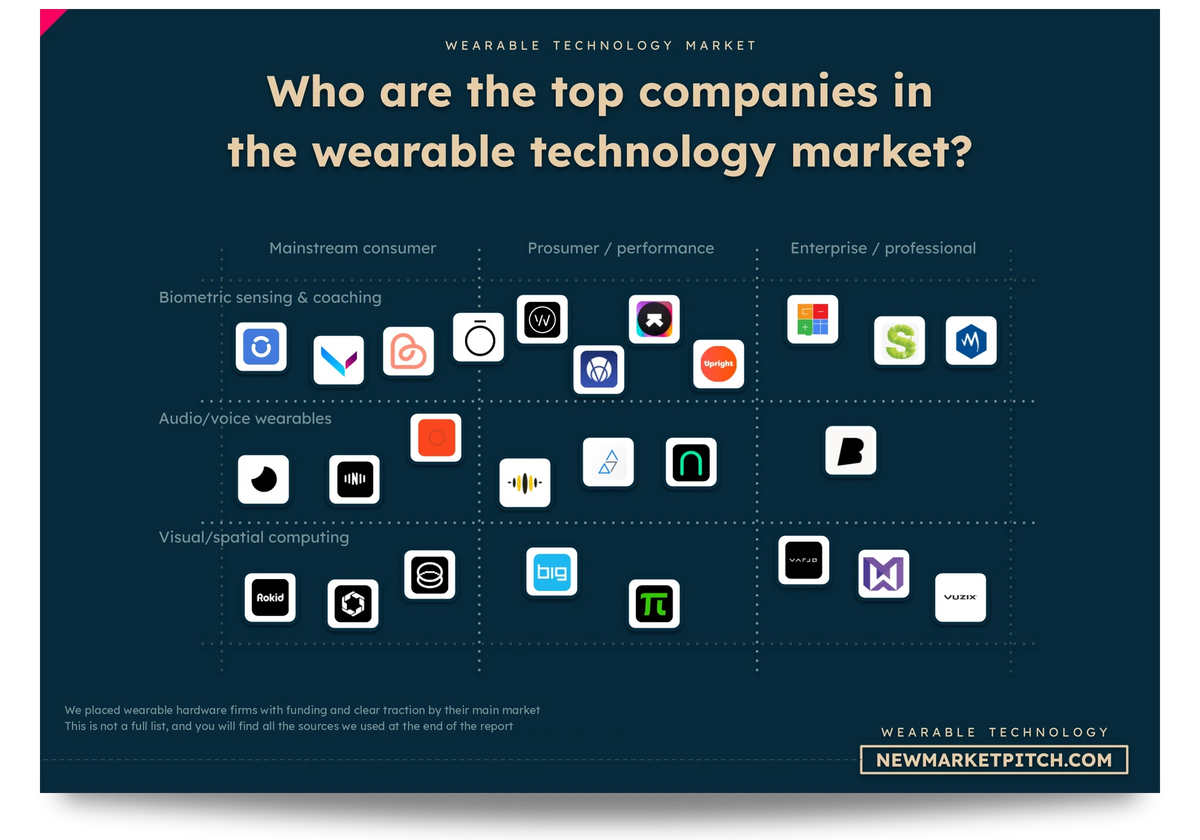
In our research about wearables, we turn what is vague and complex into simple, useful visuals. Market maps like this one show you at a glance where every startup stands.
Legato raised $12 million in August 2026 to bring its connected hearing glasses closer to commercial launch.
When was it?
Legato announced the financing on August 26, 2026.
Who are they?
Legato develops ordinary-looking smart glasses with directional speakers and hearing-assistance technology built directly into the frames.
Geographical focus?
Legato is initially focused on the United States, where the company plans to distribute its glasses through eye-care providers.
Why do we include them in the wearable technology market?
Legato belongs in the wearable technology market because its main product is a digitally connected body-worn device combining smart glasses and hearable technology.
What is the company stage?
Legato is at the late pre-product and commercialization stage, with its first Legato Frames moving toward market launch.
How much did they raise?
Legato raised $12 million in this financing.
What round is it?
Legato disclosed the investment as venture financing without announcing a conventional Series label.
Why did they raise?
Legato raised the capital to complete product development and support the launch, marketing and commercialization of its hearing glasses.
Meta-Bounds raised around $83 million to $89 million in July 2026 to scale its smart glasses hardware platform.
When was it?
Meta-Bounds' combined financing was publicly reported on July 13, 2026.
Who are they?
Meta-Bounds develops optical materials, waveguides, light engines, frames and complete hardware systems for consumer AI and AR glasses.
Geographical focus?
Meta-Bounds operates from several locations in China and supplies consumer electronics companies serving international markets.
Why do we include them in the wearable technology market?
Meta-Bounds belongs in the wearable technology market because smart glasses hardware and AR optics are central to its business and customer base.
What is the company stage?
Meta-Bounds is at the growth and manufacturing scale-up stage, with established R&D operations, production infrastructure and major commercial customers.
How much did they raise?
Meta-Bounds raised RMB600 million, equivalent to approximately $83 million to $89 million depending on the exchange rate.
What round is it?
Meta-Bounds' financing was reported as a combined Series A and Series A+ transaction.
Why did they raise?
Meta-Bounds raised the capital to expand AR optics manufacturing capacity, improve its technology stack and support rising smart glasses demand.
Even Realities raised $150 million in July 2026 as its display-first smart glasses business moved deeper into growth.
When was it?
Even Realities announced the financing on July 6, 2026.
Who are they?
Even Realities develops lightweight smart glasses that display navigation, translation, notifications and text directly in the user's field of view.
Geographical focus?
Even Realities is headquartered in Shenzhen and targets consumers across international markets.
Why do we include them in the wearable technology market?
Even Realities belongs in the wearable technology market because smart glasses and the company's wearable ring controller form the core of its product ecosystem.
What is the company stage?
Even Realities is at the growth stage, with commercial smart glasses already shipping and the company expanding manufacturing and international distribution.
How much did they raise?
Even Realities raised $150 million in the financing.
What round is it?
Even Realities raised the capital through a pre-Series B round.
Why did they raise?
Even Realities raised the funding to develop its next generation of smart glasses, deepen AI integration, scale production and accelerate international growth.

Your time is limited. In our market report about wearables, we put numbers on each part of the market, so you can see where it makes sense to focus.
Phosio raised $4 million in June 2026 to commercialize thinner and more efficient optics for smart glasses.
When was it?
Phosio announced the seed financing on June 2, 2026.
Who are they?
Phosio develops thin-film optical materials and manufacturing processes designed to make AR and AI glasses lighter, thinner and more power efficient.
Geographical focus?
Phosio is based in Oregon in the United States and serves smart glasses manufacturers operating in global markets.
Why do we include them in the wearable technology market?
Phosio belongs in the wearable technology market because its technology is specifically designed to solve optical and display constraints in wearable smart glasses.
What is the company stage?
Phosio is at the seed and early commercialization stage, moving its optical platform toward pilot manufacturing and customer deployment.
How much did they raise?
Phosio raised $4 million in the round.
What round is it?
Phosio raised a seed round.
Why did they raise?
Phosio raised the capital to commercialize and scale its thin-film optics platform for lighter and lower-cost AR and AI glasses.
Sychedelic raised $3.5 million in May 2026 to launch its connected neurostimulation headphones internationally.
When was it?
Sychedelic announced the close of its financing on May 27, 2026.
Who are they?
Sychedelic develops connected over-ear headphones combining audio, biometric sensing and closed-loop neurostimulation for focus, relaxation and sleep.
Geographical focus?
Sychedelic was founded from India and is targeting an international consumer market through a global product launch.
Why do we include them in the wearable technology market?
Sychedelic belongs in the wearable technology market because its flagship product is a connected body-worn electronic headset combining hearables and consumer neurotechnology.
What is the company stage?
Sychedelic is at the seed and pre-scale commercialization stage, with the product preparing for manufacturing and consumer shipment.
How much did they raise?
Sychedelic raised $3.5 million.
What round is it?
Sychedelic raised a seed round.
Why did they raise?
Sychedelic raised the funding to manufacture and launch its headphones, expand marketing, support R&D and enter international markets.
WHOOP raised $575 million in March 2026 to accelerate the global expansion of its health and performance wearable platform.
When was it?
WHOOP announced its Series G financing on March 31, 2026.
Who are they?
WHOOP develops a screenless wrist-worn tracker and subscription platform that analyzes sleep, strain, recovery and other physiological signals.
Geographical focus?
WHOOP operates globally and is expanding across Europe, the GCC, Latin America and Asia.
Why do we include them in the wearable technology market?
WHOOP belongs in the wearable technology market because its body-worn fitness tracker and associated health membership form the core of its business.
What is the company stage?
WHOOP is a late-stage growth company with millions of members, international operations and a large recurring subscription business.
How much did they raise?
WHOOP raised $575 million in the round.
What round is it?
WHOOP raised a Series G round.
Why did they raise?
WHOOP raised the capital to accelerate global expansion and broaden its platform from performance tracking into personalized and preventive health.

In our document detailing everything you need to know about wearable technology, we always try to gather several sources and make estimates that make sense, so you can work with solid numbers.
Sandbar raised $23 million in March 2026 to scale its Stream AI voice ring after strong early preorder demand.
When was it?
Sandbar announced its Series A financing on March 10, 2026.
Who are they?
Sandbar develops the Stream smart ring, a wearable voice interface for recording thoughts, dictating text, controlling media and interacting with AI.
Geographical focus?
Sandbar is initially focused on the United States, with broader international availability expected later.
Why do we include them in the wearable technology market?
Sandbar belongs in the wearable technology market because its defining product is a connected smart ring designed as a wearable AI and voice interface.
What is the company stage?
Sandbar is at the early commercialization and product-market-fit validation stage, with initial preorder inventory already sold out.
How much did they raise?
Sandbar raised $23 million in the financing.
What round is it?
Sandbar raised a Series A round.
Why did they raise?
Sandbar raised the capital to expand its machine learning, interaction design and software teams and prepare Stream for wider distribution.
VITURE raised $100 million in February 2026 to expand its consumer XR glasses and supporting product ecosystem.
When was it?
VITURE announced the additional financing on February 26, 2026.
Who are they?
VITURE develops consumer XR and AR glasses that connect to phones, computers and gaming devices to create large virtual displays.
Geographical focus?
VITURE targets a global consumer market and has been expanding its retail presence particularly strongly in North America.
Why do we include them in the wearable technology market?
VITURE belongs in the wearable technology market because XR and AR eyewear is the company's central product category.
What is the company stage?
VITURE is at the growth stage, with multiple commercial product generations and expanding physical retail distribution.
How much did they raise?
VITURE raised $100 million in the financing.
What round is it?
VITURE described the transaction as an additional financing round rather than giving it a new formal Series label.
Why did they raise?
VITURE raised the capital to accelerate development of its next XR hardware generation, strengthen its ecosystem and expand its market position.
XREAL raised $100 million in January 2026 as competition intensified across consumer smart glasses and spatial computing.
When was it?
XREAL announced the new funding on January 8, 2026.
Who are they?
XREAL develops lightweight consumer AR glasses that connect to phones, computers and gaming devices for virtual displays and spatial computing.
Geographical focus?
XREAL originated in China and sells its smart glasses across North America, Europe, Asia and other international markets.
Why do we include them in the wearable technology market?
XREAL belongs in the wearable technology market because consumer AR glasses and spatial-computing eyewear are the company's core business.
What is the company stage?
XREAL is at the growth stage, with established commercial hardware and an international customer base.
How much did they raise?
XREAL raised $100 million in new funding.
What round is it?
XREAL described the transaction as new funding, while private-market databases classify it as an extension of its Series D financing.
Why did they raise?
XREAL raised the capital to strengthen its product roadmap and compete more aggressively in consumer smart glasses and spatial computing.

Our report covering the wearable technology market gets updated several times a month, so you always get the latest view of where things stand.
Vitrealab raised $11 million in January 2026 to industrialize photonic light engines designed for lightweight AR glasses.
When was it?
Vitrealab announced its Series A financing on January 6, 2026.
Who are they?
Vitrealab develops photonic integrated circuits and laser light engines designed to make AR smart glasses smaller, brighter and more power efficient.
Geographical focus?
Vitrealab is based in Vienna, Austria, and targets manufacturers across the global AR display ecosystem.
Why do we include them in the wearable technology market?
Vitrealab belongs in the wearable technology market because its core technology is specifically designed for display systems used in next-generation AR eyewear.
What is the company stage?
Vitrealab is moving from advanced prototypes into industrialization and commercial development.
How much did they raise?
Vitrealab raised $11 million, also reported as approximately €9.4 million.
What round is it?
Vitrealab raised a Series A round.
Why did they raise?
Vitrealab raised the capital to industrialize its Quantum Light Chip, demonstrate new light engines and deepen relationships with AR eyewear manufacturers.
ŌURA raised more than $900 million in October 2025 to expand production, health technology and international growth.
When was it?
ŌURA announced the final Series E financing on October 14, 2025.
Who are they?
ŌURA develops the Oura Ring, which tracks sleep, activity, recovery, heart rate, temperature and other health signals through a connected app.
Geographical focus?
ŌURA was founded in Finland and now operates globally, with a major presence in the United States and broad international retail distribution.
Why do we include them in the wearable technology market?
ŌURA belongs in the wearable technology market because smart rings are the company's core product and primary consumer technology platform.
What is the company stage?
ŌURA is a late-stage scaled company with millions of users, more than $1 billion in annual revenue and a mature commercial wearable platform.
How much did they raise?
ŌURA raised more than $900 million in its Series E financing.
What round is it?
ŌURA raised a Series E round.
Why did they raise?
ŌURA raised the capital to increase ring production, accelerate product and health-platform development and support continued international expansion.

In our research about wearables, we look at what the winners do differently, so you can learn from the best instead of guessing.
Written by the New Market Pitch teamWe track new markets so founders and investors can move faster. About us