What’s the latest funding news in the smart glasses market? (October 2026)
Whether you're building or investing in the smart glasses market, our report covers everything you need to know: the players, the money, and what's coming next.
Smart glasses funding remained active in 2026, with investors backing everything from everyday AI eyewear to augmented-reality displays and specialized assistive devices.
Our October 2026 review covers 12 reported financing deals across China, the United States and France, including several rounds worth $100 million or more.
While larger manufacturers are raising capital to expand production and global distribution, smaller companies are attracting funding by solving specific problems in sports, accessibility and communication.
And if you want to better understand this new industry, you can download our pitch covering the smart glasses market.
Insights
- China accounts for nine of the 12 smart glasses financing announcements in this selection, reflecting strong activity among local hardware manufacturers, although this does not establish China's share of global investment.
- Even Realities, VITURE and XREAL announced a combined $350 million in 2026 financing, showing that investors are still willing to fund capital-intensive eyewear businesses with established products and ambitious expansion plans.
- Even Realities and XREAL were both valued at around $1 billion, yet their products serve different needs: discreet everyday information displays versus larger virtual screens and spatial computing experiences.
- NIMO reportedly reached a RMB 1.5 billion valuation after an angel round worth several hundred million yuan, an unusually substantial financing announcement for a young consumer eyewear brand.
- INMO's C1, C2 and C3 financings approached RMB 1 billion combined, but the individual C3 amount remains undisclosed, highlighting how cumulative financing figures can make smart glasses funding comparisons misleading.
- LLVision raised more than RMB 300 million from Beijing-linked investors, with plans connecting advanced eyewear production to optical services, prescription fitting and physical retail distribution.
- Three companies target particularly specific user needs: ENGO serves endurance athletes, Legato develops hearing-assistance glasses, and Tongxing builds AI eyewear for people with visual impairments.
- Camera-free smart glasses are becoming a distinct product category, with Even Realities, MemoMind and NIMO focusing on private information displays rather than photography or continuous video capture.
- MemoMind's RMB 60 million equity financing followed another RMB 50 million raised within the previous year, showing how established consumer-electronics companies can fund dedicated smart-eyewear subsidiaries.
- Recent investment is not limited to AI software capabilities: manufacturing scale, optical miniaturization, comfortable frames and retail channels now feature prominently in how eyewear startups plan to use their capital.

Written by the New Market Pitch teamWe track new markets so founders and investors can move faster. About us

In our report covering the smart glasses market, you will always find fresh funding data, taken straight from our own verified funding database.
Summary table of the latest funding deals in the smart glasses market as of October 2026
We define the smart glasses market as eyewear with integrated digital functions for information, communication or interaction.
We include camera and audio glasses, AI glasses, display glasses and augmented-reality eyewear for consumers or enterprises.
We exclude ordinary eyewear, standalone optical components and enclosed virtual-reality headsets.
The table below ranks the 12 financing announcements from newest to oldest, using the publication date when the exact transaction closing date is unavailable.
Amounts are shown in US dollars where a reliable figure can be calculated; otherwise, the original currency disclosure is retained without inventing a precise conversion.
| Name | When | Amount in $ | Round Type | Category |
|---|---|---|---|---|
| NIMO (BitFantasy) | October 8, 2026 | Undisclosed exact amount; several hundred million RMB | Angel | Consumer AI & Display Glasses |
| INMO | September 9, 2026 | Undisclosed; approximately $149M across C1–C3 | Series C3 | Consumer AR & AI Glasses |
| LLVision | September 8, 2026 | Over $44.7M | Series C+ | AR Translation & Enterprise smart glasses |
| Legato | August 26, 2026 | $12M announced | Undisclosed | AI Hearing-Assistance Glasses |
| ENGO Eyewear | July 17, 2026 | Approximately $5.9M | Venture Round | Sports AR & Heads-Up Display Glasses |
| Even Realities | July 6, 2026 | $150M | Pre-Series B | Consumer AI & Display Glasses |
| Tongxing Technology | June 18, 2026 | Undisclosed exact amount; several million RMB | Seed | AI Assistive & Accessibility Glasses |
| MemoMind | May 25, 2026 | Approximately $8.9M | Strategic Equity | Consumer AI & Display Glasses |
| Future Fullscreen | April 24, 2026 | Undisclosed exact amount; tens of millions RMB reported | Series A, reported | AR Display & Smart Eyewear |
| INAIR | April 9, 2026 | Approximately $10M-level | Series A+ | AR Productivity & Spatial Computing Glasses |
| VITURE | February 26, 2026 | $100M | Follow-on Venture | XR Entertainment & Display Glasses |
| XREAL | January 8, 2026 | $100M announced | Later-Stage Venture | Consumer AR & Spatial Computing Glasses |
All the latest funding deals in the smart glasses market as of October 2026
NIMO secured an angel round worth several hundred million yuan in October 2026, reaching a reported $224 million valuation.
When was it?
NIMO's financing was reported on October 8, 2026, although the exact closing date was not disclosed.
Who are they?
NIMO, developed by Chinese company BitFantasy, makes lightweight AI smart glasses that display navigation, translations, messages and contextual information directly in the wearer's field of view.
Geographical focus?
NIMO currently focuses on Chinese consumer and optical-retail channels while preparing to expand into international markets.
Why do we include them in the smart glasses market?
NIMO directly develops consumer AI display glasses that combine digital assistance, integrated optics and prescription-compatible eyewear.
What is the company stage?
NIMO is in early commercialization, with its first product introduced in 2026 and Chinese reporting describing monthly sales of several thousand units.
How much did they raise?
BitFantasy raised several hundred million RMB, but the precise amount was not disclosed; its reported post-money valuation reached approximately $224 million.
What round is it?
NIMO completed an angel financing round backed by Bohua Capital, Gobi Partners, Oriza Hua and Shangshi Capital.
Why did they raise?
NIMO plans to finance new smart glasses, improve its optical and AI technology, expand physical retail distribution in China and enter overseas markets.
INMO completed its Series C3 financing in September 2026, bringing its combined Series C funding close to $149 million.
When was it?
INMO's latest Series C3 financing was publicly reported on September 9, 2026.
Who are they?
INMO is a Chinese smart-eyewear manufacturer developing AI-powered AR glasses for translation, photography, navigation and hands-free information access.
Geographical focus?
INMO operates from China and markets its smart glasses internationally, with further retail expansion forming part of its growth plans.
Why do we include them in the smart glasses market?
INMO's core products are integrated AI and augmented-reality glasses, supported by the company's dedicated AIOS operating system.
What is the company stage?
INMO is in its growth stage, with commercial products, expanding distribution and reported preparations for a future stock-market listing.
How much did they raise?
INMO did not disclose the individual C3 amount, but the combined C1, C2 and C3 financings approached RMB 1 billion, or approximately $149 million.
What round is it?
INMO completed a Series C3 round led by Sichuan Zhenxing Science and Technology Innovation Fund, with participation from Jing'an Capital, Shibei High-Tech and several regional investment organizations.
Why did they raise?
INMO intends to develop its next generation of spatial-computing eyewear, improve the INMO AIOS platform and strengthen product distribution and marketing.

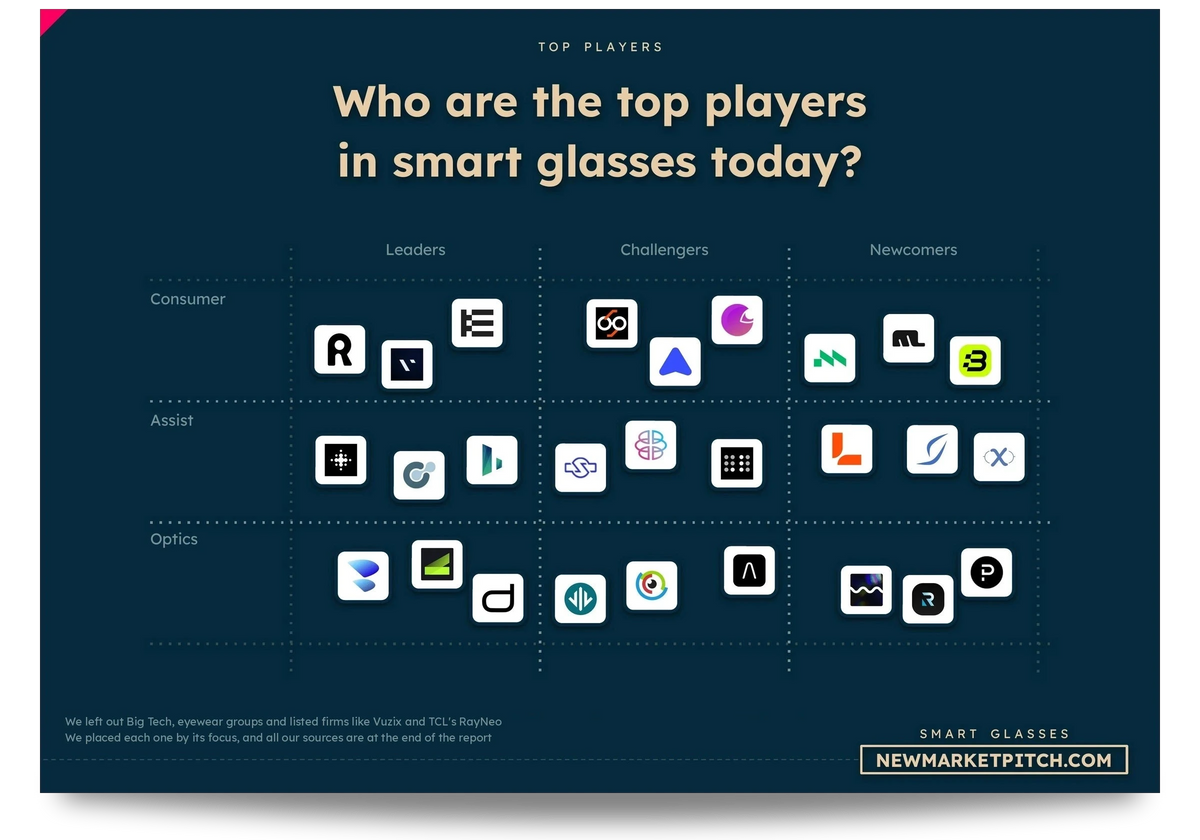
In our research about smart glasses, we turn what is vague and complex into simple, useful visuals. Market maps like this one show you at a glance where every startup stands.
LLVision raised more than $44.7 million in Series C+ financing in September 2026 to expand its AI and AR eyewear business.
When was it?
LLVision's financing was reported on September 8, 2026, with additional coverage published the following day.
Who are they?
LLVision is a Beijing-based company making augmented-reality glasses for live translation, subtitles, remote collaboration and hands-free industrial work.
Geographical focus?
LLVision serves Chinese enterprise and consumer customers while expanding internationally through its translation glasses and industrial AR solutions.
Why do we include them in the smart glasses market?
LLVision designs physical smart glasses and integrated AI software, including its Leion translation eyewear and enterprise AR devices.
What is the company stage?
LLVision is a growth-stage manufacturer with established commercial products, enterprise partnerships and an expanding consumer-eyewear business.
How much did they raise?
LLVision raised more than RMB 300 million, equivalent to over $44.7 million, bringing its reported financing over the preceding year to roughly RMB 500 million.
What round is it?
LLVision completed a Series C+ financing backed by Beijing Information Industry Development Investment Fund, Beijing New Materials Industry Investment Fund and Beijing Xianglong Asset Management.
Why did they raise?
LLVision plans to improve optical displays, AI interaction and manufacturing while developing prescription-fitting services and stronger physical retail partnerships.
Legato emerged from stealth with $12 million in announced funding in August 2026 for its AI-powered hearing glasses.
When was it?
Legato announced its funding and introduced its hearing-glasses concept on August 26, 2026.
Who are they?
Legato is an American hearing-technology startup building glasses that use microphones, AI-powered sound processing and open-ear audio to make conversations easier to hear.
Geographical focus?
Legato initially focuses on the United States, where it is targeting adults seeking discreet hearing assistance.
Why do we include them in the smart glasses market?
Legato integrates digital hearing assistance directly into eyewear frames, making its product a specialized category of audio-enabled smart glasses.
What is the company stage?
Legato was at the prelaunch stage when the financing was announced and was preparing to bring its first commercial hearing glasses to market.
How much did they raise?
Legato announced $12 million in funding, although the reporting did not clearly establish whether the entire amount represented one newly closed round or cumulative financing.
What round is it?
Legato did not disclose a formal round designation, but identified Neotribe Ventures, Listen and Village Global as investors.
Why did they raise?
Legato aims to commercialize its Legato Frames, develop its AI hearing-assistance technology and establish distribution for customers who prefer glasses to traditional hearing devices.

Your time is limited. In our market report about smart glasses, we put numbers on each part of the market, so you can see where it makes sense to focus.
ENGO Eyewear raised approximately $5.9 million in July 2026 to develop lighter augmented-reality glasses for athletes.
When was it?
ENGO's €5.1 million financing was announced on July 17, 2026.
Who are they?
ENGO Eyewear is a French company making sports glasses with integrated displays that show running pace, heart rate, cycling power and other performance information.
Geographical focus?
ENGO operates from France and sells its sports smart glasses internationally, targeting runners, cyclists and endurance athletes.
Why do we include them in the smart glasses market?
ENGO manufactures display-equipped eyewear that places live digital performance data directly in an athlete's field of view.
What is the company stage?
ENGO is in commercial growth, with existing consumer products and plans to increase international sales and industrial capacity.
How much did they raise?
ENGO secured €5.1 million, equivalent to approximately $5.9 million using an indicative October 2026 currency conversion.
What round is it?
ENGO completed a venture financing round led by Ventech, Odyssée Venture and Bpifrance Amorçage Industriel.
Why did they raise?
ENGO intends to expand international distribution, recruit additional staff and develop smaller, lighter optical systems for future sports eyewear.
Even Realities raised $150 million in July 2026, reaching a $1 billion valuation for its camera-free smart glasses.
When was it?
Even Realities announced its latest financing on July 6, 2026.
Who are they?
Even Realities is a Shenzhen-based company developing discreet smart glasses that display notifications, navigation and AI information without relying on cameras.
Geographical focus?
Even Realities operates from China and sells internationally, with the United States representing an important consumer market.
Why do we include them in the smart glasses market?
Even Realities focuses directly on consumer display glasses, combining optical hardware, digital information and connected wearable interactions.
What is the company stage?
Even Realities is in commercial growth and was reportedly profitable at the financing announcement, with an established international customer base.
How much did they raise?
Even Realities secured $150 million in new financing at a reported company valuation of approximately $1 billion.
What round is it?
Even Realities completed a pre-Series B round led by Meituan and Tencent, with other existing investors also participating.
Why did they raise?
Even Realities plans to expand manufacturing capacity, improve its integrated chip and optical technology, and develop wider international retail distribution.

In our document detailing everything you need to know about smart glasses, we always try to gather several sources and make estimates that make sense, so you can work with solid numbers.
Tongxing Technology announced a seed round worth several million yuan in June 2026 for AI glasses assisting visually impaired users.
When was it?
Tongxing Technology's seed financing was reported on June 18, 2026.
Who are they?
Tongxing Technology is a Hangzhou-based startup developing AI-assisted eyewear that helps people with visual impairments detect obstacles, understand surroundings and navigate everyday environments.
Geographical focus?
Tongxing Technology currently focuses on China, where its product development and manufacturing partnerships are based.
Why do we include them in the smart glasses market?
Tongxing develops integrated AI assistive glasses using cameras and visual recognition models to provide spoken navigation and environmental information.
What is the company stage?
Tongxing is in early commercialization and product development, having introduced its first assistive-glasses system while preparing a second generation for larger-scale manufacturing.
How much did they raise?
Tongxing raised several million RMB in seed financing, but the exact amount and its corresponding US dollar value were not disclosed.
What round is it?
Tongxing completed a seed round backed by Shenzhen Zhongyingke Communication Technology, which also became a manufacturing partner.
Why did they raise?
Tongxing plans to improve its second-generation AI navigation glasses and use Zhongyingke's manufacturing expertise to prepare for larger production volumes.
MemoMind secured approximately $8.9 million in strategic equity financing in May 2026 to develop its consumer AI glasses.
When was it?
MemoMind's latest equity financing was reported on May 25, 2026.
Who are they?
MemoMind is an AI smart-glasses brand developed through Shenzhen Qinglai Innovation, a company backed by Chinese projector manufacturer XGIMI.
Geographical focus?
MemoMind develops its products in China and targets international consumers interested in discreet AI-assisted eyewear and information displays.
Why do we include them in the smart glasses market?
MemoMind is a dedicated smart-eyewear business developing consumer glasses with digital displays, AI assistance, translation and everyday productivity features.
What is the company stage?
MemoMind is moving through early commercialization, with an established product range and consumer distribution activities supported by its electronics-industry parent.
How much did they raise?
Shenzhen Qinglai secured RMB 60 million, or approximately $8.9 million, bringing its external financing over the preceding 12 months to RMB 110 million.
What round is it?
MemoMind completed a strategic equity financing involving CICC Emerging Private Equity Investment Fund and two additional investors whose identities were not fully established in the reporting.
Why did they raise?
MemoMind sought funding to advance its smart-glasses technology, support commercialization and develop a more independently financed business while retaining ties to XGIMI.

Our report covering the smart glasses market gets updated several times a month, so you always get the latest view of where things stand.
Future Fullscreen reportedly secured a Series A investment worth tens of millions of yuan in April 2026.
When was it?
Future Fullscreen's financing was publicized on April 24, 2026, although the transaction's precise closing date was not independently confirmed.
Who are they?
Future Fullscreen is a Chinese wearable-display developer building smart glasses and head-mounted displays around its proprietary optical and screen technology.
Geographical focus?
Future Fullscreen primarily operates in China and has reported plans to develop distribution in Southeast Asia and Europe.
Why do we include them in the smart glasses market?
Future Fullscreen develops digital eyewear and AR display hardware, although its broader head-mounted computing activities make its precise smart-glasses business concentration less certain.
What is the company stage?
Future Fullscreen reports that it has moved into commercial hardware delivery and is working toward larger-scale manufacturing, but independent evidence of its commercial scale remains limited.
How much did they raise?
Future Fullscreen reportedly secured tens of millions of RMB, equivalent to several million US dollars, without disclosing a precise amount.
What round is it?
Future Fullscreen's financing was described as a Series A investment from Tianze Capital, although some promotional headlines also used an angel-round designation.
Why did they raise?
Future Fullscreen reportedly plans to increase smart-glasses production, improve optical and interaction technologies, and establish overseas distribution channels.
The financing details come primarily from promotional business coverage and have not been independently verified to the same standard as the larger reported rounds.
INAIR secured approximately $10 million-level Series A+ financing in April 2026 to expand its AR productivity ecosystem.
When was it?
INAIR announced its Series A+ financing on April 9, 2026.
Who are they?
INAIR is a Chinese spatial-computing company developing AR display glasses, portable computing devices and software that together create virtual computer screens.
Geographical focus?
INAIR is based in China, with products aimed at consumers and professional users seeking portable computing and entertainment displays.
Why do we include them in the smart glasses market?
INAIR develops augmented-reality eyewear as a core part of its computing ecosystem, although its companion hardware and operating system extend beyond the glasses themselves.
What is the company stage?
INAIR is in commercial product development and ecosystem expansion, following the introduction of its AR glasses and INAIR Pod computing device.
How much did they raise?
INAIR announced financing described as being at the $10 million level, rather than disclosing an exact transaction amount.
What round is it?
INAIR completed a Series A+ round jointly backed by Legend Capital, Hillhouse Ventures and HLC, also known as Honghui Capital.
Why did they raise?
INAIR plans to expand the INAIR Pod ecosystem, improve its spatial operating system and develop new applications for portable AR computing in professional markets.

In our research about smart glasses, we look at what the winners do differently, so you can learn from the best instead of guessing.
VITURE raised another $100 million in February 2026, bringing its financing over the preceding six months above $200 million.
When was it?
VITURE announced its latest $100 million financing on February 26, 2026.
Who are they?
VITURE is a consumer XR eyewear company developing lightweight display glasses that connect to phones, computers and gaming devices to create large virtual screens.
Geographical focus?
VITURE operates internationally, with a strong presence in North America and growing retail distribution across consumer-electronics markets.
Why do we include them in the smart glasses market?
VITURE develops open-form-factor XR display glasses designed for gaming, video streaming and portable computing, rather than enclosed virtual-reality headsets.
What is the company stage?
VITURE is in commercial growth, with several product generations, established retail partnerships and an expanding ecosystem of compatible devices.
How much did they raise?
VITURE secured $100 million in new financing, following a separate $100 million investment announced in September 2025.
What round is it?
VITURE completed a follow-on venture round led by Legend Capital, with strategic participation from Bertelsmann and other investors.
Why did they raise?
VITURE plans to develop new XR eyewear, expand its product ecosystem and strengthen international retail distribution and commercial partnerships.
XREAL announced $100 million in new financing in January 2026, supporting its AR glasses and spatial-computing ambitions.
When was it?
XREAL's latest financing was publicly confirmed on January 8, 2026, during an interview with Bloomberg Television.
Who are they?
XREAL is a Chinese augmented-reality eyewear manufacturer producing display glasses that connect to phones, computers and other devices for entertainment and spatial computing.
Geographical focus?
XREAL operates globally, with international consumer sales and technology partnerships involving major electronics and software companies.
Why do we include them in the smart glasses market?
XREAL directly manufactures AR display glasses and develops wearable spatial-computing products, including hardware designed for Google's Android XR ecosystem.
What is the company stage?
XREAL is in commercial growth, with established products, international distribution, major technology partnerships and reported preparations for a future public listing.
How much did they raise?
XREAL announced $100 million in financing, although a separate securities-data report described a smaller January transaction that should not automatically be treated as additional funding.
What round is it?
XREAL completed later-stage financing involving supply-chain partners and other investors whose identities were not fully disclosed.
Why did they raise?
XREAL plans to strengthen AR hardware development, manufacturing and commercialization as competition increases, including through its expanded partnership with Google on Android XR.
Written by the New Market Pitch teamWe track new markets so founders and investors can move faster. About us