What’s funding like in the advanced nuclear market right now?
Building a startup or looking for your next investment in advanced nuclear? Our report gives you the full picture.
Summary
Advanced nuclear funding is strong right now for companies that have already proved they can execute, but the market has become noticeably tougher for new entrants.
Funding reached at least $3.57 billion over the latest 12 months, up 59%, while the median disclosed round nearly doubled to $48.3 million. The increase is real, but it is overwhelmingly a scale-up story rather than a broad improvement across every financing size.
Strip out rounds above $50 million and the picture flips: capital actually fell 11%, from $318.3 million to $283.7 million. A company trying to raise $15 million or $30 million is operating in a very different market from Valar Atomics, X-Energy, Antares or Radiant.
The biggest change is who gets funded. Follow-ons represented 25 of 27 recent deals, while first financings fell from four to two and early-stage deal share dropped from 56.5% to 29.6%.
Advanced nuclear is also becoming more industrial. The largest rounds are increasingly tied to factories, fuel fabrication, supply chains, regulatory work and reactor deployment rather than another contained phase of technical development.
High-temperature gas reactors currently have the clearest funding momentum. Their deal count rose from three to seven and capital climbed to roughly $2.22 billion, helped by huge Valar and X-Energy financings but also by activity outside those two companies.
Microreactors are moving into a different financing league too. Deal count stayed flat at six, yet capital nearly tripled as Antares and Radiant raised hundreds of millions and reactor, licensing and fuel milestones became more concrete.
The U.S. is pulling away at the point where projects become expensive. North America accounted for 74.1% of deals but almost 94% of current capital, while the median U.S. financing was several times the European median.
Fuel is emerging as part of the investment thesis rather than a distant supply-chain problem. Standard Nuclear is already producing HALEU TRISO, supplying reactor programs and building contracted backlog while X-Energy expands its own fuel infrastructure.
The investor base has widened as well. Sequoia, Jane Street, Chevron Technology Ventures, Samsung C&T and other financial or strategic investors show that advanced nuclear is attracting capital well beyond the traditional nuclear specialist ecosystem.
The clearest way to read the market today is that funding conditions have improved dramatically after companies cross the credibility threshold. Before that point, the market is thinner than the headline $3.57 billion would suggest.

Written by the New Market Pitch teamWe track new markets so founders and investors can move faster. About us

In our report covering the advanced nuclear market, you will always find fresh funding data, taken straight from our own verified funding database.
All funding deals in the advanced nuclear market over the last 24 months
Below is the table listing all the deals. You can find our methodology at the end of this page.
If you want a deeper understanding of the market and its current dynamics, get our report covering the advanced nuclear market.
| Company | Category | Date | Stage | Deal size | What they do | Region | Lead investors | Country | Rank |
|---|---|---|---|---|---|---|---|---|---|
| Kairos Power | Molten Salt Reactors | September 2026 | Growth Equity | $70M | Develops fluoride salt-cooled high-temperature reactors using solid TRISO fuel and molten fluoride-salt coolant. | North America | Not disclosed | United States | |
| Bluecore Energy | Light-Water SMRs | September 2026 | Seed | $50M | Develops approximately 10 MWe water-cooled SMRs mounted on floating barges for ports and other power-intensive infrastructure. | North America | Silverton Partners | United States | |
| HEXANA | Sodium-Cooled Fast Reactors | August 2026 | Unknown | $2.3M | Develops modular sodium-cooled fast reactors coupled with thermal storage for industrial heat and flexible electricity generation. | Europe | Not disclosed | France | |
| Apollo Atomics | Light-Water SMRs | August 2026 | Seed | $26M | Develops compact factory-built pressurized-water reactors using a high-power-density steam-generator architecture. | North America | FCVC | United States | |
| Valar Atomics | High-Temperature Gas Reactors | August 2026 | Series B | $1B | Develops modular helium-cooled, TRISO-fueled high-temperature gas reactors designed for factory production and deployment in fleets. | North America | Sequoia Capital | United States | |
| Antares | Microreactors | July 2026 | Series C | $370M | Develops factory-built, transportable fission microreactors for defense, space and remote-power applications. | North America | Paradigm; Caffeinated Capital | United States | |
| Nuclear Turbines | High-Temperature Gas Reactors | July 2026 | Seed | $19.9M | Develops compact high-temperature reactors that directly heat compressed air for commercial gas turbines, eliminating the conventional steam cycle. | Europe | IQ Capital | United Kingdom | |
| Bluecore Energy | Light-Water SMRs | July 2026 | Seed | $10M | Develops approximately 10 MWe water-cooled SMRs mounted on floating barges for ports and other power-intensive infrastructure. | North America | Slauson & Co. | United States | |
| OTRERA New Energy | Sodium-Cooled Fast Reactors | May 2026 | Unknown | ≈$11M | Develops a modular Generation IV sodium-cooled fast reactor for electricity and industrial heat. | Europe | Not disclosed | France | |
| Aalo Atomics | Microreactors | April 2026 | Series B | Not Disclosed | Develops factory-manufactured sodium-cooled microreactor power plants for data centers and other high-demand users. | North America | Not disclosed | United States | |
| Blue Energy | Light-Water SMRs | April 2026 | Unknown | $380M | Develops prefabricated modular nuclear plants built offsite and plans to convert gas-fired plants to nuclear. | North America | VXI Capital | United States | |
| LIS Technologies | Advanced Nuclear Fuel Systems | March 2026 | Unknown | $7.1M | Develops laser uranium-enrichment technology to produce LEU and HALEU for the nuclear fuel cycle. | North America | Not disclosed | United States | |
| Valar Atomics | High-Temperature Gas Reactors | March 2026 | Series B | $340M | Develops and deploys TRISO-fueled, helium-cooled high-temperature gas reactors at large industrial sites. | North America | Not disclosed | United States | |
| Applied Atomics | Light-Water SMRs | March 2026 | Seed | >$8.3M | Develops, builds and operates modular nuclear plants using established light-water reactor architecture for industrial customers. | North America | Transition Ventures | United States | |
| Jimmy Energy SAS | High-Temperature Gas Reactors | March 2026 | Series B | $46.6M | Develops high-temperature gas-cooled nuclear thermal generators for on-site industrial heat. | Europe | Crédit Mutuel Impact | France | |
| NuCube Energy, Inc. | Microreactors | February 2026 | Series A | $13M | Develops a high-temperature modular microreactor for electricity and industrial heat up to 1,100°C. | North America | Arizona Nuclear Ventures | United States | |
| newcleo | Lead-Cooled Fast Reactors | February 2026 | Unknown | $85M | Develops lead-cooled fast reactors and recycled nuclear fuel for advanced fission deployment. | Europe | Not disclosed | France | |
| X-Energy | High-Temperature Gas Reactors | January 2026 | Growth Equity | $5M | Develops the Xe-100 high-temperature gas-cooled SMR and associated TRISO-X fuel systems. | North America | Not disclosed | United States | |
| Standard Nuclear, Inc. | Advanced Nuclear Fuel Systems | January 2026 | Series A | $140M | Manufactures TRISO and HALEU fuel forms for advanced nuclear reactors. | North America | Decisive Point | United States | |
| LIS Technologies | Advanced Nuclear Fuel Systems | January 2026 | Unknown | $17M | Develops laser uranium-enrichment technology to produce LEU and HALEU for the nuclear fuel cycle. | North America | Not disclosed | United States | |
| Steady Energy Oy | Light-Water SMRs | January 2026 | Unknown | $2.4M | Develops the LDR-50 heat-only light-water SMR for district heating and industrial heat. | Europe | Not disclosed | Finland | |
| Blykalla | Lead-Cooled Fast Reactors | December 2025 | Unknown | $50M | Develops the SEALER, a compact lead-cooled fast reactor for commercial electricity and industrial applications. | Europe | Oklo; Norrsken Launcher; Armada Investment | Sweden | |
| Radiant | Microreactors | December 2025 | Series D+ | >$300M | Develops factory-built, transportable Kaleidos nuclear microreactors for defense, remote industry and critical infrastructure. | North America | Draper Associates; Boost VC | United States | |
| ARC Clean Technology | Sodium-Cooled Fast Reactors | December 2025 | Series B | $15M | Develops the ARC-100, a 100 MWe metal-fueled sodium-cooled fast small modular reactor. | North America | Not disclosed | United States | |
| Last Energy | Microreactors | December 2025 | Series C | ≈$100M | Develops factory-manufactured pressurized-water microreactor power plants for industrial and data-center customers. | North America | Astera Institute | United States | |
| Antares | Microreactors | December 2025 | Series B | $71M | Develops factory-produced TRISO-fueled microreactors for defense, terrestrial and space power applications. | North America | Shine Capital | United States | |
| X-Energy | High-Temperature Gas Reactors | November 2025 | Series D+ | ≈$700M | Develops the Xe-100 pebble-bed high-temperature gas reactor and its proprietary TRISO-X nuclear fuel. | North America | Jane Street | United States | |
| Valar Atomics | High-Temperature Gas Reactors | November 2025 | Series A | $105M | Develops compact helium-cooled, TRISO-fueled high-temperature gas reactors intended for mass-manufactured nuclear power sites. | North America | Snowpoint Ventures; Day One Ventures; Dream Ventures | United States | |
| Aalo Atomics | Microreactors | August 2025 | Series B | $100M | Develops factory-manufactured sodium-cooled microreactors and modular nuclear plants aimed initially at data-center power. | North America | Valor Equity Partners | United States | |
| Hadron Energy | Microreactors | July 2025 | Seed | $500K | Develops factory-manufactured light-water microreactors for data centers, industrial sites and remote power. | North America | Not disclosed | United States | |
| Stellaria | Molten Salt Reactors | July 2025 | Seed | ≈$16.2M | Develops a fast-neutron molten-salt breeder reactor for modular industrial heat and electricity generation. | Europe | At One Ventures; Supernova Invest | France | |
| Terrestrial Energy | Molten Salt Reactors | July 2025 | Unknown | $25.8M | Develops the Integral Molten Salt Reactor, a modular molten-salt fission plant for industrial heat and electricity. | North America | Not disclosed | United States | |
| HEXANA | Sodium-Cooled Fast Reactors | July 2025 | Seed | ≈$2.3M | Develops a modular sodium-cooled fast-neutron reactor platform for industrial heat and electricity generation. | Europe | Not disclosed | France | |
| Hadron Energy | Microreactors | July 2025 | Seed | $500K | Develops factory-manufactured light-water microreactors for data centers, industrial sites and remote power. | North America | Not disclosed | United States | |
| TerraPower | Sodium-Cooled Fast Reactors | June 2025 | Growth Equity | $650M | Develops the Natrium advanced reactor, combining a sodium-cooled fast reactor with integrated energy storage. | North America | Not disclosed | United States | |
| Standard Nuclear, Inc. | Advanced Nuclear Fuel Systems | June 2025 | Seed | $42M | Manufactures reactor-agnostic TRISO nuclear fuel for advanced reactors at commercial scale. | North America | Decisive Point | United States | |
| Radiant | Microreactors | May 2025 | Series C | $65M | Develops the factory-produced 1 MW Kaleidos portable nuclear microreactor. | North America | DCVC | United States | |
| LIS Technologies | Advanced Nuclear Fuel Systems | May 2025 | Series A | $11.9M | Develops proprietary laser isotope-separation technology primarily for uranium enrichment and production of LEU and HALEU. | North America | Not disclosed | United States | |
| General Matter | Advanced Nuclear Fuel Systems | April 2025 | Series A | $50M | Develops domestic uranium-enrichment capacity for LEU and HALEU nuclear fuel. | North America | Founders Fund | United States | |
| Thorizon | Molten Salt Reactors | March 2025 | Series A | $17.4M | Develops the Thorizon One cartridge-core molten-salt SMR for industrial heat and electricity. | Europe | Invest-NL | Netherlands | |
| Steady Energy Oy | Light-Water SMRs | March 2025 | Series B | $23.8M | Develops the LDR-50 low-temperature light-water SMR for district and industrial heat. | Europe | 92 Ventures | Finland | |
| Valar Atomics | High-Temperature Gas Reactors | February 2025 | Seed | $19M | Develops standardized helium-cooled high-temperature gas reactors for large off-grid nuclear power sites. | North America | Riot Ventures; Initialized Capital; AlleyCorp | United States | |
| Blykalla | Lead-Cooled Fast Reactors | February 2025 | Unknown | $15.6M | Develops the SEALER lead-cooled fast small modular reactor. | Europe | Not disclosed | Sweden | |
| X-Energy | High-Temperature Gas Reactors | February 2025 | Series C | $200M | Develops Xe-100 high-temperature gas-cooled SMRs and TRISO-X fuel for their deployment. | North America | Not disclosed | United States | |
| HEXANA | Sodium-Cooled Fast Reactors | January 2025 | Seed | $15.6M | Develops modular sodium-cooled fast reactors integrated with high-temperature thermal storage for industrial heat and power. | Europe | Not disclosed | France | |
| OTRERA New Energy | Sodium-Cooled Fast Reactors | December 2024 | Seed | ≈$2.6M | Develops a modular sodium-cooled fast-neutron reactor for combined electricity and industrial heat production. | Europe | Not disclosed | France | |
| Radiant | Microreactors | November 2024 | Series C | $100M | Develops the factory-built 1 MW Kaleidos transportable fission microreactor for remote and high-reliability power applications. | North America | DCVC | United States | |
| Antares | Microreactors | October 2024 | Series A | $30M | Develops compact transportable fission microreactors for defense, remote terrestrial infrastructure and space applications. | North America | Alt Capital; Caffeinated Capital | United States | |
| Rolls-Royce SMR Limited | Light-Water SMRs | October 2024 | Growth Equity | ≈$309M | Develops a factory-built 470 MWe pressurized-water small modular reactor for grid-scale nuclear generation. | Europe | Not disclosed | United Kingdom | |
| X-Energy | High-Temperature Gas Reactors | October 2024 | Series C | ≈$500M | Develops the Xe-100 high-temperature gas-cooled SMR and the TRISO-X fuel used to power advanced reactors. | North America | Amazon's Climate Pledge Fund | United States | |
| Blue Energy | Light-Water SMRs | October 2024 | Series A | $45M | Develops shipyard-manufactured modular nuclear power plants designed to deploy standardized small reactors with reduced on-site construction. | North America | Engine Ventures; At One Ventures | United States | |
| newcleo | Lead-Cooled Fast Reactors | September 2024 | Series A | $53.4M | Develops liquid-lead-cooled fast modular reactors integrated with a recycled-MOX nuclear fuel cycle. | Europe | Not disclosed | France |

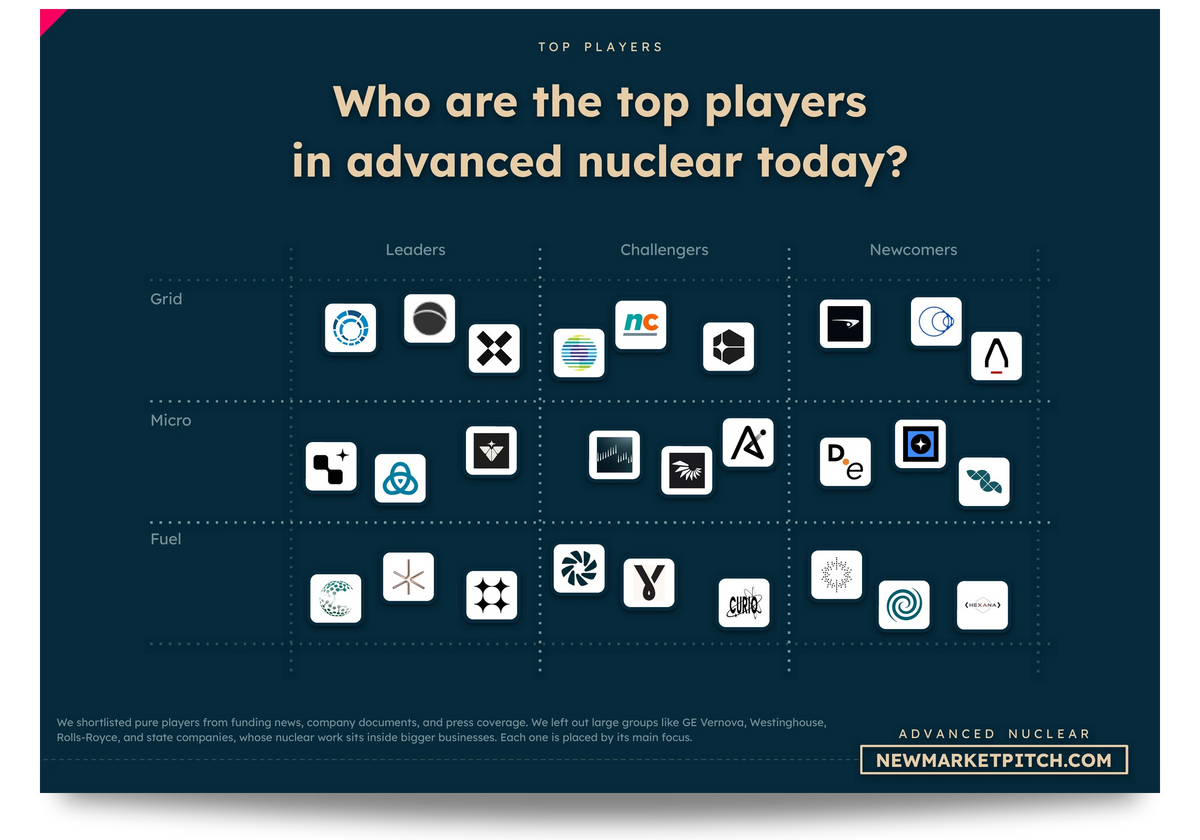
In our research about advanced nuclear reactors, we turn what is vague and complex into simple, useful visuals. Market maps like this one show you at a glance where every startup stands.
Is advanced nuclear funding actually healthier now than it was a year ago?
Advanced nuclear funding is much healthier today for companies that have already cleared the early technical hurdles, while conditions for new entrants have actually become tougher.
We counted 27 deals worth at least $3.57 billion in the latest 12 months, compared with 23 deals and roughly $2.24 billion in the previous period. The number of funded companies also increased from 19 to 21, and the median disclosed round jumped from $25.8 million to $48.3 million.
That sounds like a straightforward boom until we look at where the extra money went. First financings fell from four to two. Early-stage rounds dropped from 56.5% to 29.6% of deals. Meanwhile, 25 of the 27 current deals were follow-ons.
So the picture today is fairly sharp: advanced nuclear has become much easier to finance once a company has credibility, but the pipeline underneath those winners has not strengthened at the same pace.
| Metric | Latest 12 months | Previous 12 months | Change |
|---|---|---|---|
| Funding | ≥$3.57B | ~$2.24B | +59% |
| Deals | 27 | 23 | +17% |
| Funded companies | 21 | 19 | +11% |
| Median round | $48.3M | $25.8M | +87% |
| First financings | 2 | 4 | -50% |
| Follow-on share | 92.6% | 82.6% | +10.0pp |
| Early-stage share | 29.6% | 56.5% | -26.9pp |
| Capital below $50M rounds | $283.7M | $318.3M | -10.9% |
Would advanced nuclear funding still look strong without the giant rounds?
Advanced nuclear funding loses most of its apparent acceleration once we strip out the biggest financings.
Total capital rose 59%, but funding excluding rounds above $100 million increased by only 4.5%. Push the threshold down to $50 million and current funding actually falls 10.9% year over year, from $318.3 million to $283.7 million.
The latest period contains a $1 billion Valar Atomics Series B, X-Energy's $700 million Series D, Antares' $370 million equity financing, another $340 million Valar round and more than $300 million for Radiant. Together, these deals changed the scale of the market.
Still, they are not statistical noise. Several different companies can now raise hundreds of millions of dollars, which was less common a year earlier. The narrower point is that the improvement sits overwhelmingly in scale-stage funding. A startup looking for $15 million or $30 million has not experienced anything close to a 59% improvement in funding conditions.
Is Valar Atomics basically carrying the advanced nuclear funding boom?
Valar Atomics is doing a lot of the heavy lifting, but advanced nuclear funding now has several companies capable of raising at that level.
Valar's $1 billion Series B represents about 28% of all current funding, and the company had already raised another $340 million earlier in the period. Yet the top three deals account for 58.1% of current capital, down from 65.1% a year earlier.
That drop is interesting because the market simultaneously became more dependent on large rounds overall. Eleven current financings exceeded $50 million, up from seven, and those deals generated 92% of all capital.
Concentration has changed shape. One company no longer needs to explain most of the market because X-Energy, Antares, Radiant, Standard Nuclear and others are also raising at serious scale. The money is still concentrated, just across a somewhat wider club of large winners.
| Funding concentration | Latest 12 months | Previous 12 months |
|---|---|---|
| Largest deal / total capital | 28.1% | 29.0% |
| Top 3 / total capital | 58.1% | 65.1% |
| Top 5 / total capital | 76.0% | 78.4% |
| Top 10 / total capital | 90.1% | 91.9% |
| Rounds above $50M | 11 | 7 |
| Rounds above $100M | 7 | 4 |
| Capital from >$50M rounds | 92.0% | 85.8% |
| Capital from >$100M rounds | 82.9% | 74.0% |

Your time is limited. In our market report about advanced nuclear reactors, we put numbers on each part of the market, so you can see where it makes sense to focus.
Are more advanced nuclear companies getting funded these days?
More advanced nuclear companies are getting funded, although the increase is much smaller than the jump in capital.
We found 21 funded companies in the latest period versus 19 previously. Deal count rose from 23 to 27, and average monthly deal activity moved from 1.92 to 2.25.
That gives the current market some real breadth. We are not looking at a funding boom created by the same number of companies splitting a bigger pool of capital.
But two additional funded companies cannot explain an extra $1.32 billion of financing. Larger checks explain far more of the growth than broader access to funding.
Participation has widened a little. Financing intensity has exploded.
Are investors still funding brand-new advanced nuclear startups?
Brand-new advanced nuclear startups are getting a noticeably smaller share of today's funding market.
Only two current deals were first financings, compared with four in the previous period. Their combined capital fell from $113.2 million to $29.9 million, while the median first financing dropped from $30.3 million to $15 million.
At the same time, follow-on deals increased from 19 to 25 and absorbed at least $3.54 billion. Their median size rose from $25.8 million to $50 million.
Bluecore Energy is one of the few recent exceptions. The company emerged from stealth with $10 million and then announced a $50 million seed financing shortly afterward, showing that a new entrant can still move very quickly when investors buy into the concept.
Across the market, though, we found far more money chasing companies that had already raised before. Advanced nuclear looks more mature today, but it is also leaving a thinner generation of newly funded startups behind the current leaders.
| Financing type | Latest 12 months | Previous 12 months |
|---|---|---|
| First financings | 2 | 4 |
| First-financing share | 7.4% | 17.4% |
| First-financing capital | $29.9M | $113.2M |
| Median first financing | $15.0M | $30.3M |
| Follow-ons | 25 | 19 |
| Follow-on share | 92.6% | 82.6% |
| Follow-on capital | ≥$3.54B | $2.13B |
| Median follow-on | $50.0M | $25.8M |
Do advanced nuclear startups need more proof before investors write big checks now?
Advanced nuclear companies getting the biggest checks today usually have more technical, regulatory or industrial proof behind them than the typical funded company did a year earlier.
The median company receiving funding was around three years old, up from roughly 2.1 years. Among follow-on rounds, median company age moved from about 2.2 to 3.1 years. Series B and later rounds also became much more prominent.
The company-level examples make the shift easier to see. Standard Nuclear raised $140 million as it began producing HALEU TRISO fuel and expanded fabrication infrastructure. It subsequently reported commercial fuel deliveries and, later in 2026, $576.9 million of total contract backlog after signing a fuel agreement with Antares.
Radiant raised more than $300 million while preparing its R-50 factory in Tennessee. The U.S. Nuclear Regulatory Commission then accepted the facility's special nuclear materials license application for an accelerated review. Antares, meanwhile, reached criticality with its Mark-0 reactor, secured DOE safety approvals and signed a long-term TRISO fuel agreement during the same broader period in which it raised its large Series C.
We cannot turn those examples into a precise market-wide milestone score because disclosures differ by company. But the bar does look higher these days: investors are writing the largest checks around companies that can point to factories, fuel, regulatory progress, reactor tests or real customers.

In our document detailing everything you need to know about advanced nuclear, we always try to gather several sources and make estimates that make sense, so you can work with solid numbers.
Has advanced nuclear funding moved away from seed rounds?
Advanced nuclear funding has shifted heavily toward more mature rounds, even after allowing for weaker stage disclosure in the latest period.
Seed accounted for 18.5% of current deals, down from 34.8%. Series A fell from 21.7% to 11.1%. Series B moved the other way, reaching 22.2% of deals and 41.3% of disclosed capital.
Some care is needed here because 25.9% of current deals have an unknown stage, compared with 8.7% previously. We do not force a stage classification when the public evidence is unclear, so that missing data genuinely limits the precision of the comparison.
The direction still looks convincing when we combine stage with the other evidence. Funded companies are older, first financings have become rarer, follow-ons dominate the deal count, and median checks are much larger.
As seen above, several separate measures now point toward the same change: the center of gravity has moved away from company formation and toward companies already deep into execution.
Why are advanced nuclear rounds suddenly getting so much bigger?
Advanced nuclear rounds are getting bigger because companies are increasingly raising for factories, fuel production, supply chains and deployment rather than another relatively contained phase of technical development.
Valar said its $1 billion Series B would accelerate manufacturing of standardized nuclear plants for AI, industrial and national-security demand. X-Energy said its $700 million Series D would support supply-chain expansion and a commercial pipeline above 11 GW, including projects associated with Dow, Amazon and Centrica.
Radiant linked its more than $300 million financing to commercialization and its planned Tennessee production facility. Standard Nuclear's $140 million raise funded additional fuel-development and fabrication infrastructure beyond an already operating TRISO line.
OTRERA offers a European version of the same transition. The French company announced an industrial plant and technology hub in Normandy and described the move explicitly as a shift from design into industrialization.
These are much more expensive jobs than proving an early reactor concept. The financing market is starting to reflect the physical cost of actually building a nuclear industry.
Which advanced nuclear technologies are attracting the most money now?
High-temperature gas reactors have gained the clearest momentum in advanced nuclear funding, while microreactors are attracting much larger rounds without adding more deals.
High-temperature gas reactor funding reached roughly $2.22 billion across seven deals, compared with about $719 million across three deals in the previous period. Valar contributes heavily to that total, but X-Energy and Jimmy Energy mean the increase also has real breadth.
Microreactors stayed at six deals in both periods. Capital, however, climbed from around $296 million to at least $854 million, while the median financing went from $47.5 million to $100 million. Antares and Radiant explain much of that jump.
Light-water SMRs went the other way. Deal count increased from three to five, yet capital fell roughly 74% and the median financing dropped to around $10 million. That part of the market became broader but shallower.
| Advanced nuclear category | Current deals | Current capital | Median round | What changed |
|---|---|---|---|---|
| High-temperature gas reactors | 7 | $2.22B | $105M | More deals and much more capital |
| Microreactors | 6 | ≥$854M | $100M | Same deal count, much bigger checks |
| Light-water SMRs | 5 | $96.7M | $10M | More deals, smaller rounds |
| Advanced nuclear fuel systems | 3 | $164.1M | $17M | Similar breadth, more capital |
| Sodium-cooled fast reactors | 3 | $28.4M | $11M | Much less capital than last year |
| Lead-cooled fast reactors | 2 | $135M | $67.5M | Stronger from a small base |
| Molten salt reactors | 1 | $70M | $70M | Fewer deals, one sizable financing |

Our report covering the advanced nuclear market gets updated several times a month, so you always get the latest view of where things stand.
Are high-temperature gas reactors really taking off?
High-temperature gas reactors currently have the strongest combination of more deals, larger rounds and clearer customer demand in the advanced nuclear market.
Deal count more than doubled from three to seven, while funding roughly tripled to $2.22 billion. That makes the category harder to dismiss as a one-round story.
Valar's two huge financings obviously dominate the dollars. X-Energy adds another major pillar: its $700 million Series D came alongside an orderbook the company described as exceeding 11 GW, with projects involving Dow, Amazon and Centrica. Jimmy Energy gives the category a smaller European industrial-heat example.
The appeal is also fairly intuitive. Data centers, industrial plants and other large energy users increasingly want reliable power or high-temperature heat at a scale that renewables plus storage can struggle to provide continuously.
We still do not know which reactor economics will hold up once these projects are built. For now, though, investors are clearly treating high-temperature systems as one of the most financeable parts of advanced nuclear.
Are microreactors finally becoming a serious market?
Microreactors have reached a much more serious financing phase, although the number of companies raising has not expanded.
Current microreactor capital is almost three times the previous level with exactly six deals in each period. Antares raised $370 million of equity, Radiant raised more than $300 million, and NuCube added a $13 million Series A.
The operational progress is becoming more concrete too. Antares reported Mark-0 criticality and later signed a multi-year TRISO fuel agreement with Standard Nuclear. Radiant's planned factory entered an NRC licensing review, while Standard Nuclear delivered TRISO fuel intended for Radiant's reactor demonstration.
Those connections across reactor developers, regulators and fuel suppliers make the recent funding wave more interesting than a cluster of standalone venture rounds. We can now see pieces of an actual microreactor supply chain being financed at the same time.
Is advanced nuclear funding becoming a U.S. game?
The United States is pulling away from Europe in advanced nuclear fundraising, especially when we compare check sizes.
All 20 North American deals in the latest period came from U.S.-headquartered companies. North America captured 74.1% of deals and 93.9% of total capital, up from 65.2% and 82.0% respectively.
Europe still produced seven deals. France alone contributed financings for Jimmy Energy, OTRERA and HEXANA, while newcleo raised $85 million. The gap comes mostly from scale rather than a disappearance of European startups.
The median North American round was around $70 million. Europe's was roughly $19.9 million.
That difference becomes enormous once companies need hundreds of millions for manufacturing and deployment. For now, the U.S. market is producing far more financings at that scale.

In our research about advanced nuclear reactors, we look at what the winners do differently, so you can learn from the best instead of guessing.
Are new investors piling into advanced nuclear?
Advanced nuclear is attracting a wider group of investors now, but most of the new money is still clustering around proven companies.
We identified roughly 39 disclosed lead or strategic investors in the latest period, up from around 27 previously. Sequoia led Valar's $1 billion Series B, while Jane Street led X-Energy's $700 million Series D. Those names show that advanced nuclear is reaching well beyond a small circle of specialist climate and nuclear investors.
At the company level, funding syndicates are also becoming much larger and more varied. Standard Nuclear's Series A brought together Decisive Point, Chevron Technology Ventures, StepStone, XTX Ventures and several existing investors. Valar combined Sequoia with venture, growth and technology-focused investors.
We would be careful about claiming that investor repetition has disappeared because our dataset records disclosed leads and strategics rather than every participant in every syndicate.
The broader change is easier to defend: more pools of capital are willing to fund advanced nuclear these days, but they seem most comfortable entering once a company has crossed meaningful technical or industrial milestones.
Are utilities and industrial companies becoming more important investors?
Strategic investors are becoming more useful to advanced nuclear companies even though their share of deals has not increased.
Nine deals involved a disclosed strategic investor in each period. Because total deal count grew, the strategic participation rate actually fell from 39.1% to 33.3%.
What changed is the type of relationship attached to some of those investments. Samsung C&T agreed to combine a direct Kairos investment with engineering services for the Hermes 2 demonstration plant. Fortum invested around Steady Energy while bringing operating experience from the nuclear industry. OTRERA's shareholder group includes EDF and several engineering and industrial companies.
newcleo also brought in investors tied to component manufacturing and industrial applications.
These companies can contribute something besides cash: engineering, construction capacity, manufacturing knowledge, utility expertise or access to eventual customers. That is exactly the kind of support reactor developers need as they leave the design phase.
Is advanced nuclear money finally moving from R&D into factories?
Yes, a meaningful share of today's largest advanced nuclear financings is now tied to industrialization, manufacturing and deployment.
X-Energy is expanding its supply chain and commercial delivery platform. Radiant is building toward mass production. Standard Nuclear is expanding fuel fabrication. OTRERA is planning a factory and technology hub. Valar says it wants to manufacture standardized plants at scale.
The recent fuel data makes the transition especially tangible. Standard Nuclear reported commercial TRISO deliveries in 2026, construction substantially complete at two new production facilities and a large increase in contracted backlog. Its agreement with Antares included a firm fuel commitment plus options for considerably more material.
As pointed out above, the funding market is following companies deeper into physical execution. Upcoming proof points will increasingly be measured in factories commissioned, fuel delivered, reactors tested, licenses secured and customer projects built.

In our market report about advanced nuclear reactors, we don't want to repeat what boring consulting reports say. Instead, we show you the real and latest market signals that matter.
Could nuclear fuel become the bottleneck for all these reactor startups?
Advanced nuclear fuel has already become a major commercial constraint, and investors are now putting real money behind companies trying to solve it.
Advanced-fuel companies raised roughly $164 million across three current deals. Standard Nuclear's $140 million Series A makes up most of that figure, with LIS Technologies adding additional uranium-enrichment financings.
The more important development came after the fundraising. Standard Nuclear began producing HALEU TRISO, delivered fuel for Radiant's reactor program and signed a multi-year agreement with Antares. The company later reported $119.3 million of funded backlog and $576.9 million of total contract backlog after that Antares agreement.
X-Energy is also investing heavily in its own TRISO-X fuel infrastructure, with construction progressing on its TX-1 fabrication facility.
Fuel therefore looks much less like an abstract future issue now. Several reactor programs are reaching the point where physical fuel availability can determine how quickly projects move.
So is advanced nuclear funding stronger, weaker or just different now?
Advanced nuclear funding is stronger at the scale-up stage, weaker at the entry stage and clearly more industrial than it was a year ago.
The $3.57 billion headline is impressive, but it gives too flattering a picture of funding availability across the whole market. Once rounds above $50 million are removed, capital is down 11%. New-company financings are rarer. Early-stage activity has shrunk.
At the same time, we would undersell the change if we treated the giant rounds as meaningless outliers. Valar, X-Energy, Antares, Radiant and Standard Nuclear are raising larger amounts because parts of advanced nuclear are moving into factories, fuel production, regulatory execution and commercial deployment.
The market currently rewards companies that can show they are capable of building something physical, clearing regulatory steps and plugging into a real supply chain.
For founders at that stage, conditions look far better than a year ago. For a new advanced nuclear startup still trying to secure its first institutional round, the picture is much less comfortable.
What really changed in advanced nuclear funding over the last 12 months?
Advanced nuclear has become a scale-up funding market. Total capital rose 59%, median round size nearly doubled and several companies can now raise hundreds of millions of dollars in a single transaction.
The extra money has barely reached smaller rounds. Capital below the $50 million threshold fell 11%, which is the easiest way to see why the headline growth figure can mislead.
Existing companies captured almost everything. Follow-ons represented 25 of 27 deals, while first financings fell from four to two. Today's funding market is producing much bigger checks for established companies without creating a similarly large new generation underneath them.
High-temperature gas reactors showed the strongest genuine momentum because both deal count and capital rose sharply. Microreactors also moved up in financing scale, while their deal count stayed flat.
The U.S. extended its lead. North America captured nearly 94% of capital, and the gap with Europe increasingly comes from the ability to finance very large rounds rather than from Europe having no activity.
The required proof has changed as well. Companies raising the biggest rounds now tend to have more visible manufacturing, regulatory, fuel, customer or deployment progress behind them.
The biggest mistake would be to look at the 59% funding increase and conclude that every part of advanced nuclear suddenly became easier to finance. What has improved dramatically is the market for companies already moving from reactor development into industrial execution.
Our methodology
This analysis examines what funding is like in the advanced nuclear market right now by comparing two consecutive, non-overlapping 12-month periods. The latest period runs from October 8, 2025 through October 7, 2026, inclusive, while the previous period runs from October 8, 2024 through October 7, 2025.
We built the dataset from company and investor announcements, regulatory filings, government records, reputable financial and industry reporting, and established funding databases. When multiple credible sources covered the same financing, we cross-checked the amount, date, stage and transaction structure rather than automatically using the largest reported figure.
Funding totals include qualifying private-company equity financings. Debt, grants, loans, public offerings and financing components that could not be reliably separated from non-equity capital were excluded. When a financing package mixed equity with debt or grants, only the identifiable equity component was counted.
Companies also had to pass a strict market-definition test: advanced nuclear needed to be a core part of the company's business at the time of financing. Duplicate reports of the same round were consolidated, while extensions, additional closes and tranches were counted separately only when the public evidence supported treating them as genuinely distinct financing events or incremental capital.
Dates, stages, investors, founding dates and operating milestones were recorded only when they could be supported publicly. We did not infer a Series A or Series B from round size, assign a lead investor simply because its name appeared prominently, or estimate an undisclosed financing amount. Radiant's financing, for example, is described as more than $300 million, so the analysis uses $300 million as a conservative floor.
We preserved uncertainty around unusual transactions rather than forcing them into cleaner categories. Kairos Power's proposed Samsung C&T investment is based on a binding term sheet subject to regulatory approvals, while public reporting around Bluecore Energy's financings requires care over whether its earlier $10 million financing is included in the later $50 million seed disclosure.
The final dataset went through a separate quality-control pass covering period boundaries, duplicate financings, company-name inconsistencies, unusual transaction structures, ambiguous stages and amounts, and deals sitting close to the market-definition boundary.
Key sources used for the financing and operating evidence include Valar Atomics on its $1 billion Series B, X-Energy on its $700 million Series D and commercial pipeline, X-Energy's SEC filing on the Series D preferred-equity proceeds, Radiant on its more than $300 million financing, and the U.S. Nuclear Regulatory Commission on the accelerated review of Radiant's R-50 facility application.
Additional operating and supply-chain evidence comes from Standard Nuclear on its $140 million Series A and start of HALEU TRISO production, Standard Nuclear's 2026 operating results and contract backlog, Antares' company updates covering financing, Mark-0 criticality, DOE approvals and its TRISO supply agreement, Kairos Power on its Samsung C&T strategic investment and engineering collaboration, and OTRERA on its manufacturing plant and move toward industrialization.
For newer reactor developers and first-financing activity, we also used Aalo Atomics on its $100 million financing and data-center deployment strategy and Bluecore Energy's company news hub covering its seed financing and floating-reactor project. Our rule throughout was simple: when the evidence did not support precision, we kept the uncertainty instead of manufacturing a cleaner number.

Learning from others' mistakes is the cheapest lesson there is. In our document detailing everything you need to know about advanced nuclear, we look at what broke startups before you, so you don't repeat it.
Written by the New Market Pitch teamWe track new markets so founders and investors can move faster. About us