What are the top advanced nuclear startups by total funding raised?
Everything we know about the advanced nuclear market, in one place. Get our report whether you build or invest.
Summary
NuScale Power leads the advanced nuclear startup funding ranking with $2.9 billion raised, followed by X-energy with $2.7 billion and Oklo with $2.3 billion. TerraPower and Valar Atomics complete the top five, with $1.5 billion each. The ten largest companies have raised $13.941 billion combined.
Funding is heavily concentrated at the top. The ten largest startups account for 84.6% of the $16.469 billion raised by the 51 companies in our ranking, while the five largest alone represent 66.2%. Nuclear reactor development is an expensive business, and the companies attracting the most capital have a considerable head start.
The United States dominates the market, accounting for 32 companies and $14.700 billion in funding, or 89.3% of the total. The United Kingdom comes a distant second, largely thanks to newcleo, while France, Finland and Sweden have smaller but increasingly interesting nuclear technology ecosystems.
The financing landscape has changed considerably. NuScale, X-energy and Oklo have used public markets to raise substantial amounts, while Valar Atomics secured a $1 billion Series B led by Sequoia Capital. Private venture capital is increasingly competing with public-market financing and government-backed programmes.
Not all the companies are developing the same technology. NuScale focuses on small modular light-water reactors, Oklo on compact fast fission systems, TerraPower on sodium-cooled reactors, and X-energy on high-temperature gas-cooled technology. Other startups are targeting microreactors, molten-salt systems, nuclear fuel, enrichment and waste recycling.
AI data centers are becoming major potential customers. Meta has partnered with Oklo on a planned 1.2 GW nuclear campus in Ohio, Google is working with Kairos Power on up to 500 MW of future capacity, and Amazon and X-energy are targeting more than 5 GW by 2039. These agreements give reactor developers a clearer commercial destination, although the electricity still has to be delivered.
Several startups have moved beyond laboratory research. Antares, Valar Atomics and Aalo Atomics achieved reactor criticality during 2026, while TerraPower obtained an NRC construction permit for its Natrium project and Kairos Power started construction on Hermes 2. X-energy also completed an important NRC safety review.
Nuclear fuel could become one of the industry's biggest constraints. Advanced reactors increasingly depend on HALEU, but domestic production remains limited. Companies such as Standard Nuclear, General Matter, LIS Technologies and Hexium are developing different parts of the fuel supply chain, creating investment opportunities beyond reactor manufacturing itself.
Industrial heat and floating nuclear power offer additional markets. Steady Energy is developing a 50 MW thermal reactor for district heating, while Jimmy targets industrial heat and CORE POWER is pursuing floating nuclear power infrastructure. These applications could expand nuclear energy beyond conventional electricity generation.
The commercial outlook is improving, but important obstacles remain. Licensing, fuel availability, construction costs, manufacturing capacity and the ability to operate reliably will determine which companies can turn their technology into commercially viable power plants.
Our assessment is that advanced nuclear has entered a serious commercialization phase. The largest funding totals provide a useful indication of investor confidence, but the eventual winners will be the companies that deliver working reactors on schedule, secure long-term customers and produce electricity or heat at competitive prices.

Written by the New Market Pitch teamWe track new markets so founders and investors can move faster. About us

In our report covering the advanced nuclear market, you will always find fresh funding data, taken straight from our own verified funding database.
Top startups in the advanced nuclear market ranked by total funding raised
Here is an updated table that ranks the top startups in the advanced nuclear market based on the total amount of funding they have raised to date.
The table also includes the total number of funding rounds, the date and size of the latest round, the financing type (e.g. Series A, equity financing), key investors, the startup’s current status (active, IPO, acquired, or shut down), and a confidence score based on the data collected.
If you need to dig deeper and get more detailed data, please check our report covering the advanced nuclear market.
| # | Startup | What They Do | Total Raised ($) | Total Rounds | Last Round Date | Last Round Amount ($) | Last Round Type | Key Investors | Current Stage | Confidence | Country |
|---|---|---|---|---|---|---|---|---|---|---|---|
| 1 | NuScale Power | Small modular light-water nuclear reactors | $2.9B1 | 5 | June 2026 | $1.0B | ATM | UBS, B. Riley, Canaccord | IPO | Strong | United States |
| 2 | X-energy | Advanced reactors and nuclear fuel | $2.7B2 | 7 | April 2026 | $1.0B | IPO | J.P. Morgan, Morgan Stanley, Jefferies | IPO | Strong | United States |
| 3 | Oklo | Fast fission reactors and nuclear fuel | $2.3B | 8 | June 2026 | $680M | ATM | Undisclosed | IPO | Strong | United States |
| 4 | TerraPower | Advanced reactors and nuclear innovation | $1.5B | 9 | June 2025 | $650M | Equity Financing | Bill Gates, NVentures, HD Hyundai | Active | Partial | United States |
| 5 | Valar Atomics | Mass-manufactured advanced nuclear reactors | $1.5B | 5 | August 2026 | $1B | Series B | Sequoia Capital, Valor Equity Partners, Point72 Ventures | Active | Strong | United States |
| 6 | newcleo | Lead-cooled reactors and nuclear fuel | $1.0B | 7 | September 2026 | $247M | SPAC / PIPE | Undisclosed | IPO | Partial | United Kingdom |
| 7 | Antares | Factory-produced nuclear microreactors | $604M | 4 | July 2026 | $470M | Series C | Paradigm, Caffeinated Capital, Point72 Ventures | Active | Strong | United States |
| 8 | NANO Nuclear Energy | Portable microreactors and nuclear fuel | $542M | 4 | June 2026 | $27M | ATM | Undisclosed | IPO | Strong | United States |
| 9 | Radiant | Portable nuclear microreactors | $517M | 7 | February 2026 | Undisclosed | Series D Extension | Lockheed Martin Ventures | Active | Strong | United States |
| 10 | Terrestrial Energy | Integral molten salt reactors | $378M | 9 | October 2025 | $292M | SPAC / PIPE | Undisclosed | IPO | Partial | United States |
| 11 | Kairos Power | Fluoride salt-cooled nuclear reactors | $368M | 1 | October 2026 | $368M | Late-stage Equity | GV, DCVC, Samsung C&T | Active | Partial | United States |
| 12 | Standard Nuclear | TRISO nuclear fuel manufacturing | $334M | 5 | July 2026 | $150M | IPO | J.P. Morgan, Morgan Stanley, Jefferies | IPO | Strong | United States |
| 13 | Blue Energy | Prefabricated nuclear power plants | $235M | 3 | July 2026 | Undisclosed | Strategic Equity | Constellation Technology Ventures | Active | Partial | United States |
| 14 | CORE POWER | Floating nuclear power and marine reactors | $219M | 8 | October 2025 | $24M | Late-stage Equity | Imazo, Onomichi Dockyard | Active | Partial | United Kingdom |
| 15 | Last Energy | Factory-built small modular reactors | $169M | 4 | December 2025 | $105M | Series C | AE Ventures, Gigafund, Astera Institute | Active | Strong | United States |
| 16 | Deep Fission | Underground borehole nuclear reactors | $154M | 4 | June 2026 | $40M | IPO | 8VC, EE Holdings, Montrose Capital Partners | IPO | Strong | United States |
| 17 | Steady Energy | Small reactors for district heating | $137M | 5 | October 2026 | $6M | IPO | Lifeline Ventures, Yes VC, Move Energy | IPO | Strong | Finland |
| 18 | Aalo Atomics | Gigafactory-produced nuclear power plants | $133M2 | 4 | May 2026 | Undisclosed | Series B-II | Ontario Teachers' Pension Plan, Climate Capital | Active | Partial | United States |
| 19 | Blykalla | Lead-cooled modular nuclear reactors | $81M | 5 | December 2025 | $50M | Series B | Oklo, Norrsken Launcher, Armada Investment | Active | Partial | Sweden |
| 20 | LIS Technologies | Laser uranium enrichment technology | $71M | 7 | March 2026 | ~$7M | Equity Financing | 28 Ventures, Innovating Capital, Minetta Brook | Active | Strong | United States |
| 21 | Jimmy | Industrial nuclear heat generators | $67M+ | 3 | March 2026 | $44M | Equity Financing | Crédit Mutuel Impact, ADEME Investissement | Active | Strong | France |
| 22 | Bluecore Energy | Floating nuclear power platforms | $60M | 2 | September 2026 | $50M | Seed | Undisclosed | Active | Strong | United States |
| 23 | Copenhagen Atomics | Thorium molten-salt reactor development | $53M | 3 | January 2023 | ~$26M | Series A | Unpopular Ventures, Spectrum Impact | Active | Partial | Denmark |
| 24 | Ultra Safe Nuclear Corporation | Micro modular nuclear reactors | $50M | 3 | January 2022 | $20M | Series A-2 | Hyundai | Shutdown | Partial | United States |
| 25 | General Matter | Domestic uranium enrichment | $50M | 1 | April 2025 | $50M | Venture Equity | Founders Fund | Active | Full | United States |
| 26 | Transmutex | Accelerator-driven nuclear waste transmutation | $39M | 4 | January 2024 | ~$23M | Series A2 | Union Square Ventures, Steel Atlas, Verve Ventures | Active | Partial | Switzerland |
| 27 | Terra Innovatum | Modular nuclear microreactor systems | $37M | 1 | October 2025 | $37M | PIPE | Undisclosed | IPO | Partial | Italy |
| 28 | Thorizon | Nuclear-waste-fueled molten-salt reactors | $33M | 3 | March 2025 | ~$18M | Series A | Invest-NL, Positron Ventures, PDENH | Active | Strong | Netherlands |
| 29 | Stellaria | Fast-neutron molten-salt reactor systems | $27M | 2 | July 2025 | ~$25M | Venture Financing | At One Ventures, Supernova Invest, Technip Energies | Active | Strong | France |
| 30 | Apollo Atomics | Factory-built pressurized water microreactors | $26M | 1 | August 2026 | $26M | Seed | FCVC, Y Combinator, Telesoft Partners | Active | Strong | United States |
| 31 | Nuclear Turbines | Compact industrial nuclear reactors | $20M | 1 | July 2026 | ~$20M | Pre-Seed | Empirical Ventures, IQ Capital, Zero Carbon Capital | Active | Strong | United Kingdom |
| 32 | HEXANA | Sodium-cooled fast nuclear reactors | $19M | 2 | August 2026 | ~$2M | Strategic Equity | Groupe M, Eren Industries, CEA Investissement | Active | Partial | France |
| 33 | Clean Core Thorium Energy | Thorium-based advanced reactor fuel | $18M | 2 | February 2025 | ~$16M | Series Seed | Sumant Sinha, Lakshmi Narayanan, Deepak Parekh | Active | Strong | United States |
| 34 | ARC Clean Technology | Sodium-cooled small modular reactors | $15M | 2 | December 2025 | $15M | Series B | Xplor Ventures, Hennessy Capital Group, Banpu Ventures | Active | Partial | United States |
| 35 | First American Nuclear | Develops lead-bismuth nuclear reactors | $14M3 | 5 | September 2026 | $1M | Private Placement | Undisclosed | Active | Partial | United States |
| 36 | NuCube Energy | High-temperature industrial nuclear microreactors | $13M | 1 | February 2026 | $13M | Venture Equity | Arizona Nuclear Ventures, Rob Walton, Jordan Rose Walton | Active | Partial | United States |
| 37 | Fermi Energia | Develops Estonian nuclear power projects | $11M | 8 | June 2025 | ~$3M | Private Equity | NG Investeeringud, GO Grupp, OG Elektra | Active | Strong | Estonia |
| 38 | Applied Atomics | Develops industrial nuclear power plants | $10M | 2 | April 2026 | ~$8M | Seed | Morpheus Ventures, Transition, Acequia Capital | Active | Partial | United States |
| 39 | Molten Salt Solutions | Enriches lithium isotopes for nuclear energy | $10M | 2 | August 2026 | $7M | Seed | Dolby Family Ventures, Vanedge Capital, Alumni Ventures | Active | Strong | United States |
| 40 | Hexium | Develops laser-based nuclear isotope enrichment | $10M | 1 | April 2025 | ~$10M | Seed | MaC Venture Capital, Refactor Capital, Humba Ventures | Active | Partial | United States |
| 41 | Curio | Recycles used nuclear fuel | $8M | 2 | April 2024 | ~$8M | Seed | Synergos Holdings, Erez Capital | Active | Partial | United States |
| 42 | Moltex Energy | Develops molten salt reactor technologies | $8M4 | 1 | September 2019 | ~$8M | Series C / Equity Crowdfunding | IDOM, Shadow Foundr | Shutdown | Partial | United Kingdom |
| 43 | Dual Fluid Energy | Develops dual-fluid nuclear reactors | $6M | 1 | July 2021 | ~$6M | Private Equity | Undisclosed | Active | Partial | Germany |
| 44 | Transatomic Power | Developed advanced molten salt reactors | $5M | 3 | February 2015 | ~$3M | Series A | Founders Fund, Armada Investment Group, Acadia Woods Partners | Shutdown | Partial | United States |
| 45 | Blossom Energy | Develops high-temperature nuclear heat systems | ~$5M5 | 3 | May 2026 | ~$2M | Follow-on Venture | Environmental Energy Investment, Animal Spirits | Active | Partial | Japan |
| 46 | Gen4 Energy | Transportable nuclear power modules | $3M | 3 | March 2011 | ~$3M | Venture Equity | Altira Group | Shutdown | Low | United States |
| 47 | Otrera | Sodium-cooled fast reactor development | $3M | 2 | May 2026 | Undisclosed | Strategic Financing | EDF Group, Groupe ADF, Normandie Participations | Active | Partial | France |
| 48 | Blue Capsule Technology | Develops industrial high-temperature nuclear reactors | $2.1M+ | 2 | February 2026 | Undisclosed | Private Financing | Audacia, EREN Groupe, CEA Investissement | Active | Partial | France |
| 49 | Exodys Energy | Develops nuclear fuel recycling technology | $2M | 2 | February 2025 | ~$0M | Seed Extension | Vannevar Ventures, New York Ventures | Active | Partial | United States |
| 50 | Kärnfull Next | Develops small modular reactor projects | $2M | 1 | September 2023 | ~$2M | Seed | Climentum Capital | Acquired | Partial | Sweden |
| 51 | Hadron Energy | Advanced nuclear microreactor development | $1M | 2 | July 2025 | ~$1M | Seed Extension | Undisclosed | Active | Partial | United States |
- Includes public share offerings and SPAC proceeds, not only private rounds.
- Minimum: some private rounds have undisclosed amounts.
- Share-offering totals are uncertain; their equity status still needs confirmation.
- Moltex entered administration; an announced asset purchase is not a full acquisition.
- The earliest round is implied from total funding, not disclosed.

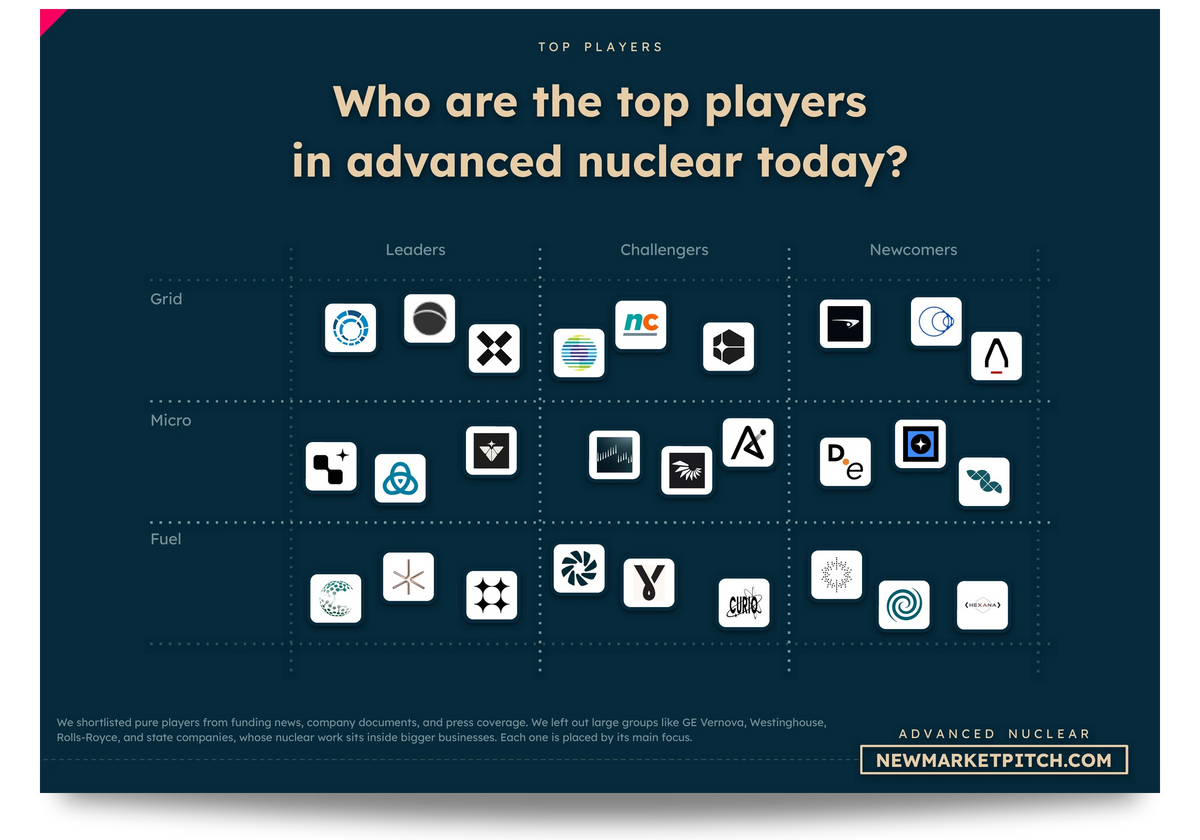
In our research about advanced nuclear reactors, we turn what is vague and complex into simple, useful visuals. Market maps like this one show you at a glance where every startup stands.
Why are investors putting so much money into advanced nuclear startups?
Investors are pouring billions into advanced nuclear startups because AI data centers, industrial facilities and governments increasingly need reliable electricity that can be produced around the clock. Nuclear energy is becoming a serious option again, and a new generation of companies is trying to make reactors smaller, faster to manufacture and easier to deploy.
The demand from technology companies is particularly interesting. In January 2026, Meta announced several nuclear energy partnerships, including an agreement with Oklo supporting a planned 1.2 GW nuclear power campus in Ohio. Google has a separate agreement with Kairos Power to develop an advanced reactor fleet capable of delivering up to 500 MW by 2035. Amazon and X-energy are targeting more than 5 GW of new nuclear capacity in the United States by 2039.
These commitments are changing the investment opportunity. Reactor developers can increasingly approach large electricity consumers with potential long-term customers already interested in securing future power supplies.
Governments are also putting considerable money behind the industry. The United States has committed billions to domestic uranium enrichment, advanced reactor demonstrations and nuclear fuel manufacturing. Europe is developing its own nuclear industrial strategy, partly to reduce dependence on imported energy and strengthen its industrial competitiveness.
The result is a market attracting several types of investors at once. Venture capital firms are financing reactor developers, industrial groups are backing manufacturing capabilities, and public-market investors are providing much larger amounts of capital to companies preparing for commercial deployment.
What are advanced nuclear startups actually building?
Advanced nuclear startups are developing five main types of technology: small modular reactors, microreactors, alternative reactor designs, nuclear fuel and enrichment systems, and technologies for recycling or processing nuclear waste.
The largest companies tend to concentrate on reactor development. NuScale Power develops small modular light-water reactors, X-energy combines high-temperature gas-cooled reactors with TRISO fuel production, and Oklo is developing compact fast fission reactors. TerraPower is developing its Natrium sodium-cooled fast reactor, while newcleo is pursuing lead-cooled reactors and nuclear fuel.
A second group is working on much smaller systems. Valar Atomics, Antares, Radiant, Aalo Atomics, Deep Fission, Last Energy and NANO Nuclear Energy are developing reactors intended for applications such as military installations, remote industrial facilities and data centers. Their approaches differ considerably, from transportable microreactors to underground reactors and factory-produced nuclear power systems.
The fuel market has also attracted substantial investment. Standard Nuclear manufactures TRISO fuel, LIS Technologies and Hexium are developing laser-based enrichment technologies, and General Matter is working on domestic uranium enrichment. Clean Core Thorium Energy focuses on advanced reactor fuel, while Curio, Exodys Energy and Transmutex are developing technologies related to nuclear fuel recycling and waste treatment.
Finally, some startups are targeting applications that conventional nuclear power plants do not necessarily serve directly. Steady Energy develops reactors for district heating, Jimmy focuses on industrial nuclear heat, and CORE POWER is developing floating nuclear power infrastructure.
The differences between these businesses are considerable. A company developing a complete reactor, one manufacturing its fuel and another building nuclear heating systems face very different commercial opportunities, financing requirements and development timelines.

Your time is limited. In our market report about advanced nuclear reactors, we put numbers on each part of the market, so you can see where it makes sense to focus.
Which advanced nuclear startups have raised the most funding?
NuScale Power leads our advanced nuclear startup funding ranking with $2.9 billion raised, followed by X-energy with $2.7 billion and Oklo with $2.3 billion. TerraPower and Valar Atomics complete the top five with $1.5 billion each.
The first three companies have accumulated $7.9 billion combined. Expanding the comparison to the top ten brings cumulative funding to $13.941 billion, showing how much investment is concentrated among the largest developers.
The ranking also includes several companies that have already entered public markets. NuScale Power, X-energy and Oklo are publicly listed, while newcleo completed its SPAC transaction in September 2026. Their funding histories remain relevant because they accumulated substantial equity financing while developing their businesses.
| Rank | Startup | Total raised | Rounds | Current stage |
|---|---|---|---|---|
| 1 | NuScale Power | $2.9B | 5 | IPO |
| 2 | X-energy | $2.7B | 7 | IPO |
| 3 | Oklo | $2.3B | 8 | IPO |
| 4 | TerraPower | $1.5B | 9 | Active |
| 5 | Valar Atomics | $1.5B | 5 | Active |
| 6 | newcleo | $1.0B | 7 | IPO |
| 7 | Antares | $604M | 4 | Active |
| 8 | NANO Nuclear Energy | $542M | 4 | IPO |
| 9 | Radiant | $517M | 7 | Active |
| 10 | Terrestrial Energy | $378M | 9 | IPO |
Is advanced nuclear startup funding concentrated in just a few companies?
Yes. The ten largest advanced nuclear startups account for approximately 84.6% of the $16.469 billion in cumulative funding across the 51 companies in our ranking.
The concentration becomes even more striking when we look at the first five companies. NuScale Power, X-energy, Oklo, TerraPower and Valar Atomics have raised $10.9 billion combined, representing approximately 66.2% of the total.
The remaining 41 companies have accumulated just $2.528 billion. Their average funding is approximately $61.7 million, compared with $1.394 billion for the top ten.
This creates two very different investment environments. The largest developers have access to capital markets and financing relationships capable of supporting expensive engineering programmes, while smaller companies must make progress with much more limited resources.
| Group | Number of startups | Combined funding | Share |
|---|---|---|---|
| Top 3 | 3 | $7.9B | 48.0% |
| Top 5 | 5 | $10.9B | 66.2% |
| Top 10 | 10 | $13.941B | 84.6% |
| Top 20 | 20 | $15.842B | 96.2% |
| Ranks 21–51 | 31 | $627M | 3.8% |
| All companies | 51 | $16.469B | 100% |

In our document detailing everything you need to know about advanced nuclear, we always try to gather several sources and make estimates that make sense, so you can work with solid numbers.
What are the biggest funding rounds in the advanced nuclear market?
The biggest recent financing transactions include $1.0 billion rounds for NuScale Power, X-energy and Valar Atomics, followed by $680 million for Oklo and $650 million for TerraPower.
The three billion-dollar transactions illustrate how financing strategies have changed across the sector.
NuScale Power completed a $1.0 billion at-the-market offering in June 2026, using its public listing to access additional equity capital. X-energy raised $1.0 billion through its IPO in April 2026, giving the company a substantial new pool of capital to advance reactor development and fuel manufacturing.
Valar Atomics followed with a $1.0 billion Series B in August 2026, led by Sequoia Capital. The financing was accompanied by a separate $200 million credit facility, which should be distinguished from the equity round.
Other large transactions include Oklo's $680 million ATM financing in June 2026, Antares' $470 million Series C in July 2026 and TerraPower's $650 million equity financing in June 2025.
Further down the ranking, Terrestrial Energy completed a $292 million SPAC/PIPE transaction, while newcleo raised $247 million through its September 2026 business combination.
The size of these transactions is remarkable for a sector in which most developers are still working toward their first commercial reactors. Investors are already financing manufacturing capacity, fuel supply chains and large-scale project development several years before many of the planned facilities can generate electricity.
Who are the biggest investors in advanced nuclear startups?
Sequoia Capital, Valor Equity Partners, Point72 Ventures, GV, DCVC, Samsung C&T and major financial institutions are among the investors backing some of the largest advanced nuclear startups.
Sequoia Capital's $1.0 billion Valar Atomics investment is particularly notable. The financing brings a major Silicon Valley venture capital firm directly into the advanced reactor manufacturing market.
TerraPower has a different investor profile, with backing from founder Bill Gates, NVentures and HD Hyundai. This combination brings together technology investment and industrial expertise.
Kairos Power has attracted GV, DCVC and Samsung C&T, while Antares has received backing from Paradigm, Caffeinated Capital and Point72 Ventures.
We also see a growing role for financial institutions in public-market transactions. NuScale's latest ATM offering involved UBS, B. Riley and Canaccord, while J.P. Morgan, Morgan Stanley and Jefferies participated in X-energy's IPO process.
| Startup | Key investors |
|---|---|
| NuScale Power | UBS, B. Riley, Canaccord |
| X-energy | J.P. Morgan, Morgan Stanley, Jefferies |
| Oklo | Undisclosed |
| TerraPower | Bill Gates, NVentures, HD Hyundai |
| Valar Atomics | Sequoia Capital, Valor Equity Partners, Point72 Ventures |
| newcleo | Undisclosed |
| Antares | Paradigm, Caffeinated Capital, Point72 Ventures |
| NANO Nuclear Energy | Undisclosed |
| Radiant | Lockheed Martin Ventures |
| Last Energy | AE Ventures, Gigafund, Astera Institute |

Our report covering the advanced nuclear market gets updated several times a month, so you always get the latest view of where things stand.
Which advanced nuclear startups have raised funding most recently?
Advanced nuclear fundraising has remained particularly active throughout 2026, with large transactions involving both established reactor developers and younger companies developing specialized technologies.
The October financing activity includes Kairos Power's $368 million late-stage equity round and Steady Energy's $6 million latest financing. In September, newcleo completed its $247 million SPAC/PIPE transaction, while Bluecore Energy recorded a $50 million seed round.
August was particularly significant for the size of the transactions. Valar Atomics raised $1.0 billion in its Series B, while Apollo Atomics completed a $26 million seed round. Molten Salt Solutions also recorded a $7 million seed financing.
July brought Antares' $470 million Series C, Standard Nuclear's $150 million IPO and Nuclear Turbines' approximately $20 million pre-seed round.
Earlier in the year, NuScale Power completed its $1.0 billion ATM offering, Oklo raised $680 million through its own ATM programme, and Deep Fission recorded a $40 million IPO transaction.
The recent activity also shows that investors are financing different parts of the industry. Kairos Power and Valar Atomics are advancing reactor technologies, Standard Nuclear is expanding fuel manufacturing, and Nuclear Turbines and Apollo Atomics are developing new reactor concepts.
How many advanced nuclear startups have gone public?
Ten companies in our advanced nuclear ranking have reached the IPO stage, with $10.482 billion in combined cumulative funding.
NuScale Power, X-energy and Oklo are the largest publicly listed companies in the group by cumulative funding. Their public-market financing has given them access to substantially more capital than many privately held reactor developers.
The list also includes newcleo, which completed its SPAC business combination in September 2026 and began trading on Nasdaq under the ticker NWCL.
Other publicly listed companies include NANO Nuclear Energy, Terrestrial Energy, Standard Nuclear, Deep Fission, Steady Energy and Terra Innovatum.
The presence of fuel manufacturers and smaller reactor developers among these companies is worth noting. Public markets are providing financing opportunities across the nuclear value chain, including businesses that are still relatively early in their technical development.
| Overall rank | Startup | Total raised |
|---|---|---|
| 1 | NuScale Power | $2.9B |
| 2 | X-energy | $2.7B |
| 3 | Oklo | $2.3B |
| 6 | newcleo | $1.0B |
| 8 | NANO Nuclear Energy | $542M |
| 10 | Terrestrial Energy | $378M |
| 12 | Standard Nuclear | $334M |
| 16 | Deep Fission | $154M |
| 17 | Steady Energy | $137M |
| 27 | Terra Innovatum | $37M |

In our research about advanced nuclear reactors, we look at what the winners do differently, so you can learn from the best instead of guessing.
Is the United States dominating advanced nuclear startup funding?
Yes. The United States accounts for 32 of the 51 advanced nuclear startups in our ranking and approximately $14.700 billion in cumulative funding, representing 89.3% of the total.
The United Kingdom comes second with $1.247 billion, largely because of newcleo's $1.0 billion funding total. France has five companies in the ranking, but their combined funding is considerably smaller, at $118 million.
The American advantage comes from several factors working together. The country has a large venture capital market, substantial government support, major technology companies looking for electricity and a relatively active regulatory environment for new reactor demonstrations.
Europe has a different investment profile. Companies such as newcleo, CORE POWER, Steady Energy, Blykalla, Jimmy and Copenhagen Atomics are developing technologies for different industrial and national markets. Their funding remains much smaller overall, although the region has several distinctive reactor and fuel technologies.
The geographical concentration is considerable: almost nine dollars out of every ten raised by the startups in our ranking have gone to American companies.
| Country | Startups | Combined funding |
|---|---|---|
| United States | 32 | $14.700B |
| United Kingdom | 4 | $1.247B |
| Finland | 1 | $137M |
| France | 5 | $118M |
| Sweden | 2 | $83M |
| Denmark | 1 | $53M |
| Switzerland | 1 | $39M |
| Italy | 1 | $37M |
| Netherlands | 1 | $33M |
| Estonia | 1 | $11M |
| Germany | 1 | $6M |
| Japan | 1 | $5M |
Are AI data centers becoming major customers for advanced nuclear startups?
AI data centers are becoming some of the most important potential customers for advanced nuclear startups, with Meta, Google and Amazon already supporting development agreements involving several gigawatts of future nuclear capacity.
Oklo's agreement with Meta is one of the clearest examples. Announced in January 2026, the agreement supports the development of a nuclear energy campus in Pike County, Ohio, with capacity that could reach 1.2 GW. Meta's prepayment arrangement is designed to help Oklo secure fuel and advance the project.
Kairos Power has a separate agreement with Google to develop a fleet of advanced nuclear power plants delivering up to 500 MW by 2035. The first project involves Hermes 2 in Tennessee, which is designed to supply up to 50 MW of electricity to the Tennessee Valley Authority grid, supporting Google's data centers in the region.
X-energy and Amazon have an even larger deployment ambition. Their partnership targets more than 5 GW of new nuclear capacity in the United States by 2039. The initial project involves four Xe-100 reactors with a combined capacity of 320 MW in Washington State.
Aalo Atomics is also designing its commercial reactors around data center requirements. Its 10 MWe reactor concept is intended to be deployed in 50 MW Aalo Pods, with the company targeting an initial on-site data center deployment in 2027.
These agreements demonstrate that major technology companies are prepared to support nuclear development well before the reactors enter commercial operation. The commercial test will be whether the developers can deliver the promised electricity on the agreed schedules and at competitive prices.

In our market report about advanced nuclear reactors, we don't want to repeat what boring consulting reports say. Instead, we show you the real and latest market signals that matter.
Have advanced nuclear startups actually built working reactors?
Several advanced nuclear startups have now achieved reactor criticality, an important engineering milestone that demonstrates a self-sustaining nuclear chain reaction under controlled test conditions.
Antares achieved zero-power fueled criticality with its Mark-0 reactor at Idaho National Laboratory on June 4, 2026. Valar Atomics followed on June 18 with its Ward 250 reactor in Utah, becoming the second company to achieve the milestone under the Department of Energy's Reactor Pilot Program.
Aalo Atomics achieved criticality with its Aalo-X reactor on July 4, 2026. The demonstration included a full-scale core designed to validate the nuclear components of its future 10 MWe commercial reactor system.
These achievements are particularly interesting because the three companies are pursuing different reactor designs. Antares is developing factory-produced microreactors, Valar Atomics is working on high-temperature gas-cooled reactors, and Aalo Atomics is building modular nuclear power plants for industrial and data center applications.
However, criticality alone does not demonstrate sustained electricity generation. The next stages involve full-power testing, reliable operation, regulatory approvals and eventually commercial deployment.
The distinction is important when evaluating progress. A reactor that has reached criticality has passed a major technical milestone, while a commercially operating nuclear plant must also demonstrate reliability, safety and competitive operating costs over an extended period.
Which advanced nuclear startups are closest to commercial deployment?
TerraPower, Kairos Power, X-energy, NuScale Power and Oklo have some of the clearest routes toward commercial deployment, although their regulatory and engineering progress varies considerably.
TerraPower achieved a major milestone in March 2026 when the Nuclear Regulatory Commission issued a construction permit for its Natrium project in Kemmerer, Wyoming. It was the first construction permit issued by the NRC for a commercial-scale non-light-water nuclear power reactor.
The Natrium system combines a 345 MW sodium-cooled fast reactor with molten-salt energy storage, allowing output to increase to 500 MW when required. The project is targeting completion around 2030, although an operating licence will still be required before electricity generation begins.
Kairos Power has also moved beyond preliminary engineering. The company broke ground on its Hermes 2 demonstration plant in April 2026. The facility will use fluoride salt cooling and TRISO fuel, with an intended electrical output of up to 50 MW.
X-energy completed its NRC safety review for the initial Xe-100 deployment on October 30, 2026. This is an important regulatory achievement because the review establishes the safety basis needed to proceed toward a construction permit for the proposed Long Mott Generating Station in Texas.
NuScale Power has an established regulatory advantage through its NRC-reviewed light-water reactor design. However, its proposed Carbon Free Power Project in Utah was terminated in November 2023 after the parties concluded that the project was unlikely to attract sufficient customer subscriptions. The company continues to pursue other domestic and international opportunities.
Oklo has also secured major customer interest through its Meta agreement and is advancing its Aurora reactor development programme. The planned Ohio project remains subject to the engineering, licensing and construction steps required before commercial power delivery.
The companies closest to deployment therefore have meaningful regulatory and commercial progress, but their timelines remain dependent on several steps that have yet to be completed.

Learning from others' mistakes is the cheapest lesson there is. In our document detailing everything you need to know about advanced nuclear, we look at what broke startups before you, so you don't repeat it.
Is nuclear fuel becoming a bottleneck for advanced nuclear startups?
Yes. The availability of high-assay low-enriched uranium, or HALEU, is emerging as one of the biggest constraints on advanced nuclear deployment, particularly for companies developing reactors that cannot use conventional commercial nuclear fuel.
HALEU contains between 5% and 19.75% uranium-235. Several advanced reactor designs use this fuel because it can support smaller reactor cores and longer operating cycles.
The problem is that commercial production capacity remains limited.
A Government Accountability Office report published in August 2026 estimated that the Department of Energy expects to have approximately 21.2 metric tons of HALEU available for advanced reactor demonstrations by the end of 2028, increasing to approximately 23.4 metric tons by the end of 2030.
The same report warned that near-term demand could exceed the available supply. Fifteen companies had submitted requests for HALEU allocations, while the Department of Energy had made conditional commitments to eight companies.
This creates a direct problem for reactor developers. A company can complete its reactor design, secure a demonstration site and attract a commercial customer, but it still needs qualified fuel to test and operate the system.
The government is trying to address the shortage through a $2.7 billion uranium enrichment programme. However, building enrichment facilities and establishing reliable commercial fuel production will take time.
Fuel availability could therefore become one of the factors separating companies that reach commercial deployment from those that remain stuck in development.
Which advanced nuclear startups are building the nuclear fuel supply chain?
Several advanced nuclear startups are developing the fuel manufacturing, uranium enrichment and recycling technologies needed to support a larger nuclear industry.
Standard Nuclear is one of the most advanced companies in this area. It manufactures TRISO fuel, which uses small uranium fuel particles coated in protective layers of carbon and ceramic. In the second quarter of 2026, the company delivered 50 kgU of TRISO fuel to Radiant for its Kaleidos microreactor and subsequently completed delivery of the full reactor core.
The company also reported a contract backlog of $576.9 million following a subsequent fuel supply agreement. This is a particularly interesting commercial development because it shows actual demand for manufactured fuel. The backlog represents contracts, not additional equity funding.
X-energy is developing its own TRISO fuel manufacturing capabilities alongside its Xe-100 reactors. newcleo combines reactor development with nuclear fuel production, while NANO Nuclear Energy is working on portable reactors and nuclear fuel.
The enrichment market includes LIS Technologies and Hexium, which are developing laser-based technologies for nuclear isotope enrichment. General Matter is pursuing domestic uranium enrichment, while Molten Salt Solutions is working on lithium isotope enrichment for nuclear energy applications.
Other startups are addressing advanced fuel and waste treatment. Clean Core Thorium Energy develops thorium-based reactor fuel, Curio and Exodys Energy focus on nuclear fuel recycling, and Transmutex is developing accelerator-driven nuclear waste transmutation technology.
These companies are addressing different stages of the fuel cycle, from producing enriched uranium to manufacturing reactor fuel and managing spent nuclear material. Their commercial prospects are closely linked to how quickly advanced reactor deployment expands.

If you build or invest in the advanced nuclear market, you need to know which business models pay off now and which ones are fading. That's why our report covering it has a whole section on it.
Can advanced nuclear startups make money from industrial heat?
Yes. Industrial heat could become a meaningful market for advanced nuclear startups because factories, chemical plants and district heating networks need reliable thermal energy throughout the year.
Steady Energy is one of the clearest examples. Its LDR-50 reactor is designed to produce 50 MW of thermal energy for district heating. In September 2026, the European Investment Bank announced financing of up to €40 million to support the company's research, testing and licensing activities.
Jimmy is developing industrial nuclear heat generators, while NuCube Energy focuses on high-temperature industrial nuclear microreactors. Blossom Energy is developing high-temperature nuclear heat systems, and Blue Capsule Technology is working on industrial high-temperature nuclear reactors.
X-energy also has an industrial application through its Xe-100 technology. Its proposed Long Mott project in Texas is being developed with Dow, with the reactor intended to provide electricity and high-temperature process steam for industrial operations.
These applications could create a different commercial opportunity from conventional electricity generation. A factory that requires continuous heat may be willing to sign a long-term agreement with a nuclear developer if the technology can provide predictable energy costs and reliable operation.
The main challenge is proving that the reactors can meet industrial temperature requirements while remaining competitive with existing natural gas and other energy sources.
Can floating nuclear power startups become a real business?
CORE POWER and Bluecore Energy are pursuing floating nuclear power, an approach that could make it easier to deploy reactors near ports, industrial facilities and coastal electricity markets.
CORE POWER is developing floating nuclear power plants and marine reactor applications. In August 2026, the company signed a collaboration agreement with the Port of Corpus Christi in Texas to study the potential use of floating nuclear power for port and regional electricity demand.
The study also considers the infrastructure required to accommodate future nuclear-powered commercial ships.
Bluecore Energy is developing nuclear power platforms designed to operate on floating barges. Its approach could allow reactors to be manufactured and assembled in controlled industrial environments before being positioned near electricity customers.
The company raised $50 million in seed financing in September 2026.
Floating nuclear power has some attractive potential advantages. Ports already have substantial industrial infrastructure, coastal locations can provide access to cooling water, and floating platforms could offer greater flexibility in where nuclear generation is deployed.
However, the model introduces additional regulatory and engineering challenges. Developers must address maritime safety, reactor security, insurance, fuel transport and the rules governing nuclear facilities operating in ports and international waters.
The commercial opportunity is interesting, particularly for industrial customers with large and predictable energy requirements, but the technology still needs to move through demonstration and licensing.

In our research about advanced nuclear reactors, we like to show you the big picture. We know your time is precious, so we make every page quick to read and packed with as much learning as possible per minute.
Are molten-salt reactor startups close to commercial deployment?
Copenhagen Atomics, Thorizon and Stellaria are developing molten-salt reactor technologies, but their projects remain at different stages of engineering and demonstration.
Copenhagen Atomics is developing thorium molten-salt reactors. Its technology uses liquid fuel circulated through a reactor system, with thorium playing an important role in the proposed fuel cycle.
Thorizon is pursuing reactors designed to use nuclear waste as part of a molten-salt fuel system. The company has raised $33 million and is developing a staged programme involving component testing, a non-nuclear pilot and eventually a nuclear demonstrator.
Stellaria is developing fast-neutron molten-salt reactor systems. Its approach aims to combine high-temperature operation with a fuel cycle designed to improve the use of nuclear material.
Kairos Power is also working with fluoride salts, but its reactor uses molten fluoride salt as a coolant while the fuel remains in solid TRISO-coated particles. This is an important technical distinction when comparing the different designs.
The main obstacle for the molten-salt developers is demonstrating long-term material performance and reliable operation. High temperatures and corrosive salts create demanding requirements for reactor components, pumps and containment systems.
The technology has considerable potential, but the distance between successful component testing and a commercially operating nuclear reactor remains substantial.
Can small modular reactors actually be cheaper than traditional nuclear power plants?
Small modular reactors could eventually become cheaper through standardized manufacturing and repeated production, but the economics remain unproven for most of the advanced nuclear startups in our ranking.
The underlying idea is straightforward. Traditional nuclear plants are enormous construction projects, often involving customized engineering and lengthy on-site work. SMR developers want to manufacture standardized reactor modules in factories, transport them to their destinations and repeat the process across multiple projects.
The US Department of Energy's Advanced Nuclear Pathways to Commercial Liftoff report highlights an important condition: more than approximately 50% of overall project spending needs to move into the factory environment for the full manufacturing advantage to materialize.
Companies such as NuScale Power, Last Energy, Aalo Atomics and Antares are pursuing different versions of this strategy.
However, the history of NuScale's Carbon Free Power Project shows how difficult the economics can become. In 2023, the project's target electricity price had increased from $58 to $89 per MWh, and the project was eventually terminated because the expected customer subscriptions were insufficient.
A study published in Nature Communications in August 2026 also examined the economic competitiveness of SMRs under higher capital-cost assumptions. The researchers found that cost escalation could substantially reduce the number of economically attractive applications, particularly for some industrial uses.
The economics will therefore depend heavily on manufacturing volumes, construction schedules, financing costs and the ability to standardize designs. A factory producing dozens of identical reactors could eventually achieve significant savings, but the first commercial units must still carry the costs and risks of pioneering a new industrial process.

When you build or invest in the advanced nuclear market, you need clarity, not confusion. In our market report about advanced nuclear reactors, we always try to put numbers on and quantify whatever is usually vague and confusing.
How much government money is going into advanced nuclear startups?
Government support is becoming a major source of financing for the advanced nuclear industry, particularly in the United States, where federal programmes are supporting uranium enrichment, reactor demonstrations and domestic fuel production.
One of the largest initiatives is the Department of Energy's $2.7 billion uranium enrichment programme announced in January 2026. General Matter received a $900 million task order to develop domestic HALEU enrichment capacity.
The distinction between this award and private fundraising is important. A government procurement contract or project award does not represent $900 million of equity raised by General Matter.
The same principle applies to other nuclear developers. TerraPower and X-energy have received support through federal advanced reactor programmes, while Standard Nuclear has secured government-backed fuel manufacturing work.
Kairos Power also received substantial Department of Energy financing alongside its October 2026 private equity round. Bloomberg reported a combined $643 million financing package, comprising $368 million from private investors and $275 million in government financing.
For the companies, government support can reduce the financial burden of developing technologies that require expensive testing and specialized infrastructure. It can also create early demand for domestic nuclear fuel and manufacturing capabilities.
For investors, the combination of private capital, government programmes and long-term industrial customers makes the sector considerably more attractive.
What happened to advanced nuclear startups that shut down or were acquired?
Several advanced nuclear startups have already shut down or changed ownership, showing how difficult it can be to finance nuclear development over many years.
Ultra Safe Nuclear Corporation accumulated $50 million in funding before entering Chapter 11 bankruptcy proceedings in October 2024. In January 2025, NANO Nuclear Energy completed an $8.5 million acquisition of selected USNC technology assets, including intellectual property, contracts and reactor-related projects.
The asset transaction allowed parts of the technology to continue under new ownership, while Ultra Safe Nuclear Corporation remained a shutdown company.
Transatomic Power also shut down after raising $5 million. The company had developed an advanced molten-salt reactor concept, but it never reached commercial deployment.
Gen4 Energy raised $3 million before shutting down, while Moltex Energy, which raised $8 million, entered administration. An announced asset-purchase process does not establish that the company itself was successfully acquired.
Kärnfull Next followed a different path. The Swedish SMR project developer had raised $2 million before Studsvik completed its acquisition in May 2026. Its project-development capabilities are now part of a larger nuclear technology group.
These cases illustrate the long development cycles associated with nuclear technology. A company may have valuable intellectual property, engineering capabilities or regulatory work, yet still struggle to finance the years required to bring a reactor into commercial operation.

A good product starts with a real problem. In our document detailing everything you need to know about advanced nuclear, we show you the ones customers still live with.
Are advanced nuclear startups finally close to a commercial breakthrough?
Advanced nuclear startups are getting closer to commercial deployment, but widespread adoption will depend on whether the current generation of companies can turn reactor demonstrations, regulatory approvals and customer agreements into operating power plants.
There is considerably more tangible progress today than there was during the previous wave of nuclear startup investment. TerraPower has obtained a construction permit for its Natrium reactor, Kairos Power has started construction on Hermes 2, and X-energy has completed its NRC safety review for its initial Xe-100 deployment.
Antares, Valar Atomics and Aalo Atomics have demonstrated reactor criticality, while Standard Nuclear has delivered a commercially produced TRISO reactor core.
The customer side is also developing quickly. Meta, Google and Amazon are supporting nuclear projects with potential capacity measured in hundreds of megawatts and, in some cases, several gigawatts.
However, these projects still have to generate electricity reliably and at commercially competitive prices. Fuel availability, licensing schedules, construction costs and manufacturing capacity will determine how quickly the industry can expand.
Our assessment is that advanced nuclear has moved into a serious commercialization phase. The investment opportunity is real, and several companies have made meaningful technical and commercial progress. The next few years will reveal which developers can turn that progress into repeatable reactor deployments.
The companies with the largest funding totals have a considerable financial advantage, but the long-term winners will ultimately be determined by their ability to deliver working nuclear power systems, secure customers and establish reliable supply chains.
Sources and methodology
This analysis ranks advanced nuclear startups by cumulative equity funding raised, covering reactor developers, small modular reactors, microreactors, nuclear fuel manufacturers, uranium enrichment technologies and companies working on nuclear waste processing and recycling. The comparison includes companies that subsequently went public or were acquired, as their historical financing remains relevant to the development of the industry.
We counted private equity rounds, IPO proceeds, SPAC/PIPE transactions and at-the-market share offerings. Debt, government grants and other non-equity financing are excluded from cumulative equity funding. Where a financing package combined different instruments, we separated the equity component from other forms of financing whenever the amounts were available. Government contracts, procurement awards and commercial backlogs are discussed separately and are not treated as equity raised.
Funding histories were assessed using individual financing announcements, company disclosures, investor announcements, regulatory filings and financial reporting. We prioritized original transaction information and gave greater weight to direct company and investor statements and official filings when reported amounts differed.
We also examined the companies' commercial and technical progress, including reactor criticality, NRC licensing milestones, construction permits, demonstration projects, industrial partnerships, nuclear fuel deliveries and agreements with major electricity consumers. These developments provide context for understanding how the investment landscape is evolving, although they do not change the funding ranking.
Key sources include company and investor announcements from NuScale Power, X-energy, Oklo, TerraPower, Valar Atomics, Antares, Kairos Power and Standard Nuclear; US Department of Energy programmes and disclosures; Nuclear Regulatory Commission records; Government Accountability Office reporting on HALEU availability; European Investment Bank financing announcements; and financial reporting from Bloomberg. We also considered official announcements from Meta, Google and Amazon concerning their nuclear energy partnerships.
For the wider market analysis, we used the US Department of Energy's Advanced Nuclear Pathways to Commercial Liftoff report, technical and regulatory information on reactor development, and published research on the economics of small modular reactors. Company-specific financing, investor participation and deployment announcements were considered alongside these industry sources.
The ranking is based on cumulative funding rather than company valuation, current cash reserves or commercial revenue. Historical equity financing remains included for companies that have since entered public markets, while shutdowns and acquisitions are discussed separately to provide a clearer picture of the risks associated with developing advanced nuclear technology.
Written by the New Market Pitch teamWe track new markets so founders and investors can move faster. About us