Who are the top investors in advanced nuclear?
Whether you're building or investing in the advanced nuclear market, our report covers everything you need to know: the players, the money, and what's coming next.
Summary
Bill Gates, Sequoia Capital, Amazon's Climate Pledge Fund, SK Group, Jane Street, Ares Management, DCVC and Valor Equity Partners are among the top investors in advanced nuclear today. Gates leads on long-term influence, Sequoia stands out for recent venture financing, and Amazon has one of the strongest strategic positions.
Advanced nuclear has entered a different financing league. Six major rounds involving TerraPower, X-energy, Radiant, Valar Atomics and Antares Nuclear raised approximately $4 billion, with individual transactions now reaching $700 million to $1 billion before most developers have built commercial power plants.
The biggest funding rounds don't reveal who invested the most. Sequoia led Valar's $1 billion Series B, Jane Street led X-energy's $700 million Series D, and Gates co-led TerraPower's $830 million financing. None of those announcements establishes the lead investor's individual contribution.
Gates has the strongest claim to long-term leadership. He founded TerraPower in 2008 and has remained involved through $1.48 billion of disclosed company financing across its 2022 and 2025 rounds, supporting the company from early research to physical construction.
Sequoia represents the newer generation of nuclear investors. Its leadership of Valar Atomics' $1 billion Series B in August 2026 shows how aggressively venture capital is pricing the possibility of factory-built reactors, even before commercial deployment has been proved.
Amazon's advantage is that it can invest and buy the finished product. Its X-energy relationship combines direct equity financing with plans for future electricity supply, while Google's agreement with Kairos Power is primarily a power-purchasing arrangement rather than a publicly documented equity investment.
Jane Street, Ares and other institutional investors are entering as financing needs become much larger. X-energy announced $1.4 billion across two private rounds in 2025 before accessing public markets in 2026, illustrating how much capital reactor developers can require on their way to deployment.
Portfolio breadth tells another story. Valor has backed both Aalo Atomics and Valar Atomics, while DCVC supported Radiant before its fundraising expanded into hundreds of millions. Early conviction and exposure to multiple reactor designs are different kinds of investment leadership.
Private venture capital is only part of the picture now. Oklo reported approximately $1.88 billion in gross proceeds from public equity sales in the first half of 2026, while federal programs, industrial partnerships and commercial power agreements provide other forms of financial support that should not be confused with equity investments.
The biggest unresolved question is whether all this money produces reactors that can generate electricity reliably and economically. Investors are financing construction, manufacturing and fuel facilities, but licensing delays, cost overruns and failed commercial projects remain serious risks. There is no verified number-one investor by dollars committed; the leaders are clearer when judged by their actual roles.

Written by the New Market Pitch teamWe track new markets so founders and investors can move faster. About us
Why are so many investors putting money into advanced nuclear now?
Advanced nuclear is attracting much bigger investors than it did a few years ago, with billion-dollar financing rounds now reaching companies that have yet to build their first commercial power plants.
The change is visible in the size and frequency of recent deals. TerraPower raised $830 million in 2022, which was an exceptional amount for an emerging reactor developer at the time. X-energy subsequently closed a $700 million round in February 2025 and another $700 million in November. Radiant secured more than $300 million in December 2025, while Valar Atomics closed a $1 billion Series B in August 2026. Antares Nuclear also announced a $470 million Series C in July 2026.
Together, those six financing events represent more than $4 billion. They cover only a handful of companies, and the amounts are company-level totals rather than individual investor contributions.
The investors have changed, too. Bill Gates and industrial groups were among the most prominent early backers. Today, firms including Sequoia Capital, Jane Street, Ares Management and Point72 are financing advanced nuclear alongside specialized energy investors.
Much of the new interest comes from the electricity demands of AI infrastructure. Large technology companies want access to reliable power, while investors increasingly see nuclear startups as potential suppliers to data centers, industrial facilities and electricity grids.
Who are the biggest investors in advanced nuclear today?
Bill Gates, SK Group, Sequoia Capital, Amazon's Climate Pledge Fund, Jane Street, Ares Management, DCVC and Valor Equity Partners are among the strongest names in advanced nuclear investing today.
Their positions are quite different. Gates has supported TerraPower since its founding in 2008. SK Group made a disclosed $250 million investment in the company in 2022. Sequoia led Valar Atomics' $1 billion Series B in August 2026, while Amazon anchored X-energy's initial $500 million Series C-1 financing announcement in October 2024.
Jane Street has become an important growth-stage investor through X-energy, and DCVC backed Radiant before the microreactor developer began raising hundreds of millions. Valor Equity Partners has taken positions in multiple nuclear startups, including Aalo Atomics and Valar Atomics.
We should be careful about calling any one of these firms the largest investor. Funding announcements generally disclose the total raised by a startup, without revealing how much each participant contributed. Leading a $1 billion financing does not establish that the lead investor personally supplied $1 billion.
This comparison focuses on advanced nuclear fission, including small modular reactors, microreactors and newer reactor designs. Nuclear fusion has a different investment landscape and is excluded.
| Investor | Main nuclear investments | Publicly documented commitment | What stands out |
|---|---|---|---|
| Bill Gates | TerraPower | Co-led $830M round in 2022; joined $650M round in 2025 | Nearly two decades of backing |
| SK Group | TerraPower | $250M investment in 2022 | Large disclosed industrial investment |
| Sequoia Capital | Valar Atomics | Led $1B Series B in 2026 | Major venture-led round |
| Amazon Climate Pledge Fund | X-energy | Anchored initial $500M Series C-1 | Investment plus reactor demand |
| Jane Street | X-energy | Led $700M Series D in 2025 | Large growth-stage financing |
| Ares Management | X-energy | Participated in successive major rounds | Institutional capital |
| DCVC | Radiant | Led $165M Series C in 2025 | Early microreactor investor |
| Valor Equity Partners | Aalo Atomics, Valar Atomics | Led Aalo's $100M Series B; joined Valar's Series B | Multiple reactor developers |
| Draper Associates and Boost VC | Radiant | Co-led $300M-plus Series D | Large microreactor commitment |
| NGP | X-energy | Participated in successive major rounds | Energy investment experience |

In our report covering the advanced nuclear market, you will always find fresh funding data, taken straight from our own verified funding database.
Is Bill Gates still the most important investor in advanced nuclear?
Bill Gates remains arguably the most influential individual investor in advanced nuclear. His involvement in TerraPower has lasted nearly two decades and supported the company through several expensive development stages.
Gates founded TerraPower in 2008. Unlike investors who entered nuclear after the recent surge in electricity demand, he supported the company while advanced reactor technologies had limited commercial attention.
The biggest publicly documented financing came in 2022. TerraPower initially announced a minimum $750 million equity raise co-led by Gates and SK Group. By November, that round had expanded to $830 million, with additional participation from ArcelorMittal and Korea Shipbuilding & Offshore Engineering.
TerraPower then completed another $650 million financing in June 2025. Gates and HD Hyundai participated alongside new investors, including NVentures, NVIDIA's venture capital arm.
The two transactions brought $1.48 billion into TerraPower. That figure measures the company's disclosed financing, rather than Gates' personal investment.
His influence also comes from what TerraPower has achieved with that backing. The company began non-nuclear construction work in Wyoming in 2024 for its Natrium project, an advanced reactor paired with energy storage.
Gates' exact ownership stake and cumulative financial contribution remain undisclosed, so we cannot responsibly call him the biggest investor by dollars invested.
If you want more recent data on this point, please see our latest advanced nuclear market report.
Has Sequoia Capital become the biggest venture investor in advanced nuclear?
Sequoia Capital has become one of the most aggressive venture investors in advanced nuclear after leading Valar Atomics' $1 billion Series B in August 2026.
The investment is remarkable partly because Valar was founded in 2023. It secured a billion-dollar equity round roughly three years later, despite having no established fleet of commercial power plants.
The financing followed a $130 million Series A announced in November 2025. Valar also secured a separate $200 million credit facility alongside its August Series B, bringing the announced equity and credit financing associated with that transaction to $1.2 billion.
Sequoia partner Shaun Maguire joined Valar's board, giving the firm a direct role in the company's development. Other Series B participants included Atreides Management, Conviction, HOF Capital, Point72, Riot Ventures, Snowpoint Ventures and Valor Equity Partners.
The Los Angeles Times reported that the financing valued Valar at approximately $6 billion, including the new investment. That is an extraordinary valuation for a young nuclear manufacturer, but Valar had also achieved a technical milestone: its Ward 250 demonstration reactor reached criticality in June 2026.
For now, Sequoia stands out for the size and timing of its nuclear investment. Other firms have a longer history of backing multiple reactor startups, so its claim to overall venture leadership remains less established.

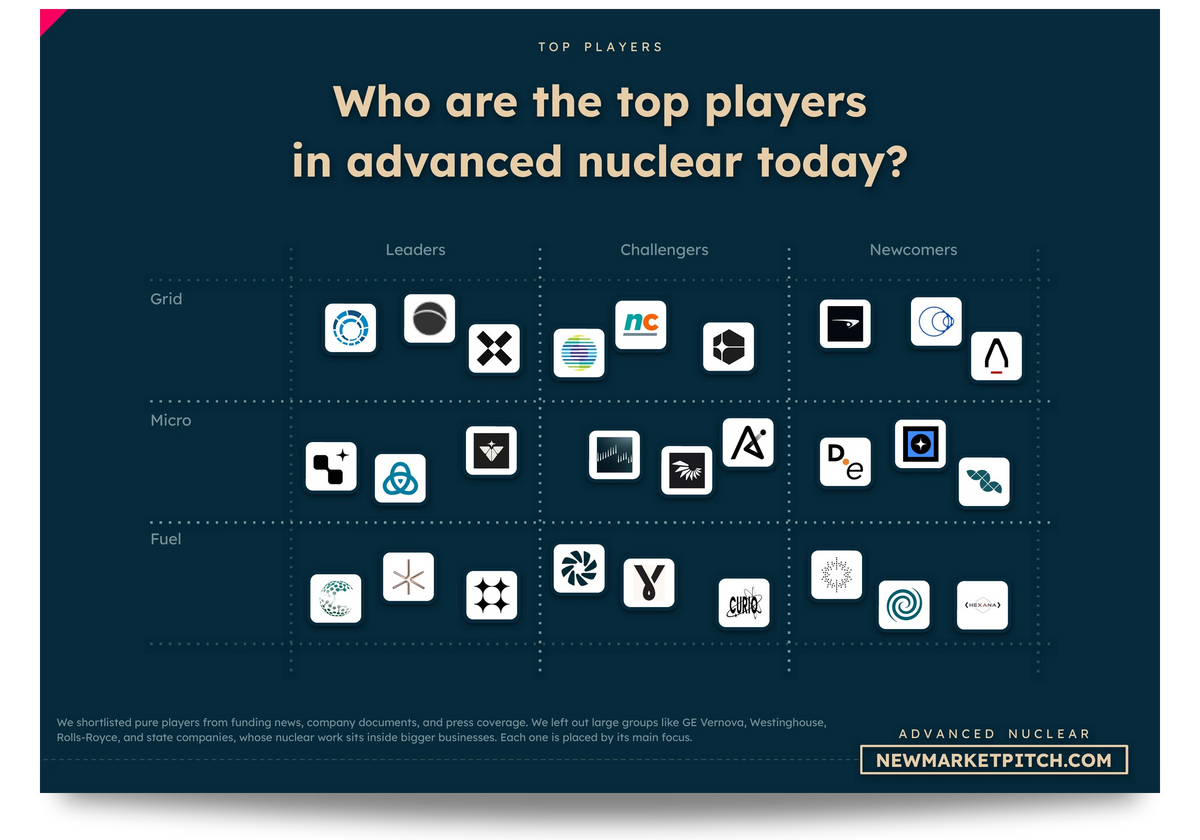
In our research about advanced nuclear reactors, we turn what is vague and complex into simple, useful visuals. Market maps like this one show you at a glance where every startup stands.
Is Amazon now the most important corporate investor in advanced nuclear?
Amazon is one of the strongest strategic investors in advanced nuclear because its relationship with X-energy combines direct financing with plans to purchase electricity from future reactors.
In October 2024, Amazon's Climate Pledge Fund anchored the initial $500 million Series C-1 financing announcement for X-energy. Other participants included affiliates of Ares Management, NGP and investors connected to Ken Griffin.
The investment was announced alongside plans involving Energy Northwest to develop an initial nuclear project of approximately 320 megawatts in Washington state.
Amazon and X-energy also outlined an ambition to support more than 5 gigawatts of advanced nuclear capacity in the United States by 2039.
To put that into perspective, 5 gigawatts would be enough generating capacity to match the output of roughly five large conventional nuclear reactors, depending on reactor size. It would also represent more than fifteen times the planned initial Washington project.
Amazon's role gives X-energy something many nuclear startups struggle to secure: a large prospective customer with a clear reason to buy its electricity.
The company has not committed to building every reactor covered by that long-term ambition, and commercial delivery still depends on licensing, construction and financing.
If you want more recent data on this point, please see our latest advanced nuclear market report.
Why has Jane Street become such a big name in advanced nuclear?
Jane Street has become a prominent advanced nuclear investor by financing X-energy at a stage when the company needed hundreds of millions of dollars to move closer to commercial deployment.
In February 2025, X-energy announced that its Series C-1 had reached $700 million. Jane Street participated alongside firms including Ares Management, Segra Capital Management and Emerson Collective.
Nine months later, Jane Street led another $700 million financing, X-energy's Series D. Returning investors included Ares, NGP, Emerson Collective and Segra, while new participants included ARK Invest, Point72, Hood River Capital Management and XTX Ventures.
X-energy therefore announced $1.4 billion across those two rounds in less than a year. The company did not disclose exactly how much Jane Street invested.
The scale is striking when compared with traditional early-stage nuclear financing. A startup developing a reactor prototype might initially need tens of millions of dollars. By the time it begins preparing manufacturing, fuel production and commercial deployment, its capital needs can reach hundreds of millions.
X-energy subsequently priced its IPO in April 2026 at $23 per share, offering approximately 44.3 million shares for gross proceeds of around $1.02 billion before any additional shares.

Your time is limited. In our market report about advanced nuclear reactors, we put numbers on each part of the market, so you can see where it makes sense to focus.
Which venture firms have invested in several advanced nuclear startups?
Valor Equity Partners is one of the clearest examples of a venture investor backing multiple advanced nuclear developers, while DCVC, Riot Ventures, Nucleation Capital and Gigafund show different forms of repeat commitment.
Valor led Aalo Atomics' $100 million Series B in August 2025. That round also included investors such as Fifty Years, Hitachi Ventures and NRG Energy.
Less than a year later, Valor participated in Valar Atomics' $1 billion Series B. The two startups are pursuing different approaches to building smaller nuclear power plants, giving Valor exposure to more than one development strategy.
Riot Ventures also appears repeatedly in Valar's financing history, including its earlier rounds and its 2026 Series B. DCVC has repeatedly backed Radiant, while Gigafund has supported Last Energy across several financing stages.
Nucleation Capital provides another example of a firm focused on nuclear innovation, including an investment in Aalo Atomics.
There are two types of repeat investor worth separating. A firm that keeps supporting one nuclear startup demonstrates continued confidence in that company. A fund backing several developers gains broader exposure to the sector, although it also faces risks across multiple reactor technologies.
Is DCVC still a leading investor in nuclear microreactors?
DCVC remains one of the most important early investors in nuclear microreactors because it helped finance Radiant before the company's funding rounds reached several hundred million dollars.
Radiant develops transportable reactors designed to provide electricity in places such as remote industrial facilities, military installations and locations with limited access to conventional power infrastructure.
In November 2024, the company announced an initial $100 million Series C led by DCVC. Andreessen Horowitz's American Dynamism team, Union Square Ventures, Felicis and Chevron Technology Ventures also participated.
By May 2025, the Series C had expanded to $165 million, again led by DCVC. Radiant reported cumulative venture funding of approximately $225 million at that point.
In December 2025, Radiant announced a Series D exceeding $300 million, led by Draper Associates and Boost VC. Lockheed Martin Ventures disclosed a strategic investment in Radiant in February 2026.
DCVC deserves particular credit for its early commitment. Draper Associates and Boost VC, meanwhile, stand out for leading the larger later-stage round.

In our document detailing everything you need to know about advanced nuclear, we always try to gather several sources and make estimates that make sense, so you can work with solid numbers.
Are industrial companies investing more seriously in advanced nuclear?
Industrial companies have been serious advanced nuclear investors for years, and their role is becoming more important as reactor startups prepare to manufacture and build actual power plants.
SK Group offers one of the strongest examples. SK Inc. and SK Innovation invested a combined $250 million in TerraPower in 2022, establishing a relationship focused on commercializing the company's Natrium technology.
TerraPower also attracted ArcelorMittal and Korean shipbuilding investors in its 2022 financing. HD Hyundai participated in the company's $650 million round in June 2025.
The relationship with Korean industrial companies has continued beyond equity financing. In August 2026, TerraPower announced agreements involving Hyundai Engineering & Construction and SK Innovation, including a framework for Hyundai E&C to support engineering, procurement and construction for up to eight future Natrium reactors.
There are older examples, too. Fluor became a majority shareholder in NuScale in 2011, while Doosan Enerbility later invested in the company and developed a role in supplying reactor components.
What has changed lately is the arrival of corporate venture investors from outside traditional nuclear engineering. NVentures joined TerraPower's 2025 financing, and Lockheed Martin Ventures invested in Radiant in 2026.
Which investors are backing the newest nuclear startups?
Sequoia Capital, Valor Equity Partners, Snowpoint Ventures, Riot Ventures and Caffeinated Capital are among the investors backing the newer generation of advanced nuclear startups, particularly Valar Atomics, Aalo Atomics and Antares Nuclear.
The amount of capital these young companies have attracted is striking.
Valar announced a $130 million Series A in November 2025, followed by a $1 billion Series B in August 2026. Antares Nuclear raised $96 million in December 2025 and announced another $470 million in July 2026. Aalo Atomics raised $100 million in August 2025.
Those five rounds alone add up to approximately $1.8 billion.
Valar attracted investors including Sequoia, Riot Ventures, Snowpoint Ventures and Valor Equity Partners. Antares' investors include Caffeinated Capital, Industrious Ventures, Point72 Ventures and Shine Capital, according to financing records. Aalo's Series B brought together Valor, Fifty Years, Hitachi Ventures and NRG Energy.
These startups are attracting substantial capital at relatively young ages because investors see opportunities in smaller, standardized reactors that could eventually be manufactured and deployed more quickly than conventional nuclear plants.
The technical progress differs considerably between companies. Valar reported achieving criticality with its Ward 250 reactor in June 2026, while Antares reported criticality with its Mark-0 reactor that same month. Aalo has been raising money to develop its Aalo-X demonstration plant.
| Startup | Selected financing | Important investors | Main focus |
|---|---|---|---|
| Valar Atomics | $1B Series B, 2026 | Sequoia, Riot, Valor | Factory-built advanced reactors |
| Antares Nuclear | $470M Series C, 2026 | Caffeinated Capital, Point72 Ventures, Shine | Specialized microreactors |
| Radiant | $300M+ Series D, 2025 | Draper Associates, Boost VC | Transportable microreactors |
| Aalo Atomics | $100M Series B, 2025 | Valor, Fifty Years, Hitachi Ventures | Modular nuclear plants |
| Last Energy | Approximately $100M Series C, 2025 | Gigafund, Astera Institute, AE Ventures | Standardized small reactors |
| Deep Fission | $80M private placement, 2026 | Ed Eisler, Mark Tompkins and other investors | Underground reactors |
| newcleo | $85M financing, 2026 | Kairos, Indaco, Azimut and industrial backers | Lead-cooled fast reactors |

Our report covering the advanced nuclear market gets updated several times a month, so you always get the latest view of where things stand.
Are European investors keeping up with the US nuclear investment boom?
European advanced nuclear companies are attracting substantial funding, although the largest recent US venture rounds remain difficult to match.
Newcleo is the strongest example of a European reactor developer raising capital on a comparable scale over several financing events.
In February 2026, the company announced an $85 million financing round, bringing the funding it had raised over the previous twelve months above $125 million and its cumulative funding since 2021 above $755 million.
Its investor base included Kairos, Indaco Ventures, Azimut Investments, the CERN pension fund and industrial investors such as Walter Tosto. Danieli and Cementir Holding also joined as industrial backers.
Newcleo then completed its merger with NewHold Investment Corp III in September 2026, raising approximately $247 million in gross proceeds through a combination of a $216 million private placement and $31 million from the SPAC trust.
By October, the company reported more than $1 billion in cumulative funding since its founding.
That total places newcleo among the best-funded advanced nuclear developers internationally. However, the money arrived through several transactions, including a public listing, rather than a single billion-dollar venture round like Valar's.
If you want more recent data on this point, please see our latest advanced nuclear market report.
Are Amazon and Google both investing directly in nuclear startups?
Amazon has a clearly documented equity investment in X-energy, while Google's landmark nuclear agreement with Kairos Power has been structured primarily around buying future electricity.
The two companies announced major nuclear agreements in October 2024, but the financial commitments serve different purposes.
Amazon's Climate Pledge Fund participated directly in X-energy's financing while supporting plans for an initial 320-megawatt development and a broader ambition involving more than 5 gigawatts of advanced nuclear power by 2039.
Google announced an agreement with Kairos Power for up to 500 megawatts of nuclear capacity by 2035, with the first commercial deployment originally targeted around 2030.
The proposed capacity under Amazon's broader collaboration is ten times Google's 500-megawatt framework. That comparison captures the scale of the ambitions, although neither represents electricity already being generated.
Google's agreement gives Kairos a potential customer for its reactors, which could support future financing and project development. Amazon has gone further by taking a publicly documented equity investment in X-energy.

In our research about advanced nuclear reactors, we look at what the winners do differently, so you can learn from the best instead of guessing.
Is the US government spending more on advanced nuclear than private investors?
The US government is one of advanced nuclear's largest financial supporters, with multibillion-dollar funding programs that help reactor developers reach stages private investors might struggle to finance alone.
In October 2020, the Department of Energy selected TerraPower and X-energy for initial awards of $80 million each under the Advanced Reactor Demonstration Program.
The broader program contemplated $3.2 billion in federal investment over seven years, subject to appropriations and matching private-sector contributions.
That is a substantial amount compared with individual venture rounds. However, the planned federal spending covered multiple activities and years, rather than representing one immediate investment into a company.
Government support also helps finance reactor testing, national laboratory facilities, nuclear fuel development and demonstration projects.
In September 2026, Antares announced selection for a $161 million strategic breakthrough award connected to demonstrating a space reactor. That award was separate from the company's $470 million private Series C.
Federal grants, cost-sharing agreements and contracts are financially important, but they generally do not give the government the same ownership position as a venture investor.
Are public-market investors putting more money into advanced nuclear than venture funds?
Public-market investors are now providing some advanced nuclear companies with more capital than even their largest private financing rounds.
X-energy provides one example. In April 2026, the company priced an IPO at $23 per share, initially offering approximately 44.3 million shares and raising around $1.02 billion in gross proceeds before any additional shares.
Oklo has raised even larger amounts through public share sales.
According to Oklo's second-quarter 2026 SEC filing, the company generated approximately $1.88 billion in gross proceeds from at-the-market equity sales during the first six months of 2026.
Approximately $1.20 billion came through its 2025 ATM program and another $680 million through its 2026 program.
For perspective, Oklo's six-month share issuance exceeded the value of Valar's $1 billion Series B, X-energy's $700 million Series D and TerraPower's $830 million 2022 financing.
Public-market offerings and ATM programs involve dispersed shareholders, while banks acting as sales agents should not automatically be counted as investors supplying their own capital.
If you want more recent data on this point, please see our latest advanced nuclear market report.

In our market report about advanced nuclear reactors, we don't want to repeat what boring consulting reports say. Instead, we show you the real and latest market signals that matter.
Are advanced nuclear investors finally funding real reactors instead of prototypes?
Advanced nuclear investors are increasingly financing construction, manufacturing and fuel production, with several companies now working on physical facilities rather than reactor designs alone.
TerraPower began non-nuclear construction activities for its Natrium project in Wyoming in 2024. X-energy has been developing its Xe-100 reactor and TRISO-X fuel manufacturing operations. Radiant has announced plans for its R-50 manufacturing facility in Tennessee.
Aalo Atomics has been preparing its Aalo-X demonstration reactor, while Valar Atomics reported achieving criticality with Ward 250 in June 2026. Antares Nuclear also reported reaching criticality with its Mark-0 reactor that month.
In Europe, newcleo reported in October 2026 that it had installed the main vessel and turbine for its PRECURSOR non-nuclear demonstration facility at the ENEA Brasimone research center in Italy.
These projects are not all at the same stage. A critical reactor demonstration, a non-nuclear engineering facility and a licensed commercial power plant represent very different levels of technical and financial progress.
NuScale's experience offers a warning. Its Carbon Free Power Project in Idaho was canceled in 2023 after projected costs rose and the project failed to secure sufficient customer subscriptions.
Could the biggest advanced nuclear investors lose billions?
Advanced nuclear investors could lose substantial amounts because company valuations and financing rounds have grown much faster than the number of commercially operating next-generation reactors.
Valar provides a revealing example. Its August 2026 financing valued the company at approximately $6 billion, including the new capital, according to reporting by the Los Angeles Times and Bloomberg.
That valuation reflects expectations about how quickly Valar could manufacture reactors and sell energy to customers. The company has demonstrated an operating reactor, but a factory producing commercial fleets remains a much larger undertaking.
X-energy has also raised enormous amounts while advancing the Xe-100 reactor, fuel manufacturing and its planned commercial projects. Each development carries engineering, licensing and construction risks.
TerraPower has a longer development history and substantial industrial support, but it must still demonstrate that its Natrium plant can deliver commercially useful power on a predictable schedule and budget.
Delays can force companies to raise additional capital, dilute existing shareholders or scale back development plans. NuScale's canceled Idaho project shows how quickly commercial economics can become a problem even after years of technical and regulatory progress.

Learning from others' mistakes is the cheapest lesson there is. In our document detailing everything you need to know about advanced nuclear, we look at what broke startups before you, so you don't repeat it.
Who are the top investors in advanced nuclear overall?
Bill Gates, Sequoia Capital, Amazon's Climate Pledge Fund, SK Group, Jane Street, Ares Management, DCVC and Valor Equity Partners currently form the strongest shortlist of leading advanced nuclear investors.
If we had to identify one person, Bill Gates would remain our choice. His involvement in TerraPower began in 2008, and he has supported its development through multiple financing rounds and the start of physical construction.
Among venture capital firms, Sequoia Capital stands out for the size of its recent commitment to Valar Atomics. Leading a $1 billion round in a company founded only three years earlier represents a particularly aggressive bet on nuclear manufacturing.
Amazon has one of the strongest positions among strategic corporate investors. Its combination of direct X-energy financing and prospective electricity demand gives it influence over both funding and commercialization.
SK Group stands out for its disclosed $250 million investment in TerraPower, while Jane Street and Ares Management have become important sources of large-scale institutional financing through X-energy.
DCVC and Valor Equity Partners deserve attention for different reasons. DCVC backed Radiant before its largest fundraising rounds, while Valor has invested across more than one reactor developer.
There is no single verified winner by total dollars invested. But the leaders are fairly clear by role: Gates has the strongest long-term individual record, Sequoia has made one of the boldest recent venture commitments, Amazon has exceptional strategic influence, and specialist investors continue to play a major role in financing the next generation of reactor developers.
If you want more recent data on this point, please see our latest advanced nuclear market report.
Our methodology
This analysis identifies the leading investors in advanced nuclear fission, including small modular reactors, microreactors and other advanced reactor technologies. We evaluated investors across capital mobilization, recent financing activity, consistency of backing, portfolio breadth, strategic importance and involvement in companies progressing toward commercial reactor deployment. Nuclear fusion investments are excluded.
We examined company financing announcements, investor disclosures, regulatory filings and government publications. Rather than ranking investors solely by the largest funding rounds, we compared their involvement across different financing stages and distinguished long-term backers from investors entering the sector through recent large transactions.
Funding round totals are attributed to the companies raising capital, not automatically to their lead investors. Where individual commitments were disclosed, such as SK Group's $250 million investment in TerraPower, we treated those figures separately. We also distinguished equity financing from debt facilities, government grants, public offerings, commercial power agreements and announced future capacity targets.
Our assessment gives weight to investors whose capital has supported reactor construction, fuel production, manufacturing preparation and commercial development. These milestones were evaluated separately because successful reactor criticality, non-nuclear construction and commercial electricity generation are not equivalent achievements.
Key sources include TerraPower's $830 million financing announcement, its original 2022 fundraising disclosure, its $650 million financing announcement in 2025, and its strategic collaboration with SK Group and KHNP.
For major US venture financings, we used Valar Atomics' $1 billion Series B announcement, X-energy's Amazon-backed financing announcement, X-energy's $700 million Series C-1 closing, its $700 million Series D announcement, and its IPO pricing disclosure.
Additional sources include Radiant's initial Series C announcement, its expanded Series C, its Series D financing, Aalo Atomics' Series B announcement, and Antares Nuclear's company updates.
For European financing, commercial partnerships and public-sector support, we consulted newcleo's financing disclosure, its September 2026 business combination announcement, Kairos Power's agreement with Google, and the US Department of Energy's Advanced Reactor Demonstration Program announcement. Public-market financing was assessed using Oklo's second-quarter 2026 SEC filing.

If you build or invest in the advanced nuclear market, you need to know which business models pay off now and which ones are fading. That's why our report covering it has a whole section on it.
Written by the New Market Pitch teamWe track new markets so founders and investors can move faster. About us