What are the latest funding trends in advanced nuclear?
Building a startup or looking for your next investment in advanced nuclear? Our report gives you the full picture.
Summary
Advanced nuclear funding in 2026 is rising sharply, but the boom is concentrated in very large follow-on rounds for companies that can increasingly show physical reactor, fuel or deployment progress.
Known equity funding reached at least $2.224 billion in the comparable period, up 77% from $1.256 billion last year and more than seven times the $293.7 million recorded two years earlier. Deal activity increased too, but much more slowly.
The median financing barely changed year on year, moving from $19 million to $19.9 million. The market therefore feels very different at the top without becoming dramatically easier for the typical startup.
Rounds above $100 million now absorb about 83% of known capital. Below $50 million, funding is actually 9% lower than in the previous comparable period, which makes the headline boom much less representative of ordinary venture rounds.
Valar Atomics, Antares and Standard Nuclear explain a large part of the jump. Their financings also illustrate what investors currently reward: reactor criticality, fuel manufacturing, testing progress and a believable path toward industrial deployment.
The funding curve has become steeper for young companies. First financings remain rare, while follow-on rounds account for roughly 90% of current deals and more than $2.19 billion of known capital.
High-temperature gas reactors currently dominate dollars, largely because of Valar, while light-water SMRs are producing one of the clearest clusters of new startup activity. Microreactors have fewer deals but much larger checks.
Advanced nuclear fuel is also becoming a more investable category. Standard Nuclear's $140 million Series A and continued financing activity around enrichment and TRISO production suggest investors increasingly see fuel as an infrastructure business rather than only a future bottleneck.
AI data-center demand is strengthening the commercial case for nuclear, particularly for Valar, Aalo, Bluecore and Kairos. But the largest financings still appear to depend more on technical proof and deployment readiness than on AI demand alone.
The U.S. is pulling far ahead in private funding scale. North America represents 70% of current deals but 92.5% of known capital, while European companies are still raising regularly but generally at much smaller sizes.
The main uncertainty is Valar Atomics, where the public record leaves open possible overlap between an earlier $340 million financing and the later $1 billion Series B. That can move the exact growth rate, but it does not change the central trend: advanced nuclear capital has moved into a much larger scale-up phase.

Written by the New Market Pitch teamWe track new markets so founders and investors can move faster. About us

In our report covering the advanced nuclear market, you will always find fresh funding data, taken straight from our own verified funding database.
All funding deals in the advanced nuclear market over the last years
Below is the table listing all the deals. You can find our methodology at the end of this page.
If you want a deeper understanding of the market and its current dynamics, get our report covering the advanced nuclear market.
| Company | Category | Date | Stage | Deal size | What they do | Region | Lead investors | Country | Rank |
|---|---|---|---|---|---|---|---|---|---|
| Kairos Power | Molten Salt Reactors | September 2026 | Growth Equity | $70M | Develops fluoride salt-cooled high-temperature reactors using solid TRISO fuel and molten fluoride-salt coolant. | North America | Not disclosed | United States | |
| Bluecore Energy | Light-Water SMRs | September 2026 | Seed | $50M | Develops approximately 10 MWe water-cooled SMRs mounted on floating barges for ports and other power-intensive infrastructure. | North America | Silverton Partners | United States | |
| HEXANA | Sodium-Cooled Fast Reactors | August 2026 | Unknown | $2.3M | Develops modular sodium-cooled fast reactors coupled with thermal storage for industrial heat and flexible electricity generation. | Europe | Not disclosed | France | |
| Apollo Atomics | Light-Water SMRs | August 2026 | Seed | $26M | Develops compact factory-built pressurized-water reactors using a high-power-density steam-generator architecture. | North America | FCVC | United States | |
| Valar Atomics | High-Temperature Gas Reactors | August 2026 | Series B | $1B | Develops modular helium-cooled, TRISO-fueled high-temperature gas reactors designed for factory production and deployment in fleets. | North America | Sequoia Capital | United States | |
| Antares | Microreactors | July 2026 | Series C | $370M | Develops factory-built, transportable fission microreactors for defense, space and remote-power applications. | North America | Paradigm; Caffeinated Capital | United States | |
| Nuclear Turbines | High-Temperature Gas Reactors | July 2026 | Seed | $19.9M | Develops compact high-temperature reactors that directly heat compressed air for commercial gas turbines, eliminating the conventional steam cycle. | Europe | IQ Capital | United Kingdom | |
| Bluecore Energy | Light-Water SMRs | July 2026 | Seed | $10M | Develops approximately 10 MWe water-cooled SMRs mounted on floating barges for ports and other power-intensive infrastructure. | North America | Slauson & Co. | United States | |
| OTRERA New Energy | Sodium-Cooled Fast Reactors | May 2026 | Unknown | ≈$11M | Develops a modular Generation IV sodium-cooled fast reactor for electricity and industrial heat. | Europe | Not disclosed | France | |
| Aalo Atomics | Microreactors | April 2026 | Series B | Not Disclosed | Develops factory-manufactured sodium-cooled microreactor power plants for data centers and other high-demand users. | North America | Not disclosed | United States | |
| Blue Energy | Light-Water SMRs | April 2026 | Unknown | $380M | Develops prefabricated modular nuclear plants built offsite and plans to convert gas-fired plants to nuclear. | North America | VXI Capital | United States | |
| LIS Technologies | Advanced Nuclear Fuel Systems | March 2026 | Unknown | $7.1M | Develops laser uranium-enrichment technology to produce LEU and HALEU for the nuclear fuel cycle. | North America | Not disclosed | United States | |
| Valar Atomics | High-Temperature Gas Reactors | March 2026 | Series B | $340M | Develops and deploys TRISO-fueled, helium-cooled high-temperature gas reactors at large industrial sites. | North America | Not disclosed | United States | |
| Applied Atomics | Light-Water SMRs | March 2026 | Seed | >$8.3M | Develops, builds and operates modular nuclear plants using established light-water reactor architecture for industrial customers. | North America | Transition Ventures | United States | |
| Jimmy Energy SAS | High-Temperature Gas Reactors | March 2026 | Series B | $46.6M | Develops high-temperature gas-cooled nuclear thermal generators for on-site industrial heat. | Europe | Crédit Mutuel Impact | France | |
| NuCube Energy, Inc. | Microreactors | February 2026 | Series A | $13M | Develops a high-temperature modular microreactor for electricity and industrial heat up to 1,100°C. | North America | Arizona Nuclear Ventures | United States | |
| newcleo | Lead-Cooled Fast Reactors | February 2026 | Unknown | $85M | Develops lead-cooled fast reactors and recycled nuclear fuel for advanced fission deployment. | Europe | Not disclosed | France | |
| X-Energy | High-Temperature Gas Reactors | January 2026 | Growth Equity | $5M | Develops the Xe-100 high-temperature gas-cooled SMR and associated TRISO-X fuel systems. | North America | Not disclosed | United States | |
| Standard Nuclear, Inc. | Advanced Nuclear Fuel Systems | January 2026 | Series A | $140M | Manufactures TRISO and HALEU fuel forms for advanced nuclear reactors. | North America | Decisive Point | United States | |
| LIS Technologies | Advanced Nuclear Fuel Systems | January 2026 | Unknown | $17M | Develops laser uranium-enrichment technology to produce LEU and HALEU for the nuclear fuel cycle. | North America | Not disclosed | United States | |
| Steady Energy Oy | Light-Water SMRs | January 2026 | Unknown | $2.4M | Develops the LDR-50 heat-only light-water SMR for district heating and industrial heat. | Europe | Not disclosed | Finland | |
| Blykalla | Lead-Cooled Fast Reactors | December 2025 | Unknown | $50M | Develops the SEALER, a compact lead-cooled fast reactor for commercial electricity and industrial applications. | Europe | Oklo; Norrsken Launcher; Armada Investment | Sweden | |
| Radiant | Microreactors | December 2025 | Series D+ | >$300M | Develops factory-built, transportable Kaleidos nuclear microreactors for defense, remote industry and critical infrastructure. | North America | Draper Associates; Boost VC | United States | |
| ARC Clean Technology | Sodium-Cooled Fast Reactors | December 2025 | Series B | $15M | Develops the ARC-100, a 100 MWe metal-fueled sodium-cooled fast small modular reactor. | North America | Not disclosed | United States | |
| Last Energy | Microreactors | December 2025 | Series C | ≈$100M | Develops factory-manufactured pressurized-water microreactor power plants for industrial and data-center customers. | North America | Astera Institute | United States | |
| Antares | Microreactors | December 2025 | Series B | $71M | Develops factory-produced TRISO-fueled microreactors for defense, terrestrial and space power applications. | North America | Shine Capital | United States | |
| X-Energy | High-Temperature Gas Reactors | November 2025 | Series D+ | ≈$700M | Develops the Xe-100 pebble-bed high-temperature gas reactor and its proprietary TRISO-X nuclear fuel. | North America | Jane Street | United States | |
| Valar Atomics | High-Temperature Gas Reactors | November 2025 | Series A | $105M | Develops compact helium-cooled, TRISO-fueled high-temperature gas reactors intended for mass-manufactured nuclear power sites. | North America | Snowpoint Ventures; Day One Ventures; Dream Ventures | United States | |
| Aalo Atomics | Microreactors | August 2025 | Series B | $100M | Develops factory-manufactured sodium-cooled microreactors and modular nuclear plants aimed initially at data-center power. | North America | Valor Equity Partners | United States | |
| Hadron Energy | Microreactors | July 2025 | Seed | $500K | Develops factory-manufactured light-water microreactors for data centers, industrial sites and remote power. | North America | Not disclosed | United States | |
| Stellaria | Molten Salt Reactors | July 2025 | Seed | ≈$16.2M | Develops a fast-neutron molten-salt breeder reactor for modular industrial heat and electricity generation. | Europe | At One Ventures; Supernova Invest | France | |
| Terrestrial Energy | Molten Salt Reactors | July 2025 | Unknown | $25.8M | Develops the Integral Molten Salt Reactor, a modular molten-salt fission plant for industrial heat and electricity. | North America | Not disclosed | United States | |
| HEXANA | Sodium-Cooled Fast Reactors | July 2025 | Seed | ≈$2.3M | Develops a modular sodium-cooled fast-neutron reactor platform for industrial heat and electricity generation. | Europe | Not disclosed | France | |
| Hadron Energy | Microreactors | July 2025 | Seed | $500K | Develops factory-manufactured light-water microreactors for data centers, industrial sites and remote power. | North America | Not disclosed | United States | |
| TerraPower | Sodium-Cooled Fast Reactors | June 2025 | Growth Equity | $650M | Develops the Natrium advanced reactor, combining a sodium-cooled fast reactor with integrated energy storage. | North America | Not disclosed | United States | |
| Standard Nuclear, Inc. | Advanced Nuclear Fuel Systems | June 2025 | Seed | $42M | Manufactures reactor-agnostic TRISO nuclear fuel for advanced reactors at commercial scale. | North America | Decisive Point | United States | |
| Radiant | Microreactors | May 2025 | Series C | $65M | Develops the factory-produced 1 MW Kaleidos portable nuclear microreactor. | North America | DCVC | United States | |
| LIS Technologies | Advanced Nuclear Fuel Systems | May 2025 | Series A | $11.9M | Develops proprietary laser isotope-separation technology primarily for uranium enrichment and production of LEU and HALEU. | North America | Not disclosed | United States | |
| General Matter | Advanced Nuclear Fuel Systems | April 2025 | Series A | $50M | Develops domestic uranium-enrichment capacity for LEU and HALEU nuclear fuel. | North America | Founders Fund | United States | |
| Thorizon | Molten Salt Reactors | March 2025 | Series A | $17.4M | Develops the Thorizon One cartridge-core molten-salt SMR for industrial heat and electricity. | Europe | Invest-NL | Netherlands | |
| Steady Energy Oy | Light-Water SMRs | March 2025 | Series B | $23.8M | Develops the LDR-50 low-temperature light-water SMR for district and industrial heat. | Europe | 92 Ventures | Finland | |
| Valar Atomics | High-Temperature Gas Reactors | February 2025 | Seed | $19M | Develops standardized helium-cooled high-temperature gas reactors for large off-grid nuclear power sites. | North America | Riot Ventures; Initialized Capital; AlleyCorp | United States | |
| Blykalla | Lead-Cooled Fast Reactors | February 2025 | Unknown | $15.6M | Develops the SEALER lead-cooled fast small modular reactor. | Europe | Not disclosed | Sweden | |
| X-Energy | High-Temperature Gas Reactors | February 2025 | Series C | $200M | Develops Xe-100 high-temperature gas-cooled SMRs and TRISO-X fuel for their deployment. | North America | Not disclosed | United States | |
| HEXANA | Sodium-Cooled Fast Reactors | January 2025 | Seed | $15.6M | Develops modular sodium-cooled fast reactors integrated with high-temperature thermal storage for industrial heat and power. | Europe | Not disclosed | France | |
| OTRERA New Energy | Sodium-Cooled Fast Reactors | December 2024 | Seed | ≈$2.6M | Develops a modular sodium-cooled fast-neutron reactor for combined electricity and industrial heat production. | Europe | Not disclosed | France | |
| Radiant | Microreactors | November 2024 | Series C | $100M | Develops the factory-built 1 MW Kaleidos transportable fission microreactor for remote and high-reliability power applications. | North America | DCVC | United States | |
| Antares | Microreactors | October 2024 | Series A | $30M | Develops compact transportable fission microreactors for defense, remote terrestrial infrastructure and space applications. | North America | Alt Capital; Caffeinated Capital | United States | |
| Rolls-Royce SMR Limited | Light-Water SMRs | October 2024 | Growth Equity | ≈$309M | Develops a factory-built 470 MWe pressurized-water small modular reactor for grid-scale nuclear generation. | Europe | Not disclosed | United Kingdom | |
| X-Energy | High-Temperature Gas Reactors | October 2024 | Series C | ≈$500M | Develops the Xe-100 high-temperature gas-cooled SMR and the TRISO-X fuel used to power advanced reactors. | North America | Amazon's Climate Pledge Fund | United States | |
| Blue Energy | Light-Water SMRs | October 2024 | Series A | $45M | Develops shipyard-manufactured modular nuclear power plants designed to deploy standardized small reactors with reduced on-site construction. | North America | Engine Ventures; At One Ventures | United States | |
| newcleo | Lead-Cooled Fast Reactors | September 2024 | Series A | $53.4M | Develops liquid-lead-cooled fast modular reactors integrated with a recycled-MOX nuclear fuel cycle. | Europe | Not disclosed | France | |
| Blykalla | Lead-Cooled Fast Reactors | September 2024 | Series A | $7.7M | Develops the SEALER family of lead-cooled fast small modular reactors. | Europe | 92 Ventures; Armada | Sweden | |
| Last Energy | Microreactors | August 2024 | Series B | $40M | Develops, owns and operates factory-manufacturable 20 MWe pressurized-water microreactor power plants. | North America | Gigafund | United States | |
| Deep Fission | Microreactors | August 2024 | Seed | $4M | Develops 15 MWe pressurized-water microreactors designed for deployment in mile-deep boreholes. | North America | 8VC | United States | |
| LIS Technologies | Advanced Nuclear Fuel Systems | August 2024 | Seed | $10.6M | Develops patented laser isotope-separation technology for uranium enrichment, including LEU and HALEU nuclear fuel. | North America | Not disclosed | United States | |
| Aalo Atomics | Microreactors | August 2024 | Series A | $27M | Develops factory-manufactured microreactor power plants for scalable nuclear generation. | North America | 50Y; Valor Equity Partners | United States | |
| Blue Capsule Technology | Sodium-Cooled Fast Reactors | July 2024 | Seed | $2.2M | Develops a high-temperature sodium-cooled modular reactor to supply industrial heat, steam and electricity. | Europe | Exergon | France | |
| Exodys Energy | Advanced Nuclear Fuel Systems | June 2024 | Seed | $2.4M | Develops UPCYCLE, a modular system that recycles spent nuclear fuel into usable feedstock for reactors. | North America | Not disclosed | United States | |
| newcleo | Lead-Cooled Fast Reactors | May 2024 | Series A | $94.1M | Develops lead-cooled fast reactors and a closed MOX fuel cycle using reprocessed nuclear material. | Europe | Not disclosed | United Kingdom | |
| Curio | Advanced Nuclear Fuel Systems | April 2024 | Seed | $7.5M | Develops NuCycle, a nuclear fuel-recycling process for recovering usable material from spent nuclear fuel. | North America | Synergos Holdings | United States | |
| Blykalla | Lead-Cooled Fast Reactors | April 2024 | Series A | $7.3M | Develops the SEALER lead-cooled fast small modular reactor for industrial heat and power. | Europe | Norrsken Launcher; Nucleation Capital | Sweden | |
| LIS Technologies | Advanced Nuclear Fuel Systems | March 2024 | Seed | $1.3M | Develops CRISLA laser uranium enrichment technology aimed at producing LEU and HALEU nuclear fuel. | North America | Not disclosed | United States | |
| Steady Energy Oy | Light-Water SMRs | March 2024 | Unknown | $10.9M | Develops the LDR-50 low-temperature light-water SMR for district and industrial heat. | Europe | Lifeline Ventures; Yes VC | Finland | |
| NANO Nuclear Energy | Microreactors | March 2024 | Series B | $2.5M | Develops portable advanced nuclear microreactors and associated HALEU fuel fabrication and transportation infrastructure. | North America | Not disclosed | United States | |
| Transmutex SA | Lead-Cooled Fast Reactors | January 2024 | Series A | $23M | Develops an accelerator-driven subcritical lead-cooled fast reactor to generate power while transmuting long-lived nuclear waste. | Europe | Union Square Ventures; Steel Atlas | Switzerland |

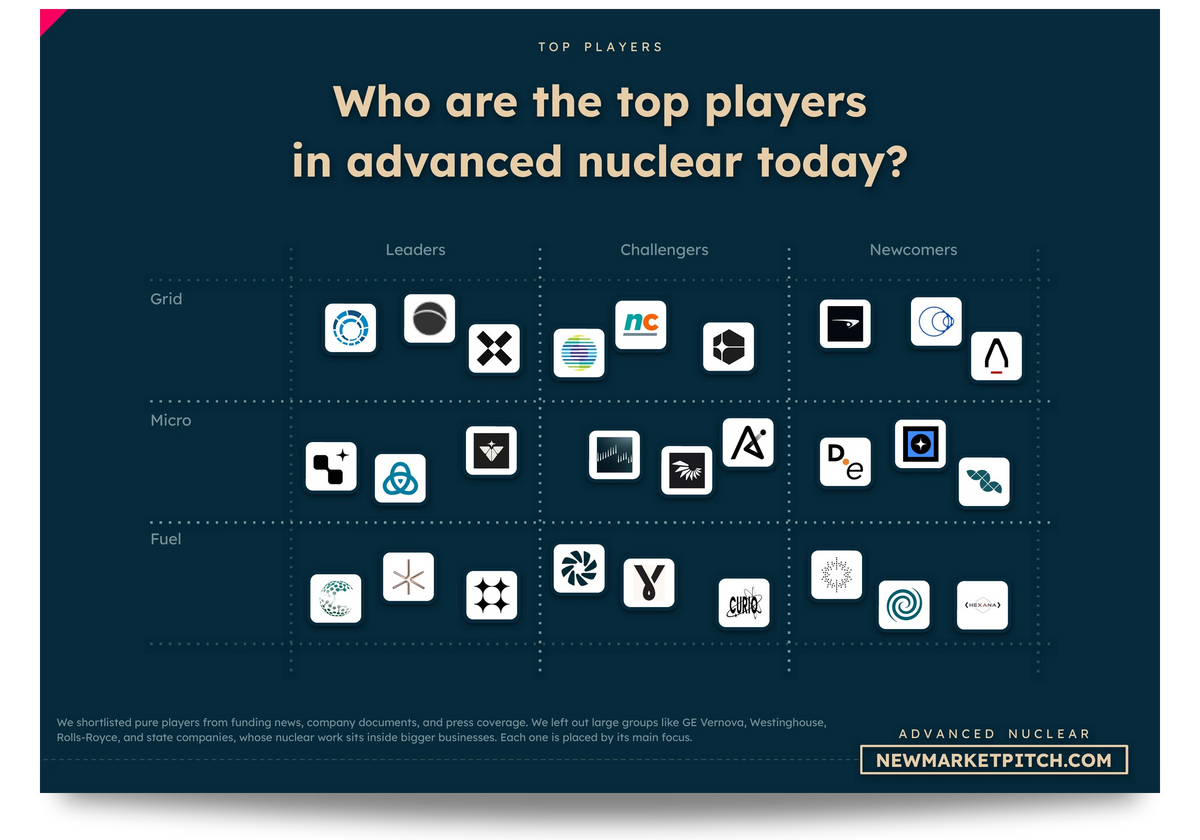
In our research about advanced nuclear reactors, we turn what is vague and complex into simple, useful visuals. Market maps like this one show you at a glance where every startup stands.
Is advanced nuclear funding really booming right now?
Advanced nuclear funding is clearly stronger today, but almost all of the acceleration is happening in the biggest rounds.
We counted 20 financings across 17 companies in the current comparable period, up from 17 deals across 15 companies a year earlier and 15 deals across 12 companies two years earlier. So activity has genuinely picked up. More companies are raising money.
The dollar increase is much bigger. Known equity funding reached at least $2.224 billion, versus $1.256 billion in the previous comparable period and $293.7 million two years earlier. That is a 77% year-on-year increase.
Yet the typical round barely moved. The median rose from $19.0 million to $19.9 million. The average jumped from $73.9 million to $117 million because the upper end of the market has become much larger.
There is one important uncertainty around Valar Atomics. We record its earlier $340 million equity financing and later $1 billion Series B separately, following the announced transactions, but reporting around the later round leaves open the possibility that part of the earlier capital is included in the $1 billion figure. Even with a conservative overlap adjustment, funding remains well ahead of last year. The size of the increase changes; the direction does not.
| Metric | Current YTD | Previous YTD | Two years earlier | Current vs previous |
|---|---|---|---|---|
| Deals | 20 | 17 | 15 | +17.6% |
| Unique companies | 17 | 15 | 12 | +13.3% |
| Known equity capital | ≥$2.224B | $1.256B | $293.7M | +77.1% |
| Median known round | $19.9M | $19.0M | $7.7M | +4.7% |
| Average known round | $117.0M | $73.9M | $19.6M | +58.4% |
| Largest round | $1.0B | $650M | $94.1M | +53.8% |
| $100M+ rounds | 4 | 3 | 0 | +1 |
| Funded companies | 17 | 15 | 12 | +13.3% |
Would advanced nuclear funding still look strong without the huge rounds?
No. Once we remove the largest advanced nuclear rounds, the year-on-year funding increase disappears.
Capital from rounds of $50 million or less is at least $218.7 million, down 9% from $240.7 million in the previous comparable period. Using a $100 million cutoff gives the same answer: current capital is at least $373.7 million, roughly 8% below last year.
That changes how we should read the headline.
Valar's $1 billion financing, Antares' $370 million equity round, Valar's earlier recorded $340 million equity financing and Standard Nuclear's $140 million Series A created a funding layer that barely existed two years ago. Four current deals above $100 million absorbed about 83% of known capital.
At the same time, the largest single deal is actually less dominant than last year's biggest transaction. Valar's $1 billion represents about 45% of current capital, whereas TerraPower's $650 million raise represented more than half of comparable 2025 funding.
The concentration has spread across several large winners. The five biggest transactions now account for roughly 87% of known capital.
For founders raising ordinary $10 million to $40 million rounds, the market currently looks much closer to last year than the $2.2 billion headline suggests.

Your time is limited. In our market report about advanced nuclear reactors, we put numbers on each part of the market, so you can see where it makes sense to focus.
Are more advanced nuclear startups actually getting funded?
Yes, advanced nuclear funding has become somewhat broader, with more deals and more funded companies than in either of the previous comparable periods.
We found 17 funded companies today, compared with 15 last year and 12 two years ago. Deal count increased from 17 to 20 year on year.
That is meaningful growth, but it is modest next to the increase in dollars.
Some of the extra activity also comes from companies financing themselves more than once. Valar appears twice in the current period. LIS Technologies raised twice. Bluecore Energy came out of stealth with an initial financing and then returned with another announced round shortly afterward.
So investors are funding a slightly larger group of companies, while the biggest change is how much they will commit once they decide a company deserves a scale-up round.
Are advanced nuclear rounds generally getting bigger?
Typical advanced nuclear rounds are only a little bigger today; the spectacular increase is almost entirely at the top.
The median known round is $19.9 million, barely above last year's $19 million. Two years ago it was $7.7 million, so there has been a real longer-term increase, but nothing close to the sevenfold rise in total capital versus that period.
What has changed is the ceiling.
Two years ago, no comparable-period financing exceeded $100 million. Last year there were three. There are four now, including one at $1 billion and two others above $300 million.
We can see the shift directly in the distribution. The $100 million-plus bucket captures 83.2% of current capital. Meanwhile, deals between $5 million and $20 million remain the most common size group.
That leaves a much more polarized market: plenty of relatively normal venture rounds at the bottom, plus a new class of very large industrial-scale financings at the top.
Why are advanced nuclear investors writing such huge checks now?
Advanced nuclear investors are writing much larger checks because several companies can now point to physical reactor, fuel and deployment milestones rather than relying mostly on future plans.
Antares is a good example. The U.S. Department of Energy announced that its Mark-0 reactor achieved zero-power criticality in 2026 at Idaho National Laboratory. The test gave Antares a physical proof point shortly before the company announced a $470 million financing package, of which we count $370 million as equity.
Valar reached another important milestone when its Ward 250 reactor achieved criticality under the DOE Reactor Pilot Program. Valar says the reactor later generated electricity during a public demonstration, before the company closed its $1 billion Series B led by Sequoia.
Standard Nuclear shows the same shift on the fuel side. Its $140 million Series A came alongside the start of commercial-scale HALEU TRISO fuel production. The company said the money would expand production infrastructure rather than fund an early research concept.
The broader U.S. environment has changed as well. The Department of Energy's reactor pilot effort pushed several privately developed advanced reactors toward criticality during 2026. Aalo, Antares and Valar are all part of that wider move from design work toward hardware and operations.
Investors can now judge some of these companies using evidence that simply did not exist a couple of years ago.

In our document detailing everything you need to know about advanced nuclear, we always try to gather several sources and make estimates that make sense, so you can work with solid numbers.
Which advanced nuclear companies are pulling funding upward?
Valar Atomics, Antares and Standard Nuclear explain most of the current advanced nuclear funding surge.
Valar alone represents the biggest concentration of capital. Its later $1 billion Series B is the largest transaction in our current-period dataset, while the earlier $340 million equity financing is also among the top three. As noted above, we preserve the possible overlap rather than pretending the public record is perfectly clean.
Antares adds another $370 million of equity. Standard Nuclear contributes $140 million. newcleo's private financing earlier in the year adds $85 million, while Kairos Power's announced Samsung C&T agreement includes $70 million of direct equity within a broader package of investment and engineering support.
The scale difference is enormous. The top four recorded financings alone represent well over four times the entire comparable-period advanced nuclear funding total from two years ago.
| Company | Recorded current financing | Category | Stage |
|---|---|---|---|
| Valar Atomics | $1.0B | High-Temperature Gas Reactors | Series B |
| Antares | $370M equity | Microreactors | Series C |
| Valar Atomics | $340M equity | High-Temperature Gas Reactors | Series B |
| Standard Nuclear | $140M | Advanced Nuclear Fuel | Series A |
| newcleo | $85M | Lead-Cooled Fast Reactors | Unknown |
| Kairos Power | $70M direct equity | Molten Salt Reactors | Growth Equity |
| Bluecore Energy | $50M | Light-Water SMRs | Seed |
| Jimmy Energy | ~$46.6M equity | High-Temperature Gas Reactors | Series B |
Are early-stage advanced nuclear startups having a harder time raising?
Early-stage advanced nuclear funding is still happening, but it currently represents a much smaller part of the market.
Seed and Series A deals make up 35% of current financings. That compares with 58.8% last year and 80% two years ago.
We should be careful with the exact stage percentages because six current deals have no reliably disclosed stage. Even so, the direction is hard to miss when we combine stage, round size and company history.
Series B alone accounts for 62.4% of known capital. Antares adds another huge Series C. Only a relatively small amount of current money is reaching companies at their first institutional financing.
Young startups can still raise. Nuclear Turbines secured roughly $19.9 million in its first recorded financing. Bluecore Energy emerged with an initial $10 million raise before announcing a much larger seed round. Apollo Atomics raised $26 million.
What we are seeing these days is a much steeper funding curve between 'interesting new reactor company' and 'company investors believe can actually build at scale.'

Our report covering the advanced nuclear market gets updated several times a month, so you always get the latest view of where things stand.
Are new advanced nuclear startups getting squeezed out?
New advanced nuclear companies are still appearing, but the funding boom is overwhelmingly benefiting companies that have already raised before.
Only two current financings are classified as first financings, equal to last year's count despite the increase in total activity. Two years ago there were three.
Those two current first financings account for about $29.9 million of known capital. Follow-on financings account for more than $2.19 billion.
That difference is too large to dismiss as normal variation.
Nuclear Turbines and Bluecore show that genuinely new companies can still attract venture money. But investors are committing dramatically more capital to established programs such as Valar, Antares, Standard Nuclear and newcleo.
Our first-financing classification comes from our review of publicly identifiable financing histories, so we use it as a directional measure rather than claiming we can reconstruct every private capital event perfectly.
The direction is still clear: today's extraordinary funding totals come from investors doubling down on companies that have already survived earlier rounds.
Why are high-temperature gas reactors getting so much attention?
High-temperature gas reactors are currently the strongest advanced nuclear funding category because they gained both more deals and much more capital.
HTGRs represent 25% of current deals, up from 11.8% in the previous comparable period. Their share of capital jumped from 17.4% to 63.5%.
Valar drives most of the dollar increase, but the category has more going on than one giant round. Jimmy Energy raised about $46.6 million of equity for its industrial-heat nuclear systems. Nuclear Turbines entered the market with roughly $19.9 million. X-Energy also received another equity investment.
Jimmy's financing is particularly useful because it shows a different commercial angle from Valar. Jimmy is targeting industrial heat rather than simply selling electricity, and its financing combined private equity with separate French state support.
HTGRs also benefit from the buildout of TRISO fuel capacity. That links reactor development with another part of the market that investors are now funding directly through companies such as Standard Nuclear.
Valar still makes the category's current capital share unusually high. We would therefore take the category's growing deal activity seriously while treating its 63.5% share of total dollars as much less stable.
| Category | Current deal share | Current capital share | Previous deal share | Previous capital share |
|---|---|---|---|---|
| High-Temperature Gas Reactors | 25.0% | 63.5% | 11.8% | 17.4% |
| Microreactors | 15.0% | 17.2% | 23.5% | 13.2% |
| Advanced Nuclear Fuel | 15.0% | 7.4% | 17.6% | 8.3% |
| Light-Water SMRs | 25.0% | 4.4% | 5.9% | 1.9% |
| Lead-Cooled Fast Reactors | 5.0% | 3.8% | 5.9% | 1.2% |
| Molten Salt Reactors | 5.0% | 3.1% | 17.6% | 4.7% |
| Sodium-Cooled Fast Reactors | 10.0% | 0.6% | 17.6% | 53.2% |

In our research about advanced nuclear reactors, we look at what the winners do differently, so you can learn from the best instead of guessing.
Are light-water SMRs becoming a real startup cluster?
Yes, light-water SMRs are currently producing one of the clearest new-company clusters in advanced nuclear, even though the checks remain relatively small.
Five current financings fall into this category, representing 25% of all deals. The comparable share last year was only 5.9%.
The companies are young. Bluecore Energy was founded recently and is developing floating water-cooled SMRs aimed at ports and other power-intensive infrastructure. Apollo Atomics is building compact pressurized-water systems. Applied Atomics is also using established light-water architecture rather than trying to invent a completely new reactor physics concept.
Bluecore is probably the clearest example of how quickly this part of the market is moving. It came out of stealth with an initial financing, then announced another $50 million round shortly afterward.
Yet the whole light-water SMR category represents only 4.4% of current capital.
So light-water designs are attracting founders and venture rounds right now, while the giant scale-up checks are still going elsewhere.
Are microreactors losing momentum?
Microreactors are attracting fewer advanced nuclear deals than last year, but the companies that break through are raising much more money.
Microreactor deal share fell from 23.5% to 15%. Capital share still increased from 13.2% to 17.2%.
Antares explains most of that change. Its $370 million equity Series C came after Mark-0 reached criticality, giving the company a technical milestone that a few years ago would have been extremely unusual for a venture-backed nuclear startup.
The company has kept adding operational evidence since then. Antares announced a multi-year TRISO fuel supply agreement with Standard Nuclear and later received a large government award connected to a space-reactor demonstration.
That combination of reactor testing, fuel supply and mission-specific customers helps explain why one microreactor company can now command a financing measured in hundreds of millions of dollars.
The category looks more selective than weak.
Did investors suddenly lose interest in sodium-cooled reactors?
No, the apparent collapse in sodium-cooled advanced nuclear funding mostly comes from an unusually large comparison deal.
Sodium-cooled reactors represented 53.2% of capital in the previous comparable period and only 0.6% now. That sounds dramatic until we look at TerraPower.
TerraPower raised $650 million last year. That single financing dominated the entire category and more than half of total market capital during the comparable period.
Current sodium-cooled activity includes HEXANA, but at much smaller financing sizes. HEXANA also recently brought Groupe M into its shareholder base through a €2 million strategic investment tied to an existing industrial partnership.
This is a good example of why category capital shares are particularly volatile in advanced nuclear. One construction-scale financing can move an entire reactor category from the top of the market to the bottom a year later.
We saw the same effect two years ago when lead-cooled reactors captured a huge share of capital.
For now, sodium-cooled funding looks quiet rather than abandoned.

In our market report about advanced nuclear reactors, we don't want to repeat what boring consulting reports say. Instead, we show you the real and latest market signals that matter.
Is advanced nuclear fuel becoming a serious investment category?
Yes, advanced nuclear fuel is becoming easier to finance because the market is moving from a future supply-chain problem toward actual production.
Standard Nuclear's $140 million Series A is the standout transaction. The company says it already operates commercial-scale TRISO manufacturing infrastructure and is using the new capital to expand production capacity.
LIS Technologies also raised twice during the current period as it develops laser uranium-enrichment technology for LEU and HALEU.
This part of the market gives investors a different exposure from betting on one specific reactor platform. A reactor-agnostic fuel supplier can potentially sell into several developers if deployment expands.
Recent company activity makes that argument more tangible. Antares announced a multi-year TRISO supply agreement with Standard Nuclear. The Department of Energy has also been running programs aimed at expanding advanced fuel availability alongside its reactor pilot work.
Fuel still represents less capital than the largest reactor categories today. What has changed is the proximity to real manufacturing and real customers.
Are advanced nuclear investors becoming more selective?
Yes, advanced nuclear investors currently look more selective, and the reward for passing that filter has become much bigger.
Several pieces fit together. The share of first financings is low. Follow-ons account for 90% of deals. The median company age at financing increased from about 2.2 years to 3.3 years. Later-stage rounds absorb most of the capital.
Meanwhile, we do not see an explosion in the number of disclosed lead investors. We identified 11 current lead or co-lead investors, the same number as in the previous comparable period.
What has changed is the check size attached to conviction.
Sequoia led Valar's $1 billion Series B. Paradigm and Caffeinated Capital co-led Antares' large Series C. Decisive Point led Standard Nuclear's $140 million Series A. IQ Capital backed Nuclear Turbines, while Silverton Partners led Bluecore's later seed financing.
None of the disclosed current leads appears on more than one deal in our dataset. Capital is therefore being spread across different sponsors, but each sponsor is making a relatively concentrated company-level bet.
It looks increasingly like investors are picking programs they think can reach deployment rather than rushing into anything with 'nuclear' in the pitch deck.
Are strategic investors taking over advanced nuclear funding?
Strategic investors are currently showing up in important advanced nuclear deals, but they have not become more common overall.
We count strategic participation in five current financings, the same number as in the comparable previous period. Their share of deals actually slipped from 29.4% to 25%.
The interesting change is what some of those relationships involve.
Fortum invested €2.1 million into Steady Energy while also agreeing to provide nuclear operations and maintenance expertise. Groupe M invested in HEXANA after its subsidiary had already worked with the company as an industrial supplier. newcleo's strategic backers include companies linked to reactor components and industrial applications.
Kairos Power gives us the clearest recent example. Samsung C&T agreed to provide up to $100 million through direct investment and engineering services, subject to approvals, while working with Kairos on Hermes 2 and future reactor deployment. Kairos said shortly afterward that adding Samsung C&T to its EPC team should improve execution and cost and schedule certainty.
Strategic participation is becoming more useful operationally even though it is not becoming more frequent.

Learning from others' mistakes is the cheapest lesson there is. In our document detailing everything you need to know about advanced nuclear, we look at what broke startups before you, so you don't repeat it.
Is AI data-center demand really pushing advanced nuclear funding higher?
AI data-center demand is giving advanced nuclear companies a much stronger commercial story, although we cannot isolate how much of the funding increase comes directly from AI.
The connection has become much more concrete lately.
Valar says its $1 billion financing will help scale standardized plants for artificial intelligence, industrial and national-security power demand. The company also demonstrated its Ward 250 reactor powering Nvidia Blackwell hardware.
Aalo describes its reactors as purpose-built for AI data centers and is developing a plant designed to sit alongside data-center infrastructure. Bluecore is targeting ports and other electricity-hungry infrastructure. Kairos is working toward commercial deployment while its technology is already tied to Google's nuclear-power strategy.
The broader electricity-demand environment helps because nuclear developers can now point to large customers actively looking for firm power, rather than relying purely on long-range forecasts.
Still, the biggest current rounds have something else in common: reactor criticality, manufacturing infrastructure, fuel supply, government testing programs or concrete deployment partners.
AI demand improves the revenue story. Technical progress appears to determine who gets the giant check.
Is the U.S. pulling away from Europe in advanced nuclear funding?
Yes, U.S. Advanced nuclear companies are currently raising much larger private rounds than their European peers.
North America accounts for 70% of current deals and 92.5% of known capital. Europe still has six financings, so there is no shortage of European activity. The gap is mostly about scale.
Valar, Antares and Standard Nuclear alone represent more than $1 billion of U.S. funding. Europe has meaningful financings from newcleo, Jimmy Energy and Nuclear Turbines, but none reaches the same hundreds-of-millions range in our private-funding dataset.
France is one of the stronger European pockets. Jimmy raised €40 million of private equity alongside separate public support, and HEXANA attracted new industrial capital.
newcleo is now a special case because it moved into the public markets. The company completed its business combination and began trading on Nasdaq in 2026, raising gross proceeds that sit outside our private-company funding comparison. That listing also shows how the European financing path can eventually move beyond private venture rounds entirely.
The regional gap remains very large in private capital today, while Europe's most mature companies may increasingly use different financing channels.

If you build or invest in the advanced nuclear market, you need to know which business models pay off now and which ones are fading. That's why our report covering it has a whole section on it.
Could advanced nuclear funding finish at a record level?
Yes, advanced nuclear funding is already close enough to previous full-year totals that another sizeable financing could push the market well beyond recent years.
Current known capital equals about 86% of the entire previous year's total, even though our primary comparison stops well before year-end. Current deal count is 20 versus 24 during that full previous year.
Compared with the year before that, current funding has already reached roughly 174% of the entire annual total, while deal count is already close to the full-year figure.
We should not annualize those numbers. Advanced nuclear funding is far too lumpy for a straight-line projection. A single reactor financing can add hundreds of millions of dollars in one day.
But the starting point is unusually strong.
Even without another $1 billion deal, one or two large scale-up rounds would be enough to make the final annual capital total stand out historically.
What is actually changing in advanced nuclear funding?
Advanced nuclear funding is getting stronger, more top-heavy and much more focused on companies that can show physical progress.
The biggest change is the arrival of a genuine scale-up financing tier. Rounds above $100 million now account for more than four-fifths of known capital. Two years ago, there were none in the comparable period.
More companies are also raising, so the market has not narrowed to a tiny handful of names. Seventeen companies received funding versus 15 last year and 12 two years ago. The increase in participation is real, just much smaller than the increase in dollars.
As seen above, normal-sized funding has not strengthened in the same way. Capital below the $50 million and $100 million thresholds is slightly lower than last year. A startup raising a normal venture round should therefore not read the headline funding growth as evidence that every part of the market has become easier.
Investors are also putting more money behind companies with proof. Reactor criticality at Antares and Valar, fuel production at Standard Nuclear, and deployment-oriented partnerships at Kairos all point in the same direction. Technical and industrial progress now has a much more obvious financial reward.
HTGRs currently have the strongest category momentum, while light-water SMRs are producing more new startup activity. Microreactors are seeing fewer but much larger financings. The apparent collapse in sodium-cooled funding is mostly a TerraPower comparison effect.
The main caution remains the exact Valar total because of the possible overlap between its recorded financings. That uncertainty can move the headline growth rate substantially. It does not change the broader picture we see today: advanced nuclear investors are willing to commit unprecedented amounts once a company looks capable of moving from reactor development into actual deployment.
Our methodology
This analysis measures advanced nuclear fundraising from January 1 through October 7, 2026 and compares it with the strictly equivalent January 1 through October 7 periods in 2025 and 2024. Full-year figures are used only as secondary context and are not treated as directly comparable with the year-to-date periods.
We focus on qualifying private-company equity financings. Debt, grants, loans, unconverted debt-like instruments, public-market offerings and other non-equity capital are excluded from the funding totals. When a financing package combines several forms of capital, we count only the identifiable equity component. That is why Antares' $470 million package contributes $370 million to the equity total and Jimmy Energy's €80 million package contributes only the €40 million private-equity portion.
Companies also have to pass a strict market-definition test: advanced nuclear must be a core part of the company's business at the time of financing. We treat genuine financing events separately while consolidating duplicate reporting, extensions or tranches when the evidence indicates they belong to the same transaction.
Dates, stages, lead investors, strategic participation, company histories and financing amounts are recorded only when supported by public evidence. We do not infer round labels from deal size, assume that a prominent investor led a financing, or estimate undisclosed amounts simply to make the dataset look more complete.
Where credible public reporting leaves uncertainty, we keep it visible. The most important example is Valar Atomics, whose earlier $340 million financing and later $1 billion Series B are recorded as announced while preserving the possibility of partial overlap. Bluecore Energy's financing history also requires care when distinguishing separate announced transactions.
After compiling the dataset, we ran a separate quality-control pass for missed deals, date boundaries, duplicate transactions, equity-versus-debt classification, unusual financing structures and market eligibility. The goal is to keep the comparison consistent across all three periods rather than maximize the headline total.
Key sources used in the analysis include the U.S. Department of Energy on Antares' Mark-0 criticality and its Reactor Pilot Program, Valar Atomics on its $1 billion Series B, Antares' company updates, Standard Nuclear on its $140 million Series A and HALEU TRISO production, and Kairos Power on its Samsung C&T investment and engineering collaboration.
We also used Fortum's announcement on Steady Energy, Jimmy Energy's financing announcement, HEXANA on Groupe M's strategic investment, Bluecore Energy on its $50 million financing, Aalo Atomics on its Series B, TerraPower's $650 million financing, X-Energy's financing announcement, and newcleo's public-market transition.

In our research about advanced nuclear reactors, we like to show you the big picture. We know your time is precious, so we make every page quick to read and packed with as much learning as possible per minute.
Written by the New Market Pitch teamWe track new markets so founders and investors can move faster. About us