How big is the advanced nuclear market before mass deployment?
Whether you're building or investing in the advanced nuclear market, our report covers everything you need to know: the players, the money, and what's coming next.
Summary
The advanced nuclear market is roughly a $5 billion-a-year market today on a strict SMR investment basis, with the broader advanced-fission ecosystem probably already in the high-single-digit billions once fuel, microreactors and dedicated supply-chain investment are included.
Revenue makes the market look much smaller than it really is. Most Western developers still earn tens of millions rather than billions because the reactors absorbing today's capital will not generate electricity revenue for years.
The market has crossed an important line from development into construction. Ontario's BWRX-300, TerraPower's Natrium and Kairos Power's Hermes projects mean advanced nuclear can no longer be described mainly as licensing work, prototypes and PowerPoint pipelines.
Government funding still absorbs much of the first-of-a-kind risk. Public money is financing reactor demonstrations, fuel infrastructure, licensing and early project development before utilities and private customers are willing to carry the full risk themselves.
Private capital is getting much larger at the same time. Several reactor developers can now raise hundreds of millions of dollars, and X-energy has moved into billion-dollar public-market financing territory.
The customer market is also becoming more concrete. Amazon, Google, Dow, utilities and European governments are attaching specific sites, capacities and development programs to advanced reactors rather than simply saying they are interested in nuclear power.
The headline reactor pipeline is much bigger than the current market, but it needs a heavy discount. Projects already financed or under construction deserve far more weight than contingent gigawatt targets that may take a decade or more to convert into actual orders.
Fuel may become a market almost as strategically important as the reactors themselves. Billions are already being committed to HALEU enrichment, TRISO fabrication, graphite and heavy-component manufacturing because many proposed reactor fleets cannot exist without those supply chains.
The industry still has far more designs than the market can support. The next few years are likely to concentrate spending around a much smaller group of reactor platforms that can secure permits, factories, fuel and repeat customers.
The real economic test is repetition. Advanced nuclear can plausibly become a $25 billion-plus annual investment market around 2030, but only if the first plants prove that later units can be delivered faster and cheaper instead of becoming another generation of bespoke nuclear megaprojects.

Written by the New Market Pitch teamWe track new markets so founders and investors can move faster. About us

Your time is limited. In our report covering the advanced nuclear market, we put numbers on each part of the market, so you can see where it makes sense to focus.
What should actually count as the advanced nuclear market today?
The advanced nuclear market today is best measured by the money already going into new reactors, fuel, factories and first projects, which puts the current market at roughly $5 billion a year on a strict SMR investment basis and somewhat higher if we include the wider advanced-fission supply chain.
We need that definition because almost none of the sector can be measured cleanly through electricity sales yet. The useful scope includes small modular reactors such as GE Hitachi's BWRX-300 and Rolls-Royce SMR, Generation IV systems such as TerraPower's Natrium and Kairos Power's fluoride-salt-cooled reactor, high-temperature gas reactors such as X-energy's Xe-100, and microreactors from companies such as Radiant.
Fuel and manufacturing also belong in the calculation when they are being built specifically for these reactors. HALEU enrichment, TRISO fuel plants, nuclear graphite production and specialized reactor factories are already absorbing real capital.
We should exclude most spending on conventional large reactors, existing nuclear fleets and life extensions. The IEA estimates annual investment across nuclear power much more broadly at tens of billions of dollars, but folding all of that into advanced nuclear would tell us very little about this market.
Fusion should stay separate as well. It attracts some of the same investors and energy buyers, but its technology, deployment timeline and industrial chain are different enough to distort the calculation.
| What we measure | What it captures | Approximate scale now |
|---|---|---|
| Electricity from advanced reactors | Existing commercial fleet | Very small |
| Advanced reactor company revenue | Engineering, development and government work | Hundreds of millions |
| Annual SMR investment | Projects being developed and built | Around $5bn |
| Advanced fuel infrastructure | HALEU, TRISO and related capacity | Billions committed over several years |
| First reactor programs | Approved construction budgets | Tens of billions |
| Announced deployment pipelines | Possible future reactor construction | Much larger, but less certain |
| Mature advanced nuclear market | Repeated commercial deployments | Still ahead |
Why is the advanced nuclear market so hard to size before mass deployment?
The advanced nuclear market is hard to size because billions can be spent several years before a reactor produces commercial electricity.
X-energy shows the problem clearly. Its latest half-year results reported roughly $98 million of revenue and grant income, while operating expenses were far higher as the company increased engineering, procurement and work under the U.S. Advanced Reactor Demonstration Program.
NuScale offers another example. It generated only around $31.5 million of revenue in 2025, mostly from engineering and licensing work rather than reactor operation.
TerraPower makes the gap even more obvious. The company raised $650 million in 2025, then formally started construction of its Natrium plant in Wyoming this year after receiving its NRC construction permit.
Current reactor revenue remains small, while money being invested now is already measured in billions. For a pre-deployment industry, annual investment tells us much more than electricity revenue.

In our research about advanced nuclear reactors, we always try to gather several sources and make estimates that make sense, so you can work with solid numbers.
Is advanced nuclear already a real commercial electricity market?
No. Advanced nuclear electricity sales are still too small to describe the sector as a mature power market today.
The world's existing nuclear fleet remains overwhelmingly conventional. IAEA operating data show more than 400 nuclear reactors in service globally, while advanced designs account for only a tiny fraction of commercial generation.
Russia has operated the Akademik Lomonosov floating nuclear plant for several years, and China has brought advanced projects such as the HTR-PM high-temperature gas reactor into operation. These projects matter because they prove that advanced reactor technologies can reach the grid.
They have not yet produced the kind of repeated deployment Western SMR developers are promising.
That is changing at the construction level. Ontario is building the first BWRX-300 at Darlington. TerraPower has started construction of Natrium in Wyoming. Kairos Power broke ground this year on Hermes 2, a 50 MW commercial-scale demonstration reactor in Tennessee.
So we can already see the next commercial fleet taking physical shape. Revenue from that fleet will come later.
How much money is actually going into advanced nuclear right now?
Roughly $5 billion a year is the strongest defensible anchor for advanced nuclear investment today, and current projects suggest that annual spending could rise quickly from here.
The IEA's work on SMRs estimates annual investment at around $5 billion today. In its stronger deployment scenario, that climbs above $25 billion around 2030.
Current projects fit that order of magnitude.
Ontario has approved a C$20.9 billion budget covering development and construction of four BWRX-300 reactors at Darlington. That money will be spent over many years rather than in a single year, but the first reactor is already under construction and a 2.1-million-pound basemat module was installed this year.
The UK has allocated £2.6 billion to launch its SMR program with Rolls-Royce SMR. The British program has now moved beyond selection: Great British Energy-Nuclear signed the development contract with Rolls-Royce SMR this year.
The United States is spending heavily upstream as well. The Department of Energy awarded $2.7 billion in uranium enrichment contracts early this year, including $900 million each for Centrus and General Matter to develop HALEU capacity that advanced reactors will need.
Those programs overlap in time, so adding every headline budget together would inflate the annual market. Their scale still fits a several-billion-dollar annual industry.

In our market report about advanced nuclear reactors, we don't want to repeat what boring consulting reports say. Instead, we show you the real and latest market signals that matter.
Are advanced nuclear companies making serious revenue yet?
Advanced nuclear companies are starting to post meaningful revenue, but none of the leading Western developers has reached fleet-scale reactor economics.
X-energy is the clearest public example now. Its latest quarterly results showed $54.6 million of revenue and grant income, up from $21.5 million a year earlier. Across the first half, the figure reached about $98 million.
Most of that activity still comes from services and government-supported development. X-energy's spending remains substantially above its revenue because the company is simultaneously developing the Xe-100, building fuel capacity and preparing its first projects with Dow and Amazon.
NuScale remains smaller commercially. Its 2025 revenue came in at roughly $31.5 million, generated largely through engineering and project work.
The numbers are meaningful, but they still describe development-stage companies rather than reactor vendors operating large fleets.
Is government money still carrying the advanced nuclear market?
Yes. Government money still carries a large share of the expensive early risk in advanced nuclear, even as private customers and investors become more important.
The U.S. Advanced Reactor Demonstration Program remains one of the biggest examples. TerraPower and X-energy were selected for cost-shared demonstration projects, with federal commitments running into billions of dollars.
Washington has since pushed further upstream into fuel. The Department of Energy's new $2.7 billion enrichment program includes two $900 million HALEU awards, one to Centrus and another to General Matter, plus $900 million for Orano to expand conventional low-enriched uranium capacity.
Britain is taking a similar approach with Rolls-Royce SMR. The government has allocated £2.6 billion to the SMR program and is paying for the work needed to turn the selected design into a buildable project.
Canada's model is slightly different because a provincial utility is leading construction directly. Ontario Power Generation owns the Darlington project, while public financing from Ontario and the federal government supports the capital structure.
Private buyers are beginning to absorb more demand risk through agreements with Google, Amazon, Dow and other customers. For now, governments still carry much of the technology, licensing and first-project risk.
Is private money becoming large enough to change the market?
Yes. Private advanced nuclear funding has moved from small technology bets into rounds and public offerings worth hundreds of millions or more.
TerraPower raised $650 million in 2025 from investors including Bill Gates, HD Hyundai and Nvidia's venture arm. The money arrived while the company was preparing Natrium for construction rather than funding an early laboratory concept.
Radiant closed a $165 million Series C in 2025 and then raised more than $300 million later that year. The company says the newer funding will help it scale commercialization and build its R-50 microreactor factory in Oak Ridge.
X-energy has gone further. After large private rounds, the company completed its stock-market listing this year and raised roughly $1.1 billion in net proceeds.
These sums are still small compared with what full reactor fleets will cost, but they are large enough to finance factories, engineering teams, fuel plants and early procurement.
| Company | Recent capital event | What it helps fund |
|---|---|---|
| X-energy | ~$1.1bn net IPO proceeds | Reactor, fuel and project scaling |
| X-energy | Two $700m private rounds | Commercialization and supply chain |
| TerraPower | $650m financing | Natrium development and deployment |
| Radiant | >$300m financing | Microreactor factory and commercialization |
| Radiant | $165m Series C | Kaleidos development and testing |
| Valar Atomics | $130m financing | High-temperature reactor development |
| Other reactor startups | Tens to hundreds of millions | Licensing, demonstrations and factories |
If you want more recent data on this point, please see our latest advanced nuclear market report.

In our document detailing everything you need to know about advanced nuclear, we like to show you the big picture. We know your time is precious, so we make every page quick to read and packed with as much learning as possible per minute.
Are Amazon and Google creating a real advanced nuclear customer market?
Yes. Amazon and Google have moved advanced nuclear demand well beyond vague corporate interest, although most of the capacity they want still depends on reactors that have never operated commercially.
Amazon's relationship with X-energy is especially large. Its first project with Energy Northwest starts with four Xe-100 units totaling 320 MW and could expand to 960 MW. The wider plan targets more than 5 GW of new nuclear capacity in the United States by 2039.
Google's agreement with Kairos Power covers up to 500 MW by 2035. More importantly, the first piece now has a specific reactor, utility and site. Hermes 2 is under construction in Oak Ridge and is expected to provide up to 50 MW to the Tennessee Valley Authority grid under the first binding U.S. utility power purchase agreement for an advanced reactor. That grid supplies Google's data centers in Tennessee and Alabama.
Industrial demand is developing alongside data-center demand. X-energy's first major Xe-100 project is planned at Dow's Seadrift site in Texas, where the reactors would provide both electricity and high-temperature industrial steam.
So the early customer base is already broader than hyperscalers. Utilities, chemical plants and data centers are all testing advanced reactors for slightly different reasons.
The commercial question now is whether the first projects can be delivered cheaply enough for those customers to order the second fleet.
How big is the advanced nuclear order pipeline now?
The advanced nuclear pipeline is already measured in tens of gigawatts, but only a fraction is firm enough to treat like a real reactor order book.
X-energy currently reports the clearest large Western pipeline. Its latest results put the total at 144 Xe-100 reactors and about 11.5 GW across the United States and UK, assuming customers exercise all of their contingent rights. Dow, Amazon and Centrica account for that pipeline.
The behavior behind those numbers is getting more serious. X-energy and Doosan have a binding reservation agreement covering manufacturing capacity for 16 reactors. X-energy also signed a ten-year graphite agreement with SGL Carbon, including an initial three-year award worth more than $100 million, and recently agreed to fund an expansion that could provide graphite billets for up to eight reactors per year.
Google and Kairos add another 500 MW pathway, with Hermes 2 already representing the first 50 MW.
Ontario's four BWRX-300 units contribute about 1.2 GW, with the first reactor physically under construction.
Rolls-Royce SMR now has commitments in more than one European market. Britain selected it for the country's first SMRs, while Swedish developer Videberg Kraft chose Rolls-Royce SMR this year for a multibillion-pound nuclear program.
The gap between a pipeline and an order book remains large, especially for long-range capacity options.
| Project or pipeline | Potential capacity | How far has it gone? |
|---|---|---|
| X-energy total pipeline | ~11.5 GW | Customers identified; much remains contingent |
| Amazon/X-energy U.S. target | >5 GW | First project in development |
| X-energy/Centrica UK ambition | ~6 GW | Early development |
| Ontario BWRX-300 fleet | 1.2 GW | First reactor under construction |
| Google/Kairos agreement | Up to 500 MW | First 50 MW project under construction |
| Energy Northwest/X-energy | 320 MW initially | Development and supply-chain work underway |
| Rolls-Royce SMR UK program | Up to ~1.5 GW initially | Developer selected and contracted |
| Rolls-Royce SMR Sweden | Multireactor program | Developer selected |
If you want more recent data on this point, please see our latest advanced nuclear market report.

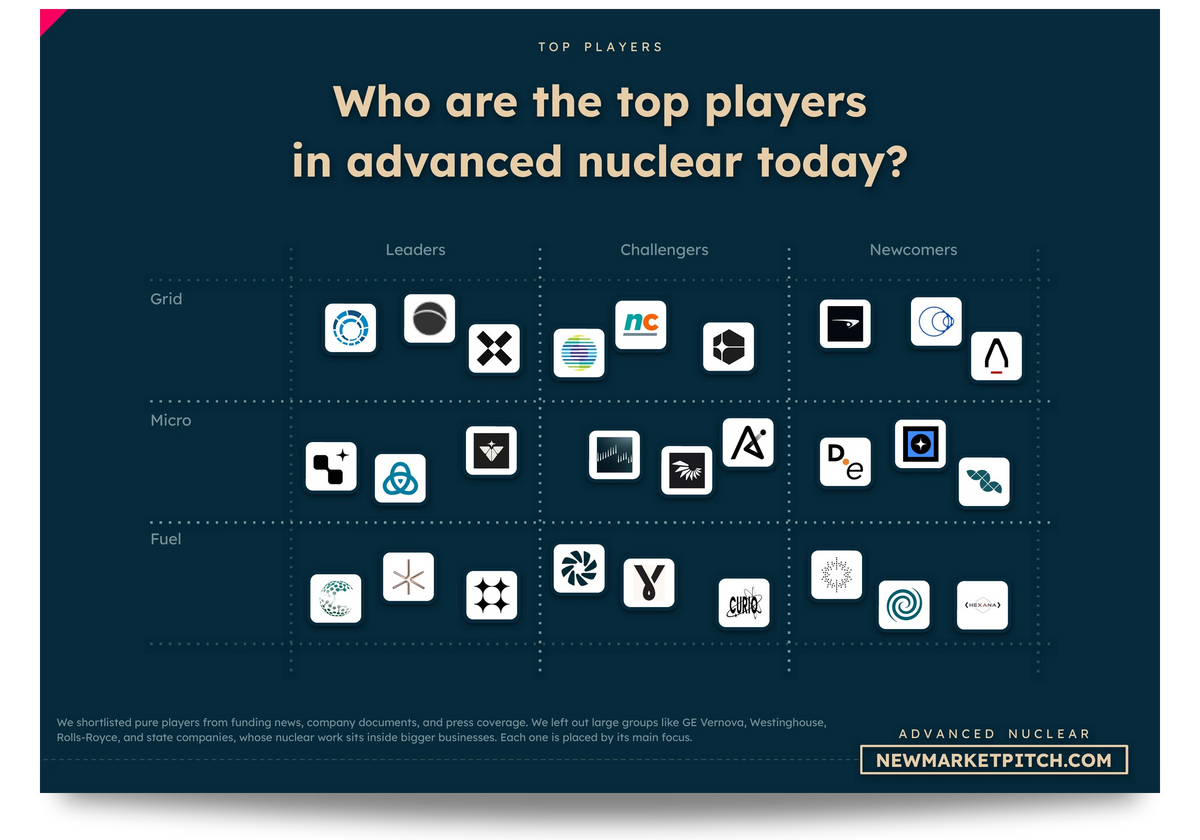
In our report covering the advanced nuclear market, we turn what is vague and complex into simple, useful visuals. Market maps like this one show you at a glance where every startup stands.
Is Ontario proving that advanced nuclear has become a construction market?
Yes. Ontario's Darlington project is currently the clearest Western proof that SMRs have moved from slide decks and licensing programs into large-scale physical construction.
Ontario Power Generation plans four 300 MW BWRX-300 reactors at the Darlington site, for 1.2 GW in total. The provincial government has approved a C$20.9 billion project budget covering development, site work, engineering and construction of all four units.
The first unit alone is expected to cost around C$6.1 billion, with another C$1.6 billion for systems and services shared across the four-reactor site. Later units are expected to become cheaper as workers, suppliers and engineering teams repeat the same design.
Construction has already passed milestones that are difficult to dismiss as preparation work. The first reactor foundation is taking shape, including the installation of a 2.1-million-pound basemat module this year. OPG has also applied for the operating licence needed once construction and commissioning are complete.
The project is now pulling capital into the wider industry. GE Vernova Hitachi is investing C$70 million in an SMR engineering and service center near Darlington, while more than 80% of project procurement is expected to come from Canada.
Ontario therefore gives us something the industry badly needed: a real first fleet where we will eventually be able to compare the cost of unit one with units two, three and four.
Are advanced nuclear fuel and supply chains already becoming real markets?
Yes. Advanced nuclear fuel, graphite, reactor components and manufacturing capacity are already attracting billions of dollars before most of the reactors that will use them enter service.
HALEU is the clearest bottleneck. It contains more fissile uranium than the fuel used by most conventional light-water reactors, and many advanced reactor designs depend on it.
The United States has responded with a $2.7 billion enrichment program spread over the coming decade. Centrus and General Matter each received $900 million task orders to create domestic HALEU enrichment capacity. Orano received another $900 million for low-enriched uranium capacity.
Centrus has already produced and delivered U.S.-made HALEU under an earlier Department of Energy program. X-energy has now signed long-term enrichment agreements with Centrus and General Matter covering part of the fuel requirements for its 11.5 GW pipeline.
The next step is fabrication. X-energy's TRISO-X plant in Tennessee received the first U.S. Part 70 licence for commercial HALEU fuel fabrication this year, and construction of the facility has moved into interior build-out as the main structure nears completion.
The supply chain is widening beyond fuel. X-energy's ten-year agreement with SGL Carbon includes more than $100 million for the first commercial deployment, while a later deal will expand SGL's French graphite capacity enough to supply billets for up to eight Xe-100 reactors per year.
Doosan has separately reserved manufacturing capacity for major steel components for 16 Xe-100 units.
Radiant plans an Oak Ridge factory for transportable Kaleidos microreactors, while Kairos is producing many components internally as it builds successive test and demonstration reactors.
Enrichment plants, fuel factories and component suppliers are therefore receiving capital and production commitments before reactor fleets reach scale.

Our research about advanced nuclear reactors gets updated several times a month, so you always get the latest view of where things stand.
Are there too many advanced nuclear designs for the market to support?
Yes. The advanced nuclear industry still has far more reactor concepts than the likely number of commercial winners.
The OECD Nuclear Energy Agency's latest broad review found 127 SMR technologies worldwide. Only 74 had enough current public information and developer participation to be included in its detailed assessment.
Around 25 of the remaining designs were still under development but stayed outside the assessment, while others lacked resources, had been paused or were no longer actively progressing.
Even among the 74 assessed designs, readiness varies enormously. BWRX-300 has a licensed construction project in Canada. TerraPower has an NRC construction permit and a plant under construction. Kairos has two physical reactor projects in Tennessee and a Google-backed deployment agreement. X-energy has customers, fuel infrastructure and long-lead supply contracts. Rolls-Royce SMR has secured government-backed projects in Britain and Sweden.
The market is already starting to separate a small group of serious deployment candidates from a much larger design funnel.
If you want more recent data on this point, please see our latest advanced nuclear market report.
How much of the announced advanced nuclear pipeline should we actually believe?
We should take projects under construction seriously, signed commercial agreements with caution, and long-range gigawatt targets as useful demand evidence rather than guaranteed orders.
Ontario's first BWRX-300 sits near the top of that hierarchy. The reactor has financing, a licensed site, an owner and active construction.
TerraPower's Natrium project has now reached a similar threshold after receiving its NRC construction permit and beginning construction of the nuclear plant this year.
Kairos' Hermes 2 also deserves more weight now than it did when the Google agreement was first announced. The reactor has broken ground, has a specific 50 MW output target and sits behind a binding power purchase agreement with TVA.
X-energy's 11.5 GW pipeline needs heavier discounting. The company itself says that figure assumes customers exercise their contingent rights in full. The first Dow and Amazon projects are much more valuable evidence than the eventual total.
The same applies to national targets. A government selecting a reactor developer is stronger than issuing a nuclear strategy, while an approved construction budget tells us much more than either.
That leaves a credible first wave surrounded by a much larger pool of possible follow-on capacity.
Could advanced nuclear already be a $20 billion or $30 billion annual market?
No. A $20 billion to $30 billion current annual advanced nuclear market would require mixing multiyear project budgets and future commitments into a single-year number.
Ontario illustrates why. Its Darlington program has a C$20.9 billion budget, but construction stretches across many years.
Britain's £2.6 billion SMR allocation is also spread across a multiyear program, while the United States' $2.7 billion uranium enrichment awards run for up to ten years.
The same problem appears with reactor pipelines. X-energy's 11.5 GW could eventually represent tens of billions of dollars of construction, but those reactors have not all been ordered, financed or scheduled.
The current annual market is much closer to $5 billion than $20 billion or $30 billion.

In our market report about advanced nuclear reactors, you will always find fresh funding data, taken straight from our own verified funding database.
What is the best number for the advanced nuclear market today?
About $5 billion a year is the best clean estimate for today's advanced nuclear market, with the broader advanced-fission ecosystem probably reaching into the high-single-digit billions once fuel, microreactors and other non-SMR activity are included.
The $5 billion anchor comes from the IEA's estimate of current SMR investment and fits the scale we see when we look across actual projects.
Darlington is absorbing billions over its construction schedule. Natrium and Hermes 2 are now under construction. Britain is spending heavily on Rolls-Royce SMR. Washington is funding advanced reactors and a $2.7 billion enrichment build-out. Private developers are raising hundreds of millions at a time.
There is not enough public information to claim that the broader market is precisely $6.7 billion, $8.4 billion or any similar number. Government funding, company spending and project budgets overlap too much for that level of precision.
The order of magnitude is clear, though. Advanced nuclear has already grown beyond a small R&D niche. We are looking at a several-billion-dollar annual industry before a large Western commercial fleet exists.
If you want more recent data on this point, please see our latest advanced nuclear market report.
How much bigger could advanced nuclear get once reactors start deploying repeatedly?
Advanced nuclear could become a $25 billion-plus annual investment market around the end of the decade if the projects being built now turn into repeat orders.
The IEA provides the most useful benchmark. Its stronger SMR scenario takes annual investment from roughly $5 billion today to more than $25 billion around 2030, about a fivefold increase.
The long-run numbers become much larger. In the IEA's Announced Pledges Scenario, SMRs reach around 120 GW globally by 2050 and require roughly $670 billion of cumulative investment.
Those numbers depend heavily on costs falling after the first units. Ontario offers an early real-world test: its first BWRX-300 carries a large share of common site and development costs, while OPG expects later units to benefit from repetition.
The same logic sits behind X-energy's 144-reactor pipeline, Kairos' multi-plant deal with Google and Rolls-Royce SMR's factory-oriented design. None of those business models works particularly well if every reactor becomes another bespoke megaproject.
The next stage of market growth depends heavily on repeating the same few designs.
What could stop advanced nuclear from becoming a much larger market?
First projects becoming too expensive to repeat is now the biggest threat to advanced nuclear growth.
Demand is much easier to see these days. Electricity consumption is rising, data centers want firm power, governments want domestic energy supply and industrial companies need reliable low-carbon heat.
The harder question is cost.
Ontario's first BWRX-300 is expected to cost roughly C$6.1 billion before allocating C$1.6 billion of common four-unit infrastructure. That is acceptable as a first-of-a-kind project only if later reactors get meaningfully cheaper.
Fuel remains another constraint. The United States is spending billions to build domestic enrichment precisely because HALEU supply cannot currently support a large advanced reactor fleet.
Financing becomes harder as projects move forward too. Raising $500 million for a reactor developer is very different from financing several power plants worth $5 billion or $10 billion each.
And the industry still needs to prove schedules. Nuclear projects lose economic appeal quickly when construction slips by several years because financing costs continue accumulating before electricity revenue begins.
The market has enough customer demand to grow. Cost and execution will decide how much of that demand turns into actual construction.
If you want more recent data on this point, please see our latest advanced nuclear market report.

In our document detailing everything you need to know about advanced nuclear, we look at what the winners do differently, so you can learn from the best instead of guessing.
Has advanced nuclear finally become an infrastructure market?
Yes. Advanced nuclear is now behaving like an early infrastructure market because real reactors, fuel plants, factories and long-lead components are being built at the same time.
Ontario is constructing a BWRX-300 and has installed the first major foundation module.
TerraPower received its Natrium construction permit and formally started building the nuclear plant this year.
Kairos Power has broken ground on Hermes 2 while construction of its earlier Hermes demonstration reactor is also progressing in Tennessee.
X-energy's TRISO-X fuel factory is nearing completion of vertical construction, and the company has already secured production commitments for graphite and major steel components.
The UK has moved Rolls-Royce SMR into contracted project development and the company has since secured a second major European commitment in Sweden.
Upstream, Centrus and General Matter now have $900 million U.S. HALEU awards, while X-energy has signed long-term enrichment arrangements to feed its planned fleet.
Companies are now installing equipment, reserving factory capacity and committing long-lead capital. The industrial system needed for wider deployment has clearly started forming.
So how big is the advanced nuclear market before mass deployment?
The advanced nuclear market is already roughly a $5 billion-a-year investment market, with the broader advanced-fission ecosystem probably worth several billion dollars more, while approved projects and credible future commitments now reach tens of billions.
Commercial reactor revenue remains small because the Western advanced reactor fleet barely exists. X-energy's latest half-year revenue and grant income was still below $100 million, NuScale's annual revenue was only around $31.5 million, and most developers have yet to operate a commercial power plant.
The spending underneath those numbers is far larger. Ontario has a C$20.9 billion four-reactor program already under construction. TerraPower and Kairos are building plants in the United States. Britain has committed £2.6 billion to launch its SMR program. Washington has awarded $2.7 billion for uranium enrichment. Private reactor companies are raising hundreds of millions or, in X-energy's case, more than $1 billion through the public markets.
As seen above, the pipeline is bigger again. X-energy reports 11.5 GW across Dow, Amazon and Centrica. Google and Kairos are working toward 500 MW. Ontario is building 1.2 GW. Rolls-Royce SMR now has commitments in Britain and Sweden.
We would therefore use roughly $5 billion as the clean current market number. A high-single-digit-billion estimate is reasonable for the broader ecosystem, while $20 billion or $30 billion would overstate annual activity today.
The IEA sees SMR investment moving above $25 billion annually around 2030 in a stronger deployment scenario.
Whether advanced nuclear gets there will be decided by a small group of first projects. Darlington needs to show that later BWRX-300 units can get cheaper. Natrium needs to avoid the schedule problems that have hurt conventional nuclear. Kairos needs to turn Hermes into a repeatable commercial plant. X-energy needs its 11.5 GW pipeline to convert into actual reactor orders.
If those projects work, today's roughly $5 billion market could become a much larger construction industry. If they do not, advanced nuclear could remain a sizeable but specialized market built around demonstrations, government programs and a limited number of premium customers.
Our methodology
The advanced nuclear market is unusually difficult to size because the industry sits between technology development and large-scale commercial deployment. There is plenty of activity, but no single revenue number captures it properly yet. Instead of relying on broad market forecasts, company narratives or an intuitive judgment about how "real" the sector feels, we broke the question into the parts that reveal where the market actually stands today.
We looked separately at current investment, company revenue, projects under construction, government funding, private capital, customer commitments, reactor pipelines, fuel infrastructure, manufacturing capacity and the economics of the first commercial projects. For each dimension, we prioritized the most recent developments that materially changed the picture, then assessed them together rather than treating any one announcement as proof of market scale.
We gave different types of evidence different weight. Physical construction, regulatory approvals, committed project budgets, executed contracts and actual capital deployment tell us more than long-range capacity targets or early-stage development agreements. Announced reactor pipelines still matter, but mainly as evidence of potential demand until projects move further toward financing and construction.
Where several numbers describe different stages of the same underlying activity, we did not simply add them together. A multiyear reactor budget, government support, company financing and supply-chain spending can overlap. We therefore used clean annual investment benchmarks where they were available and used project-level evidence to test whether those benchmarks remained consistent with what is happening on the ground.
Freshness mattered as well. Advanced nuclear is moving quickly enough that construction starts, permits, fuel contracts and financing events can change the answer within a short period. We therefore favored recent regulatory filings, government decisions, company financial disclosures and project updates over older forecasts when assessing the market's current state.
The final estimate comes from separating three things that are often mixed together: the market operating today, capital already committed to projects over several years, and the much larger deployment opportunity that could emerge if the first wave of reactors is successfully repeated. That is why we use roughly $5 billion as the clean current SMR investment benchmark while treating the broader advanced-fission ecosystem as somewhat larger rather than pretending there is a precise single total.
Key sources used for this analysis include the International Energy Agency's nuclear investment outlook, the IEA's executive summary for its nuclear outlook, the Government of Ontario's Energy for Generations plan, Ontario's approval of the first Darlington BWRX-300, Ontario's Darlington construction update, the U.S. Nuclear Regulatory Commission's Natrium construction-permit record, TerraPower's $650 million financing announcement, Kairos Power's Hermes 2 construction update, Kairos Power's agreement with Google, the U.S. Department of Energy's $2.7 billion uranium-enrichment awards, DOE's update on U.S. HALEU production, Centrus' $900 million HALEU award, X-energy's second-quarter 2026 results, X-energy's SEC filing covering its reactor pipeline and contingent customer rights, X-energy's TRISO-X fuel-fabrication licence announcement, NuScale's 2025 financial results, Radiant's Series C announcement, Radiant's subsequent financing announcement, the UK government's Rolls-Royce SMR development contract, and the OECD Nuclear Energy Agency's SMR Dashboard.

If you build or invest in the advanced nuclear market, you need to know which business models pay off now and which ones are fading. That's why our report covering it has a whole section on it.
Written by the New Market Pitch teamWe track new markets so founders and investors can move faster. About us