Which advanced nuclear startup is growing the fastest?
Whether you're building or investing in the advanced nuclear market, our report covers everything you need to know: the players, the money, and what's coming next.
Summary
X-energy is currently the fastest-growing advanced nuclear startup based on measurable business growth, with revenue and grant income increasing 132% in the first half of 2026. TerraPower, however, is ahead in actually building a commercial-scale advanced reactor.
AI data centers have changed the economics of advanced nuclear development. Amazon, Google and Meta are supporting more than 9 gigawatts of potential reactor capacity through agreements with X-energy, Kairos Power, TerraPower and Oklo, although much of that capacity remains conditional.
X-energy's growth is unusually visible for an industry where most developers have little commercial revenue to report. Its second-quarter revenue and grant income rose 154% year over year, and its potential pipeline now covers 144 Xe-100 reactors, equivalent to approximately 11.5 gigawatts.
The catch is that X-energy's reported income includes government grants and development work, rather than electricity sales. Its first-half operating expenses reached $274.2 million, nearly 2.8 times its revenue and grant income, showing just how expensive this expansion is.
TerraPower presents the strongest challenge to X-energy's lead. Its Natrium project received an NRC construction permit in March 2026 and began authorized nuclear construction in April, putting it ahead of X-energy in the race to complete a full-scale advanced reactor.
Kairos Power has another important advantage: a defined route to its first electricity sales through Google and the Tennessee Valley Authority. Its Hermes 2 demonstration plant targets up to 50 megawatts around 2030, a smaller initial deployment but one tied to a concrete power purchase arrangement.
Oklo illustrates the difference between financing growth and commercial growth. It held approximately $3 billion in liquidity at the end of June 2026 and achieved a reactor criticality milestone in August, but its commercial Aurora reactors remain undeployed.
Customer announcements require careful interpretation. X-energy's 11.5-gigawatt pipeline, Oklo's 12-gigawatt agreement with Switch and the multigigawatt programs backed by Amazon and Meta are not equivalent to financed, licensed reactor orders.
X-energy's most interesting competitive advantage may ultimately come from nuclear fuel and manufacturing. Its investments in TRISO fuel production, enrichment arrangements and specialized graphite suppliers could help it build reactors repeatedly, provided its first projects prove successful.
Smaller developers such as Antares Nuclear, Aalo Atomics and Valar Atomics are making impressive progress with early reactor demonstrations, but achieving criticality is still a long way from producing reliable commercial electricity.
The decisive test will come around 2030 and beyond. X-energy leads today on measurable business expansion, TerraPower on large-reactor construction and Kairos Power on its demonstration-to-electricity pathway. The eventual winner will be the company that can turn its first successful reactor into a repeatable, economically viable fleet.

Written by the New Market Pitch teamWe track new markets so founders and investors can move faster. About us

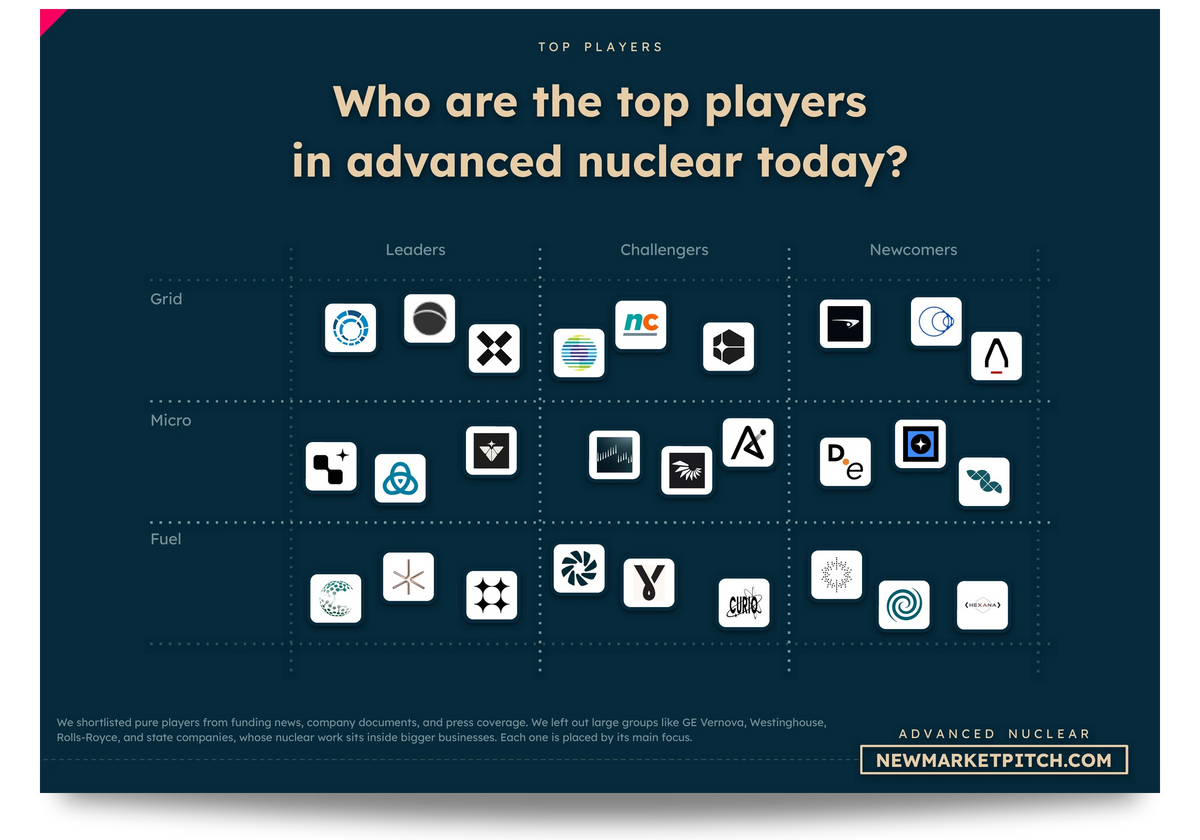
In our report covering the advanced nuclear market, we turn what is vague and complex into simple, useful visuals. Market maps like this one show you at a glance where every startup stands.
Why are advanced nuclear startups suddenly growing so fast?
Advanced nuclear startups are growing much faster because big technology companies have started putting real money behind new reactors, especially to power AI data centers.
Amazon, Google and Meta have all signed agreements to support advanced nuclear development. These deals are changing an industry where startups historically depended on government funding, research grants and investors willing to wait more than a decade for commercial results.
The scale is striking. Amazon is backing X-energy's ambition to deploy more than 5 gigawatts of nuclear power in the United States by 2039. Google signed a 500-megawatt development agreement with Kairos Power in October 2024. Meta went further in January 2026, announcing agreements supporting up to 2.8 gigawatts from TerraPower and 1.2 gigawatts from Oklo.
Together, these four commitments represent more than 9 gigawatts of potential nuclear capacity, although the projects are at different stages and some remain conditional. For perspective, that is roughly equivalent to the generating capacity of nine large conventional nuclear reactors.
Another change is happening on the technical side. Through the Department of Energy's Reactor Pilot Program, Antares Nuclear, Valar Atomics and Aalo Atomics reached reactor criticality by mid-2026. These early tests produced no commercial electricity, but they showed that small private developers could move from designs to working nuclear systems.
Advanced nuclear is now attracting customers, capital and construction activity at the same time. The difficult question is which company is actually turning that opportunity into a growing business.
Which advanced nuclear startup is growing the fastest right now?
X-energy is currently our strongest pick for the fastest-growing advanced nuclear startup, thanks to its rising revenue, expanding customer base and investment in reactor manufacturing.
According to X-energy's August 2026 financial results, revenue and grant income reached $98 million in the first half of 2026, up 132% from $42.3 million a year earlier. Its second-quarter growth was even faster, at 154%.
The company has also disclosed a potential pipeline of 144 Xe-100 reactors, representing approximately 11.5 gigawatts of generating capacity. Its customers and development partners include Dow, Amazon and Centrica, giving it exposure to industrial energy, data centers and traditional electricity utilities.
But X-energy does not lead every part of the race. TerraPower has already secured permission to construct its first commercial-scale Natrium reactor. Kairos Power is building demonstration reactors and has a defined route to selling electricity to Google through the Tennessee Valley Authority.
We give X-energy the overall lead because its financial growth and industrial expansion can both be measured. TerraPower remains the strongest challenger for actual reactor deployment.
If you want more recent data on this point, please see our latest advanced nuclear market report.

Our research about advanced nuclear reactors gets updated several times a month, so you always get the latest view of where things stand.
What should count as growth for an advanced nuclear startup?
The best way to judge advanced nuclear startup growth is to measure how quickly a company is turning customer interest and investment into revenue, licensed projects and reactors that can be built repeatedly.
Revenue alone cannot settle the question. Many nuclear developers spend years designing and testing reactors before selling electricity. Their early income may come from engineering work, government contracts or development agreements.
Funding is also an imperfect measure. A startup can raise billions of dollars without completing its first reactor. Likewise, a company announcing 5 gigawatts of future capacity may have fewer firm commercial commitments than a competitor with one fully financed 300-megawatt project.
We looked at the companies through three connected questions: how fast their businesses are expanding, how far their reactors have progressed toward operation, and whether they have the resources and customers needed to build more than one plant.
The comparison focuses on advanced fission developers rather than nuclear fusion startups or established nuclear divisions inside large industrial companies. Financial growth rates are included only where public disclosures make a reasonable comparison possible.
| Company | Strongest evidence today | Biggest remaining gap |
|---|---|---|
| X-energy | 132% first-half revenue and grant income growth | First commercial reactors still awaiting construction authorization |
| TerraPower | Natrium construction permit and authorized nuclear construction | No operating commercial reactor |
| Kairos Power | Two Hermes projects advancing in Tennessee | First electricity sales still years away |
| Oklo | Around $3B in liquidity and a criticality milestone | Commercial Aurora reactor undeployed |
| NuScale Power | NRC-approved SMR design | Revenue declining in the latest reported quarter |
| Radiant | Microreactor testing preparations | Full-power commercial performance unproven |
| Aalo Atomics | First reactor criticality achieved | No sustained commercial electricity output |
| Antares Nuclear | Mark-0 reactor reached criticality | Testing remains at zero power |
Is X-energy's revenue really growing that quickly?
X-energy's revenue and grant income are growing at an impressive rate, and the latest quarterly figures suggest its expansion is accelerating.
The company's first-quarter revenue and grant income increased from $20.8 million in 2025 to $43.4 million in 2026, a gain of approximately 109%. In the second quarter, the figure increased from $21.5 million to $54.6 million, or 154%.
We calculated that the second quarter generated 55.7% of X-energy's first-half revenue and grant income, compared with 50.8% a year earlier. More of the company's reported income is now arriving in the later quarter.
There is an important qualification. X-energy's reported figure includes government grants, and its core business is still based on reactor development, engineering and manufacturing preparation. The company is not yet collecting recurring electricity revenue from a commercial fleet.
Its costs also grew quickly. First-half operating expenses increased 146%, reaching $274.2 million. Operating cash outflow rose approximately 166% to $164.6 million.
So the growth is real, but it's expensive. X-energy is expanding its development activity and recognized income while spending substantially more money. The next test is whether commercial revenue continues growing as its first reactor projects enter construction.

In our market report about advanced nuclear reactors, we look at what the winners do differently, so you can learn from the best instead of guessing.
Is X-energy actually building reactors or just announcing deals?
X-energy is building the infrastructure needed to manufacture nuclear reactors, although most of its announced projects are still years away from producing electricity.
Its Xe-100 design produces approximately 80 megawatts of electricity per reactor. Four modules could supply 320 megawatts, while twelve could generate 960 megawatts.
The company's first major industrial project is being developed with Dow in Seadrift, Texas. The proposed Long Mott Generating Station would use four reactors to provide electricity and high-temperature industrial heat.
Amazon is supporting another deployment program in Washington through Energy Northwest. In October 2026, X-energy, Amazon and American Electric Power also announced an agreement to evaluate twelve Xe-100 reactors in Indiana.
If the Washington project reaches its full potential, the two Amazon-related projects could represent approximately 1.9 gigawatts of generating capacity. That would cover roughly 38% of Amazon's broader 5-gigawatt ambition.
X-energy also has a joint development relationship with Centrica covering approximately 6 gigawatts of potential capacity in the United Kingdom.
These agreements give the company an unusually broad set of possible deployment locations. However, the 144-reactor pipeline includes contingent rights and projects that are not yet approved, financed or under construction.
The company's lead looks strongest in customer development and preparations for manufacturing. Its first commercial reactor construction milestone remains ahead.
Could TerraPower be growing faster than X-energy?
TerraPower is moving faster than X-energy toward completing a full-scale nuclear power plant, and its Wyoming project gives it a serious claim to industry leadership.
TerraPower began non-nuclear construction work at its Natrium site in June 2024. In March 2026, the Nuclear Regulatory Commission approved its construction permit, the first issued by the NRC for a commercial non-light-water nuclear reactor.
Authorized nuclear construction began the following month.
This is a major achievement. Licensing has historically been one of the biggest barriers between a promising reactor design and an actual nuclear power plant. TerraPower has already crossed a regulatory hurdle that several competing startups are still approaching.
Its financial and commercial backing is also substantial. TerraPower raised $650 million in June 2025 from investors including Nvidia's NVentures, Bill Gates and HD Hyundai.
In January 2026, Meta agreed to support development of up to eight Natrium reactors, potentially providing 2.8 gigawatts of baseload capacity. TerraPower subsequently announced an engineering, procurement and construction framework with Hyundai Engineering & Construction in August 2026 for as many as eight future reactors.
TerraPower has made progress in funding, licensing, construction and future customer development.
The limitation is financial transparency. As a private company, TerraPower does not publish revenue figures comparable to X-energy's quarterly disclosures.
If the question is who is furthest ahead in building a utility-scale advanced reactor, TerraPower wins. For measurable company-wide financial growth, we still favor X-energy.
If you want more recent data on this point, please see our latest advanced nuclear market report.

In our document detailing everything you need to know about advanced nuclear, you will always find fresh funding data, taken straight from our own verified funding database.
Is Kairos Power closer to selling nuclear electricity than X-energy?
Kairos Power has a more clearly defined route to its first electricity sales through Google and the Tennessee Valley Authority, although its planned initial output is much smaller than X-energy's commercial projects.
Kairos is developing fluoride salt-cooled high-temperature reactors through a series of demonstration facilities in Oak Ridge, Tennessee.
Its first Hermes reactor entered nuclear construction in 2025. The company then broke ground on Hermes 2 in April 2026, with the second project designed to produce up to 50 megawatts of electricity.
Hermes 2 is expected to deliver electricity to TVA's grid under an agreement linked to Google's data center demand. The target for operations is 2030.
That first project would represent one-tenth of the 500 megawatts contemplated by Kairos Power's broader agreement with Google.
What makes Kairos interesting is the way it is developing the technology. Instead of moving immediately from engineering to a large commercial fleet, the company is building successive reactors to test construction methods, equipment and operating systems.
The Department of Energy also committed up to $303 million in milestone-based funding under a 2024 agreement.
Kairos has a smaller announced commercial pipeline than X-energy, but its early projects have a relatively clear progression from technical testing to electricity delivery. That could prove valuable when the company starts building larger plants.
Is Oklo growing as quickly as its reputation suggests?
Oklo is growing quickly in funding, partnerships and nuclear technology development, but we have not seen evidence of commercial revenue growth comparable to X-energy's.
According to Oklo's second-quarter 2026 results, the company held approximately $3.01 billion in cash, cash equivalents and marketable debt securities at the end of June.
That gives it substantial financial resources for engineering, licensing, fuel development and construction.
Its operating cash usage increased from $30.7 million in the first half of 2025 to $65.5 million in the same period of 2026. The higher spending reflects expanding operations, although it also shows how much capital the company is using before commercial deployment.
Oklo achieved an important technical milestone in August 2026 when its Groves Isotope Test Reactor in Texas reached first criticality. The reactor was developed in less than a year after groundbreaking through the Department of Energy's pilot program.
The project demonstrates reactor development and operational capabilities. However, Groves is a low-power test reactor associated with isotope production, rather than a commercial Aurora electricity plant.
Oklo's customer opportunities are also growing. Its January 2026 agreement with Meta supports the potential development of a 1.2-gigawatt nuclear campus in Ohio.
Oklo is one of the best-funded advanced nuclear developers. Its commercial growth still needs to catch up with its financing and ambitious development plans.

Learning from others' mistakes is the cheapest lesson there is. In our report covering the advanced nuclear market, we look at what broke startups before you, so you don't repeat it.
Which advanced nuclear startup has the strongest customer deals?
X-energy currently has one of the strongest mixes of advanced nuclear customers, while Kairos Power stands out for the concrete electricity purchase agreement attached to its first power-producing project.
X-energy is working with three very different customer groups. Dow wants industrial energy for chemical manufacturing, Amazon needs electricity for data centers, and Centrica is pursuing utility-scale nuclear development in the United Kingdom.
This gives X-energy several ways to sell the same reactor technology.
TerraPower's agreement with Meta is also important, particularly because the potential eight-unit Natrium program involves 345-megawatt reactors. However, the future units still depend on development, financing and regulatory approvals.
Kairos Power's partnership with Google and TVA is smaller but more clearly connected to an initial electricity purchase agreement.
Oklo has announced a 12-gigawatt master power agreement with Switch, alongside its Meta partnership. Some of its broader customer pipeline consists of nonbinding agreements, so it would be misleading to count every gigawatt as a firm reactor order.
The amount of planned capacity is only half the story. The type of customer commitment is equally important, especially when commercial operation may still be years away.
| Startup | Customer | Potential capacity | Current commitment |
|---|---|---|---|
| X-energy | Amazon | 5+ GW | Long-term deployment objective |
| X-energy | Centrica | ~6 GW | Joint development |
| X-energy | Dow | 320 MW | Initial industrial project in licensing |
| TerraPower | Meta | Up to 2.8 GW | Development funding and future project rights |
| Kairos Power | 500 MW | Multiplant development agreement | |
| Kairos Power | TVA / Google | Up to 50 MW | Initial binding electricity purchase agreement |
| Oklo | Meta | Up to 1.2 GW | Development arrangement with prepayment support |
| Oklo | Switch | 12 GW | Master agreement for potential future projects |
If you want more recent data on this point, please see our latest advanced nuclear market report.
Is X-energy falling behind TerraPower in nuclear approvals?
X-energy is currently behind TerraPower in commercial reactor construction approvals, although its first Texas project has made meaningful progress through the regulatory process.
X-energy and Dow submitted their construction permit application for the proposed Long Mott Generating Station in March 2025.
In May 2026, the NRC completed its environmental assessment and issued a finding of no significant impact. The agency continued its safety review under an 18-month review schedule.
That is encouraging, but X-energy still needs the required construction authorization before moving into nuclear construction.
TerraPower crossed that milestone in March 2026 for its Wyoming Natrium project. Kairos Power has also secured construction authorization for its Hermes demonstration program.
Without the required permits, even a well-financed developer cannot simply start nuclear construction. Delays can push back customer delivery schedules and increase project costs substantially.
X-energy's Texas permit is now one of the most important milestones to watch. Approval would narrow the gap with TerraPower and allow its first major industrial project to move into a more advanced phase.

Your time is limited. In our research about advanced nuclear reactors, we put numbers on each part of the market, so you can see where it makes sense to focus.
Could nuclear fuel give X-energy an advantage over its competitors?
X-energy could gain a major advantage from manufacturing its own TRISO nuclear fuel, particularly as advanced reactor developers compete for limited supplies of specialized uranium fuel.
The Xe-100 uses TRISO fuel, which contains small uranium particles protected by multiple layers of heat-resistant materials. Producing this fuel consistently at commercial scale requires specialized factories and strict quality controls.
X-energy is developing its TX-1 fuel fabrication facility in Oak Ridge, Tennessee, through its subsidiary TRISO-X.
During 2026, the company acquired approximately 70 additional acres near its fuel manufacturing campus and received an $11 million economic development grant from Tennessee.
It has also established long-term enrichment arrangements with Centrus Energy and General Matter.
In August 2026, X-energy announced an agreement with SGL Carbon to increase production of specialized nuclear graphite in France. The planned expansion is intended to support material production for up to eight Xe-100 reactors annually by 2030.
Those eight reactors would represent 640 megawatts of generating capacity.
This does not mean X-energy will be able to manufacture eight complete reactors annually by 2030. The agreement addresses one part of the supply chain, and several other components must scale alongside it.
The broader challenge is that many advanced reactors need high-assay low-enriched uranium, or HALEU, which has a much smaller commercial supply chain than conventional reactor fuel.
TerraPower also depends on appropriate fuel supplies for Natrium, while Oklo is pursuing recycling technologies that could eventually reduce some of its fuel requirements.
X-energy is investing simultaneously in reactors, fuel fabrication and critical suppliers. That could make repeated construction easier once its first plants are operating, and it may become one of the company's most valuable advantages.
Is NuScale Power falling behind newer nuclear startups?
NuScale Power is losing ground in measurable commercial growth even though it has achieved important regulatory milestones ahead of several advanced nuclear competitors.
NuScale has received NRC approval for its 77-megawatt small modular reactor design. That gives the company a significant regulatory foundation.
However, its second-quarter 2026 revenue declined by approximately $8 million compared with the same quarter in 2025.
The decrease was mainly linked to the completion of engineering work for the proposed Doicești nuclear project in Romania.
The project involves six NuScale modules. A February 2026 investment decision supported further development, although additional preconstruction work still depended on financing and contractual arrangements.
NuScale held approximately $1.9 billion in liquidity at the end of June 2026, showing that its difficulties were not simply a lack of corporate cash.
The contrast with X-energy is noticeable. Both companies have substantial financial resources and ambitious reactor programs, but NuScale's recently reported revenue was declining while X-energy's was increasing.
NuScale could still turn its regulatory advantage into a meaningful commercial business. For now, we see stronger evidence of growth at X-energy.
If you want more recent data on this point, please see our latest advanced nuclear market report.

In our market report about advanced nuclear reactors, we always try to gather several sources and make estimates that make sense, so you can work with solid numbers.
Are smaller nuclear startups moving faster than X-energy?
Several microreactor startups are moving faster through early technical demonstrations than X-energy, but they have not yet shown comparable commercial growth.
Antares Nuclear reached first criticality with its Mark-0 reactor in June 2026. Valar Atomics and Aalo Atomics also achieved criticality milestones through the Department of Energy's Reactor Pilot Program.
These achievements are notable because the companies moved from reactor development into controlled nuclear testing.
Still, the demonstrations occurred at zero power or under similarly limited testing conditions. They have yet to establish sustained electricity generation, reliable thermal systems or competitive commercial operation.
Radiant is taking another approach with its portable Kaleidos microreactor. It received preliminary safety authorization in February 2026 for testing at Idaho National Laboratory and has been pursuing additional licensing for facilities in Tennessee.
Smaller reactors can offer developers a shorter path to early demonstrations and potentially simpler customer installations. That helps explain why several young companies are moving quickly.
Whether this translates into faster commercial growth remains unresolved. Public financial disclosures are limited, and none of these companies has demonstrated a substantial operating fleet.
Some deserve to rank ahead on the speed of early reactor testing. On overall business growth, though, X-energy has much stronger evidence behind it.
Is X-energy burning too much cash to keep growing?
X-energy is spending heavily, but its recent financing has given it enough liquidity to continue its expansion without an immediate funding crisis.
Its first-half 2026 financial statements show $274.2 million in operating expenses against $98 million in revenue and grant income.
Operating expenses were therefore approximately 2.8 times the reported top line.
The company used $164.6 million in operating cash and another $239.6 million in investing activities during the same six months. Combined, those figures represent around $404 million in cash deployment.
That is roughly five times the $80.5 million used in those two activities during the first half of 2025.
X-energy also raised approximately $1.1 billion in net proceeds through its April 2026 IPO and finished June with around $1.9 billion in total liquidity.
Its current cash position gives it considerable flexibility, although future spending on commercial construction could be much larger than its present development expenses.
We also compared the growth in reported income with the growth in costs. During the first half of 2026, X-energy generated approximately $55.7 million more in revenue and grant income than a year earlier, while operating expenses increased by about $162.8 million.
That works out to nearly $2.92 in additional operating expenses for every additional dollar of reported income.
The company is clearly choosing to invest aggressively in its next stage of development. Its ability to finance and deliver the first commercial plants will determine whether that spending produces a durable business.
| Financial metric | H1 2025 | H1 2026 | Change |
|---|---|---|---|
| Revenue and grant income | $42.3M | $98.0M | +132% |
| Q1 revenue and grant income | $20.8M | $43.4M | +109% |
| Q2 revenue and grant income | $21.5M | $54.6M | +154% |
| Operating expenses | $111.4M | $274.2M | +146% |
| Operating cash outflow | $61.8M | $164.6M | +166% |
| Investing cash outflow | $18.7M | $239.6M | +1,184% |
| Combined operating and investing outflow | $80.5M | $404.2M | +402% |

If you build or invest in the advanced nuclear market, you need to know which business models pay off now and which ones are fading. That's why our report covering it has a whole section on it.
Could TerraPower or Kairos Power overtake X-energy?
TerraPower and Kairos Power could both overtake X-energy in commercial deployment if they complete their first electricity-producing reactors before X-energy brings its Xe-100 projects online.
TerraPower has the most advanced large-reactor construction program among these three companies. Its 345-megawatt Natrium facility in Wyoming is expected to be completed around 2030, although it will still need a separate operating license before generating commercial electricity.
Kairos Power is targeting the same period for Hermes 2, with up to 50 megawatts of planned electricity output.
X-energy's initial commercial deployments are also expected around the beginning of the 2030s, with projects involving Dow and Amazon-backed developers.
The important difference will emerge after the first reactor is completed.
TerraPower is working toward larger individual power plants. Kairos Power is using smaller demonstration projects to develop and test its manufacturing and operating methods. X-energy is preparing to produce standardized 80-megawatt modules supported by its own specialized fuel supply chain.
A first successful reactor would give each company valuable experience, but building the second, fifth and tenth units without repeating expensive development work will be the more demanding challenge.
TerraPower has an advantage in first-project construction today. X-energy could still move ahead in deployed capacity if its manufacturing approach allows it to build standardized units more quickly.
Can X-energy actually build reactors fast enough to deliver its huge pipeline?
X-energy has a credible plan to manufacture reactors repeatedly, but delivering its announced pipeline would require industrial capacity far beyond anything the company has demonstrated so far.
The full potential pipeline represents approximately 11.5 gigawatts across 144 Xe-100 reactors.
Even delivering 10% would mean building roughly fourteen or fifteen reactors, enough to generate more than one gigawatt of electricity.
That is a major undertaking for a company still approaching construction of its first commercial plant.
X-energy would need to coordinate nuclear-grade manufacturing, fuel production, licensing, construction contractors, utilities and electricity buyers across multiple projects.
Its work with Dow provides a first industrial application. Its relationships with Amazon and Centrica could eventually create a much larger market for standardized reactors.
The company's investments in fuel manufacturing and critical component suppliers are intended to support that expansion.
However, there is still no demonstrated production rate for complete commercial Xe-100 reactors. We cannot assume that its eventual factories and contractors will meet the pace suggested by its customer pipeline.
The same uncertainty affects TerraPower, Kairos Power and their competitors. Every leading advanced nuclear startup still needs to prove that it can move from a first-of-a-kind reactor to repeated commercial construction.
X-energy has made substantial preparations for that transition, but the decisive evidence will come from actual construction schedules and completed units.

In our report covering the advanced nuclear market, we don't want to repeat what boring consulting reports say. Instead, we show you the real and latest market signals that matter.
Which advanced nuclear startup is growing the fastest overall?
X-energy is currently our pick for the fastest-growing advanced nuclear startup, based on its reported financial growth, growing customer relationships and increasingly developed manufacturing supply chain.
Its first-half revenue and grant income grew 132%, its development pipeline reached approximately 11.5 gigawatts of potential capacity, and its recent financing has given it substantial resources to continue building the business.
Those numbers make X-energy stand out among the leading reactor developers with publicly available financial information.
TerraPower is the most serious alternative. It is ahead in building a full-scale advanced nuclear plant, having secured a construction permit and begun authorized nuclear construction at its Wyoming Natrium project.
Kairos Power is another strong contender, with its Hermes demonstration program and a defined electricity purchase arrangement connected to Google's data center demand.
Oklo has attracted considerable financial backing and made progress in reactor testing, while NuScale's recent revenue performance has been weaker despite its regulatory achievements.
For now, our ranking puts X-energy first for measurable business growth, TerraPower first for utility-scale construction progress, and Kairos Power among the strongest for its route from demonstration reactors to commercial electricity sales.
X-energy deserves the overall lead today, but the ranking remains provisional. Once the first commercial reactors are operating, electricity delivered, construction costs and the pace of additional deployments will provide much stronger evidence of which company is actually winning.
If you want more recent data on this point, please see our latest advanced nuclear market report.
Sources and methodology
This analysis identifies which advanced nuclear startup is growing the fastest using evidence available through October 28, 2026. We compare advanced fission developers across financial growth, customer agreements, reactor construction, regulatory progress, manufacturing readiness and their ability to deploy reactors at commercial scale. Nuclear fusion companies and established nuclear divisions of large industrial groups are excluded.
We prioritized original company financial disclosures, SEC filings, Nuclear Regulatory Commission records, Department of Energy announcements and primary commercial agreements. Where comparable financial information was available, we calculated year-over-year changes in reported revenue and grant income, operating expenses and cash flows. Where private companies did not disclose comparable figures, we examined verified construction, licensing, technical and commercial milestones.
We distinguish reported revenue and grant income from recurring electricity sales, corporate liquidity from operating growth, and announced reactor capacity from firm construction commitments. Potential deployment pipelines include projects at different stages of development, so they are not treated as completed orders or guaranteed future capacity. Reactor criticality milestones are assessed separately from sustained commercial electricity generation.
The financial comparison gives particular weight to X-energy's first-half 2026 results, including its 132% growth in revenue and grant income and the corresponding increase in operating expenses and cash outflows. Those figures were compared with NuScale's reported revenue performance, Oklo's liquidity and operating cash use, and the construction and commercial milestones disclosed by TerraPower and Kairos Power.
We also examined whether business growth is supported by tangible progress toward repeatable reactor deployment. This includes NRC construction authorizations, the maturity of customer agreements, reactor manufacturing preparations, specialized nuclear fuel supply and the difference between initial demonstration projects and full commercial plants. The final assessment reflects the combined evidence rather than a mechanical ranking based on funding, revenue or announced gigawatts alone.
Key financial and regulatory sources include X-energy's second-quarter 2026 financial results, X-energy's SEC financial disclosure, the NRC's Long Mott Generating Station licensing records, the Department of Energy's announcement of TerraPower's construction permit, Oklo's second-quarter 2026 business update, Oklo's SEC Form 10-Q, NuScale's second-quarter 2026 results, and the NRC's NuScale US460 design approval records.
For customer commitments and deployment progress, we used Amazon's nuclear energy investment announcement, X-energy's agreement with Amazon and American Electric Power, X-energy's Centrica development update, TerraPower's construction permit announcement, TerraPower's Meta agreement, Kairos Power's Google partnership information, Kairos Power's Hermes 2 groundbreaking announcement, and Meta's announcement of its nuclear agreements.
Additional technical and manufacturing evidence comes from X-energy's nuclear graphite manufacturing agreement with SGL Carbon, the Department of Energy's Reactor Pilot Program records, and Radiant's preliminary safety authorization announcement.

In our research about advanced nuclear reactors, we like to show you the big picture. We know your time is precious, so we make every page quick to read and packed with as much learning as possible per minute.
Written by the New Market Pitch teamWe track new markets so founders and investors can move faster. About us