What are the most valuable advanced nuclear startups?
Whether you're building or investing in the advanced nuclear market, our report covers everything you need to know: the players, the money, and what's coming next.
Summary
TerraPower is the most valuable private advanced nuclear startup, valued at $6.0B–$9.0B, followed by Valar Atomics at $5.8B–$6.2B and Aalo Atomics at $2.7B–$2.9B. These three companies lead a market increasingly driven by demand for reliable electricity, data-center expansion and government investment in nuclear technology.
Eight private advanced nuclear startups are valued at $1 billion or more, with Kairos Power close to joining that group. The highest valuations cover everything from utility-scale reactors to transportable microreactors and uranium enrichment, showing that investors are betting on several parts of the nuclear industry at once.
TerraPower has arguably the strongest commercial reactor development record among the leaders. Its Natrium project received a U.S. Nuclear Regulatory Commission construction permit in March 2026, an important step toward a planned 345 MW commercial plant in Wyoming.
Valar Atomics, Aalo Atomics and Antares have taken a different route, reaching nuclear criticality with experimental reactors in June and July 2026. Their speed has attracted enormous investor interest, but these zero-power tests are still a long way from proving that commercial reactors can operate profitably.
The fuel supply chain is becoming nearly as valuable as reactor technology itself. General Matter is valued at about $2B, based on reported fundraising talks, after securing a $900M federal uranium-enrichment task order, while limited domestic supplies of high-assay low-enriched uranium could slow the deployment of several advanced reactor designs.
Google and Amazon have turned advanced nuclear into a genuine commercial opportunity. Google's agreement with Kairos Power targets up to 500 MW of future capacity, while Amazon has invested $500M in X-energy and backed nuclear development plans totaling several gigawatts.
Kairos Power is an interesting valuation outlier. At $900M–$1.4B, it sits well below Aalo Atomics despite holding multiple construction permits and having a major agreement with Google. Its regulatory progress looks unusually substantial relative to its current estimated value.
American companies dominate the highest valuations. Seven of the eight private billion-dollar startups are based in the United States, supported by federal demonstration programs, deep venture-capital markets and demand from technology companies. European developers have considerable technical expertise but generally smaller valuations.
Smaller reactors could find their first profitable markets in military installations, remote industrial sites, maritime applications and locations where conventional electricity is expensive. That commercial opportunity is quite different from competing against large power plants on ordinary wholesale electricity prices.
The biggest question is whether these companies can turn early engineering achievements into repeatable, economical reactor production. Most still face expensive construction, licensing, fuel procurement and manufacturing challenges. Advanced nuclear valuations have a stronger foundation than they did a few years ago, but investors are already pricing in a commercial industry that has barely begun to operate at scale.

Written by the New Market Pitch teamWe track new markets so founders and investors can move faster. About us

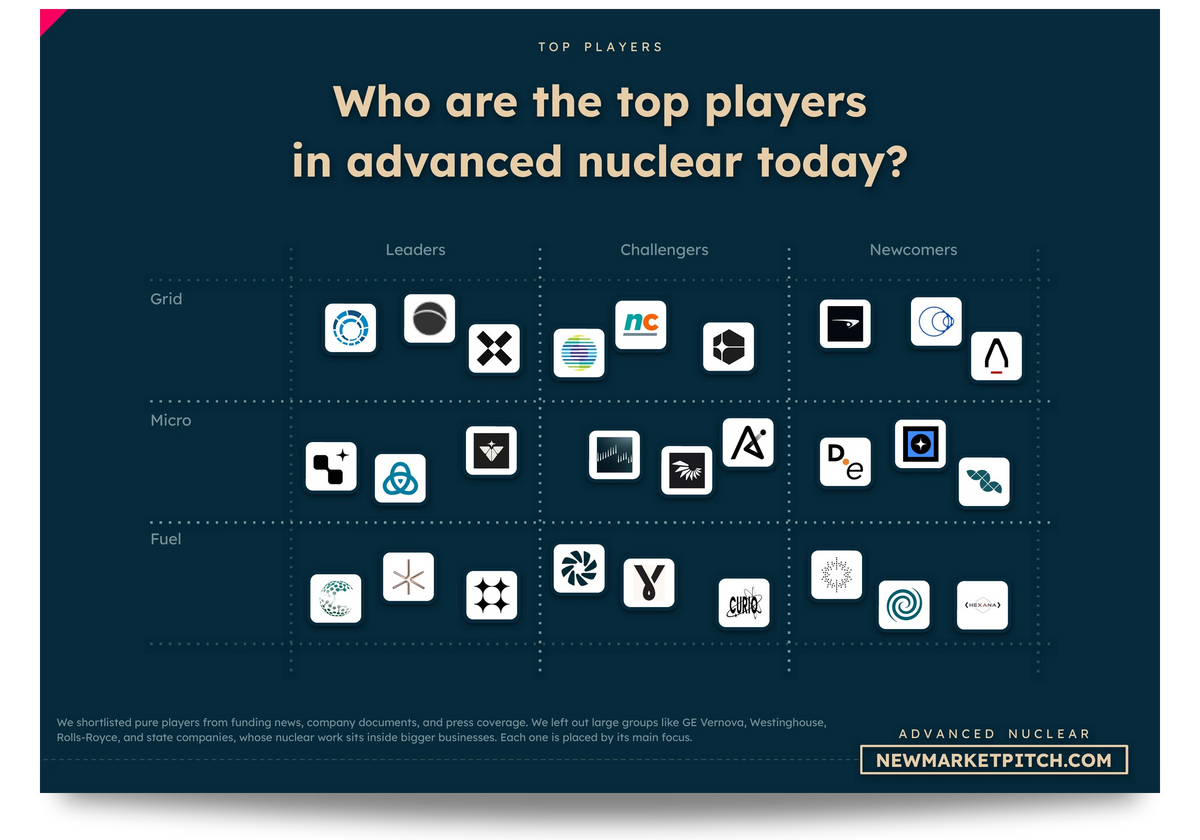
In our report covering the advanced nuclear market, we turn what is vague and complex into simple, useful visuals. Market maps like this one show you at a glance where every startup stands.
Top startups in the advanced nuclear market ranked by valuation
Here is an updated table that ranks the top startups in the advanced nuclear market based on their latest reported or estimated valuations.
If you need to dig deeper and get more detailed data, please check our report covering the advanced nuclear market.
| # | Startup Name | What They Do | Current Valuation ($) | Valuation Confidence Level | Valuation Type | Evidence Status | Total Funding ($) | Funding Confidence Level | Country |
|---|---|---|---|---|---|---|---|---|---|
| 1 | TerraPower | Develops Natrium advanced nuclear reactors | $6.0B–$9.0B | Partial Confidence | Comparables-Based Estimate | Estimated | $1.5B | Strong Confidence | United States |
| 2 | Valar Atomics | Manufactures high-temperature nuclear reactors | $5.8B–$6.2B | Strong Confidence | Implied Valuation from Raise | Estimated | $1.5B | Strong Confidence | United States |
| 3 | Aalo Atomics | Manufactures nuclear reactors for datacenters | $2.7B–$2.9B | Strong Confidence | Implied Valuation from Raise | Estimated | $133M | Full Confidence | United States |
| 4 | Radiant | Develops transportable nuclear microreactors | $1.8B–$2.6B | Partial Confidence | Implied Valuation from Raise | Estimated | $517M+ | Strong Confidence | United States |
| 5 | Antares | Develops defense-focused nuclear microreactors | $2.0B–$2.1B | Strong Confidence | Implied Valuation from Raise | Estimated | $479M | Full Confidence | United States |
| 6 | General Matter | Enriches uranium for advanced reactors | $2B | Partial Confidence | Active Raise Valuation | Estimated | $50M | Full Confidence | United States |
| 7 | CORE POWER | Develops maritime nuclear propulsion systems | $1.3B–$2.0B | Partial Confidence | Implied Valuation from Raise | Implied | $200M+ | Partial Confidence | United Kingdom |
| 8 | Blue Energy | Develops shipyard-built modular nuclear plants | $1.0B–$1.8B | Low Confidence | Comparables-Based Estimate | Estimated | $45M+ | Partial Confidence | United States |
| 9 | Kairos Power | Develops fluoride-salt-cooled nuclear reactors | $900M–$1.4B | Partial Confidence | Comparables-Based Estimate | Estimated | $70M | Partial Confidence | United States |
| 10 | Copenhagen Atomics | Develops thorium molten-salt reactors | $500M–$900M | Low Confidence | Comparables-Based Estimate | Estimated | ~$55M+ | - | Denmark |
| 11 | Last Energy | Develops factory-built modular nuclear plants | $617M | Partial Confidence | Implied Valuation from Raise | Estimated | $169M | Strong Confidence | United States |
| 12 | Natura Resources | Develops liquid-fueled molten-salt reactors | $400M–$650M | Partial Confidence | Comparables-Based Estimate | Estimated | $120M+ | - | United States |
| 13 | NuCube Energy | Develops solid-state nuclear microreactors | $430M–$550M | Strong Confidence | IPO or Listing Range Valuation | Implied | $13M+ | Partial Confidence | United States |
| 14 | Jimmy | Develops nuclear heat for industry | $350M–$530M | Partial Confidence | Comparables-Based Estimate | Estimated | $67M+ | Full Confidence | France |
| 15 | Blykalla | Develops lead-cooled modular nuclear reactors | $250M–$400M | Partial Confidence | Implied Valuation from Raise | Implied | $90M | Strong Confidence | Sweden |
| 16 | Bluecore Energy | Develops floating nuclear power barges | $200M–$333M | Strong Confidence | Implied Valuation from Raise | Implied | $60M | Full Confidence | United States |
| 17 | LIS Technologies | Develops laser uranium enrichment technology | $180M–$300M | Partial Confidence | Implied Valuation from Raise | Implied | $72M | Partial Confidence | United States |
| 18 | Apollo Atomics | Develops factory-built pressurized-water reactors | $125M–$175M | Strong Confidence | Implied Valuation from Raise | Implied | $27M | Partial Confidence | United States |
| 19 | Transmutex | Develops accelerator-driven nuclear transmutation systems | $110M–$180M | Partial Confidence | Implied Valuation from Raise | Implied | $40M | Strong Confidence | Switzerland |
| 20 | ARC Clean Technology | Develops sodium-cooled fast modular reactors | $100M–$160M | Partial Confidence | Implied Valuation from Raise | Implied | $16M+ | Partial Confidence | Canada |
| 21 | Thorizon | Develops nuclear-waste-fueled molten-salt reactors | $85M–$155M | Partial Confidence | Comparables-Based Estimate | Estimated | $32M | Strong Confidence | Netherlands |
| 22 | Stellaria | Develops fast-neutron molten-salt reactors | $90M–$140M | Partial Confidence | Implied Valuation from Raise | Implied | $29M | Full Confidence | France |
| 23 | Saltfoss Energy | Develops floating molten-salt reactors | $70M–$140M | Low Confidence | Comparables-Based Estimate | Estimated | ~$56M | - | Norway |
| 24 | Otrera | Develops sodium-cooled fast reactors | $65M–$135M | Partial Confidence | Comparables-Based Estimate | Estimated | $3M+ | Partial Confidence | France |
| 25 | HEXANA | Develops sodium-cooled reactors and storage | $70M–$120M | Partial Confidence | Comparables-Based Estimate | Estimated | $18M | Partial Confidence | France |
| 26 | Nuclear Turbines | Develops industrial nuclear microreactors | $70M–$110M | Strong Confidence | Implied Valuation from Raise | Implied | $20M | Full Confidence | United Kingdom |
| 27 | Clean Core Thorium Energy | Develops thorium-based advanced nuclear fuel | $65M–$100M | Partial Confidence | Comparables-Based Estimate | Estimated | $16M | Partial Confidence | United States |
| 28 | Fermi Energia | Develops Estonia's first nuclear power plant | $45M–$90M | Low Confidence | Comparables-Based Estimate | Estimated | $5M+ | - | Estonia |
| 29 | First American Nuclear | Develops lead-bismuth cooled nuclear reactors | $45M–$85M | Partial Confidence | Active Raise Valuation | Estimated | ~$13.7M | - | United States |
| 30 | Hexium | Develops laser-based nuclear isotope enrichment | $38M–$60M | Partial Confidence | Implied Valuation from Raise | Implied | $12M+ | - | United States |
| 31 | Applied Atomics | Develops integrated nuclear power plants | $35M–$50M | Partial Confidence | Implied Valuation from Raise | Implied | $10M | Partial Confidence | United States |
| 32 | Curio | Develops nuclear waste recycling technologies | $30M–$50M | Partial Confidence | Comparables-Based Estimate | Estimated | $8M | Full Confidence | United States |
| 33 | Molten Salt Solutions | Enriches lithium isotopes for nuclear applications | $28M–$38M | Partial Confidence | Implied Valuation from Raise | Implied | ~$10M | - | United States |
| 34 | Prodigy Clean Energy | Develops transportable nuclear power plants | $18M–$42M | Low Confidence | Comparables-Based Estimate | Estimated | Undisclosed | - | Canada |
| 35 | Dual Fluid Energy | Develops liquid-fuel nuclear reactor technology | $18M–$40M | Low Confidence | Comparables-Based Estimate | Estimated | $6M | Full Confidence | Germany |
| 36 | Blue Capsule Technology | Develops industrial high-temperature nuclear reactors | $12M–$23M | Partial Confidence | Comparables-Based Estimate | Estimated | $2.1M+ | Strong Confidence | France |
| 37 | HolosGen | Develops transportable modular nuclear generators | $7M–$22M | Low Confidence | Proxy-Based Estimate | Estimated | Undisclosed | - | United States |
| 38 | Exodys Energy | Develops advanced nuclear fuel recycling | $9M–$17M | Low Confidence | Implied Valuation from Raise | Implied | ~$2.4M | - | United States |
| 39 | Blossom Energy | Develops thermal storage and reactor systems | $9M–$14M | Partial Confidence | Implied Valuation from Raise | Implied | ~$5M | - | Japan |
Which startups in the advanced nuclear market have been acquired or gone public?
These startups no longer have a private-market valuation of their own, so we list them separately, using their acquisition price or their current market capitalization.
| # | Startup Name | What They Do | Current Valuation ($) | Valuation Confidence Level | Valuation Type | Evidence Status | Total Funding ($) | Funding Confidence Level | Country |
|---|---|---|---|---|---|---|---|---|---|
| 1 | Oklo | Develops advanced fast-fission power plants | $4.7B | Full Confidence | Public Market Cap | Observed | $3.5B+ | Partial Confidence | United States |
| 2 | X-energy | Develops reactors and TRISO nuclear fuel | $4.33B | Full Confidence | Public Market Cap | Observed | $2.7B | Strong Confidence | United States |
| 3 | NuScale Power | Develops light-water small modular reactors | $2.42B | Full Confidence | Public Market Cap | Observed | $3.8B+ | Partial Confidence | United States |
| 4 | Standard Nuclear | Manufactures TRISO advanced nuclear fuel | $1.87B | Full Confidence | Public Market Cap | Observed | $332M | Full Confidence | United States |
| 5 | newcleo | Develops lead-cooled reactors and MOX fuel | $1.3B | Full Confidence | Public Market Cap | Observed | $1.0B | Partial Confidence | United Kingdom |
| 6 | NANO Nuclear Energy | Develops portable advanced nuclear microreactors | $589M | Full Confidence | Public Market Cap | Observed | $680M | Full Confidence | United States |
| 7 | Steady Energy | Develops nuclear district-heating reactors | $360M | Full Confidence | Public Market Cap | Observed | $136M | Strong Confidence | Finland |
| 8 | Terrestrial Energy | Develops integral molten-salt reactor plants | $341M | Full Confidence | Public Market Cap | Observed | $389M | Partial Confidence | United States |
| 9 | Terra Innovatum | Develops factory-built nuclear microreactors | $264M | Full Confidence | Public Market Cap | Observed | Undisclosed | - | Italy |
| 10 | Deep Fission | Develops underground borehole nuclear reactors | $195M | Full Confidence | Public Market Cap | Observed | $154M | Full Confidence | United States |
| 11 | Hadron Energy | Develops light-water nuclear microreactors | $54M | Full Confidence | Public Market Cap | Observed | $32M+ | Partial Confidence | United States |
| 12 | Ultra Safe Nuclear | Developed TRISO-fueled modular nuclear reactors | $9M1 | Strong Confidence | Acquisition Value | Observed | $300M | Strong Confidence | United States |
| 13 | Moltex Energy | Develops molten-salt reactors and recycling | $7M–$10M2 | Partial Confidence | Acquisition Value | Estimated | $10M | Strong Confidence | United Kingdom |
| 14 | Kärnfull Next | Develops Swedish modular reactor projects | $8M | Full Confidence | Acquisition Value | Observed | $2M | Full Confidence | Sweden |
- Price for specific technology assets, not a sale of the company.
- Technology-asset deal subject to closing conditions, not a company sale.

Our research about advanced nuclear reactors gets updated several times a month, so you always get the latest view of where things stand.
Why are advanced nuclear startup valuations rising so fast?
Advanced nuclear startups are attracting billion-dollar valuations because investors now see a real market for new reactors, especially from data centers, industrial companies and governments worried about electricity supply.
The biggest change comes from customers. In October 2024, Google signed an agreement with Kairos Power for up to 500 MW of future nuclear capacity. Amazon has gone further financially, investing $500M in X-energy and supporting plans for more than 5 GW of new nuclear capacity by 2039.
Government support has also become more substantial. The U.S. Department of Energy selected TerraPower and X-energy for cost-shared demonstration projects in 2020, while its January 2026 uranium-enrichment awards included a $900M task order for General Matter.
Then came the reactor tests. Antares reached zero-power criticality in June 2026, followed by Valar Atomics later that month and Aalo Atomics in July. These milestones showed that several young companies could build functioning experimental nuclear systems rather than merely propose them.
The investment story has broadened remarkably quickly. Investors are financing large power plants, transportable microreactors, nuclear fuel production and industrial heating systems. The industry has moved beyond a handful of expensive demonstration projects, although commercial revenue still trails the valuations by a considerable distance.
Which advanced nuclear startups are worth the most today?
TerraPower currently leads the private advanced nuclear ranking at $6.0B–$9.0B, followed by Valar Atomics at $5.8B–$6.2B and Aalo Atomics at $2.7B–$2.9B.
These three companies are pursuing quite different markets. TerraPower is building Natrium, a 345 MW sodium-cooled reactor intended for utility-scale electricity generation. Valar Atomics develops high-temperature nuclear systems, while Aalo Atomics is designing modular reactors that can supply electricity to data centers.
General Matter is valued at about $2B, even though it develops uranium enrichment infrastructure rather than nuclear reactors. Radiant, valued at $1.8B–$2.6B, specializes in transportable microreactors. Antares, at $2.0B–$2.1B, targets smaller nuclear systems suited to defense and remote-power applications.
One unusual feature of this market is that reactor size has surprisingly little to do with valuation. A company building a large power station can command a valuation similar to one developing much smaller nuclear systems, while an enrichment business can reach the same financial tier without manufacturing reactors.
For investors, the opportunities extend across the nuclear supply chain. For customers, these businesses are solving completely different problems. The ranking says a great deal about where capital is flowing, but much less about which reactor design will eventually win.

In our market report about advanced nuclear reactors, we look at what the winners do differently, so you can learn from the best instead of guessing.
How many advanced nuclear unicorns are there?
Eight private advanced nuclear startups have valuation ranges starting at $1B or more, representing about 21% of the 39 companies in our private ranking.
Those eight companies are TerraPower, Valar Atomics, Aalo Atomics, General Matter, Radiant, Antares, CORE POWER and Blue Energy. A ninth company, Kairos Power, is valued at $900M–$1.4B, putting it partly above the unicorn threshold.
The variety is striking. TerraPower is developing a commercial power station, Radiant and Antares are working on compact systems, CORE POWER is pursuing maritime nuclear applications, and General Matter is building enrichment infrastructure. All can attract billion-dollar valuations despite having very different customers and development requirements.
Advanced nuclear has already produced a meaningful group of unicorns, even though most companies are still years away from generating electricity or supplying nuclear fuel at commercial scale. That is an aggressive financial starting point for such a capital-intensive industry.
Is TerraPower still the most valuable private nuclear startup?
TerraPower remains the highest-ranked private advanced nuclear startup, with a $6.0B–$9.0B valuation and one of the industry's most advanced commercial reactor projects.
Its strongest achievement is the Natrium project in Kemmerer, Wyoming. On March 9, 2026, the U.S. Nuclear Regulatory Commission issued a construction permit for the 345 MW sodium-cooled reactor. According to the Department of Energy, this was the first construction permit issued by the NRC for a commercial non-light-water power reactor.
TerraPower submitted its application in March 2024, and the NRC completed its safety review in December 2025. That is substantial progress for a reactor design that differs from the light-water technology used in most existing commercial nuclear plants.
Natrium also includes molten-salt thermal storage, allowing the facility to increase electrical output to 500 MW for limited periods. This gives the plant more flexibility to respond to changing electricity demand.
The project is expected to be completed around 2030, although TerraPower will still need an operating license before generating commercial electricity.
TerraPower's leading position looks justified by its regulatory and construction progress. Still, its valuation range overlaps Valar Atomics' $5.8B–$6.2B, despite the enormous difference between a utility-scale commercial project and a young developer advancing through experimental reactor tests.

In our document detailing everything you need to know about advanced nuclear, you will always find fresh funding data, taken straight from our own verified funding database.
Why is Valar Atomics worth so much?
Valar Atomics has reached a $5.8B–$6.2B valuation because it has moved unusually quickly from reactor development to a successful nuclear experiment.
On June 18, 2026, Valar's Ward 250 reactor achieved zero-power fueled criticality at the Utah San Rafael Energy Lab. The Department of Energy described it as the first DOE-authorized reactor built outside a national laboratory.
Criticality means that a controlled nuclear chain reaction can sustain itself. For an advanced reactor developer, this is a major technical milestone because it confirms important aspects of the nuclear core's behavior.
Valar's result came just two weeks after Antares achieved criticality at Idaho National Laboratory. Aalo Atomics followed in July, meaning three companies in our ranking reached this milestone within roughly one month.
That's quite a change for an industry that spent years talking mainly about designs, simulations and regulatory preparation.
There is a catch, though. The Ward 250 demonstration was conducted at zero power. Investors are still betting on Valar's ability to progress toward sustained high-temperature operation, commercial reactor manufacturing and electricity or industrial-heat delivery.
Valar's valuation reflects extraordinary confidence in its execution speed. The next serious test is whether it can operate a reactor under conditions much closer to what paying customers will need.
Is Aalo Atomics becoming a major nuclear startup for data centers?
Aalo Atomics is becoming a serious contender in nuclear power for data centers, with a $2.7B–$2.9B valuation and a successful experimental reactor test.
Aalo is developing approximately 10 MWe modular reactors that can be combined into 50 MWe Aalo Pods. This approach would allow customers to add generation capacity in smaller increments than a conventional nuclear power plant.
On July 4, 2026, its Aalo-X experimental reactor achieved zero-power fueled criticality at Idaho National Laboratory. The Department of Energy confirmed the achievement two days later.
The timing was impressive. Aalo built its test reactor in less than eight months, according to the company's development announcements. That's remarkably fast for a nuclear engineering project, even an experimental one.
Aalo's intended customers also have a clear reason to explore nuclear power. Large data centers require continuous electricity, and access to sufficient grid capacity can influence where new facilities are built.
Compared with TerraPower's utility-scale project, Aalo is aiming for smaller, repeatable installations. Compared with Radiant's approximately 1 MWe microreactor, its planned modules target substantially larger electricity loads.
Still, building an experimental reactor quickly doesn't establish what commercial units will cost. Aalo needs to show that its modular design can be manufactured repeatedly, licensed and connected to customers' electrical infrastructure.
The company has made serious technical progress. Its long-term valuation will depend on how cheaply and quickly it can actually deliver those first commercial installations.

Learning from others' mistakes is the cheapest lesson there is. In our report covering the advanced nuclear market, we look at what broke startups before you, so you don't repeat it.
Are Radiant and Antares actually close to selling nuclear microreactors?
Radiant and Antares are making credible progress toward commercial nuclear microreactors, but their valuations still reflect substantial future revenue expectations.
Radiant has a $1.8B–$2.6B valuation and is developing Kaleidos, a transportable reactor designed to produce approximately 1 MWe of electricity. Antares, valued at $2.0B–$2.1B, is pursuing microreactors for demanding environments, including defense installations.
Antares achieved zero-power criticality with its Mark-0 reactor at Idaho National Laboratory on June 4, 2026. This established an important technical foundation for its later reactor designs.
Radiant is working toward an integrated nuclear testing program for Kaleidos. The company has also developed manufacturing plans in Tennessee, reflecting its ambition to produce multiple transportable reactors rather than build each installation as an entirely separate engineering project.
The commercial opportunity is particularly interesting in locations where diesel generators, fuel transport or grid extensions are expensive. A remote military installation can have very different electricity economics from a conventional urban customer.
The first microreactor businesses will ultimately be judged by installation cost, fuel logistics, operating reliability and the total price customers pay for electricity. Compact nuclear reactors are impressive engineering achievements, but repeat orders will depend on those practical results.
Radiant and Antares have reduced important technical uncertainties. Commercial deployments will determine whether microreactors can become attractive businesses at scale.
Why is General Matter worth billions without building nuclear reactors?
General Matter has an estimated $2B valuation because uranium enrichment is becoming one of the most strategically important parts of advanced nuclear power.
Many advanced reactor designs require high-assay low-enriched uranium, known as HALEU. This fuel contains more uranium-235 than conventional commercial reactor fuel, but commercial HALEU production capacity in the United States remains limited.
General Matter received a $900M task order from the Department of Energy in January 2026 to help expand domestic HALEU enrichment capacity. American Centrifuge Operating received a separate $900M award under the same federal initiative.
The total package announced by the department amounted to $2.7B across three enrichment companies, including an additional award for low-enriched uranium production.
That's an enormous federal commitment to a supply chain supporting an industry whose first commercial advanced reactors are still being developed.
The attraction of General Matter is straightforward: it could serve several reactor developers rather than depend on the success of one particular reactor design.
There is a similar strategic logic behind LIS Technologies, Hexium and Clean Core Thorium Energy, although these companies work on different enrichment technologies or advanced fuel products.
One important distinction: General Matter's $900M federal task order is tied to performance and project milestones. It doesn't mean the company has already earned $900M in revenue.
Even so, General Matter could become a major nuclear supplier if domestic enrichment capacity expands as planned. Reactor developers will need qualified fuel, and the companies capable of producing it may hold considerable bargaining power.

Your time is limited. In our research about advanced nuclear reactors, we put numbers on each part of the market, so you can see where it makes sense to focus.
Could uranium fuel shortages slow down advanced nuclear startups?
Uranium fuel shortages could delay advanced nuclear deployment, especially for companies that need HALEU before their first reactors can operate.
The U.S. Government Accountability Office examined the problem in August 2026. Its report found that projected HALEU availability might fall short of near-term demand, while emphasizing that demand remains uncertain because many proposed reactor projects have not yet been built.
The Department of Energy expected approximately 21.2 metric tons of HALEU to be available by the end of 2028 and about 23.4 metric tons by 2030 under the supply assumptions examined by the GAO.
Several reactor developers are therefore competing for a relatively limited supply of qualified fuel. Additional production capacity requires enrichment equipment, regulatory approvals, investment and long-term customer commitments.
The problem creates a difficult cycle. Enrichment businesses want confirmed reactor demand before making enormous investments, while reactor developers need confidence that fuel will be available before committing to commercial schedules.
This helps explain why nuclear fuel companies are gaining attention alongside reactor manufacturers. A supplier capable of delivering qualified domestic fuel could become commercially important well before advanced nuclear electricity production reaches a large scale.
| Fuel supply milestone | Evidence | Why it matters |
|---|---|---|
| October 2020 | DOE selects TerraPower and X-energy for demonstration awards | Creates demand for advanced reactor fuel |
| January 2024 | DOE begins soliciting domestic HALEU enrichment services | Establishes a federal procurement pathway |
| October 2024 | DOE selects four suppliers for HALEU enrichment contracts | Expands the potential supplier base |
| January 2026 | General Matter receives a $900M task order | Supports planned enrichment capacity |
| January 2026 | American Centrifuge Operating receives a separate $900M task order | Adds another major domestic investment |
| August 2026 | GAO warns that projected HALEU supply may be insufficient | Confirms an important deployment constraint |
| By 2030 | DOE's examined plans indicate about 23.4 metric tons of available HALEU | Shows the limited near-term scale of expected supply |
Is Kairos Power worth less than Aalo Atomics despite having more permits?
Kairos Power has a lower estimated valuation than Aalo Atomics despite having a longer regulatory track record and a major customer agreement with Google.
Kairos is valued at $900M–$1.4B, compared with Aalo Atomics' $2.7B–$2.9B range.
The regulatory comparison is revealing. Kairos received construction permits for its Hermes demonstration reactor in December 2023 and its Hermes 2 test facility in November 2024. Those approvals came before Aalo's July 2026 criticality demonstration.
Kairos also signed a development agreement with Google in October 2024 covering up to 500 MW of nuclear electricity capacity by 2035. The plan involves multiple reactors and a sequence of projects, beginning with an initial deployment targeted around 2030.
Aalo, meanwhile, has attracted a considerably higher valuation after rapidly developing and testing its own reactor technology.
Does that make Kairos undervalued? Possibly. Its permitting history and named customer commitments are unusually strong for a company in this valuation range.
The two businesses have different reactor designs and commercialization strategies, but the gap is still worth examining. If regulatory progress and customer commitments were the only considerations, Kairos would look particularly competitive.

In our market report about advanced nuclear reactors, we always try to gather several sources and make estimates that make sense, so you can work with solid numbers.
Are Google and Amazon really spending money on advanced nuclear power?
Google and Amazon have moved beyond casual interest in advanced nuclear power, although the electricity covered by their agreements is largely scheduled for future delivery.
Google's October 2024 arrangement with Kairos Power targets up to 500 MW of capacity by 2035, with the first deployment planned around 2030. It creates a commercial framework for a fleet of advanced reactors.
Amazon has made a more direct equity commitment through its $500M investment in X-energy. It is also working with Energy Northwest on a project in Washington state initially targeting 320 MW, potentially expandable to 960 MW.
In October 2026, Amazon, X-energy and American Electric Power announced a proposed project in Indiana involving twelve 80 MW Xe-100 reactors. Together, they would produce 960 MW of generation capacity if completed.
These are serious commitments, particularly because Amazon is supporting both nuclear technology development and individual projects.
But the quantities need some perspective. A 500 MW development target is different from 500 MW of operating electricity generation. Even a signed power-purchase agreement leaves permitting, construction and commissioning work ahead.
Hyperscalers have become genuine financial and commercial partners for advanced nuclear developers. Their involvement improves the industry's prospects considerably, although most of the expected electricity production remains years away.
Which advanced nuclear technologies are attracting the highest valuations?
Sodium-cooled reactors, high-temperature systems and modular reactor designs currently dominate the upper end of private advanced nuclear valuations, with uranium enrichment emerging as another major category.
TerraPower's Natrium project uses sodium cooling. Valar Atomics develops high-temperature reactor technology, and Aalo Atomics is pursuing compact modular systems. General Matter has built its investment case around fuel enrichment.
Other reactor designs are receiving investment at smaller valuation levels. Kairos Power develops fluoride-salt-cooled reactors, Copenhagen Atomics works on thorium molten-salt systems, and Blykalla focuses on lead-cooled reactors.
Thorizon, Stellaria and Saltfoss Energy are also developing molten-salt concepts, while ARC Clean Technology and HEXANA pursue sodium-cooled designs.
These technologies have different trade-offs involving operating temperature, fuel, materials, reactor size and industrial applications. For example, reactors operating at higher temperatures may be useful for supplying industrial heat alongside electricity.
However, no reactor category has established a broad commercial manufacturing lead. Today's valuations tell us considerably more about fundraising and project progress than they do about the eventual cost per megawatt-hour.
It is far too early to declare which reactor technology will dominate in twenty years. Some of the eventual winners may not even be among today's most valuable startups.

If you build or invest in the advanced nuclear market, you need to know which business models pay off now and which ones are fading. That's why our report covering it has a whole section on it.
Can nuclear microreactors compete with conventional nuclear power plants?
Nuclear microreactors could become competitive in specialized locations, especially where reliable electricity is expensive or difficult to obtain. Competing with large power plants on ordinary wholesale electricity prices will be harder.
The differences in reactor size are substantial. TerraPower's Natrium project targets 345 MWe, Aalo Atomics is designing approximately 10 MWe modules, and Radiant's Kaleidos is intended to generate about 1 MWe.
A large nuclear plant can spread many fixed costs across greater electricity production. Smaller reactors offer potential advantages in transport, installation and the ability to match local demand.
That makes remote industrial sites, military facilities and isolated communities promising early markets. A customer currently dependent on delivered diesel fuel may be willing to pay considerably more for dependable power than a customer connected to a large electricity grid.
Specialized developers are pursuing similar opportunities outside conventional electricity generation. Jimmy targets industrial heat, CORE POWER develops maritime nuclear applications, and Bluecore Energy works on floating nuclear power systems.
These specialized markets could give smaller reactors a practical entry point. The tougher challenge comes later, when manufacturers try to compete with conventional power generation across larger and more price-sensitive markets.
Can advanced nuclear startups really manufacture reactors at scale?
Advanced nuclear startups are getting closer to repeatable reactor manufacturing, but no private company in our ranking has yet demonstrated a large commercial fleet built at predictable unit costs.
Aalo Atomics wants to produce standardized modules, Radiant is developing manufacturing infrastructure for transportable systems, and Last Energy promotes factory-built nuclear plants.
Blue Energy is pursuing an especially different construction model by developing modular plants assembled using shipyard infrastructure. Prodigy Clean Energy is also working on transportable nuclear facilities.
These approaches share a common goal: reduce the amount of specialized work performed at individual construction sites.
Yet manufacturing a reactor involves much more than producing its core. Companies need qualified components, fuel supply, quality-control systems, transport arrangements and regulatory approval for the finished installation.
The industry's first genuinely useful manufacturing comparisons will come from building successive commercial units. The real question is whether the second, fifth or tenth reactor costs less and takes less time to deliver than the first.
Until those results are available, factory-production plans remain difficult to value precisely. Making one reactor work is hard enough. Making dozens at a competitive price is an entirely different industrial challenge.

In our report covering the advanced nuclear market, we don't want to repeat what boring consulting reports say. Instead, we show you the real and latest market signals that matter.
Are European advanced nuclear startups falling behind American companies?
European advanced nuclear startups are developing plenty of interesting technology, but American companies currently dominate the highest private valuation tier.
Of the eight companies whose valuation ranges begin at $1B, seven are based in the United States. CORE POWER, from the United Kingdom, is the only European representative.
Across the full private ranking, 22 of the 39 startups are American, accounting for about 56%. European companies represent most of the remaining group, with businesses operating in France, Sweden, Denmark, the Netherlands, Switzerland, Germany, Norway, Estonia and the United Kingdom.
France has five private companies in the ranking: Jimmy, Stellaria, Otrera, HEXANA and Blue Capsule Technology. Their technologies include industrial nuclear heating, molten-salt reactors and sodium-cooled systems.
Northern Europe has another cluster. Copenhagen Atomics is working on thorium molten-salt reactors, Blykalla is developing lead-cooled technology, and Thorizon is pursuing reactors designed to use recycled nuclear materials.
The United States has several advantages that translate more directly into large private valuations: major government demonstration programs, a deep venture-capital market and concentrated demand from technology companies building data centers.
Europe has technological depth but fewer companies reaching the same financial scale. Closing that gap will depend on bringing reactor projects through licensing, securing enough construction capital and converting industrial partnerships into actual facilities.
Are advanced nuclear startups raising enough money to justify their valuations?
Advanced nuclear startups are raising substantial amounts of capital, but their valuations depend on much more than the money already invested.
TerraPower has approximately $1.5B in reported funding against its $6.0B–$9.0B valuation. Aalo Atomics has raised $133M and is valued at $2.7B–$2.9B. Antares has $479M in funding against a $2.0B–$2.1B valuation.
The differences are large because investors price ownership based on expected future value, rather than simply adding up historical investments.
However, nuclear companies face a financial challenge that many software startups do not. Reactor construction, manufacturing infrastructure, testing facilities and fuel production can require considerable additional capital before meaningful commercial revenue appears.
Government awards also need to be separated from equity funding. A cost-shared construction grant or a federal procurement contract can reduce financing pressure, but its total value should not be added directly to a company's equity valuation.
Public companies show how far market values can diverge from historical financing. NuScale Power has a $2.42B market capitalization against $3.8B+ in reported funding, while NANO Nuclear Energy has a $589M market capitalization against $680M in funding. In both cases, market value sits below cumulative reported funding as investors reassess future prospects, and because reported funding can include financing categories beyond equity capital.
For private startups, the question is how much capital must still be raised before cash generation becomes dependable. A high valuation can coexist with substantial future financing needs, and existing shareholders may face significant dilution along the way.

In our research about advanced nuclear reactors, we like to show you the big picture. We know your time is precious, so we make every page quick to read and packed with as much learning as possible per minute.
What does an advanced nuclear startup need to become a unicorn?
An advanced nuclear startup can reach a billion-dollar valuation well before operating a commercial power plant, provided investors believe it has a credible path to licensing, customers and large-scale deployment.
The clearest examples show three different approaches.
Aalo Atomics reached $2.7B–$2.9B through a modular reactor strategy and rapid experimental progress. Valar Atomics reached $5.8B–$6.2B while advancing high-temperature reactor technology. General Matter reached about $2B by focusing on uranium enrichment, a strategically important part of the nuclear supply chain.
None of those companies needed an operating commercial reactor to achieve unicorn status. They convinced investors that their technology addresses an important problem and that their teams can execute demanding development programs.
The path becomes more difficult as the business grows. Experimental success must eventually be followed by regulatory approvals, qualified manufacturing, customer contracts and reliable operations.
For fuel companies, the milestones are different. Production capacity, customer commitments and actual enrichment output may matter more than reactor construction.
Reaching $1B is therefore possible at a relatively early commercial stage. Keeping that valuation through the far more expensive construction and deployment stages is another matter entirely.
Which advanced nuclear startups have gone public or been acquired?
Several major advanced nuclear businesses have already entered public markets, while others have been acquired through transactions that reveal the financial risks of nuclear technology development.
Oklo currently has a $4.7B public market capitalization, X-energy stands at $4.33B, and NuScale Power at $2.42B. These companies are valued through publicly traded shares rather than private startup financing rounds.
Standard Nuclear has a $1.87B market capitalization, followed by newcleo at $1.3B and NANO Nuclear Energy at $589M. Smaller public-market valuations include Steady Energy, Terrestrial Energy, Terra Innovatum, Deep Fission and Hadron Energy.
The acquisition category tells a much harsher story. Ultra Safe Nuclear's specified technology assets were acquired for $9M after the company had attracted approximately $300M in funding, following financial distress. That low price reflects an asset transaction rather than the acquisition of a healthy operating company.
Moltex Energy's technology-asset transaction was estimated at $7M–$10M and remained subject to closing conditions. Kärnfull Next had an acquisition value of $8M.
These outcomes illustrate how sharply financial results can differ within advanced nuclear. Some businesses have gained access to public equity markets, while other technologies have changed hands at prices far below their historical investment requirements.
Public-company capitalizations also offer useful comparisons for private valuations, although share prices can change quickly. They are a reminder that even after a nuclear startup reaches the stock market, investors can radically revise what its technology and future commercial projects are worth.
Are advanced nuclear startups overvalued right now?
Advanced nuclear startups are not uniformly overvalued, but some of today's multibillion-dollar valuations assume that companies will overcome several expensive engineering and commercial challenges.
The strongest businesses now have measurable achievements. TerraPower has a commercial reactor construction permit. Kairos Power has regulatory approvals and a long-term agreement with Google. Several microreactor developers have demonstrated nuclear criticality, while General Matter has secured a major federal enrichment award.
These developments make the sector more credible than it was a few years ago.
Yet commercial nuclear construction remains expensive, and most advanced designs still lack a track record of repeated, profitable deployment. Companies also face financing dilution, fuel availability constraints, component manufacturing challenges and regulatory requirements that continue after initial construction permits.
The market could therefore separate sharply between companies that successfully commission operating facilities and those that remain stuck in development.
A successful first reactor would strengthen a company's case, but investors will eventually want evidence that subsequent units can be built faster, operated reliably and sold at a price customers accept.
Our assessment is that advanced nuclear startup valuations have a real foundation, especially at companies making measurable progress toward deployment. The speculative part is how quickly investors expect those projects to become profitable businesses.
The next few years should make those differences much clearer. Today, nuclear startups are being valued for an industrial future that is beginning to take shape, but has yet to prove itself at commercial scale.
Our methodology
We analyzed the advanced nuclear market to identify the most valuable startups developing advanced reactors, nuclear fuel, uranium enrichment and related infrastructure. Our private ranking covers 39 independent companies, while publicly traded businesses and acquisitions are treated separately.
We prioritized recent funding rounds, company and investor announcements, regulatory decisions, government contracts, financial disclosures and major commercial agreements. For companies with disclosed financing valuations, those transactions generally served as the primary reference. Where a precise valuation was not publicly announced, we estimated a range using financing history, comparable companies, business maturity and commercial progress. The distinction between confirmed transaction prices and estimated valuations is important, particularly for companies still several years away from revenue-generating operations.
We also examined nuclear-specific milestones, including construction permits, experimental reactor criticality, fuel qualification, manufacturing plans and agreements with electricity customers. These achievements help explain investor interest, but they do not automatically translate into commercial revenue. Government grants, procurement awards and historical funding were evaluated separately from equity valuations to avoid treating different financial measures as interchangeable.
Public companies were valued using market capitalization, while acquired businesses were assessed using transaction values. Technology-asset purchases were distinguished from acquisitions of entire companies, particularly in distressed situations. Private valuations are expressed as ranges where appropriate, reflecting differences in financing dates, operating progress and comparable-company valuations.
A company can appear in this ranking even when its total funding is undisclosed: its position depends on its valuation, not on the capital it has raised.
Key sources include the U.S. Nuclear Regulatory Commission's TerraPower construction permit, the Department of Energy's Natrium project specifications, and the Advanced Reactor Demonstration Program awards. For reactor development milestones, we used the DOE's announcements covering Antares, Valar Atomics and Aalo Atomics, together with its Reactor Pilot Program.
For nuclear fuel and enrichment, we relied on the DOE's $2.7B uranium-enrichment awards, its HALEU enrichment program, and the Government Accountability Office's August 2026 assessment of HALEU supply. Commercial agreements were checked against Kairos Power's agreement with Google, Google's announcement, Amazon's nuclear investment commitments and its Indiana nuclear development agreement. Additional project information came from the DOE's demonstration project records, its 2026 advanced reactor progress report, the NRC's Kairos Power licensing records, and NuScale Power's SEC filings.
Written by the New Market Pitch teamWe track new markets so founders and investors can move faster. About us