Advanced nuclear: what are the biggest unsolved problems?
Whether you're building or investing in the advanced nuclear market, our report covers everything you need to know: the players, the money, and what's coming next.
Summary
The biggest unsolved problems in advanced nuclear reactors are construction costs, commercial financing, advanced fuel shortages, long-term reliability, and mass production. Construction economics is the toughest industry-wide problem, while fuel availability could stop several leading designs from operating even after their reactors are built.
Advanced nuclear is already commercially operational in China, but the Western developers attracting billions in investment have little commercial operating history. China's Shidaowan HTR-PM has operated commercially since December 2023, while most US projects are still working through construction, licensing, or demonstration milestones.
The industry has far more reactor designs than proven businesses. The OECD Nuclear Energy Agency tracked 156 small and micro modular reactor projects in September 2026, yet only a fraction have reached meaningful deployment milestones. Counting reactor projects tells us very little about whether their developers can actually deliver electricity at competitive prices.
Small modular reactors have not demonstrated that being smaller makes nuclear power cheaper. NuScale's cancelled Idaho project saw estimated costs climb above $8 billion and its target electricity price rise from $58 to $89 per MWh. Factory production could eventually change the economics, but the repeated orders needed to make that work barely exist.
First-of-a-kind construction is another expensive problem. China's HTR-PM required more than 2,200 sets of first-of-a-kind equipment and roughly 11 years between the start of construction and commercial operation. The real economic breakthrough will come when second and third installations become substantially cheaper, rather than simply proving that the first reactor works.
Fuel supply is a potential showstopper. US government projections indicate approximately 21.2 metric tonnes of HALEU available by the end of 2028 and a cumulative 23.4 tonnes by 2030 through federal supply efforts. Several prominent reactor developers depend on fuel that does not yet have a mature commercial supply chain outside Russia and China.
Technical challenges differ sharply across reactor technologies. Sodium-cooled reactors have to manage reactive coolants, molten-salt designs face corrosion and chemistry problems, and high-temperature gas reactors require qualified fuel and graphite components. A safety advantage in one area can introduce a completely different engineering problem elsewhere.
Google, Amazon, and Dow are changing the commercial picture by becoming prospective long-term customers and development partners. But Google's Kairos Power agreement targets initial deployment around 2030, which means advanced nuclear is unlikely to solve the immediate electricity shortages affecting AI data centers.
Regulatory progress is now ahead of commercial proof. TerraPower received its Natrium construction permit in March 2026, Kairos Power has secured permits for experimental reactors, and NuScale has an approved updated design. Those achievements remove important barriers, but they do not establish construction costs, operating reliability, or investment returns.
Our assessment is that advanced nuclear is technically promising but commercially unproven at scale. The decisive evidence will be a developer building its third or fourth commercial reactor faster and cheaper than its first, operating those plants reliably across multiple fuel cycles, and attracting customers willing to finance repeat orders without extraordinary public support.

Written by the New Market Pitch teamWe track new markets so founders and investors can move faster. About us

A good product starts with a real problem. In our report covering the advanced nuclear market, we show you the ones customers still live with.
Are advanced nuclear reactors actually ready for commercial use?
Advanced nuclear reactors are already operating in China and Russia, but most of the new designs attracting investment today are still years away from proving they can produce electricity commercially.
China's Shidaowan HTR-PM entered commercial operation in December 2023. Its two high-temperature gas-cooled reactors supply a common turbine, making it one of the clearest examples of advanced nuclear technology operating beyond the experimental stage. Russia's Akademik Lomonosov floating nuclear power plant has supplied electricity since 2020, although its reactors are based on established marine nuclear technology rather than a completely new concept.
The United States is now reaching important construction milestones. TerraPower received a Nuclear Regulatory Commission construction permit for its Natrium reactor in March 2026, the first US construction permit for a commercial non-light-water power reactor. Kairos Power has secured permits for its Hermes experimental reactors, while X-energy is working with Dow on a proposed industrial nuclear installation in Texas.
The scale of development is striking. The OECD Nuclear Energy Agency's September 2026 dashboard tracked 156 small and micro modular reactor projects worldwide, with 95 included in its detailed assessment. That represents an increase from 129 tracked projects in January 2026, although some projects in the broader database are inactive, paused, or excluded from detailed assessment.
Yet the number of designs says little about how many reactors will actually be built. Most developers still lack operating commercial plants, and almost none can point to a fleet of identical advanced reactors built at progressively lower costs.
Why are Google, Amazon and other big companies suddenly interested in advanced nuclear?
Advanced nuclear is attracting much more attention because data centers and industrial companies want dependable, low-carbon electricity for decades, and some are willing to support reactor projects long before they produce power.
Google's 2024 agreement with Kairos Power targets up to 500 MW of nuclear capacity, with initial deployment planned around 2030 and additional projects through 2035. Amazon has backed X-energy's development and announced agreements involving Energy Northwest, while Dow is pursuing four Xe-100 reactors at its Seadrift chemical manufacturing site in Texas.
These companies have different motivations. Google and Amazon are preparing for electricity demand from increasingly power-hungry data centers. Dow needs industrial steam as well as electricity, making high-temperature reactors particularly interesting.
The International Energy Agency's 2025 report, The Path to a New Era for Nuclear Energy, estimated annual global nuclear investment at around $65 billion. Under its announced-pledges scenario, investment could reach $120 billion annually by 2030, with more than 1,000 small modular reactors representing roughly 120 GW of capacity by 2050.
That's an ambitious projection. It assumes a level of financing, construction activity, and policy support that the market has yet to demonstrate.
What has genuinely changed is the type of customer showing interest. Advanced nuclear developers are increasingly negotiating with large electricity users that can commit to long-term demand rather than relying exclusively on traditional utilities.

If you build or invest in the advanced nuclear market, you need to know which business models pay off now and which ones are fading. That's why our report covering it has a whole section on it.
Can small modular reactors really make nuclear power cheaper?
Small modular reactors have yet to prove they can produce cheaper electricity than large conventional nuclear plants. The biggest problem is that smaller reactors lose some economies of scale, while the factory production meant to compensate for that disadvantage barely exists today.
A conventional 1,000 MW reactor spreads expensive equipment, security, staffing, and infrastructure across a large amount of electricity. Four 250 MW reactors can provide the same capacity, but they still need reactor-specific equipment and safety systems. Developers hope factory manufacturing, shared facilities, and shorter construction schedules will reduce those costs enough to make the smaller units competitive.
NuScale's cancelled Carbon Free Power Project shows how badly those assumptions can unravel.
The planned installation in Idaho saw estimated project costs rise from approximately $5.3 billion to more than $8 billion. Its targeted electricity price rose from $58 to $89 per MWh in January 2023, an increase of roughly 53%. NuScale and Utah Associated Municipal Power Systems eventually cancelled the project in November 2023 after failing to secure enough customer commitments.
That experience doesn't establish what TerraPower's Natrium, X-energy's Xe-100, or Kairos Power's fluoride-salt-cooled reactors will cost. The technologies and business models are different.
Still, it exposes the central weakness in the SMR economic argument: developers promise lower costs once they manufacture many identical reactors, but customers want evidence of competitive prices before placing large orders. Someone has to take the risk on those first expensive units.
If you want more recent data on this point, please see our latest advanced nuclear market report.
Why does the first advanced nuclear reactor cost so much to build?
The first advanced nuclear reactor is usually expensive because developers have to invent or qualify parts of the manufacturing process while building the plant itself. They also need to complete detailed engineering, test unfamiliar equipment, and satisfy regulators without much operating experience to rely on.
China's Shidaowan HTR-PM is a useful example. According to Tsinghua University's project documentation, the plant required more than 2,200 sets of first-of-a-kind equipment, including over 660 sets of innovative equipment. Construction started in December 2012, and commercial operation followed approximately 11 years later.
Some of that work should become easier on the next project. Engineers can reuse designs, suppliers become familiar with the components, and construction teams learn which procedures create delays.
But there's a catch. Many advanced nuclear companies are developing reactors that haven't been built anywhere else. Their first projects need specialised equipment, new production lines, and years of technical work before there is any guarantee that more orders will follow.
Kairos Power is trying to reduce that risk through its Hermes test programme, gaining construction and operating experience before moving to larger commercial units. TerraPower's Natrium project takes a different approach, combining established sodium-cooled reactor concepts with a new commercial plant configuration and thermal energy storage.
The economic question is how much of the first project's cost disappears on the second and third installations. If each customer requires major design changes or custom site engineering, developers could end up repeating expensive first-of-a-kind work.

Learning from others' mistakes is the cheapest lesson there is. In our market report about advanced nuclear reactors, we look at what broke startups before you, so you don't repeat it.
Could a nuclear fuel shortage stop advanced reactors from being built?
A shortage of advanced nuclear fuel could delay some of the most promising US reactors even after construction is complete. The biggest immediate problem is HALEU, a uranium fuel that several advanced designs require but which still lacks a large commercial supply chain outside Russia and China.
Conventional commercial reactors generally use uranium enriched below 5% uranium-235. HALEU contains more than 5% but less than 20%, allowing certain advanced reactor designs to use different core configurations and operate for longer periods between refuelling.
TerraPower, X-energy, and Kairos Power are among the companies seeking this fuel.
The US Government Accountability Office's 2026 assessment gives us a good measure of the shortage. More than a dozen advanced reactor developers had requested HALEU from the Department of Energy. Based on estimates available in April 2026, DOE expected to have approximately 21.2 metric tonnes of uranium in HALEU form available by the end of 2028 and a cumulative 23.4 tonnes by the end of 2030.
That's only about 2.2 additional tonnes between those two projected supply totals. DOE officials expected demand to exceed the material available through government programmes before commercial production could fill the gap.
The United States is investing heavily to change that. In January 2026, DOE awarded initial $900 million enrichment-capacity task orders to American Centrifuge Operating, a Centrus subsidiary, and General Matter.
However, enrichment is only one part of the process. Advanced fuel must also be converted into the required chemical form, manufactured into qualified fuel assemblies, and transported to reactor sites.
A completed reactor could therefore remain idle while its developer waits for qualified fuel.
Which advanced nuclear technologies have the hardest problems to solve?
Molten-salt, sodium-cooled, lead-cooled, and high-temperature gas reactors face some of the hardest technical questions in advanced nuclear. Light-water SMRs benefit from decades of reactor operating experience, although their construction costs remain a major challenge.
The differences come from how each technology handles heat, radiation, fuel, and coolant.
Sodium-cooled reactors can operate at relatively low pressure, but sodium reacts chemically with water and air. Molten-salt systems can operate at high temperatures, but salt chemistry and corrosion need careful control. Gas-cooled reactors use specialised fuels and materials that must withstand high temperatures and long periods of irradiation.
The OECD Nuclear Energy Agency's 2025 safety research roadmap identifies high-temperature materials, corrosive coolants, graphite behaviour, and irradiation damage as important research gaps for several advanced reactor families.
Long-term material durability is particularly difficult to establish. Some designs operate at temperatures approaching 800°C or expose structural components to intense neutron radiation. Over decades, those conditions can cause corrosion, swelling, cracking, and changes in mechanical strength.
Molten-salt reactors face a challenging combination of temperature and chemistry. Salt composition, impurities, and operating conditions can all affect corrosion rates. Sodium-cooled reactors benefit from experience with Russia's BN-series reactors and France's historical Phénix and Superphénix programmes, but new designs still require their own component qualification.
High-temperature gas-cooled reactors face another problem: graphite changes under irradiation, potentially affecting the reactor core over time.
The NEA has also highlighted limited testing infrastructure capable of reproducing these demanding conditions. Developers need enough evidence to predict how long components will last and how often they will require replacement.
We can compare these technologies by looking at the technical issue most likely to complicate deployment.
| Reactor technology | Biggest unresolved challenge | Company or project |
|---|---|---|
| Light-water SMR | Making smaller reactors economical | NuScale VOYGR |
| Sodium-cooled fast reactor | Sodium handling and advanced fuel supply | TerraPower Natrium |
| High-temperature gas-cooled | TRISO fuel manufacturing and graphite qualification | X-energy Xe-100 |
| Fluoride-salt-cooled reactor | Salt chemistry and component durability | Kairos Power KP-FHR |
| Molten-salt-fuelled reactor | Fuel-salt corrosion, processing and waste management | Terrestrial Energy IMSR |
| Lead-cooled fast reactor | Corrosion and oxygen control in liquid lead | BREST-OD-300 |
| Microreactor | High unit costs and remote operating requirements | Westinghouse eVinci |
| Fast reactor using recycled fuel | Fuel-cycle complexity and material qualification | Russian fast-reactor programmes |

When you build or invest in the advanced nuclear market, you need clarity, not confusion. In our document detailing everything you need to know about advanced nuclear, we always try to put numbers on and quantify whatever is usually vague and confusing.
Are advanced nuclear reactors actually safer?
Some advanced nuclear reactors have genuine safety advantages over conventional designs, especially in how they remove heat during an emergency. But the level of safety depends on the reactor, and newer coolants and fuels introduce hazards of their own.
Passive safety is one of the most promising developments. Certain reactors use natural circulation, gravity, or heat transfer through structural materials to remove residual heat without relying entirely on powered emergency systems.
High-temperature gas-cooled reactors use TRISO fuel, whose protective layers are designed to retain radioactive fission products under demanding conditions. Sodium-cooled reactors operate at much lower pressures than conventional pressurised-water reactors, reducing certain high-pressure accident risks.
Those advantages have to be considered alongside other hazards. Sodium can burn when exposed to air and react strongly with water. Molten-salt systems require careful management of chemistry and corrosion. New fuel types need extensive testing before regulators can establish confidence in their behaviour during accidents.
China's HTR-PM has provided valuable evidence about high-temperature gas-cooled technology. In the United States, NRC reviews of Kairos Power and TerraPower projects are examining safety cases for different reactor configurations.
There's enough evidence to take the safety advantages of selected advanced designs seriously. Claiming that every advanced reactor is inherently safer than every conventional reactor goes much further than the available evidence supports. And frankly, it isn't a useful way to compare very different technologies.
If you want more recent data on this point, please see our latest advanced nuclear market report.
Is nuclear regulation still holding advanced reactors back?
US nuclear regulation is becoming less of an obstacle for advanced reactor developers that can present convincing safety evidence. The industry has made some of its clearest recent progress in licensing, although approvals still take time and don't guarantee that a plant will operate.
Kairos Power received its first Hermes construction permit in December 2023, followed by permits for Hermes 2 in November 2024. The Nuclear Regulatory Commission reported that its review of the second application used approximately 60% fewer resources than the first.
TerraPower submitted its Natrium construction permit application in March 2024 and received approval in March 2026. That was an important breakthrough because the NRC had never previously issued a construction permit for a commercial non-light-water power reactor.
NuScale also received NRC approval for its updated 77 MWe reactor module design in 2025.
These decisions show that regulators can evaluate unfamiliar designs and that experience with related applications can make subsequent reviews more efficient.
There are still limits. Construction permits don't authorise commercial operation, and developers must satisfy further requirements involving inspections, equipment, staffing, and operating procedures.
International licensing is another difficulty. A reactor approved in the United States doesn't automatically qualify for construction in Canada, the United Kingdom, or Poland.
For now, regulatory progress looks stronger than commercial progress. Developers are increasingly obtaining permission to build reactors, while evidence that they can build them profitably remains scarce.

In our report covering the advanced nuclear market, we look at what the winners do differently, so you can learn from the best instead of guessing.
Can advanced nuclear compete with solar, wind and natural gas?
Advanced nuclear currently has a weak case against the cheapest solar, wind, and gas projects on upfront cost, but it could become competitive where customers need dependable low-carbon electricity around the clock or industrial heat at high temperatures.
The comparison changes depending on what customers actually need.
Solar and wind can generate inexpensive electricity in favourable locations, but their output varies with weather and time of day. Batteries help shift that electricity across hours, while longer periods of low renewable generation may require additional firm power, storage, transmission, or demand flexibility.
Natural gas offers reliable and dispatchable generation with an established construction supply chain. Its drawbacks include fuel-price exposure and carbon emissions.
Nuclear plants can provide continuous low-carbon generation, although they face much larger upfront investments and longer development timelines.
The strongest advanced nuclear opportunities may therefore be industrial sites where reliable electricity and heat are needed together. Dow's proposed Xe-100 installation in Texas is designed to supply steam and power to chemical manufacturing operations.
A conventional renewable electricity contract alone cannot directly replace every industrial heat requirement without additional equipment or changes to the production process.
That's why comparing an advanced reactor's electricity price with the lowest solar auction price can be misleading. We need to compare the full cost of delivering the same energy service, including reliability, storage, backup generation, and industrial heat where applicable.
Still, advanced nuclear has a lot to prove on price. Its strongest case today is for demanding applications where reliability, clean electricity, and industrial heat are valuable enough to justify higher initial costs.
If you want more recent data on this point, please see our latest advanced nuclear market report.
Can advanced nuclear solve the electricity shortage caused by AI data centers?
Advanced nuclear could eventually supply substantial amounts of electricity to AI data centers, but the reactors being developed today will arrive too late to resolve the most immediate power shortages.
Google's agreement with Kairos Power targets initial deployment around 2030, followed by additional projects through 2035. Amazon's work with X-energy similarly focuses on future reactor capacity.
Those timeframes are significant because data centers need electricity when their computing equipment is installed, rather than when a future generation project is finally commissioned.
The potential scale is nevertheless meaningful. Google's proposed 500 MW portfolio, operating at an illustrative 90% capacity factor, would generate approximately 3.94 TWh of electricity annually. That's equivalent to a continuous average power output of 450 MW across an entire year.
For a large data-center operator, that is a substantial long-term power source. It could also reduce dependence on fossil-fuel generation if the reactors deliver the expected output.
However, most new advanced nuclear agreements are still tied to development projects, prospective capacity, or future commissioning dates. They don't represent electricity that customers can currently use.
The interesting development is that hyperscalers are becoming long-term partners in nuclear projects rather than simply purchasing electricity from existing power plants. Their willingness to commit to future demand could help finance early reactors.

Your time is limited. In our research about advanced nuclear reactors, we put numbers on each part of the market, so you can see where it makes sense to focus.
Can advanced nuclear reactors actually run reliably for decades?
Long-term reliability remains largely unproven for today's newest advanced reactor designs. A reactor reaching criticality or entering commercial operation gives us useful technical evidence, but commercial customers need years of dependable electricity output.
Established nuclear plants provide a demanding benchmark. In mature markets, conventional reactors often achieve capacity factors around 80-90% or higher, although performance varies by country, plant age, and operating conditions.
For advanced reactors, achieving similar availability may be difficult during the first operating years. New equipment can develop unexpected faults, maintenance procedures take time to improve, and operators have limited experience with unfamiliar systems.
China's HTR-PM is particularly important because its operating history can help researchers understand the performance of high-temperature gas-cooled technology under real commercial conditions. However, one operating plant cannot establish fleet-wide reliability.
The financial effect of lower availability is easy to quantify.
A 100 MW reactor operating at a 90% capacity factor produces approximately 788,400 MWh per year. At 50%, it produces only 438,000 MWh. Annual output falls by about 44%, while much of the plant's financing, staffing, and security cost remains.
The industry needs operating data covering multiple fuel cycles, including planned maintenance, unexpected shutdowns, component replacements, and refuelling performance.
Could advanced nuclear reactors create new security risks?
Advanced nuclear could create new fuel-security and safeguards challenges, especially where reactors use higher-enriched uranium, recycled nuclear material, or are deployed at remote locations.
HALEU is one example. Its enrichment remains below the 20% uranium-235 threshold used to distinguish low-enriched from highly enriched uranium. Nevertheless, it contains substantially more uranium-235 than the fuel used in most commercial reactors.
That difference requires careful material accounting, physical protection, transport arrangements, and safeguards.
Microreactors introduce another question. Developers want to supply military bases, remote communities, mines, and isolated industrial sites. Some of these locations may lack the security infrastructure normally associated with a large nuclear power station.
Fast-reactor concepts involving plutonium-bearing fuel or recycling create additional safeguards requirements.
The challenge is to design security systems suited to the actual risks without imposing a full conventional nuclear plant's operating burden on every small installation.

In our market report about advanced nuclear reactors, we always try to gather several sources and make estimates that make sense, so you can work with solid numbers.
Can advanced nuclear reactors really be mass-produced in factories?
Factory production could make advanced nuclear much cheaper, but the supply chain isn't ready to manufacture hundreds of reactors. No major Western developer has demonstrated the production volumes needed to prove that model works.
The idea is straightforward. Instead of building most of a reactor at a construction site, companies manufacture standardised modules in controlled factories, transport them, and assemble them with less on-site work.
That should improve quality and reduce some construction delays. But nuclear power plants still need foundations, cooling systems, electrical infrastructure, grid connections, security arrangements, and commissioning work.
Factory economics also depend heavily on order volumes. A production facility designed to manufacture 20 reactor modules a year becomes expensive if customers purchase only two or three.
The OECD NEA's assessments show how early the industry remains in repeat manufacturing. Despite tracking dozens of advanced reactor projects, the agency has not identified an established global fleet-production model comparable to mature industrial manufacturing programmes.
The wider supply chain faces additional problems. Nuclear-grade reactor vessels, heat exchangers, pumps, and control systems require specialised manufacturing and certification. Some advanced technologies need production methods that barely exist commercially.
X-energy is developing dedicated TRISO fuel manufacturing capacity. TerraPower needs qualified equipment suited to sodium-cooled operation. Kairos Power requires components designed for fluoride-salt environments.
These differences make it harder to create a single manufacturing base serving every reactor developer.
There's also a workforce problem. The IEA's 2025 nuclear report identifies qualified engineers, welders, inspectors, and specialist construction workers as major requirements for expanding nuclear capacity.
Suppliers face a difficult investment decision. They need predictable orders before expanding expensive production lines, while reactor developers need reliable suppliers before offering firm prices and delivery dates.
The key measure will be whether manufacturers can produce identical reactor modules with fewer labour hours and whether completed plants actually become cheaper as production volumes increase.
Which advanced nuclear problems are the hardest to solve right now?
The hardest advanced nuclear problems today are construction economics, financing, fuel supply, and reliable operation. Materials qualification and manufacturing capacity are also serious obstacles, but their importance varies considerably across reactor technologies.
Construction economics ranks first because it affects almost every developer. An advanced reactor can have excellent safety characteristics and enough fuel, but customers won't order many units if its electricity is too expensive.
Financing is closely connected. Early nuclear projects require large commitments before they generate revenue, and investors have limited operating data with which to judge the risks.
Fuel availability is particularly severe for HALEU-dependent designs. Unlike cost improvements that might develop gradually through construction experience, fuel must be available before a reactor can begin operating.
Reliability becomes decisive once plants are commissioned. A reactor that repeatedly shuts down will struggle to produce competitively priced electricity, regardless of its construction cost.
Our ranking below is an assessment based on the available evidence, rather than a statistical industry-wide risk model.
| Unsolved problem | Severity today | Main evidence | What would prove improvement |
|---|---|---|---|
| Construction cost | Very high | NuScale's cancelled Idaho project | Several identical plants built at falling costs |
| Commercial financing | Very high | Heavy dependence on public funding and strategic buyers | Private financing with manageable risk guarantees |
| HALEU fuel supply | Very high for affected designs | GAO's 2026 supply assessment | Reliable commercial delivery of qualified fuel |
| Operating reliability | Very high | Limited long-term experience with new reactor designs | High availability across multiple fuel cycles |
| Factory manufacturing | Very high | No established Western SMR production fleet | Repeated modules built with fewer labour hours |
| Materials durability | High for several advanced designs | NEA research gaps involving corrosion and irradiation | Long-term qualification of critical components |
| Construction schedules | High | First-of-a-kind project timelines | Predictable delivery from permit to commissioning |
| Skilled workforce | High | IEA concerns about nuclear workforce capacity | Enough qualified workers to support multiple projects |
| Regulatory approvals | Medium-high | Complex design-specific and site-specific reviews | Faster repeated approvals with strong safety evidence |
| Waste and safeguards | High, design-dependent | Unconventional fuels and deployment models | Approved waste and security arrangements |
If you want more recent data on this point, please see our latest advanced nuclear market report.

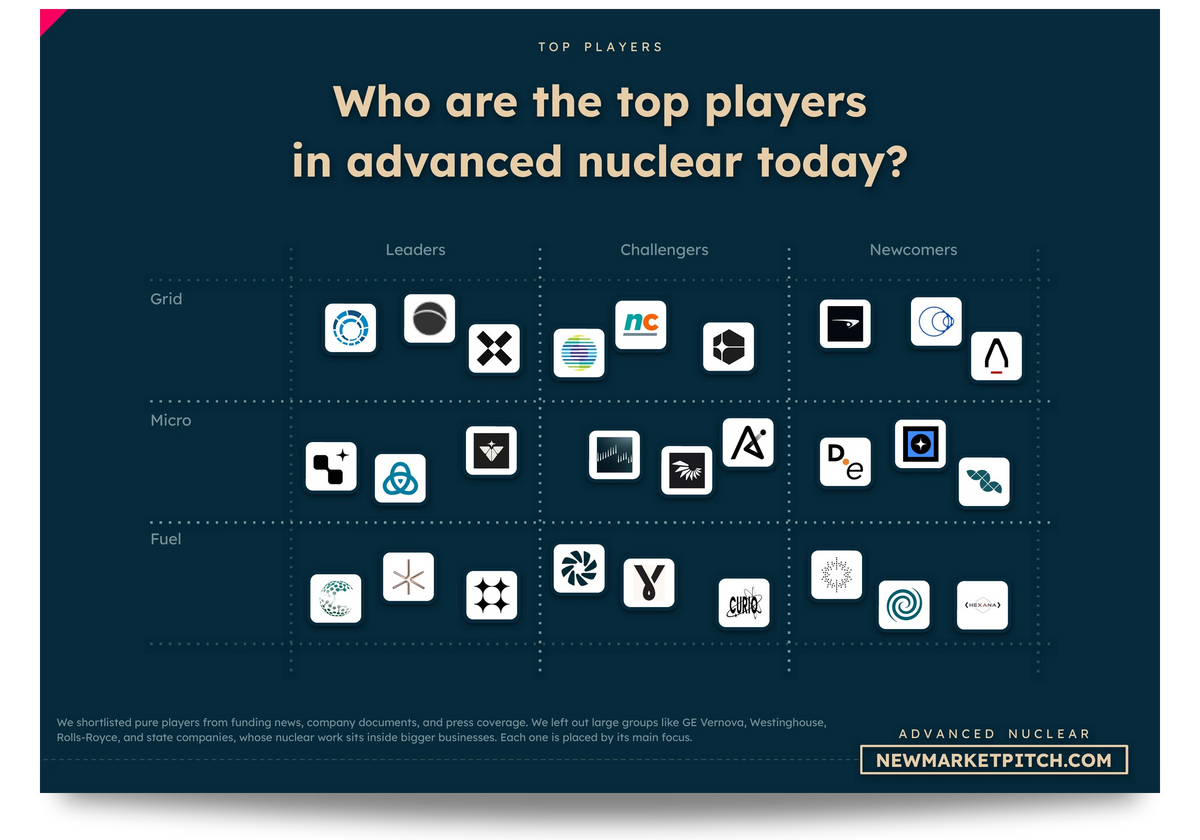
In our document detailing everything you need to know about advanced nuclear, we turn what is vague and complex into simple, useful visuals. Market maps like this one show you at a glance where every startup stands.
What would prove that advanced nuclear has finally solved its biggest problems?
Advanced nuclear will have proved its commercial potential when developers can build several reactors of the same design, operate them reliably, and show that successive projects cost less without requiring extraordinary government support.
A good first test is actual construction expenditure. Developers need to disclose how much their plants cost to complete, how those figures compare with initial budgets, and whether later installations become cheaper.
A second test is operating performance. Customers should be able to examine several years of electricity production, maintenance costs, refuelling performance, and unexpected shutdowns.
The third is repeat orders. A first reactor can be funded partly because governments want to demonstrate a technology. A second or third reactor ordered by a customer who has seen the first plant operate would provide stronger evidence of genuine commercial demand.
Finally, financing should become less dependent on public support. That doesn't mean government involvement must disappear, since nuclear energy has always operated within public regulatory and policy frameworks. But private lenders and customers should eventually be able to price project risks using real operating records.
The most convincing milestone would be a developer delivering its third or fourth commercial reactor faster and cheaper than its first while maintaining strong operating availability.
Final verdict: what are the biggest unsolved problems in advanced nuclear?
The biggest unsolved problems in advanced nuclear are making reactors affordable to build, securing enough advanced fuel, proving they can operate reliably, and producing identical plants at scale. Of these, construction economics is the most important problem for the industry as a whole, while fuel shortages could become the most immediate obstacle for several leading designs.
The technical progress is substantial. China has operated a commercial high-temperature gas-cooled plant since 2023, and US regulators have approved construction of increasingly advanced reactor designs. Large customers such as Google, Amazon, and Dow are also providing developers with clearer long-term demand.
But the industry is still missing its strongest commercial evidence: a series of completed, reliably operating advanced reactors whose construction costs decline with each new installation.
Some technologies will resolve these problems faster than others. Light-water SMRs have an advantage in technological maturity, while sodium-cooled, molten-salt, and high-temperature designs may ultimately offer benefits that justify their additional development work.
For now, we see advanced nuclear as technically promising but commercially unproven at scale. The decisive breakthrough will come when the next reactor is demonstrably cheaper and faster to build than the previous one, and customers are willing to finance more of them on that basis.
If you want more recent data on this point, please see our latest advanced nuclear market report.

Our report covering the advanced nuclear market gets updated several times a month, so you always get the latest view of where things stand.
Our methodology
This analysis examines the biggest unsolved problems facing advanced nuclear reactors as of October 2026. We assessed construction economics, commercial financing, nuclear fuel availability, engineering complexity, safety, regulation, manufacturing capacity, customer demand, and long-term operating reliability to identify which obstacles most directly prevent advanced reactors from becoming a commercially repeatable industry.
We prioritised documented outcomes over industry forecasts or developer promises. Our evidence includes operating reactor projects, regulatory approvals, government assessments, published construction costs, fuel supply projections, manufacturing milestones, and commercial agreements. We distinguished technologies already producing electricity from experimental reactors, permitted projects, and proposed commercial installations.
We also examined how problems interact. A construction permit demonstrates regulatory progress but does not establish that a reactor can be financed economically. A successful first-of-a-kind project does not prove that later units will be cheaper. And a completed reactor may still face delays if qualified fuel is unavailable. Our severity rankings are qualitative assessments based on the evidence available, rather than statistically calculated industry-wide risk scores.
For construction economics, we examined NuScale's cancelled Carbon Free Power Project alongside the cost and manufacturing challenges of first-of-a-kind reactors. For fuel supply, we used US Government Accountability Office estimates of government-supported HALEU availability through 2030. Technical and safety challenges were assessed by reactor family, since light-water, sodium-cooled, molten-salt, and high-temperature gas-cooled technologies face substantially different engineering requirements.
We treated corporate nuclear agreements as evidence of prospective demand, not guaranteed electricity supply or completed financing. Similarly, regulatory construction permits were not counted as operating approvals. Long-term commercial readiness was assessed against evidence of completed construction, multi-year operating availability, repeat orders, and declining costs across successive reactor installations.
Key sources include the OECD Nuclear Energy Agency's September 2026 SMR Digital Dashboard, the International Energy Agency's nuclear energy investment report, the US Government Accountability Office's 2026 nuclear fuel assessment, the Department of Energy Inspector General's audit of the Carbon Free Power Project, and the OECD NEA's 2025 Strategic Roadmap for Nuclear Reactor Safety Research.
Additional primary references include the Nuclear Regulatory Commission's TerraPower Natrium construction permit, the NRC's Kairos Power Hermes 2 licensing record, the NuScale US460 design approval, the Department of Energy's HALEU enrichment programme, the DOE's documentation of TRISO-X fuel manufacturing, and the US Energy Information Administration's nuclear generation and capacity data.
For deployment experience and commercial demand, we also consulted the International Atomic Energy Agency's review of marine-based SMRs, Google's nuclear energy agreement with Kairos Power, Amazon's nuclear project announcements, and DOE's report on X-energy's advanced fuel facility construction.
Our conclusions reflect the cumulative strength of these sources as of October 2026. The central test is whether reactor developers can move beyond individual technical achievements and deliver multiple commercially operating plants with reliable output, predictable schedules, and progressively lower construction costs.

In our research about advanced nuclear reactors, we don't want to repeat what boring consulting reports say. Instead, we show you the real and latest market signals that matter.
Written by the New Market Pitch teamWe track new markets so founders and investors can move faster. About us