What are the top advanced nuclear startups by revenue today?
Whether you're building or investing in the advanced nuclear market, our report covers everything you need to know: the players, the money, and what's coming next.
Summary
X-energy currently leads the advanced nuclear startup revenue ranking with $90M in first-half 2026 services revenue, followed by newcleo, Standard Nuclear, Oklo, ASP Isotopes, NuScale Power, NANO Nuclear Energy and Steady Energy.
The biggest advanced nuclear startups are making money from engineering, nuclear equipment, fuel manufacturing and industrial services. None of the eight ranked companies is yet earning substantial revenue from operating a commercial fleet of next-generation nuclear reactors.
X-energy's revenue lead is considerable. Its $90M in half-year services revenue is nearly 17 times Standard Nuclear's $5.33M, while five of the eight ranked startups have selected revenue figures below $2M or the approximate equivalent.
Revenue growth is accelerating at some companies. X-energy's first-half services revenue increased 165% year over year, Standard Nuclear grew 473%, and newcleo recorded 46% growth in the first half of 2026. But those sales are still being generated against very high development costs.
Newcleo is an interesting exception to the typical pre-commercial reactor developer. It earned €32.8M in FY2025 from existing industrial products and services, although that was below its 2024 revenue. Its lead-cooled reactor technology remains under development.
Nuclear fuel is emerging as one of the earlier sources of commercial revenue. Standard Nuclear generated approximately $3.1M in fuel product sales during the first half of 2026, while ASP Isotopes earned $800K from its nuclear-fuels segment. Neither business needs to wait for an entire new reactor fleet to start selling electricity.
The revenue picture gets much weaker further down the ranking. Oklo has only just started recognizing sales, NuScale's first-half revenue collapsed 97% year over year, and NANO Nuclear's initial revenue came from an acquired nuclear transportation business rather than microreactor deliveries.
Some of the industry's largest commercial commitments belong to companies without comparable revenue disclosures. General Matter secured a $900M government task order, Radiant Industries announced an Army agreement worth up to $750M, and TerraPower reached an agreement with Meta covering up to eight Natrium plants.
Big technology companies are helping create a market for advanced reactors. Google is backing Kairos Power deployments, Meta has arrangements involving TerraPower and Oklo, and Amazon is supporting X-energy's development plans. Most of the associated electricity deliveries are still years away.
Regulatory progress is becoming more concrete. TerraPower received a construction permit for its first Natrium plant in March 2026, while Kairos Power began construction work on Hermes 2 in April. These are important steps, but neither represents an operating commercial fleet.
The United States dominates the ranking, accounting for six of eight companies. Newcleo represents the United Kingdom and Steady Energy represents Finland, while several French, Swedish, Danish and Canadian developers remain outside the revenue ranking.
X-energy is the commercial leader today, but the longer-term outcome is wide open. The companies earning the most from engineering and fuel services now may not be the ones generating the most electricity revenue a decade from now.

Written by the New Market Pitch teamWe track new markets so founders and investors can move faster. About us

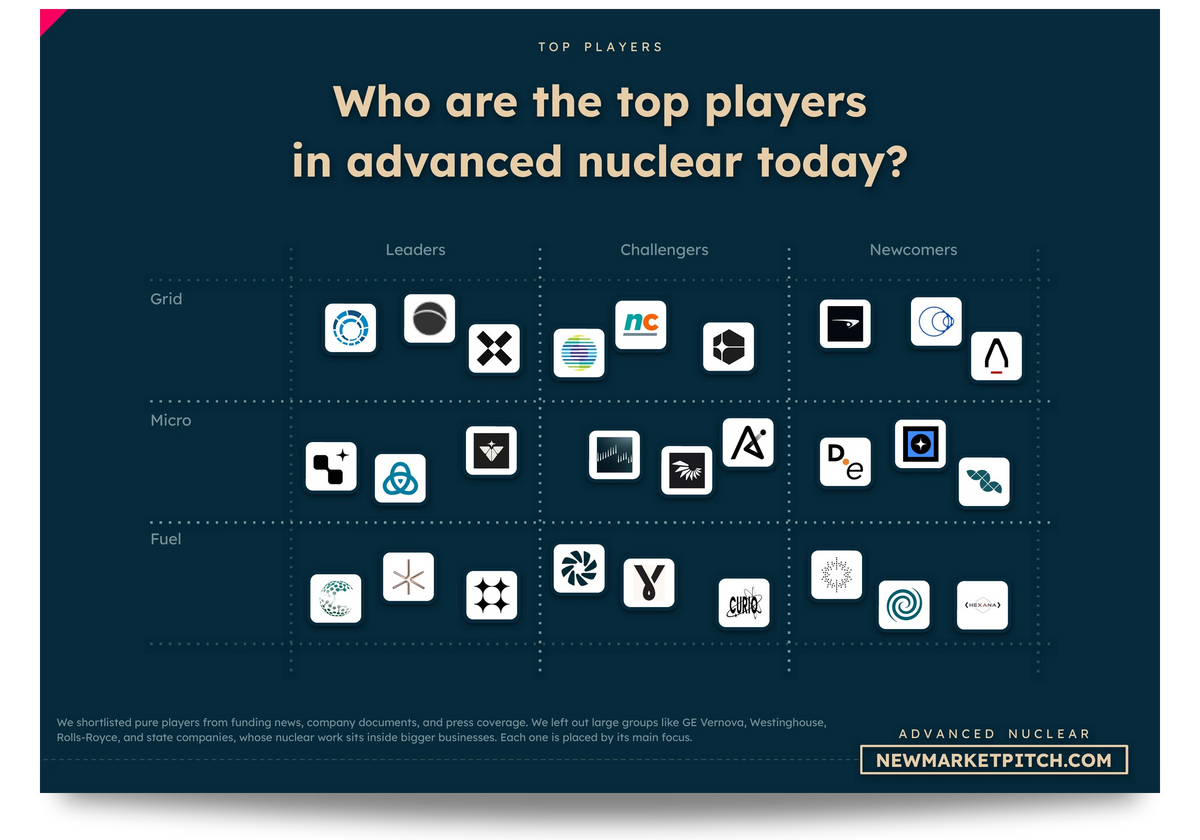
In our report covering the advanced nuclear market, we turn what is vague and complex into simple, useful visuals. Market maps like this one show you at a glance where every startup stands.
The ranking of top startups in the Advanced Nuclear Market by revenue
Below is a table ranking the startups of this market by their current revenue scale. You can find our methodology at the end of this page.
If you want a deeper understanding of the market and its current dynamics, get our report on the advanced nuclear market.
| Ranking | Company | Latest Metric | Metric Type | Freshness | Disclosed When | Source Quality | Confidence | Segment | Why This Ranking | Local Metric | Country |
|---|---|---|---|---|---|---|---|---|---|---|---|
| 1 | X-energy | $90M | Services Revenue | Very Fresh · 4mo | Aug 2026 | Filed / Audited | High | Advanced Reactors / TRISO Fuel | Leads the startups on strong recent revenue evidence from a specialist advanced-nuclear company, with $90M half-year services revenue against newcleo's ~$37M. Excludes the separately identified $7.999M of grant income. | us | |
| 2 | newcleo | ~$37M | Fiscal-Year Revenue from Products and Services | Fresh · 10mo | Oct 1, 2026 | Filed / Audited | Medium | Lead-Cooled Reactors / Advanced Fuel | A verified annual figure, supported by €19.429M of H1 2026 revenue. Below X-energy because the revenue comes primarily from equipment, spare parts, installation and consulting rather than operating advanced reactors. | €32.8M | fr |
| 3 | Standard Nuclear | $5.33M | H1 Revenue | Very Fresh · 4mo | Aug 26, 2026 | Filed / Audited | High | TRISO Fuel Manufacturing | Particularly clean market fit, with commercial fuel deliveries. The $576.9M contract-backlog figure is excluded from revenue and does not justify ranking it above companies with much greater recognized sales. | us | |
| 4 | Oklo | $1.21M | H1 Revenue | Very Fresh · 4mo | Aug 7, 2026 | Filed / Audited | Medium | Fast Reactors / Nuclear Isotopes | Clear first reported revenue, placing it above companies with smaller recognized figures. This does not demonstrate meaningful commercial electricity revenue from Aurora reactors. | us | |
| 5 | ASP Isotopes | $800K | Nuclear Fuels Segment Revenue | Very Fresh · 4mo | Aug 14, 2026 | Filed / Audited | Medium | Advanced Nuclear Fuel / Enrichment | Uses the nuclear-fuels segment's actual revenue, not the company's $9.303M H1 consolidated revenue from specialist isotopes and other businesses. Above NuScale by disclosed amount, but not yet proven fuel-sales scale. | us | |
| 6 | NuScale Power | $640K | H1 Revenue | Very Fresh · 4mo | Aug 5, 2026 | Filed / Audited | High | Small Modular Reactors | Selected the current $640,000 half-year figure instead of the much larger FY2025 revenue because a completed engineering contract caused a major revenue decline. A historical annual figure would overstate its present recognized revenue level. | us | |
| 7 | NANO Nuclear Energy | $214K | Quarterly Revenue | Very Fresh · 4mo | Aug 2026 | Filed / Audited | Low | Microreactors / Nuclear Fuel Logistics | Small recognized revenue from Secured Transportation Systems following its May acquisition, not from commercial reactor deployment. Above Steady because it generated actual revenue in the latest half-year period. | us | |
| 8 | Steady Energy | ~$305K | Annual Net Turnover | Fresh · 10mo | Sep 2026 | Filed / Audited | Medium | Nuclear District Heating / SMRs | Preserves the latest useful annual sales disclosure, while explicitly recognizing that H1 2026 net turnover was €0. This substantially reduces its usefulness as evidence of current revenue and places it below NANO. | €270K | fi |
| NR | Radiant Industries | <$750M | Government Contract Award / Bookings | Very Fresh · 2mo | Aug 26, 2026 | Company Disclosed | Medium | Transportable Microreactors | A substantial contract for up to 15 Kaleidos units is stronger commercial evidence than a funding round. However, the total spans future development and delivery and cannot be compared directly with annual revenue. | us | |
| NR | General Matter | $900M | Government Task-Order Award | Fresh · 9mo | Jan 8, 2026 | Credible Reported | Medium | HALEU Enrichment | Major government-supported advanced-fuel capacity program, with a subsequent NRC license application. The award is not $900M of realized revenue, preventing a defensible revenue rank. | us | |
| NR | TerraPower | <8 Natrium plants | Planned Project Units / Commercial Agreement | Very Fresh · 2mo | Aug 2026 | Company Disclosed | Low | Sodium-Cooled Advanced Reactors | A construction-permitted first project and an agreement with Meta demonstrate commercial progress. Neither the potential eight-plant fleet nor project investment equals earned company revenue. | us | |
| NR | Kairos Power | <50 MWe contracted capacity | Contracted Power Capacity / PPA | Very Fresh · 5mo | May 28, 2026 | Company Disclosed | Medium | Fluoride-Salt-Cooled Reactors | A binding power-purchase structure associated with Hermes 2 is meaningful evidence of future commercialization. No recognized power-sales revenue or contract dollar amount was substantiated. | us | |
| NR | Aalo Atomics | 1 critical test reactor | Operational Reactor Demonstration | Very Fresh · 3mo | Jul 4, 2026 | Company Disclosed | Low | Factory-Built Sodium-Cooled Reactors | Achieved criticality in a full-scale core demonstration and has a commercial partnership with Crusoe, but no verifiable reactor sales or revenue figure. | us | |
| NR | Blykalla | 6 proposed units | Proposed Project Units | Very Fresh · 0mo | Oct 2026 | Company Disclosed | Low | Lead-Cooled SMRs | Two Swedish project applications provide meaningful deployment scale. The units are planned and should not be counted as reactors sold or revenue contracted. | se | |
| NR | Deep Fission | <150 MW contracted capacity | Master Energy Purchase Agreement Capacity | Very Fresh · 0mo | Oct 20, 2026 | Company Disclosed | Low | Underground Microreactors | A signed long-duration agreement is useful, but the customer has no minimum power-purchase obligation. SEC disclosures state the company had not generated revenue. | us | |
| NR | Antares Nuclear | 1 US Army installation selection | Government Project Selection | Very Fresh · 2mo | Aug 26, 2026 | Credible Reported | Low | Military / Remote-Site Microreactors | Selected for Fort Bragg, providing stronger evidence than fundraising alone. The Army's combined $2.2B program must not be attributed to Antares individually. | us | |
| NR | Valar Atomics | Not disclosed | Other Scale Signal: Reactor Development | Very Fresh · 2mo | Aug 2026 | Company Disclosed | Low | High-Temperature Gas Reactors | An important recently financed developer, including a reported major 2026 capital raise. Funding and reactor-development progress do not establish revenue. | us | |
| NR | Last Energy | Not disclosed | Other Scale Signal: Development Pipeline | Very Fresh · 0mo | Company Disclosed | Low | Factory-Built Microreactors | Significant industrial microreactor development activity, but public project proposals and financing cannot be substituted for sales, backlog or recognized revenue without a verified contract perimeter. | us | ||
| NR | Blue Energy | Not disclosed | Other Scale Signal: Modular Plant Development | Very Fresh · 0mo | Company Disclosed | Low | Shipyard-Manufactured Nuclear Plants | Qualifies through its modular nuclear-plant architecture. The disclosed investment and development activity provide no defensible basis for revenue ranking. | us | ||
| NR | Jimmy Energy | 1 industrial reactor project | Regulatory Project / Proposed Deployment | Very Fresh · 0mo | 2026 | Credible Reported | Low | Nuclear Industrial Heat / TRISO | Regulatory submissions cover an industrial heat reactor and dedicated TRISO assembly facility. No verified commercial heat-sales revenue. | fr | |
| NR | Hexana | 1 advanced reactor program | Regulatory Development Project | Very Fresh · 0mo | 2026 | Credible Reported | Low | Sodium-Cooled Modular Reactors | Relevant fast-reactor developer identified both in fundraising records and nuclear-regulatory engagement. Project status is not a substitute for a commercial revenue figure. | fr | |
| NR | Stellaria | 1 demonstrator project | Reactor Licensing / Demonstration Project | Very Fresh · 0mo | 2026 | Credible Reported | Low | Fast-Neutron Molten-Salt Reactors | Demonstrator and fuel-related licensing work provide technical scale. Its €23M financing announcement is equity funding, not revenue. | fr | |
| NR | Natura Resources | 1 demonstration reactor | Reactor Demonstration Project | Very Fresh · 3mo | Jul 21, 2026 | Company Disclosed | Low | Liquid-Fueled Molten-Salt Reactors | A real demonstration project with documented DOE safety engagement, but project funding and regulatory progress cannot establish sales. | us | |
| NR | ARC Clean Technology | 1 proposed reactor project | Proposed Reactor Project | Very Fresh · 0mo | 2026 | Credible Reported | Low | Sodium-Cooled Fast SMRs | The Point Lepreau proposal and regulatory process substantiate market participation. No reactor revenue figure was verified. | ca | |
| NR | Thorizon | 1 reactor platform | Product Development | Very Fresh · 0mo | Company Disclosed | Low | Molten-Salt SMRs | Identifiable modular molten-salt reactor technology and industrial positioning, but no substantiated turnover or customer-booking amount. | nl | ||
| NR | Seaborg Technologies | Not disclosed | Other Scale Signal: Reactor Platform | Very Fresh · 0mo | Company Disclosed | Low | Floating Molten-Salt Reactors | Qualifies as a specialist reactor developer. Floating-plant concepts and partnerships do not provide a reliable revenue value. | dk | ||
| NR | Copenhagen Atomics | ~$82.2K | Historical Annual Revenue | Historical · 82mo | Third-Party Estimate | Low | Thorium / Molten-Salt Reactors | The historical sales number is retained rather than invented or discarded. However, later annual-account summaries do not disclose turnover, so ranking it against 2026 revenue would be misleading. | DKK 548K | dk | |
| NR | Calogena | 1 reactor design under review | Regulatory Review / Proposed Reactor | Very Fresh · 0mo | 2026 | Credible Reported | Low | Nuclear District Heating | Multiple regulatory safety-option submissions establish a concrete development program, but do not show commercial revenue. | fr | |
| NR | Blue Capsule | 1 high-temperature reactor program | Regulatory Development Project | Very Fresh · 0mo | 2026 | Credible Reported | Low | High-Temperature Reactors | Specifically identified in the French regulator's project-review pipeline. No defensible sales or bookings figure found. | fr | |
| NR | Otrera | 1 sodium-cooled reactor program | Regulatory Development Project | Very Fresh · 0mo | 2026 | Company Disclosed | Low | Sodium-Cooled Fast Reactors | Developer of a fast modular reactor with documented regulatory work. Employee and program scale are not used to manufacture revenue. | fr | |
| NR | Archeos | 1 proposed reactor project | Regulatory Development Project | Very Fresh · 0mo | 2026 | Credible Reported | Low | Modular Heat Reactors | Early-stage French entrant identified in the regulator's preparatory review. No commercial sales information is available. | fr | |
| NR | Terrestrial Energy | Not disclosed | Other Scale Signal: Reactor Development Agreements | Very Fresh · 4mo | Aug 11, 2026 | Company Disclosed | Low | Integral Molten-Salt Reactors | Reactor licensing, site agreements and projected unit economics are meaningful business progress. Its projected $2.7B lifetime revenue per future plant is explicitly not realized or contracted company revenue. | us | |
| NR | Moltex Energy | Not disclosed | Other Scale Signal: Reactor Licensing | Undated | Credible Reported | Low | Stable-Salt Reactors / Fuel Recycling | Qualifies through its advanced reactor and fuel cycle. Regulatory engagement does not provide sufficiently precise commercial scale for a numerical position. | ca |

Our research about advanced nuclear reactors gets updated several times a month, so you always get the latest view of where things stand.
Why is everyone suddenly interested in advanced nuclear startups?
Advanced nuclear startups are getting serious attention because technology companies now need enormous amounts of reliable electricity, and several have started backing actual reactor projects.
Google helped change the market in October 2024 when it signed an agreement with Kairos Power for up to 500 MWe of nuclear capacity by 2035. In January 2026, Meta announced an agreement with TerraPower covering up to eight Natrium reactor plants, potentially delivering 2.8 GW of baseload electricity. Amazon has also supported X-energy's reactor-development plans, including a proposed initial four-reactor project with Energy Northwest.
Developers that previously depended heavily on government programs and investors are now negotiating directly with companies facing long-term electricity shortages. It's a pretty significant change in who is willing to support these projects.
There has also been progress on the regulatory side. In March 2026, the U.S. Nuclear Regulatory Commission issued TerraPower a construction permit for its first Natrium plant in Wyoming, the first construction permit for a commercial non-light-water power reactor in the United States.
But electricity deliveries under these newer agreements are generally expected around 2030 or later.
Which advanced nuclear startups make the most revenue today?
X-energy is currently the largest advanced nuclear startup by revenue in our ranking, followed by newcleo, Standard Nuclear, Oklo, ASP Isotopes, NuScale Power, NANO Nuclear Energy and Steady Energy.
The numbers show how young this market still is. X-energy reported $90M in services revenue during the first six months of 2026. Newcleo generated €32.8M from products and services in FY2025, while Standard Nuclear recorded $5.33M in first-half 2026 sales.
After those three companies, the figures fall sharply. Oklo reported $1.21M, ASP Isotopes generated $800K from its nuclear-fuels segment, and NuScale Power recorded $640K during the first half of 2026. NANO Nuclear reported $214K for its latest fiscal quarter, while Steady Energy's latest useful annual turnover figure was €270K in FY2025.
These figures cover different reporting periods and business activities, which we preserve rather than turning them into hypothetical annual sales. The ranking reflects the strongest relevant commercial evidence available for each startup, including the recency of its revenue.
| Rank | Advanced nuclear startup | Revenue | Reporting period and metric |
|---|---|---|---|
| 1 | X-energy | $90M | H1 2026 services revenue |
| 2 | newcleo | €32.8M | FY2025 products and services revenue |
| 3 | Standard Nuclear | $5.33M | H1 2026 revenue |
| 4 | Oklo | $1.21M | H1 2026 revenue |
| 5 | ASP Isotopes | $800K | H1 2026 nuclear-fuels segment revenue |
| 6 | NuScale Power | $640K | H1 2026 revenue |
| 7 | NANO Nuclear Energy | $214K | Q3 FY2026 quarterly revenue |
| 8 | Steady Energy | €270K | FY2025 annual net turnover; H1 2026 turnover was zero |

In our market report about advanced nuclear reactors, we look at what the winners do differently, so you can learn from the best instead of guessing.
How much revenue does X-energy make?
X-energy made $90M in services revenue during the first half of 2026, putting the advanced nuclear startup comfortably ahead of every other company in our revenue ranking.
The company's August 2026 financial results show that services revenue increased from $34.0M in the first half of 2025 to $90.0M in the first half of 2026, a 165% increase. Second-quarter revenue alone reached $50.1M, compared with $16.9M a year earlier.
The growth is unusually strong for a company still developing its first commercial Xe-100 reactor deployments. X-energy already earns money from engineering and development services while preparing larger reactor and fuel projects involving customers such as Dow and Amazon.
X-energy also recorded approximately $8M in grant income during the first half of 2026. We keep that separate from services revenue.
Its growth has come with substantial costs, though. Direct expenses reached approximately $152M in the first half, compared with $64.9M a year earlier.
Is newcleo already making serious money from nuclear technology?
Newcleo is already an established revenue-generating nuclear technology business, with €32.8M in FY2025 products and services revenue, placing it second in the advanced nuclear startup ranking.
The company's latest annual figure was actually lower than the €46.7M recorded in 2024. The subsequent recovery is more encouraging.
In the first half of 2026, newcleo generated €19.429M, compared with €13.347M a year earlier. Revenue grew approximately 46%, driven by equipment manufacturing, installation, spare parts and consultancy services.
Newcleo is developing lead-cooled fast reactors and advanced nuclear fuel capabilities, but most of its current revenue comes from existing industrial work. It already has paying customers, even though its reactor technology has not reached commercial deployment.
The financial results also show the cost of developing that technology. Newcleo reported an approximately €82M net loss in the first half of 2026, against €19.429M in revenue.
Newcleo entered public markets in September 2026, making it eligible under our startup definition.

In our document detailing everything you need to know about advanced nuclear, you will always find fresh funding data, taken straight from our own verified funding database.
Is Standard Nuclear becoming a real nuclear fuel supplier?
Standard Nuclear is already selling specialized nuclear fuel products and services, and its revenue is growing extremely quickly. The company ranks third among advanced nuclear startups with $5.33M in first-half 2026 sales.
According to its August 2026 financial results, revenue increased from $930,865 in the first half of 2025 to $5.33M in the first half of 2026. That's growth of approximately 473%.
The most interesting part is the change in the company's revenue mix. In the first half of 2025, Standard Nuclear's reported revenue came from services. A year later, it had generated approximately $3.1M in product revenue, alongside $2.23M from services.
The company is developing manufacturing capabilities for TRISO fuel, used in several advanced reactor designs. It has also announced fuel supply agreements involving developers such as Radiant Industries and Antares Nuclear.
Standard Nuclear's reported backlog reached $576.9M after including an August 2026 fuel supply agreement. That amount covers future contractual activity and remains separate from the $5.33M already recognized.
Its first-half cost of revenue was $6.56M, resulting in a gross loss of approximately $1.23M. The demand is real. Whether larger production volumes will generate attractive margins is still an open question.
How much money is Oklo making from nuclear energy?
Oklo reported $1.21M in revenue during the first half of 2026, placing it fourth among advanced nuclear startups. The company has started earning money, although its Aurora reactors have yet to generate commercial electricity revenue.
The SEC filing published in August 2026 shows that all $1.21M was recognized during the second quarter. In the equivalent six months of 2025, Oklo recorded no revenue.
It's a clear change in its financial profile. The sales, however, remain tiny compared with operating expenditure.
Oklo spent approximately $66.5M on R&D and $58.1M on general and administrative expenses during the first half of 2026. Its operating loss reached approximately $124M.
The company is pursuing fast reactors, nuclear fuel capabilities and electricity supply agreements. Meta's January 2026 nuclear procurement announcement also included an arrangement involving Oklo.
Those future projects could make the business far larger, but its present financial position is still driven overwhelmingly by development spending. The first $1.21M of revenue is a useful milestone, though it tells us very little about what commercial power generation might eventually earn.

Learning from others' mistakes is the cheapest lesson there is. In our report covering the advanced nuclear market, we look at what broke startups before you, so you don't repeat it.
How much revenue does ASP Isotopes make from nuclear fuel?
ASP Isotopes generated $800K from its nuclear-fuels segment in the first half of 2026, giving it fifth place in the advanced nuclear startup revenue ranking.
The company's total revenue was substantially higher at $9.303M, according to its August 2026 SEC filing. Most of that money came from other activities, including specialist isotopes and related services.
ASP Isotopes works across several industries, so counting its entire revenue as advanced nuclear fuel sales would exaggerate the scale of that particular business. Its nuclear-fuels segment accounted for approximately 8.6% of consolidated revenue during the first six months of 2026.
The nuclear-fuels business also reported a loss before allocation to noncontrolling interests of approximately $20M over the same period. Its revenue is still extremely small compared with the amount being invested.
ASP Isotopes is developing enrichment and isotope-separation technologies that could become useful for advanced nuclear fuel supply.
Why has NuScale Power's revenue fallen so much?
NuScale Power's revenue fell approximately 97% year over year in the first half of 2026, leaving the small modular reactor developer with just $640K in recognized sales and sixth place in our ranking.
According to the company's second-quarter 2026 financial statements, revenue declined from $21.429M in the first six months of 2025 to $640K in the equivalent 2026 period.
Second-quarter revenue was only $75K, compared with $8.054M a year earlier.
The main reason is the changing pattern of engineering work and associated revenue recognition. Earlier contracts supported much higher sales, but that work did not continue at the same level.
NuScale remains one of the best-known developers of small modular reactor technology and has achieved important U.S. regulatory milestones. Its design approvals, however, have yet to translate into a consistent stream of large commercial orders and revenue.

Your time is limited. In our research about advanced nuclear reactors, we put numbers on each part of the market, so you can see where it makes sense to focus.
Is NANO Nuclear Energy already selling microreactors?
NANO Nuclear Energy is generating revenue from nuclear logistics, but commercial microreactor sales have not started. The company ranks seventh with $214K in revenue for its third fiscal quarter of 2026.
The money came from Secured Transportation Systems, a specialized nuclear transportation and logistics business acquired in May 2026.
That acquisition gave NANO Nuclear an existing commercial activity alongside its reactor-development programs. It also brought experience in handling and transporting radioactive materials, which could support the company's broader nuclear operations.
Meanwhile, NANO Nuclear is developing the KRONOS MMR microreactor platform. In August 2026, the company reported that the U.S. Nuclear Regulatory Commission had accepted its construction permit application for a project at the University of Illinois.
Is Steady Energy making money from nuclear district heating?
Steady Energy has generated some commercial turnover, but its latest results show that revenue remains extremely limited. The Finnish district-heating reactor startup ranks eighth, with €270K in FY2025 net turnover.
According to its official financial figures, turnover increased from €175K in 2024 to €270K in 2025, a gain of approximately 54%.
However, Steady Energy reported zero net turnover in the first half of 2026, compared with €270K during the equivalent period a year earlier.
The company is developing compact nuclear reactors designed to supply heat to district-heating networks. It's a different business from selling electricity to data centers or national grids.
Steady Energy's first-half 2026 EBITDA loss was approximately €11.7M, while cash and bank balances stood at approximately €32M at the end of June.

In our market report about advanced nuclear reactors, we always try to gather several sources and make estimates that make sense, so you can work with solid numbers.
Which advanced nuclear startups have more than $10 million in revenue?
X-energy and newcleo are the only ranked advanced nuclear startups whose selected revenue figures exceed approximately $10M. The reporting periods differ, so these numbers should be read as disclosed revenue figures rather than perfectly comparable annual totals.
X-energy generated $90M in services revenue during the first half of 2026. Newcleo reported €32.8M for FY2025, equivalent to roughly $37M using an indicative exchange rate for that period.
Standard Nuclear comes next with $5.33M for the first half of 2026. Oklo reported $1.21M, while the other ranked companies disclosed substantially smaller figures.
Of the eight ranked startups, two have selected revenue figures above the $10M threshold, one is between $5M and $10M, and five are below $2M or the approximate currency equivalent.
That concentration explains part of the disconnect between the industry's huge project announcements and the small numbers appearing in financial statements. Most developers are still years away from the revenue levels normally associated with major energy companies.
Are nuclear fuel startups making money faster than reactor developers?
Nuclear fuel startups are beginning to generate product revenue earlier than many reactor developers, which are still waiting for their first commercial electricity sales. X-energy and newcleo nevertheless occupy the top two positions in the overall advanced nuclear startup ranking.
Standard Nuclear is a useful example. Its first-half 2026 revenue reached $5.33M, including approximately $3.1M from fuel products. ASP Isotopes generated $800K from nuclear-fuels activities during the same period.
Both businesses can sell products or services that support reactor development without waiting for a new fleet of reactors to start generating electricity.
That gives fuel manufacturers a potentially shorter route to early revenue, although fuel qualification, manufacturing approvals and production costs remain substantial challenges.
Reactor-focused companies face a more complicated path. A new power plant generally requires years of design work, licensing, financing, construction and testing before electricity sales can begin.
The difference is already visible across the ranking. X-energy reported services revenue, newcleo generated products and services revenue, and Standard Nuclear earned money from fuel-related products and services. NANO Nuclear's first recognized revenue came from nuclear transportation.
Meanwhile, Kairos Power's Hermes 2 plant is expected to supply up to 50 MWe to the Tennessee Valley Authority grid, supporting Google's electricity needs. TerraPower's agreement with Meta targets initial Natrium deployments as early as 2032.
For the moment, revenue in advanced nuclear mostly comes from building the industry rather than operating its future power plants.

If you build or invest in the advanced nuclear market, you need to know which business models pay off now and which ones are fading. That's why our report covering it has a whole section on it.
Which advanced nuclear startups have the biggest contracts but little disclosed revenue?
General Matter, Radiant Industries, TerraPower and Kairos Power have some of the most substantial commercial agreements among advanced nuclear startups without comparable recognized revenue figures.
General Matter received a $900M Department of Energy task order announced in January 2026 to support domestic HALEU enrichment capacity.
Radiant Industries announced an agreement with the U.S. Army worth up to $750M in August 2026, covering the development and delivery of 15 Kaleidos microreactors.
TerraPower has a major commercial agreement with Meta covering up to eight Natrium plants, while Kairos Power is developing its first commercial-scale reactor project under an agreement involving Google and the Tennessee Valley Authority.
These commitments cover different parts of the market: nuclear fuel, military microreactors and commercial electricity generation.
The amounts and project sizes cannot be added together as company revenue. Some cover future construction or delivery, others are conditional agreements, and some establish potential capacity without guaranteed electricity purchases.
| Startup | Disclosed commitment or scale | Type of commercial evidence |
|---|---|---|
| Radiant Industries | Up to $750M | Government contract award / bookings |
| General Matter | $900M | Government task-order award |
| TerraPower | Up to 8 Natrium plants | Planned project units / commercial agreement |
| Kairos Power | Up to 50 MWe | Contracted power capacity / PPA |
| Aalo Atomics | 1 critical test reactor | Operational reactor demonstration |
| Blykalla | 6 proposed units | Proposed reactor projects |
| Deep Fission | Up to 150 MW | Master energy purchase agreement capacity |
| Antares Nuclear | 1 U.S. Army installation selection | Government project selection |
Can TerraPower become one of the biggest advanced nuclear companies?
TerraPower could become one of the largest advanced nuclear businesses if it successfully delivers its planned Natrium projects, but the company currently remains unranked by revenue.
The biggest development came in March 2026, when the U.S. Nuclear Regulatory Commission issued the construction permit for its first Natrium reactor project in Kemmerer, Wyoming.
TerraPower had submitted its application in March 2024. The permit therefore marked the conclusion of an important two-year regulatory process and authorized construction of the nuclear facility. A separate operating license will still be needed before the plant can operate.
The company also announced an agreement with Meta in January 2026 covering up to eight Natrium plants. The proposed fleet would deliver up to 2.8 GW of baseload electricity and potentially reach 4 GW of output when including integrated energy-storage capacity.
Meta's initial commitment supports two units, with rights to energy from up to six additional units.
That gives TerraPower a clearer route toward a multi-plant commercial business than many earlier-stage reactor developers. Its biggest challenge now is turning permitted projects and customer agreements into financed, completed facilities.
We still cannot establish TerraPower's current revenue position against the ranked startups because no sufficiently comparable figure has been disclosed.

In our report covering the advanced nuclear market, we don't want to repeat what boring consulting reports say. Instead, we show you the real and latest market signals that matter.
Is Kairos Power closer than other startups to selling nuclear electricity?
Kairos Power is one of the more advanced reactor startups in moving toward commercial electricity sales, thanks to its Hermes 2 project and agreements involving Google and the Tennessee Valley Authority.
In April 2026, Kairos Power began construction work on Hermes 2 in Oak Ridge, Tennessee. The facility is designed to deliver up to 50 MWe and forms the first deployment under Google's broader agreement for up to 500 MWe of advanced nuclear power.
The electricity will be purchased by the Tennessee Valley Authority through a binding power-purchase agreement announced in August 2025.
There is now a named site, an identified electricity buyer, construction activity and a planned operating date. That's more concrete than the early-stage commercial plans of many competing reactor developers.
Kairos Power has also followed a staged development strategy, using demonstration reactors to test its fluoride-salt-cooled technology before pursuing larger commercial plants.
The company currently remains unranked on revenue because its publicly available commercial disclosures do not establish a comparable recognized sales figure.
Still, Hermes 2 puts Kairos Power among the startups worth watching as the industry approaches its first new commercial electricity deliveries.
Could Radiant Industries become a major microreactor supplier?
Radiant Industries has one of the strongest government procurement commitments among microreactor startups, with an Army agreement worth up to $750M for 15 Kaleidos reactors announced in August 2026.
The Kaleidos microreactor is designed to be transported and deployed at locations requiring reliable power, including military installations and remote industrial sites.
Radiant's agreement was awarded under the U.S. Army's Janus program. It covers future development and deployment rather than revenue already recognized.
The company's progress extends beyond the contract announcement. In August 2026, its Kaleidos demonstration unit arrived at Idaho National Laboratory for testing, while work was progressing on its manufacturing facility in Oak Ridge, Tennessee.
Radiant's investors have described initial Army deliveries as targeted for 2028.
If the company can complete reactor testing, manufacturing and deployment successfully, the Army contract could help establish a repeatable commercial product.
For now, Radiant remains unranked by revenue. Its commercial significance comes from the size of the procurement commitment and the progress of its reactor-testing program.

In our research about advanced nuclear reactors, we like to show you the big picture. We know your time is precious, so we make every page quick to read and packed with as much learning as possible per minute.
Why is the U.S. government spending billions on advanced nuclear fuel?
The U.S. government is spending billions on nuclear fuel because many advanced reactors will need enrichment and manufacturing capabilities that are not yet available at sufficient commercial scale.
In January 2026, the Department of Energy announced $2.7B in uranium enrichment task orders. The awards included $900M for General Matter to develop domestic HALEU enrichment capacity, alongside other agreements supporting uranium enrichment.
HALEU contains between 5% and 19.75% uranium-235, a higher concentration than the fuel typically used by existing commercial light-water reactors.
Several advanced reactor designs depend on this fuel, creating a potential supply bottleneck as more projects move toward construction.
The Department of Energy also awarded $28M to Global Laser Enrichment for work on advanced enrichment technology.
This government spending creates opportunities for startups working on enrichment, fuel production, transportation and related engineering. Standard Nuclear and ASP Isotopes are already reporting revenue from parts of the fuel industry, while General Matter has a substantial government award.
The $900M General Matter award is a future work commitment rather than recognized annual revenue. Its size shows how seriously the United States is treating the need for domestic advanced nuclear fuel capacity.
Are advanced nuclear startups growing quickly or struggling to make money?
Advanced nuclear startup revenue is growing quickly at several companies, but profitability remains elusive because reactor and fuel development requires enormous spending before commercial production reaches scale.
X-energy increased first-half services revenue by 165% year over year, while Standard Nuclear reported growth of approximately 473%. Newcleo's first-half revenue rose 46%, although its preceding annual revenue had declined.
NuScale offers a contrasting example. Its first-half 2026 revenue fell 97% after earlier engineering work stopped generating the same level of recognized sales.
Profitability is equally uneven. X-energy reported approximately $152M in direct expenses against $90M of services revenue during the first half of 2026. Newcleo reported an €82M net loss, and Standard Nuclear's first-half cost of revenue exceeded sales by approximately $1.23M.
Oklo's operating loss reached approximately $124M during the first half of 2026, against $1.21M in revenue.
These companies are spending heavily on engineering teams, reactor design, licensing, testing facilities and manufacturing capacity.
The companies with accelerating revenue have demonstrated stronger commercial activity. But attractive margins, repeatable construction economics and low-cost reactor manufacturing remain largely unproven.

When you build or invest in the advanced nuclear market, you need clarity, not confusion. In our market report about advanced nuclear reactors, we always try to put numbers on and quantify whatever is usually vague and confusing.
Which countries have the strongest advanced nuclear startups?
The United States clearly dominates the current advanced nuclear startup revenue ranking, accounting for six of the eight ranked companies.
X-energy, Standard Nuclear, Oklo, ASP Isotopes, NuScale Power and NANO Nuclear Energy are headquartered in the United States.
Newcleo is based in the United Kingdom, while Steady Energy is headquartered in Finland.
The United States also has a substantial pipeline of companies that remain unranked, including TerraPower, Kairos Power, Radiant Industries, General Matter, Aalo Atomics, Deep Fission and Antares Nuclear.
Europe has a growing group of developers working on different reactor technologies. France is home to companies such as Jimmy Energy, Hexana, Stellaria, Calogena, Blue Capsule, Otrera and Archeos. Sweden has Blykalla, while Denmark has Seaborg Technologies and Copenhagen Atomics.
Canada has notable advanced reactor developers including ARC Clean Technology and Moltex Energy.
Which other advanced nuclear startups could become important?
Several currently unranked advanced nuclear startups are making credible technical progress, although their commercial revenue remains undisclosed or too difficult to compare reliably.
Aalo Atomics reported reaching criticality in a reactor demonstration in July 2026 and has been developing factory-built sodium-cooled reactors.
Blykalla is working on lead-cooled reactor projects in Sweden, while Deep Fission is pursuing an underground microreactor design and has announced a long-term energy-purchase agreement covering potential generating capacity.
France has a particularly active group of companies developing smaller nuclear systems for industrial applications. Jimmy Energy focuses on nuclear heat, Stellaria is developing molten-salt reactor technology, and Hexana is pursuing fast-reactor technology.
Some developers are even earlier in their commercialization process. Copenhagen Atomics has a historical FY2019 sales figure of DKK 548K, but more recent turnover is not sufficiently established for a current numerical ranking. Terrestrial Energy has discussed project economics for its molten-salt reactors without reporting comparable recognized company revenue.
Their eventual commercial scale will depend on licensing, demonstration results, financing, manufacturing and customer demand.
| Startup | Reported scale or activity | Revenue limitation |
|---|---|---|
| Valar Atomics | Reactor development | Not disclosed |
| Last Energy | Development pipeline | Not disclosed |
| Blue Energy | Modular nuclear plant development | Not disclosed |
| Jimmy Energy | 1 industrial reactor project | No comparable revenue figure |
| Hexana | 1 advanced reactor program | No comparable revenue figure |
| Stellaria | 1 demonstrator project | No comparable revenue figure |
| Natura Resources | 1 demonstration reactor | No comparable revenue figure |
| ARC Clean Technology | 1 proposed reactor project | No comparable revenue figure |
| Thorizon | 1 reactor platform | No comparable revenue figure |
| Seaborg Technologies | Reactor platform development | Not disclosed |
| Copenhagen Atomics | DKK 548K, FY2019 | Historical annual revenue |
| Calogena | 1 reactor design under review | No comparable revenue figure |
| Blue Capsule | 1 high-temperature reactor program | No comparable revenue figure |
| Otrera | 1 sodium-cooled reactor program | No comparable revenue figure |
| Archeos | 1 proposed reactor project | No comparable revenue figure |
| Terrestrial Energy | Reactor development agreements | Not disclosed |
| Moltex Energy | Reactor licensing | Not disclosed |

A good product starts with a real problem. In our document detailing everything you need to know about advanced nuclear, we show you the ones customers still live with.
How big are advanced nuclear startups compared with established nuclear companies?
Advanced nuclear startups remain much smaller than established nuclear equipment and services businesses, which already benefit from decades of commercial operations.
GE Vernova reported $1.57B from its Nuclear Power business during the first half of 2026, although that figure includes substantial activities connected to conventional nuclear power.
Westinghouse Electric Company's new-build business generated approximately $800M in FY2025, while Holtec Nuclear Corporation reported $577M in consolidated FY2025 revenue.
These are different financial scopes, so the figures should not be treated as a direct ranking of advanced reactor sales. They do show how much existing nuclear infrastructure contributes to the industry's current revenue.
X-energy's $90M in first-half services revenue is substantial for an advanced nuclear startup but remains far below the sales generated by these established businesses.
Incumbents also have existing customers, service operations and manufacturing relationships. Startups generally need to build those capabilities while developing and licensing new technologies.
GE Vernova, Westinghouse and Holtec are included here only as scale comparisons. They are excluded from the startup ranking because they do not meet the startup eligibility rules.
Which advanced nuclear startups could make the most revenue in the next decade?
X-energy has the strongest current revenue position, while TerraPower, Kairos Power and several fuel and microreactor developers have projects that could eventually generate much larger commercial sales.
X-energy has the advantage of already generating substantial services revenue while working on reactor and fuel projects.
Newcleo can build on existing industrial products and services, and Standard Nuclear has begun generating revenue from commercial fuel deliveries.
TerraPower's Natrium projects and Kairos Power's Hermes 2 development could eventually create substantial electricity revenue if construction and licensing progress as planned. Radiant's military procurement agreement offers a different route through reactor manufacturing and delivery.
General Matter could also become an important commercial fuel supplier as domestic enrichment capacity expands.
The biggest uncertainty is the speed at which these companies can move from development projects to repeatable manufacturing and operation.
A developer with several large power agreements may eventually generate far more revenue than a company currently earning millions from engineering services. But those future sales depend on plants actually being financed, built and operated.
Today, X-energy's revenue lead is well supported. The future revenue ranking remains open because most of the industry's planned reactor capacity has yet to become operational.

In our report covering the advanced nuclear market, we try to remove everything that could confuse you, especially if you're investing or building in this market.
What are the top advanced nuclear startups by revenue today?
X-energy is currently the clear revenue leader among advanced nuclear startups, followed in order by newcleo, Standard Nuclear, Oklo, ASP Isotopes, NuScale Power, NANO Nuclear Energy and Steady Energy.
X-energy's $90M in first-half 2026 services revenue places it far ahead of the other ranked startups. Newcleo has a meaningful industrial business with €32.8M in FY2025 revenue, while Standard Nuclear is growing rapidly through nuclear fuel products and services.
The remaining five ranked companies have much smaller disclosed sales, and several are still spending vastly more on development than they earn from customers.
What makes this market unusual is the difference between current company revenue and the scale of future electricity projects. TerraPower, Kairos Power, Radiant Industries and General Matter have secured major agreements without reporting comparable revenue figures.
For now, the biggest advanced nuclear startups by revenue are mainly making money from engineering, equipment, fuel and related industrial services. X-energy leads that market today, while the much larger business of producing and selling electricity from new reactors is still taking shape.
Our methodology
We ranked advanced nuclear startups by their current commercial revenue scale, using publicly available financial disclosures as of November 2026. The ranking covers developers of advanced nuclear reactors, small modular reactors, microreactors, specialized nuclear fuel and closely related technologies. We focused on recognized revenue rather than the size of announced projects or future electricity commitments.
We applied one consistent startup definition. A company qualifies if it was founded in 2000 or later, has never been publicly listed or first went public within the last five years, and operates independently rather than as a division of a larger group. Companies acquired within the previous three years remain eligible and are identified alongside their acquirers where relevant. Established nuclear businesses such as GE Vernova, Westinghouse and Holtec appear only as comparisons.
We examined public financial evidence spanning the past ten years, prioritizing annual reports, SEC filings, company financial statements, official earnings releases and government announcements. Where available, we also examined quarterly revenue, trailing-twelve-month sales, annualized revenue, segment revenue, bookings, contract awards and other commercial indicators. The central ranking uses actual revenue figures rather than future contract values.
Where multiple figures existed, we selected the measure that best reflected the company's current commercial activity, considering its relevance, reliability and reporting date. We kept each company's original reporting currency and period rather than constructing annual revenue estimates. Consequently, the ranking includes different fiscal periods and should not be interpreted as a comparison of eight identical accounting measures.
We also distinguished revenue from engineering services, industrial equipment, fuel products, nuclear transportation and electricity generation. For ASP Isotopes, we used nuclear-fuels segment revenue rather than consolidated company revenue. For X-energy, grant income remains separate from services revenue. For NANO Nuclear, we identified the contribution of its acquired transportation business. Newcleo's existing industrial sales are likewise distinguished from future reactor operations.
Companies without a sufficiently comparable public revenue figure remain unranked. Government awards, fuel supply backlogs, reactor construction agreements, power-purchase commitments and proposed generating capacity are discussed separately. We did not estimate company sales from reactor counts, contract announcements, electricity capacity or planned delivery schedules.
For the financial ranking, key sources include X-energy's second-quarter 2026 financial results, newcleo's first-half 2026 results, newcleo's SEC-filed financial statements, Standard Nuclear's second-quarter results, Oklo's SEC Form 10-Q, ASP Isotopes' SEC Form 10-Q, NuScale Power's financial results, NANO Nuclear Energy's fiscal third-quarter results, and Steady Energy's official financial figures.
For commercial agreements and reactor milestones, we relied on Google's Kairos Power agreement, Google's Tennessee Valley Authority project announcement, Kairos Power's Hermes 2 construction announcement, Kairos Power's project update, TerraPower's Meta agreement, Meta's nuclear energy announcement, Radiant Industries' Army contract announcement, and the U.S. Nuclear Regulatory Commission's TerraPower construction permit announcement.
For nuclear fuel policy and government awards, key references include the U.S. Department of Energy's $2.7B uranium enrichment announcement, the Department of Energy's HALEU enrichment program, and the Nuclear Regulatory Commission's advanced reactor licensing updates. These sources support the distinction throughout the analysis between money companies have already earned and the much larger contracts and reactor projects they are still working to deliver.
In our report covering the advanced nuclear market, we turn what is vague and complex into simple, useful visuals. Market maps like this one show you at a glance where every startup stands.
Written by the New Market Pitch teamWe track new markets so founders and investors can move faster. About us